REVIEW 5 minor 1 cited by
Khovanskii's Pfaffian zero bound is asymptotically sharp in chain-degree α and in function degrees β.
Reviewed by Pith at T0; open to challenge. T0 means a machine referee read the full paper against a public rubric. the ladder, T0–T4 →
T0 review · grok-4.5
2026-07-12 12:32 UTC pith:OCUIFPN7
load-bearing objection Clean asymptotic lower bounds matching Khovanskii in α and β; proofs hold up, s left open as expected.
Parameterwise Sharpness of Khovanskii's Bezout-type Bound for Pfaffian Functions
The pith
A machine-rendered reading of the paper's core claim, the machinery that carries it, and where it could break.
Core claim
The dependence of Khovanskii's bound on the chain-degree α is asymptotically sharp: for every α,s there exists a Pfaffian function of format (α,1,s) with at least α^s nondegenerate real zeros. Independently, the dependence on the function degrees β is asymptotically sharp: for fixed n and s there exist Pfaffian systems of format (s,β,s) with Ω_{n,s}(β^{n+s}) regular common zeros, matching the order predicted by the theorem as β oà∞.
What carries the argument
A nested-interval inverse-branch construction for the α-sharpness (starting from a carefully scaled exponential of a monic polynomial with α simple roots and iteratively pulling back α intervals under the covering map) and a dimension-counting argument on the vector space of Pfaffian functions of degree β with respect to an algebraically independent chain for the β-sharpness.
Load-bearing premise
The degree-sharpness argument needs an algebraically independent Pfaffian chain of the stated order; without that independence the dimension count that produces many zeros fails.
What would settle it
Either exhibit, for some α and s, a Pfaffian function of format (α,1,s) whose number of nondegenerate real zeros is o(α^s), or show that every Pfaffian chain of order s on n variables is algebraically dependent over the rational functions, collapsing the lower bound in β.
Editorial analysis
A structured set of objections, weighed in public.
Referee Report
Summary. The paper studies the sharpness of Khovanskii's Bézout-type upper bound on the number of isolated real zeros of systems of Pfaffian equations, which depends on the chain-degree α, the degrees β_i of the functions, and the order s of the underlying Pfaffian chain. The authors prove two main asymptotic sharpness results. Theorem 1.2 constructs, for every α, s ∈ ℕ, a single Pfaffian function of format (α, 1, s) with at least α^s nondegenerate real zeros, matching the α^s growth in the bound. Theorem 1.3 and Corollary 1.4 show that, for fixed n and s, there exist systems of n Pfaffian functions of format (s, β, s) with Ω_{n,s}(β^{n+s}) regular common zeros, matching the growth in the β-parameters. The proofs rely on an explicit analytic construction via nested inverse branches of exp(a p(x)) for the α-result, and on a dimension-counting argument in the vector space of Pfaffian functions of degree ≤ β (combined with an algebraically independent iterated-exponential chain) for the β-result. A brief discussion of the s-dependence and a product construction combining the two regimes are also included.
Significance. Khovanskii's theorem is a foundational quantitative result in Pfaffian geometry and o-minimality, yet its sharpness has remained largely open. Establishing that the bound is asymptotically tight in the parameters α and β (for fixed n, s) is a clear and useful contribution: it confirms that the dominant growth rates appearing in the classical estimate cannot be improved in those regimes, and it supplies concrete families of examples that attain the predicted order. The constructions are fully explicit and self-contained; the algebraic-independence argument for the iterated-exponential chain is carefully written and discharges the only non-trivial hypothesis needed for the dimension count. The work therefore strengthens the foundations of effective Pfaffian geometry and supplies useful test cases for any future improvements of the bound.
minor comments (5)
- In the statement of Theorem 1.1 the product and sum are written with a slightly awkward line-break; a single displayed formula would improve readability.
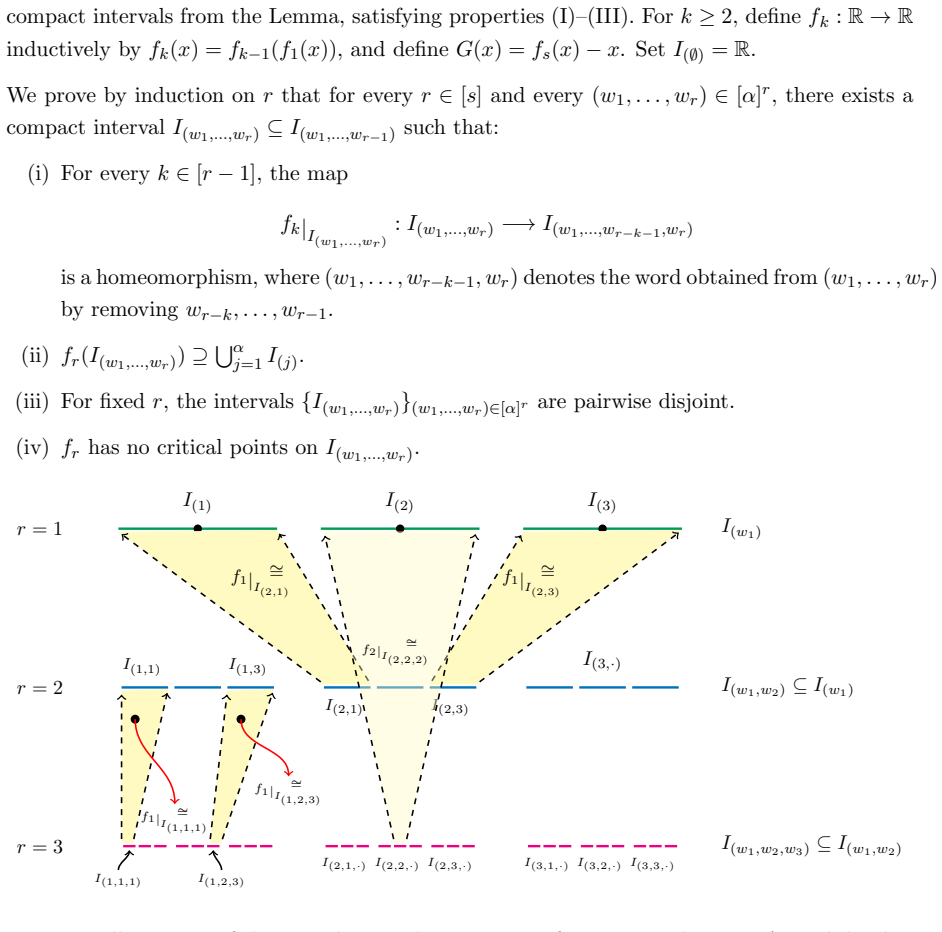
- Figure 1 is helpful, but the caption could briefly recall that the maps are the successive restrictions of f_1 (or f_r) that realize the inverse branches.
- In the non-degeneracy argument for G at the end of the proof of Theorem 1.2, the lower bound |f_s'| ≥ (a δ m)^s is clear, yet a one-line remark that a can be chosen after all other constants (η, δ, m, ho, au) have been fixed would make the quantifiers fully transparent.
- Section 3.3.1 compares Khovanskii’s bound with the sharper estimate of Barbagallo–Jeronimo–Sabia for polynomials in e^x; a short sentence noting that the format of such a function is (1, m+n, 1) would make the comparison self-contained.
- A few minor typographical inconsistencies appear (e.g., “Khovanski˘ ı” vs. “Khovanskii”, occasional missing spaces around “=”). These are easily cleaned in production.
Circularity Check
No circularity: lower bounds arise from explicit constructions and dimension counting that do not reduce to their own inputs or to self-citations.
full rationale
The paper's central claims are asymptotic lower bounds matching the growth of Khovanskii's upper bound in the parameters α and β. Theorem 1.2 is proved by an explicit analytic construction (Lemma 3.1 plus nested inverse-branch intervals and a fixed-point/IVT argument for fs, with nondegeneracy from a chain-rule lower bound that becomes >1 for large a). Theorem 1.3 is a pure dimension-counting argument on the vector space V_β of format-(α,β,s) functions once algebraic independence of the chain is assumed; Corollary 1.4 supplies an explicit iterated-exponential chain and proves its algebraic independence by a self-contained asymptotic comparison of growth rates along rays (eqs. (3.9)–(3.14)). Khovanskii's theorem is used only as the comparison target whose order of growth is matched; it is never an ingredient inside the constructions. There are no fitted parameters renamed as predictions, no uniqueness theorems imported from the authors' prior work, and no self-citation that carries the load of either lower bound. The derivations are therefore independent of their conclusions by construction.
Axiom & Free-Parameter Ledger
axioms (4)
- domain assumption Definition of a Pfaffian chain of order s and chain-degree α (triangular system of first-order PDEs with polynomial coefficients of degree ≤α) and of a Pfaffian function of degree β with respect to that chain.
- domain assumption Khovanskii's upper bound (Theorem 1.1) on the number of isolated real zeros of a Pfaffian system.
- standard math Standard real analysis: Intermediate Value Theorem, chain rule, local diffeomorphisms away from critical points, asymptotic growth of iterated exponentials.
- standard math Dimension of the vector space of polynomials of total degree ≤eta in n+s variables equals binom(β+n+s,n+s).
read the original abstract
Khovanskii's theorem gives a Bezout-type upper bound for the number of isolated real solutions of a system of $n$ Pfaffian equations in $n$ variables in terms of three complexity parameters: the chain-degree $\alpha$, the degrees $\beta_i$ of the Pfaffian functions, and the order $s$ of the underlying Pfaffian chain. Despite its fundamental role in Pfaffian geometry and o-minimality, little is known about the sharpness of this bound. We investigate the theorem from a parameter-by-parameter perspective. We show that its dependence on the chain-degree $\alpha$ is asymptotically sharp by constructing, for every $\alpha,s \in \mathbb{N}$, a Pfaffian function of format $(\alpha,1,s)$ with at least $\alpha^s$ nondegenerate real zeros. We also show that its dependence on the degrees $\beta_i$ is asymptotically sharp: for fixed $n$ and $s$, we construct Pfaffian systems having $\Omega_{n,s}(\beta^{n+s})$ regular common zeros, matching the order of growth predicted by Khovanskii's theorem as $\beta\to\infty$.
Figures
Forward citations
Cited by 1 Pith paper
-
Tubular Neighbourhoods of Pfaffian Sets and Applications to Neural Networks
Tube-volume bounds for smooth Pfaffian hypersurfaces yield condition-number tails for Pfaffian neural classifiers, with polynomial-in-width control for single-layer rational-weight sigmoids.
Reference graph
Works this paper leans on
-
[1]
Incidences with pfaffian curves and functions, 2023.arXiv:2311
[Bal23] Alexander Balsera. Incidences with pfaffian curves and functions, 2023.arXiv:2311. 05517. 4 [BJS23] Mar´ ıa Laura Barbagallo, Gabriela Jeronimo, and Juan Sabia. On the zeros of univariate E-polynomials.Rev. Un. Mat. Argentina, 65(1):33–46, 2023.doi:10.33044/revuma
-
[2]
3.3 [GV04] Andrei Gabrielov and Nicolai Vorobjov
doi:10.1007/978-0-387-75155-9_2. 3.3 [GV04] Andrei Gabrielov and Nicolai Vorobjov. Complexity of computations with Pfaffian and Noetherian functions.Normal forms, bifurcations and finiteness problems in dif- ferential equations, 137:211–250,
-
[3]
1.2 2One must take some care with the| · |appearing in the definition ofℓ p norms, though the problem can essentially be reduced to this form. 21 [Ily02] Yu. Ilyashenko. Centennial history of Hilbert’s 16th problem.Bull. Amer. Math. Soc. (N.S.), 39(3):301–354, 2002.doi:10.1090/S0273-0979-02-00946-1. 1.1 [JS21] Gareth Jones and Harry Schmidt. Pfaffian defi...
-
[4]
Fewnomials and Pfaff manifolds
1.1 [Kho84] Askold G Khovanski˘ ı. Fewnomials and Pfaff manifolds. InProceedings of the Interna- tional Congress of Mathematicians, Vol. 1, 2 (Warsaw, 1983), pages 549–564. PWN, Warsaw,
1983
-
[5]
1.2, 4 [NS25] Abhiram Natarajan and Adam Sheffer
doi:10.1017/fms.2025.10150. 1.2, 4 [NS25] Abhiram Natarajan and Adam Sheffer. Distinct distances on pfaffian curves,
-
[6]
arXiv:2510.04337. 4 [Spe99] Patrick Speissegger. The Pfaffian closure of an o-minimal structure.J. Reine Angew. Math., 508:189–211,
-
[7]
Springer Interna- tional Publishing, Cham, 2016.doi:10.1007/978-3-319-32162-2_15
1.1 [Sze16] Endre Szemer´ edi.Erd˝ os’s Unit Distance Problem, pages 459–477. Springer Interna- tional Publishing, Cham, 2016.doi:10.1007/978-3-319-32162-2_15. 4 [VdD98] Lou Van den Dries.Tame topology and o-minimal structures, volume
discussion (0)
Sign in with ORCID, Apple, or X to comment. Anyone can read and Pith papers without signing in.