REVIEW 4 minor 1 cited by
Outerplanar distance metrics have no constant-point characterization, yet can still be recognized in polynomial time by treating graphs as collections of paths and their intersections.
Reviewed by Pith at T0; open to challenge. T0 means a machine referee read the full paper against a public rubric. the ladder, T0–T4 →
T0 review · grok-4.5
2026-07-12 12:10 UTC pith:LJ4TOGQY
load-bearing objection Solid poly-time recognition for outerplanar metrics plus a clean no-local-characterization result; the paths-and-intersections machinery is the real reusable piece.
Paths and Intersections: Recognizing Outerplanar Metrics
The pith
A machine-rendered reading of the paper's core claim, the machinery that carries it, and where it could break.
Core claim
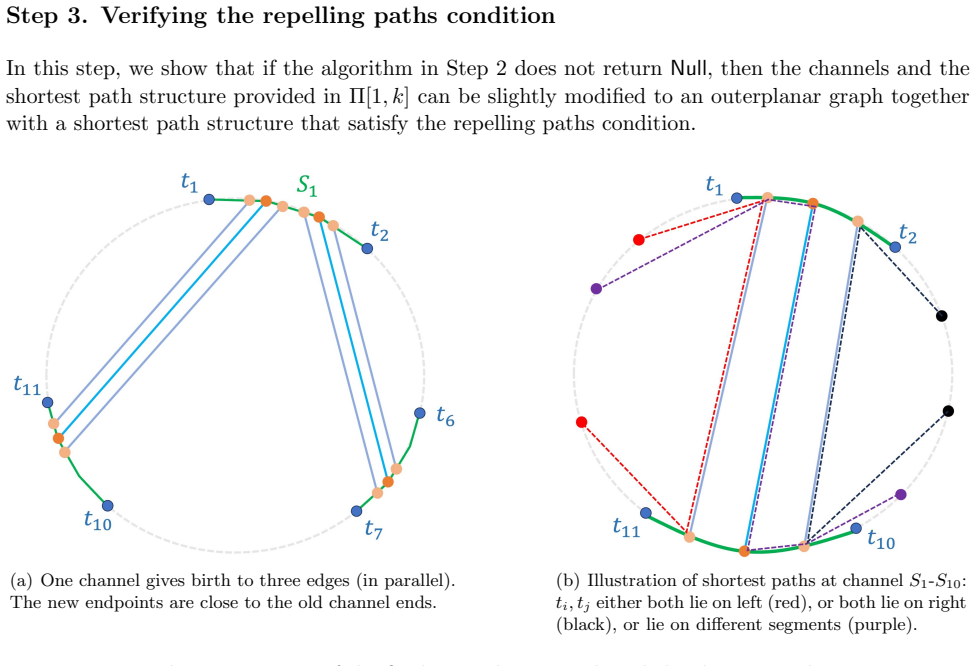
A metric on k terminals is outerplanar if and only if there exists a canonical outerplanar graph and a shortest-path structure on its terminals such that every pair of repelling terminal pairs is assigned disjoint paths; the existence of such a structure can be decided by dynamic programming in O(k^5) time, after which a distance LP that is guaranteed feasible by a dual-flow argument recovers the edge weights.
What carries the argument
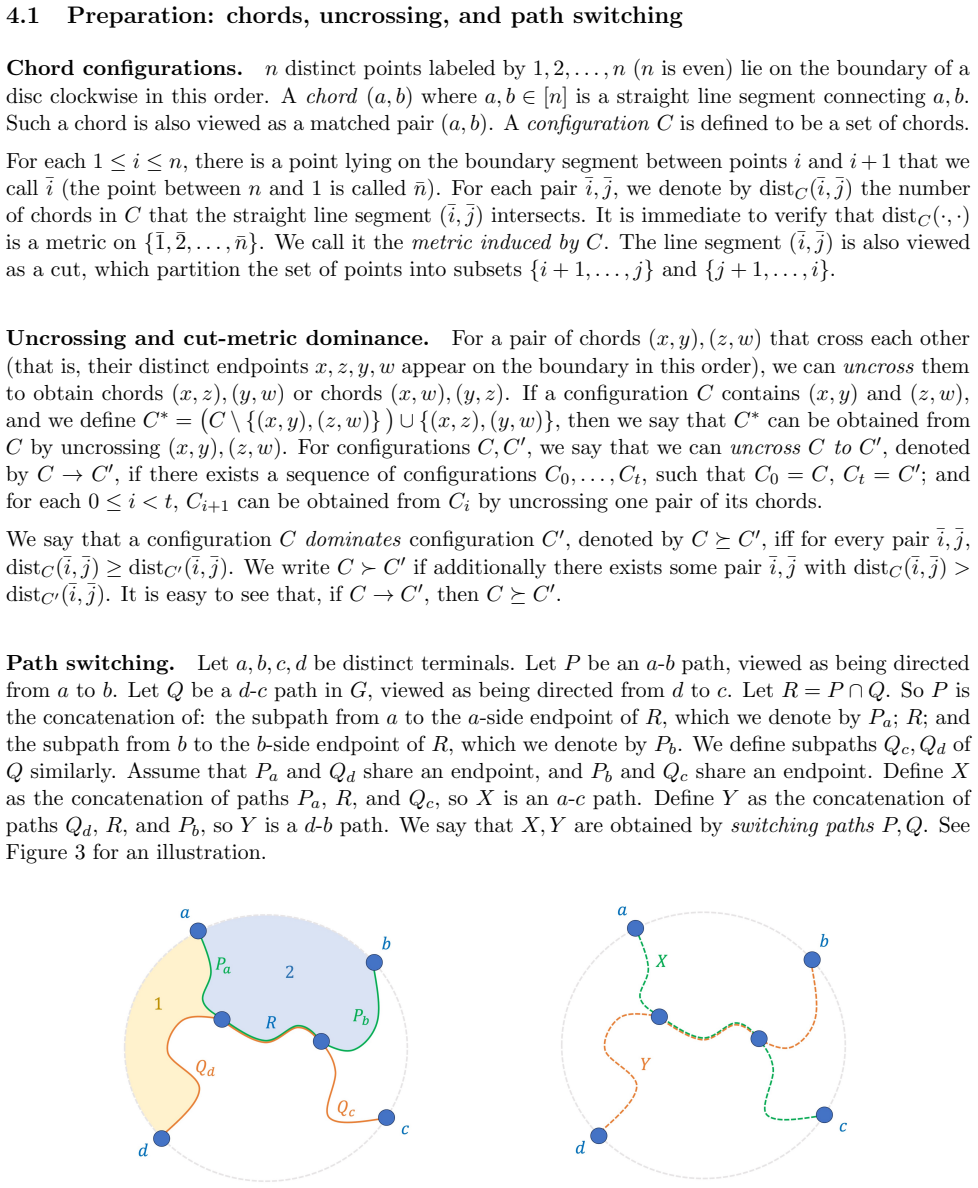
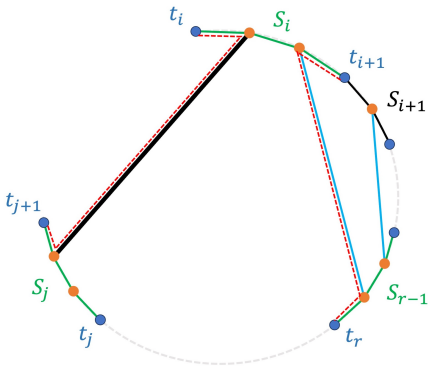
The repelling-paths condition: two pairs of terminals are repelling when their four distances violate one of the two inequalities that would be forced by intersecting shortest paths; the condition simply requires that every such pair of paths be placed disjointly. Sufficiency of the condition for the existence of edge lengths is proved by showing that any dual flow obstruction can be uncrossed until it contradicts the four-point properties of Okamura–Seymour metrics.
Load-bearing premise
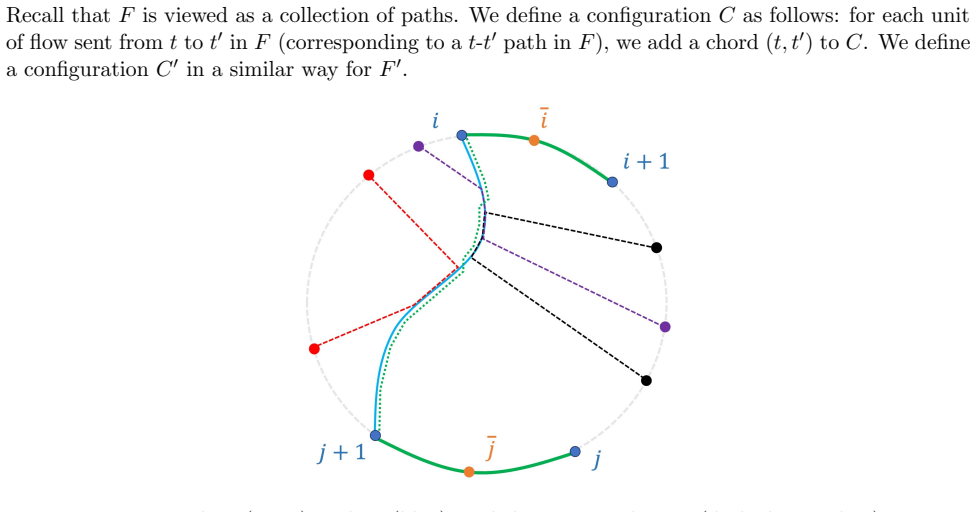
Once a candidate collection of paths satisfies the combinatorial repelling condition, the associated linear program for edge lengths is always feasible; that claim rests on a pure combinatorial lemma equating chord dominance with the possibility of successive uncrossing.
What would settle it
Exhibit a concrete metric and a path structure that obeys every repelling-paths condition yet for which the dual flow LP still admits a positive-cost obstruction, or find a finite family of forbidden submetrics that completely characterises outerplanarity.
If this is right
- Any distance-realization problem whose graphs admit a circular order of terminals can be attacked by first recovering that order and then searching for a path structure that respects a suitable non-crossing condition.
- The same path-intersection viewpoint yields a polynomial algorithm for outerplanar metrics even though no constant-point local certificate exists.
- The dual-flow / uncrossing argument shows that numerical feasibility of edge lengths is completely determined by a combinatorial intersection pattern.
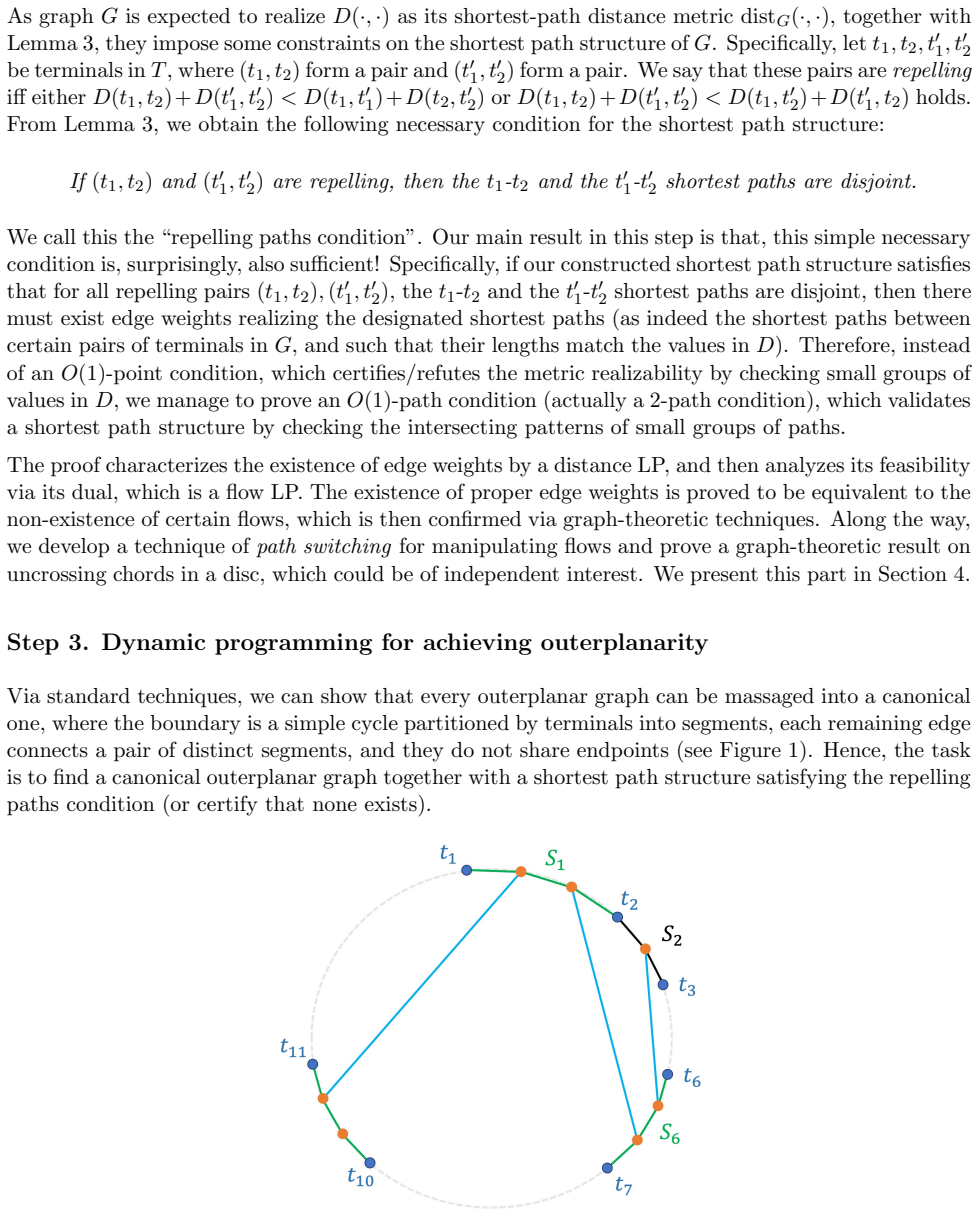
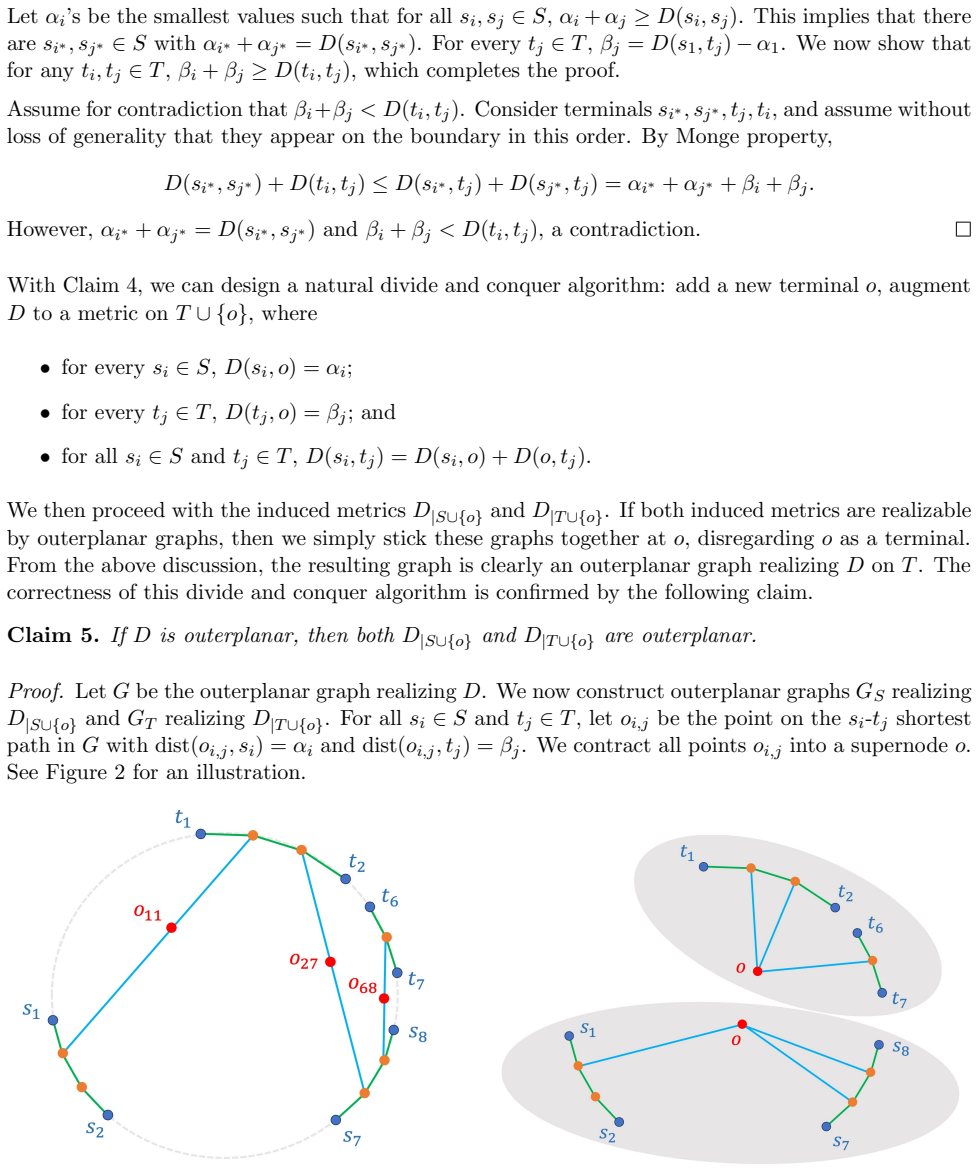
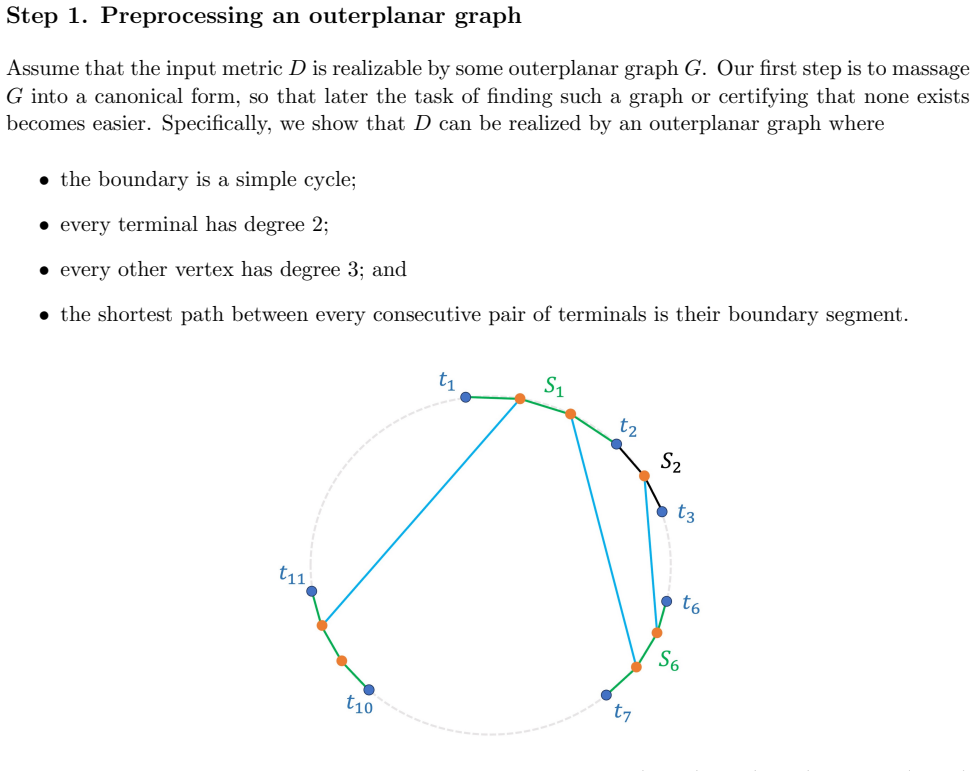
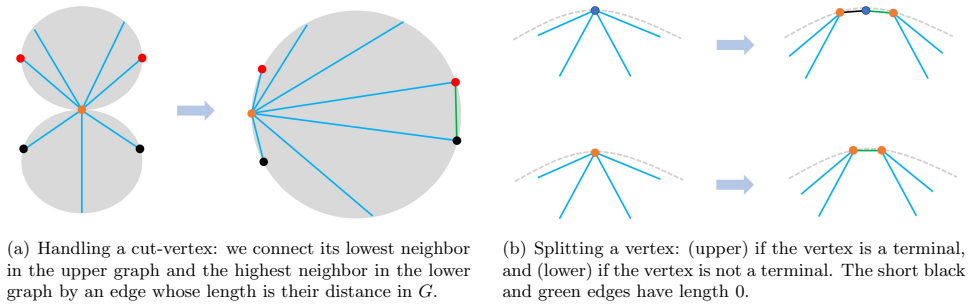
- Canonical outerplanar skeletons (simple boundary cycle, degree-3 Steiner vertices, maximally filled channels) are sufficient for exact distance realization.
Where Pith is reading between the lines
- The same path-and-intersection language may decide distance realization for larger planar families once an appropriate “repelling” or “non-crossing” condition is identified.
- Because the algorithm returns an explicit realizing graph whenever one exists, it immediately supplies a compact certificate of outerplanarity that can be verified independently of the dynamic program.
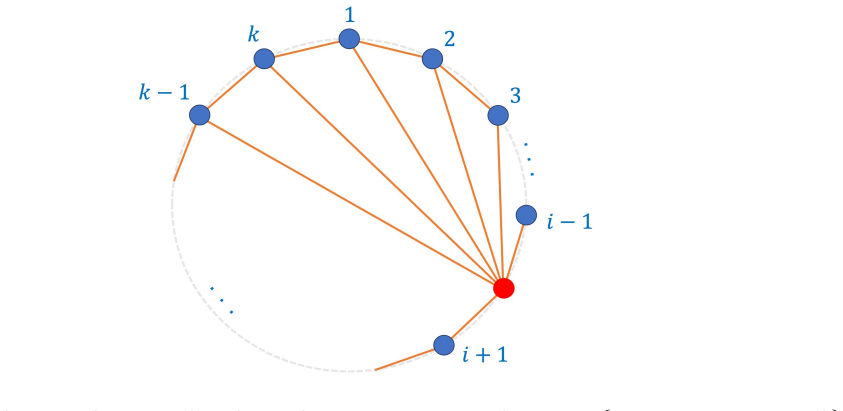
- The non-existence of an O(1)-point condition suggests that any complete characterization of outerplanar metrics must involve global topological data of the same order as the number of terminals.
Editorial analysis
A structured set of objections, weighed in public.
Referee Report
Summary. The paper studies the distance-realization problem for outerplanar graphs: given a metric D on a terminal set T of size k, decide whether there exists an edge-weighted outerplanar graph realizing the distances of D exactly, and construct one if so. Theorem 1 shows that, unlike trees and Okamura–Seymour instances, outerplanar metrics admit no O(1)-point characterization: for every k≥20 there is a non-outerplanar metric on k points whose every proper restriction is outerplanar (proved via the wheel metric and K4-minors). Theorem 2 supplies a constructive O(k^5)-time algorithm. The algorithm first recovers a circular ordering of the terminals (Section 3), then builds a canonical outerplanar graph together with a shortest-path structure that obeys the “repelling-paths condition” (every pair of terminal pairs that violate the four-point inequalities must be assigned disjoint paths). Sufficiency of this combinatorial condition for the existence of realizing edge lengths is established by a dual-flow argument, path-switching, and a pure uncrossing lemma on chord configurations (Lemma 9 and Section 4). The required structure is found by dynamic programming over boundary segments and channels (Section 5).
Significance. The result cleanly interpolates between the classical 4-point characterizations for trees/cacti and the Okamura–Seymour setting, while demonstrating that the absence of a local characterization need not preclude a polynomial-time algorithm. The “paths-and-intersections” viewpoint, the repelling-paths condition, and the chord-uncrossing lemma (Lemma 12) are of independent structural interest and already appear useful for related metric-realization and planar-emulator questions. The algorithm is fully constructive, self-contained (apart from a standard circular-order subroutine that is re-derived), and runs in O(k^5) time; the dual-flow feasibility proof is combinatorial rather than numerical. These features make the paper a solid contribution to algorithmic metric graph theory.
minor comments (4)
- The Ellipsoid-method runtime analysis at the end of Section 5 is stated as O(k^2)·O(k)·O(k^2)=O(k^5). A short remark that the bit-complexity of the separation oracle (all-pairs distances in an outerplanar graph with rational lengths) remains polynomial would make the claim fully rigorous.
- In the proof of Claim 11 the side-switching curve γ is defined with respect to the sets L and R; a one-sentence clarification that Property 5 already guarantees L∩R=∅ would help the reader follow the intersection-counting argument.
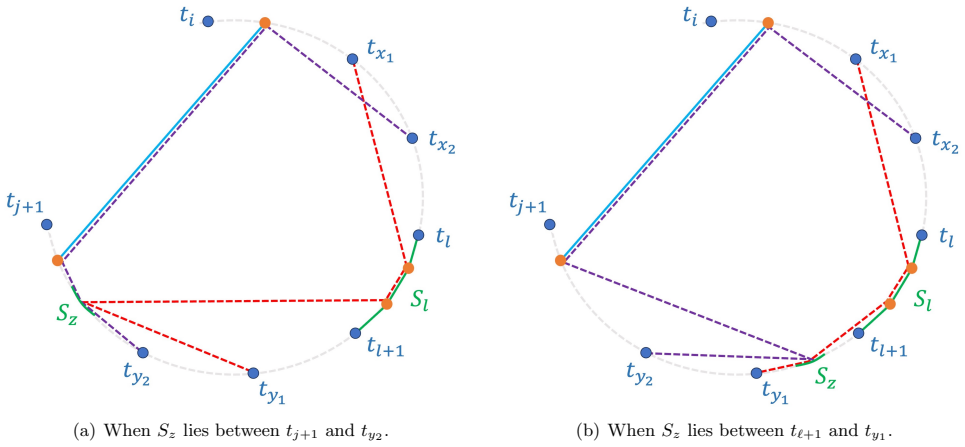
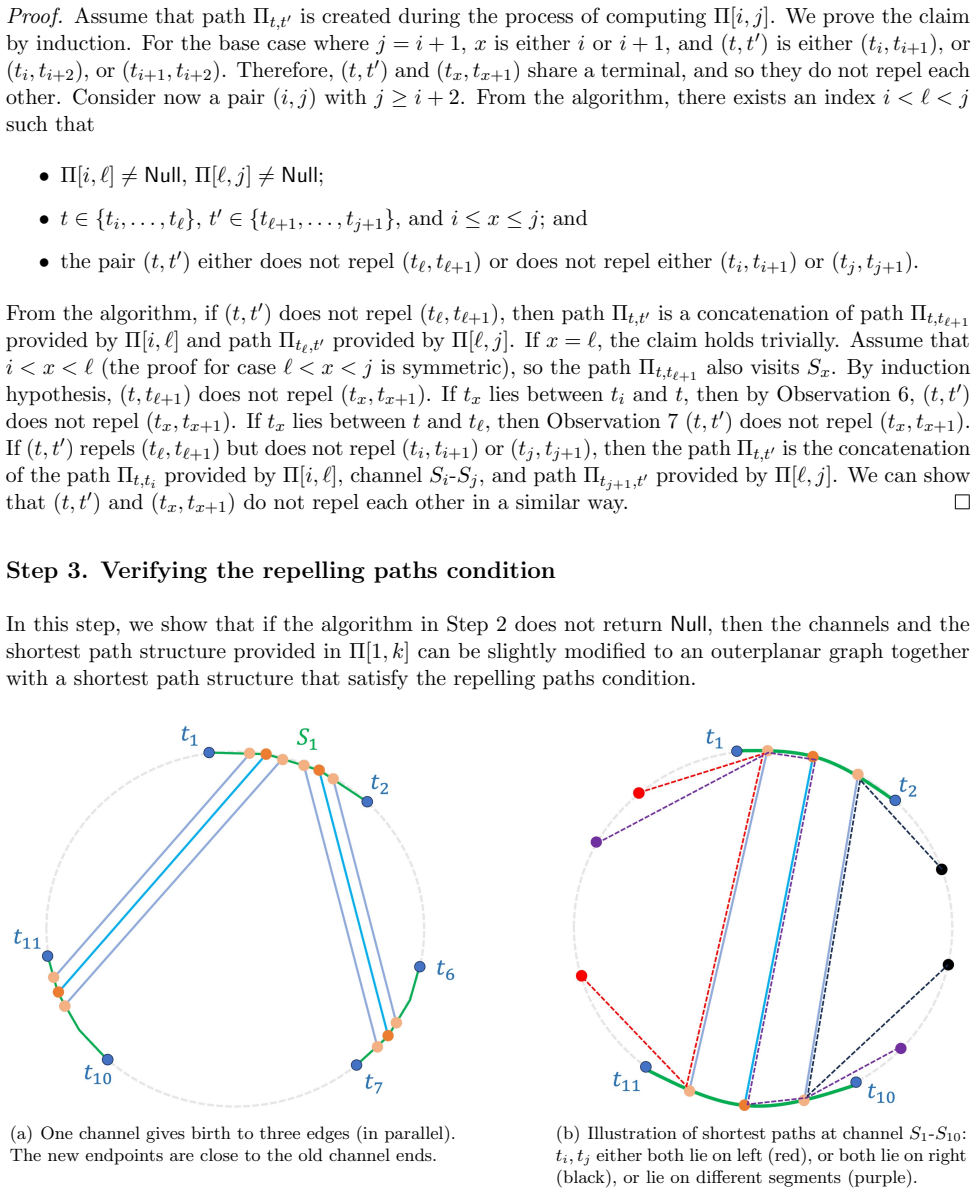
- Figures 2, 5 and 9 are referenced extensively; ensuring that the final camera-ready versions label the regions (1,2) and the three parallel edges of each channel would improve readability.
- A few typographical inconsistencies appear in the supplied text (e.g., “dist G”, missing spaces around subscripts, “O(k 5)”). These are easily cleaned in revision.
Circularity Check
No significant circularity: combinatorial proofs of repelling-paths sufficiency and DP are self-contained; only minor non-load-bearing self-citation for OS ordering subroutine.
specific steps
-
self citation load bearing
[Section 3 (circular ordering) and Lemma 9 proof (flow conversion)]
"From previous work [CT25], there is an efficient algorithm that, given any Okamura-Seymour metric, determines the circular ordering... Using standard techniques [CT25], we can convert any pair F, F′ of flows..."
CT25 is by the same authors. The citation supplies the OS ordering algorithm (re-used as a black-box subroutine) and a standard flow-alignment technique. However it is not load-bearing for the paper's novel content (repelling-paths sufficiency via uncrossing or the outerplanar DP); the authors re-prove the needed Claims 4–5/Observations and the dual argument is independent. Minor and does not force the main theorems.
full rationale
The paper's central claims (Theorem 1 via wheel-metric path intersections in Appendix A; Theorem 2 via circular order + repelling-paths Lemma 9 + DP) are derived from first-principles graph arguments. Lemma 9's sufficiency reduces LP feasibility (via Farkas dual flows) to a pure combinatorial statement: after path-switching to enforce Property 5 (potential on non-crossing pairs), chord configurations satisfy cut-metric dominance (Claim 11 via side-switching curve γ), and Lemma 12 (good-pair uncrossing for matchings + vertex-splitting reduction preserving dominance) plus Monge four-point forces the dual objective non-increasing, ruling out violation. All steps are proved in-line with no fitted parameters, no self-definitional equations, and no uniqueness imported to force the result. Section 3's circular-order subroutine cites CT25 (same authors) for the OS Monge algorithm and a flow-conversion technique, but re-proves the needed Claims 4–5, Observations 6–8, and runtime; this is a non-load-bearing subroutine (outerplanar is a special case of OS) and does not make the novel repelling/DP content circular. No ansatz smuggling or renaming of known results occurs. Honest non-finding of circularity is warranted.
Axiom & Free-Parameter Ledger
axioms (3)
- domain assumption Four-point Monge property completely characterizes Okamura-Seymour metrics (used to recover circular order).
- standard math Outerplanar graphs are K4-minor-free and admit a canonical form with degree-2 terminals and maximal channels.
- standard math Farkas lemma applied to the distance LP yields dual multi-commodity flows.
invented entities (2)
-
repelling paths condition
no independent evidence
-
canonical outerplanar graph (segments + channels)
no independent evidence
Cite this review
Pith. "Pith review of Paths and Intersections: Recognizing Outerplanar Metrics." pith.science (2026). https://pith.science/paper/LJ4TOGQY
@misc{pith2026260625827,
  author       = {Pith},
  title        = {Pith review of: Paths and Intersections: Recognizing Outerplanar Metrics},
  year         = {2026},
  howpublished = {\url{https://pith.science/paper/LJ4TOGQY}},
  note         = {Machine review of arXiv:2606.25827}
}
read the original abstract
We study the following distance realization problem: given a metric $D$ on a set $T$ of terminals, does there exist an (edge-weighted) outerplanar graph $G$, such that $T\subseteq V(G)$, and for every pair $t,t'\in T$, $\textsf{dist}_G(t,t')=D(t,t')$? We first prove that there is no ``local characterization'', forming a contrast with trees and Okamura-Seymour instances. Our main result is an efficient algorithm for this problem whose running time is polynomial in $|T|$. Both our proof and our algorithm utilize a recent new approach of analyzing graph structures, by viewing graphs as paths and their intersections, which we believe is of independent interest.
Figures







Forward citations
Cited by 1 Pith paper
-
Paths and Intersections: Minimum Realization of Okamura-Seymour Instances
Every OS metric has a unique minimum-crossing medial template; its primal arrangements are precisely the fewest-edge disk realizations, recoverable with realizing lengths in polynomial time.
Reference graph
Works this paper leans on
-
[1]
A local-to-global theorem for congested shortest paths
[AW22] Shyan Akmal and Nicole Wein. A local-to-global theorem for congested shortest paths. arXiv preprint arXiv:2211.07042,
-
[2]
Graph realization of distance sets
[BNPPR22] Amotz Bar-Noy, David Peleg, Mor Perry, and Dror Rawitz. Graph realization of distance sets. In47th International Symposium on Mathematical Foundations of Computer Science (MFCS 2022). Schloss-Dagstuhl-Leibniz Zentrum f¨ ur Informatik,
2022
-
[3]
On the structure of unique shortest paths in graphs
[Bod19] Greg Bodwin. On the structure of unique shortest paths in graphs. InProceedings of the Thirtieth Annual ACM-SIAM Symposium on Discrete Algorithms, pages 2071–2089. SIAM,
2071
-
[4]
Planar emulators for monge matrices
[CO20] Hsien-Chih Chang and Tim Ophelders. Planar emulators for monge matrices. In J. Mark Keil and Debajyoti Mondal, editors,Proceedings of the 32nd Canadian Conference on Computational Geometry, CCCG 2020, August 5-7, 2020, University of Saskatchewan, Saskatoon, Saskatchewan, Canada, pages 141–147,
2020
-
[5]
Path and intersections: Characterization of quasi-metrics in directed okamura-seymour instances
[CT25] Yu Chen and Zihan Tan. Path and intersections: Characterization of quasi-metrics in directed okamura-seymour instances. InProceedings of the 2025 Annual ACM-SIAM Symposium on Discrete Algorithms (SODA), pages 2467–2490. SIAM,
2025
-
[6]
Paths and intersections: Exact emulators for planar graphs.arXiv preprint arXiv:2507.09620,
[LTZ25] George Z Li, Zihan Tan, and Tianyi Zhang. Paths and intersections: Exact emulators for planar graphs.arXiv preprint arXiv:2507.09620,
discussion (0)
Sign in with ORCID, Apple, or X to comment. Anyone can read and Pith papers without signing in.