REVIEW 1 major objections 1 cited by
The SKA-Mid Galactic Plane survey at 10-15 GHz will deliver the first complete map of ionised gas and stellar feedback across the Milky Way.
Reviewed by Pith at T0; open to challenge. T0 means a machine referee read the full paper against a public rubric. the ladder, T0–T4 →
T0 review · grok-4.3
2026-06-29 04:32 UTC pith:X7XJTVRS
load-bearing objection This is a clear science-case proposal for an SKA-Mid Galactic Plane survey at 10-15 GHz, but it states performance goals without the supporting calculations or simulations. the 1 major comments →
The 10-15 GHz radio continuum survey of the Galactic Plane with SKAO
The pith
A machine-rendered reading of the paper's core claim, the machinery that carries it, and where it could break.
Core claim
The SKA-Mid Galactic Plane survey at 10-15 GHz, with its unprecedented sensitivity, angular resolution and mapping speed, will provide the first panoptic view of ionised gas and stellar feedback across the Milky Way, tracing thermal radio jets, hypercompact and ultracompact HII regions, supernova remnants, planetary nebulae and evolved massive stars at scales smaller than 0.05 pc out to 20 kpc.
What carries the argument
The SKA-Mid Galactic Plane survey at 10-15 GHz, which resolves ionised structures at physical scales smaller than 0.05 pc at distances up to 20 kpc.
Load-bearing premise
The SKA-Mid instrument will achieve the required sensitivity, angular resolution below 0.05 pc at 20 kpc, and mapping speed once built and commissioned.
What would settle it
Commissioning data showing that SKA-Mid cannot reach the stated sensitivity or angular resolution at 10-15 GHz across the Galactic Plane would prevent the survey from delivering the claimed panoptic view.
If this is right
- It will produce a uniform census of ionised gas structures associated with all phases of massive-star evolution across the entire Milky Way.
- The data will complement existing far-infrared, sub-millimetre and molecular-line surveys by adding the missing ionised-gas component.
- It will enable systematic studies of stellar feedback processes on Galactic scales that were previously limited to smaller regions.
- The survey will resolve thermal radio jets, hypercompact HII regions, supernova remnants and planetary nebulae at sub-parsec scales throughout the disk.
Where Pith is reading between the lines
- Combining the new radio maps with existing multi-wavelength data sets could allow direct measurement of the energy budget of stellar feedback on Galaxy-wide scales.
- The survey's resolution may reveal previously undetected faint or compact ionised regions that alter current estimates of the total ionising luminosity in the Milky Way.
- If polarisation information is obtained, the data could constrain the role of magnetic fields in shaping ionised gas structures at the scales of individual HII regions.
Editorial analysis
A structured set of objections, weighed in public.
Referee Report
Summary. The manuscript is a survey proposal describing the scientific motivation for the SKA-Mid Galactic Plane survey at 10-15 GHz. It argues that existing multi-wavelength surveys leave a gap in uniform coverage of ionized gas and stellar feedback, and that the proposed survey will deliver the first panoptic view by achieving high sensitivity, angular resolution below 0.05 pc at distances up to 20 kpc, and efficient mapping speed.
Significance. If the stated instrumental performance is achieved, the survey would provide a valuable complement to existing far-infrared, sub-millimetre, molecular-line, and lower-frequency radio surveys, enabling systematic studies of ionized structures across the full Galactic Plane.
major comments (1)
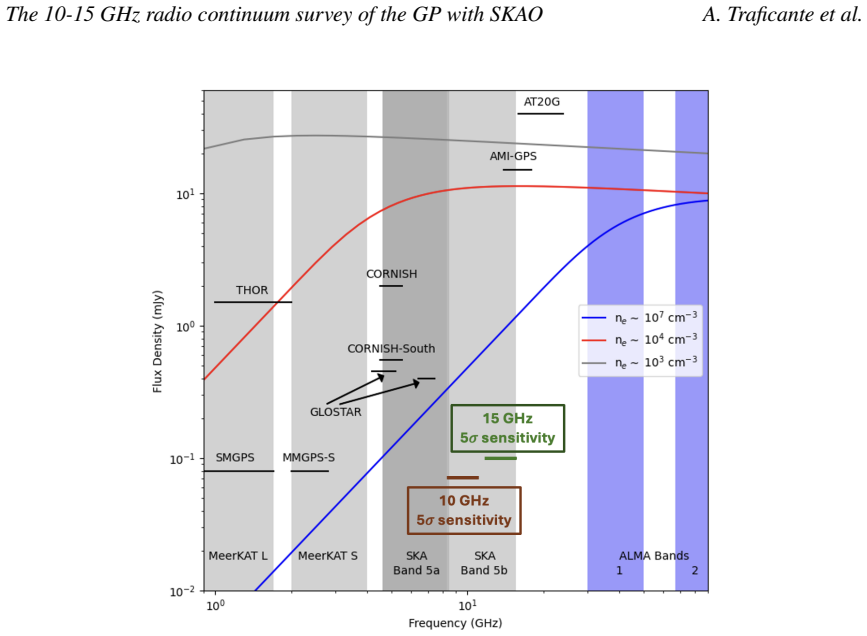
- [Abstract] Abstract: The central performance claims (sensitivity, angular resolution <0.05 pc at 20 kpc, and mapping speed at 10-15 GHz) are asserted without any quantitative justification, error budgets, sensitivity calculations, or simulation results to support that SKA-Mid will deliver these capabilities.
Simulated Author's Rebuttal
We thank the referee for their constructive review of our survey proposal manuscript. The single major comment is addressed below, and we will revise the manuscript to incorporate the requested justification.
read point-by-point responses
-
Referee: [Abstract] Abstract: The central performance claims (sensitivity, angular resolution <0.05 pc at 20 kpc, and mapping speed at 10-15 GHz) are asserted without any quantitative justification, error budgets, sensitivity calculations, or simulation results to support that SKA-Mid will deliver these capabilities.
Authors: We agree that the abstract would be strengthened by including brief quantitative support for these claims. The quoted figures are taken directly from the official SKA-Mid technical specifications (maximum baseline yielding ~0.5 arcsec resolution at 15 GHz, corresponding to <0.05 pc at 20 kpc, and the published sensitivity and survey-speed estimates from the SKA Observatory design documents). In the revised manuscript we will add one or two sentences in the abstract (or a footnote) that cite these specifications and the SKA sensitivity calculator, together with a short reference to the error budget implicit in the array configuration. We will also ensure the main text contains an explicit subsection summarising the adopted sensitivity, resolution, and mapping-speed calculations. No new simulations are required, as the values rest on the instrument design rather than on custom modelling. revision: yes
Circularity Check
No significant circularity identified
full rationale
The manuscript is a survey proposal whose text contains no derivations, equations, fitted parameters, or load-bearing self-citations. The central claim is a prospective description of future SKA-Mid capabilities and science goals; it does not advance any empirical result or mathematical chain whose internal logic could reduce to its own inputs by construction. The load-bearing assumptions are external (instrument performance once built) rather than internal reductions, so the paper is self-contained with no circular steps.
Axiom & Free-Parameter Ledger
read the original abstract
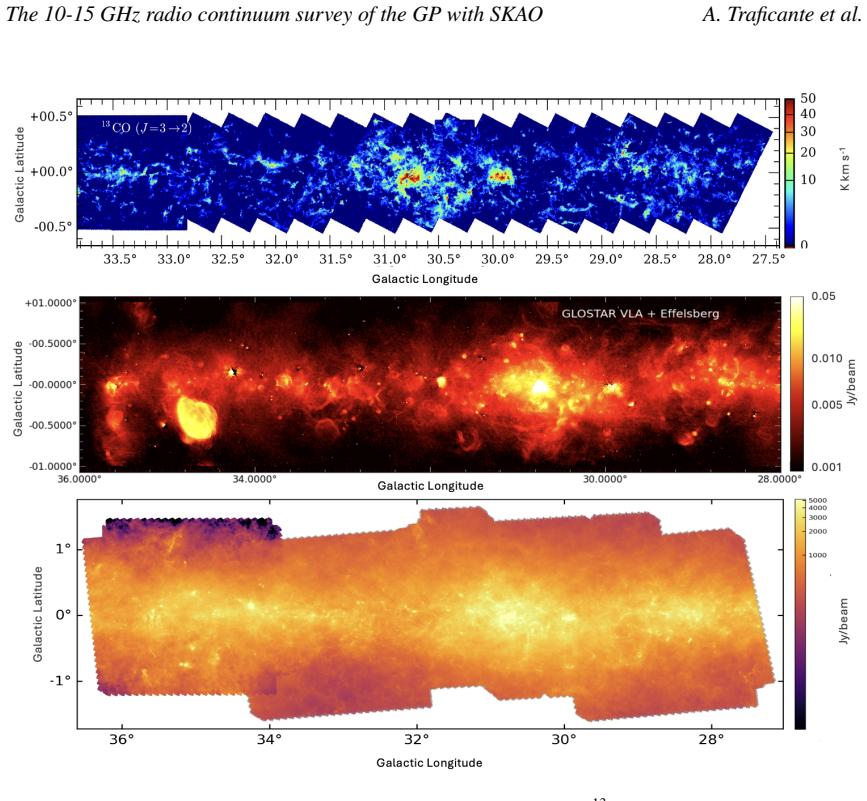
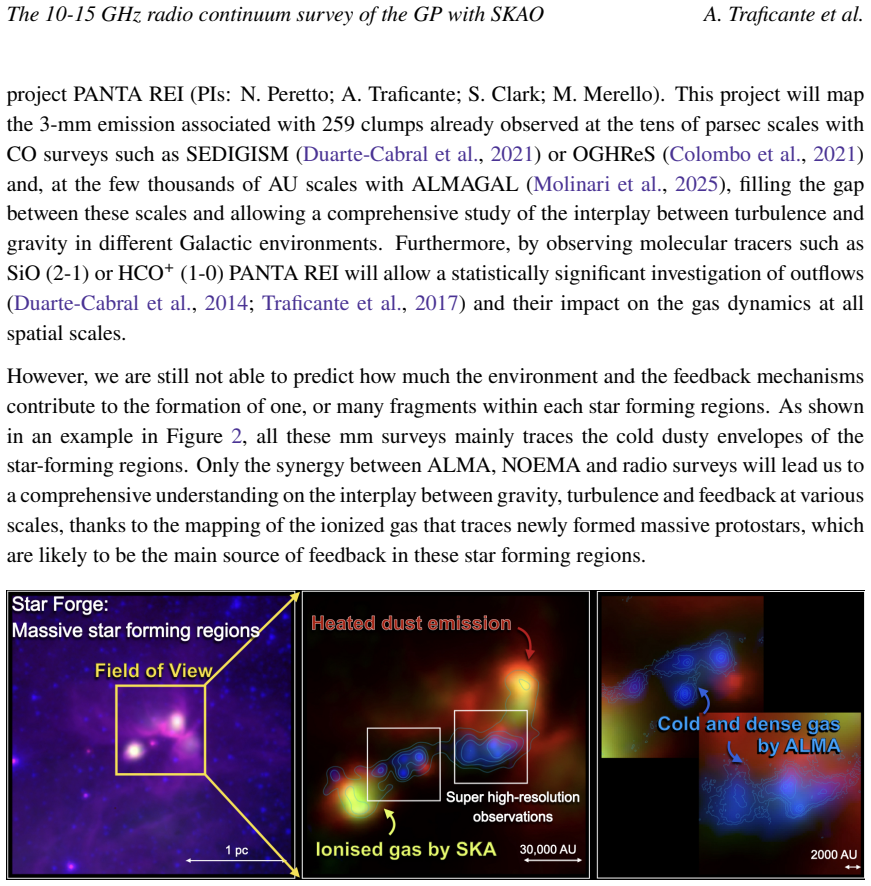
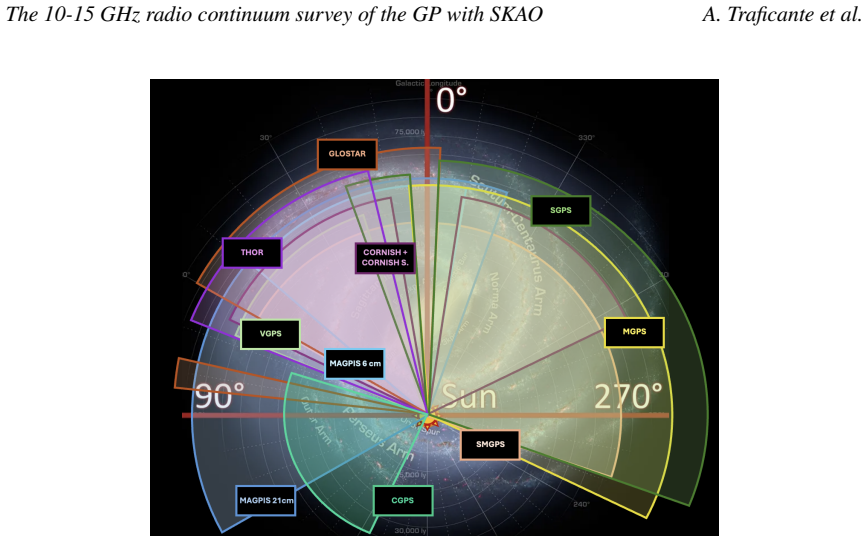
Star formation emerges from the complex interplay between gravity, turbulence, magnetic fields, and stellar feedback, all of which vary across spatial scales and Galactic environments. Over the past decades, extensive multiwavelength surveys of the Galactic Plane have progressively unveiled this complexity. Far-infrared and sub-millimetre surveys have identified and characterized tens of thousands of star-forming regions, revealing their mass, temperature, and evolutionary stage. Complementary molecular-line surveys, spanning several CO transitions and isotopologues, have mapped the gas kinematics from giant molecular clouds down to sub-parsec structures. The advent of interferometers such as ALMA has revolutionized this field, enabling systematic studies of gas dynamics, fragmentation, and collapse in dense clumps at scales of a few thousand astronomical units. At the same time, mid-infrared and radio surveys at frequencies 0.8 <= nu <= 5 GHz have traced ionised gas associated with the earliest and latest phases of massive-star evolution, including thermal radio jets, hypercompact and ultracompact HII regions, supernova remnants, planetary nebulae, and evolved massive stars. Yet, a uniform, Galaxy-wide census of ionised structures and feedback processes remains elusive. A transformational leap forward requires a sensitive, high-resolution radio survey of the Galactic Plane at 10-15 GHz, capable of resolving physical scales smaller than 0.05 pc at distances up to 20 kpc. This is precisely the goal of the SKA-Mid Galactic Plane survey, which will, with its unprecedented sensitivity, angular resolution, and mapping speed, provide the first panoptic view of ionised gas and stellar feedback across the Milky Way.
Figures
Forward citations
Cited by 1 Pith paper
-
How Should We Understand the Core Mass Function? A memo of the CMF2IMF conference at ESO Garching
High-mass CMF slopes depend strongly on minimum fitting mass; early-stage cores (ASHES) appear steeper, consistent with an evolving high-mass end.
Reference graph
Works this paper leans on
-
[1]
doi: 10.1088/0067-0049/192/1/4. L. Anderson et al. InAdvancing Astrophysics with the SKA – II (AASKAII)
-
[2]
doi: 10.1088/0004-637X/690/1/706. L. D. Anderson et al.A&A, 537:A1,
-
[3]
doi: 10.1051/0004-6361/201117640. L. D. Anderson et al.ApJSS, 212(1):1,
-
[4]
doi: 10.1088/0067-0049/212/1/1. L. D. Anderson et al.A&A, 605:A58,
-
[5]
doi: 10.1051/0004-6361/201731019. L. D. Anderson et al.A&A, 693:A247,
-
[6]
doi: 10.1051/0004-6361/202451038. M. Anderson et al.MNRAS, 508(2):2964–2978,
-
[7]
doi: 10.1093/mnras/stab2674. G. Anglada, L. F. Rodríguez, and C. Carrasco-González.A&ARv, 26(1):3,
-
[8]
doi: 10.1007/s00159-018-0107-z. M. Armante et al.A&A, 686:A122,
-
[9]
doi: 10.1051/0004-6361/202347595. A. Avison et al.MNRAS, 526(2):2278–2300,
-
[10]
doi: 10.1093/mnras/stad2824. P. J. Barnes et al.ApJSS, 196(1):12,
-
[11]
doi: 10.1088/0067-0049/196/1/12. P. J. Barnes et al.ApJ, 812(1):6,
-
[12]
W.Batrla,H.E.Matthews,K.M.Menten,andC.M.Walmsley.Nature,326(6108):49–51,1987
doi: 10.1088/0004-637X/812/1/6. W.Batrla,H.E.Matthews,K.M.Menten,andC.M.Walmsley.Nature,326(6108):49–51,1987. doi: 10.1038/326049a0. M. Benedettini et al.A&A, 633:A147,
-
[13]
31 The 10-15 GHz radio continuum survey of the GP with SKAO A
doi: 10.1051/0004-6361/201936096. 31 The 10-15 GHz radio continuum survey of the GP with SKAO A. Traficante et al. M. Benedettini et al.A&A, 654:A144,
-
[14]
doi: 10.1051/0004-6361/202141433. R. A. Benjamin et al.PASP, 115(810):953–964,
-
[15]
doi: 10.1086/376696. H. Beuther et al.A&A, 595:A32, 2016a. doi: 10.1051/0004-6361/201629143. H. Beuther et al.A&A, 595:A32, 2016b. doi: 10.1051/0004-6361/201629143. H. Beuther et al.A&A, 617:A100,
-
[16]
doi: 10.1051/0004-6361/201833021. H. Beuther, R. Kuiper, and M. Tafalla.ARA&A, 63(1):1–44,
-
[17]
doi: 10.1146/annurev-astro-013125-122023. M. Bonfand et al.A&A, 687:A163,
-
[18]
doi: 10.1051/0004-6361/202347856. C. Bordiu et al.MNRAS, 2025a. doi: 10.1093/mnras/staf1667. C. Bordiu et al.A&A, 695:A144, 2025b. doi: 10.1051/0004-6361/202450356. S.L.Breen,S.P.Ellingsen,J.L.Caswell,andB.E.Lewis.MNRAS,401(4):2219–2244,2010. doi: 10.1111/j.1365-2966. 2009.15831.x. S. L. Breen et al.MNRAS, 435(1):524–530,
-
[19]
doi: 10.1093/mnras/stt1315. S. L. Breen et al.MNRAS, 450(4):4109–4136,
-
[20]
doi: 10.1093/mnras/stv847. C. L. Brogan et al.ApJL, 639(1):L25–L29,
-
[21]
doi: 10.1086/501500. A. Brunthaler et al.A&A, 651:A85,
-
[22]
doi: 10.1051/0004-6361/202039856. C. S. Buemi et al.MNRAS, 465(4):4147–4158,
-
[23]
doi: 10.1093/mnras/stw3074. C. S. Buemi et al. InAdvancing Astrophysics with the SKA – II (AASKAII)
-
[24]
doi: 10.1017/pasa.2013.22. S. J. Carey et al.PASP, 121(875):76,
-
[25]
doi: 10.1086/596581. R. Cesaroni et al.A&A, 579:A71,
-
[26]
doi: 10.1051/0004-6361/201525953. X. Chen et al.MNRAS, 466(4):4364–4369,
-
[27]
doi: 10.1093/mnras/stx011. Y. Chen et al.A&A, 678:A137,
-
[28]
doi: 10.1051/0004-6361/202346491. E. Churchwell et al.ApJ, 649(2):759–778,
-
[29]
doi: 10.1086/507015. E. Churchwell et al.ApJ, 670(1):428–441,
-
[30]
doi: 10.1086/521646. E. Churchwell et al.PASP, 121(877):213,
-
[31]
doi: 10.1086/597811. A. Coletta et al.A&A, 696:A151,
-
[32]
doi: 10.1051/0004-6361/202452706. D. Colombo et al.A&A, 655:L2,
-
[33]
doi: 10.1051/0004-6361/202142182. Y. Contreras et al.A&A, 549:A45,
-
[34]
doi: 10.1051/0004-6361/201220155. T. Csengeri et al.A&A, 565:A75,
-
[35]
doi: 10.1051/0004-6361/201322434. C. J. Cyganowski et al.AJ, 136(6):2391–2412,
-
[36]
doi: 10.1088/0004-6256/136/6/2391. T. M. Dame, D. Hartmann, and P. Thaddeus.ApJ, 547(2):792,
-
[37]
doi: 10.1086/318388. C. G. De Pree et al.ApJL, 781(2):L36, 2014a. doi: 10.1088/2041-8205/781/2/L36. C. G. De Pree et al.ApJL, 781(2):L36, 2014b. doi: 10.1088/2041-8205/781/2/L36. L. Deharveng et al.A&A, 523:A6,
work page internal anchor Pith review doi:10.1086/318388 2041
-
[38]
doi: 10.1051/0004-6361/201014422. J. T. Dempsey, H. S. Thomas, and M. J. Currie.ApJSS, 209(1):8,
-
[39]
doi: 10.1088/0067-0049/209/1/8. J. Dey et al.A&A, 689:A254,
-
[40]
doi: 10.1051/0004-6361/202039873. R. Dokara et al.A&A, 671:A145,
-
[41]
doi: 10.1051/0004-6361/202245339. A. Duarte-Cabral et al.A&A, 558:A125,
-
[42]
doi: 10.1051/0004-6361/201321393. A. Duarte-Cabral et al.A&A, 570:A1,
-
[43]
doi: 10.1051/0004-6361/201423677. A. Duarte-Cabral et al.MNRAS, 500:3027–3049,
-
[44]
doi: 10.1093/mnras/staa2480. S. W. Duchesne et al.PASA, 40:e034,
-
[45]
doi: 10.1017/pasa.2023.31. S. A. Dzib et al.A&A, 670:A9,
-
[46]
doi: 10.1051/0004-6361/202143019. D. Elia et al.MNRAS, 504(2):2742–2766,
-
[47]
doi: 10.1093/mnras/stab1038. D. Elia et al.ApJ, 941(2):162,
-
[48]
doi: 10.3847/1538-4357/aca27d. I. N. Evans et al.ApJSS, 274(2):22,
-
[49]
doi: 10.3847/1538-4365/ad6319. L. Eyer et al.A&A, 674:A13,
-
[50]
doi: 10.1051/0004-6361/202244242. R. Franco-Hernández and L. F. Rodríguez.ApJL, 604(2):L105–L108,
-
[51]
doi: 10.1086/386282. A.Frank etal. InH.Beuther, R. S.Klessen, C.P. Dullemond, andT.Henning, editors,Protostars andPlanetsVI, pages 451–474,
-
[52]
doi: 10.2458/azu_uapress_9780816531240-ch020. S. Freund et al.A&A, 664:A105,
-
[53]
32 The 10-15 GHz radio continuum survey of the GP with SKAO A
doi: 10.1051/0004-6361/202142573. 32 The 10-15 GHz radio continuum survey of the GP with SKAO A. Traficante et al. Gaia Collaboration et al.A&A, 674:A41, 2023a. doi: 10.1051/0004-6361/202243232. Gaia Collaboration et al.A&A, 674:A1, 2023b. doi: 10.1051/0004-6361/202243940. R. Galván-Madrid, L. F. Rodríguez, P. T. P. Ho, and E. Keto.ApJL, 674(1):L33,
-
[54]
doi: 10.1086/528957. R. Galván-Madrid et al.ApJSS, 274(1):15,
-
[55]
doi: 10.3847/1538-4365/ad61e6. E. C. Gardiner et al.ApJ, 967(2):145,
-
[56]
doi: 10.3847/1538-4357/ad39e1. S. Geen, P. Hennebelle, P. Tremblin, and J. Rosdahl.MNRAS, 454(4):4484–4502, 2015a. doi: 10.1093/mnras/stv2272. S. Geen et al.MNRAS, 448(4):3248–3264, 2015b. doi: 1093/mnras/stv251. S. Goedhart et al.MNRAS, 531(1):649–681,
-
[57]
doi: 10.1093/mnras/stae1166. P. F. Goldsmith, U. A. Yıldız, W. D. Langer, and J. L. Pineda.ApJ, 814(2):133,
-
[58]
doi: 10.1086/590229. M. González-Avilés, S. Lizano, and A. C. Raga.ApJ, 621(1):359–371,
-
[59]
doi: 10.1086/427470. D. A. Green.Journal of Astrophysics and Astronomy, 46(1):14,
-
[60]
doi: 10.1007/s12036-024-10038-4. J. A. Green et al.MNRAS, 392(2):783–794,
-
[61]
doi: 10.1111/j.1365-2966.2008.14091.x. M. Y. Grudić et al.MNRAS, 512(1):216–232,
-
[62]
doi: 10.1093/mnras/stac526. A. Hacar et al. In S. Inutsuka et al., editors,Protostars and Planets VII, volume 534 ofAstronomical Society of the Pacific Conference Series, page 153,
-
[63]
doi: 10.48550/arXiv.2203.09562. D. J. Helfand et al.AJ, 131(5):2525–2537,
-
[64]
doi: 10.1086/503253. P. Hennebelle and M. Y. Grudić.ARA&A, 62(1):63–111,
-
[65]
doi: 10.1146/annurev-astro-052622-031748. M. G. Hoare et al. In B. Reipurth, D. Jewitt, and K. Keil, editors,Protostars and Planets V, page 181,
-
[66]
doi: 10.48550/arXiv.astro-ph/0603560. M. G. Hoare et al.PASP, 124(919):939,
work page internal anchor Pith review Pith/arXiv arXiv doi:10.48550/arxiv.astro-ph/0603560
-
[67]
doi: 10.1086/668058. P. F. Hopkins et al.MNRAS, 491(3):3702–3729,
-
[68]
doi: 10.1093/mnras/stz3129. A. Ingallinera et al. InAdvancing Astrophysics with the SKA – II (AASKAII)
-
[69]
doi: 10.1093/mnras/stad005. K. Ishihara et al.ApJ, 974(1):95,
-
[70]
doi: 10.3847/1538-4357/ad630f. N. Izumi et al.ApJ, 963(2):163,
-
[71]
doi: 10.3847/1538-4357/ad18c6. J. M. Jackson et al.ApJSS, 163(1):145,
-
[72]
doi: 10.1086/500091. J. M. Jackson et al.PASA, 30:e057,
-
[73]
doi: 10.1017/pasa.2013.37. D. T. Jaffe and J. Martín-Pintado.ApJ, 520(1):162–172,
-
[74]
doi: 10.1086/307440. A. Karska et al.A&A, 697:A186,
-
[75]
doi: 10.1051/0004-6361/202453109. A. Karska et al. InAdvancing Astrophysics with the SKA – II (AASKAII)
-
[76]
doi: 10.1086/379545. S. Khan et al.A&A, 689:A81,
-
[77]
doi: 10.1051/0004-6361/202449390. K.-T. Kim and B.-C. Koo.ApJ, 549(2):979–996,
-
[78]
M. Klassen, T. Peters, and R. E. Pudritz.ApJ, 758(2):137, 2012a. doi: 10.1088/0004-637X/758/2/137. M. Klassen, R. E. Pudritz, and T. Peters.MNRAS, 421(4):2861–2871, 2012b. doi: 10.1111/j.1365-2966.2012.20523.x. A. Koley et al.A&A, 702:A133,
-
[79]
doi: 10.1051/0004-6361/202553830. M. S. N. Kumar, P. Palmeirim, D. Arzoumanian, and S. I. Inutsuka.A&A, 642:A87,
-
[80]
doi: 10.1051/0004-6361/ 202038232. S. Kurtz. In R. Cesaroni, M. Felli, E. Churchwell, and M. Walmsley, editors,Massive Star Birth: A Crossroads of Astrophysics, volume 227 ofIAU Symposium, pages 111–119,
discussion (0)
Sign in with ORCID, Apple, or X to comment. Anyone can read and Pith papers without signing in.