REVIEW 1 major objections 2 cited by
Allowing dark energy to cluster reverses the relaxation of neutrino mass bounds seen in smooth models.
Reviewed by Pith at T0; open to challenge. T0 means a machine referee read the full paper against a public rubric. the ladder, T0–T4 →
T0 review · grok-4.3
2026-06-29 03:04 UTC pith:THM6C54L
load-bearing objection Including dark energy perturbations reverses the reported relaxation of neutrino mass limits in dynamical DE models. the 1 major comments →
Dark energy perturbations and the robustness of cosmological neutrino-mass constraints
The pith
A machine-rendered reading of the paper's core claim, the machinery that carries it, and where it could break.
Core claim
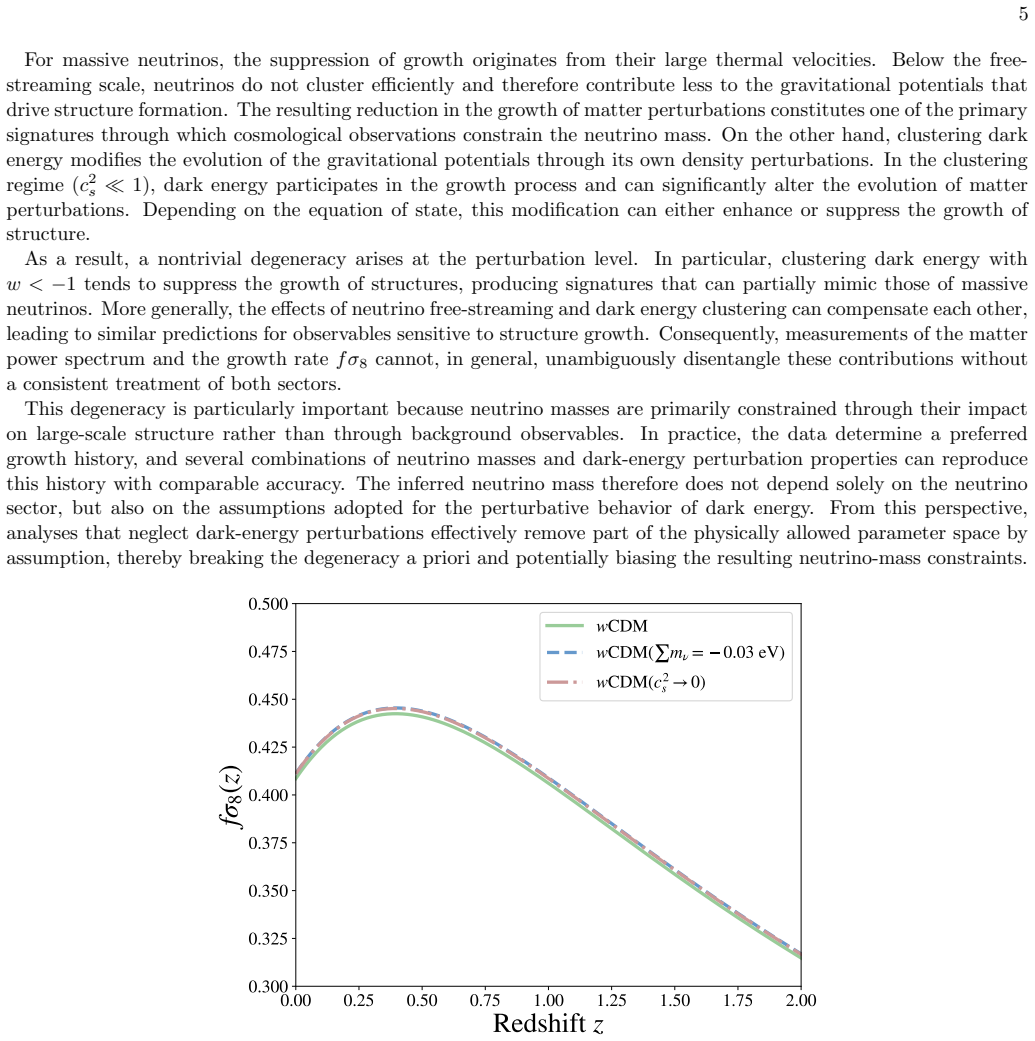
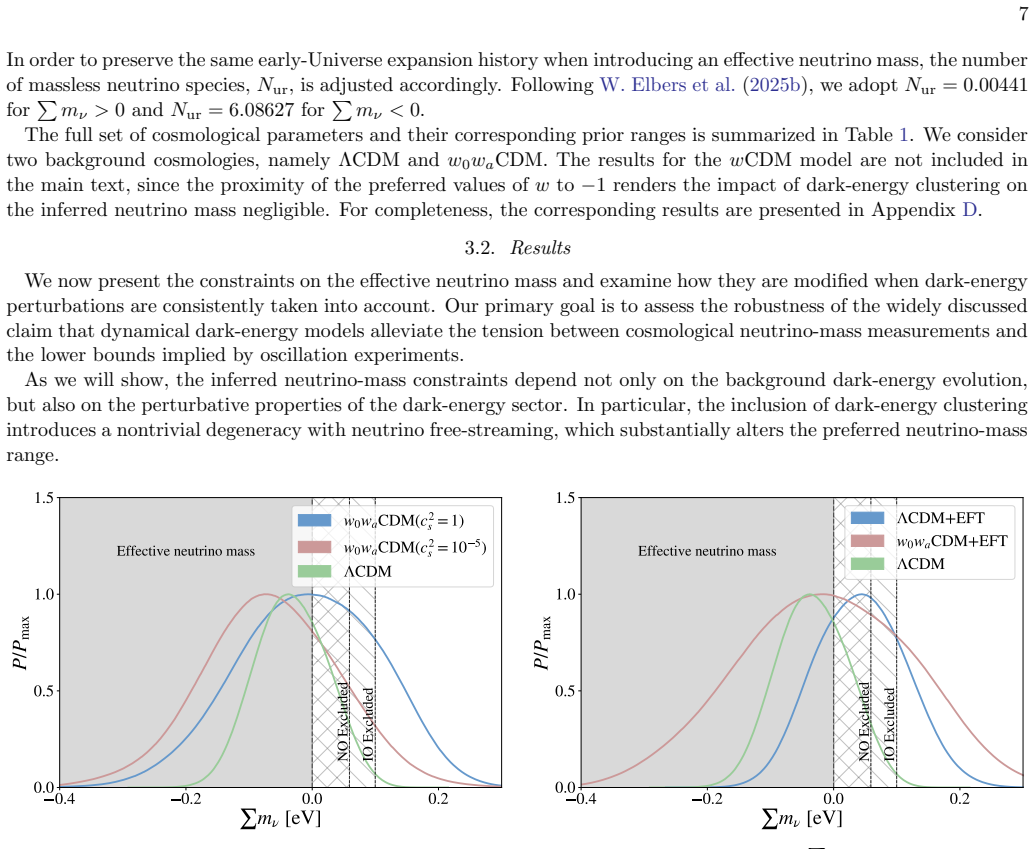
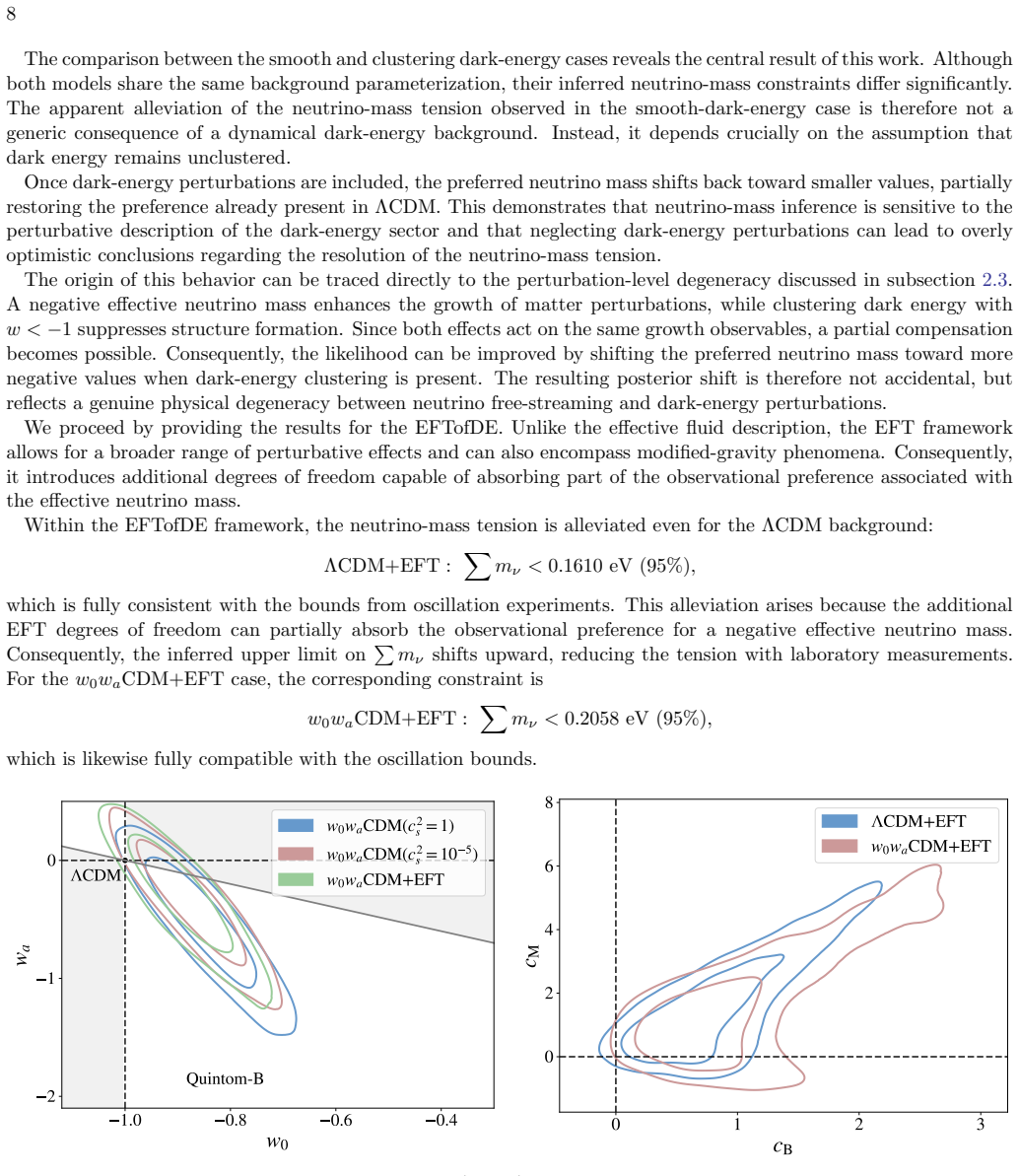
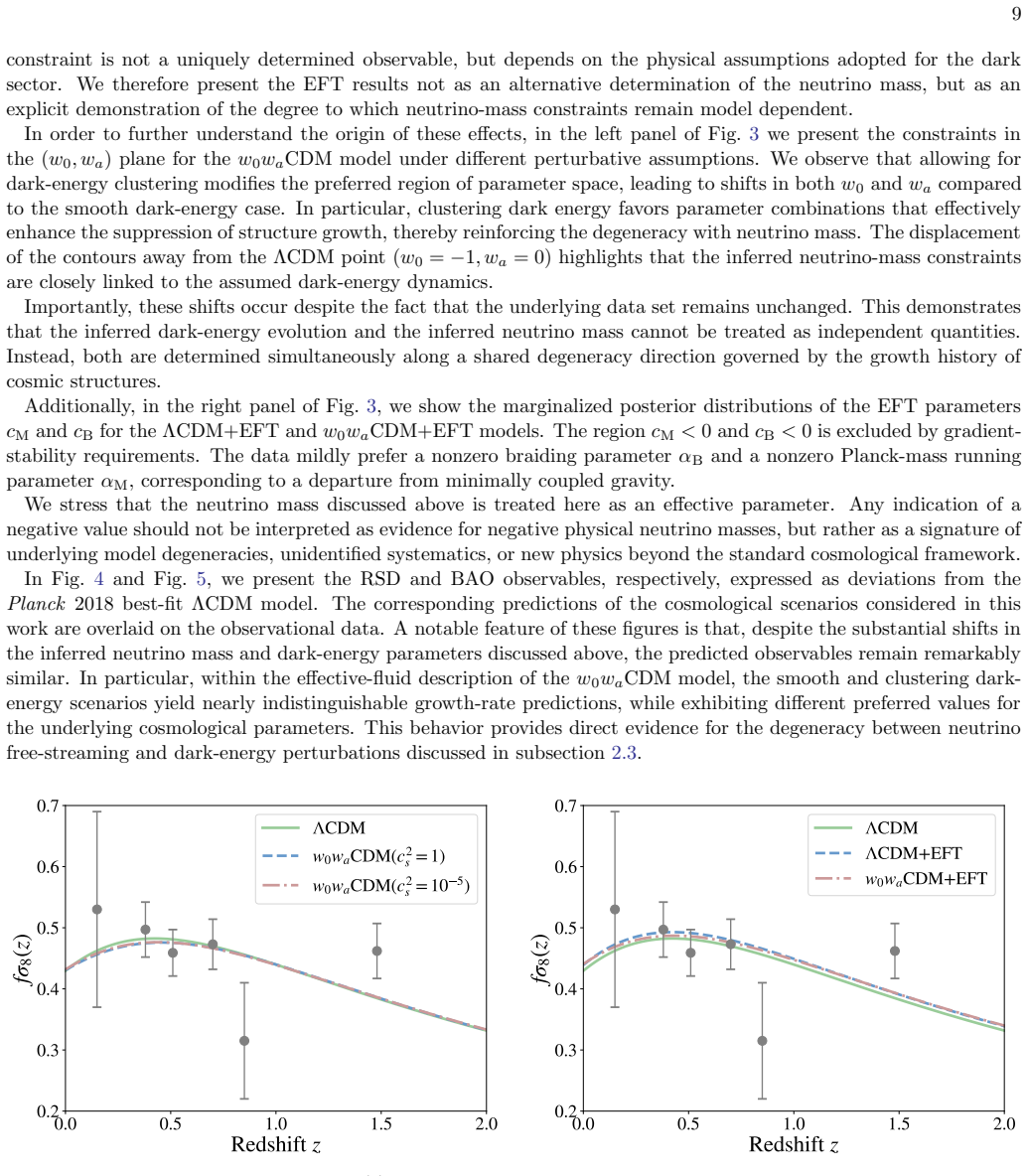
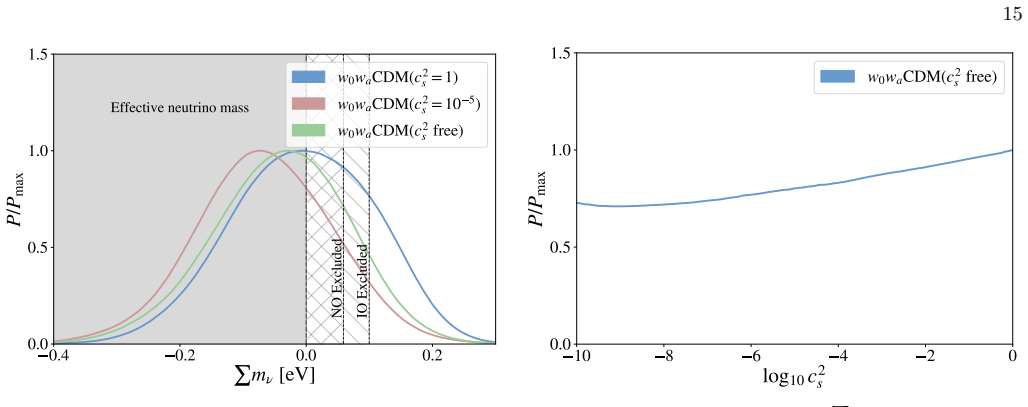
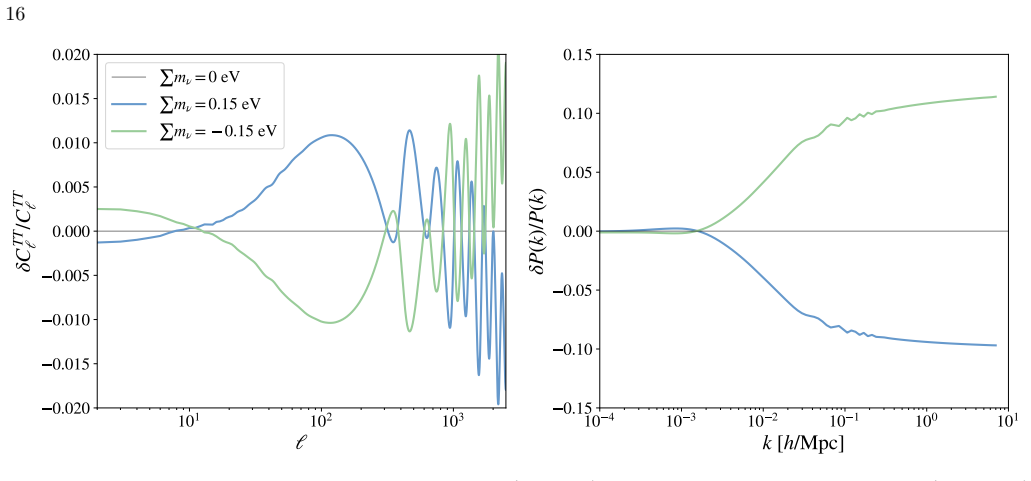
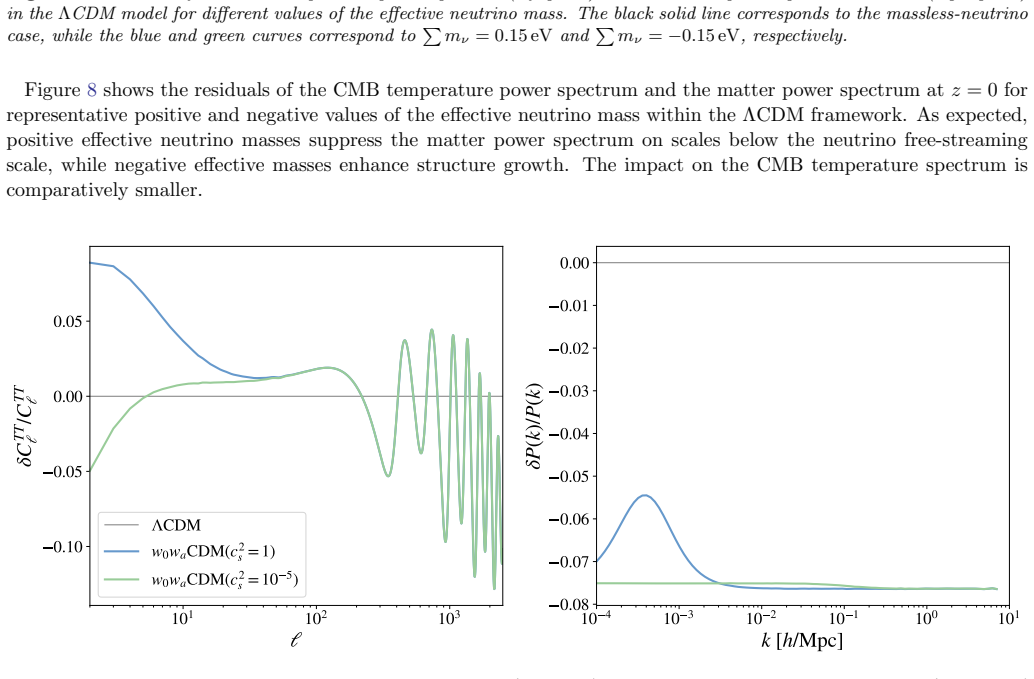
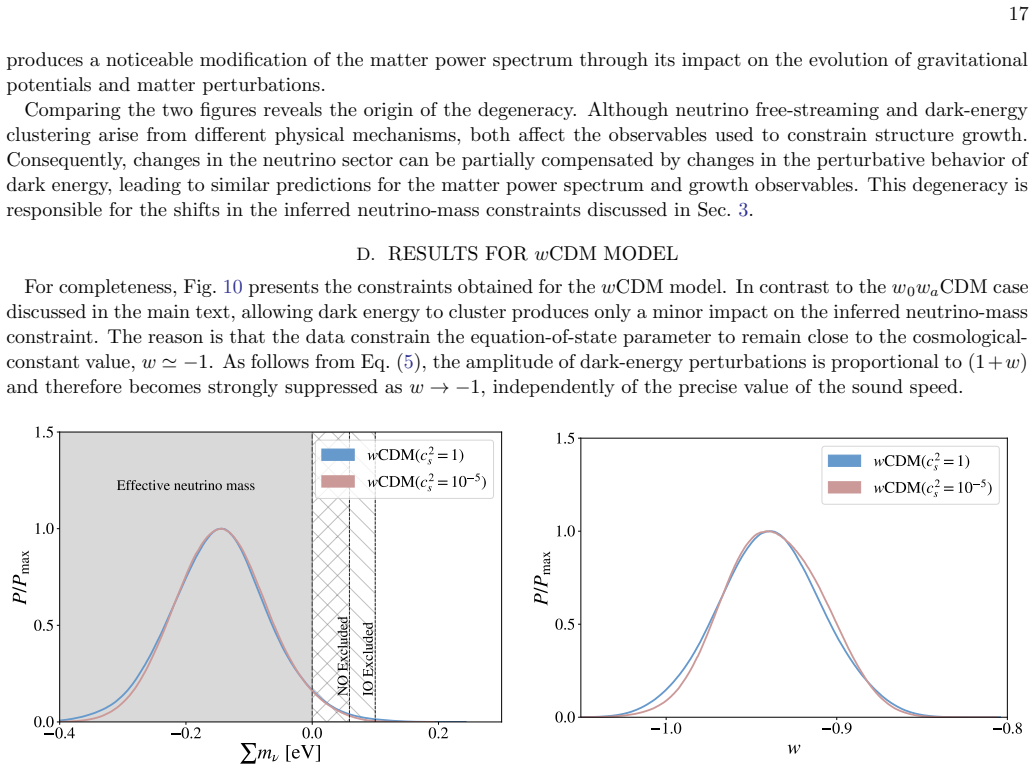
Cosmological data from CMB, BAO, RSD, and supernovae indicate that including dark energy perturbations in dynamical dark energy models shifts the preferred neutrino mass sum to smaller and more negative values, in contrast to the relaxation obtained when perturbations are neglected. This occurs because neutrino free-streaming and dark energy perturbations produce similar effects on structure growth observables, allowing different combinations to fit the data equally well.
What carries the argument
The degeneracy between neutrino free-streaming and dark-energy perturbations in structure-growth observables such as redshift-space distortions.
Load-bearing premise
The main driver of the change in neutrino mass preference is the degeneracy with dark energy perturbations rather than other modeling choices or data features.
What would settle it
If new data from redshift-space distortion surveys shows no shift in neutrino mass when dark energy perturbations are modeled, the degeneracy explanation would be falsified.
If this is right
- Smooth dark energy models relax the upper bounds on neutrino mass.
- Including dark energy clustering moves the preferred neutrino mass lower.
- Multiple pairs of neutrino mass and dark energy clustering parameters can fit the data similarly.
- Neutrino mass constraints from cosmology are sensitive to the treatment of dark energy perturbations.
- Consistent modeling of dark energy perturbations is required for reliable neutrino mass inference.
Where Pith is reading between the lines
- Analyses of other parameters influenced by structure growth might show similar model dependencies when dark energy perturbations are added.
- Upcoming surveys with better measurements of growth rate could help distinguish the contributions from neutrinos and dark energy.
- The findings highlight the need to consider perturbation effects in any extension of the standard cosmological model that involves clustering components.
Editorial analysis
A structured set of objections, weighed in public.
Referee Report
Summary. The paper examines the robustness of cosmological upper limits on the sum of neutrino masses when dynamical dark energy is allowed to cluster. Using CMB, BAO, RSD and supernova data, it finds that the relaxation of neutrino-mass bounds previously reported for smooth dynamical dark energy disappears once dark-energy perturbations are included; instead the posterior for the neutrino mass shifts toward smaller and even negative values. The authors attribute this shift to a degeneracy between neutrino free-streaming and dark-energy clustering that is visible in the growth observables (primarily RSD).
Significance. If the central result holds, the work shows that neutrino-mass constraints from current data are sensitive to the treatment of dark-energy perturbations and are therefore more model-dependent than is commonly assumed. This has direct implications for the interpretation of the apparent tension between cosmological and oscillation bounds on the neutrino mass sum.
major comments (1)
- [Results / Interpretation section (exact section number not visible in abstract)] The central claim that the shift in neutrino-mass preference is driven by a degeneracy specifically in structure-growth observables (RSD and related data) is load-bearing for the interpretation. The manuscript should provide an explicit test (e.g., a run with RSD data removed) showing that the shift disappears or reverses when only CMB+BAO+SN are used, thereby isolating the contribution of growth data from possible late-time ISW or lensing effects in the CMB.
Simulated Author's Rebuttal
We thank the referee for the detailed and constructive report. The suggestion to explicitly isolate the contribution of growth observables is well taken and will improve the robustness of our interpretation. We address the major comment below.
read point-by-point responses
-
Referee: The central claim that the shift in neutrino-mass preference is driven by a degeneracy specifically in structure-growth observables (RSD and related data) is load-bearing for the interpretation. The manuscript should provide an explicit test (e.g., a run with RSD data removed) showing that the shift disappears or reverses when only CMB+BAO+SN are used, thereby isolating the contribution of growth data from possible late-time ISW or lensing effects in the CMB.
Authors: We agree that an explicit test removing the RSD likelihood is the cleanest way to isolate the role of growth observables versus possible CMB contributions (late ISW or lensing). In the revised manuscript we will add a dedicated subsection and accompanying figure that repeats the full MCMC analysis using only CMB+BAO+SN. This will directly show whether the shift toward smaller (or negative) neutrino masses persists in the absence of RSD data. We expect the test to confirm that the degeneracy is driven by the growth observables, but we will report the outcome transparently regardless of the result. revision: yes
Circularity Check
No circularity: result obtained from external data fits
full rationale
The paper fits cosmological models to independent datasets (CMB, BAO, RSD, supernovae) both with and without dark-energy perturbations, then reports the resulting shifts in neutrino-mass posteriors. The claimed degeneracy is exhibited by comparing these fits rather than being imposed by definition, self-citation, or by relabeling a fitted parameter as a prediction. No load-bearing step reduces the reported neutrino-mass shift to an input by construction.
Axiom & Free-Parameter Ledger
free parameters (2)
- dark energy equation-of-state parameters
- sum of neutrino masses
axioms (2)
- standard math Linear cosmological perturbation theory on an FLRW background
- domain assumption The chosen data sets (CMB, BAO, RSD, supernovae) provide independent constraints on the relevant parameters
read the original abstract
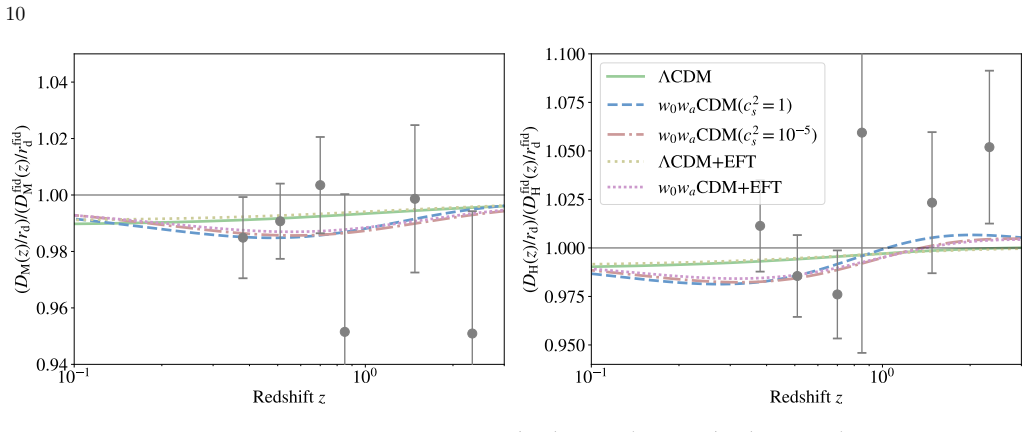
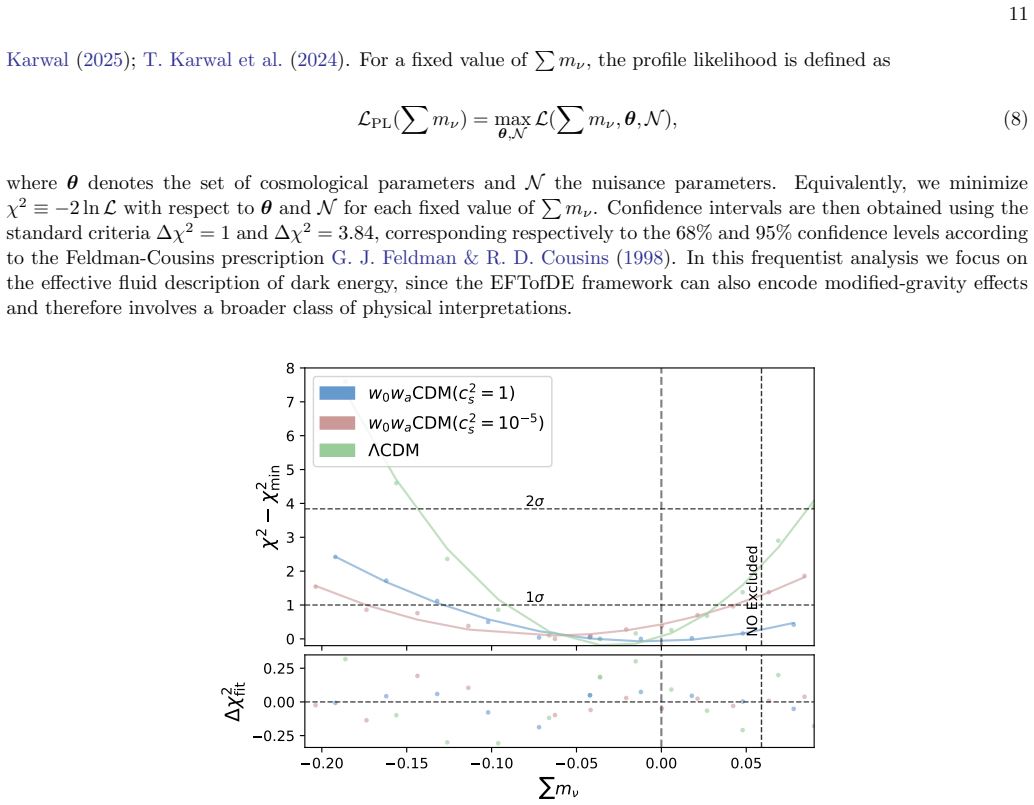
Cosmological observations are placing increasingly stringent bounds on the sum of neutrino masses, approaching the lower limits implied by neutrino oscillation experiments. Recent studies have suggested that dynamical dark energy may alleviate this apparent tension. However, these conclusions generally rely on the assumption that dark energy remains smooth, neglecting its perturbations. In this work we investigate the robustness of cosmological neutrino-mass constraints by consistently incorporating dark-energy perturbations. Using CMB, BAO, RSD, and supernova data, we show that the commonly reported alleviation of the neutrino-mass tension in dynamical dark-energy models is not generic. While smooth dark energy substantially relaxes the neutrino-mass bounds, allowing dark energy to cluster shifts the preferred neutrino mass toward smaller, and even more negative, effective values. We demonstrate that this behavior originates from a degeneracy between neutrino free-streaming and dark-energy perturbations in structure-growth observables. Different combinations of neutrino mass and dark-energy clustering can provide similarly good fits to current data while yielding significantly different neutrino-mass constraints. Our results show that cosmological neutrino-mass measurements are inherently model dependent and that reliable neutrino-mass inference requires a consistent treatment of dark-energy perturbations.
Figures
Forward citations
Cited by 2 Pith papers
-
Measuring Cosmic Neutrino Masses Independently of Dark Energy
Two dark-energy-robust cosmological routes bound ∑mν to <0.152 eV (marginalized) and <0.41 eV (late-Universe-free), with the latter independent of tested w(a) models by construction.
-
Neutrino mass constraints in the Schwarzschild-de Sitter black-hole dark energy model with ACT DR6 and DESI DR2 data
SdSDE dark energy yields a ~0.16–0.21 eV positive neutrino-mass preference with DESI+ACT data, but χ² strongly favors extended ΛCDM and the shift is likely compensation.
discussion (0)
Sign in with ORCID, Apple, or X to comment. Anyone can read and Pith papers without signing in.