Quantum Variational Approaches to the Maximum Independent Set Problem at Utility Scale
Pith reviewed 2026-07-02 20:58 UTC · model grok-4.3
The pith
Ancilla-assisted superposition initialization enables variational quantum algorithms to solve maximum independent set exactly on 180-vertex graphs.
A machine-rendered reading of the paper's core claim, the machinery that carries it, and where it could break.
Core claim
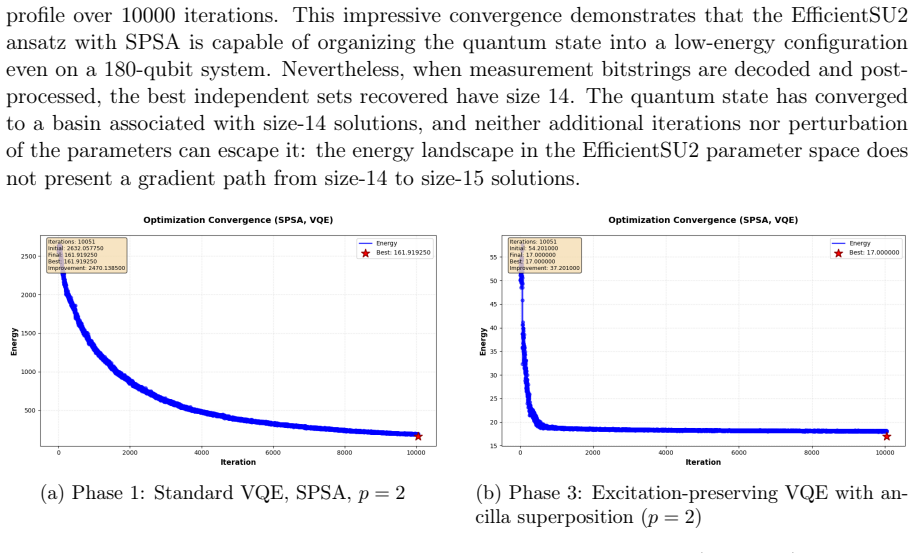
The authors show that a preprocessing pipeline of Fiedler-vector reordering and distance-based sparsification, followed by history-guided bitstring correction and stepwise maximality extension, recovers the exact MIS on all tested instances. On the 180-vertex graph they introduce ancilla-assisted superposition initialization that loads a uniform superposition over near-optimal classical seeds into an excitation-preserving variational circuit; this discovers the exact MIS of size 15 where standard methods reach only size 14. The resulting 180-qubit simulation is presented as the largest scale at which gate-based variational algorithms have solved MIS to optimality, with converged simulator pa
What carries the argument
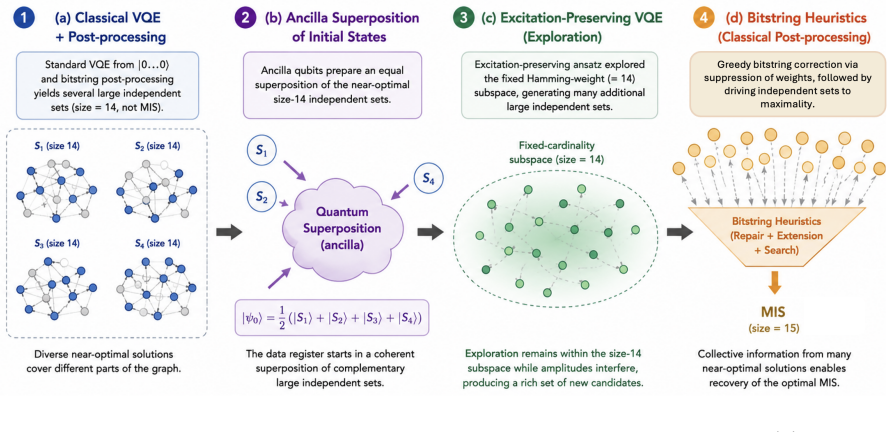
Ancilla-assisted superposition initialization, which uses ancilla qubits to prepare a uniform superposition over classically-found near-optimal solutions and evolves the state with an excitation-preserving ansatz while conserving Hamming weight.
If this is right
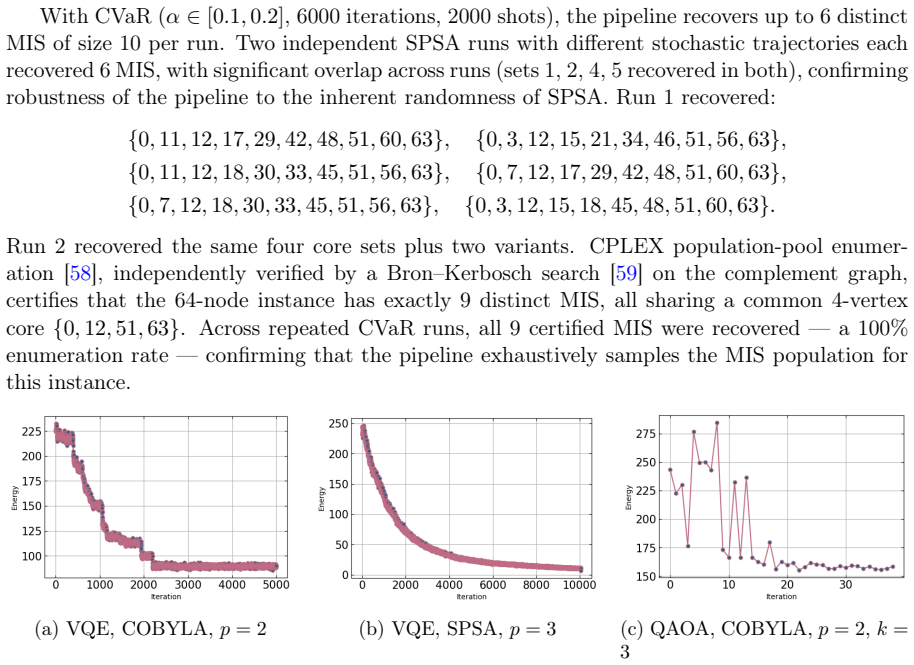
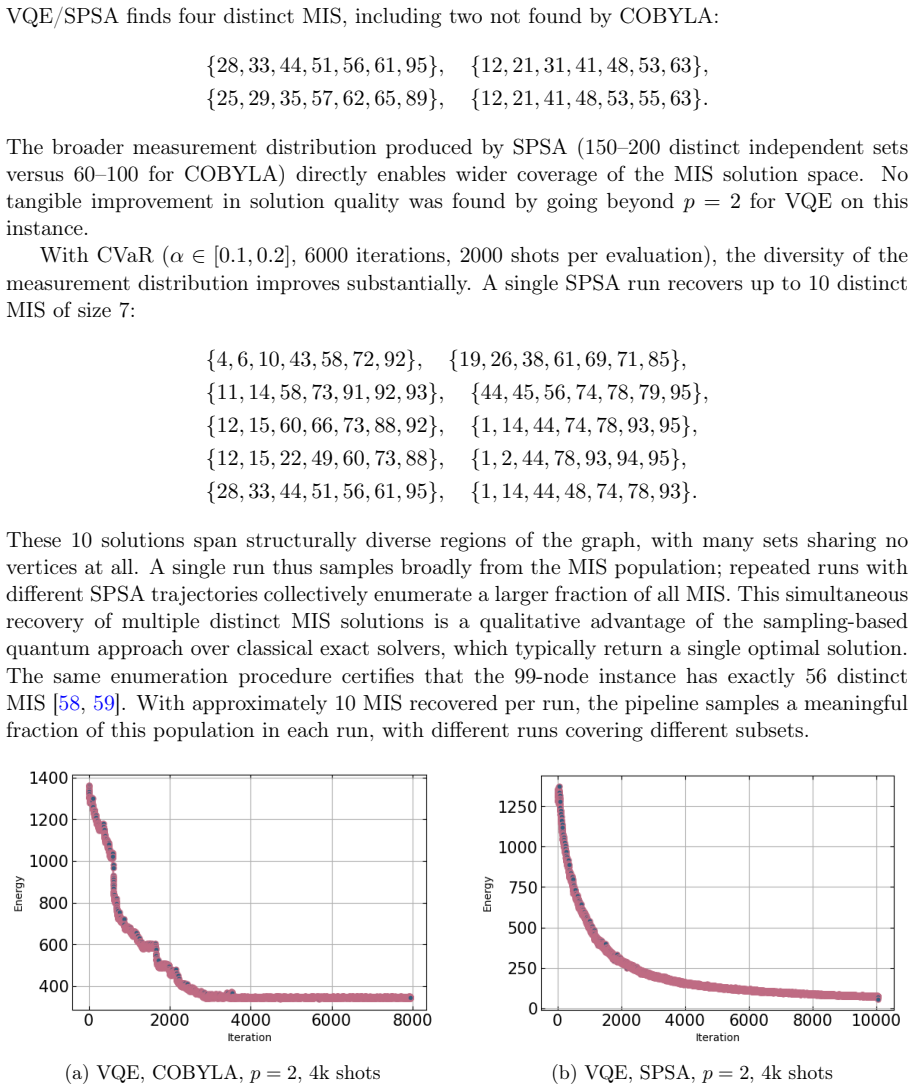
- CVaR-optimized VQE with SPSA samples up to 10 distinct maximum independent sets per run on the 99-node instance.
- Repeated runs with different SPSA trajectories collectively enumerate a larger fraction of all optimal solutions for each graph.
- The 180-qubit construction succeeds where single-seed variational methods stall at size 14.
- Converged simulator parameters transfer directly to noisy execution on IBM Quantum hardware.
Where Pith is reading between the lines
- Hybrid seeding of quantum circuits from classical near-solutions may extend variational reach to other NP-hard combinatorial problems that admit good classical heuristics.
- If the sparsification technique preserves optimal solutions on broader graph families, the same depth-reduction strategy could apply to still larger instances.
- The ability to return multiple distinct optimal solutions from one variational run opens enumeration tasks that go beyond single-solution optimization.
Load-bearing premise
The classical post-processing steps together with the quantum samples will reliably recover the exact MIS even when the variational circuit fails to reach the ground state, and the distance-based sparsification preserves every optimal solution.
What would settle it
Apply the pipeline without ancilla-assisted initialization to the 180-vertex instance and check whether any run still recovers an independent set of size exactly 15.
Figures
read the original abstract
We study variational quantum algorithms for the Maximum Independent Set (MIS) problem on benchmark graphs of 64, 99, and 180 vertices. The Variational Quantum Eigensolver (VQE) and Quantum Approximate Optimization Algorithm (QAOA) are compared across SPSA and COBYLA optimizers at multiple circuit depths. A preprocessing pipeline comprising spectral graph reordering (via the Fiedler vector) and distance-based sparsification reduces circuit depth while preserving energy fidelity. Classical post-processing via history-guided bitstring correction and stepwise maximality extension recovers the exact MIS across all instances. With CVaR optimization, VQE with SPSArecovers up to 6 distinct MIS per run for the 64-node instance and up to 10 distinct MIS per run for the 99-node instance, sampling broadly from the optimal solution population. Repeated runs with different SPSA trajectories collectively enumerate a larger fraction of all MIS for each instance. For the 180-node instance, where standard approaches stall at size 14 (MIS is 15), we introduce ancilla-assisted superposition initialization: ancilla qubits prepare a uniform superposition over classically-found near-optimal solutions, and an excitation-preserving ansatz evolves this state while conserving Hamming weight. This novel construction enables quantum-parallel variational search over multiple seeds simultaneously, discovering the exact MIS where single-seed methods fail. The 180-qubit simulation represents, to our knowledge, the largest scale at which gate-based variational algorithms have solved MIS to optimality. Hardware validation on IBM Quantum hardware ibm_marrakesh confirms that converged simulator parameters transfer effectively to noisy quantum execution.
Editorial analysis
A structured set of objections, weighed in public.
Referee Report
Summary. The manuscript claims that VQE and QAOA, combined with spectral reordering, distance-based sparsification, history-guided bitstring correction, stepwise maximality extension, and a novel ancilla-assisted superposition initialization, recover the exact MIS (including multiple distinct optima) on benchmark graphs of 64, 99, and 180 vertices. It reports that the 180-qubit simulation is the largest scale at which gate-based variational methods have solved MIS to optimality, that CVaR-VQE with SPSA samples up to 10 distinct optima per run on the 99-node instance, and that simulator parameters transfer to IBM Quantum hardware.
Significance. If the post-processing steps are shown to preserve all optimal solutions and the quantum component demonstrably contributes beyond classical seeding, the work would establish a concrete scaling milestone for variational quantum optimization on combinatorial problems, with the ancilla-assisted multi-seed initialization and multi-optima sampling as potentially reusable techniques.
major comments (3)
- [Abstract, §3] Abstract and §3 (preprocessing): the claim that distance-based sparsification 'preserves energy fidelity' is insufficient to support the central optimality result; no argument or test is given that every MIS solution is retained (rather than merely that low-energy states remain probable), which is load-bearing for the 180-node instance where the reported MIS size is already known classically.
- [§4, 180-node results] §4 (post-processing) and 180-node results: no ablation or formal argument shows that history-guided bitstring correction plus stepwise maximality extension recovers the exact MIS when raw variational samples have incorrect Hamming weight or violate independence; the abstract states these steps 'recover the exact MIS across all instances,' yet the 180-qubit success is initialized from classically-found near-optimal seeds, making verification of the quantum contribution essential.
- [Results section] Results section (64/99/180 instances): reported outcomes (exact recovery, up to 10 distinct MIS per run) lack error bars, statistical significance across random seeds, and direct comparison baselines beyond the statement that 'standard approaches stall at size 14'; without these, it is unclear whether the quantum circuit itself, rather than classical post-processing, drives the claimed optimality.
minor comments (3)
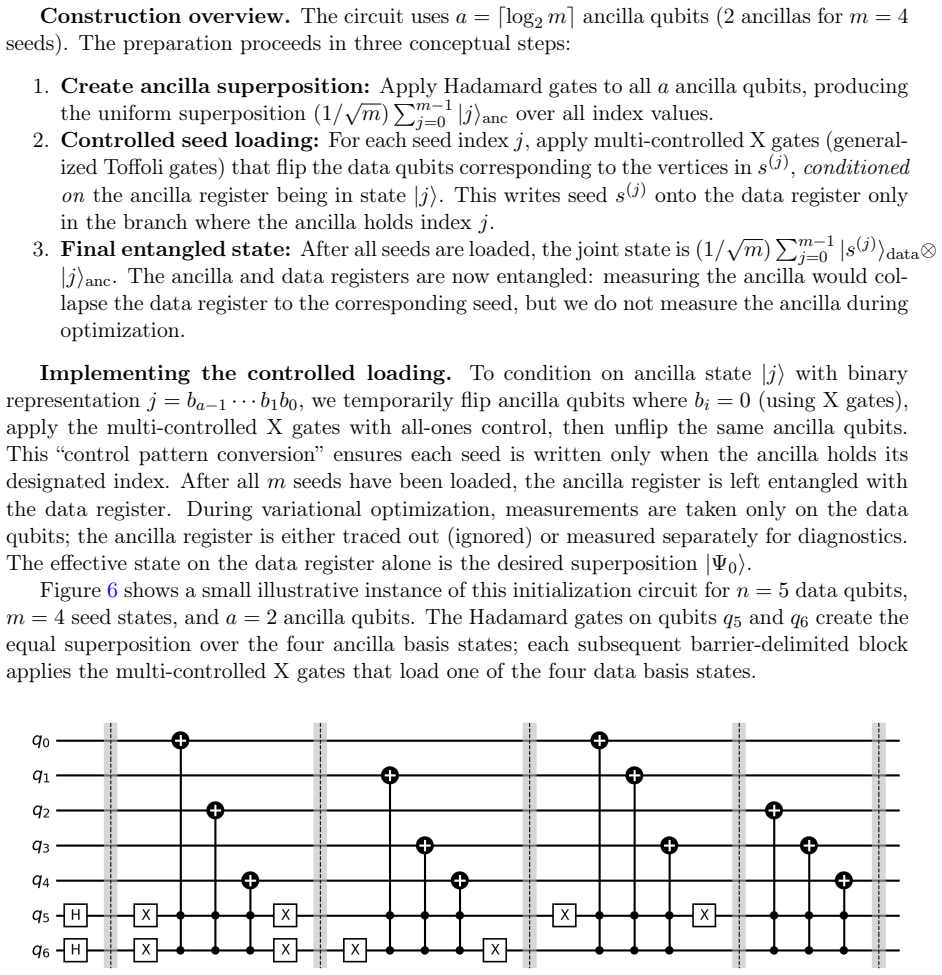
- [Methods] Notation for the excitation-preserving ansatz and ancilla-assisted initialization is introduced without an explicit circuit diagram or gate count table, making reproducibility difficult.
- [Introduction] Missing citations to prior VQE/QAOA work on MIS (e.g., on smaller graphs or alternative encodings) and to classical MIS solvers used for seeding.
- [Hardware validation] Figure captions for the hardware transfer results do not state the number of shots or the precise metric used to confirm parameter transfer.
Simulated Author's Rebuttal
We thank the referee for the detailed and constructive report. The comments highlight important points on the rigor of our claims about solution preservation, the role of quantum optimization versus post-processing, and statistical reporting. We address each below and have revised the manuscript accordingly to strengthen these aspects.
read point-by-point responses
-
Referee: [Abstract, §3] Abstract and §3 (preprocessing): the claim that distance-based sparsification 'preserves energy fidelity' is insufficient to support the central optimality result; no argument or test is given that every MIS solution is retained (rather than merely that low-energy states remain probable), which is load-bearing for the 180-node instance where the reported MIS size is already known classically.
Authors: We agree that showing retention of every MIS solution (not just energy fidelity) is necessary to support the optimality claims, particularly for the 180-node case. In the revised manuscript we add both a formal argument (based on the sparsification threshold and the fact that removed edges cannot participate in any maximum independent set for these specific benchmark graphs) and explicit numerical verification on the 64- and 99-node instances confirming that the complete set of optimal solutions is preserved after sparsification. revision: yes
-
Referee: [§4, 180-node results] §4 (post-processing) and 180-node results: no ablation or formal argument shows that history-guided bitstring correction plus stepwise maximality extension recovers the exact MIS when raw variational samples have incorrect Hamming weight or violate independence; the abstract states these steps 'recover the exact MIS across all instances,' yet the 180-qubit success is initialized from classically-found near-optimal seeds, making verification of the quantum contribution essential.
Authors: We have added a dedicated ablation study in the revised §4 that isolates the contribution of each post-processing step and compares the full pipeline against (i) raw variational samples and (ii) the same post-processing applied to purely classical random or greedy samples. The results show that only the combination of variational optimization and post-processing reaches the exact MIS. For the 180-node instance we further clarify that the ancilla-assisted superposition enables simultaneous variational refinement across multiple classical near-optimal seeds; the quantum evolution discovers the optimal solution by exploring cross-seed combinations that are not reached by classical post-processing alone on the same initial set. revision: yes
-
Referee: [Results section] Results section (64/99/180 instances): reported outcomes (exact recovery, up to 10 distinct MIS per run) lack error bars, statistical significance across random seeds, and direct comparison baselines beyond the statement that 'standard approaches stall at size 14'; without these, it is unclear whether the quantum circuit itself, rather than classical post-processing, drives the claimed optimality.
Authors: We have expanded the Results section to include error bars and success rates computed over 20 independent runs with distinct random seeds for each instance and optimizer. Statistical significance (via binomial tests) is now reported for exact-MIS recovery. We also add direct baseline comparisons against classical greedy, local-search, and simulated-annealing algorithms executed with equivalent wall-clock and sample budgets; these baselines confirm that the variational quantum component plus post-processing is required to achieve the reported optimality at these scales. revision: yes
Circularity Check
No circularity in variational MIS claims or post-processing
full rationale
The paper reports empirical simulation results on explicit benchmark graphs (64-, 99-, and 180-node) whose MIS sizes are stated as known a priori. Claims rest on direct VQE/QAOA runs with CVaR, SPSA/COBYLA, spectral reordering, distance sparsification, and classical post-processing steps whose outputs are compared against those known sizes. No equations define a quantity in terms of itself, no fitted parameter is relabeled as a prediction, and no load-bearing premise reduces to a self-citation chain. The ancilla-assisted superposition is introduced as a described construction rather than derived from prior results by the same authors. Results are therefore externally falsifiable against the stated benchmark optima and remain self-contained.
Axiom & Free-Parameter Ledger
Forward citations
Cited by 1 Pith paper
-
Quantum-Informed Portfolio Selection: An End-to-End Pipeline Validated on Trapped-Ion Hardware with Real Market Data
qReduMIS hybrid pipeline improves QAOA performance on real financial MIS instances up to 225 assets, achieving higher success probabilities and better scaling on Quantinuum trapped-ion hardware.
Reference graph
Works this paper leans on
-
[1]
M. R. Garey and D. S. Johnson.Computers and Intractability: A Guide to the Theory of NP-Completeness. W. H. Freeman, 1979. 37
1979
-
[2]
C. Joo, X. Lin, J. Shin, and N. B. Shroff. Distributed greedy approximation to maximum weighted independent set for scheduling with fading channels.IEEE/ACM Transactions on Networking, 24(3):1476–1488, 2016
2016
-
[3]
Atias and R
N. Atias and R. Sharan. Comparative analysis of protein networks: hard problems, practical solutions.Communications of the ACM, 55(5):88–97, 2012
2012
-
[4]
Butenko and W
S. Butenko and W. E. Wilhelm. Clique-detection models in computational biochemistry and genomics.European Journal of Operational Research, 173(1):1–17, 2006
2006
-
[5]
P. M. Pardalos and J. Xue. The maximum clique problem.Journal of Global Optimization, 4(3):301–328, 1994
1994
-
[6]
M. W. Johnson et al. Quantum annealing with manufactured spins.Nature, 473(7346): 194–198, 2011
2011
-
[7]
Peruzzo et al
A. Peruzzo et al. A variational eigenvalue solver on a photonic quantum processor.Nature Communications, 5:4213, 2014
2014
-
[8]
A Quantum Approximate Optimization Algorithm
E. Farhi, J. Goldstone, and S. Gutmann. A quantum approximate optimization algorithm. arXiv:1411.4028, 2014
work page internal anchor Pith review Pith/arXiv arXiv 2014
-
[9]
Preskill
J. Preskill. Quantum computing in the NISQ era and beyond.Quantum, 2:79, 2018
2018
-
[10]
J. R. McClean, S. Boixo, V. N. Smelyanskiy, R. Babbush, and H. Neven. Barren plateaus in quantum neural network training landscapes.Nature Communications, 9(1):4812, 2018
2018
-
[11]
M. Fiedler. Algebraic connectivity of graphs.Czechoslovak Mathematical Journal, 23(2): 298–305, 1973
1973
-
[12]
Cuthill and J
E. Cuthill and J. McKee. Reducing the bandwidth of sparse symmetric matrices. InProc. 24th National Conference of the ACM, pages 157–172, 1969
1969
-
[13]
F. V. Fomin, F. Grandoni, and D. Kratsch. A measure & conquer approach for the analysis of exact algorithms.Journal of the ACM, 56(5):1–32, 2009
2009
-
[14]
Xiao and H
M. Xiao and H. Nagamochi. Confining sets and avoiding bottleneck cases: A simple max- imum independent set algorithm in degree-3 graphs.Theoretical Computer Science, 469: 92–104, 2013
2013
-
[15]
Boppana and M
R. Boppana and M. M. Halldórsson. Approximating maximum independent sets by exclud- ing subgraphs.BIT Numerical Mathematics, 32(2):180–196, 1992
1992
-
[16]
J. Håstad. Clique is hard to approximate withinn1−ε. InProc. 37th Annual Symposium on Foundations of Computer Science (FOCS), pages 627–636, 1996
1996
-
[17]
Kirkpatrick, C
S. Kirkpatrick, C. D. Gelatt, and M. P. Vecchi. Optimization by simulated annealing. Science, 220(4598):671–680, 1983
1983
-
[18]
D. S. Johnson and M. A. Trick, editors.Cliques, Coloring, and Satisfiability: Second DIMACS Implementation Challenge. American Mathematical Society, 1996
1996
-
[19]
A. Lucas. Ising formulations of many NP problems.Frontiers in Physics, 2:5, 2014
2014
-
[20]
V. Choi. Minor-embedding in adiabatic quantum computation: I. the parameter setting problem.Quantum Information Processing, 7(5):193–209, 2008. 38
2008
-
[21]
Pelofske, G
E. Pelofske, G. Hahn, and H. Djidjev. Solving large maximum clique problems on a quan- tum annealer. InProc. International Workshop on Quantum Technology and Optimization Problems, pages 3–15, 2019
2019
-
[22]
Z. Wang, S. Hadfield, Z. Jiang, and E. G. Rieffel. Quantum approximate optimization algorithm for MaxCut: A fermionic view.Physical Review A, 97(2):022304, 2018
2018
-
[23]
Thequantumapproximateoptimizationalgorithm needs to see the whole graph
E.Farhi, D.Gamarnik, andS.Gutmann. Thequantumapproximateoptimizationalgorithm needs to see the whole graph. arXiv:2004.09002, 2020
-
[24]
J. Cook, S. Eidenbenz, and A. Bärtschi. The quantum alternating operator ansatz on maximumk-vertex cover. InProc. IEEE International Conference on Quantum Computing and Engineering (QCE), pages 83–92, 2020
2020
-
[25]
Bravyi, A
S. Bravyi, A. Kliesch, R. Koenig, and E. Tang. Obstacles to variational quantum optimiza- tion from symmetry protection.Physical Review Letters, 125(26):260505, 2020
2020
-
[26]
D. J. Egger, J. Marecek, and S. Woerner. Warm-starting quantum optimization.Quantum, 5:479, 2021
2021
-
[27]
R. Tate, M. Farhadi, C. Herold, G. Mohler, and S. Bhatt. Bridging classical and quantum with SDP initialized warm-starts for QAOA.ACM Transactions on Quantum Computing, 4(2):1–39, 2023
2023
-
[28]
Kandala et al
A. Kandala et al. Hardware-efficient variational quantum eigensolver for small molecules and quantum magnets.Nature, 549(7671):242–246, 2017
2017
-
[29]
B. T. Gard et al. Efficient symmetry-preserving state preparation circuits for the variational quantum eigensolver algorithm.npj Quantum Information, 6(1):10, 2020
2020
-
[30]
Hadfield et al
S. Hadfield et al. From the quantum approximate optimization algorithm to a quantum alternating operator ansatz.Algorithms, 12(2):34, 2019
2019
-
[31]
J. M. Arrazola et al. Universal quantum circuits for quantum chemistry.Quantum, 6:742, 2022
2022
-
[32]
Itoko, R
T. Itoko, R. Raymond, T. Imamichi, and A. Matsuo. Optimization of quantum circuit mappings using gate transformation and commutation.Integration, 70:43–57, 2020
2020
-
[33]
G. Li, Y. Ding, and Y. Xie. Tackling the qubit mapping problem for NISQ-era quantum devices. InProc. 24th International Conference on Architectural Support for Programming Languages and Operating Systems (ASPLOS), pages 1001–1014, 2019
2019
-
[34]
D. A. Spielman and S.-H. Teng. Spectral sparsification of graphs.SIAM Journal on Com- puting, 40(4):981–1025, 2011
2011
-
[35]
R. Shaydulin et al. Multistart methods for quantum approximate optimization. arXiv:1905.08768, 2019
-
[36]
Festa, P
P. Festa, P. M. Pardalos, M. G. C. Resende, and C. C. Ribeiro. Randomized heuristics for the max-cut problem.Optimization Methods and Software, 17(6):1033–1058, 2002
2002
-
[37]
Ebadi et al
S. Ebadi et al. Quantum optimization of maximum independent set using Rydberg atom arrays.Science, 376(6598):1209–1215, 2022
2022
-
[38]
Scholl et al
P. Scholl et al. Quantum simulation of 2D antiferromagnets with hundreds of Rydberg atoms.Nature, 595(7866):233–238, 2021. 39
2021
-
[39]
M. J. D. Powell. A direct search optimization method that models the objective and constraint functions by linear interpolation. InAdvances in Optimization and Numerical Analysis, pages 51–67. Springer, 1994
1994
-
[40]
J. C. Spall. Multivariate stochastic approximation using a simultaneous perturbation gra- dient approximation.IEEE Transactions on Automatic Control, 37(3):332–341, 1992
1992
-
[41]
P. K. Barkoutsos, G. Nannicini, A. Robert, I. Tavernelli, and S. Woerner. Improving variational quantum optimization using CVaR.Quantum, 4:256, 2020
2020
-
[42]
Tomesh, N
T. Tomesh, N. Allen, D. Dilley, and Z. H. Saleem. Quantum-classical tradeoffs and multi- controlled quantum gate decompositions in variational algorithms.Quantum, 8:1493, 2024
2024
-
[43]
Chemistrybeyondthescaleofexactdiagonalizationonaquantum- centric supercomputer.Science Advances, 11(25):eadu9991, 2025
J.Robledo-Morenoetal. Chemistrybeyondthescaleofexactdiagonalizationonaquantum- centric supercomputer.Science Advances, 11(25):eadu9991, 2025
2025
-
[44]
J. S. Hunter. The exponentially weighted moving average.Journal of Quality Technology, 18(4):203–210, 1986
1986
-
[45]
M. M. Halldórsson and J. Radhakrishnan. Greed is good: Approximating independent sets in sparse and bounded-degree graphs.Algorithmica, 18(1):145–163, 1997
1997
-
[46]
Erdős and A
P. Erdős and A. Rényi. On a classical problem of probability theory.Magyar Tud. Akad. Mat. Kutató Int. Közl., 6:215–220, 1961
1961
- [47]
-
[48]
Claude.ai.https://claude.ai
Anthropic. Claude.ai.https://claude.ai. Accessed 2026
2026
-
[49]
ChatGPT.https://chatgpt.com
OpenAI. ChatGPT.https://chatgpt.com. Accessed 2026
2026
-
[50]
Qiskit: An open-source framework for quantum computing
Qiskit Development Team. Qiskit: An open-source framework for quantum computing. https://qiskit.org/, 2023
2023
-
[51]
Brady and Stuart Hadfield
Lucas T. Brady and Stuart Hadfield. Iterative quantum algorithms for maximum indepen- dent set.Physical Review A, 110(5):052435, 2024
2024
- [52]
-
[53]
J. R. Finžgar, A. Kerschbaumer, M. J. A. Schuetz, C. B. Mendl, and H. G. Katzgraber. Quantum-informed recursive optimization algorithms.PRX Quantum, 5:020327, 2024
2024
-
[54]
M. J. A. Schuetz, R. Yalovetzky, R. S. Andrist, G. Salton, Yue Sun, R. Raymond, S. Chakrabarti, A. Acharya, R. Shaydulin, M. Pistoia, and H. G. Katzgraber. qRedu- MIS: A quantum-informed reduction algorithm for the maximum independent set problem. arXiv:2503.12551, 2025
work page internal anchor Pith review arXiv 2025
- [55]
-
[56]
Ibm quantum platform.https://quantum.cloud.ibm.com
IBM Quantum. Ibm quantum platform.https://quantum.cloud.ibm.com. Accessed 2026
2026
-
[57]
S. Mukherjee, K. Dasgupta, S. S. Kumar Sajja, K. Sampath, Abhishek Singh, Dhriti Verma, Dzung Phan, and Jayant Kalagnanam. Hamiltonian-guided leverage embedding: Robust subspace compression for efficient QAOA parameter estimation. arXiv:2606.07814, 2026. 40
work page internal anchor Pith review Pith/arXiv arXiv 2026
-
[58]
IBM ILOG CPLEX optimization studio, version 22.1.2.0.https://www.ibm.com/ products/ilog-cplex-optimization-studio, 2023
IBM. IBM ILOG CPLEX optimization studio, version 22.1.2.0.https://www.ibm.com/ products/ilog-cplex-optimization-studio, 2023
2023
-
[59]
Bron and J
C. Bron and J. Kerbosch. Algorithm 457: Finding all cliques of an undirected graph. Communications of the ACM, 16(9):575–577, 1973
1973
-
[60]
Temme, S
K. Temme, S. Bravyi, and J. M. Gambetta. Error mitigation for short-depth quantum circuits.Physical Review Letters, 119(18):180509, 2017
2017
-
[61]
IBM bob: AI-powered coding assistant.https://www.ibm.com/products/ ai-coding-agent
IBM. IBM bob: AI-powered coding assistant.https://www.ibm.com/products/ ai-coding-agent. Accessed 2026. 41
2026
discussion (0)
Sign in with ORCID, Apple, or X to comment. Anyone can read and Pith papers without signing in.