Ab initio α-α scattering with high-fidelity chiral interactions
Pith reviewed 2026-06-30 08:09 UTC · model grok-4.3
The pith
Alpha-alpha scattering phase shifts match empirical data in the first ab initio calculation with a high-fidelity chiral interaction on a fine lattice.
A machine-rendered reading of the paper's core claim, the machinery that carries it, and where it could break.
Core claim
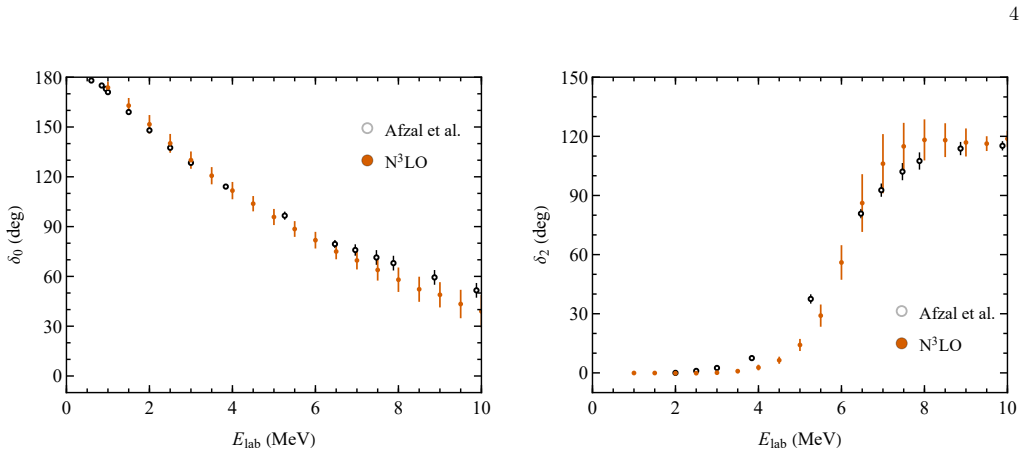
We present the first calculation of low-energy α-α scattering using the high-fidelity N3LO chiral NLEFT interaction on a fine lattice. Wave function matching and the adiabatic projection method are used; the severely ill-conditioned two-cluster norm matrix is inverted stably via Tikhonov regularization extrapolated to vanishing regulator strength and cross-checked with truncated singular-value decomposition. The extracted S- and D-wave phase shifts agree with empirical analyses, thereby extending validation of the interaction from bound states and charge radii to scattering observables.
What carries the argument
Adiabatic projection method on a fine lattice with Tikhonov regularization and extrapolation applied to the two-cluster norm matrix.
If this is right
- Validation of the chiral interaction now covers scattering observables in addition to bound states and radii.
- Ab initio nuclear reactions become feasible on fine lattices for light systems.
- The same regularization technique can be applied to other two-cluster scattering problems on fine lattices.
- The method supplies a practical route to reaction rates relevant to astrophysical helium burning.
Where Pith is reading between the lines
- The regularization procedure may generalize to other lattice calculations where fine spacing produces ill-conditioned overlap matrices.
- Agreement between phase shifts and data suggests the interaction accurately describes both discrete and continuum states, which could improve predictions for few-body reaction cross sections.
- Extension to three-cluster systems would test whether the same numerical strategy remains stable when the norm matrix dimension grows further.
Load-bearing premise
Tikhonov regularization followed by extrapolation of the regulator to zero strength recovers the correct physical phase shifts from the severely ill-conditioned two-cluster norm matrix.
What would settle it
An independent calculation of the same S- and D-wave phase shifts that employs a different regularization scheme or a coarser lattice and obtains statistically different results would falsify the recovery of physical scattering data.
Figures
read the original abstract
Low-energy $\alpha$-$\alpha$ scattering underlies stellar helium burning and sharply tests nuclear forces in the reaction regime. We present its first calculation using the high-fidelity N3LO chiral NLEFT interaction, incorporated through wave function matching, on a fine lattice, using the adiabatic projection method. On the fine lattice, the two-cluster norm matrix becomes severely ill-conditioned, and its direct inversion is unstable. We address this with Tikhonov regularization, extrapolating the regulator to zero, and confirm the result with an independent truncated singular-value decomposition. The S- and D-wave phase shifts agree with empirical analyses, extending the validation of this interaction from bound states and charge radii to scattering and providing a practical route to ab initio nuclear reactions on fine lattices
Editorial analysis
A structured set of objections, weighed in public.
Referee Report
Summary. The manuscript reports the first ab initio calculation of low-energy α-α scattering using the high-fidelity N3LO chiral NLEFT interaction via wave function matching and the adiabatic projection method on a fine lattice. The severely ill-conditioned two-cluster norm matrix is stabilized using Tikhonov regularization with extrapolation of the regulator strength to zero, cross-checked by truncated SVD. The resulting S- and D-wave phase shifts are reported to agree with empirical analyses, extending validation of the interaction to scattering observables.
Significance. If the regularization and extrapolation procedure is robust, this work provides a practical route to ab initio nuclear reactions on fine lattices and extends validation of the chiral interaction from bound states and charge radii to the reaction regime, which is relevant for stellar helium burning.
major comments (1)
- [Abstract] Abstract: the central numerical step—Tikhonov regularization followed by extrapolation of the regulator to zero strength—is load-bearing for the extracted phase shifts, yet no information is provided on the functional form of the extrapolation, the range of regulator values, or quantitative convergence diagnostics (e.g., stability of the extrapolated limit or comparison to unregularized results in the physical subspace). This leaves open the possibility of residual bias or truncation artifacts in the reported S- and D-wave phase shifts.
minor comments (2)
- The abstract states that the phase shifts 'agree with empirical analyses' but provides no quantitative measures (e.g., error bars, χ² values, or specific references to the empirical data sets used for comparison).
- No lattice parameters (spacing, volume, or number of sites) or interaction details beyond the N3LO label are mentioned in the abstract, which would aid assessment of the computational setup.
Simulated Author's Rebuttal
We thank the referee for the careful reading and constructive feedback. The single major comment concerns the level of detail provided on the Tikhonov regularization and extrapolation procedure. We address this point below and will revise the manuscript accordingly.
read point-by-point responses
-
Referee: [Abstract] Abstract: the central numerical step—Tikhonov regularization followed by extrapolation of the regulator to zero strength—is load-bearing for the extracted phase shifts, yet no information is provided on the functional form of the extrapolation, the range of regulator values, or quantitative convergence diagnostics (e.g., stability of the extrapolated limit or comparison to unregularized results in the physical subspace). This leaves open the possibility of residual bias or truncation artifacts in the reported S- and D-wave phase shifts.
Authors: We agree that the abstract is too concise on this central technical step. The body of the manuscript (Section III and Appendix B) describes the Tikhonov procedure, the linear extrapolation in regulator strength λ, the range λ ∈ [10^{-6}, 10^{-3}], and the stability diagnostics, together with the truncated-SVD cross-check. However, these details are not summarized in the abstract. We will revise the abstract to state the functional form of the extrapolation, the regulator range employed, and the quantitative convergence tests performed. We will also add a brief statement that the extrapolated phase shifts remain stable within the quoted uncertainties and agree with the SVD results in the physical subspace. These changes will be made in the revised manuscript. revision: yes
Circularity Check
No circularity; direct numerical computation validated externally
full rationale
The paper computes α-α phase shifts via adiabatic projection on a fine lattice using a pre-existing N3LO chiral interaction (input), wave-function matching, and Tikhonov regularization plus SVD for the ill-conditioned norm matrix. The reported S- and D-wave results are then compared to independent empirical phase-shift analyses. No equation reduces to its own input by construction, no fitted parameter is relabeled as a prediction, and no load-bearing premise rests solely on self-citation chains. The regularization step is a standard numerical stabilizer whose validity is cross-checked within the paper and against external data; the derivation chain therefore remains self-contained against external benchmarks.
Axiom & Free-Parameter Ledger
Forward citations
Cited by 1 Pith paper
-
Elastic deuteron-deuteron scattering within Nuclear Lattice Effective Field Theory
Nuclear lattice EFT calculation of 5S2 dd scattering yields scattering length 12.96 fm and effective range 3.62 fm, larger than prior results and indicating stronger repulsion.
Reference graph
Works this paper leans on
-
[1]
Hoyle, On nuclear reactions occurring in very hot stars
F. Hoyle, On nuclear reactions occurring in very hot stars. i. the synthesis of elements from carbon to nickel, Astrophysical Journal Supplement Series1, 121 (1954)
1954
-
[2]
E. M. Burbidge, G. R. Burbidge, W. A. Fowler, and F. Hoyle, Synthesis of the elements in stars, Reviews of Modern Physics29, 547 (1957)
1957
-
[3]
W. A. Fowler, Experimental and theoretical nuclear as- trophysics: The quest for the origin of the elements, Re- views of Modern Physics56, 149 (1984)
1984
-
[4]
Freer and H
M. Freer and H. O. U. Fynbo, The hoyle state in 12c, Progress in Particle and Nuclear Physics78, 1 (2014)
2014
-
[5]
Freer, H
M. Freer, H. Horiuchi, Y. Kanada-En’yo, D. Lee, and U.- G. Meißner, Microscopic clustering in light nuclei, Rev. Mod. Phys.90, 035004 (2018)
2018
-
[6]
S. A. Afzal, A. A. Z. Ahmad, and S. Ali, Systematic survey of theα-αinteraction, Rev. Mod. Phys.41, 247 (1969). 6
1969
-
[7]
Elhatisari, N
S. Elhatisari, N. Li, A. Rokash, J. M. Alarc´ on, D. Du, N. Klein, B.-N. Lu, U.-G. Meißner, E. Epelbaum, H. Krebs, T. A. L¨ ahde, D. Lee, and G. Rupak, Nuclear binding near a quantum phase transition, Phys. Rev. Lett.117, 132501 (2016)
2016
-
[8]
Lazauskas, Solution of then- 4he elastic scattering problem using the faddeev-yakubovsky equations, Phys
R. Lazauskas, Solution of then- 4he elastic scattering problem using the faddeev-yakubovsky equations, Phys. Rev. C97, 044002 (2018)
2018
-
[9]
Lazauskas and J
R. Lazauskas and J. Carbonell, Description of four- and five-nucleon systems by solving faddeev-yakubovsky equations in configuration space, Front. Phys.7, 251 (2020)
2020
-
[10]
Kievsky, S
A. Kievsky, S. Rosati, M. Viviani, L. E. Marcucci, and L. Girlanda, A high-precision variational approach to three- and four-nucleon bound and zero-energy scattering states, J. Phys. G: Nucl. Part. Phys.35, 063101 (2008)
2008
-
[11]
L. E. Marcucci, J. Dohet-Eraly, L. Girlanda, A. Gnech, A. Kievsky, and M. Viviani, The hyperspherical harmon- ics method: A tool for testing and improving nuclear interaction models, Front. Phys.8, 69 (2020)
2020
-
[12]
Carlson, S
J. Carlson, S. Gandolfi, F. Pederiva, S. C. Pieper, R. Schi- avilla, K. E. Schmidt, and R. B. Wiringa, Quantum monte carlo methods for nuclear physics, Rev. Mod. Phys.87, 1067 (2015)
2015
-
[13]
K. M. Nollett, S. C. Pieper, R. B. Wiringa, J. Carlson, and G. M. Hale, Quantum monte carlo calculations of neutron-αscattering, Phys. Rev. Lett.99, 022502 (2007)
2007
-
[14]
R. B. Wiringa, S. C. Pieper, J. Carlson, and V. R. Pand- haripande, Quantum monte carlo calculations ofa= 8 nuclei, Phys. Rev. C62, 014001 (2000)
2000
-
[15]
Quaglioni and P
S. Quaglioni and P. Navr´ atil, Ab initio many-body cal- culations ofn- 3h,n- 4he,p- 3,4he, andn- 10be scattering, Phys. Rev. Lett.101, 092501 (2008)
2008
-
[16]
Baroni, P
S. Baroni, P. Navr´ atil, and S. Quaglioni, Ab initio de- scription of the exotic unbound 7he nucleus, Phys. Rev. Lett.110, 022505 (2013)
2013
-
[17]
Navr´ atil, S
P. Navr´ atil, S. Quaglioni, G. Hupin, C. Romero-Redondo, and A. Calci, Unified ab initio approaches to nuclear structure and reactions, Phys. Scr.91, 053002 (2016)
2016
-
[18]
Hebborn, G
C. Hebborn, G. Hupin, K. Kravvaris, S. Quaglioni, P. Navr´ atil, and P. Gysbers, Ab initio prediction of the 4He(d, γ)6Li big bang radiative capture, Phys. Rev. Lett. 129, 042503 (2022)
2022
-
[19]
Kravvaris, S
K. Kravvaris, S. Quaglioni, G. Hupin, and P. Navr´ atil, Ab initio framework for nuclear scattering and reactions in- duced by light projectiles, Physics Letters B856, 138930 (2024)
2024
-
[20]
Hagen and N
G. Hagen and N. Michel, Elastic proton scattering of medium mass nuclei from coupled-cluster theory, Phys. Rev. C86, 021602 (2012)
2012
-
[21]
M. Pine, D. Lee, and G. Rupak, Adiabatic projection method for scattering and reactions on the lattice, Eur. Phys. J. A49, 151 (2013)
2013
-
[22]
Elhatisari and D
S. Elhatisari and D. Lee, Fermion-dimer scattering us- ing an impurity lattice monte carlo approach and the adiabatic projection method, Phys. Rev. C90, 064001 (2014)
2014
-
[23]
Elhatisari, D
S. Elhatisari, D. Lee, G. Rupak, E. Epelbaum, H. Krebs, T. A. L¨ ahde, T. Luu, and U.-G. Meißner, Ab initio alpha- alpha scattering, Nature528, 111 (2015)
2015
-
[24]
S. Elhatisari, T. A. L¨ ahde, D. Lee, U.-G. Meißner, and T. Vonk, Alpha-alpha scattering in the Multiverse, JHEP 02(2022), 001, arXiv:2112.09409 [nucl-th]
-
[25]
Elhatisari, L
S. Elhatisari, L. Bovermann, Y.-Z. Ma, E. Epelbaum, D. Frame, F. Hildenbrand, M. Kim, Y. Kim, H. Krebs, T. A. L¨ ahde, D. Lee, N. Li, B.-N. Lu, U.-G. Meißner, G. Rupak, S. Shen, and H. Yu, Wavefunction matching for solving quantum many-body problems, Nature630, 59 (2024)
2024
-
[26]
B.-N. Lu, T. A. L¨ ahde, D. Lee, and U.-G. Meißner, Breaking and restoration of rotational symmetry for ir- reducible tensor operators on the lattice, Phys. Rev. D 92, 014506 (2015), arXiv:1504.01685 [nucl-th]
work page internal anchor Pith review Pith/arXiv arXiv 2015
-
[27]
S. Shen, S. Elhatisari, D. Lee, U.-G. Meißner, and Z. Ren, Ab initio study of the beryllium isotopes 7be to 12be, Phys. Rev. Lett.134, 162503 (2025)
2025
-
[28]
Y.-Z. Ma, Z. Lin, B.-N. Lu, S. Elhatisari, D. Lee, N. Li, U.-G. Meißner, A. W. Steiner, and Q. Wang, Structure Factors for Hot Neutron Matter from Ab Initio Lattice Simulations with High-Fidelity Chiral Interactions, Phys. Rev. Lett.132, 232502 (2024), arXiv:2306.04500 [nucl- th]
-
[29]
Elhatisari, F
S. Elhatisari, F. Hildenbrand, and U.-G. Meißner, Ab ini- tio lattice study of neutron–alpha scattering with chiral forces at n3lo, Journal of Physics G: Nuclear and Particle Physics52, 125102 (2025)
2025
-
[30]
Carlson, V
J. Carlson, V. R. Pandharipande, and R. B. Wiringa, Variational calculations of resonant states in 4He, Nucl. Phys. A424, 47 (1984)
1984
-
[31]
Borasoy, E
B. Borasoy, E. Epelbaum, H. Krebs, D. Lee, and U.-G. Meißner, Two-particle scattering on the lattice: Phase shifts, spin-orbit coupling, and mixing angles, Eur. Phys. J. A34, 185 (2007), [Erratum: Eur. Phys. J. A 35, 343 (2008)]
2007
-
[32]
Lee, Lattice simulations for few- and many-body sys- tems, Prog
D. Lee, Lattice simulations for few- and many-body sys- tems, Prog. Part. Nucl. Phys.63, 117 (2009)
2009
-
[33]
T. A. L¨ ahde and U.-G. Meißner,Nuclear Lattice Effective Field Theory: An Introduction, Lect. Notes Phys., Vol. 957 (Springer, Cham, 2019)
2019
-
[34]
Lee, Lattice effective field theory simulations of nuclei, Annu
D. Lee, Lattice effective field theory simulations of nuclei, Annu. Rev. Nucl. Part. Sci.75, 109 (2025)
2025
-
[35]
Epelbaum, H
E. Epelbaum, H. Krebs, D. Lee, and U.-G. Meißner, Ab initio calculation of the hoyle state, Phys. Rev. Lett.106, 192501 (2011)
2011
-
[36]
Epelbaum, H
E. Epelbaum, H. Krebs, T. A. L¨ ahde, D. Lee, and U.- G. Meißner, Structure and rotations of the hoyle state, Phys. Rev. Lett.109, 252501 (2012)
2012
-
[37]
N. Li, S. Elhatisari, E. Epelbaum, D. Lee, B.-N. Lu, and U.-G. Meißner, Neutron-proton scattering with lat- tice chiral effective field theory at next-to-next-to-next- to-leading order, Phys. Rev. C98, 044002 (2018)
2018
-
[38]
J. M. Alarc´ on, D. Du, N. Klein, T. A. L¨ ahde, D. Lee, N. Li, B.-N. Lu, T. Luu, and U.-G. Meißner, Neutron- proton scattering at next-to-next-to-leading order in nu- clear lattice effective field theory, Eur. Phys. J. A53, 83 (2017)
2017
-
[39]
B.-N. Lu, N. Li, S. Elhatisari, D. Lee, E. Epelbaum, and U.-G. Meißner, Essential elements for nuclear binding, Phys. Lett. B797, 134863 (2019)
2019
-
[40]
See Supplemental Material for details on the lattice setup, the APM, the different ways of regularizing the norm matrices, the comparison of the results using the two regularizations and the Euclidean time extrapola- tion
-
[41]
Nucleon-deuteron scattering using the adiabatic projection method
S. Elhatisari, D. Lee, U.-G. Meißner, and G. Ru- pak, Nucleon-deuteron scattering using the adiabatic projection method, Eur. Phys. J. A52, 174 (2016), arXiv:1603.02333 [nucl-th]. 7
work page internal anchor Pith review Pith/arXiv arXiv 2016
-
[42]
B.-N. Lu, T. A. L¨ ahde, D. Lee, and U.-G. Meißner, Pre- cise determination of lattice phase shifts and mixing an- gles, Phys. Lett. B760, 309 (2016)
2016
-
[43]
A. N. Tikhonov and V. Y. Arsenin,Solutions of Ill-Posed Problems(Winston & Sons, Washington, D.C., 1977)
1977
-
[44]
P. C. Hansen,Rank-Deficient and Discrete Ill-Posed Problems: Numerical Aspects of Linear Inversion (SIAM, Philadelphia, 1998)
1998
-
[45]
H. A. Bethe, Theory of the effective range in nuclear scattering, Phys. Rev.76, 38 (1949)
1949
- [46]
-
[47]
high-fidelity
H. Meyeret al., in preparation. 8 Supplemental Material: Ab initioα–αscattering with high-fidelity chiral interactions This Supplemental Material collects the technical details underlying the Letter: the interaction and lattice setup (Sec. S1), the construction of the two-cluster basis and the two-step adiabatic Hamiltonian (Sec. S2), the Tikhonov λ→0 ext...
-
[48]
2. 4. 6. 8. 10. 12. 0. 30. 60. 90. 120. 150. 180. Elab (MeV) δ0 (deg) i = 5
-
[49]
2. 4. 6. 8. 10. 12. Elab (MeV) i = 6
-
[50]
2. 4. 6. 8. 10. 12. Elab (MeV) i = 7
-
[51]
2. 4. 6. 8. 10. 12. Elab (MeV) i = 8 Afzal et al. Matching 6 Matching 7 Matching 8 FIG. S3:S-waveα–αphase shiftδ 0 versus laboratory energyE lab for eight choices of the Tikhonov regularization dimension (panelsi= 1–8, whereλtimes ani-dimensional identity is added to the smallest norm eigenvalues). Within each panel, the colored points embed anm×mblock of...
-
[52]
2. 4. 6. 8. 10. 12. 0. 30. 60. 90. 120. 150. 180. Elab (MeV) δ0 (deg) Truncate at 5
-
[53]
2. 4. 6. 8. 10. 12. Elab (MeV) Truncate at 6
-
[54]
2. 4. 6. 8. 10. 12. Elab (MeV) Truncate at 7 Afzal et al. Matching 6 Matching 7 Matching 8 FIG. S5:S-wave phase shiftδ 0 versusE lab for six choices of the TSVD truncation dimensioni. S5. Euclidean-time extrapolation We compute the adiabatic Hamiltonian for theS- andD-wave channels at Euclidean-time projectionsL t = 20,30,40,50,and 60 (lattice units). Aft...
-
[55]
2. 4. 6. 8. 10. 30. 60. 90. 120. 150. 180. Elab (MeV) δ0 (deg) FIG. S7:S-waveα–αphase shift from the Tikhonov (filled circles) and truncated-SVD (filled squares) regularizations, compared with the empirical analysis [6] (open circles). The two agree within jackknife uncertainties. The lattice series are offset slightly in energy for visibility. point is e...
-
[56]
2. 4. 6. 8. 10.0. 30. 60. 90. 120. 150. Elab (MeV) δ0 (deg) FIG. S8: As in Fig. S7 for theD-wave. 172. 174. 176. Elab = 1 MeV 150. 155. Elab = 2 MeV 125. 130. 135. Elab = 3 MeV 100. 102. 104. 106. 108. 110. Elab = 4.5 MeV
-
[57]
30. 40. 50. 60. 85. 90. 95. Elab = 5.5 MeV
-
[58]
30. 40. 50. 60. 70. 75. 80. Elab = 6.5 MeV
-
[59]
30. 40. 50. 60. 45. 50. 55. 60. Elab = 8.5 MeV
-
[60]
30. 40. 50. 60. 30. 35. 40. 45. 50. Elab = 10 MeV Lt (lattice units) δ0 (deg) lattice data fit Extrapolation error Total error FIG. S9:L t → ∞extrapolation of theS-wave phase shiftδ 0 at eight laboratory energies. Points are the lattice results atL t = 20–60, error bars are the 1σMC uncertainty. The solid curve is the fitδ 0(Lt) =δ ∞ +a e −dE Lt and the d...
-
[61]
30. 40. 50. 60. 10. 20. 30. 40. Elab = 5.5 MeV
-
[62]
30. 40. 50. 60. 40. 60. 80. 100. 120. Elab = 6.5 MeV
-
[63]
30. 40. 50. 60. 100. 110. 120. 130. Elab = 8.5 MeV
-
[64]
30. 40. 50. 60. 105. 110. 115. 120. Elab = 10 MeV Lt (lattice units) δ2 (deg) lattice data fit Extrapolation error Total error FIG. S10: As in Fig. S9, for theD-wave phase shiftδ 2, fittingδ 2(Lt) =δ ∞ +a e −dE Lt
discussion (0)
Sign in with ORCID, Apple, or X to comment. Anyone can read and Pith papers without signing in.