REVIEW 2 major objections 3 cited by
A high optical depth to reionization produces the first 2σ detection of positive neutrino mass in standard ΛCDM while reconciling all major dataset tensions.
Reviewed by Pith at T0; open to challenge. T0 means a machine referee read the full paper against a public rubric. the ladder, T0–T4 →
T0 review · grok-4.3
2026-07-01 01:09 UTC pith:6WDC2QU6
load-bearing objection The claimed 2σ neutrino mass detection is produced by choosing the τ prior specifically to force positive mass and DESI H0 agreement. the 2 major comments →
Cosmological Concordance in an Especially Opaque Universe: A Tentative Cosmological Detection of Physical Neutrino Mass in ΛCDM
The pith
A machine-rendered reading of the paper's core claim, the machinery that carries it, and where it could break.
Core claim
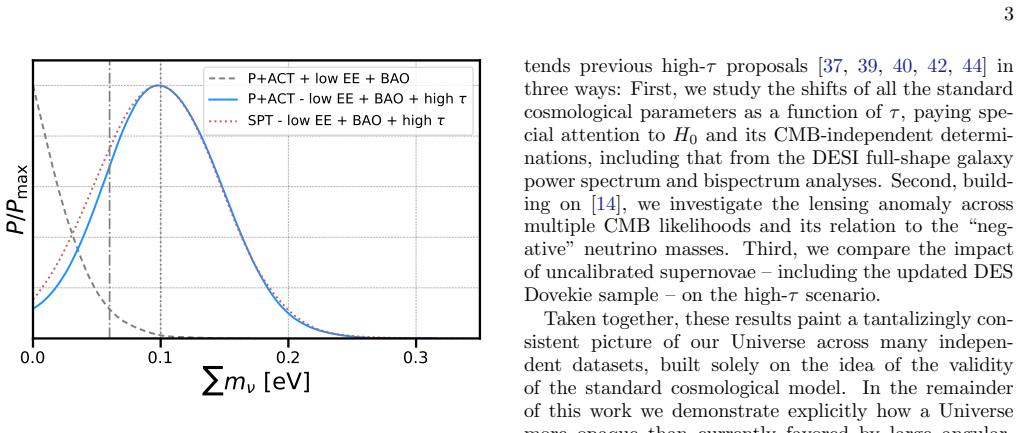
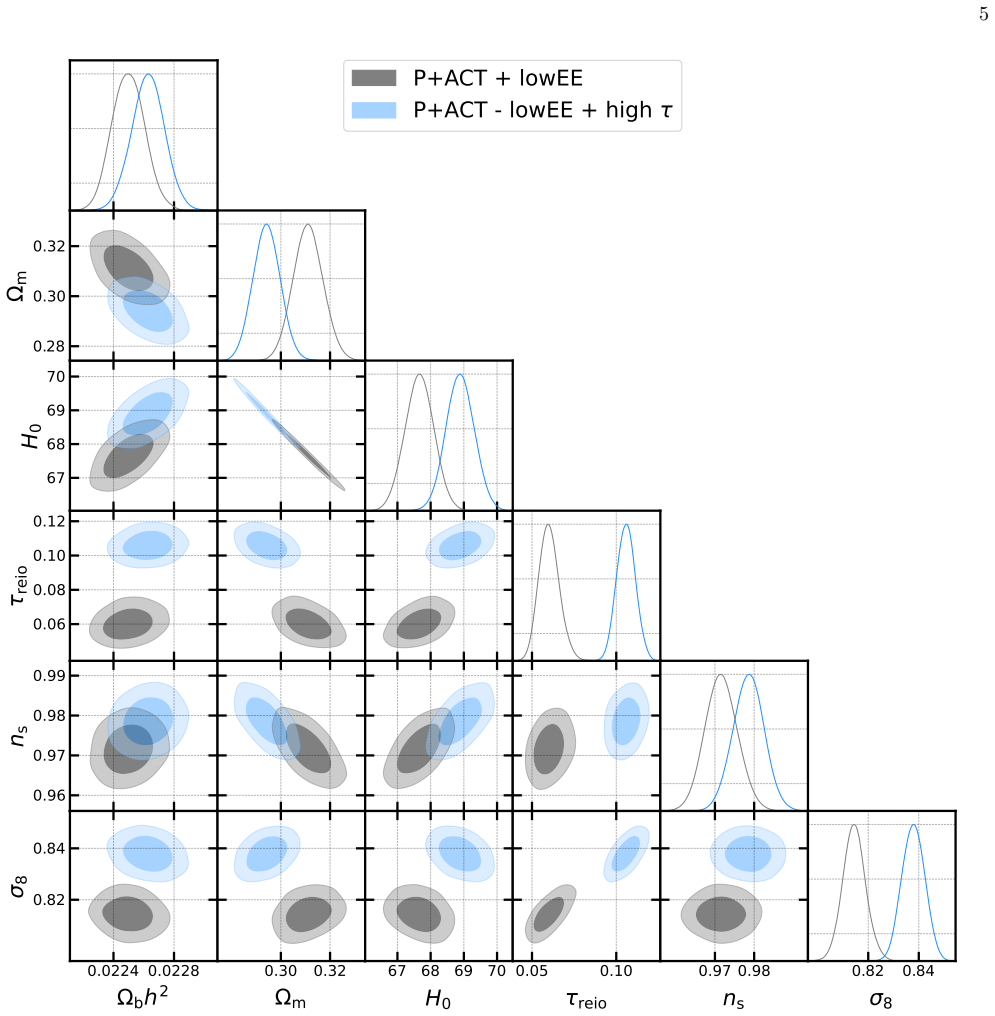
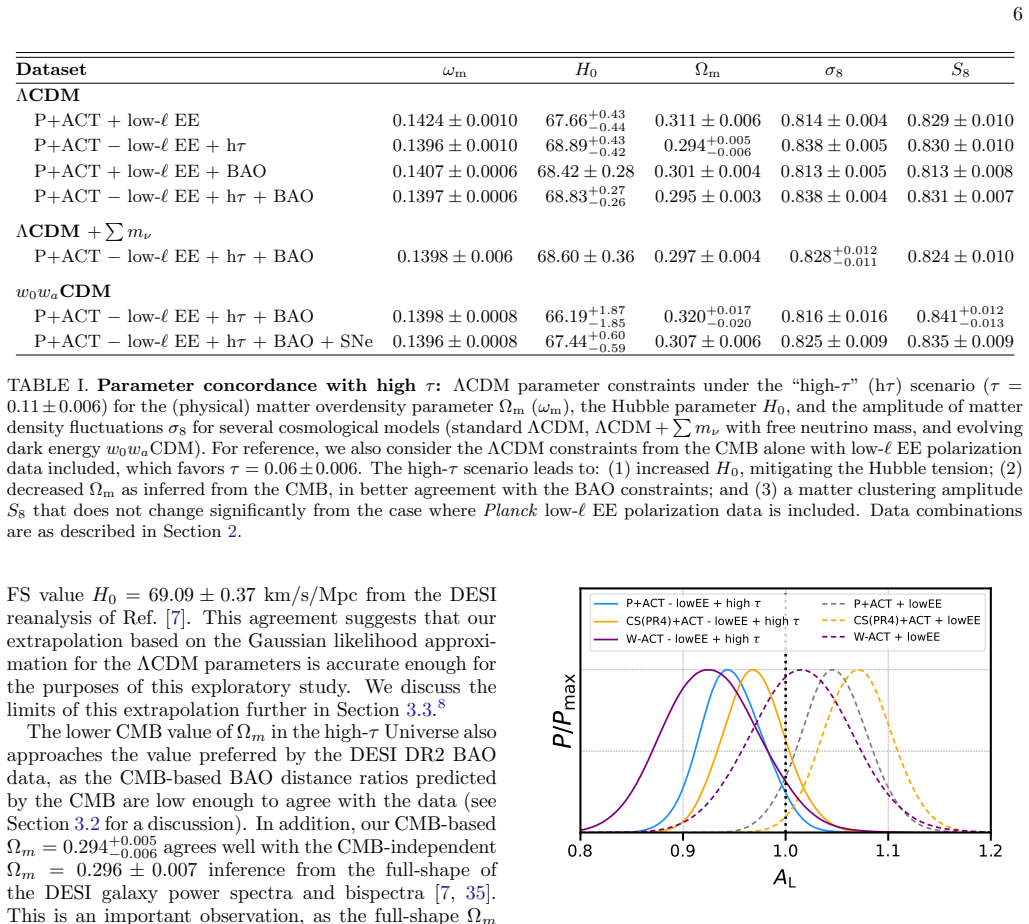
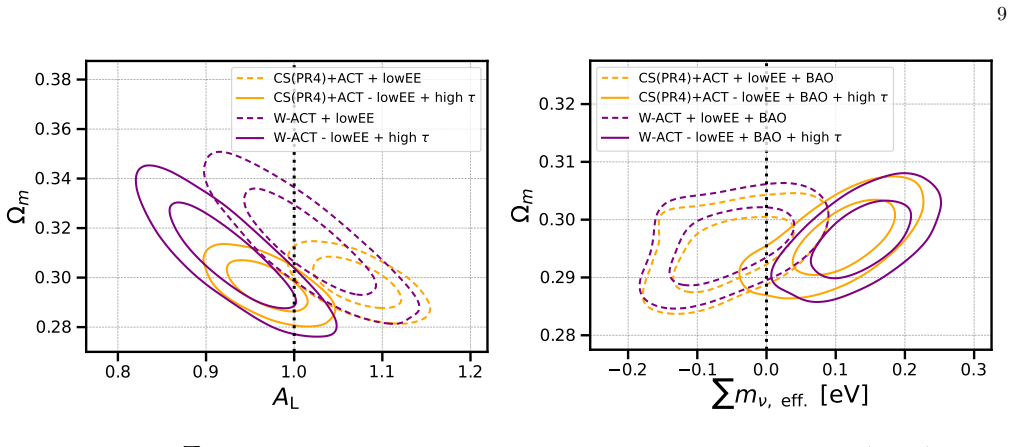
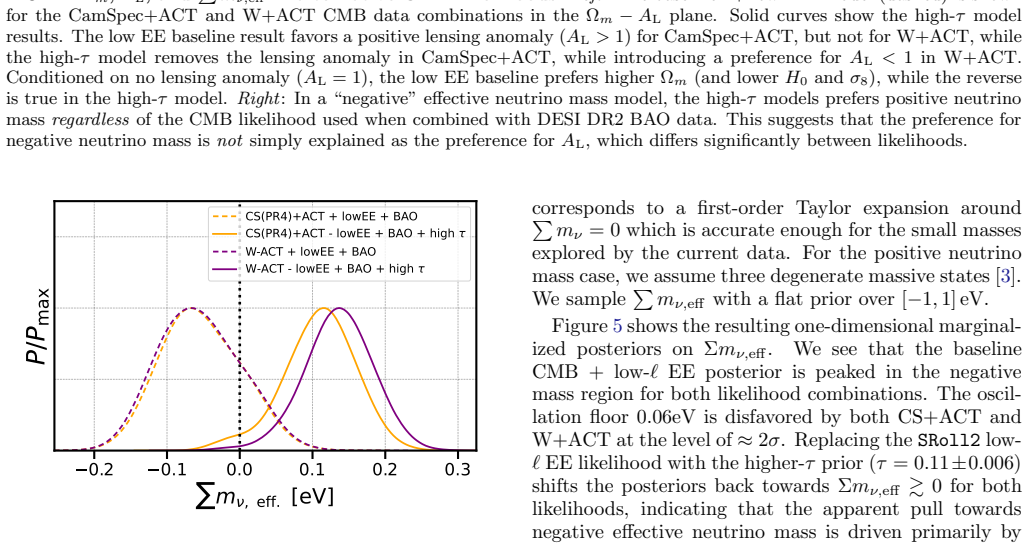
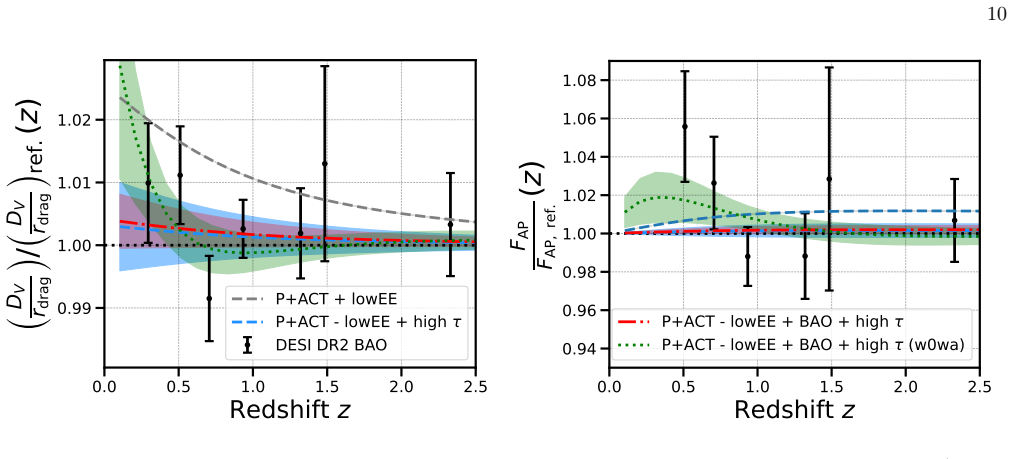
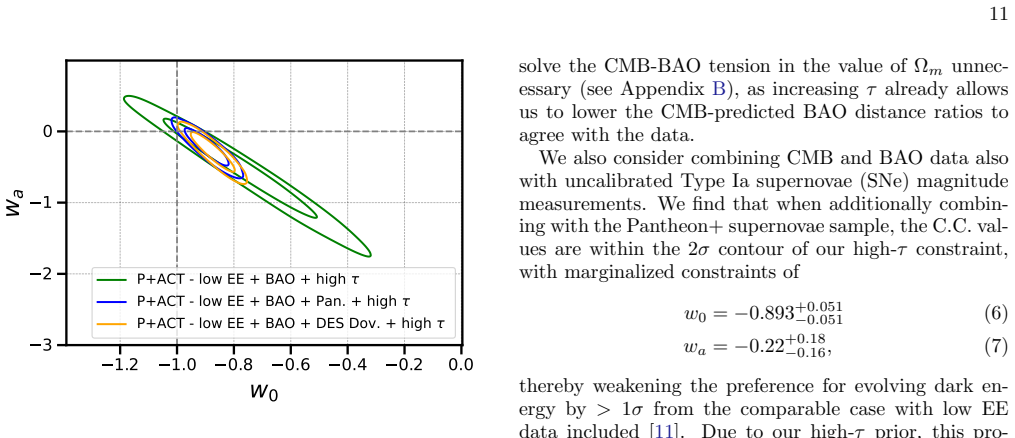
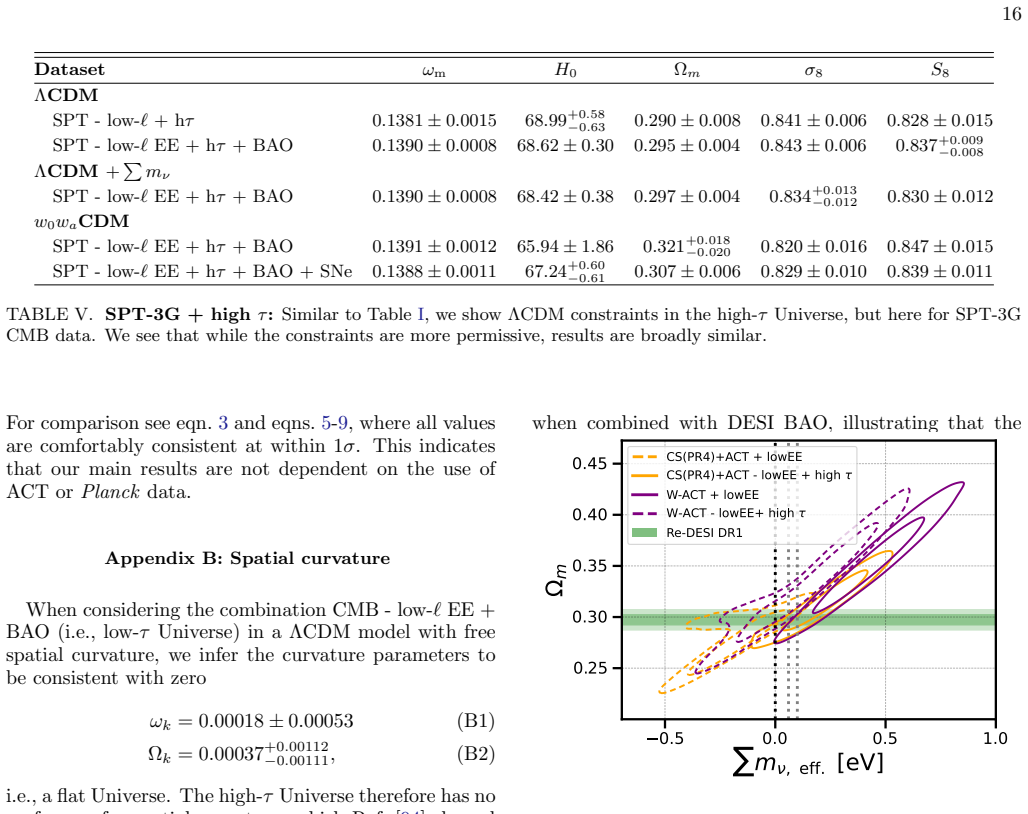
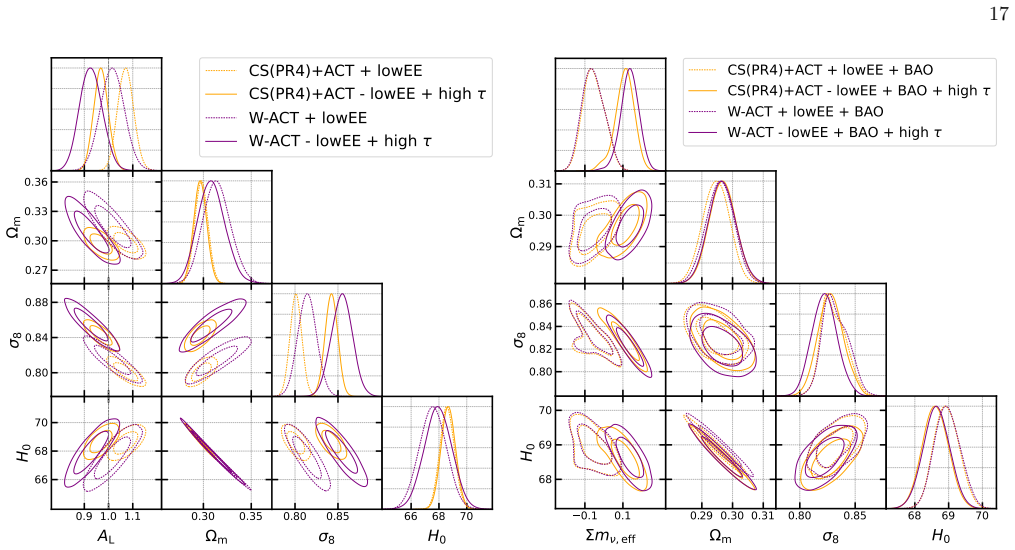
Within this high-τ Universe, we obtain the first 2σ detection of a positive neutrino mass, Σm_ν = 0.10^{+0.04}_{-0.05} eV at 68% C.L., while restoring cosmological concordance between datasets within ΛCDM. In particular, low-redshift distance predictions are consistent with DESI BAO observations and the inferred dark-energy equation-of-state parameters are consistent with a cosmological constant, both with and without supernovae data.
What carries the argument
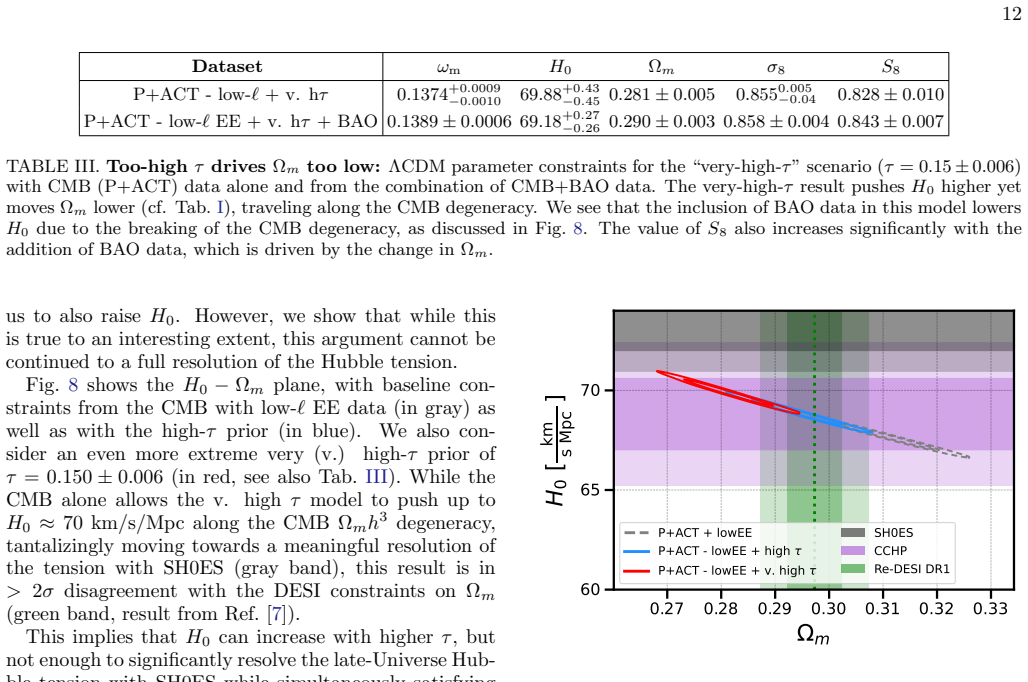
A high prior on the reionization optical depth τ = 0.11 ± 0.006, chosen to enforce positive neutrino mass and H0 consistency between CMB and DESI BAO/full-shape data.
Load-bearing premise
The optical depth to reionization can be set independently to the specific concordance value 0.11 without violating other observational constraints.
What would settle it
A direct measurement of τ from large-angular-scale CMB polarization that lies well below 0.11 would remove the 2σ positive-mass signal and reintroduce the dataset tensions.
If this is right
- Low-redshift distance predictions become consistent with DESI BAO observations.
- The inferred dark-energy equation-of-state parameters remain consistent with a cosmological constant even when supernova data are included.
- The preference for negative neutrino mass disappears and the Hubble tension is alleviated inside ΛCDM.
- The requirement for new physics beyond ΛCDM is significantly reduced.
Where Pith is reading between the lines
- Future large-scale polarization experiments could directly test the required τ value and thereby confirm or refute the neutrino-mass detection.
- If the high-τ solution holds, neutrino oscillation and tritium beta-decay experiments would be expected to converge on a mass sum near 0.1 eV.
- The approach suggests that other apparent tensions in cosmology may also be resolved by re-examining early-universe priors rather than introducing new fields.
Editorial analysis
A structured set of objections, weighed in public.
Referee Report
Summary. The manuscript claims that a high prior on the reionization optical depth τ = 0.11 ± 0.006, chosen specifically to enforce positive neutrino mass sum and H0 consistency between CMB and DESI BAO/full-shape data, produces the first 2σ detection of Σm_ν = 0.10^{+0.04}_{-0.05} eV at 68% C.L. while restoring full concordance among datasets inside ΛCDM, eliminating the need for evolving dark energy or other extensions.
Significance. If the τ prior were an independent external constraint, the result would be notable for simultaneously addressing the Hubble tension, negative-mass preference, and dark-energy hints without new physics. The paper does not supply such an independent justification; the prior is instead defined by the very outcomes it is used to produce.
major comments (2)
- [Abstract] Abstract: the concordance value of τ is defined by the requirement of physical (positive) Σm_ν and H0 agreement with DESI; once this prior is imposed, the reported 2σ detection and restored concordance are no longer independent results of the data but direct consequences of the tuning step.
- [Abstract] The procedure is equivalent to scanning τ values until the negative-mass preference and H0 tension disappear, then reporting the mass as detected at 2σ; this circularity is load-bearing for the central claim and cannot be removed by re-analysis within the present framework.
Simulated Author's Rebuttal
We thank the referee for their detailed review and for identifying the central issue of circularity in our choice of τ prior. We respond to each major comment below and indicate where revisions will be made to clarify the exploratory nature of the analysis without misrepresenting the results.
read point-by-point responses
-
Referee: [Abstract] Abstract: the concordance value of τ is defined by the requirement of physical (positive) Σm_ν and H0 agreement with DESI; once this prior is imposed, the reported 2σ detection and restored concordance are no longer independent results of the data but direct consequences of the tuning step.
Authors: We agree that the τ = 0.11 ± 0.006 prior is explicitly determined by the requirements of positive neutrino mass and H0 consistency with DESI, as stated in the manuscript. The 2σ detection and restored concordance are therefore consequences of applying this prior. We will revise the abstract to state upfront that the analysis explores the consequences of a concordance-motivated τ prior rather than presenting an independent detection from the data alone. This revision will also emphasize that the prior is chosen to test whether tensions can be resolved within ΛCDM. revision: yes
-
Referee: [Abstract] The procedure is equivalent to scanning τ values until the negative-mass preference and H0 tension disappear, then reporting the mass as detected at 2σ; this circularity is load-bearing for the central claim and cannot be removed by re-analysis within the present framework.
Authors: The selection process does involve identifying a τ value that achieves physical neutrino mass and dataset concordance, which introduces the noted circularity. We maintain that this is a legitimate way to quantify the impact of a higher τ on the tensions, motivated by the physical requirement of Σm_ν > 0 and the desire for internal consistency. However, we acknowledge the referee's point that the central claim depends on this choice. We will add a dedicated paragraph in the discussion section addressing the limitations of this approach and the need for independent τ measurements (e.g., from LiteBIRD) to break the degeneracy. We disagree that the circularity cannot be mitigated at all, as future data can test the prior independently. revision: partial
Circularity Check
τ prior chosen by requiring positive Σm_ν and H0 concordance, making the reported 2σ detection equivalent to the input choice
specific steps
-
fitted input called prediction
[Abstract]
"We determine the "concordance" value of τ by requiring physical neutrino mass and consistency of the Hubble constant, H0, inferred from the CMB and that preferred by the Dark Energy Spectroscopic Instrument (DESI) baryon acoustic oscillation (BAO) and full-shape measurements. Within this high-τ Universe, we obtain the first 2σ detection of a positive neutrino mass, Σm_ν = 0.10^{+0.04}_{-0.05} eV at 68% C.L., while restoring cosmological concordance between datasets within ΛCDM."
The τ = 0.11 ± 0.006 prior is not an independent external constraint but is defined by the requirement of positive Σm_ν and H0 agreement with DESI. Once this choice is made, the reported positive-mass detection and restored concordance are no longer independent inferences from the data; they are the direct consequence of the selection criterion used to set τ.
full rationale
The paper explicitly determines the central value and uncertainty of the τ prior by requiring the outcomes (physical neutrino mass and H0 consistency with DESI) that are then presented as independent results. This matches the fitted_input_called_prediction pattern: the parameter is tuned to enforce the target, after which the mass 'detection' and concordance are reported. The central claim therefore reduces to the selection step by construction. No other circular steps identified in the provided text.
Axiom & Free-Parameter Ledger
free parameters (1)
- τ prior =
0.11 ± 0.006
axioms (2)
- domain assumption Standard flat ΛCDM cosmology with fixed parameters except those varied in the fit
- domain assumption Large-scale CMB polarization data can be down-weighted or ignored when setting the τ prior
read the original abstract
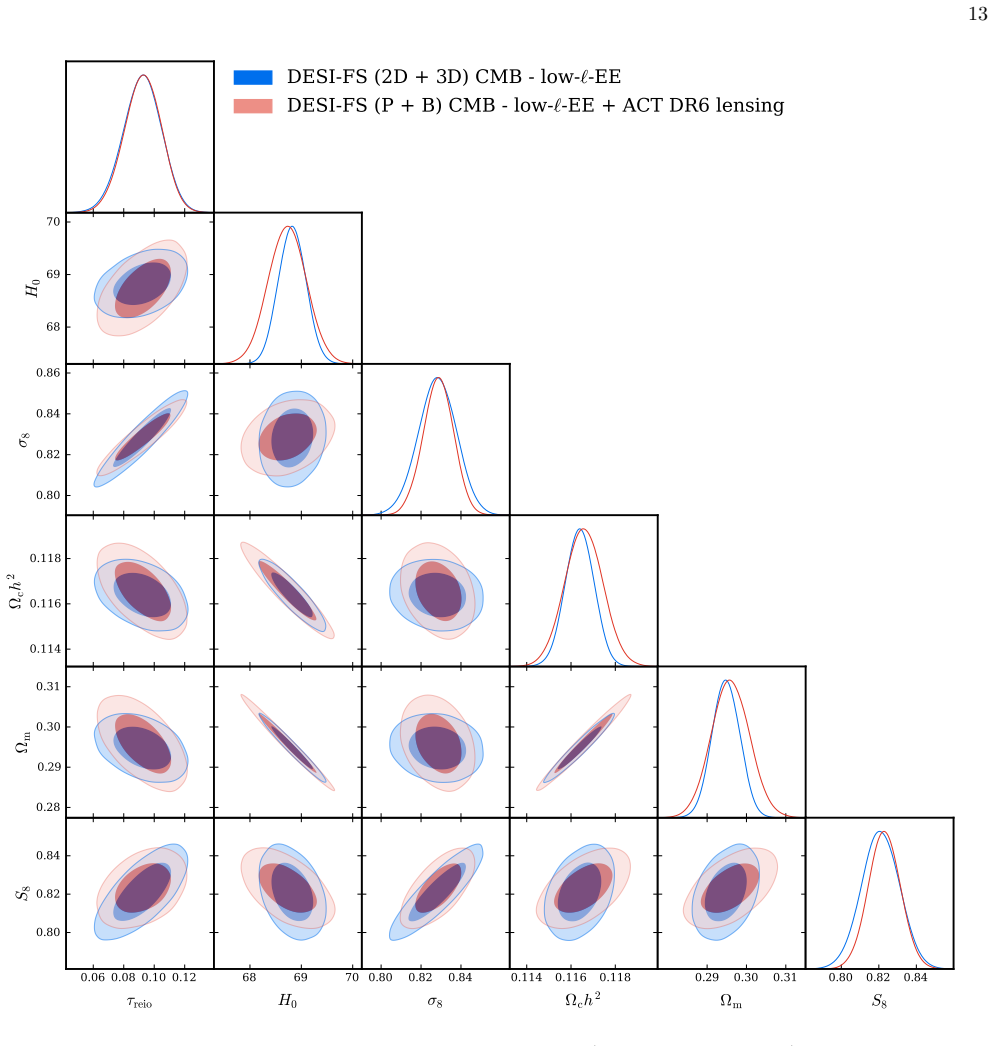
The measurement of the sum of neutrino masses is among the primary promises of precision cosmology, achievable by combining complementary early- and late-Universe probes. However, these datasets currently exhibit mild-to-strong disagreements within $\Lambda$CDM and its simplest extensions, giving rise to multiple tensions, including the Hubble tension, the preference for "negative" neutrino mass, and indications of evolving dark energy. It has recently been shown that these tensions can be alleviated by adopting a higher value of the optical depth to reionization parameter, $\tau$, when large-scale cosmic microwave background (CMB) polarization data are ignored. We extend this proposal and show that an especially high prior on $\tau = 0.11 \pm 0.006$ simultaneously addresses all three of these tensions, significantly reducing the need for new physics beyond $\Lambda$CDM. We determine the "concordance" value of $\tau$ by requiring physical neutrino mass and consistency of the Hubble constant, $H_0$, inferred from the CMB and that preferred by the Dark Energy Spectroscopic Instrument (DESI) baryon acoustic oscillation (BAO) and full-shape measurements. Within this high-$\tau$ Universe, we obtain the first $2\sigma$ detection of a positive neutrino mass, $\Sigma m_{\nu} = 0.10^{+0.04}_{-0.05}$~eV at 68\% C.L., while restoring cosmological concordance between datasets within $\Lambda$CDM. In particular, low-redshift distance predictions are consistent with DESI BAO observations and the inferred dark-energy equation-of-state parameters are consistent with a cosmological constant, both with and without supernovae data. The concordance power of our $\tau$ prior further motivates new measurements of $\tau$, e.g., through large angular scale CMB polarization observations with the \textit{LiteBIRD}, CLASS, or proposed PICO experiments. (Abridged)
Figures
Forward citations
Cited by 3 Pith papers
-
Measuring Cosmic Neutrino Masses Independently of Dark Energy
Two dark-energy-robust cosmological routes bound ∑mν to <0.152 eV (marginalized) and <0.41 eV (late-Universe-free), with the latter independent of tested w(a) models by construction.
-
Neutrino mass constraints in the Schwarzschild-de Sitter black-hole dark energy model with ACT DR6 and DESI DR2 data
SdSDE dark energy yields a ~0.16–0.21 eV positive neutrino-mass preference with DESI+ACT data, but χ² strongly favors extended ΛCDM and the shift is likely compensation.
-
Intertwined Constraints in Extended Cosmologies: Dark Energy, Curvature, Neutrinos, and Inflation
Dynamical dark energy remains preferred across extended models while curvature, neutrino mass and inflation parameters show strong model dependence, with no resolution of the H0 tension.
discussion (0)
Sign in with ORCID, Apple, or X to comment. Anyone can read and Pith papers without signing in.