REVIEW 1 major objections 1 cited by
Beyond the Library: An Agentic Framework for Autoformalizing Research Mathematics
T0 review · 1 major / 0 minor · reviewed 2026-07-03 · grok-4.3
Pith's one-line read An agentic framework using general-purpose LLMs can translate research mathematics papers into verifiable Lean formalizations, including proofs, even when concepts lie outside existing libraries.
desk verdict This paper produces actual Lean formalizations of main theorems and proofs from five STOC papers via an agentic pipeline with general coding LLMs and a new Auxiliary Lemma step for library extension. read the letter →
The pith
A machine-rendered reading of the paper's core claim, the machinery that carries it, and where it could break.
The reading
What carries the argument
An orchestrator that manages a multi-agent pipeline for research-level mathematics, using the Auxiliary Lemma technique to validate dynamically extended type definitions.
What would settle it
An independent expert review of one of the five STOC formalizations that identifies a material mismatch between the Lean code and the paper's stated theorem or proof steps, despite the original validation.
Extended reading notes
Core claim
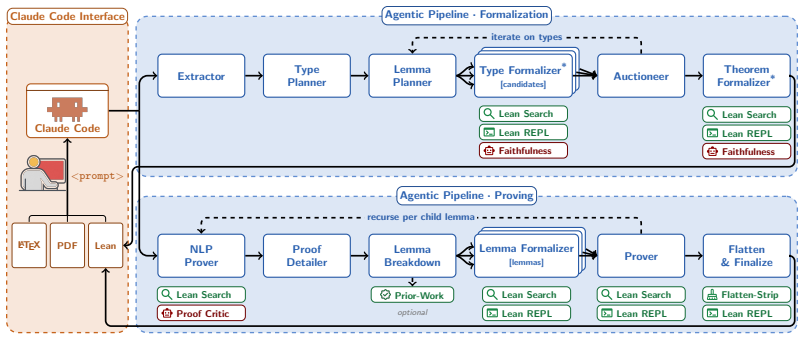
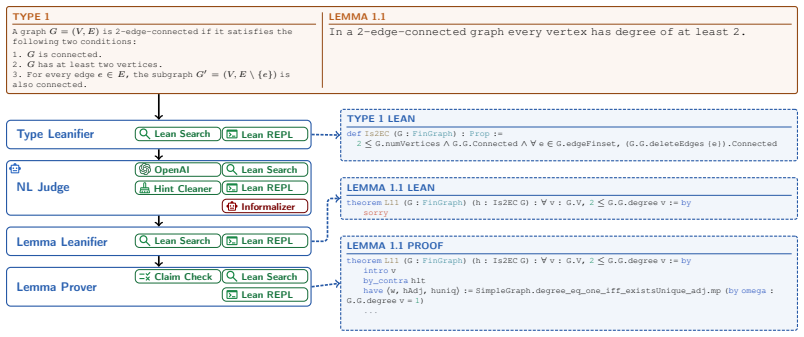
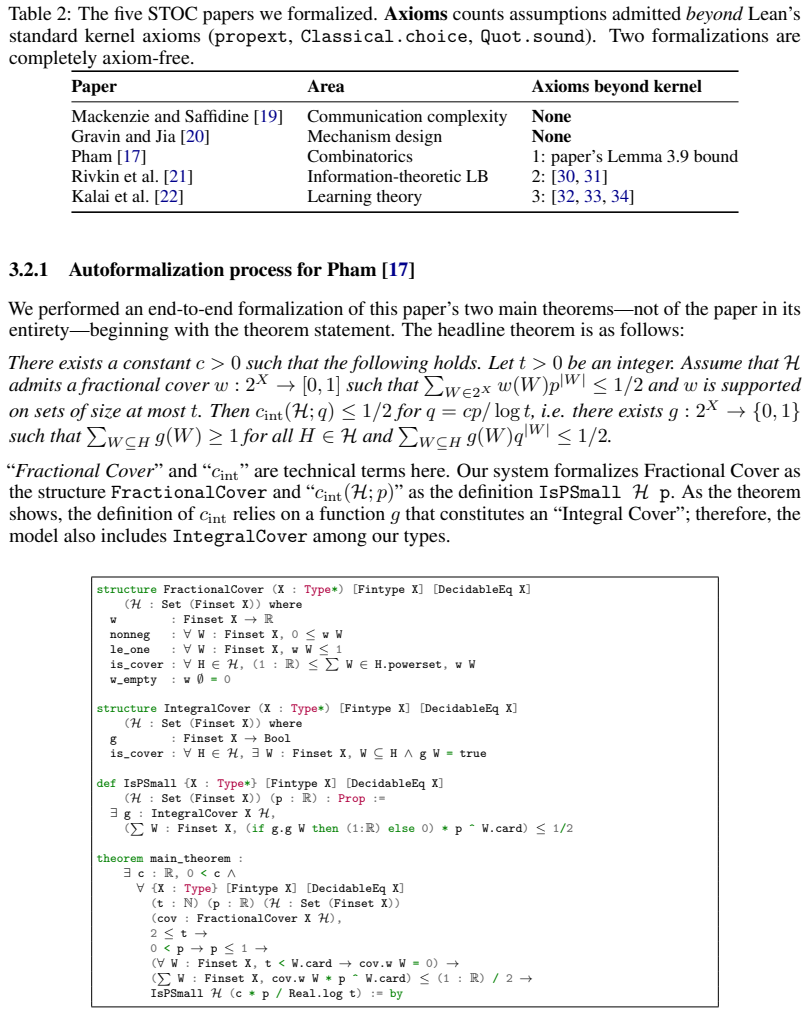
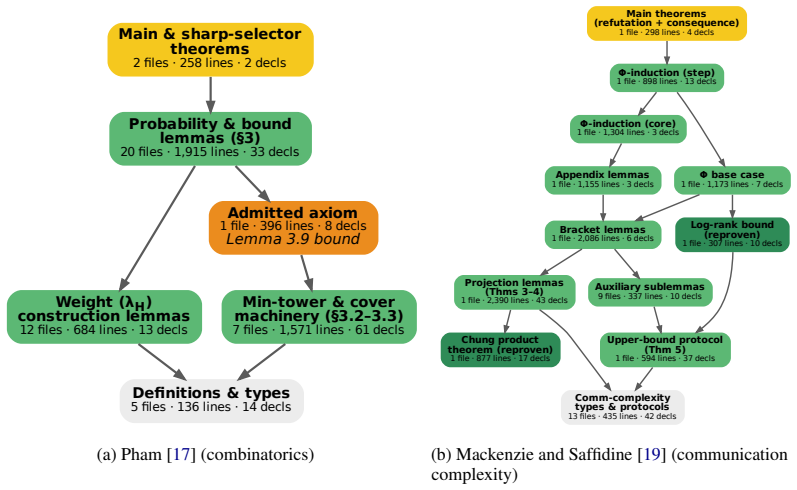
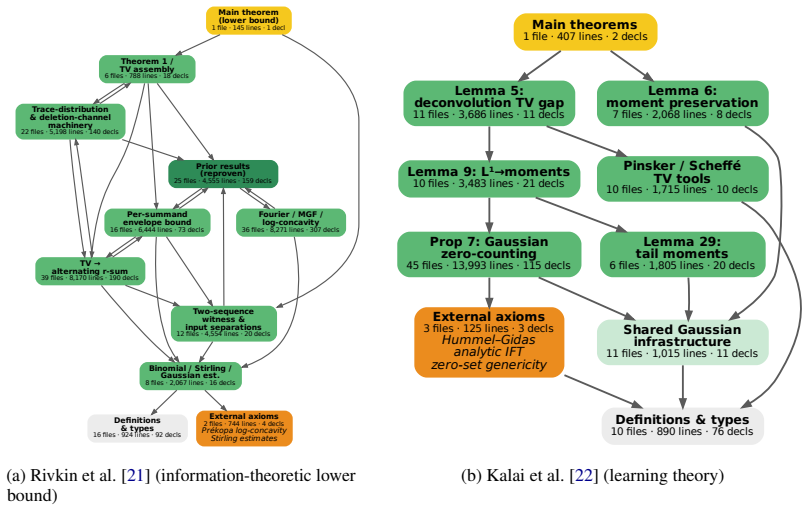
We introduce an agentic autoformalization framework powered by general coding LLMs whose orchestrator manages a multi-agent pipeline that dynamically extends necessary type definitions and validates them via a novel Auxiliary Lemma technique before formalizing the primary theorems. The system is applied to five STOC papers, successfully formalizing their main theorems and proofs with validation by human experts; two of the formalizations are proved using only axioms from Lean's kernel.
Load-bearing premise
Human experts can reliably detect whether a generated Lean formalization correctly captures the original natural-language theorem and proof.
Editorial extensions
If this is right
- The framework produces machine-checked Lean proofs for main theorems from papers in combinatorics, communication complexity, mechanism design, and learning theory.
- Formalizations succeed for papers whose concepts lie outside the scope of existing libraries such as Mathlib.
- Both theorem statements and their proofs can be formalized together.
- Some research-level proofs can be completed using only the kernel axioms of Lean.
Reading between the lines
- If the multi-agent orchestration continues to improve at catching subtle mismatches, the same pipeline could be tested on papers from other conferences or fields.
- Dynamic library extension via auxiliary lemmas could be applied to other formal systems beyond Lean to handle emerging mathematical concepts.
- Success on STOC papers raises the question of whether the same system can be run on new preprints to produce verified versions before or alongside peer review.
Editorial analysis
A structured set of objections, weighed in public.
Referee Report
Summary. The paper introduces an agentic multi-agent framework powered by general-purpose coding LLMs for autoformalizing research-level mathematics into Lean 4. The system uses an orchestrator to manage a pipeline that dynamically extends types outside Mathlib and employs a novel Auxiliary Lemma technique for validation. It reports machine-checked Lean formalizations for a random sample of 32 PutnamBench problems and, more centrally, for the main theorems and proofs of five STOC papers spanning combinatorics, communication complexity, mechanism design, and learning theory, with human expert validation; two of the proofs use only Lean's kernel axioms. All formalizations are released publicly.
Significance. If the results hold, the work demonstrates that agentic systems with general LLMs can produce machine-checked formalizations of research mathematics outside existing libraries, including full proofs. The open release of the formalizations, the use of external benchmarks (PutnamBench and STOC papers), and the machine-checked outputs (with two kernel-only proofs) are concrete strengths that provide reusable artifacts for the community.
major comments (1)
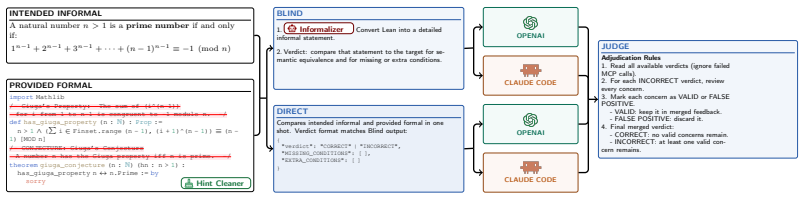
- [STOC evaluation section] STOC evaluation section: The central claim that the system successfully formalizes main theorems and proofs from five STOC papers (with human expert validation) rests on experts confirming that the generated Lean statements and proofs correctly capture the natural-language originals. The paper itself notes that LLMs produce subtle errors evading human detection; Lean mechanically verifies proof correctness but provides no guarantee of semantic fidelity for the statements, particularly for research-level concepts outside Mathlib. A more detailed account of the validation protocol (number of experts, specific checks performed, handling of potential encoding mismatches) is required to support the claim.
Simulated Author's Rebuttal
We thank the referee for their careful review and constructive feedback on the STOC evaluation. We agree that a more detailed description of the validation protocol is required to support the claims and will revise the manuscript accordingly.
read point-by-point responses
-
Referee: The central claim that the system successfully formalizes main theorems and proofs from five STOC papers (with human expert validation) rests on experts confirming that the generated Lean statements and proofs correctly capture the natural-language originals. The paper itself notes that LLMs produce subtle errors evading human detection; Lean mechanically verifies proof correctness but provides no guarantee of semantic fidelity for the statements, particularly for research-level concepts outside Mathlib. A more detailed account of the validation protocol (number of experts, specific checks performed, handling of potential encoding mismatches) is required to support the claim.
Authors: We agree that the current description of the validation protocol is insufficient to fully substantiate the claim, particularly given the acknowledged risk of subtle LLM errors and the lack of mechanical guarantees for semantic fidelity. In the revised manuscript we will add a dedicated subsection to the STOC evaluation that details the protocol as follows: five domain experts (one per paper, each with direct expertise in the relevant STOC area) were provided with the original paper excerpts and the generated Lean code; they performed line-by-line semantic equivalence checks, explicitly comparing custom type definitions and proof steps against the natural-language source; any encoding mismatches or ambiguities were flagged, discussed in written correspondence, and resolved through iterative updates to the formalization until the expert confirmed fidelity. We will also add an explicit limitations paragraph acknowledging that human validation, while necessary, cannot eliminate all risk of undetected discrepancies. These additions will be placed immediately after the description of the five formalizations. revision: yes
Circularity Check
No circularity: empirical results on external benchmarks
full rationale
The paper describes an agentic autoformalization system and reports direct empirical outcomes on independent external inputs (PutnamBench sample and five STOC papers). Success is measured by Lean kernel verification plus human expert validation of statement fidelity; no equations, fitted parameters, predictions, or self-citations are invoked to derive the reported results. The evaluation chain is therefore self-contained against external benchmarks rather than reducing to internal definitions or prior author work.
Assumptions & free parameters
assumptions (1)
- domain assumption General-purpose coding LLMs can be prompted to generate correct Lean 4 code when guided by an orchestrator and auxiliary lemmas.
invented entities (1)
-
Auxiliary Lemma technique
Cite this review
Pith. "Pith review of Beyond the Library: An Agentic Framework for Autoformalizing Research Mathematics." pith.science (2026). https://pith.science/paper/M5ZHPPSI
@misc{pith2026260631134,
  author       = {Pith},
  title        = {Pith review of: Beyond the Library: An Agentic Framework for Autoformalizing Research Mathematics},
  year         = {2026},
  howpublished = {\url{https://pith.science/paper/M5ZHPPSI}},
  note         = {Machine review of arXiv:2606.31134}
}
read the original abstract
While Large Language Models (LLMs) have demonstrated exceptional capabilities in mathematical reasoning, they frequently produce subtle errors that evade human detection. Formal mathematical languages like Lean 4 offer mechanical proof checking, strongly motivating the need for autoformalization: the automatic translation of natural language mathematics into verifiable code. Recent trends indicate that general-purpose LLMs, heavily optimized for standard programming, now outperform smaller models explicitly fine-tuned for Lean. Leveraging this shift, we introduce *Theo*, an agentic autoformalization framework powered by general coding LLMs. At the core of our system is an orchestrator that manages a multi-agent pipeline tailored for research-level mathematics. Because cutting-edge research frequently relies on concepts outside the scope of existing libraries like Mathlib, our system dynamically extends necessary type definitions and validates them via a novel Auxiliary Lemma technique before formalizing the primary theorems. We applied our approach to PutnamBench, producing machine-checked Lean proofs for a random sample of 32 problems. Furthermore, we evaluate our system on seven research papers---five from the ACM Symposium on Theory of Computing (STOC) and two recent OpenAI manuscripts---spanning combinatorics, communication complexity, mechanism design, learning theory, number theory, discrete geometry, and graph theory. We successfully formalize their main theorems and proofs and validate the generated formalizations with human experts; notably, two developments require no axioms beyond Lean's kernel. All of our formalizations are available at https://beyondthelibrary.github.io/formal_arxiv/.
Figures
Figures from the paper (3 more)
Forward citations
Cited by 1 Pith paper
-
MechGeo: Autoformalizing and Proving Euclidean Geometry in Lean 4
MechGeo autoformalizes and kernel-verifies Lean 4 proofs for 43 historical IMO geometry problems and IMO 2026 P2, after human repair of 14 under-specified statements.
Reviewed July 3, 2026 · model on record in the stance chip above.
Discussion (0). Continue with ORCID to comment.