REVIEW 3 major objections 5 minor 1 cited by
One matrix inversion solves path-dependent statistical-arbitrage execution.
Reviewed by Pith at T0; open to challenge. T0 means a machine referee read the full paper against a public rubric. the ladder, T0–T4 →
T0 review · deepseek-v4-flash
2026-08-02 09:23 UTC pith:4ATXSTHX
load-bearing objection The quadratic reduction is real and useful; the backtest's endpoint feature evaluation is the main thing to fix before trusting the empirical numbers. the 3 major comments →
Signature-Based Optimal Execution for Statistical Arbitrage with Path-Dependent Trading Signals
The pith
A machine-rendered reading of the paper's core claim, the machinery that carries it, and where it could break.
Core claim
The central claim is Theorem 2.9: under temporary impact with an exogenous information path, with signal α_t = Kx_t and trading speed v_t = Bx_t both linear in the truncated signature x_t, the objective combining signal reward, temporary impact, inventory risk, dollar-neutrality, and terminal liquidation collapses exactly to J(θ) = θᵀAθ + bᵀθ + c with θ = vec(B). The matrices A and b are explicit expectations of Kronecker products of signature Gram blocks, prices, and penalty matrices; A is negative semidefinite, so the problem is concave, and the unconstrained optimum is θ* = −½ A⁻¹b. The reduction is exact within the policy class: approximation enters only through truncation, moment estima
What carries the argument
The workhorse is the truncated signature x_t of a time-augmented market path Z_t — a coordinate vector containing all iterated integrals up to level N. Both alpha and the control are linear maps on this same vector, α_t = Kx_t and v_t = Bx_t, so inventory is affine in θ = vec(B) through y_t = ∫₀ᵗ x_u du. Products like vᵀΛv and (QᵀP)² then become Kronecker products of signature Gram blocks with impact and price matrices; taking expectations and integrating in time yields the deterministic quadratic-form data A, b, c. Assumption 2.3 — that the law of Z does not depend on B — keeps P_t and x_t exogenous, which is what makes every term at most quadratic in θ.
Load-bearing premise
The load-bearing premise is that the information path, including the mid-price in the dollar-neutrality term, is exogenous: trading does not feed back into prices or into the signal; if permanent or transient impact makes P_t and x_t depend on the chosen B, the objective stops being quadratic in the policy coefficients.
What would settle it
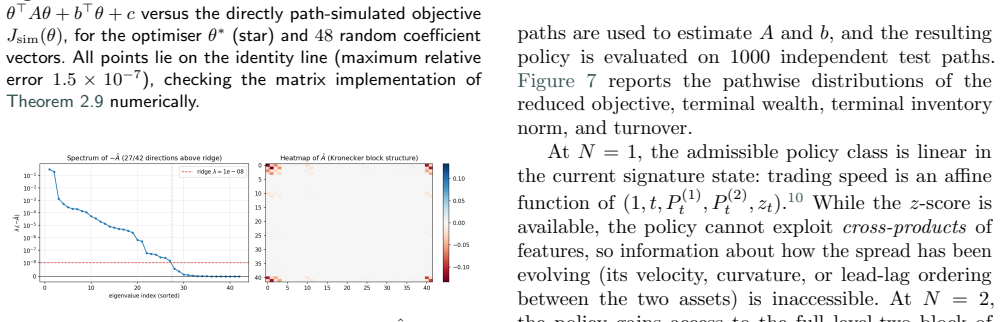
Switch on permanent price impact so the mid-price used in the dollar-neutrality penalty depends on cumulative inventory, then repeat the paper's identity check — direct path simulation of the objective versus θᵀAθ + bᵀθ + c on random θ. The two will diverge, showing the reduction is specific to temporary impact. Separately, run the same workflow on dozens of pairs and out-of-sample windows; if the signature policy's return on turnover does not systematically beat the z-score benchmark after costs, the empirical outperformance claim is not general.
If this is right
- Offline calibration, instant execution: once A and b are estimated from historical paths or simulations, the optimal trading matrix is one regularized linear solve, and the live trading speed is one matrix-vector product with no dynamic-programming step.
- Classical schedules are a special case: when the features are restricted to time only, the quadratic program reduces to deterministic liquidation schedules of the classical Almgren–Chriss type, now approximated by polynomial trading speeds.
- Constraints stay cheap: trading-speed bounds, inventory caps, and hard dollar-neutrality requirements become finite-dimensional convex constraints on θ, preserving a tractable quadratic programme.
- Richer path features become usable: second-order coordinates such as the Lévy area encode lead-lag geometry that z-score thresholds ignore, and the same quadratic reduction still applies.
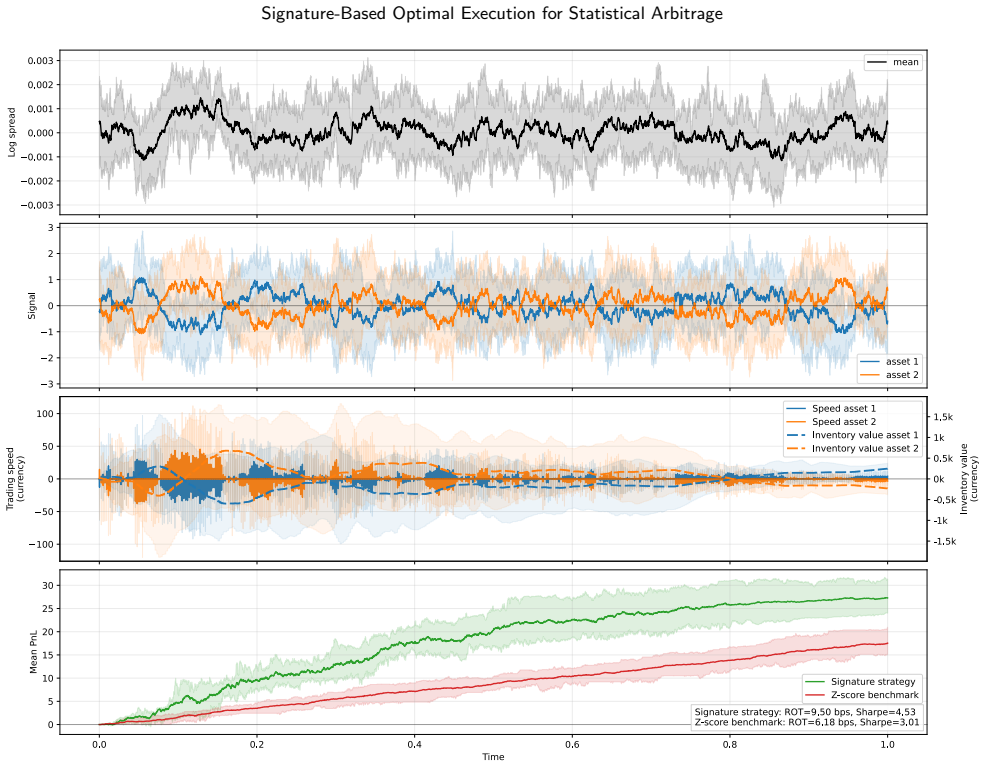
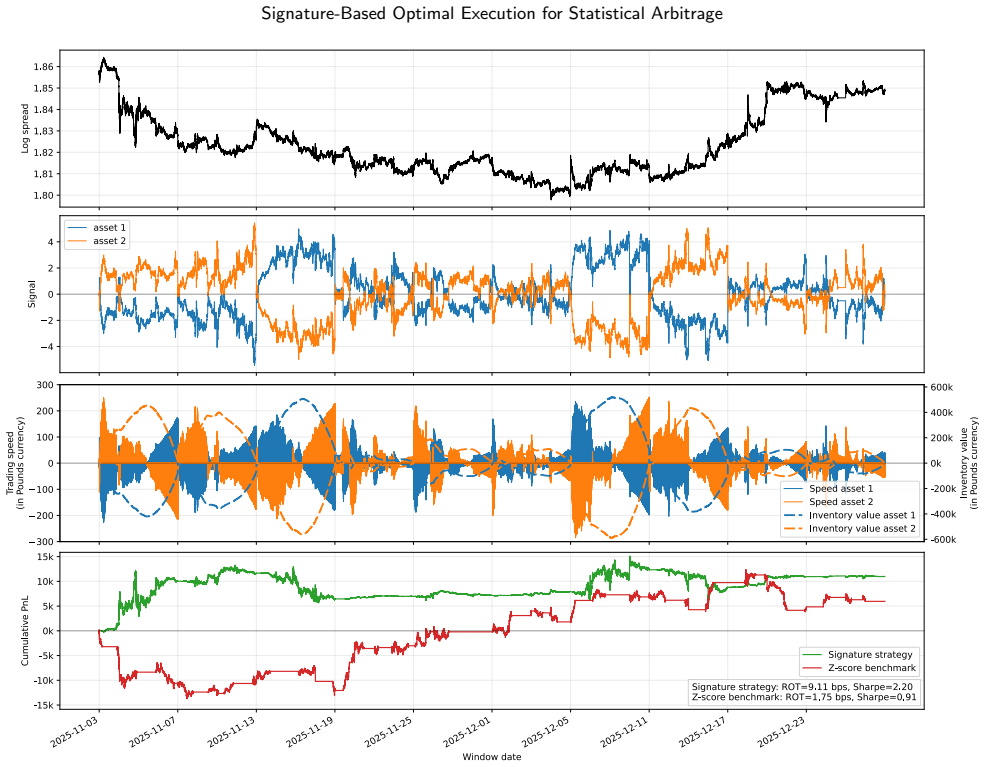
- Reported performance: in the paper's experiments the signature policy achieves roughly 9 basis points return on turnover versus 6 for the z-score benchmark on synthetic data, and roughly 9 versus 2 basis points on a single two-stock historical window.
Where Pith is reading between the lines
- If the exogeneity assumption survives in practice, the same reduction should extend to any alpha expressible as a linear functional of an exogenous path — for example order-flow imbalance or residual-factor signals — without re-deriving the control theory; only the moment-estimation block changes.
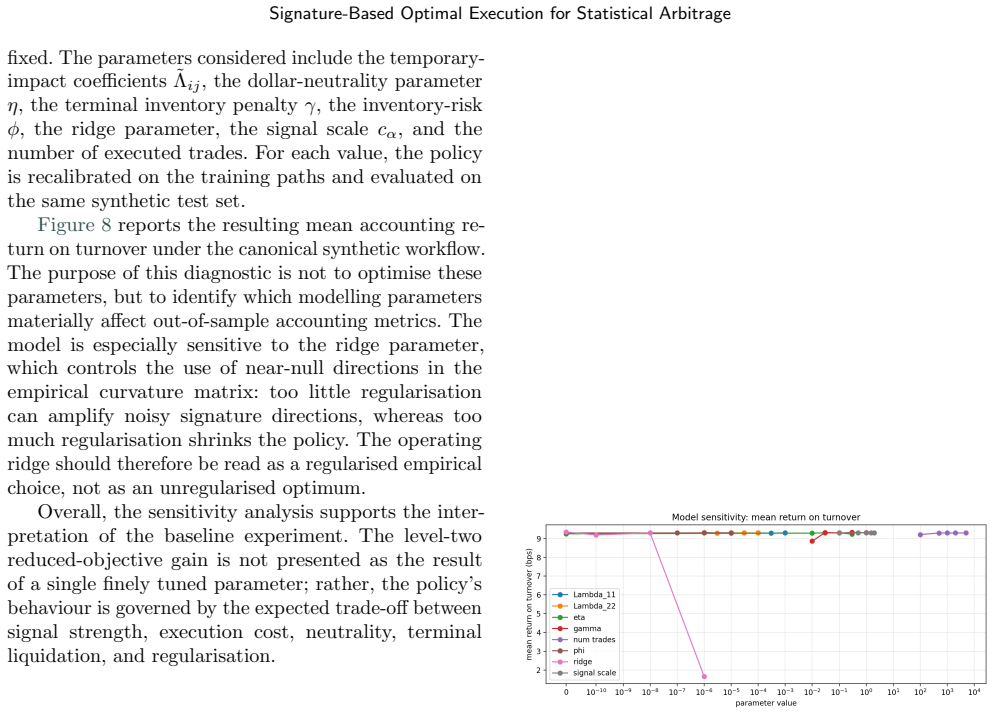
- The near-null eigenvalue tail reported for the empirical curvature matrix suggests that the 'one matrix solve' story is conditional on regularization; an out-of-sample sweep across ridge values would quantify how much of the benchmark outperformance is real signal versus shrinkage luck.
- A natural testable extension is to replace the soft dollar-neutrality and terminal-liquidation penalties with hard constraints and check whether the constrained quadratic programme retains its edge; that is the practical desk version of the same problem.
- Because the identity J(θ) = θᵀAθ + bᵀθ + c is pathwise algebraic, it should hold for any stochastic model for the information path satisfying mild integrability; re-running the paper's identity check under a different data-generating process would be a cheap robustness probe.
Editorial analysis
A structured set of objections, weighed in public.
Referee Report
Summary. This paper proposes a signature-based optimal execution framework for statistical arbitrage. Both the alpha signal, α_t = K x_t, and the trading speed, v_t = B x_t, are modeled as linear functionals of the truncated signature x_t of an exogenous market/information path Z_t. The central theoretical result, Theorem 2.9, asserts that the path-dependent execution objective (2.12) — signal reward, temporary impact, inventory risk, dollar neutrality, and terminal liquidation — reduces exactly to a finite-dimensional concave quadratic program J(θ) = θ^T A θ + b^T θ + c, with A, b, c given explicitly in (2.15)–(2.17), so that the optimal coefficient vector is obtained by one matrix inversion. The paper includes a numerical check of the reduction (Figure 5), synthetic experiments under a common-trend/OU-spread model, and a single Shell–BP historical window, reporting higher return on turnover than a z-score threshold benchmark (≈9 vs 6 bps synthetic; ≈9 vs 2 bps historical).
Significance. If the main theorem holds as stated, the paper makes a useful contribution: it shows that a non-Markovian execution problem, restricted to signature-linear controls, can be solved as a static quadratic program without dynamic programming or HJB equations. The strengths are the explicit tensor assembly, the closed-form OU moment blocks in Appendix C, the shuffle-algebra reformulation in Appendix B, the numerical validation of the reduction to floating-point precision, and the paper's candid statement of limitations. However, the empirical contribution is currently undermined by the endpoint feature-evaluation convention in Section C.4, which introduces look-ahead into the reported ROT comparisons. The theoretical result is sound within its stated scope, but the empirical claims need to be re-run with a causal protocol before they can be taken as evidence of out-of-sample performance.
major comments (3)
- [Section C.4 / Sections 3.3–3.4] The paper states in Section C.4 that 'features are evaluated at bucket endpoints in both the matrix assembly and the backtest' and that a strictly predictable live implementation would use left-endpoint features. This is not merely an implementation robustness issue: using the endpoint signature means the trading speed assigned to an execution bucket is computed from information spanning the entire bucket, including the concurrent price move. Since calibration and evaluation share this convention, the fitted policy can exploit within-bucket price information, inflating the reported ROT comparisons (≈9 vs 6 bps synthetic; ≈9 vs 2 bps Shell–BP). Please rerun the empirical workflow with strictly causal left-endpoint features and report both metrics; if the difference is material, the empirical conclusions must be revised.
- [Assumption 2.3 / Section 2.2] The quadratic reduction relies fundamentally on Assumption 2.3: the law of the information path Z does not depend on B, i.e. a temporary-impact setting. If trading has permanent or transient impact, or if the spread signal itself responds to the strategy's trades, then P_t and x_t become functions of B, and the terms (Q_t^T P_t)^2 and Q_t^T K x_t are no longer quadratic in θ. This is a genuine scope restriction. The paper acknowledges the temporary-impact assumption, but the title and framing should state clearly that permanent impact and any feedback of trading into the signal are outside the model, and a brief discussion of where the algebra breaks would help readers avoid over-generalizing Theorem 2.9.
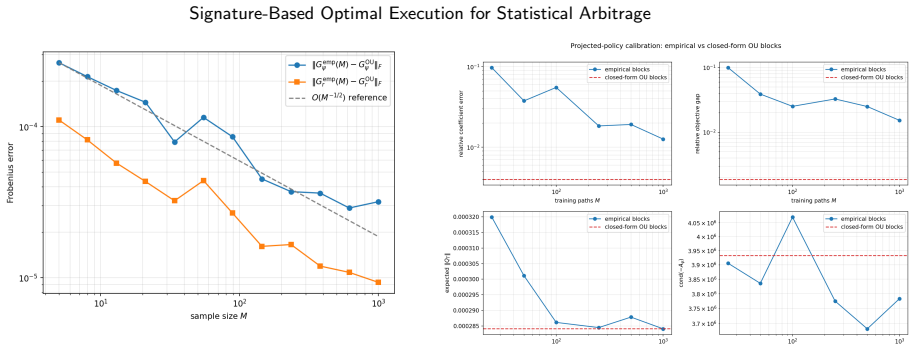
- [Section 2.6 / Figures 6 and 8] The practical claim of a 'one matrix solve' depends on A being negative definite. Figure 6 shows that only 29 of 42 directions lie above the ridge level, and Figure 8 shows that return on turnover is materially sensitive to λ_ridge. Thus the reported solution is not a clean closed form but a regularized empirical solve whose output depends on the chosen ridge. Please report a systematic ridge-selection procedure (e.g. cross-validation) and show out-of-sample ROT across a range of λ_ridge, rather than presenting a single λ_ridge = 1e−8 solve as the canonical result.
minor comments (5)
- [Abstract] 'We shows' should be 'We show'.
- [Eq. (2.15)] The symbol for the temporary-impact matrix appears as 'eΛ' in the displayed formula; it should be '\tildeΛ' consistently with the text.
- [Section 3.3 vs Section C.4] Section 3.3 reports 10,000 training paths and 5,000 test paths, while Section C.4 and Figures 6–8 use 1,000 training and 1,000 test paths. Please clarify which configuration underlies Figure 1 and ensure the headline result is tied to a single, clearly described experimental setup.
- [Figure 5 / Section D] The text reports a maximum relative error of 2.2 × 10^−7, while the Figure 5 caption reports 1.5 × 10^−7. Reconcile the numbers.
- [Section 3.2] The z-score benchmark is a fixed-threshold, position-capped rule that does not solve an execution problem with impact or inventory penalties. The ROT comparison should be interpreted with this limitation stated explicitly; the benchmark is a reference rule, not a strong baselining of the execution component.
Circularity Check
No significant circularity: Theorem 2.9 is a direct algebraic reduction, and the empirical comparison uses a legitimate train/test protocol.
full rationale
The paper's central claim, Theorem 2.9, is a self-contained algebraic derivation rather than a circular one. Substituting the signature-linear control v_t = B x_t and the induced affine inventory Q_t = Q_0 + (∫_0^t x_u du)^⊤ B into the objective (2.12) mechanically produces a quadratic form in θ = vec(B); the matrices A, b, c in (2.15)-(2.17) are defined as expectations of moments of the exogenous path and the fixed signal matrix K, not in terms of the optimal policy. The proof exhibits each objective term's contribution to A, b, and c explicitly, and Appendix D checks the identity against direct pathwise simulation to floating-point precision. There is no fitted parameter renamed as a prediction: the empirical ROT comparison evaluates the fitted policy on held-out paths (5000 synthetic test paths; Nov-Dec 2025 for Shell-BP) using the same z-score alpha for both arms, so the outperformance is a simulation/backtest result, not a number forced by construction. The paper cites prior signature-execution work, but none of the cited results are from the present authors and none is load-bearing: the quadratic reduction depends only on the stated linear-feature ansatz and the exogeneity assumption. The endpoint feature convention noted in Section C.4 is a potential look-ahead/implementation concern about the empirical backtest, not a circularity of the derivation; the paper itself flags that a live implementation would use left-endpoint features, and this does not make the theorem or the benchmark comparison circular. Overall, the derivation chain is independent, explicit, and numerically verified, so no circular step is present.
Axiom & Free-Parameter Ledger
free parameters (8)
- c_alpha (signal scale) =
1.5 (Section 3.3); 5.02e-2 = 0.5*kappa*bsd(S) (C.5)
- Lambda temporary-impact matrix =
diag(1e-4, 1e-5) Section 3.3; diag(1e-1, 1e-2) Section 3.4; diag(3e-3, 3e-4) C.5
- lambda_ridge =
1e-8 (Section 3.3); 0 (Section 3.4); sensitivity sweep in Figure 8
- eta (dollar-neutrality weight) =
0.1 (Section 3.3); 0.01 (Section 3.4 and C.5)
- gamma (terminal-liquidation weight) =
0.1 (synthetic); 1 (historical)
- Benchmark policy parameters =
entry/exit z-scores 2/0; capital caps 1000 (synthetic) and GBP 500,000 (historical)
- Synthetic DGP parameters =
kappa=50, sigma_M=sigma_X=0.02, rho=0.3, mu=0
- Truncation level N and z-score window tau =
N=2; tau=600 grid steps (Section 3.3 warm-up), 8h rolling (Section 3.4)
axioms (6)
- domain assumption Assumption 2.1: the information path Z admits a geometric rough-path lift; the truncated signature x_t is well defined.
- domain assumption Assumption 2.2: integrability of feature moments, E[int ||x_t||^2 dt] < inf and E[int ||P_t||^2 ||y_t||^2 dt] < inf.
- domain assumption Assumption 2.3: exogeneity of the information path Z with respect to the control B (temporary-impact-only setting).
- domain assumption Density/universality of linear functionals on signatures in spaces of continuous path functionals.
- ad hoc to paper Synthetic DGP (3.1)-(3.4): common-trend log-prices with an OU spread and correlated Brownian drivers.
- domain assumption For the OU-projected closed-form blocks only: the spread follows (C.4) with known kappa, sigma.
Cite this review
Pith. "Pith review of Signature-Based Optimal Execution for Statistical Arbitrage with Path-Dependent Trading Signals." pith.science (2026). https://pith.science/paper/4ATXSTHX
@misc{pith2026260631387,
  author       = {Pith},
  title        = {Pith review of: Signature-Based Optimal Execution for Statistical Arbitrage with Path-Dependent Trading Signals},
  year         = {2026},
  howpublished = {\url{https://pith.science/paper/4ATXSTHX}},
  note         = {Machine review of arXiv:2606.31387}
}
read the original abstract
We develop a signature-based framework for optimal execution in statistical arbitrage strategies with path-dependent predictive signals. Both the alpha process and the trading speed are modelled as linear functionals of the truncated signature of a time-augmented market path, placing signal generation and execution on the same truncated signature basis. This allows the trading rule to react to the realised history of the signal while accounting for temporary impact, inventory exposure, terminal liquidation, and approximate dollar neutrality. The main contribution is a quadratic reduction theorem: within the class of signature-linear trading speeds, the restricted path-dependent execution problem becomes a finite-dimensional concave quadratic programme in the policy coefficients. After running synthetic experiments under a mean-reverting log-spread model, we find that the fitted policy achieves a higher return on turnover than a classical $z$-score threshold benchmark. We show how the same workflow can be deployed on a historical equity pairs-trading backtest, where the fitted signature policy again outperforms the benchmark in accounting terms.
Figures


Forward citations
Cited by 1 Pith paper
-
Expected signatures via partial integration, coordinate change and symmetrization
A coordinate transform on the tensor algebra lets expected signatures of augmented rough processes be computed by deterministic integration of Gaussian/polynomial correlators, dramatically reducing numerical cost.
Reference graph
Works this paper leans on
-
[1]
E. Gatev, W. N. Goetzmann, K. G. Rouwenhorst, Pairs trading: Performance of a relative-value arbitrage rule, The Review of Financial Studies 19 (3) (2006) 797–827. doi:10.1093/rfs/hhj020
-
[2]
M. Avellaneda, J.-H. Lee, Statistical arbitrage in the US equities market, Quantitative Finance 10 (7) (2010) 761–782. doi:10.1080/14697680903124632
-
[3]
R. Almgren, N. Chriss, Optimal execution of portfolio transactions, Journal of Risk 3 (2) (2000) 5–39. doi: 10.21314/JOR.2001.041
-
[4]
Cartea, S
´A. Cartea, S. Jaimungal, J. Penalva, Algorithmic and High- Frequency Trading, Cambridge University Press, 2015
2015
-
[5]
C. Lorenz, A. Schied, Drift dependence of optimal trade execution strategies under transient price impact, Finance and Stochastics 17 (4) (2013) 743–770. doi:10.1007/s00780- 013-0211-x
doi:10.1007/s00780- 2013
- [6]
-
[7]
P. N. Kolm, J. Turiel, N. Westray, Deep order flow imbalance: Extracting alpha at multiple horizons from the limit order book, Mathematical Finance 33 (4) (2023) 1044–1081. doi: 10.1111/mafi.12413
-
[8]
L. G. Gyurk´ o, T. Lyons, M. Kontkowski, J. Field, Extracting information from the signature of a financial data stream, arXiv preprint arXiv:1307.7244arXiv:1307.7244
-
[9]
J. Kalsi, T. Lyons, I. Perez Arribas, Optimal execution with rough path signatures, SIAM Journal on Financial Mathe- matics 11 (2) (2020) 470–493.doi:10.1137/19M1259778
-
[10]
´A. Cartea, I. Perez Arribas, L. S´ anchez-Betancourt, Double- execution strategies using path signatures, SIAM Journal on Financial Mathematics 13 (4) (2022) 1379–1417. doi: 10.1137/21M1456467
-
[11]
O. Futter, B. Horvath, M. Wiese, Signature trading: A path- dependent extension of the mean-variance framework with exogenous signals (2023).arXiv:2308.15135. URLhttps://arxiv.org/abs/2308.15135
Pith/arXiv arXiv 2023
-
[12]
H. Buehler, B. Horvath, T. Lyons, I. Perez Arribas, B. Wood, Generating financial markets with signatures, SSRN Elec- tronic Journaldoi:10.2139/ssrn.3657366
-
[13]
Kidger, J
P. Kidger, J. Morrill, J. Foster, T. Lyons, Neural controlled differential equations for irregular time series, in: Advances in Neural Information Processing Systems, Vol. 33, 2020, pp. 6696–6707. URL https://proceedings.neurips.cc/paper_files/ paper/2020/file/4a5876b450b45371f6cfe5047ac8cd45- Paper.pdf
2020
-
[14]
Bonnier, P
P. Bonnier, P. Kidger, I. P. Arribas, C. Salvi, T. Lyons, Deep signature transforms, Curran Associates Inc., Red Hook, NY, USA, 2019
2019
-
[15]
C.-I. Lu, J. Sester, Generative model for financial time series trained with mmd using a signature kernel, arXiv preprint arXiv:2407.19848arXiv:2407.19848
-
[16]
G. Manten, C. Casolo, E. Ferrucci, S. W. Mogensen, C. Salvi, N. Kilbertus, Signature kernel conditional independence tests in causal discovery for stochastic processes (2025). arXiv:2402.18477. URLhttps://arxiv.org/abs/2402.18477
Pith/arXiv arXiv 2025
-
[17]
T. J. Lyons, M. Caruana, T. L´ evy, Differential Equations Driven by Rough Paths, Vol. 1908 of Lecture Notes in Mathematics, Springer, 2007. doi:10.1007/978-3-540- 71285-5
-
[18]
Lyons, Differential equations driven by rough signals, Revista Matem´ atica Iberoamericana 14 (2) (1998) 215–310
T. Lyons, Differential equations driven by rough signals, Revista Matem´ atica Iberoamericana 14 (2) (1998) 215–310
1998
-
[19]
I. Chevyrev, A. Kormilitzin, A Primer on the Signature Method in Machine Learning, Springer Nature Switzerland, 2025, p. 3–64.doi:10.1007/978-3-031-97239-3_1. URLhttp://dx.doi.org/10.1007/978-3-031-97239-3_1
-
[20]
D. Levin, T. Lyons, H. Ni, Learning from the past, predicting the statistics for the future, learning an evolving system, arXiv preprint arXiv:1309.0260arXiv:1309.0260
-
[21]
A. Fermanian, Embedding and learning with signatures, Computational Statistics & Data Analysis 157 (2021) 107148. doi:10.1016/j.csda.2020.107148
arXiv 2021
-
[22]
C. Krauss, Statistical arbitrage pairs trading strategies: Review and outlook, Journal of Economic Surveys 31 (2) (2017) 513–545.doi:10.1111/joes.12153
-
[23]
J. F. Caldeira, G. V. Moura, Selection of a portfolio of pairs based on cointegration: A statistical arbitrage strategy, SSRN Electronic Journaldoi:10.2139/ssrn.2196391
-
[24]
Z. Guo, H. Jin, J. Kuang, Z. Qian, J. Wang, Signature decomposition method applying to pair trading, Journal of Futures Markets 46 (3) (2026) 582–603. doi:https: //doi.org/10.1002/fut.70075
-
[25]
Cuchiero, P
C. Cuchiero, P. Schmocker, J. Teichmann, Global universal approximation of functional input maps on weighted spaces, Constr. Approx. 63 (2) (2026) 537–612. doi:10.1007/ s00365-025-09726-3
2026
-
[26]
Vidyamurthy, Pairs Trading: Quantitative Methods and Analysis, John Wiley & Sons, 2004
G. Vidyamurthy, Pairs Trading: Quantitative Methods and Analysis, John Wiley & Sons, 2004
2004
-
[27]
J. Sirignano, R. Cont, Universal features of price formation in financial markets: Perspectives from deep learning, Quan- titative Finance 19 (9) (2019) 1449–1459. doi:10.1080/ 14697688.2019.1622295
arXiv 2019
-
[28]
Z T 0 B, S0,t(Z) dt−γ DX i F i 2 , S0,T (Z) E# =E
R. J. Elliott, J. van der Hoek, W. P. Malcolm, Pairs trading, Quantitative Finance 5 (3) (2005) 271–276. doi: 10.1080/14697680500149370. correspondence:g.morbelli@uva.nlPage 12 of 21 Signature-Based Optimal Execution for Statistical Arbitrage A. Explicit Tensor Computation This appendix provides detailed algebraic expansion underlying the proof of Theorem...
discussion (0)
Sign in with ORCID, Apple, or X to comment. Anyone can read and Pith papers without signing in.