REVIEW 1 major objections 4 minor 1 cited by
A fully inertial slender-body theory predicts drag, lift and torque on steadily translating slender particles for diameter-based Reynolds numbers up to 10.
Reviewed by Pith at T0; open to challenge. T0 means a machine referee read the full paper against a public rubric. the ladder, T0–T4 →
A matched asymptotic inertial slender-body theory using quasi-2D Navier-Stokes inner flow plus Oseenlets and potential sources/dipoles outer flow predicts force and torque on translating slender particles accurately up to Re_D=10.
T0 review reviewed 2026-07-12 challenge →
load-bearing objection Solid, usable extension of slender-body theory that actually works up to Re_D ~ 10 for forces and (with the potential correction) torque. the 1 major comments →
An inertial slender-body theory
The pith
A machine-rendered reading of the paper's core claim, the machinery that carries it, and where it could break.
The reading
Core claim
Matching the quasi-two-dimensional full Navier-Stokes equations in the inner region (scale of the particle diameter) to an outer superposition of linearized Navier-Stokes (Oseen) flow driven by a line of forces and potential flow driven by sources and source dipoles produces an inertial slender-body theory whose integrated forces and torque remain accurate for steadily translating slender particles up to diameter Reynolds number 10.
What carries the argument
The inertial slender-body integral equation for force density along the particle axis, closed by matching coefficients that embed finite-Re_D two-dimensional drag laws and later superposed with a potential-flow source and source-dipole distribution that supplies the Reynolds-number growth of torque.
Load-bearing premise
The outer flow can still be written as a linear sum of Oseen force singularities and potential sources even when the diameter Reynolds number is order one to ten, and axial convection of momentum may be neglected near the particle provided it is not nearly aligned with its velocity.
What would settle it
Compare the theory's net force and torque against a body-fitted finite-difference Navier-Stokes solution for a prolate spheroid of aspect ratio 20-100 at Re_D = 5-10 and inclination angles from 15 to 90 degrees; a clear failure of the torque to grow with Re_D would falsify the claim.
If this is right
- Drag and lift on slender fibers can be obtained from a one-dimensional integral equation rather than full three-dimensional Navier-Stokes for Re_D up to 10.
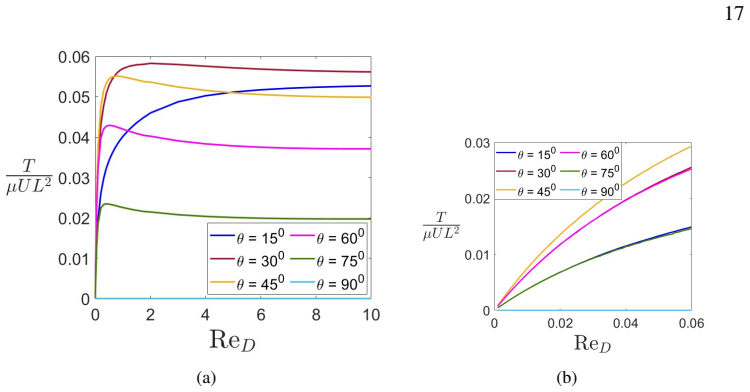
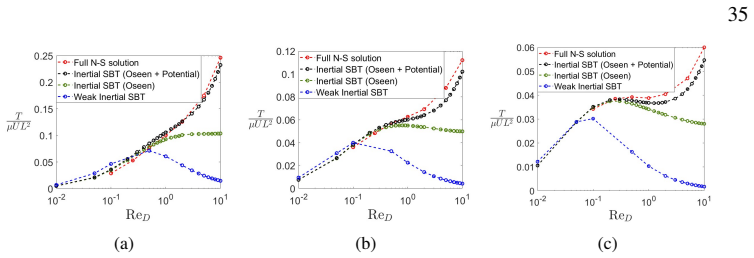
- Once potential sources are included, inertial torque grows monotonically with Reynolds number at finite aspect ratio, correcting earlier non-monotonic Oseen-only predictions.
- At large length-based Reynolds number the local force becomes independent of fiber length and is set by the local cross-section drag law.
- The simple Stokes angular form of drag and lift remains a good approximation only up to Re_D about 1; beyond that the effective coefficients become angle-dependent.
- The same matching framework can be extended to transient settling and imposed linear flows once the steady theory is accepted.
Where Pith is reading between the lines
- The same local two-dimensional drag coefficients could be replaced by those for non-circular or mildly curved cross-sections, extending the theory beyond prolate spheroids and straight cylinders.
- A hybrid treatment that restores streamwise convection near zero inclination would remove the present restriction to angles greater than roughly 15 degrees.
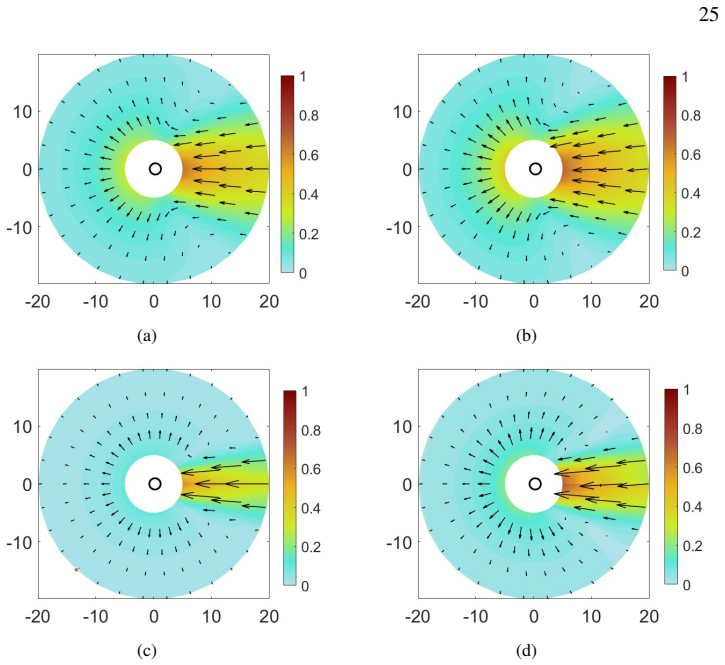
- Because the outer Oseen-plus-potential field already matches the leading 1/h disturbance in the intermediate region at Re_D = 5, the same singular distributions may serve as a cheap multi-particle interaction model at moderate inertia.
- Orientation closures used in climate and manufacturing models that currently assume low-Re fiber dynamics could be replaced by this Re_D-dependent torque without resolving each particle's flow.
Editorial analysis
A structured set of objections, weighed in public.
Referee Report
Summary. The paper constructs a fully inertial slender-body theory for a steadily translating slender particle by matching a quasi-two-dimensional full Navier–Stokes solution in the inner (diameter-scale) region to an outer solution that superposes Oseenlets (line of forces) with a potential-flow field driven by sources and source dipoles. Matching coefficients η_⊥ and η_∥ are obtained from empirical/asymptotic two-dimensional drag laws so that the local force density coincides with the quasi-2D NS response; the resulting integral equation is solved numerically. Drag and lift are carried by the Oseen distribution; potential singularities are added to restore a torque that continues to grow with Re_D at finite aspect ratio. Systematic comparisons with the authors’ finite-difference NS solver (prolate-spheroidal coordinates), with 2-D cylinder data, and with the experiments of Jayaweera & Mason demonstrate accuracy of force and torque for Re_D up to 10 (aspect ratios 20–100, angles ≳15°).
Significance. The work closes a long-standing gap between classical Stokes SBT, the weakly inertial theory of Khayat & Cox (valid only for Re_L ≪ ln κ and Re_D ≪ 1), and the regime of practical interest in which both Re_D and Re_L are O(1) or larger. The construction is falsifiable: forces and torque are compared directly against independent three-dimensional NS solutions and experiments that were not used to calibrate the matching coefficients. The transition to a locally two-dimensional drag law at large Re_L, the non-monotonic parallel force at high Re_D, and the restoration of a growing torque by potential singularities are concrete, testable predictions. The theory supplies a computationally cheap tool for sedimentation, fiber orientation in turbulence, and related multiphase problems once the stated geometric restrictions are respected.
major comments (1)
- The linear superposition of Oseenlets with potential sources/dipoles (eqs. 4.59–4.60) and the neglect of axial convection for θ > 15° are the least rigorous modelling steps (§2.1, §4 introduction, final paragraph of §5). They are explicitly flagged as non-rigorous, the force is independent of the potential term (d’Alembert), and the torque improvement is demonstrated by direct NS comparison (figs. 11–13, 21–22). No further derivation is required for acceptance, but a short quantitative statement of the residual discrepancy (e.g., maximum relative torque error versus NS at Re_D = 5–10) would strengthen the claim of “accuracy up to Re_D = 10.”
minor comments (4)
- The empirical constants a, b, c in C_∥f (eq. 2.35) and the piecewise expression for q (eq. 2.34) should be accompanied by a brief statement of the fitting residual or a reference to the COMSOL data set so that the free parameters are fully documented.
- Figure 6 captions and the surrounding text would benefit from an explicit note that the logarithmic endpoint singularity for cylinders is expected and integrable; readers unfamiliar with classical SBT may otherwise misinterpret the divergence.
- A few typographical inconsistencies appear (e.g., Re_D versus Re𝐷, occasional missing spaces around operators). A light copy-edit pass would remove them.
- The restriction θ ≳ 15° is stated clearly in the conclusions; it would help to restate it once in the abstract or introduction so that the claimed range of validity is visible at first reading.
Circularity Check
No significant circularity: matching coefficients are calibrated from independent 2-D NS drag laws, the outer Oseen+potential construction is derived by asymptotics, and 3-D force/torque predictions are tested against separate full NS solutions and experiments.
full rationale
The derivation chain is self-contained matched asymptotics. Inner quasi-2-D NS supplies local drag coefficients C_perp_f (Espinosa-Gayosso empirical fit) and C_parallel_f (COMSOL heat-transfer analogy with least-squares constants a,b,c); these enter the matching factors eta via (2.40)-(2.41) so that the SBT force density recovers the known 2-D laws when Re_L is large. The outer solution is the standard Oseen Green function plus an independent potential-flow slender-body expansion for sources and dipoles that recovers Lamb's torque to the expected order. Superposition (4.59)-(4.60) is an explicit modeling step, not a fit to the target 3-D data. Validation (Figs. 7-13, 20-22) uses the authors' finite-difference solver and external experiments; those comparisons are independent checks, not inputs that force the predictions by construction. The single self-citation (Sharma & Koch solver) supplies numerical benchmarks only. No equation reduces to a fitted target, no uniqueness theorem is imported, and no known empirical pattern is merely renamed. Score 1 reflects only the ordinary use of the authors' own validated code for comparison.
Axiom & Free-Parameter Ledger
free parameters (2)
- empirical constants a,b,c in C_∥f (Nusselt-analogy fit) =
a=0.8042, b=2.4248, c=1.7022
- piecewise empirical expression for q(Re_D⊥) that defines C_⊥f =
piecewise: Kaplun form for Re≤0.01, polynomial in m=ln(Re/0.01) for 0.01<Re≤10
axioms (4)
- domain assumption Outer flow may be approximated by the Oseen linearization even when the local diameter Reynolds number is O(1)–10, provided the force–velocity relation is taken from the full 2-D NS solution.
- domain assumption Axial convection of momentum is negligible inside the inner region when the angle between velocity and fiber axis exceeds ~15°.
- ad hoc to paper Potential-flow sources and source dipoles may be linearly superposed on the Oseen field to restore finite-thickness effects on torque.
- standard math Standard matched-asymptotics expansion in 1/ln(κ) and 1/κ for slender bodies.
invented entities (1)
-
matching coefficients η_⊥(s) and η_∥(s)
no independent evidence
Cite this review
Pith. "Pith review of An inertial slender-body theory." pith.science (2026). https://pith.science/paper/JORWNMVS
@misc{pith2026260702993,
  author       = {Pith},
  title        = {Pith review of: An inertial slender-body theory},
  year         = {2026},
  howpublished = {\url{https://pith.science/paper/JORWNMVS}},
  note         = {Machine review of arXiv:2607.02993}
}
abstract
We present a fully inertial slender-body theory (SBT) that incorporates the effect of fluid inertia on the scale of the length (the "outer" region) as well as the characteristic diameter (the "inner" region) of a steadily translating slender particle. This is achieved by matching the solution of the quasi-two-dimensional full Navier-Stokes equations in the inner region to an outer solution that consists of a superposition of a solution of the linearized Navier-Stokes equations driven by a line of forces and a potential flow solution driven by a line distribution of sources and source dipoles. The drag and lift forces result from the distribution of Oseen force singularities. These Oseenlets also predominantly govern the torque at small Reynolds numbers and large aspect ratios. However, the potential flow singularities play a crucial role in yielding a torque that grows with increasing Reynolds number at large Reynolds numbers and finite aspect ratios. By comparing the forces and torque on the steadily translating particle with those obtained from a finite difference Navier-Stokes solution, we demonstrate the accuracy of the resulting inertial SBT for $\mathrm{Re}_D$ up to 10, where $\mathrm{Re}_D$ is the Reynolds number based on the smallest dimension, i.e., the characteristic cross-sectional diameter of the slender particle.
Figures









Forward citations
Cited by 1 Pith paper
-
Long rigid fibres in a turbulent channel flow: comparison between experiments and simulations
For long fibres in a turbulent channel, near-wall orientation statistics collapse when wall distance is normalised by fibre length, and pole-vaulting-driven tumbling peaks at about half a fibre length from the wall wi...
Reference graph
Works this paper leans on
-
[1]
Abramowitz and I
M. Abramowitz and I. Stegun , title =
-
[2]
Barker and D
T. Barker and D. G. Schaeffer and P. Boh\'orquez and J. M. N. T. Gray , title =. J. Fluid. Mech. , year =
-
[3]
Batchelor , title =
G.K. Batchelor , title =. J. Fluid Mech. , year =
-
[4]
A. V. Briukhanov and S. S. Grigorian and S. M. Miagkov and M. Y. Plam and I. E. Shurova and M. E. Eglit and Y. L. Yakimov , title =. Physics of Snow and Ice, Proceedings of the International Conference on Low Temperature Science , volume =
-
[5]
Brownell and L.K
C.J. Brownell and L.K. Su , title =. AIAA Paper 2004-2335 , year =
2004
-
[6]
Brownell and L.K
C.J. Brownell and L.K. Su , title =. AIAA Paper 2007-1314 , year =
2007
-
[7]
Dennis , title =
S.C.R. Dennis , title =. Ninth Intl Conf. on Numerical Methods in Fluid Dynamics , publisher =. 1985 , editor =
1985
-
[8]
Formation of levees, troughs and elevated channels by avalanches on erodible slopes , author =. J. Fluid Mech. , volume =
-
[9]
Hwang and E.O
L.-S. Hwang and E.O. Tuck , title =. J. Fluid Mech. , year =
-
[10]
and Saut, Jean Claude , title =
Joseph, Daniel D. and Saut, Jean Claude , title =. Theoretical and Computational Fluid Dynamics , publisher=
-
[11]
Worster , title =
M.G. Worster , title =. Interactive dynamics of convection and solidification , publisher =. 1992 , editor =
1992
-
[12]
Koch , title =
W. Koch , title =. J. Sound Vib. , year =
-
[13]
Lee , title =
J.-J. Lee , title =. J. Fluid Mech. , year =
-
[14]
Linton and D.V
C.M. Linton and D.V. Evans , title =. Phil.\ Trans.\ R. Soc.\ Lond. , year =
-
[15]
Martin , title =
P.A. Martin , title =. 1980 , journal =
1980
-
[16]
Rogallo , title =
R.S. Rogallo , title =
-
[17]
Ursell , title =
F. Ursell , title =. 1950 , journal =
1950
-
[18]
On the oscillations Near and at resonance in open pipes , year =
L. On the oscillations Near and at resonance in open pipes , year =. J. Engng Maths , volume =
-
[19]
Miller , title =
P.L. Miller , title =. 1991 , address =
1991
-
[20]
Camera Calibration Toolbox for Matlab , howpublished =
Bouguet, J.-Y , year=. Camera Calibration Toolbox for Matlab , howpublished =
-
[21]
Journal of Fluid Mechanics , volume=
Slender-body theory for particles of arbitrary cross-section in Stokes flow , author=. Journal of Fluid Mechanics , volume=. 1970 , publisher=
1970
-
[22]
General theory , author=
The motion of long slender bodies in a viscous fluid Part 1. General theory , author=. Journal of Fluid mechanics , volume=. 1970 , publisher=
1970
-
[23]
The motion of long slender bodies in a viscous fluid. Part 2. Shear flow , author=. Journal of Fluid Mechanics , volume=. 1971 , publisher=
1971
-
[24]
Journal of Fluid Mechanics , volume=
Slender-body theory for slow viscous flow , author=. Journal of Fluid Mechanics , volume=. 1976 , publisher=
1976
-
[25]
Journal of Fluid Mechanics , volume=
Inertia effects on the motion of long slender bodies , author=. Journal of Fluid Mechanics , volume=. 1989 , publisher=
1989
-
[26]
Journal of Engineering Mathematics , volume=
Asymptotics beyond all orders for a low Reynolds number flow , author=. Journal of Engineering Mathematics , volume=. 1996 , publisher=
1996
-
[27]
1924 , publisher=
Hydrodynamics , author=. 1924 , publisher=
1924
-
[28]
Journal of Fluid mechanics , volume=
Particle capture and low-Reynolds-number flow around a circular cylinder , author=. Journal of Fluid mechanics , volume=. 2012 , publisher=
2012
-
[29]
Proceedings of the Royal Society of London
On the forces acting on a circular cylinder set obliquely in a uniform stream at low values of Reynolds number , author=. Proceedings of the Royal Society of London. Series A. Mathematical and Physical Sciences , volume=. 1953 , publisher=
1953
-
[30]
Journal of Fluid Mechanics , volume=
The behaviour of freely falling cylinders and cones in a viscous fluid , author=. Journal of Fluid Mechanics , volume=. 1965 , publisher=
1965
-
[31]
Journal of Computational Physics , volume=
Finite difference method in prolate spheroidal coordinates for freely suspended spheroidal particles in linear flows of viscous and viscoelastic fluids , author=. Journal of Computational Physics , volume=. 2023 , publisher=
2023
-
[32]
Physics of Fluids A: Fluid Dynamics , volume=
Hydrodynamic diffusion in dilute sedimenting suspensions at moderate Reynolds numbers , author=. Physics of Fluids A: Fluid Dynamics , volume=. 1993 , publisher=
1993
-
[33]
Journal of Fluid Mechanics , volume=
Evolution of clusters of sedimenting low-Reynolds-number particles with Oseen interactions , author=. Journal of Fluid Mechanics , volume=. 2008 , publisher=
2008
-
[34]
Journal of Fluid Mechanics , volume=
Sedimentation of hard-sphere suspensions at low Reynolds number , author=. Journal of Fluid Mechanics , volume=. 2005 , publisher=
2005
-
[35]
The Journal of chemical physics , volume=
Sedimentation of spheres at small Reynolds number , author=. The Journal of chemical physics , volume=. 2005 , publisher=
2005
-
[36]
Journal of Fluid Mechanics , volume=
On the periodic fundamental solutions of the Stokes equations and their application to viscous flow past a cubic array of spheres , author=. Journal of Fluid Mechanics , volume=. 1959 , publisher=
1959
-
[37]
Journal of Fluid Mechanics , volume=
The slow motion of slender rod-like particles in a second-order fluid , author=. Journal of Fluid Mechanics , volume=. 1975 , publisher=
1975
-
[38]
Journal of Fluid Mechanics , volume=
Rotation of a fibre in simple shear flow of a dilute polymer solution , author=. Journal of Fluid Mechanics , volume=. 2023 , publisher=
2023
-
[39]
Highly elastic fluids , author=
Orientation in simple shear flow of semi-dilute fiber suspensions 2. Highly elastic fluids , author=. Journal of non-newtonian fluid mechanics , volume=. 1996 , publisher=
1996
-
[40]
Rheologica Acta , volume=
Particle motions in non-Newtonian media: I: Couette flow , author=. Rheologica Acta , volume=. 1971 , publisher=
1971
-
[41]
Weakly elastic fluids , author=
Orientation in simple shear flow of semi-dilute fiber suspensions 1. Weakly elastic fluids , author=. Journal of non-newtonian fluid mechanics , volume=. 1996 , publisher=
1996
-
[42]
Further observations in elasticoviscous fluids , author=
Particle motions in non-newtonian media: III. Further observations in elasticoviscous fluids , author=. Rheologica Acta , volume=. 1975 , publisher=
1975
-
[43]
Journal of Fluid Mechanics , volume=
Rigid ring-shaped particles that align in simple shear flow , author=. Journal of Fluid Mechanics , volume=. 2013 , publisher=
2013
-
[44]
Journal of Fluid Mechanics , volume=
Controlling rotation and migration of rings in a simple shear flow through geometric modifications , author=. Journal of Fluid Mechanics , volume=. 2018 , publisher=
2018
-
[45]
Journal of Fluid Mechanics , volume=
Slender body theory for particles with non-circular cross-sections with application to particle dynamics in shear flows , author=. Journal of Fluid Mechanics , volume=. 2019 , publisher=
2019
-
[46]
2023 , publisher=
Dinamica di fibre in flussi viscosi e turbolenti: uno studio sperimentale e numerico , author=. 2023 , publisher=
2023
-
[47]
Physical Review Fluids , volume=
Robust microstructure of self-aligning particles in a simple shear flow , author=. Physical Review Fluids , volume=. 2024 , publisher=
2024
-
[48]
Journal of Fluid Mechanics , volume=
Inertial torques and a symmetry breaking orientational transition in the sedimentation of slender fibres , author=. Journal of Fluid Mechanics , volume=. 2019 , publisher=
2019
-
[49]
Journal of Non-Newtonian Fluid Mechanics , volume=
Orientation of finite Reynolds number anisotropic particles settling in turbulence , author=. Journal of Non-Newtonian Fluid Mechanics , volume=. 2023 , publisher=
2023
-
[50]
Journal of Fluid Mechanics , volume=
Low Reynolds number heat transfer from a circular cylinder , author=. Journal of Fluid Mechanics , volume=. 1968 , publisher=
1968
-
[51]
Journal of Fluid Mechanics , volume=
Uniform asymptotic solutions for potential flow about a slender body of revolution , author=. Journal of Fluid Mechanics , volume=. 1975 , publisher=
1975
-
[52]
1987 , publisher=
Fluid Mechanics: Volume 6 , author=. 1987 , publisher=
1987
-
[53]
1954 , publisher=
Heat transfer from wires at Reynolds numbers in the Oseen range , author=. 1954 , publisher=
1954
-
[54]
Journal of Fluid Mechanics , volume=
Axially symmetric potential flow around a slender body , author=. Journal of Fluid Mechanics , volume=. 1967 , publisher=
1967
-
[55]
Journal of Mathematics and Mechanics , pages=
Low Reynolds number flow past a circular cylinder , author=. Journal of Mathematics and Mechanics , pages=. 1957 , publisher=
1957
-
[56]
The Physics of Fluids , volume=
Equation of motion for a small rigid sphere in a nonuniform flow , author=. The Physics of Fluids , volume=. 1983 , publisher=
1983
-
[57]
Journal of fluid mechanics , volume=
The lift on a small sphere in a slow shear flow , author=. Journal of fluid mechanics , volume=. 1965 , publisher=
1965
-
[58]
Journal of Fluid Mechanics , volume=
Simple shear flow round a rigid sphere: inertial effects and suspension rheology , author=. Journal of Fluid Mechanics , volume=. 1970 , publisher=
1970
-
[59]
Journal of fluid Mechanics , volume=
Inertial migration of a small sphere in linear shear flows , author=. Journal of fluid Mechanics , volume=. 1991 , publisher=
1991
-
[60]
Physics of Fluids , volume=
Structure and dynamics of dilute suspensions of finite-Reynolds-number settling fibers , author=. Physics of Fluids , volume=. 2009 , publisher=
2009
-
[61]
Journal of fluid mechanics , volume=
Sedimentation in a dilute dispersion of spheres , author=. Journal of fluid mechanics , volume=. 1972 , publisher=
1972
-
[62]
Archive for Rational Mechanics and Analysis , volume=
Analysis of the viscosity of dilute suspensions beyond Einstein’s formula , author=. Archive for Rational Mechanics and Analysis , volume=. 2020 , publisher=
2020
-
[63]
Journal of Fluid Mechanics , volume=
The determination of the bulk stress in a suspension of spherical particles to order c2 , author=. Journal of Fluid Mechanics , volume=. 1972 , publisher=
1972
-
[64]
Journal of Fluid Mechanics , volume=
The effect of inertia on the orientation dynamics of anisotropic particles in simple shear flow , author=. Journal of Fluid Mechanics , volume=. 2016 , publisher=
2016
-
[65]
Physical Review E , volume=
Effect of weak fluid inertia upon Jeffery orbits , author=. Physical Review E , volume=. 2015 , publisher=
2015
-
[66]
Quarterly Journal of the Royal Meteorological Society: A journal of the atmospheric sciences, applied meteorology and physical oceanography , volume=
Doppler lidar measurements of oriented planar ice crystals falling from supercooled and glaciated layer clouds , author=. Quarterly Journal of the Royal Meteorological Society: A journal of the atmospheric sciences, applied meteorology and physical oceanography , volume=. 2010 , publisher=
2010
-
[67]
Journal of the Atmospheric Sciences , volume=
On the orientation of ice crystals in a cumulonimbus cloud , author=. Journal of the Atmospheric Sciences , volume=. 1981 , publisher=
1981
-
[68]
Environmental science & technology , volume=
Effects of particle properties on the settling and rise velocities of microplastics in freshwater under laboratory conditions , author=. Environmental science & technology , volume=. 2019 , publisher=
2019
-
[69]
Marine pollution bulletin , volume=
Settling velocity of microplastic particles of regular shapes , author=. Marine pollution bulletin , volume=. 2017 , publisher=
2017
-
[70]
Fiber orientation control related to papermaking , author=
-
[71]
2005 , school=
Fluid mechanics of fibre suspensions related to papermaking , author=. 2005 , school=
2005
-
[72]
Journal of Fluid Mechanics , volume=
The instability of a dispersion of sedimenting spheroids , author=. Journal of Fluid Mechanics , volume=. 1989 , publisher=
1989
-
[73]
Journal of Fluid Mechanics , volume=
Dynamic simulations of the inhomogeneous sedimentation of rigid fibres , author=. Journal of Fluid Mechanics , volume=. 2002 , publisher=
2002
-
[74]
Journal of Fluid Mechanics , volume=
Inertial effects on fibre motion in simple shear flow , author=. Journal of Fluid Mechanics , volume=. 2005 , publisher=
2005
-
[75]
Industrial & engineering chemistry research , volume=
Measurement and prediction of pressure drop in pneumatic conveying: Effect of particle characteristics, mass loading, and Reynolds number , author=. Industrial & engineering chemistry research , volume=. 2005 , publisher=
2005
-
[76]
Physics of Fluids , volume=
A computational evaluation of the Ergun and Forchheimer equations for fibrous porous media , author=. Physics of Fluids , volume=. 2001 , publisher=
2001
-
[77]
Proceedings of the Royal Society of London
The motion of ellipsoidal particles immersed in a viscous fluid , author=. Proceedings of the Royal Society of London. Series A, Containing papers of a mathematical and physical character , volume=. 1922 , publisher=
1922
-
[78]
Equilibrium orientations of rods and discs (experimental) , author=
The kinetics of flowing dispersions: III. Equilibrium orientations of rods and discs (experimental) , author=. Journal of Colloid and Interface Science , volume=. 1967 , publisher=
1967
-
[79]
Physics of Fluids , volume=
The dynamics of fibrous aerosols in a quiescent atmosphere , author=. Physics of Fluids , volume=. 1994 , publisher=
1994
-
[80]
Physical Review Fluids , volume=
Inertial effects on fibers settling in a vortical flow , author=. Physical Review Fluids , volume=. 2017 , publisher=
2017
This paper was first reviewed by grok-4.5 on July 12, 2026.
discussion (0)
Sign in with ORCID, Apple, or X to comment. Anyone can read and Pith papers without signing in.