REVIEW 3 major objections 5 minor 1 cited by
This paper argues that the binary black-hole mergers in the fifth LIGO–Virgo–KAGRA catalog split into four distinct subpopulations—differing in mass, mass ratio, and spin—and that the four-component model beats a single smooth population mo
Reviewed by Pith at T0; open to challenge. T0 means a machine referee read the full paper against a public rubric. the ladder, T0–T4 →
T0 review · deepseek-v4-flash
2026-08-01 06:03 UTC pith:XYVZLUH4
load-bearing objection A careful but methodologically circular four-component decomposition of GWTC-5.0; the Bayes factor is overstated, but the analysis is worth engaging seriously. the 3 major comments →
Revealing Four Subpopulations of Binary Black-Hole Mergers with the Fifth Gravitational-Wave Transient Catalog
The pith
A machine-rendered reading of the paper's core claim, the machinery that carries it, and where it could break.
Core claim
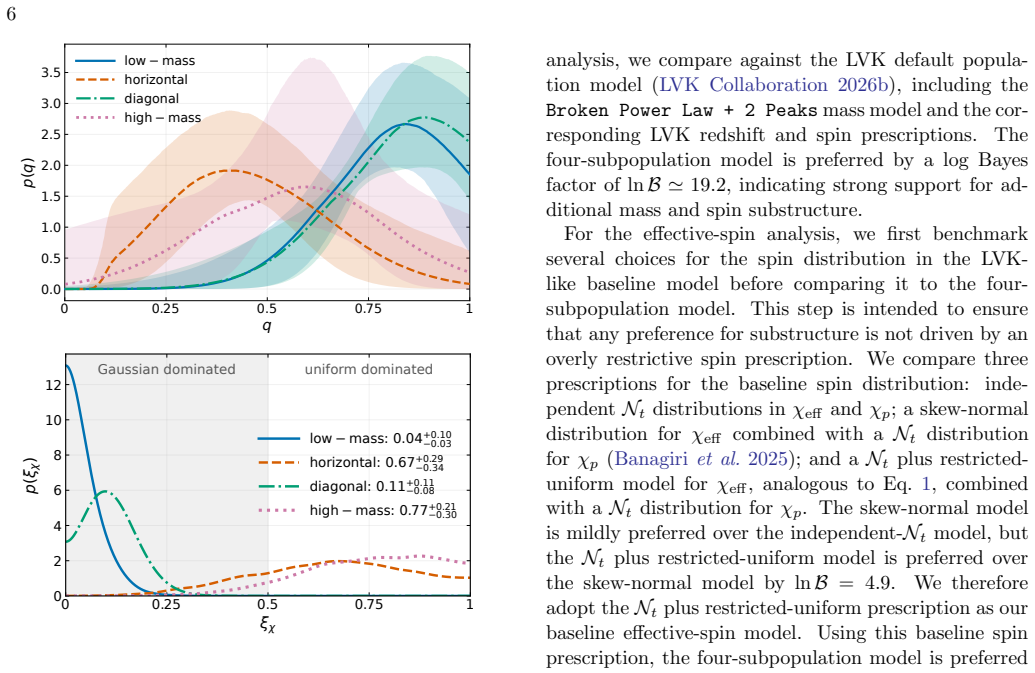
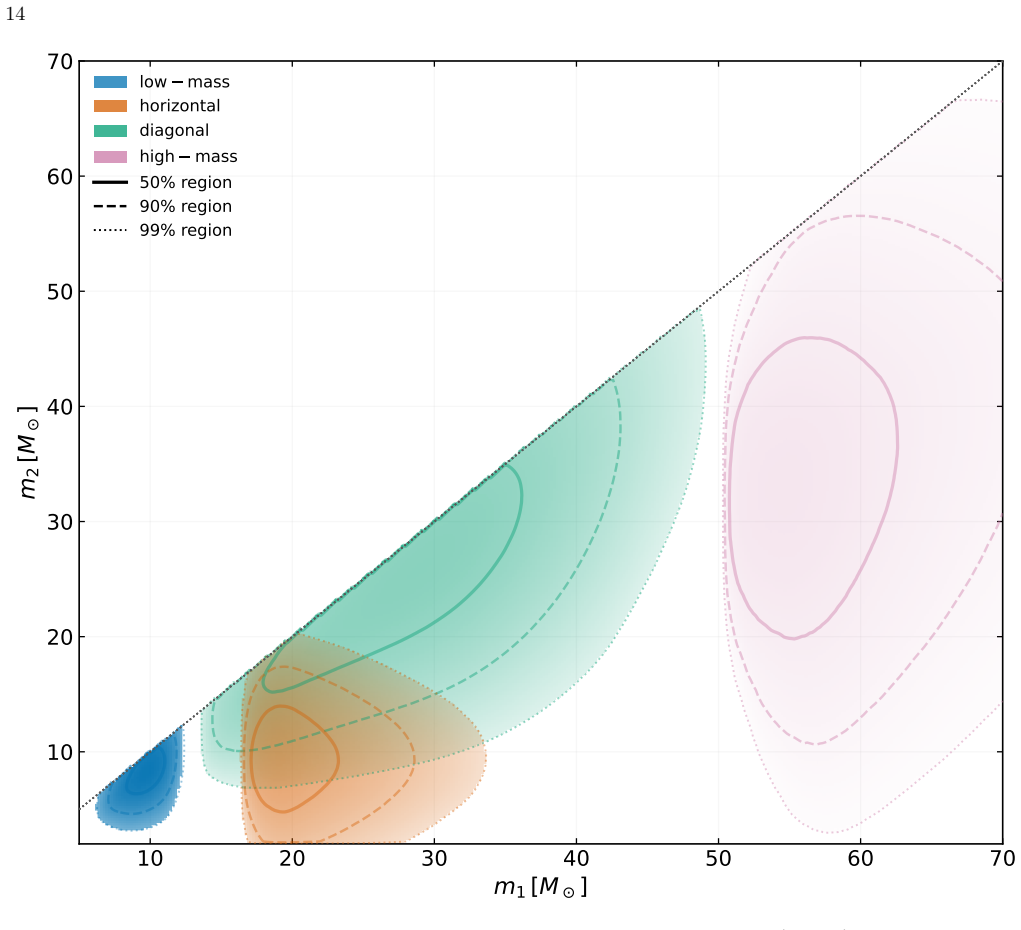
The central claim is that the GWTC-5.0 binary black-hole population is naturally described by four subpopulations with distinct mass, mass-ratio, and spin properties, and the four-component model is preferred over the standard LIGO–Virgo–KAGRA population model by a log Bayes factor of 19.2. The low-mass component centres at 10.1 solar masses in primary mass, favours near-equal mass ratio (mean 0.85), has low spins and aligned tilts, and contributes ~70% of the merger rate. The horizontal component contributes ~13%, pairs a secondary concentrated near 9.2 solar masses with a power-law primary extending to ~37 solar masses, and shows mixed spin properties. The diagonal component contributes ~1
What carries the argument
The method is a two-stage hybrid. First, a non-parametric maximum-likelihood population reconstruction ('pi-stroke') represents the population as a weighted collection of delta functions and is used only to identify where the data want support in the (m1, m2) plane. Second, guided by the four clusters seen there, the authors construct a parametric mixture: each subpopulation gets its own mass distribution (truncated normals, power laws, and Planck tapers) and its own spin model, either in effective spin (a truncated normal plus uniform mixture for chi_eff) or in physical spins (spin magnitudes and tilt alignments). The comparison model is the standard LIGO–Virgo–KAGRA default population mode
Load-bearing premise
The four-component structure and the evidence for it are both derived from the same data: the mixture was designed after seeing clusters in the non-parametric reconstruction of these 259 events, and the Bayes factor does not correct for that look-elsewhere effect; if the clusters are artifacts of the maximum-likelihood delta-function solution, the four-component claim collapses.
What would settle it
Feed the same two-stage pipeline mock gravitational-wave catalogs drawn from a single smooth population (or apply it to the next independent catalog), and check how often a four-component model is preferred by ln BF > 10. If such false positives are common, the claimed evidence is a selection artifact; if a future catalog also yields four stable components with similar mixture fractions, the claim is supported.
If this is right
- If the four-component model is correct, the majority of binary black-hole mergers come from a low-mass, low-spin channel near 10 solar masses, and the depletion near 14 solar masses is real structure, with the merger rate there about 26 times lower than the default model predicts.
- The population cannot be summarized by the primary-mass distribution alone: the horizontal and diagonal components overlap in primary mass but have very different mass-ratio and spin behaviour, so mass ratio and spin are needed to separate channels.
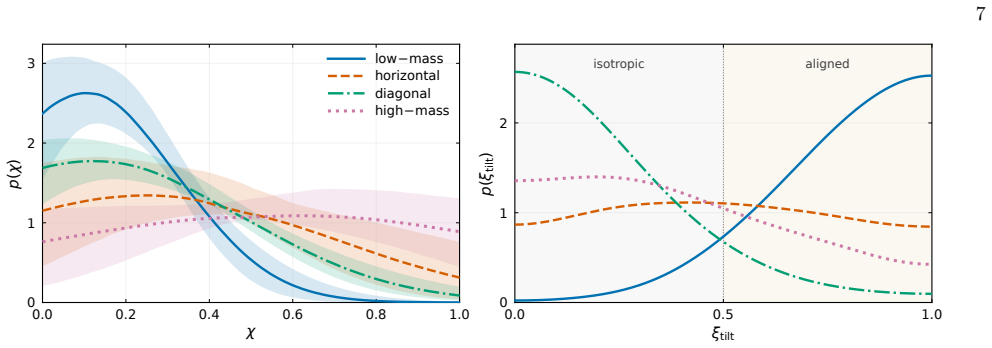
- Distinct spin properties across components support formation-channel interpretations: low-mass and diagonal are low-spin, horizontal is mixed, high-mass is broad and misaligned, consistent with hierarchical mergers.
- Current data do not require separate redshift evolution for the four components: allowing component-specific redshift laws changes the log Bayes factor by less than about 0.5.
- The paper reports independent agreement from another non-parametric analysis of similar subpopulation structure, suggesting the findings are not unique to this particular method.
Where Pith is reading between the lines
- The reported ln BF = 19.2 likely overstates the evidence because the four-component model was chosen after inspecting the same events' non-parametric reconstruction; a principled correction for this in-sample model selection, or a comparison with 3- and 5-component alternatives, would give a fairer evidence figure.
- If the 14 solar-mass depletion is astrophysical, stellar-evolution models can be tested by predicting the gap's location and width as functions of progenitor metallicity and redshift; future events inside the gap would challenge it.
- The horizontal component's mixed spins imply a testable distinction: stable mass transfer with tidal spin-up predicts systematically positive chi_eff and aligned tilts for this component, whereas a dynamical origin predicts isotropic tilts.
- The diagonal component's low chi_eff with possibly broad tilts is near the edge of current sensitivity; a larger catalog can determine whether its tilt distribution is truly isotropic, which would strongly favour formation in dense stellar environments over field binaries.
Editorial analysis
A structured set of objections, weighed in public.
Referee Report
Summary. The paper analyzes 259 binary black-hole mergers from GWTC-5.0 and argues that the population is naturally decomposed into four subpopulations in the (m1, m2) plane: a dominant low-mass component near 10–12 Msun, an unequal-mass 'horizontal' branch with secondary near 10 Msun, a near-equal-mass 'diagonal' branch peaking near 30–35 Msun, and a rare high-mass component with broad spins interpreted as hierarchical mergers. The method is two-stage: a non-parametric maximum-likelihood reconstruction (pi-stroke) is used as a discovery step, and the four parametric components are then 'motivated by these clusters' (Sec. 2). The four-component model is compared with the LVK default population model, reporting ln BF = 19.2 (physical spin) and ln BF = 16.5 (effective spin) in Sec. 4. The paper includes posterior predictive checks, selection effects following LVK prescriptions, and robustness to spin parameterization. The main claim is that these four components are distinct physical populations with distinct spin and mass-ratio properties.
Significance. If the four-component decomposition is robust, the paper would strengthen the emerging picture of multiple BBH formation channels, and the hybrid data-driven-plus-parametric approach is a useful methodological contribution. The analysis is generally careful: it uses standard LVK event selection and selection effects, includes posterior predictive intervals, does not impose the pair-instability gap, and checks both effective-spin and physical-spin parameterizations. However, the central evidence—the ln BF = 19.2 preference over the LVK baseline—is computed in-sample: the four components were chosen after inspecting the pi-stroke reconstruction of the same 259 events. The manuscript provides no 3- or 5-component comparison and no correction for the model-selection loop. Unless this is addressed, the 'overwhelmingly preferred' claim (Abstract) is not supported by the presented analysis.
major comments (3)
- [Sec. 2 / Sec. 4]
- [Sec. 2, Eq. (1)]
- [Sec. 1 / Sec. 4]
minor comments (5)
- [Title]
- [Sec. 2]
- [Sec. 6]
- [Fig. 1]
- [Appendix B]
Circularity Check
No circularity found: the four-component model is fitted to the same data it is compared against, which is a statistical selection-effect concern, but no step reduces by construction to its own input.
full rationale
Walking the derivation chain: single-event posterior samples are used (1) to run a pi-stroke maximum-likelihood reconstruction, (2) to motivate a four-component parametric mixture, and (3) to compute a Bayes factor against the LVK default model on the same 259 events. This is an in-sample model-selection procedure, and the paper candidly states in Sec. 1: 'This procedure reverses the usual order of inference: rather than beginning with a theoretically motivated model and searching for its imprint in the data, we first identify and characterize the dominant structures preferred by the observations and only then interpret them astrophysically.' That is a real methodological caveat about look-elsewhere/selection effects, but it is not circularity in the sense required here: no fitted parameter is renamed as a prediction, no equation is defined in terms of the quantity it claims to prove, and the reported ln BF = 19.2 is an actual computed evidence ratio, not an identity. The pi-stroke citations (Payne & Thrane 2023; Guttman et al. 2026) are method citations rather than imported conclusions, and the paper explicitly warns that pi-stroke 'should not be interpreted as the true astrophysical population distribution, nor as a smooth density estimate.' The absence of 3- or 5-component benchmarks and the lack of a null-hypothesis correction are correctness/statistical concerns, not circular reductions. No self-citation chain forces the central claim, and the astrophysical interpretations are presented as non-unique. Thus no significant circularity.
Axiom & Free-Parameter Ledger
free parameters (10)
- Mixture fractions f1, f2, f3 =
f_low=0.709+0.069/-0.099, f_horiz=0.130+0.082/-0.059, f_diag=0.141+0.079/-0.047
- Low-mass component mass parameters (7) =
mu_m1=10.1+1.5/-0.8 Msun, mu_q=0.85+0.12/-0.10; boundaries/taper widths in repo
- Horizontal component parameters (6) =
alpha=5.2+4.0/-5.7, mu_m2=9.2+2.3/-2.4 Msun, sigma_m2=3.8+1.8/-1.7 Msun
- Diagonal component parameters (9) =
lambda_pk=0.78+0.20/-0.34, mu_pk=31.0+2.7/-4.2 Msun
- High-mass component parameters (6) =
alpha_U and boundaries in repo; q-peak ~0.58+0.19/-0.25
- Redshift evolution index kappa =
not reported in text
- Effective-spin parameters (8) =
xi_chi: low=0.04, horiz=0.67, diag=0.11, high=0.77; other mu/sigma in repo
- Physical-spin parameters (13) =
mu_chi high=0.58+0.36/-0.45, sigma_chi high=0.70+0.27/-0.36; others in repo
- Fixed chi_eff uniform interval (-0.47, 0.47) =
-0.47, 0.47 (fixed by hand)
- Aligned tilt component center mu_tilt = 1 =
1 (fixed)
axioms (5)
- domain assumption The 259 selected GWTC-5.0 events and their posterior samples are reliable and independent.
- domain assumption The injection-based selection function is a valid estimate of detection efficiency.
- domain assumption The pi-stroke maximum-likelihood reconstruction is a valid exploratory tool and its delta-function clusters correspond to real population support.
- ad hoc to paper The fixed spin-uniform interval (-0.47, 0.47) brackets the true chi_eff support of hierarchical-merger populations.
- domain assumption Mass-spin model adequacy: four truncated-normal/power-law components can represent the true population without misspecification.
invented entities (4)
-
low-mass subpopulation
independent evidence
-
horizontal subpopulation
no independent evidence
-
diagonal subpopulation
independent evidence
-
high-mass subpopulation
independent evidence
read the original abstract
Gravitational-wave data are beginning to reveal a structured landscape of black-hole masses and spins, suggesting multiple formation processes are now being resolved observationally. We analyze data from LIGO--Virgo--KAGRA's (LVK's) fifth Gravitational-Wave Transient Catalog and find that the population is naturally described by four distinct subpopulations. The dominant component, contributing $\simeq70\%$ of the astrophysical merger rate, is characterised by a low-mass population centred near $10M_\odot$ and is separated from heavier systems by a depletion near $14M_\odot$. This component may be associated with black holes formed from failed supernovae. Above this depletion, we find two intermediate-mass components: an unequal-mass branch pairing the lower-mass, $\simeq10M_\odot$ black hole with a heavier black hole, perhaps associated with isolated-binary/stable-mass-transfer formation, and a nearly equal-mass branch peaking near $30$--$35M_\odot$ whose low spins and mass distribution favour first-generation systems possibly born in dense stellar environments. A fourth, percent-level component extends to higher masses and is characterized by a broad mass-ratio distribution and large spin magnitudes, consistent with a hierarchical-merger population. Our four-component model is overwhelmingly preferred over a standard LVK population model by a natural-log Bayes factor of $\ln(\mathrm{BF}) = 19.2$. Our work observationally unveils a new subpopulation of black-hole mergers utilising a new hybrid data-driven and parametric-model discovery method, bringing us one step closer to understanding stellar-mass black-hole archaeology.
Figures


Forward citations
Cited by 1 Pith paper
-
A Four-dimensional Model-agnostic Probe into the Astrophysical Origins of Binary Black Hole Subpopulations
A GPU-accelerated binned Gaussian process yields the first model-agnostic 4D BBH population in (m1, q, χeff, χp), revealing four mass-based subpopulations and new spin-mass-ratio correlations.
Reference graph
Works this paper leans on
-
[1]
A&A , volume =
Failed supernovae as a natural explanation for the binary black hole mass distribution , author =. A&A , volume =. 2023 , publisher =
2023
-
[2]
Low-mass failed supernovae and the 10\,M_
Isaac Legred and Jacob Golomb and Katerina Chatziioannou , year=. Low-mass failed supernovae and the 10\,M_. 2604.01420 , archivePrefix=
-
[3]
Model exploration in gravitational-wave astronomy with the maximum population likelihood , author =. Phys. Rev. Res. , volume =. 2023 , month =. doi:10.1103/PhysRevResearch.5.023013 , url =
-
[4]
Guttman, Nir and Payne, Ethan and Lasky, Paul D. and Thrane, Eric , title =. 2026 , month =. doi:10.3847/1538-4357/ae17af , url =
-
[5]
Journal of Open Source Software , doi =
Colm Talbot and Amanda Farah and Shanika Galaudage and Jacob Golomb and Hui Tong , title =. Journal of Open Source Software , doi =. 2025 , publisher =
2025
-
[6]
2026 , eprint=
Evidence for additional structure in the effective spin distribution hints at multiple formation pathways in GWTC-5.0 , author=. 2026 , eprint=
2026
-
[7]
Monthly Notices of the Royal Astronomical Society , volume =
Antonini, Fabio and Gieles, Mark and Dosopoulou, Fani and Chattopadhyay, Debatri , title =. Monthly Notices of the Royal Astronomical Society , volume =. 2023 , month =. doi:10.1093/mnras/stad972 , url =
-
[8]
Oey, M. S. , title =. 2011 , month =. doi:10.1088/2041-8205/739/2/L46 , url =
-
[9]
2026 , eprint=
Reversible-jump MCMC reveals binary black hole subpopulations with distinct redshift evolution , author=. 2026 , eprint=
2026
-
[10]
and Vijaykumar, Aditya and Fishbach, Maya , title =
Farah, Amanda M. and Vijaykumar, Aditya and Fishbach, Maya , title =. 2026 , month =. doi:10.3847/2041-8213/ae4e19 , url =
-
[11]
Ray, Anarya and Hernandez, Ignacio Magaña and Breivik, Katelyn and Creighton, Jolien , title =. 2025 , month =. doi:10.3847/1538-4357/adf22a , url =
-
[12]
Tong, Hui and Fishbach, Maya and Thrane, Eric and Mould, Matthew and Callister, Thomas A. and Farah, Amanda M. and Guttman, Nir and Banagiri, Sharan and Beltran-Martinez, Daniel and Farr, Ben and Galaudage, Shanika and Godfrey, Jaxen and Heinzel, Jack and Kalomenopoulos, Marios and Miller, Simona J. and Vijaykumar, Aditya , date =. Evidence of the pair-in...
-
[14]
Population of Merging Compact Binaries Inferred Using Gravitational Waves through GWTC-3 , author=. Phys. Rev. X , volume =. 2023 , month =. doi:10.1103/PhysRevX.13.011048 , url =
-
[15]
2026 , eprint=
Compactness Peaks and Subpopulations: Probing Stellar Physics and Formation Channels of Merging Binary Black Holes , author=. 2026 , eprint=
2026
-
[16]
Galaudage, Shanika and Lamberts, Astrid , year=. Compactness peaks: An astrophysical interpretation of the mass distribution of merging binary black holes , volume=. doi:10.1051/0004-6361/202451654 , journal=
-
[17]
2025 , eprint=
GWTC-4.0: Population Properties of Merging Compact Binaries , author=. 2025 , eprint=
2025
-
[18]
Banagiri, Sharan and Thrane, Eric and Lasky, Paul D. , year=. Evidence for Three Subpopulations of Merging Binary Black Holes at Different Primary Masses , volume=. Physical Review Letters , publisher=. doi:10.1103/blyb-lqv6 , number=
-
[19]
Mandel, Ilya and de Mink, Selma E. , title =. Monthly Notices of the Royal Astronomical Society , volume =. 2016 , month =. doi:10.1093/mnras/stw379 , url =
-
[20]
Kishore Roy, Soumendra and van Son, Lieke A C and Farr, Will M , title =. 2025 , month =. doi:10.1088/1361-6382/ae1921 , url =
-
[21]
2021 , eprint=
A Thesaurus for Common Priors in Gravitational-Wave Astronomy , author=. 2021 , eprint=
2021
-
[23]
Schneider, Fabian R. N. and Podsiadlowski, Philipp and Laplace, Eva , title =. 2023 , month =. doi:10.3847/2041-8213/acd77a , url =
-
[24]
Postnov, Konstantin A. and Yungelson, Lev R. , date =. The Evolution of Compact Binary Star Systems , url =. Living Reviews in Relativity , number =. 2014 , bdsk-url-1 =. doi:10.12942/lrr-2014-3 , id =
-
[25]
Star Cluster Population of High Mass Black Hole Mergers in Gravitational Wave Data , author =. Phys. Rev. Lett. , volume =. 2025 , month =. doi:10.1103/PhysRevLett.134.011401 , url =
-
[26]
and Adamcewicz, Christian and Doctor, Zoheyr and Kalogera, Vicky , title =
Banagiri, Sharan and Callister, Thomas A. and Adamcewicz, Christian and Doctor, Zoheyr and Kalogera, Vicky , title =. 2025 , month =. doi:10.3847/1538-4357/adf4c6 , url =
-
[27]
2025 , eprint=
A subpopulation of low-mass, spinning black holes: signatures of dynamical assembly , author=. 2025 , eprint=
2025
-
[28]
2026 , eprint=
GWTC-5.0: An Introduction to Version 5.0 of the Gravitational-Wave Transient Catalog , author=. 2026 , eprint=
2026
-
[29]
2026 , eprint=
GWTC-5.0: Population Properties of Merging Compact Binaries , author=. 2026 , eprint=
2026
-
[30]
Adamcewicz, Christian and Guttman, Nir and Lasky, Paul D. and Thrane, Eric , year=. Do Both Black Holes Spin in Merging Binaries? Evidence from GWTC-4 and Astrophysical Implications , volume=. The Astrophysical Journal , publisher=. doi:10.3847/1538-4357/ae1370 , number=
-
[31]
Talbot, Colm and Thrane, Eric , title =. 2018 , month =. doi:10.3847/1538-4357/aab34c , url =
-
[32]
B. P. Abbott and others. GW170608: Observation of a 19 Solar-mass Binary Black Hole Coalescence
-
[33]
GW190412: Observation of a Binary-Black-Hole Coalescence with Asymmetric Masses
R Abbott and others. GW190412: Observation of a Binary-Black-Hole Coalescence with Asymmetric Masses
-
[34]
Properties of the Binary Black Hole Merger GW150914
B P Abbott and others. Properties of the Binary Black Hole Merger GW150914
-
[35]
On the properties of the massive binary black hole merger GW170729
Katerina Chatziioannou and others. On the properties of the massive binary black hole merger GW170729
-
[36]
GWTC-2: Compact Binary Coalescences Observed by LIGO and Virgo During the First Half of the Third Observing Run
R Abbott and others. GWTC-2: Compact Binary Coalescences Observed by LIGO and Virgo During the First Half of the Third Observing Run
-
[37]
Talbot and E Thrane
C. Talbot and E Thrane. Determining the population properties of spinning black holes
-
[38]
High resolution nonparametric inference of gravitational-wave populations in multiple dimensions , author =. Phys. Rev. D , volume =. 2025 , month =. doi:10.1103/PhysRevD.111.063043 , url =
-
[39]
Heinzel, Jack and Mould, Matthew and Vitale, Salvatore , year=. Nonparametric analysis of correlations in the binary black hole population with LIGO-Virgo-KAGRA data , volume=. Physical Review D , publisher=. doi:10.1103/physrevd.111.l061305 , number=
-
[40]
2026 , eprint=
Black hole mergers from dense star clusters with realistic binary populations , author=. 2026 , eprint=
2026
-
[41]
Zevin, Michael and Bavera, Simone S. , title =. 2022 , month =. doi:10.3847/1538-4357/ac6f5d , url =
-
[42]
Most Black Holes Are Born Very Slowly Rotating , volume=
Fuller, Jim and Ma, Linhao , year=. Most Black Holes Are Born Very Slowly Rotating , volume=. The Astrophysical Journal Letters , publisher=. doi:10.3847/2041-8213/ab339b , number=
-
[43]
Olejak, Aleksandra and Klencki, Jakub and Xu, Xiao-Tian and Wang, Chen and Belczynski, Krzysztof and Lasota, Jean-Pierre , year=. Unequal-mass highly spinning binary black hole mergers in the stable mass transfer formation channel , volume=. doi:10.1051/0004-6361/202450480 , journal=
-
[44]
Hierarchical mergers of stellar-mass black holes and their gravitational-wave signatures , volume=
Gerosa, Davide and Fishbach, Maya , year=. Hierarchical mergers of stellar-mass black holes and their gravitational-wave signatures , volume=. Nature Astronomy , publisher=. doi:10.1038/s41550-021-01398-w , number=
-
[45]
Marchant, Pablo and Pappas, Kaliroë M. W. and Gallegos-Garcia, Monica and Berry, Christopher P. L. and Taam, Ronald E. and Kalogera, Vicky and Podsiadlowski, Philipp , year=. The role of mass transfer and common envelope evolution in the formation of merging binary black holes , volume=. doi:10.1051/0004-6361/202039992 , journal=
-
[46]
Applications to X-ray binaries and to the binarypulsars
The effects of sudden mass loss and a random kick velocity produced in a supernova explosion on the dynamics of a binary star of arbitrary orbital eccentricity. Applications to X-ray binaries and to the binarypulsars. , keywords =. doi:10.1086/160871 , adsurl =
-
[47]
M.\ and Takens, \ R
Tauris, \ T. M.\ and Takens, \ R. J.\. Runaway velocities of stellar components originating from disrupted binaries via asymmetric supernova explosions. Astronomy and Astrophysics. 1998
1998
-
[48]
Gravitational waves from supernova mass loss and natal kicks in close binaries , volume=
Holgado, A Miguel and Ricker, Paul M , year=. Gravitational waves from supernova mass loss and natal kicks in close binaries , volume=. Monthly Notices of the Royal Astronomical Society , publisher=. doi:10.1093/mnras/stz2925 , number=
-
[49]
Modelling precession effects with a single effective precession parameter , author =
Towards models of gravitational waveforms from generic binaries: II. Modelling precession effects with a single effective precession parameter , author =. Phys. Rev. D , volume =. 2015 , month =. doi:10.1103/PhysRevD.91.024043 , url =
-
[50]
Coalescence of two spinning black holes: An effective one-body approach , author =. Phys. Rev. D , volume =. 2001 , month =. doi:10.1103/PhysRevD.64.124013 , url =
-
[51]
and Klencki, J
Belczynski, K. and Klencki, J. and Fields, C. E. and Olejak, A. and Berti, E. and Meynet, G. and Fryer, C. L. and Holz, D. E. and O’Shaughnessy, R. and Brown, D. A. and Bulik, T. and Leung, S. C. and Nomoto, K. and Madau, P. and Hirschi, R. and Kaiser, E. and Jones, S. and Mondal, S. and Chruslinska, M. and Drozda, P. and Gerosa, D. and Doctor, Z. and Gie...
-
[52]
Li, Yin-Jie and Wang, Yuan-Zhu and Tang, Shao-Peng and Fan, Yi-Zhong , year=. Resolving the Stellar-Collapse and Hierarchical-Merger Origins of the Coalescing Black Holes , volume=. Physical Review Letters , publisher=. doi:10.1103/physrevlett.133.051401 , number=
-
[53]
2026 , eprint=
Transitions in the Mass-ratio and Spin Properties of Binary Black Holes in GWTC-5 , author=. 2026 , eprint=
2026
-
[54]
2026 , eprint=
Distinct spin properties and astrophysical origin of low mass binary black holes in gravitational wave data , author=. 2026 , eprint=
2026
-
[55]
Tiwari, Vaibhav and Fairhurst, Stephen , title =. 2021 , month =. doi:10.3847/2041-8213/abfbe7 , url =
-
[56]
Examining the Gap in the Chirp Mass Distribution of Binary Black Holes , volume=
Tiwari, Vaibhav , year=. Examining the Gap in the Chirp Mass Distribution of Binary Black Holes , volume=. The Astrophysical Journal , publisher=. doi:10.3847/1538-4357/ae2260 , number=
-
[57]
2026 , eprint=
The Chirp-Mass Ladder: A New Rung Emerges , author=. 2026 , eprint=
2026
-
[58]
2026 , eprint=
No model-independent evidence for a peak in binary black hole spin (mis)alignments , author=. 2026 , eprint=
2026
-
[59]
Mould, Matthew and Gerosa, Davide and Taylor, Stephen R. , year=. Deep learning and Bayesian inference of gravitational-wave populations: Hierarchical black-hole mergers , volume=. Physical Review D , publisher=. doi:10.1103/physrevd.106.103013 , number=
-
[60]
Reexamining Evidence of a Pair-instability Mass Gap in the Binary Black Hole Population , volume=
Ray, Anarya and Kalogera, Vicky , year=. Reexamining Evidence of a Pair-instability Mass Gap in the Binary Black Hole Population , volume=. The Astrophysical Journal Letters , publisher=. doi:10.3847/2041-8213/ae374d , number=
-
[61]
Mould, Matthew and Heinzel, Jack and Álvarez-López, Sofía and Plunkett, Cailin and Wolfe, Noah E. and Vitale, Salvatore , year=. Measurement prospects for the pair-instability mass cutoff with gravitational waves , volume=. Physical Review D , publisher=. doi:10.1103/sqy9-nnqq , number=
-
[62]
Toubiana, A and Katz, Michael L and Gair, Jonathan R , year=. Is there an excess of black holes around 20 M⊙? Optimizing the complexity of population models with the use of reversible jump MCMC. , volume=. Monthly Notices of the Royal Astronomical Society , publisher=. doi:10.1093/mnras/stad2215 , number=
-
[63]
2026 , eprint=
Emergent structure in the binary black hole mass distribution and implications for population-based cosmology , author=. 2026 , eprint=
2026
-
[64]
2026 , eprint=
When the black holes align: a subpopulation of aligned massive binary black holes observed via gravitational waves , author=. 2026 , eprint=
2026
-
[65]
Aligned Hierarchical Black Hole Mergers in Active-Galactic-Nuclei Disks Revealed by GWTC-4 , volume=
Li, Yin-Jie and Wang, Yuan-Zhu and Tang, Shao-Peng and Fan, Yi-Zhong , year=. Aligned Hierarchical Black Hole Mergers in Active-Galactic-Nuclei Disks Revealed by GWTC-4 , volume=. Physical Review Letters , publisher=. doi:10.1103/qyfv-wkv1 , number=
-
[66]
Li, Yin-Jie and Wang, Yuan-Zhu and Tang, Shao-Peng and Chen, Tong and Fan, Yi-Zhong , title =. 2025 , month =. doi:10.3847/1538-4357/add535 , url =
-
[67]
Edelman, Bruce and Farr, Ben and Doctor, Zoheyr , year=. Cover Your Basis: Comprehensive Data-driven Characterization of the Binary Black Hole Population , volume=. The Astrophysical Journal , publisher=. doi:10.3847/1538-4357/acb5ed , number=
-
[68]
2025 , eprint=
Population of Binary Black Holes Inferred from One Hundred and Fifty Gravitational Wave Signals , author=. 2025 , eprint=
2025
-
[69]
2026 , eprint=
Joint population and strong-lensing inference for resolved gravitational-wave events probes the black-hole merger rate beyond the peak of star formation , author=. 2026 , eprint=
2026
-
[70]
Sadiq, Jam and Dent, Thomas and Gieles, Mark , title =. 2023 , month =. doi:10.3847/1538-4357/ad0ce6 , url =
-
[71]
On the Astrophysical Origin of Binary Black Hole Subpopulations: A Tale of Three Channels? , volume=
Ray, Anarya and Mukherjee, Shirsha and Zevin, Michael and Kalogera, Vicky , year=. On the Astrophysical Origin of Binary Black Hole Subpopulations: A Tale of Three Channels? , volume=. The Astrophysical Journal Letters , publisher=. doi:10.3847/2041-8213/ae80cb , number=
-
[72]
Sridhar, Omkar and Ray, Anarya and Kalogera, Vicky. Characterizing Binary Black Hole Subpopulations in GWTC-4 with Binned Gaussian Processes: On the Origins of the 35 M _ ⊙ Peak. Astrophys. J. Lett. 2026. doi:10.3847/2041-8213/ae8011. arXiv:2511.22093
Pith/arXiv arXiv 2026
-
[73]
Inferring black hole formation channels in GWTC-4.0 via parametric mass-spin correlations derived from first principles , author =. Phys. Rev. D , volume =. 2026 , month =. doi:10.1103/3mb7-vnft , url =
-
[74]
Schneider, F. R. N. and Podsiadlowski, Ph. and Müller, B. , title =. doi:10.1051/0004-6361/202039219
-
[75]
2025 , eprint=
Good things always come in 3s: trimodality in the binary black-hole chirp-mass distribution supports bimodal black-hole formation , author=. 2025 , eprint=
2025
-
[76]
Mandel, Ilya and Riley, Jeff and Boesky, Adam and Brček, Adam and Hirai, Ryosuke and Kapil, Veome and Lau, Mike Y. M. and Merritt, JD and Rodríguez-Segovia, Nicolás and Romero-Shaw, Isobel and Song, Yuzhe and Stevenson, Simon and Vajpeyi, Avi and van Son, L. A. C. and Vigna-Gómez, Alejandro and Willcox, Reinhold , title =. 2025 , month =. doi:10.3847/1538...
-
[77]
and Boyett, Kristian N
Riley, Jeff and Agrawal, Poojan and Barrett, Jim W. and Boyett, Kristian N. k. and Broekgaarden, Floor S. and Chattopadhyay, Debatri and Gaebel, Sebastian M. and Gittins, Fabian and Hirai, Ryosuke and Howitt, George and Justham, Stephen and Khandelwal, Lokesh and Kummer, Floris and Lau, Mike Y. m. and Mandel, Ilya and de Mink, Selma E. and Neijssel, Coenr...
2022
discussion (0)
Sign in with ORCID, Apple, or X to comment. Anyone can read and Pith papers without signing in.