Inter-qubit interaction mediated by collective modes in a linear array of three-dimensional cavities
Pith reviewed 2026-05-25 13:13 UTC · model grok-4.3
The pith
A hybrid technique estimates inter-qubit coupling in 3D cavity arrays by combining Hamiltonians with simple simulations.
A machine-rendered reading of the paper's core claim, the machinery that carries it, and where it could break.
Core claim
Inter-qubit interactions in a linear array of 3D cavities are mediated by collective electromagnetic modes, and these interaction strengths can be obtained accurately from a Hamiltonian model supplemented by only simple HFSS runs rather than complete electromagnetic simulations of every configuration.
What carries the argument
The hybrid estimation technique that merges a Hamiltonian description of the multi-cavity system with targeted HFSS simulation outputs to extract inter-qubit couplings mediated by collective modes.
If this is right
- Coupling strengths between distant qubits can be predicted without performing a complete electromagnetic simulation of the entire array.
- The modular cavity construction allows rapid experimental testing of different linear layouts while the hybrid method supplies the theoretical couplings.
- The same collective-mode mediation picture can be applied to estimate interactions once the array size exceeds what full HFSS can comfortably handle.
Where Pith is reading between the lines
- The approach may lower the computational barrier for exploring scaling limits in cavity-based quantum processors.
- Validation on two-dimensional cavity lattices would test whether the same Hamiltonian-plus-limited-simulation logic extends beyond linear chains.
Load-bearing premise
The agreement between hybrid estimates and full simulations observed for three-cavity lines will continue to hold for larger or differently arranged qubit-cavity arrays.
What would settle it
A direct side-by-side comparison on a four-cavity linear array in which the hybrid method and a full HFSS simulation produce inter-qubit coupling values that differ by more than the reported agreement margin for the three-cavity case.
Figures


read the original abstract
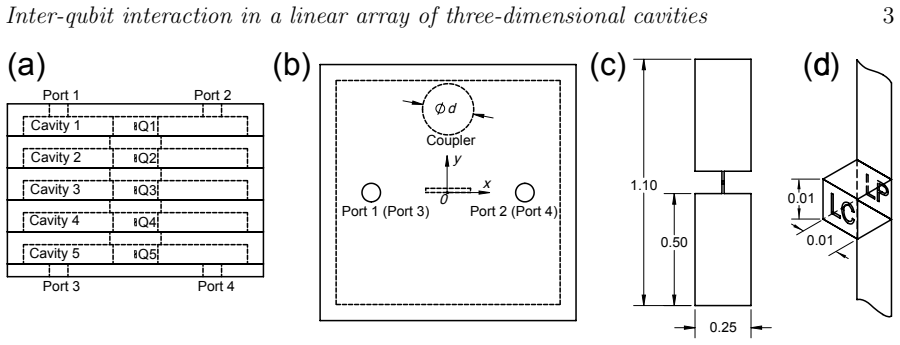
A design of LEGO-like construction set that allows assembling of different linear arrays of three-dimensional (3D) cavities and qubits for circuit quantum electrodynamics (cQED) experiments has been developed. A study of electromagnetic properties of qubit-3D cavity arrays has been done by using high frequency structure simulator (HFSS). A technique for estimation of inter-qubit coupling strength between qubits embedded in different cavities of cavity array, which combines Hamiltonian description of the system with simple HFSS simulations, has been proposed. A good agreement between inter-qubit coupling strengths, which were obtained by using this technique and directly from simulation, demonstrates the suitability of the method for more complex qubit-cavity arrays where usage of finite-element electromagnetic simulators is limited.
Editorial analysis
A structured set of objections, weighed in public.
Referee Report
Summary. The manuscript describes a modular LEGO-like construction set for assembling linear arrays of three-dimensional cavities with embedded qubits for cQED experiments. HFSS finite-element simulations are used to characterize the electromagnetic properties of these arrays. A hybrid technique is proposed that combines a Hamiltonian description of the collective modes with a small number of simple HFSS runs to estimate inter-qubit coupling strengths; the authors report good numerical agreement between this hybrid estimate and direct HFSS extraction for a linear three-cavity array and conclude that the method is therefore suitable for more complex arrays where full HFSS simulations become impractical.
Significance. A validated hybrid method that avoids full finite-element runs for larger cavity-qubit arrays would be a useful practical tool for cQED device design. The modular assembly concept could also simplify experimental iteration. The reported agreement for the three-cavity case is a positive but limited demonstration; the broader utility claim hinges on whether the Hamiltonian model remains complete when array size or topology increases.
major comments (1)
- [Abstract] Abstract: the assertion that agreement in the three-cavity linear case 'demonstrates the suitability of the method for more complex qubit-cavity arrays' is not supported by any additional evidence or analysis. No simulations, bounds, or arguments are provided to show that the Hamiltonian plus limited HFSS procedure captures all relevant collective-mode or higher-order interactions once the array becomes branched or larger than three cavities.
minor comments (1)
- The abstract contains several awkward or incomplete English constructions (e.g., 'A design of LEGO-like construction set') that should be revised for readability.
Simulated Author's Rebuttal
We thank the referee for their review and constructive comment. We address the concern regarding the abstract below.
read point-by-point responses
-
Referee: [Abstract] Abstract: the assertion that agreement in the three-cavity linear case 'demonstrates the suitability of the method for more complex qubit-cavity arrays' is not supported by any additional evidence or analysis. No simulations, bounds, or arguments are provided to show that the Hamiltonian plus limited HFSS procedure captures all relevant collective-mode or higher-order interactions once the array becomes branched or larger than three cavities.
Authors: We agree that the abstract overstates the implications of the three-cavity linear-array results. The manuscript presents a hybrid Hamiltonian-plus-HFSS approach whose validity is demonstrated only for that specific case. We will revise the abstract to remove the claim that the agreement 'demonstrates the suitability' for more complex arrays and instead state that the agreement supports further exploration of the method for larger linear arrays where full HFSS becomes impractical. The underlying Hamiltonian is constructed from the collective cavity modes, which formally extends to larger N, but we acknowledge that explicit checks for branched topologies or higher-order effects lie outside the current work. revision: yes
Circularity Check
No circularity; hybrid method validated externally against HFSS.
full rationale
The derivation proposes a Hamiltonian-plus-HFSS hybrid for estimating inter-qubit couplings, then directly compares its outputs to independent full HFSS simulations on the same 3-cavity linear array. This is an external consistency check, not a self-definition, fitted-parameter renaming, or self-citation chain. No equations reduce the claimed prediction to the input data by construction, and the central claim remains falsifiable against the simulator. The extrapolation assumption to larger arrays is a separate correctness concern, not circularity.
Axiom & Free-Parameter Ledger
Reference graph
Works this paper leans on
-
[1]
Wendin G 2017 Reports on Progress in Physics 80 106001
work page 2017
-
[2]
Barends R, Kelly J, Megrant A, Veitia A, Sank D, Jeffrey E, White T C , Mutus J, Fowler A G, Campbell B, Chen Y, Chen Z, Chiaro B, Dunsworth A, Neill C, O’Malley P, Roushan P, Vainsencher A, Wenner J, Korotkov A N, Cleland A N and Martinis J M 20 14 Nature 508 500
-
[3]
Neill C, Roushan P, Kechedzhi K, Boixo S, Isakov S V, Smelyanskiy V, Megrant A, Chiaro B, Dunsworth A, Arya K, Barends R, Burkett B, Chen Y, Chen Z, Fowle r A, Foxen B, Giustina M, Graff R, Jeffrey E, Huang T, Kelly J, Klimov P, Lucero E, Mutus J, Ne eley M, Quintana C, Sank D, Vainsencher A, Wenner J, White T C, Neven H and Martinis J M 2 018 Science 360 195
-
[4]
Reagor M, Osborn C B, Tezak N, Staley A, Prawiroatmodjo G, Sch eer M, Alidoust N, Sete E A, Didier N, da Silva M P, Acala E, Angeles J, Bestwick A, Block M, Bloom B , Bradley A, Inter-qubit interaction in a linear array of three-dimensi onal cavities 15 Bui C, Caldwell S, Capelluto L, Chilcott R, Cordova J, Crossman G, Cu rtis M, Deshpande S, El Bouayadi ...
work page 2018
-
[5]
Barends R, Lamata L, Kelly J, Garcia-Alvarez L, Fowler A G, Megra nt A, Jeffrey E, White T C, Sank D, Mutus J Y, Campbell B, Chen Y, Chen Z, Chiaro B, Dunsworth A, Hoi I C, Neill C, O’Malley P J J, Quintana C, Roushan P, Vainsencher A, Wenner J, Solan o E and Martinis J M 2015 Nature Communications 6 7654
work page 2015
-
[6]
Fitzpatrick M, Sundaresan N M, Li A C Y, Koch J and Houck A A 2017 Physical Review X 7 011016
work page 2017
-
[7]
Paik H, Schuster D I, Bishop L S, Kirchmair G, Catelani G, Sears A P , Johnson B R, Reagor M J, Frunzio L, Glazman L I, Girvin S M, Devoret M H and Schoelkopf R J 2011 Physical Review Letters 107 240501
work page 2011
-
[8]
Rigetti C, Gambetta J M, Poletto S, Plourde B L T, Chow J M, Corco les A D, Smolin J A, Merkel S T, Rozen J R, Keefe G A, Rothwell M B, Ketchen M B and Steffen M 201 2 Physical Review B 86 100506
-
[9]
URL https://www.ansys.com/
-
[10]
Nigg S E, Paik H, Vlastakis B, Kirchmair G, Shankar S, Frunzio L, De voret M H, Schoelkopf R J and Girvin S M 2012 Physical Review Letters 108 240502
work page 2012
-
[11]
Solgun F and DiVincenzo D P 2015 Annals of Physics 361 605
work page 2015
-
[12]
Majer J, Chow J M, Gambetta J M, Koch J, Johnson B R, Schreier J A, Frunzio L, Schuster D I, Houck A A, Wallraff A, Blais A, Devoret M H, Girvin S M and Schoelkopf R J 2 007 Nature 449 443
-
[13]
Filipp S, Goppl M, Fink J M, Baur M, Bianchetti R, Steffen L and Wallr aff A 2011 Physical Review A 83 063827
work page 2011
-
[14]
Mckay D C, Naik R, Reinhold P, Bishop L S and Schuster D I 2015 Physical Review Letters 114 080501
work page 2015
-
[15]
Koch J, Yu T M, Gambetta J, Houck A A, Schuster D I, Majer J, B lais A, Devoret M H, Girvin S M and Schoelkopf R J 2007 Physical Review A 76 042319
work page 2007
-
[16]
Gely M F, Steele G A and Bothner D 2018 Physical Review A 98 053808
work page 2018
discussion (0)
Sign in with ORCID, Apple, or X to comment. Anyone can read and Pith papers without signing in.