A novel object slicing based grasp planner for 3D object grasping using underactuated robot gripper
Pith reviewed 2026-05-24 18:21 UTC · model grok-4.3
The pith
An object slicing method computes feasible grasps for underactuated grippers directly from point clouds of complex shapes.
A machine-rendered reading of the paper's core claim, the machinery that carries it, and where it could break.
Core claim
The central claim is that an object slicing technique can quickly identify kinematically feasible contact points on arbitrary 3D shapes so that underactuated fingers reach multiple goal locations at once, yielding high-quality grasps for both adaptive and fingertip modes without object simplification or analytic finger solutions.
What carries the argument
The object slicing technique, which intersects the object geometry with successive planes to generate candidate contact sets that the underactuated finger kinematics can reach.
If this is right
- Grasp planning becomes possible for underactuated hands on raw sensor data of everyday objects.
- The same pipeline produces both enveloping and precision grasps.
- No geometric primitive fitting step is required before planning.
- Kinematic constraints of the specific gripper are enforced during contact selection.
Where Pith is reading between the lines
- The slicing approach could be extended to generate grasp candidates for hands with more than two fingers by applying the same plane intersections per finger.
- Integration with online depth camera streams might support reactive grasping when objects move or the scene changes.
- Computation speed gains from slicing could allow the planner to be used inside a larger motion planning loop that also considers arm reachability.
Load-bearing premise
Object slicing reliably identifies contact points that underactuated fingers can reach simultaneously without a closed-form kinematic solution.
What would settle it
Running the planner on objects with deep concavities or thin protrusions and observing that most generated contact sets lie outside the reachable workspace of the gripper's joints would falsify the method.
Figures
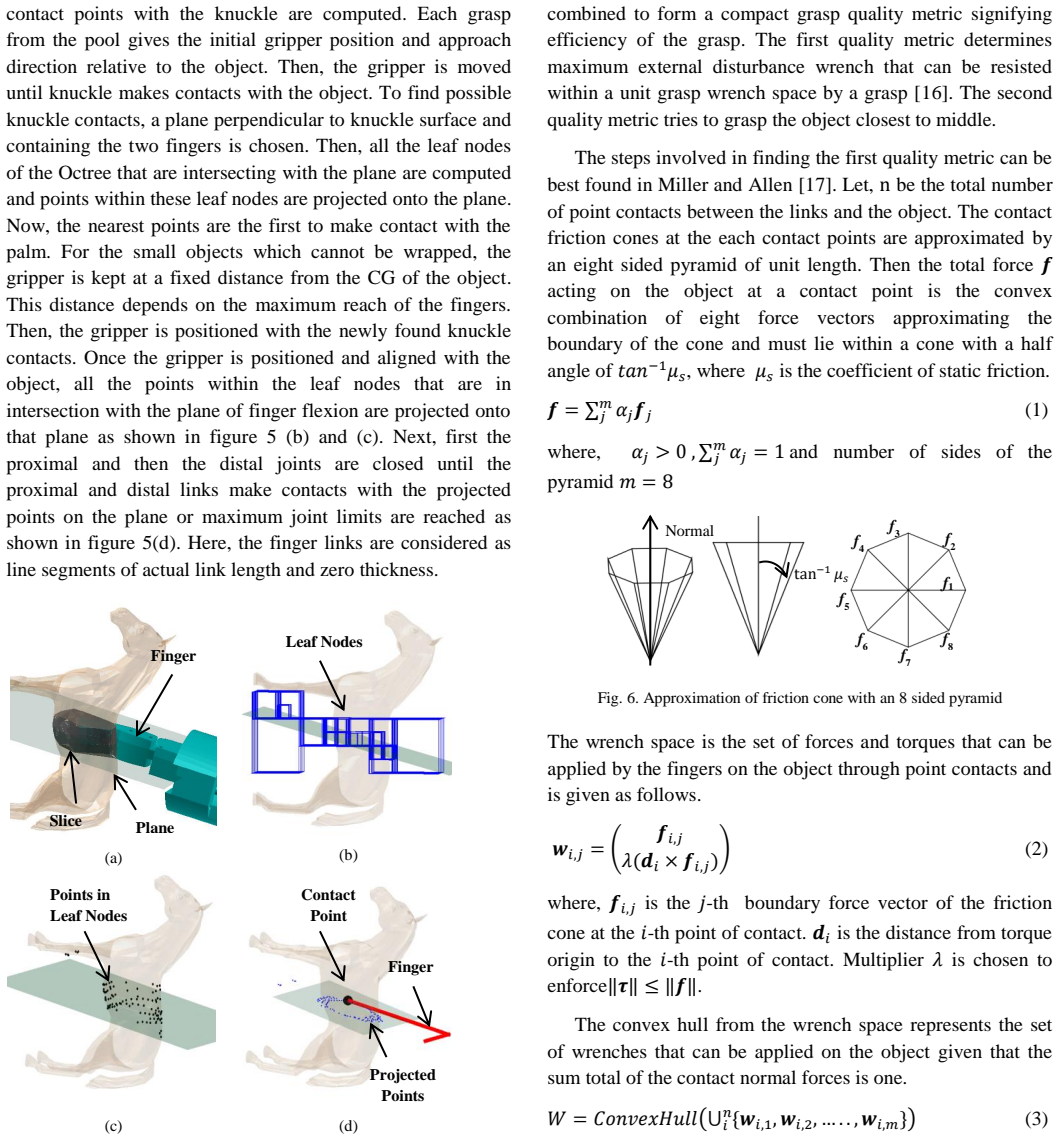
read the original abstract
Robotic grasping of arbitrary objects even in completely known environments still remains a challenging problem. Most previously developed algorithms had focused on fingertip grasp, failing to solve the problem even for fully actuated hands/grippers during adaptive/wrapping type of grasps, where each finger makes contact with object at several points. Kinematic closed form solutions are not possible for such an articulated finger which simultaneously reaches several given goal points. This paper, presents a framework for computing best grasp for an underactuated robotic gripper, based on a novel object slicing method. The proposed method quickly find contacts using an object slicing technique and use grasp quality measure to find the best grasp from a pool of grasps. To validate the proposed method, implementation has been done on twenty-four household objects and toys using a two finger underactuated robot gripper. Unlike the many other existing approaches, the proposed approach has several advantages: it can handle objects with complex shapes and sizes; it does not require simplifying the objects into primitive geometric shape; Most importantly, it can be applied on point clouds taken using depth sensor; it takes into account gripper kinematic constraints and generates feasible grasps for both adaptive/enveloping and fingertip types of grasps.
Editorial analysis
A structured set of objections, weighed in public.
Referee Report
Summary. The paper proposes a grasp planner for underactuated robotic grippers that uses a novel object-slicing technique to generate candidate contact points on 3D objects (including from depth-sensor point clouds) without reducing them to geometric primitives, followed by grasp-quality evaluation to select feasible grasps. The method is claimed to handle both fingertip and adaptive/enveloping grasps while respecting gripper kinematic constraints, and is validated by implementation on 24 household objects and toys using a two-finger underactuated gripper.
Significance. If the slicing procedure demonstrably produces kinematically reachable multi-contact configurations for underactuated fingers, the approach would be useful for practical grasping of complex shapes from real sensor data. The validation on 24 objects and explicit handling of both grasp types are positive features, but the absence of any reported error metrics, success rates, or comparison baselines limits the strength of the empirical claim.
major comments (2)
- [Abstract] Abstract: the assertion that the method “takes into account gripper kinematic constraints” is load-bearing for the central claim yet unsupported; the text states that closed-form kinematics are impossible for an articulated underactuated finger reaching multiple goal points simultaneously, but provides no description of how the slicing step or subsequent selection enforces simultaneous reachability under the gripper’s tendon routing and joint coupling.
- [Abstract] Abstract (validation paragraph): the claim of successful implementation on 24 objects is presented without any quantitative results (success rate, grasp quality values, failure modes, or comparison to baselines), so it is impossible to assess whether the generated grasps are actually kinematically feasible or merely geometrically plausible.
minor comments (1)
- [Abstract] The abstract would benefit from a brief statement of the grasp-quality metric employed and the precise definition of “feasible grasp.”
Simulated Author's Rebuttal
We thank the referee for the constructive feedback on our manuscript. We address the major comments point-by-point below and will revise the paper to improve clarity and empirical reporting.
read point-by-point responses
-
Referee: [Abstract] Abstract: the assertion that the method “takes into account gripper kinematic constraints” is load-bearing for the central claim yet unsupported; the text states that closed-form kinematics are impossible for an articulated underactuated finger reaching multiple goal points simultaneously, but provides no description of how the slicing step or subsequent selection enforces simultaneous reachability under the gripper’s tendon routing and joint coupling.
Authors: We agree that the current manuscript does not provide an explicit description of how the slicing procedure or grasp selection enforces simultaneous reachability under the specific tendon routing and joint coupling of the underactuated gripper. The slicing generates candidate contacts along object cross-sections chosen to be compatible with the finger's adaptive motion, and the quality measure is applied only to those contacts; however, no formal reachability check or mapping to tendon lengths is detailed. We will add a dedicated subsection explaining the constraint handling (including how slices are oriented relative to the gripper base and how invalid configurations are filtered) in the revised version. revision: yes
-
Referee: [Abstract] Abstract (validation paragraph): the claim of successful implementation on 24 objects is presented without any quantitative results (success rate, grasp quality values, failure modes, or comparison to baselines), so it is impossible to assess whether the generated grasps are actually kinematically feasible or merely geometrically plausible.
Authors: The validation section reports experiments on 24 objects but indeed omits quantitative metrics such as success rates, grasp quality values, failure modes, or baselines. We will revise both the abstract and the experimental results section to report these metrics (e.g., percentage of successful grasps for fingertip vs. enveloping types, average grasp quality, and observed failure cases) from the existing experiments. revision: yes
Circularity Check
No circularity: algorithmic description with no self-referential equations or fitted predictions
full rationale
The paper presents a grasp-planning framework that generates candidate contacts via object slicing then ranks them by an (unspecified) grasp quality measure. No equations, parameters, or derivations appear in the provided text. Claims about handling kinematic constraints are stated at the level of method capability rather than derived from any self-defined quantity or prior self-citation that would reduce the result to its inputs by construction. The approach is therefore self-contained as a descriptive algorithm.
Axiom & Free-Parameter Ledger
Lean theorems connected to this paper
-
IndisputableMonolith/Foundation/RealityFromDistinction.leanreality_from_one_distinction unclear?
unclearRelation between the paper passage and the cited Recognition theorem.
A novel object slicing based grasp planner... object slicing technique and use grasp quality measure... takes into account gripper kinematic constraints
-
IndisputableMonolith/Cost/FunctionalEquation.leanwashburn_uniqueness_aczel unclear?
unclearRelation between the paper passage and the cited Recognition theorem.
Kinematic closed form solutions are not possible for such an articulated finger which simultaneously reaches several given goal points
What do these tags mean?
- matches
- The paper's claim is directly supported by a theorem in the formal canon.
- supports
- The theorem supports part of the paper's argument, but the paper may add assumptions or extra steps.
- extends
- The paper goes beyond the formal theorem; the theorem is a base layer rather than the whole result.
- uses
- The paper appears to rely on the theorem as machinery.
- contradicts
- The paper's claim conflicts with a theorem or certificate in the canon.
- unclear
- Pith found a possible connection, but the passage is too broad, indirect, or ambiguous to say the theorem truly supports the claim.
Reference graph
Works this paper leans on
-
[1]
Shimoga, ―Robot grasp synthesis algorithms: A survey ,‖ Int
K.B. Shimoga, ―Robot grasp synthesis algorithms: A survey ,‖ Int. J. Robotics Research, vol. 15, no. 3, pp. 230–266, 1996
work page 1996
-
[2]
A. Sahbani, S. Khoury, and P. Bidaud, ―An overview of 3D object grasp synthesis algorithms,‖ Robotics and Autonomous Systems, vo. 60, no. 3, pp. 326-336, 2012
work page 2012
-
[3]
A. Bicchi, ―On the closure properties of robotic grasping, ‖ International Journal of Robotics Research, vol. 14, no. 4, pp. 319–344, 1995
work page 1995
- [4]
- [5]
-
[6]
D. Wren, and R. Fisher, ―Dexterous hand grasping strategies using preshapes and digit trajectories, ‖ in IEEE International Conference on Systems, Man and Cybernetics, 1995, pp. 910-915
work page 1995
- [7]
-
[8]
N. Vahrenkamp, L. Westkamp, N. Yamanobe, E. E. Aksoy, and T. Asfour, ―Part-based grasp planning for familiar objects, ‖ in IEEE-RAS 16th International Conference on Humanoid Robots (Humanoids), Cancun, 2016, pp. 919-925
work page 2016
-
[9]
C. Rosales, L. Ros, JM. Porta and R. Suarez, ―Synthesizing grasp configurations with specified contact regions,‖ The International Journal of Robotics Research, vol. 30, no. 4, pp. 431–443, 2011
work page 2011
- [10]
-
[11]
J. P. Saut and D. Sidobre, ―Efficient models for grasp planning with a multi-fingered hand,‖ Robotics and Autonomous Systems, vol. 60, pp. 347–357, 2012
work page 2012
-
[12]
Z. Xue, S.W. Rühl, J.M. Zöllner and R. Dillmann, ―An Automatic Grasp Planning System for Multi-fingered Robotic Hands,‖ in Towards Service Robots for Everyday Environments. vol. 76, Prassler E. et al. (eds) , Springer Tracts in Advanced Robotics, Springer, Berlin, Heidelberg, 2012, pp. 391-402
work page 2012
-
[13]
Y. Li, J.P. Saut, J. Pettre, A. Sabhani and F. Multon, ―Fast Grasp Planning by Using Cord Geometry to Find Grasping Points, ‖ in International Conference on Robotics and Automation, 2013, pp. 3265 - 3270
work page 2013
- [14]
- [15]
-
[16]
C. Ferrari and J. Canny, ―Planning optimal grasps, ‖ in International Conference on Robotics and Automation, 1992, pp. 2290-2295
work page 1992
-
[17]
Examples of 3D grasp quality computations
A.T. Miller and P. K. Allen , "Examples of 3D grasp quality computations." in Proceedings 1999 IEEE International Confer ence on Robotics and Automation, 1999, pp. 1240-1246
work page 1999
-
[18]
P. Shilane, P. Min, M. Kazhdan and T. Funkhouser, ―The princeton shape benchmark,‖ in Proceedings Shape Modeling Applications,
discussion (0)
Sign in with ORCID, Apple, or X to comment. Anyone can read and Pith papers without signing in.