Time-dependent coupled cluster theory on the Keldysh contour for non-equilibrium systems
Pith reviewed 2026-05-24 15:13 UTC · model grok-4.3
The pith
Keldysh contour extends finite-temperature coupled cluster theory to non-equilibrium driven systems.
A machine-rendered reading of the paper's core claim, the machinery that carries it, and where it could break.
Core claim
Leveraging the Keldysh formalism extends finite temperature coupled cluster theory to thermal systems driven out of equilibrium, yielding Keldysh coupled cluster theory with implemented equations for singles and doubles calculations of finite temperature dynamics, as shown on a Hubbard model with Peierls phase and an ab initio model of warm-dense silicon under an ultrafast XUV pulse.
What carries the argument
Keldysh coupled cluster theory on the contour, which encodes time-dependent non-equilibrium evolution while retaining the coupled cluster expansion for thermal systems.
If this is right
- Finite-temperature dynamics become accessible for driven lattice models such as the Hubbard chain under a Peierls phase.
- Ab initio calculations of warm-dense matter response to ultrafast pulses, such as XUV irradiation of silicon, can be performed at the CCSD level.
- The Keldysh contour implementation supplies the working equations needed to propagate the cluster amplitudes in time for non-equilibrium thermal states.
Where Pith is reading between the lines
- The same contour-based extension could be applied to other truncations or to open systems coupled to baths.
- Direct benchmarks against time-dependent exact methods on small clusters would quantify the error introduced by the doubles truncation under drive.
- The framework suggests a route to embed Keldysh CC into larger embedding schemes for extended materials.
Load-bearing premise
The singles and doubles truncation of coupled cluster remains accurate enough for the non-equilibrium dynamics on the Keldysh contour.
What would settle it
Exact diagonalization of the driven Hubbard model with Peierls phase would show whether Keldysh CCSD matches the true dynamics at the same parameters.
Figures





read the original abstract
We leverage the Keldysh formalism to extend our implementation of finite temperature coupled cluster theory [\textit{J. Chem. Theory Comput.} 2018, \textit{14}, 5690-5700] to thermal systems that have been driven out of equilibrium. The resulting Keldysh coupled cluster theory is discussed in detail. We describe the implementation of the equations necessary to perform Keldysh coupled cluster singles and doubles calculations of finite temperature dynamics, and we apply the method to some simple systems including a Hubbard model with a Peierls phase and an {\it ab initio} model of warm-dense silicon subject to an ultrafact XUV pulse.
Editorial analysis
A structured set of objections, weighed in public.
Referee Report
Summary. The manuscript extends the authors' prior finite-temperature coupled cluster theory to non-equilibrium thermal systems by leveraging the Keldysh formalism. It discusses the resulting Keldysh coupled cluster theory in detail, describes the implementation of the equations required for Keldysh CCSD calculations of finite-temperature dynamics, and applies the method to a Hubbard model with a Peierls phase and an ab initio model of warm-dense silicon subject to an ultrafast XUV pulse.
Significance. If the algebraic construction of the time-dependent amplitudes on the contour is formally correct and the truncation is applied consistently, this provides a new computational framework for simulating driven finite-temperature quantum many-body systems. The work directly extends a previously published equilibrium method and includes concrete applications to model systems, which is a strength for a methods paper in this area.
minor comments (1)
- The abstract contains a typographical error ('ultrafact XUV pulse' should read 'ultrafast XUV pulse').
Simulated Author's Rebuttal
We thank the referee for their positive assessment of the manuscript and for recommending minor revision. The report provides a concise summary of the work but does not raise any specific major comments requiring point-by-point rebuttal.
Circularity Check
Minor self-citation to prior equilibrium CC method; new Keldysh derivation is independent
full rationale
The paper extends the authors' own 2018 finite-temperature CC implementation to the Keldysh contour for driven systems. This is a standard self-citation for continuity of code/method, but the central load-bearing content is the algebraic construction of the time-dependent CCSD amplitudes on the contour, which is presented as a formal extension without any reduction of predictions to fitted parameters, self-definitional loops, or load-bearing uniqueness theorems imported from the same authors. No equations are shown to collapse to inputs by construction, and the truncation accuracy is treated as an empirical question rather than a formal premise.
Axiom & Free-Parameter Ledger
Lean theorems connected to this paper
-
IndisputableMonolith/Cost/FunctionalEquation.leanwashburn_uniqueness_aczel unclear?
unclearRelation between the paper passage and the cited Recognition theorem.
We leverage the Keldysh formalism to extend our implementation of finite temperature coupled cluster theory... Keldysh coupled cluster singles and doubles calculations of finite temperature dynamics
-
IndisputableMonolith/Foundation/RealityFromDistinction.leanreality_from_one_distinction unclear?
unclearRelation between the paper passage and the cited Recognition theorem.
the amplitude equations... sμ(τ) = −∫... Sμ[s(τ′)]... along the Keldysh contour
What do these tags mean?
- matches
- The paper's claim is directly supported by a theorem in the formal canon.
- supports
- The theorem supports part of the paper's argument, but the paper may add assumptions or extra steps.
- extends
- The paper goes beyond the formal theorem; the theorem is a base layer rather than the whole result.
- uses
- The paper appears to rely on the theorem as machinery.
- contradicts
- The paper's claim conflicts with a theorem or certificate in the canon.
- unclear
- Pith found a possible connection, but the passage is too broad, indirect, or ambiguous to say the theorem truly supports the claim.
Reference graph
Works this paper leans on
-
[1]
The quantum many-body problem for a realistic material
-
[2]
The statistical mixture of many-body states im- plied by a finite temperature
-
[3]
The generically non-thermal, time-dependent dis- tribution of states generated by the perturbation
-
[4]
For simplicity in this study we will neglect the descrip- tion of electron-nuclear coupling
The coupling between electronic and nuclear de- grees of freedom. For simplicity in this study we will neglect the descrip- tion of electron-nuclear coupling. However, points 1.-
-
[5]
already pose major challenges for an electronic treat- ment. In ab initio real time dynamics, there have been applications of real-time density functional theory (DFT) to both materials as well as molecules 6–15, while time- dependent ab initio wavefunction methods such as time- dependent configuration interaction 16–18 and coupled cluster methods have bee...
-
[6]
In Section II A we describe the working equations of the FT-CC method presented in Ref. 49
-
[7]
In Section II B we describe some important aspects of the Keldysh formalism
-
[8]
In Section II C we generalize the imaginary time FT-CC to out of equilibrium systems using the Keldysh formalism
-
[9]
Time-dependent coupled cluster theory on the Keldysh contour for non-equilibrium systems
In the final Sections (II D-II F) we discuss several important properties and extensions of the theory. arXiv:1907.11695v1 [cond-mat.stat-mech] 26 Jul 2019 2 A. Finite temperature coupled cluster In Ref. 49 we presented a finite temperature coupled cluster theory which provides an ansatz for the correla- tion contribution to the grand potential Ω such that ...
work page internal anchor Pith review Pith/arXiv arXiv 1907
-
[10]
Practical improvements necessary to decrease the computational cost and memory requirements
-
[11]
Modifications of the theory to lessen the impact of particle-number symmetry breaking and other unphysical effects at longer times ACKNOWLEDGMENTS This work is supported by the US Department of En- ergy, Office of Science, via grant number SC0018140. Appendix A: Introduction to the Keldysh formalism We imagine a system in thermal equilibrium at time t = 0. At...
-
[12]
Preliminaries We will consider a 1-particle Hamiltonian of the form H =h0 +f(t). (E1) The corresponding grand potential is denoted by Ω, and and we will can do perturbation theory in powers of f: Ω = Ω[0] + Ω[1] + Ω[2] +... (E2) The value of some observable at time t is given by ⟨O⟩ (t1) = ∂ ∂α Ω[α] ⏐⏐⏐⏐ α=0 (E3) where H[α] =h0 +f(t) +αδC(t−t1)O (E4) as d...
-
[13]
CCS is complete to all orders in perturbation the- ory and is therefore exact
-
[14]
LCCS is complete only to 3rd order in perturbation theory
-
[15]
The 4th order terms missing in LCCS are those arising from the 3rd skeleton in Figure 6(c)
-
[16]
Second order perturbation theory The free energy at second order can be expressed as a contour integral Ω[2] = i β ∫ C dt ∑ ia fiasa i (t)[1] (E5) 14 a) b) c) FIG. 6. Hugenholtz skeletons contributing to (a) second or- der, (b) 3rd order, and (c) 4th order in perturbation theory. = + = + + a) b) FIG. 7. Hugenholtz skeletons representing the iteration in (...
-
[17]
Third order perturbation theory We can perform the same analysis for the 3rd order terms. We must use the second order amplitudes sa i (t)[2] =−i ∫ C(t) C(0) dt′ei∆a i (t′−t) ∑ b fab(α)sb i(t′)[1]− ∑ j fji(α)sa j (t′)[1] (E15) =− ∫ C(t) C(0) dt′ei∆a i (t′−t) [ ∑ b (1−na)fab(α) ∫ C(t′) C(0) dt′′ei∆b i(t′′−t′)fbi(α)ni(1−nb) − ∑ j nifji(α) ∫ C(t′) C(0...
-
[18]
Some features of 4th order perturbation theory 4th order perturbation theory becomes quite tedious, but it is sufficient for our purposes to consider the pair of 4th order diagrams that arise from the quadratic term in the CCS equations. These diagrams correspond to the skeleton listed 3rd in Figure 6(c): Ω[4]∗(α) = i β ∫ C dt ∑ ia fia(α)sa i (t)[3∗] = i β ...
-
[19]
Numerical results From this discussion and the discussion given in Sec- tion II F, we conclude several things about particle num- ber conservation in the 1-particle problem:
-
[20]
nth order perturbation theory should conserve par- ticle number
-
[21]
For 2nd and 3rd order perturbation theory, each diagram individually conserves the particle number
-
[22]
But this is not true of 4th order perturbation theory where the (∗) terms (and therefore the remaining terms also) do not conserve particle number
-
[23]
LCCS does not conserve particle number
-
[24]
Ab initio quantum dynamics using coupled-cluster
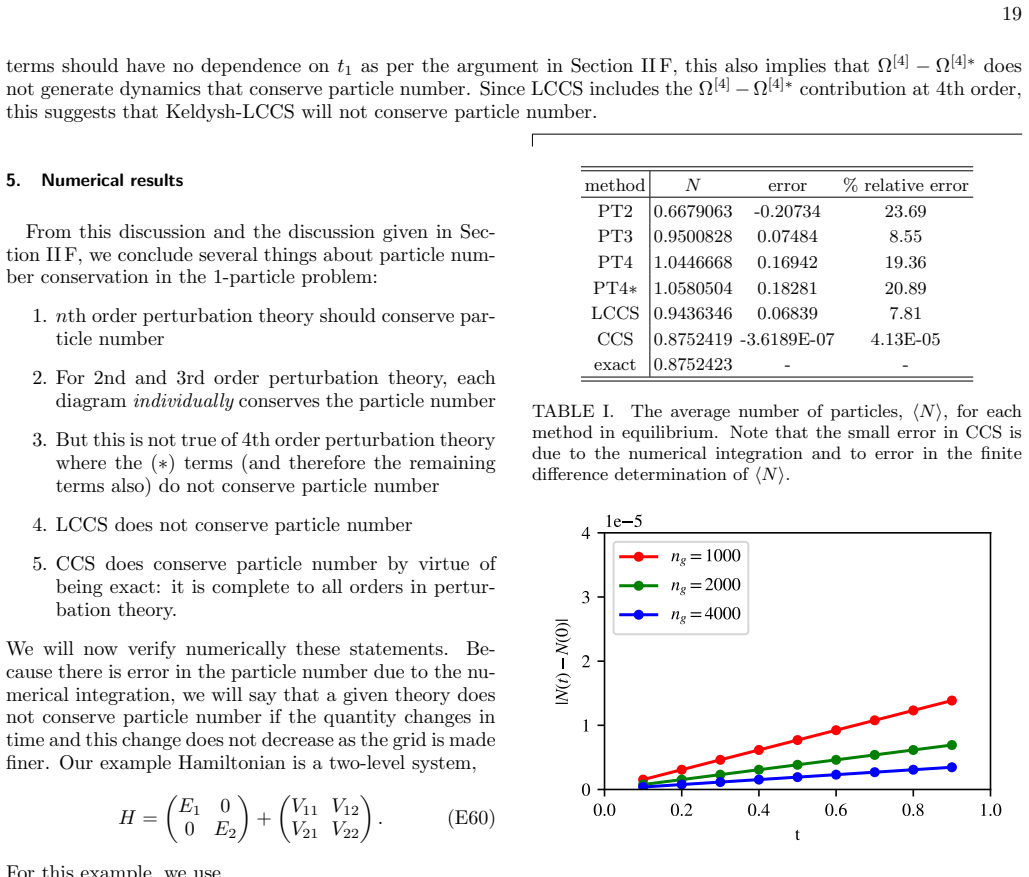
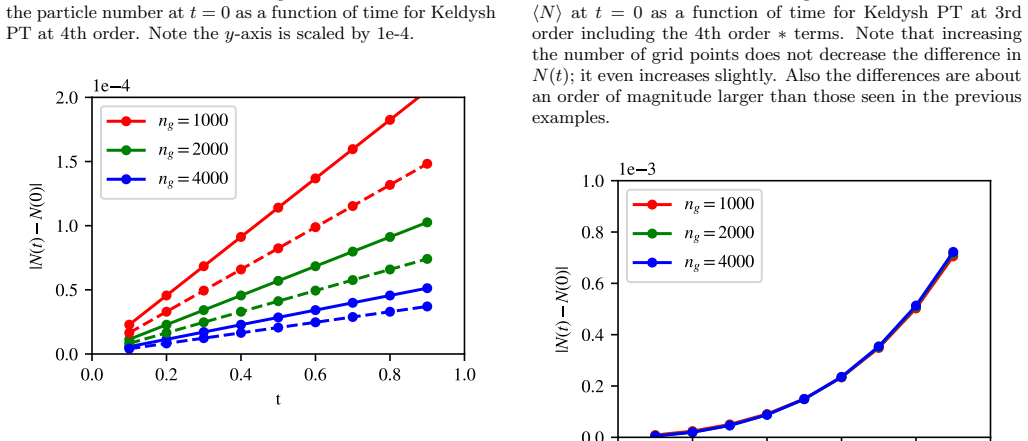
CCS does conserve particle number by virtue of being exact: it is complete to all orders in pertur- bation theory. We will now verify numerically these statements. Be- cause there is error in the particle number due to the nu- merical integration, we will say that a given theory does not conserve particle number if the quantity changes in time and this ch...
work page internal anchor Pith review Pith/arXiv arXiv doi:10.1088/0953-8984/21/6/064224 2000
discussion (0)
Sign in with ORCID, Apple, or X to comment. Anyone can read and Pith papers without signing in.