REVIEW 3 major objections 5 minor 27 references
Task-assisted Motion Planning in Partially Observable Domains
T0 review · 3 major / 5 minor · reviewed 2026-08-14 · deepseek-v4-flash
Pith's one-line read A hybrid task-motion planner folds robot pose uncertainty into PDDL+ task planning, producing waypoint paths that minimize both travel distance and belief covariance.
desk verdict A plausible PDDL+-semantic-attachment integration for belief-space navigation TMP, but the planner minimizes a single noisy observation path rather than the expectation in its stated objective, and the validation is too thin to support the claims as written. read the letter →
The pith
A machine-rendered reading of the paper's core claim, the machinery that carries it, and where it could break.
The reading
What carries the argument
The load-bearing mechanism is the PDDL+ process-event pair: a process odometry simulates the robot translation in steps of $\delta_{\mathrm{trans}}^k = \Delta \times d_{\mathrm{factor}}$, and an event belief update triggers an external semantic attachment that computes the EKF propagated belief and, when a landmark is in range, the posterior belief, attaching the covariance trace to the event effect. These returned values guide the staged relaxed-plan-graph heuristic and the weighted A* search, so the belief estimate is not a post-hoc check but part of the search guidance. Semantic attachments, meaning external procedures attached to function symbols, are the bridge that lets a discrete task planner call numerical belief updates without leaving PDDL+ semantics.
What would settle it
Simulate the same corridor scenario in continuous time, recording the true EKF covariance trace along the executed waypoint sequence, and compare it with the trace the planner predicted at $\Delta = 0.5, 1, 2, 3$. If the predicted trace differs materially from the continuous-time trace, or if the planner's chosen waypoint sequence changes when $\Delta$ is refined, the discretized belief model is not faithful.
Extended reading notes
Core claim
The central claim is that PDDL+ processes and events, combined with semantic attachments whose computed belief values feed the planner's heuristic, can carry belief-space reasoning inside task planning. The planner searches over a sampled set of collision-free poses, and for each candidate waypoint action it simulates the motion with a discretized odometry process; each simulation step triggers an event that calls an external library to apply EKF prediction and update equations (8)-(9), returning the trace of the covariance as an effect. The search is a weighted A* that folds the covariance trace into the cost, so the resulting plan minimizes the objective (10), a sum of distance-to-goal and uncertainty costs. The authors present this as the first TMP approach based on PDDL+ planning semantics, and they validate it in a simulated corridor where the robot must reach a charging dock.
Load-bearing premise
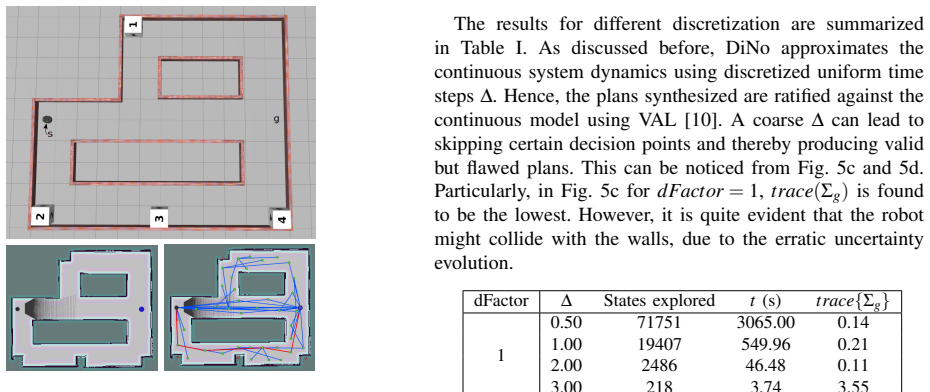
Planner discretization of motion (the step size $\Delta$ and motion factor $d_{\mathrm{factor}}$) accurately represents the true continuous belief trajectory; the paper itself notes a coarse $\Delta$ can skip decision points and yield valid but flawed plans.
Editorial extensions
If this is right
- A robot can be given goal conditions that mix symbolic and geometric requirements, such as reaching a pose with covariance trace below a threshold, and the planner will reject action sequences that violate them.
- The same PDDL+ domain description can serve any mobile robot navigation problem; only the map, landmarks, initial belief, and goal pose change.
- Because belief updates happen during heuristic construction, planning time grows with the number of sampled poses and the fineness of discretization; coarser settings trade accuracy for speed.
- The battery model shows task-level constraints like power limits can be folded into the same plan, so a motion-only plan can be catastrophic when it ignores them.
Reading between the lines
- The discretization dependence suggests a natural testable extension: an adaptive step-size controller that refines $\Delta$ near landmarks or high-curvature belief changes, or a closed-form bound relating discretization error to covariance-trace error.
- The belief-update-count plots expose a possible degeneracy: a coarse $\Delta$ skips the very measurements that would reduce uncertainty, so the optimal-looking plan in trace terms may be invalid; a planner that reports which decision points were skipped could flag this.
- The framework's separation of task search from the external EKF means the same scaffolding could attach other estimators, such as particle filters or non-Gaussian beliefs, without changing the PDDL+ model, as long as the attachment returns a scalar cost.
Signed reviews
Editorial analysis
A structured set of objections, weighed in public.
Referee Report
Summary. The manuscript proposes an integrated Task-Motion Planning framework for mobile-robot navigation under state uncertainty. The planner samples collision-free poses with a potential-field RRT, encodes the navigation problem in PDDL+, and uses semantic attachments inside the DiNo planner to perform EKF belief propagation and updates during a weighted A* search. The stated objective is a finite-horizon cost combining distance to the goal and the covariance trace, with an expectation over future observations. The approach is evaluated in a Gazebo corridor environment for several planner and motion discretizations, and an extended experiment adds a battery-discharge constraint. The authors claim this is the first TMP approach based on PDDL+ planning semantics.
Significance. If the central claims hold, the paper makes a useful integration contribution: it demonstrates that belief-space reasoning can be carried out inside a hybrid PDDL+ planner through semantic attachments, and that the resulting uncertainty estimates can guide heuristic search. The PDDL+ domain description is a reusable artifact, and the empirical study addresses a realistic navigation scenario with VAL validation and an explicit discussion of discretization effects. However, the significance is currently limited by a mismatch between the formal objective in Eq. (10) and the implemented planner, and by the single-scenario, single-sample experimental validation. The framework is plausible and worth pursuing, but the specific claim that the planner minimizes Eq. (10) is not established as written.
major comments (3)
- [Section IV-D, Algorithm 1, Eq. (10)] The objective in Eq. (10) is an expectation over future observations, but the planner replaces the observation process with a single randomized measurement: Section IV-D states that the nominal observation is corrupted with noise to obtain z_{k+1}, and Algorithm 1 applies the EKF update to that single draw. No averaging over observation realizations is described, so the generated plan minimizes the cost of one sampled observation trajectory, not the expectation in (10). This is load-bearing because the posterior mean and the linearization points for subsequent EKF steps depend on the sampled noise. The authors should either weaken the claim to a single-observation approximation of (10) and support it empirically, or average over multiple observation samples within the search.
- [Section IV-C and IV-D, Algorithm 1] Even under a single-observation approximation, the paper does not specify how the full cost (10) is evaluated during search. Algorithm 1 returns only trace(Σ) in its event effects, and Section IV-B says only that cΣ is absorbed into g(·); no implementation of the distance-to-goal term cG is given, and the EKF posterior mean is not returned to the PDDL state. Since the mean affects cG and future linearizations, the implemented weighted A* search is underspecified with respect to the stated objective. The authors should provide a precise mapping from PDDL state variables and semantic-attachment effects to the g(·) and heuristic costs actually used in search.
- [Section V, Table I and Fig. 5] The empirical evaluation does not support the quantitative claims about optimal discretization choices. Each row of Table I appears to report a single run, which is problematic because the planner uses randomized observations; a single run does not characterize the distribution of trace(Σ_g). The observation in Fig. 5c that the robot might collide with walls is based on visual inspection of a covariance curve rather than an executed collision check or path feasibility analysis. Repeating experiments over multiple random seeds and reporting summary statistics, or switching to a deterministic nominal-observation update, would be required to support statements such as 'the optimal values for Δ and dFactor are 1.00 and 2 respectively'.
minor comments (5)
- [Section IV-B] The text says DiNo uses a modified Enforced Hill-Climbing search and then states that the search is modified to weighted A*; please clarify which search is actually used for the reported experiments.
- [Section V] The word 'ratified' appears in 'the plans synthesized are ratified against the continuous model'; 'validated' or 'verified' is the intended term.
- [Conclusion] The phrase 'the extant of such pruning' should be 'the extent of such pruning'.
- [Eq. (6)] In Eq. (6), the index inside the product should be i rather than k: the product should read ∏_{i=1}^k p(x_i | x_{i-1}, u_{i-1}) p(z_i | x_i).
- [References] Reference [19] contains the typo 'Airtificial Intellignece'; also, Fig. 3's caption writes 'precess' where 'process' is meant.
Circularity Check
No circular derivation; the planner's belief updates are standard EKF equations, and the PDDL+/semantic-attachment integration is an implementation of those equations rather than a self-referential prediction.
full rationale
The paper's derivations are self-contained. Equations (8) and (9) are the standard EKF prediction and update; Equation (10) is an objective, not a fitted output. Algorithm 1 instantiates (8)-(9) inside the PDDL+ event, and the cost trace(Σ) is computed from those equations rather than from the plan being validated. The reference to the authors' prior work [24] frames the paper as an extension, but none of the central claims reduce to that citation: the belief-space equations, the PDDL+ encoding, and the VAL/Gazebo validation are presented in this paper. The paper's own caveats—coarse Δ can skip decision points (Section V) and scalability remains a challenge (Section VI)—are correctness/complexity limitations, not circularity. The strongest correctness concern is that Algorithm 1 simulates one observation sample for the posterior mean while cost (10) is stated as an expectation over future observations; this is an approximation/correctness gap, not a circular reduction, since the EKF covariance trace (the uncertainty cost) does not depend on the simulated observation values and the objective is not defined in terms of the planner's output. No fitted parameter is renamed as a prediction, and no load-bearing argument relies on a self-citation.
Assumptions & free parameters
free parameters (7)
- Planner discretization Δ =
0.5, 1, 2, 3; 'optimal' 1.00
- Motion discretization constant dFactor =
1, 2; 'optimal' 2
- Temporal planning horizon T =
20
- Number of sampled poses m =
40
- Battery discharge rate =
d(charge)/dt = -0.11(101 - charge)
- Goal uncertainty threshold η =
0.20
- Number of poses near landmarks in potential-field RRT =
user defined
assumptions (6)
- domain assumption Motion and observation models are linear-Gaussian enough for the EKF to capture the belief.
- domain assumption Data association is solved.
- domain assumption The environment map, landmark set, initial belief, and goal pose are known at planning time.
- domain assumption The PDDL+ process and event discretization at Δ approximates the continuous motion sufficiently.
- ad hoc to paper The sampled waypoint set wp contains a feasible path to the goal.
- ad hoc to paper A single simulated noisy observation is a sufficient stand-in for the expectation over future observations in cost (10).
Cite this review
Pith. "Pith review of Task-assisted Motion Planning in Partially Observable Domains." pith.science (2026). https://pith.science/paper/V4GUYOLD
@misc{pith2026190810227,
  author       = {Pith},
  title        = {Pith review of: Task-assisted Motion Planning in Partially Observable Domains},
  year         = {2026},
  howpublished = {\url{https://pith.science/paper/V4GUYOLD}},
  note         = {Machine review of arXiv:1908.10227}
}
read the original abstract
We present an integrated Task-Motion Planning framework for robot navigation in belief space. Autonomous robots operating in real world complex scenarios require planning in the discrete (task) space and the continuous (motion) space. To this end, we propose a framework for integrating belief space reasoning within a hybrid task planner. The expressive power of PDDL+ combined with heuristic-driven semantic attachments performs the propagated and posterior belief estimates while planning. The underlying methodology for the development of the combined hybrid planner is discussed, providing suggestions for improvements and future work. Furthermore we validate key aspects of our approach using a realistic scenario in simulation.
Figures


Figures from the paper (3 more)


Reference graph
Works this paper leans on
-
[24]
Towards Perception Aware Task-Motion Planning
Antony Thomas, Sunny Amatya, Fulvio Mastrogiovanni, and Marco Baglietto. Towards Perception Aware Task-Motion Planning. In Proceedings of the AAAI Fall Symposium on Reasoning and Learning in Real-World Systems for Long-Term Autonomy , pages 88–95, 2018
work page 2018
-
[1]
Boosting Search Guidance in Problems with Semantic Attachments
Sara Bernardini, Maria Fox, Derek Long, and Chiara Piacentini. Boosting Search Guidance in Problems with Semantic Attachments. In International Conference on Automated Planning and Scheduling (ICAPS), pages 29–37, Pittsburgh, PA, USA, June 2017
work page 2017
-
[2]
A hybrid approach to intricate motion, manipulation and task planning
St ´ephane Cambon, Rachid Alami, and Fabien Gravot. A hybrid approach to intricate motion, manipulation and task planning. The International Journal of Robotics Research , 28(1):104–126, 2009
work page 2009
-
[3]
Neil T. Dantam, Zachary K. Kingston, Swarat Chaudhuri, and Lydia E. Kavraki. An Incremental Constraint-Based Framework for Task and Motion Planning. International Journal of Robotics Research, Special Issue on the 2016 Robotics: Science and Systems Conference , 37(10):1134–1151, 2018
work page 2016
-
[4]
Semantic Attachments for Domain-Independent Planning Systems
Christian Dornhege, Patrick Eyerich, Thomas Keller, Sebastian Tr ¨ug, Michael Brenner, and Bernhard Nebel. Semantic Attachments for Domain-Independent Planning Systems. In International Conference on Automated Planning and Scheduling (ICAPS) , pages 114–121, Thessaloniki, Greece, September 2009
work page 2009
-
[5]
Integrating symbolic and geometric planning for mobile manipulation
Christian Dornhege, Marc Gissler, Matthias Teschner, and Bernhard Nebel. Integrating symbolic and geometric planning for mobile manipulation. In Safety, Security & Rescue Robotics (SSRR), IEEE International Workshop on, pages 1–6. IEEE, 2009
work page 2009
-
[6]
STRIPS: A new approach to the application of theorem proving to problem solving
Richard E Fikes and Nils J Nilsson. STRIPS: A new approach to the application of theorem proving to problem solving. Artificial Intelligence, 2(3-4):189–208, 1971
work page 1971
-
[7]
Modelling Mixed Discrete-Continuous Domains for Planning
Maria Fox and Derek Long. Modelling Mixed Discrete-Continuous Domains for Planning. Journal of Artificial Intelligence Research , 27(1):235–297, 2006
work page 2006
Show all 27 references
-
[8]
FFRob: Leveraging symbolic planning for efficient task and motion planning
Caelan Reed Garrett, Tomas Lozano-Perez, and Leslie Pack Kaelbling. FFRob: Leveraging symbolic planning for efficient task and motion planning. The International Journal of Robotics Research , 37(1):104– 136, 2018
2018
-
[9]
Ignor- ing Delete Lists
J ¨org Hoffmann. The Metric-FF Planning System: Translating “Ignor- ing Delete Lists” to Numeric State Variables. Journal of Artificial Intelligence Research, 20:291–341, 2003
2003
-
[10]
V AL: Automatic plan validation, continuous effects and mixed initiative planning using PDDL
Richard Howey, Derek Long, and Maria Fox. V AL: Automatic plan validation, continuous effects and mixed initiative planning using PDDL. In 16th IEEE International Conference on Tools with Artificial Intelligence (ICTAI), pages 294–301, 2004
2004
-
[11]
Integrated robot task and motion planning in the now
Leslie P Kaelbling and Tom ´as Lozano-P´erez. Integrated robot task and motion planning in the now. Technical Report 2012-018, Computer Science and Artificial Intelligence Laboratory, Massachusetts Institute of Technology, 2012
2012
-
[12]
Planning and acting in partially observable stochastic domains
Leslie Pack Kaelbling, Michael L Littman, and Anthony R Cassan- dra. Planning and acting in partially observable stochastic domains. Artificial Intelligence, 101(1-2):99–134, 1998
1998
-
[13]
Integrated task and motion planning in belief space
Leslie Pack Kaelbling and Tom ´as Lozano-P ´erez. Integrated task and motion planning in belief space. The International Journal of Robotics Research, 32(9-10):1194–1227, 2013
2013
-
[14]
Rrt-connect: An efficient approach to single-query path planning
James J Kuffner and Steven M LaValle. Rrt-connect: An efficient approach to single-query path planning. In Robotics and Automation,
-
[15]
Dantam, Caelan Garrett, Aliakbar Akbari, Siddharth Srivastava, and Lydia E
Fabien Lagriffoul, Neil T. Dantam, Caelan Garrett, Aliakbar Akbari, Siddharth Srivastava, and Lydia E. Kavraki. Platform-independent benchmarks for task and motion planning. Robotics and Automation Letters, 2018
2018
-
[16]
Petlon: Planning efficiently for task-level-optimal navigation
Shih-Yun Lo, Shiqi Zhang, and Peter Stone. Petlon: Planning efficiently for task-level-optimal navigation. In Proceedings of the 17th International Conference on Autonomous Agents and MultiAgent Systems, pages 220–228. International Foundation for Autonomous Agents and Multiage...
2018
-
[17]
A constraint-based method for solving sequential manipulation planning problems
Tom ´as Lozano-P ´erez and Leslie Pack Kaelbling. A constraint-based method for solving sequential manipulation planning problems. In Intelligent Robots and Systems (IROS), IEEE/RSJ International Con- ference on, pages 3684–3691. IEEE, 2014
2014
-
[18]
PDDL- The Planning Domain Definition Language
Drew McDermott, Malik Ghallab, Adele Howe, Craig Knoblock, Ashwin Ram, Manuela Veloso, Daniel Weld, and David Wilkins. PDDL- The Planning Domain Definition Language. In AIPS-98 Planning Competition Committee , 1998
1998
-
[19]
Shakey the robot
Nils J Nilsson. Shakey the robot. Technical Report 323, Airtificial Intellignece Center, SRI International, Menlo Park, California, 1984
1984
-
[20]
A unified framework for data association aware robust belief space planning and perception
Shashank Pathak, Antony Thomas, and Vadim Indelman. A unified framework for data association aware robust belief space planning and perception. The International Journal of Robotics Research , 37(2- 3):287–315, 2018
2018
-
[21]
Combined task and motion planning under partial observability: An optimization-based approach
Camille Phiquepal and Marc Toussaint. Combined task and motion planning under partial observability: An optimization-based approach. RSS Workshop on Integrated Task and Motion Planning , 2017
2017
-
[22]
Heuristic Planning for PDDL+ Domains
Wiktor Mateusz Piotrowski, Maria Fox, Derek Long, Daniele Maga- zzeni, and Fabio Mercorio. Heuristic Planning for PDDL+ Domains. In AAAI Workshop: Planning for Hybrid Systems , Phoenix, Arizona, USA, July 2016
2016
-
[23]
Combined task and motion planning through an extensible planner-independent interface layer
Siddharth Srivastava, Eugene Fang, Lorenzo Riano, Rohan Chitnis, Stuart Russell, and Pieter Abbeel. Combined task and motion planning through an extensible planner-independent interface layer. In Robotics and Automation (ICRA), IEEE International Conference on , pages 639–646....
2014
-
[25]
Logic-geometric programming: An optimization- based approach to combined task and motion planning
Marc Toussaint. Logic-geometric programming: An optimization- based approach to combined task and motion planning. In Twenty- Fourth International Joint Conference on Artificial Intelligence , 2015
2015
-
[26]
Weyhrauch
Richard W. Weyhrauch. Prolegomena to a theory of mechanized formal reasoning. Artificial Intelligence, 13, 1980
1980
-
[2000]
Proceedings. ICRA’00. IEEE International Conference on , vol- ume 2, pages 995–1001. IEEE, 2000
2000
Reviewed August 14, 2026 · model on record in the stance chip above.
Discussion (0). Continue with ORCID to comment.