REVIEW 4 major objections 5 minor 29 references
Neuromorphic Visual Odometry System for Intelligent Vehicle Application with Bio-inspired Vision Sensor
T0 review · 4 major / 5 minor · reviewed 2026-08-14 · deepseek-v4-flash
Pith's one-line read The paper claims the first in-vehicle visual odometry system that uses only a neuromorphic camera, validated on a real urban driving dataset with average planar localization error 0.581 m (relative 0.5578%).
desk verdict A competent application study of event-camera VO on driving data, but the 'first event-only' claim is unresolved because the paper never states whether the borrowed Zhu et al. tracker received IMU data. read the letter →
The pith
A machine-rendered reading of the paper's core claim, the machinery that carries it, and where it could break.
The reading
What carries the argument
The load-bearing mechanism is the event-frame feature-tracking pipeline from [14], used as the front end. Events are accumulated over a short time window into a frame; an Expectation-Maximization optical-flow step warps those events back to a common time, producing a corrected edge-like image; Harris corners are detected on that image; and features are matched between successive corrected frames by affine alignment. Around this front end, the system wraps a standard keyframe visual odometry loop: bundle adjustment for pose via PnP, triangulation of matched points, a depth filter for map-point insertion, and an eight-point-algorithm bootstrap. The front end is what converts the asynchronous event stream into the sparse, trackable features that the rest of the pipeline depends on.
What would settle it
Run the feature tracker and the full odometry pipeline on the same urban driving sequence twice: once with the IMU channel completely disabled and once with it enabled, comparing tracked feature lifetimes and final trajectory error. If disabling the IMU collapses the tracks or substantially increases the error, the paper's event-only claim is falsified.
Extended reading notes
Core claim
The central discovery is a feasibility result: an event-camera-only visual odometry pipeline can run on real road data and keep the vehicle on track to sub-meter accuracy, with 0.581 m average planar error and 0.5578% relative position error over 439 m. The system borrows the event-frame feature tracker from [14], aggregates events into frames, corrects them with EM optical flow, detects Harris corners, aligns features between warped frames, then estimates pose through bundle adjustment and builds a sparse map by triangulation filtered by a Gaussian plus uniform depth model. Bootstrapping uses the eight-point algorithm on the first two event frames because no map exists at startup. The experiments also show that tracked features live long enough on average (16.488 frames by day, 14.321 at night) for the depth filter to converge, and that tracking degrades only mildly at night compared with conventional cameras. The authors are explicit that the system currently runs offline only, because the feature tracker is too slow to track about 100 points in real time.
Load-bearing premise
The event-only claim assumes the feature-tracking code taken from [14] can produce stable tracks without any IMU data; the paper does not state whether the inertial channel of the driving dataset was supplied to that code.
Editorial extensions
If this is right
- If the claimed error numbers hold, event-camera-only odometry is accurate enough for some automotive positioning uses on smooth urban roads, with relative position error below 0.6%.
- The reported feature lifetimes of over 14 frames on average in both day and night indicate that event-based tracking is stable enough to feed a depth filter, not just for lab demonstrations.
- The sharp error increase after the vehicle crosses two bumps shows that road roughness, not illumination, is the current limiting condition for event-only visual odometry.
- Because the system currently runs offline, real-time in-vehicle use waits on a faster feature tracker or a lighter tracking scheme.
- The modular parallel tracking-and-mapping structure means a faster front end can be slotted in without redesigning the pose and depth estimation threads.
Reading between the lines
- The borrowed tracking algorithm was originally part of a visual-inertial odometry system; if the released code silently expects IMU measurements, the 'event-only' claim would need qualification, and this is testable but not resolved in the paper.
- A natural next experiment is to compare the same pipeline with and without the inertial channel on the same driving sequence; the 0.5578% error would then separate the event-camera contribution from any hidden inertial support.
- The bump-induced drift suggests that event-only vehicle odometry would benefit most from adding gyroscope or wheel-odometry measurements around vertical accelerations, rather than adding a full frame camera.
- If feature tracking becomes real-time, the same architecture could plausibly transfer to the motorcycle and drone sequences in the same dataset, where the sensor's low latency matters most.
Signed reviews
Editorial analysis
A structured set of objections, weighed in public.
Referee Report
Summary. The paper proposes a visual odometry system for vehicles that uses only a neuromorphic (event) camera, building on a feature detection and tracking algorithm originally developed by Zhu et al. [14]. The system aggregates events into frames, performs EM optical-flow correction, detects Harris corners, and then runs a parallel tracking-and-mapping pipeline: pose estimation by bundle adjustment/PnP, depth estimation by triangulation with a probabilistic depth filter, and initialization by the eight-point algorithm. Experiments are reported on the MVSEC urban driving dataset, with feature-lifetime statistics for day and night scenes and a trajectory evaluation over one 439 m interval (12 s to 72 s), giving an average planar error of 0.581 m and a relative position error of 0.5578%. The paper explicitly states that feature tracking is not real-time and that the system currently runs in offline mode.
Significance. If the central claim were fully established, this would be a useful early demonstration of event-camera-only visual odometry in a driving scenario, complementing prior event-based VO work that relies on IMU or conventional images. The paper uses standard, well-understood geometric estimation machinery (PnP, bundle adjustment, depth filters, eight-point initialization) and evaluates on a public dataset, which are strengths. However, the headline claim that the system 'only uses a neuromorphic camera' is not yet supported because the paper does not disclose whether the borrowed tracker from [14] received IMU data, and the quantitative evidence rests on a single sequence with no error bars and no same-data baseline. The significance is therefore conditional on resolving these points.
major comments (4)
- [Sections III.A and IV.C] The paper never states whether the feature tracker taken from Zhu et al. [14] was executed with IMU data from the MVSEC dataset. This matters because [14] is an event-based visual-inertial odometry algorithm, and Table 1 explicitly classifies Zhu et al. 2017 as 'fusion with IMU based on Kalman filter.' If IMU measurements were supplied to the tracker, the resulting feature tracks and the reported 0.5578% relative position error were not produced by a system that uses only a neuromorphic camera, contradicting the abstract's claim. The authors should state exactly what inputs the source code consumes and, if the claim is to stand, provide a run of the tracker without IMU data.
- [Section IV.D] The quantitative evaluation is based on a single sequence of about 439 m (12 s to 72 s of the MVSEC dataset) with LOAM-based localization as ground truth. There are no error bars, no repeated runs with different initializations or parameters, and no baseline comparison on the same sequence (e.g., a standard frame-based VO, EVO, or another event-based VO). The comparison in the text to EVO's 0.2% relative error is drawn from a different dataset and is therefore not a controlled comparison. As written, the experiment demonstrates that the pipeline runs on one sequence rather than verifying the feasibility claim in the abstract.
- [Section IV.C] The paper states that the system 'is far from meeting the requirement of tracking about 100 feature points synchronously' and 'can only run in offline mode,' with feature tracking results recorded to a txt file and later fed into the odometry pipeline. This means the evaluated system is not a real-time in-vehicle visual odometry system. The abstract's characterization should be qualified, or the authors should demonstrate at least a synchronous version of the pipeline, even at reduced feature count.
- [Section III.A] The description of the EM optical-flow correction is under-specified: the text does not clarify whether the correction uses only the event stream or also uses IMU priors as in the original algorithm of [14]. Figure 2 is reproduced from [14] without stating which components are reused and which are modified. This ambiguity is directly load-bearing for the event-only claim and should be resolved.
minor comments (5)
- [Section IV.C] There is a typo in the sentence 'the real-time performance of this feature tracking algorithm is quite pool'; it should be 'poor.' Also, the caption of Fig. 14 says 'event basd visual odometry system' and should say 'based.'
- [References] References [25] and [26] are the same Longuet-Higgins 1981 paper, with [26] containing a typo ('alorithm'). They should be merged, or the duplicate removed.
- [Table 1] The symbols '√' and 'X' are used inconsistently: for Zhu et al. [14] the 'Event camera only' column is marked 'X,' which is correct, but the same symbol is used in other columns to mean different things. The table should use a clearer legend.
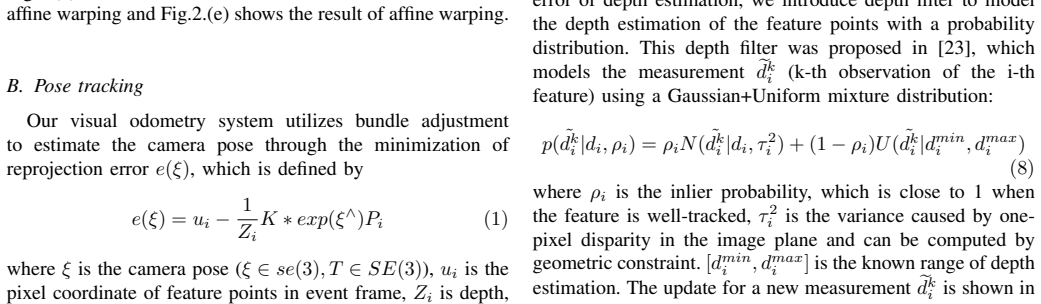
- [Equation (1)] Equation (1) is missing spacing or a multiplication symbol between the scalar factor 1/Z_i and K*exp(ξ^)P_i, making the formula hard to read. The Jacobian in Eq. (2) is described as 'a 26 Jacobian matrix' and should be written as a 2×6 Jacobian.
- [General] The word 'transfer' is used in several places (e.g., 'rotation and transfer between the first two event frames'); the standard term in visual odometry is 'translation.'
Circularity Check
No circular derivation: the reported error is measured against an external ground truth, and the borrowed feature tracker creates an unresolved input assumption rather than a circular reduction.
full rationale
The paper reports the average planar error (0.581 m) and relative position error (0.5578%) as experimental statistics for a 439 m urban segment of the MVSEC dataset (Section IV.D, Table III), not as quantities derived from fitted parameters. The pose pipeline is a standard geometric chain: essential-matrix bootstrapping (Section III.E), PnP/bundle adjustment via Eq. (1)-(5), triangulation Eq. (6)-(7), and a Gaussian+Uniform depth filter Eq. (8). None of these equations encodes the reported error, and no parameter is fit to MVSEC and then re-labeled as a prediction. The feature tracker is imported from external prior work (Section III.A: 'The feature detection and feature tracking algorithm utilized in our system is proposed by Zhu et al. in [14]'; Section IV.C: 'Using the source code provided by Alex Zhu et al.'), so the paper is not self-citing a load-bearing theorem. The one substantive concern is that the headline 'only uses a neuromorphic camera' claim is left undetermined because the paper never states whether that borrowed source code consumed IMU data, and Table I classifies Zhu et al. [14] as 'fusion with IMU based on Kalman filter.' That is a missing-support/correctness issue, not a circular reduction: the reported numbers are measurements from an external dataset, not consequences of an assumed conclusion. No circular step can be exhibited, so the appropriate score is 0.
Assumptions & free parameters
free parameters (4)
- Depth filter convergence threshold
- Key frame interval
- Event aggregation time interval
- Feature lifetime cutoff =
3 frames
assumptions (4)
- standard math Essential matrix, PnP, and bundle adjustment constraints model camera motion from point correspondences (Section III.B, III.E).
- domain assumption Depth measurements follow a Gaussian+Uniform mixture model with an inlier probability (Eq.8, from Vogiatzis and Hernandez [23]).
- domain assumption The feature tracking algorithm from Zhu et al. [14] runs correctly on event frames without inertial data (Section III.A).
- domain assumption LOAM output provides accurate ground truth for the vehicle trajectory (Section IV.D).
Cite this review
Pith. "Pith review of Neuromorphic Visual Odometry System for Intelligent Vehicle Application with Bio-inspired Vision Sensor." pith.science (2026). https://pith.science/paper/3BP7BSKA
@misc{pith2026190902490,
  author       = {Pith},
  title        = {Pith review of: Neuromorphic Visual Odometry System for Intelligent Vehicle Application with Bio-inspired Vision Sensor},
  year         = {2026},
  howpublished = {\url{https://pith.science/paper/3BP7BSKA}},
  note         = {Machine review of arXiv:1909.02490}
}
read the original abstract
The neuromorphic camera is a brand new vision sensor that has emerged in recent years. In contrast to the conventional frame-based camera, the neuromorphic camera only transmits local pixel-level changes at the time of its occurrence and provides an asynchronous event stream with low latency. It has the advantages of extremely low signal delay, low transmission bandwidth requirements, rich information of edges, high dynamic range etc., which make it a promising sensor in the application of in-vehicle visual odometry system. This paper proposes a neuromorphic in-vehicle visual odometry system using feature tracking algorithm. To the best of our knowledge, this is the first in-vehicle visual odometry system that only uses a neuromorphic camera, and its performance test is carried out on actual driving datasets. In addition, an in-depth analysis of the results of the experiment is provided. The work of this paper verifies the feasibility of in-vehicle visual odometry system using neuromorphic cameras.
Figures


Figures from the paper (10 more)


Reference graph
Works this paper leans on
-
[14]
Event-based visual inertial odometry,
A. Z. Zhu, N. Atanasov, and K. Daniilidis, “Event-based visual inertial odometry,” in IEEE Conference on Computer Vision & Pattern Recog- nition, 2017
work page 2017
-
[1]
Neuromorphic vision based multivehicle detection and tracking for intelligent transportation system,
G. Chen, H. Cao, M. Aafaque, J. Chen, and C. Ye, “Neuromorphic vision based multivehicle detection and tracking for intelligent transportation system,” Journal of Advanced Transportation , vol. 2018, no. 4815383, p. 13, 2018
work page 2018
-
[2]
Evo: A geometric approach to event-based 6-dof parallel tracking and mapping in real-time,
H. Rebecq, T. Horstschaefer, G. Gallego, and D. Scaramuzza, “Evo: A geometric approach to event-based 6-dof parallel tracking and mapping in real-time,” IEEE Robotics & Automation Letters , vol. 2, no. 2, pp. 593–600, 2017
work page 2017
-
[3]
Interacting maps for fast visual interpretation,
M. Cook, L. Gugelmann, F. Jug, C. Krautz, and A. Steger, “Interacting maps for fast visual interpretation,” in International Joint Conference on Neural Networks , 2011
work page 2011
-
[4]
Simul- taneous mosaicing and tracking with an event camera,
H. Kim, A. Handa, R. Benosman, S.-H. Ieng, and A. Davison, “Simul- taneous mosaicing and tracking with an event camera,” in Proceedings of the British Machine Vision Conference . BMV A Press, 2014
work page 2014
-
[5]
D. Weikersdorfer, R. Hoffmann, and J. Conradt, Simultaneous Localiza- tion and Mapping for Event-Based Vision Systems , 2013
work page 2013
-
[6]
Low-latency event-based visual odome- try,
A. Censi and D. Scaramuzza, “Low-latency event-based visual odome- try,” inIEEE International Conference on Robotics & Automation , 2014
work page 2014
-
[7]
Event- based 3d slam with a depth-augmented dynamic vision sensor,
D. Weikersdorfer, D. B. Adrian, D. Cremers, and J. Conradt, “Event- based 3d slam with a depth-augmented dynamic vision sensor,” in IEEE International Conference on Robotics & Automation , 2014
work page 2014
Show all 29 references
-
[8]
Event-based, 6-dof pose tracking for high-speed maneuvers,
E. Mueggler, B. Huber, and D. Scaramuzza, “Event-based, 6-dof pose tracking for high-speed maneuvers,” in IEEE/RSJ International Confer- ence on Intelligent Robots & Systems , 2014
2014
-
[9]
Event-based, 6-dof camera tracking for high- speed applications,
G. Gallego, J. E. A. Lund, E. Mueggler, H. Rebecq, T. Delbruck, and D. Scaramuzza, “Event-based, 6-dof camera tracking for high- speed applications,” IEEE Transactions on Pattern Analysis & Machine Intelligence, vol. PP, no. 99, pp. 1–1, 2016
2016
-
[10]
Low-latency visual odometry using event-based feature tracks,
B. Kueng, E. Mueggler, G. Gallego, and D. Scaramuzza, “Low-latency visual odometry using event-based feature tracks,” in IEEE/RSJ Inter- national Conference on Intelligent Robots & Systems , 2016
2016
-
[11]
H. Kim, S. Leutenegger, and A. J. Davison, Real-Time 3D Reconstruc- tion and 6-DoF Tracking with an Event Camera , 2016
2016
-
[12]
Emvs: Event- based multi-view stereo3d reconstruction with an event camera in real- time,
H. Rebecq, G. Gallego, E. Mueggler, and D. Scaramuzza, “Emvs: Event- based multi-view stereo3d reconstruction with an event camera in real- time,” International Journal of Computer Vision , no. 2, pp. 1–21, 2017
2017
-
[13]
Accurate angular velocity estimation with an event camera,
G. Gallego and D. Scaramuzza, “Accurate angular velocity estimation with an event camera,” IEEE Robotics & Automation Letters , vol. PP, no. 99, pp. 1–1, 2017
2017
-
[15]
Continuous-time visual-inertial odometry for event cameras,
M. Elias, G. Guillermo, R. Henri, and S. Davide, “Continuous-time visual-inertial odometry for event cameras,” IEEE Transactions on Robotics, vol. PP, no. 99, pp. 1–16, 2017
2017
-
[16]
Ultimate slam? combining events, images, and imu for robust visual slam in hdr and high speed scenarios,
A. R. Vidal, H. Rebecq, T. Horstschaefer, and D. Scaramuzza, “Ultimate slam? combining events, images, and imu for robust visual slam in hdr and high speed scenarios,” IEEE Robotics & Automation Letters , vol. 3, no. 2, pp. 994–1001, 2018
2018
-
[17]
Svo: Fast semi-direct monocular visual odometry,
C. Forster, M. Pizzoli, and D. Scaramuzza, “Svo: Fast semi-direct monocular visual odometry,” in IEEE International Conference on Robotics & Automation , 2014
2014
-
[18]
Parallel tracking and mapping for small ar workspaces,
G. Klein and D. Murray, “Parallel tracking and mapping for small ar workspaces,” in IEEE & Acm International Symposium on Mixed & Augmented Reality , 2008
2008
-
[19]
Orb-slam: a versatile and accurate monocular slam system,
R. Murartal, J. M. M. Montiel, and J. D. Tardos, “Orb-slam: a versatile and accurate monocular slam system,” IEEE Transactions on Robotics , vol. 31, no. 5, pp. 1147–1163, 2017
2017
-
[20]
Engel, T
J. Engel, T. Schps, and D. Cremers, LSD-SLAM: Large-Scale Direct Monocular SLAM , 2014
2014
-
[21]
Harltey and A
A. Harltey and A. Zisserman, Multiple view geometry in computer vision (2. ed.) , 2003
2003
-
[22]
Computer vision and image under- standing,
B. A. Maxwell and S. A. Shafer, “Computer vision and image under- standing,” Machine Learning & Data Mining Methods & Applications , vol. 72, no. 2, pp. 143–162(20), 2003
2003
-
[23]
Video-based, real-time multi-view stereo ,
G. V ogiatzis and C. Hernndez, “Video-based, real-time multi-view stereo ,” Image & Vision Computing , vol. 29, no. 7, pp. 434–441, 2011
2011
-
[24]
A survey of planar homography estimation techniques,
A. Agarwal, C. V . Jawahar, and P. J. Narayanan, “A survey of planar homography estimation techniques,” in Technical Reports, International Institute of Information Technology , 2005
2005
-
[25]
A computer algorithm for reconstructing a scene from two projections,
H. C. Longuet-Higgins, “A computer algorithm for reconstructing a scene from two projections,” Nature, vol. 293, no. 5828, pp. 133–135, 1981
1981
-
[26]
A computer alorithm for reconstructing a scene from two projections,
——, “A computer alorithm for reconstructing a scene from two projections,” vol. 293, no. 5828, pp. 133–135, 1981
1981
-
[27]
The event-camera dataset: Event-based data for pose estimation, vi- sual odometry, and slam,
E. Mueggler, H. Rebecq, G. Gallego, T. Delbruck, and D. Scaramuzza, “The event-camera dataset: Event-based data for pose estimation, vi- sual odometry, and slam,” International Journal of Robotics Research , vol. 36, no. 49, pp. 142–149, 2017
2017
-
[28]
The multi vehicle stereo event camera dataset: An event camera dataset for 3d perception,
A. Z. Zhu, D. Thakur, T. Ozaslan, B. Pfrommer, V . Kumar, and K. Daniilidis, “The multi vehicle stereo event camera dataset: An event camera dataset for 3d perception,” IEEE Robotics & Automation Letters , vol. 3, no. 3, pp. 2032–2039, 2018
2018
-
[29]
Lifetime estimation of events from dynamic vision sensors,
E. Mueggler, C. Forster, N. Baumli, G. Gallego, and D. Scaramuzza, “Lifetime estimation of events from dynamic vision sensors,” in IEEE International Conference on Robotics & Automation , 2015
2015
Reviewed August 14, 2026 · model on record in the stance chip above.
Discussion (0). Continue with ORCID to comment.