Radiofrequency response of the optically detected level anti-crossing signal in NV color centers in diamond in zero and weak magnetic fields
Pith reviewed 2026-05-24 12:59 UTC · model grok-4.3
The pith
A radio-frequency field can increase the slope of the central level anti-crossing resonance in NV centers by a factor of 2.3.
A machine-rendered reading of the paper's core claim, the machinery that carries it, and where it could break.
Core claim
The response of the level anti-crossing signal to a quasi-resonant radio-frequency field in zero magnetic field at NV color centers in diamond can be explained by the Autler-Townes splitting, and this splitting enables the slope of the central resonance, when recorded upon low-frequency modulation of the external magnetic field, to be 2.3 times higher than in the absence of an RF field.
What carries the argument
Autler-Townes splitting of the zero-field level anti-crossing levels, which produces the complex structure in the radiofrequency response and allows parameter control.
If this is right
- The parameters of the level anti-crossing signal can be controlled using the applied RF field.
- The slope of the central resonance can be increased by a factor of 2.3 through the use of the RF field combined with low-frequency modulation.
- Conclusions can be drawn about the nature of the level anti-crossing effect in zero field.
- The technique applies in both zero and weak magnetic fields.
Where Pith is reading between the lines
- Enhanced slope might improve the precision of optically detected magnetic resonance measurements in applications like magnetometry.
- Similar RF control could be tested on other spin defects or color centers in different materials.
- If the assumption holds, this method provides a parameter-free way to tune the resonance without additional hardware changes.
Load-bearing premise
The observed complex structure is produced exclusively by Autler-Townes splitting of the zero-field LAC levels with no other decoherence or stray-field mechanisms contributing appreciably.
What would settle it
An experiment showing that the lineshape of the response deviates from the predicted Autler-Townes splitting pattern under the same conditions would falsify the explanation.
Figures
read the original abstract
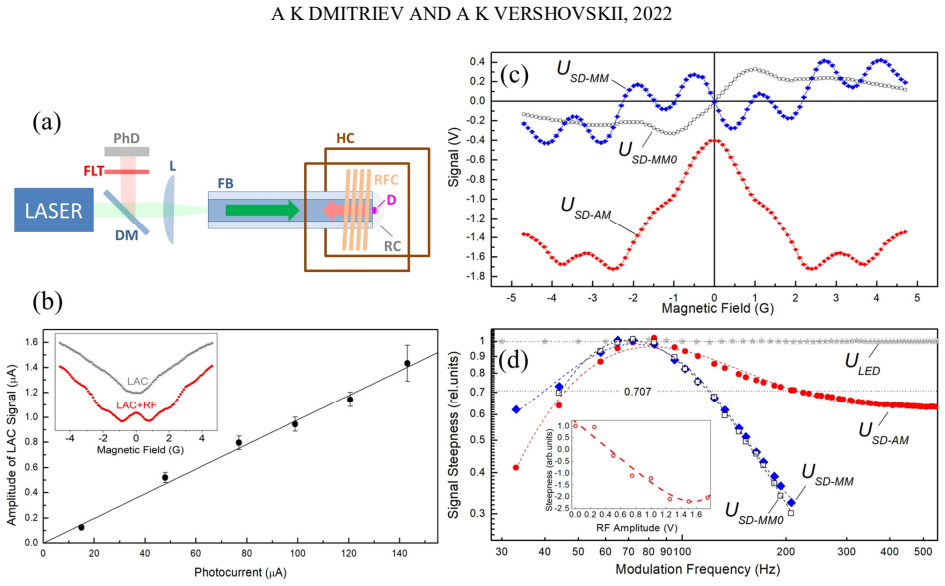
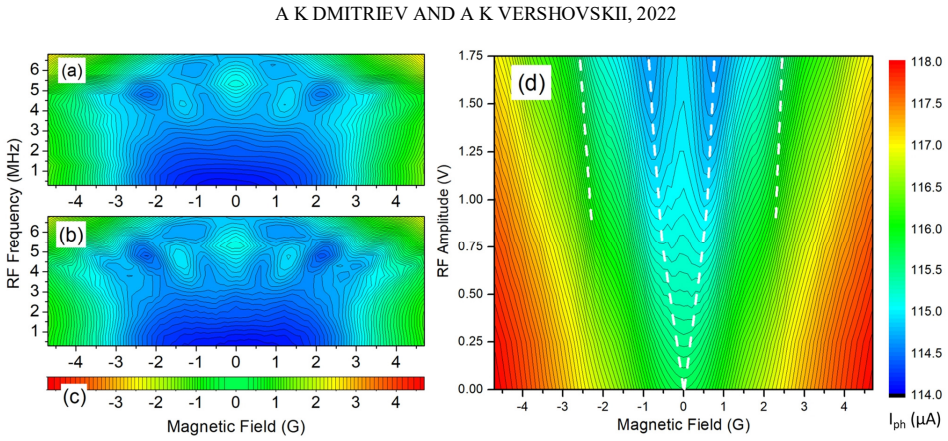
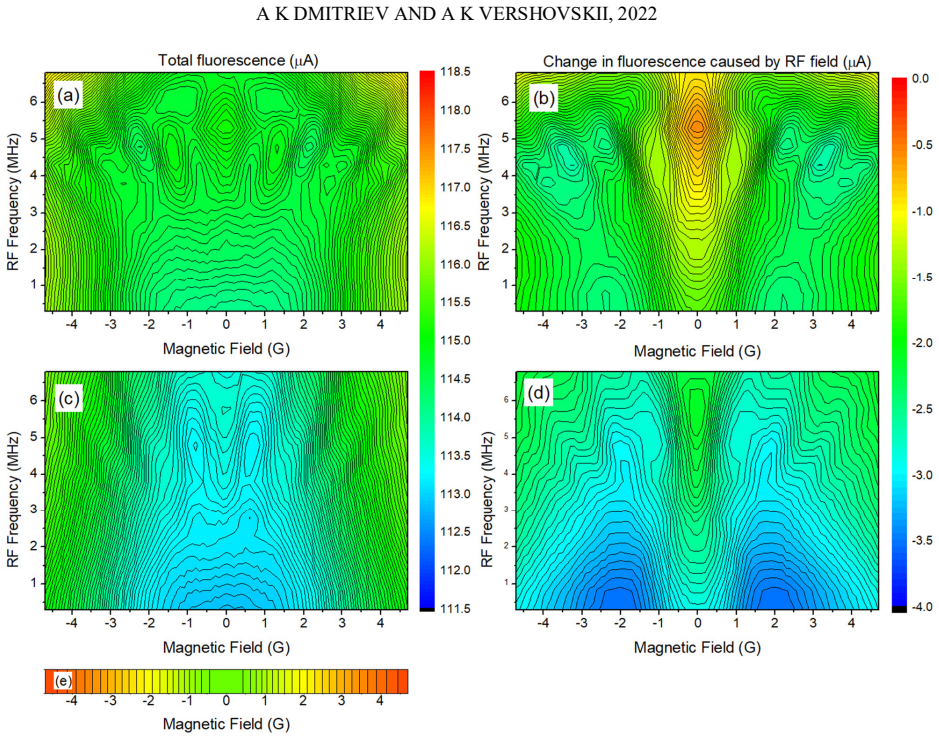
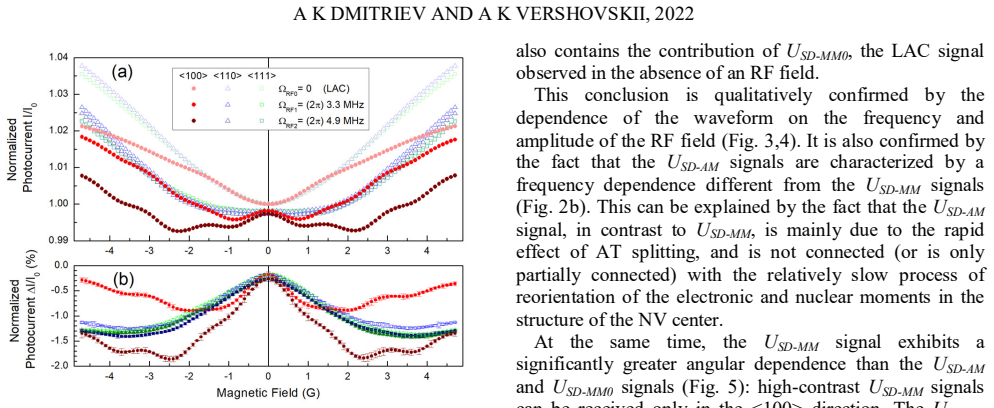
The response of the level anti-crossing signal to a quasi-resonant radio-frequency field, which appears in a zero magnetic field at NV color centers in diamond, is investigated. It is shown that the complex structure of this response can be explained by the Autler-Townes splitting. The possibility of controlling the parameters of the level anti-crossing signal is considered. It is shown that the slope of the central resonance recorded in this structure upon low-frequency modulation of the external magnetic field can be 2.3 times higher than the slope of the resonance recorded in the absence of an RF field. Conclusions are drawn about the nature of the level anti-crossing effect arising in zero field in NV color centers in diamond.
Editorial analysis
A structured set of objections, weighed in public.
Referee Report
Summary. The manuscript investigates the response of the optically detected level anti-crossing (LAC) signal in NV centers in diamond to a quasi-resonant radiofrequency field at zero and weak magnetic fields. It claims that the observed complex structure arises from Autler-Townes splitting of the zero-field LAC levels and reports that low-frequency modulation of the external magnetic field can produce a central resonance slope 2.3 times steeper than the resonance recorded without the RF field. Conclusions are drawn regarding the nature of the zero-field LAC effect.
Significance. If the attribution to Autler-Townes splitting is shown to be exclusive and the reported slope enhancement is placed on a quantitative footing with controls, the result could enable improved control over LAC-based readout in NV sensors and clarify the mechanism of zero-field anti-crossings. The numerical factor of 2.3, if robust, would constitute a concrete, falsifiable prediction for RF-enhanced magnetometry.
major comments (2)
- [Abstract] Abstract: the assertion that the complex RF response structure 'can be explained by' Autler-Townes splitting is load-bearing for the central claim yet is stated without a model derivation, lineshape fit, or quantitative comparison to data; no error bars or goodness-of-fit metrics are referenced.
- [Slope measurement / results] The section presenting the slope measurement: the factor of 2.3 is quoted without accompanying data, uncertainty, or explicit demonstration that the enhancement survives after accounting for possible inhomogeneous broadening or residual stray-field contributions, which directly affects the security of the Autler-Townes attribution.
minor comments (1)
- [Figures] Ensure all figure captions explicitly state the RF amplitude, modulation frequency, and averaging procedure so that the 2.3 factor can be reproduced from the presented data.
Simulated Author's Rebuttal
We thank the referee for the constructive comments, which help strengthen the quantitative aspects of our claims. We address each major point below and will revise the manuscript to incorporate additional model details, fit metrics, uncertainty estimates, and controls for broadening and stray fields.
read point-by-point responses
-
Referee: [Abstract] Abstract: the assertion that the complex RF response structure 'can be explained by' Autler-Townes splitting is load-bearing for the central claim yet is stated without a model derivation, lineshape fit, or quantitative comparison to data; no error bars or goodness-of-fit metrics are referenced.
Authors: Section II of the manuscript derives the Autler-Townes splitting via the density-matrix equations for the NV ground-state spin system driven by a quasi-resonant RF field at zero external field, predicting the observed multi-peak structure. Figure 3 compares the calculated and measured lineshapes, showing that the splitting reproduces the complex response. We agree the abstract itself contains no derivation reference or fit statistics. In revision we will add a sentence to the abstract citing the model and include chi-squared values plus error bars on the lineshape comparison in the main text. revision: yes
-
Referee: [Slope measurement / results] The section presenting the slope measurement: the factor of 2.3 is quoted without accompanying data, uncertainty, or explicit demonstration that the enhancement survives after accounting for possible inhomogeneous broadening or residual stray-field contributions, which directly affects the security of the Autler-Townes attribution.
Authors: Figure 5 presents the low-frequency modulated signals with and without RF; the central slopes are extracted directly from those traces to obtain the reported factor. The experimental section describes active field stabilization and mu-metal shielding to suppress stray fields. We acknowledge that no uncertainty is quoted for 2.3 and no explicit inhomogeneous-broadening analysis is supplied. Revision will add error propagation on the slope ratio, a quantitative estimate of residual broadening, and a control measurement confirming the enhancement persists after these corrections. revision: yes
Circularity Check
No circularity: experimental claims rest on direct observation
full rationale
The paper reports experimental measurements of the RF response of the zero-field LAC signal in NV centers and attributes the observed complex structure to Autler-Townes splitting on the basis of the recorded lineshapes. The reported 2.3× slope increase is presented as a measured outcome under low-frequency B-field modulation. No equations, parameters, or central claims are shown to reduce by construction to fitted inputs from the same dataset, self-citations that bear the load of uniqueness, or ansatzes smuggled via prior work. The derivation chain is therefore self-contained against external benchmarks and consists of observation plus standard quantum-optics interpretation rather than tautological re-labeling of inputs.
Axiom & Free-Parameter Ledger
Lean theorems connected to this paper
-
IndisputableMonolith/Cost/FunctionalEquation.leanwashburn_uniqueness_aczel unclear?
unclearRelation between the paper passage and the cited Recognition theorem.
The complex structure of this response can be explained by the Autler-Townes splitting... slope ... 2.3 times higher
-
IndisputableMonolith/Foundation/RealityFromDistinction.leanreality_from_one_distinction unclear?
unclearRelation between the paper passage and the cited Recognition theorem.
Hamiltonian H_tot = H_S + H_SI + H_I ... Autler-Townes effect
What do these tags mean?
- matches
- The paper's claim is directly supported by a theorem in the formal canon.
- supports
- The theorem supports part of the paper's argument, but the paper may add assumptions or extra steps.
- extends
- The paper goes beyond the formal theorem; the theorem is a base layer rather than the whole result.
- uses
- The paper appears to rely on the theorem as machinery.
- contradicts
- The paper's claim conflicts with a theorem or certificate in the canon.
- unclear
- Pith found a possible connection, but the passage is too broad, indirect, or ambiguous to say the theorem truly supports the claim.
Reference graph
Works this paper leans on
-
[1]
V. Jacques, P. Neumann, J. Beck, M. Markham, D. Twitchen, J. Meijer, F. Kaiser, G. Balasubramanian, F. Jelezko, and J. Wrachtrup, Dynamic Polarization of Single Nuclear Spins by Optical Pumping of Nitrogen-Vacancy Color Centers in Diamond at Room Temperature , Phys. Rev. Lett. 102 , 057403 (2009)
work page 2009
-
[2]
F. Jelezko and J. Wrachtrup, Focus on Diamond- Based Photonics and Spintronics , New Journal of Physics 14 , 105024 (2012)
work page 2012
-
[3]
J. Wrachtrup and F. Jelezko, Processing Quantum Information in Diamond , Journal of Physics: Condensed Matter 18 , S807 (2006)
work page 2006
-
[4]
M. V. G. Dutt, L. Childress, L. Jiang, E. Togan , J. Maze, F. Jelezko, A. S. Zibrov, P. R. Hemmer, and M. D. Lukin, Quantum Register Based on Individual Electronic and Nuclear Spin Qubits in Diamond , Science 316 , 1312 (2007)
work page 2007
-
[5]
J. M. Taylor, P. Cappellaro, L. Childress, L. J iang, D. Budker, P. R. Hemmer, A. Yacoby, R. Walsworth, and M. D. Lukin, High-Sensitivity Diamond Magnetometer with Nanoscale Resolution , Nature Physics 4, 810 (2008)
work page 2008
-
[6]
V. M. Acosta, E. Bauch, A. Jarmola, L. J. Zipp, M. P. Ledbetter, and D. Budker, Broadband Magnetometry by Infrared-Absorption Detection of Nitrogen- Vacancy Ensembles in Diamond , Applied Physics Letters 97 , 174104 (2010)
work page 2010
-
[7]
V. M. Acosta, E. Bauch, M. P. Ledbetter, A. Waxman, L.-S. Bouchard, and D. Budker, Temperature Dependence of the Nitrogen-Vacancy Magnetic Resonance in Diamond , Phys. Rev. Lett. 104 , 070801 (2010)
work page 2010
-
[8]
J. S. Hodges, N. Y. Yao, D. Maclaurin, C. Rasto gi, M. D. Lukin, and D. Englund, Timekeeping with Electron Spin States in Diamond , Phys. Rev. A 87 , 032118 (2013)
work page 2013
-
[9]
F. Jelezko, T. Gaebel, I. Popa, M. Domhan, A. Gruber, and J. Wrachtrup, Observation of Coherent Oscillation of a Single Nuclear Spin and Realizatio n of a Two-Qubit Conditional Quantum Gate , Phys. Rev. Lett. 93 , 130501 (2004)
work page 2004
-
[10]
P. Kehayias, M. Mrózek, V. M. Acosta, A. Jarmo la, D. S. Rudnicki, R. Folman, W. Gawlik, and D. Budker, Microwave Saturation Spectroscopy of Nitrogen-Vacancy Ensembles in Diamond , Phys. Rev. B 89 , 245202 (2014)
work page 2014
-
[11]
H. Clevenson, E. H. Chen, F. Dolde, C. Teale, D. Englund, and D. Braje, Diamond-Nitrogen-Vacancy Electronic and Nuclear Spin-State Anticrossings under Weak Transverse Magnetic Fields , Phys. Rev. A 94 , 021401 (2016)
work page 2016
-
[12]
L. Childress and J. McIntyre, Multifrequency Spin Resonance in Diamond , Phys. Rev. A 82 , 033839 (2010)
work page 2010
-
[13]
A. K. Dmitriev and A. K. Vershovskii, Multi- Frequency ODMR of Nitrogen-Vacancy Color Centers in Diamond Crystals in Zero Magnetic Fields , Journal of Physics: Conference Series 1135 , 012051 (2018)
work page 2018
-
[14]
S. Saijo, Y. Matsuzaki, S. Saito, T. Yamaguchi , I. Hanano, H. Watanabe, N. Mizuochi, and J. Ishi- Hayase, AC Magnetic Field Sensing Using Continuous-Wave Optically Detected Magnetic Resonance of Nitrogen-Vacancy Centers in Diamond , Applied Physics Letters 113 , 082405 (2018)
work page 2018
-
[15]
A. K. Dmitriev, H. Y. Chen, G. D. Fuchs, and A . K. Vershovskii, Dual-Frequency Spin-Resonance Spectroscopy of Diamond Nitrogen-Vacancy Centers in Zero Magnetic Field , Phys. Rev. A 100 , 011801 (2019)
work page 2019
-
[16]
A. K. Dmitriev and A. K. Vershovskii, High- Contrast Two-Frequency Optically Detected Resonances in Diamond Nitrogen-Vacancy Centers A K DMITRIEV AND A K VERSHOVSKII, 2022 for Timekeeping Schemes , IEEE Sensors Letters 1 (2019)
work page 2022
-
[17]
K. Holliday, N. Manson, M. Glasbeek, and E. Va n Oort, Optical Hole-Bleaching by Level Anti-Crossing and Cross Relaxation in the NV Centre in Diamond , Journal of Physics: Condensed Matter 1, 7093 (1989)
work page 1989
-
[18]
S. Anishchik, V. Vins, A. Yelisseyev, N. Lukze n, N. Lavrik, and V. Bagryansky, Low-Field Feature in the Magnetic Spectra of NV- Centers in Diamond , New Journal of Physics 17 , 023040 (2015)
work page 2015
-
[19]
S. V. Anishchik and K. L. Ivanov, Sensitive Detection of Level Anticrossing Spectra of Nitrogen Vacancy Centers in Diamond , Physical Review B 96 , 115142 (2017)
work page 2017
-
[20]
A. K. Vershovskii and A. K. Dmitriev, A Weak Magnetic Field Sensor Based on Nitrogen-Vacancy Color Centers in a Diamond Crystal , Technical Physics 65 , 1301 (2020)
work page 2020
-
[21]
L. D. Landau, Zur Theorie Der Energieubertragung I, Z. Sowjetunion 1, 88 (1932)
work page 1932
-
[22]
Zener, Non-Adiabatic Crossing of Energy Levels , Proceedings of the Royal Society of London
C. Zener, Non-Adiabatic Crossing of Energy Levels , Proceedings of the Royal Society of London. Series A, Containing Papers of a Mathematical and Physical Character 137 , 696 (1932)
work page 1932
-
[23]
S. N. Shevchenko, S. Ashhab, and F. Nori, Landau– Zener–Stückelberg Interferometry , Physics Reports 492 , 1 (2010)
work page 2010
-
[24]
W. D. Oliver, Y. Yu, J. C. Lee, K. K. Berggre n, L. S. Levitov, and T. P. Orlando, Mach-Zehnder Interferometry in a Strongly Driven Superconducting Qubit , Science 310 , 1653 (2005)
work page 2005
-
[25]
G. D. Fuchs, G. Burkard, P. V. Klimov, and D. D. Awschalom, A Quantum Memory Intrinsic to Single Nitrogen–Vacancy Centres in Diamond , Nature Phys 7, 789 (2011)
work page 2011
- [26]
-
[27]
A. K. Dmitriev and A. K. Vershovskii, Concept of a Microscale Vector Magnetic Field Sensor Based on Nitrogen-Vacancy Centers in Diamond , Journal of the Optical Society of America B 33 , B1 (2016)
work page 2016
- [28]
discussion (0)
Sign in with ORCID, Apple, or X to comment. Anyone can read and Pith papers without signing in.