Field-free Josephson diode with controllable efficiency using magnetic tunnel barrier
Pith reviewed 2026-05-24 05:35 UTC · model grok-4.3
The pith
A magnetic tunnel barrier in asymmetric Josephson junctions produces a robust zero-field diode effect whose efficiency reaches 40 percent when the barrier's micromagnetic structure is modified.
A machine-rendered reading of the paper's core claim, the machinery that carries it, and where it could break.
Core claim
An asymmetric Josephson junction that incorporates a magnetic weak link exhibits a zero-field diode effect in its switching current; the efficiency of this effect can be increased up to 40 percent by altering the micromagnetic structure of the barrier, as demonstrated in fabricated long NbN/GdN/NbN junctions in cross geometry.
What carries the argument
The micromagnetic configuration of the GdN magnetic barrier, which breaks reciprocity in the Josephson critical current without external fields.
If this is right
- The diode maintains high efficiency from the lowest accessible temperatures up to at least 4.2 K.
- Efficiency can be raised to 40 percent by deliberate modification of the barrier's micromagnetic structure.
- The junctions operate at frequencies approaching 28 GHz.
- The fabrication uses standard sputter deposition and mesa patterning, indicating a scalable route to field-free Josephson diodes.
Where Pith is reading between the lines
- Absence of external magnets could simplify integration of these diodes into dense superconducting circuits.
- The same magnetic-barrier approach may be transferable to other material combinations or junction geometries that require non-reciprocal transport.
- Voltage-tunable or current-tunable control of the micromagnetic state would allow in-situ adjustment of diode polarity or efficiency after fabrication.
Load-bearing premise
The observed difference between positive and negative switching currents is caused by the micromagnetic state of the GdN layer rather than by geometric asymmetry from fabrication or by trapped magnetic flux.
What would settle it
Fabrication and measurement of otherwise identical NbN junctions that lack the GdN magnetic layer and show equal positive and negative switching currents would falsify the claim that the magnetic barrier produces the diode effect.
Figures


read the original abstract
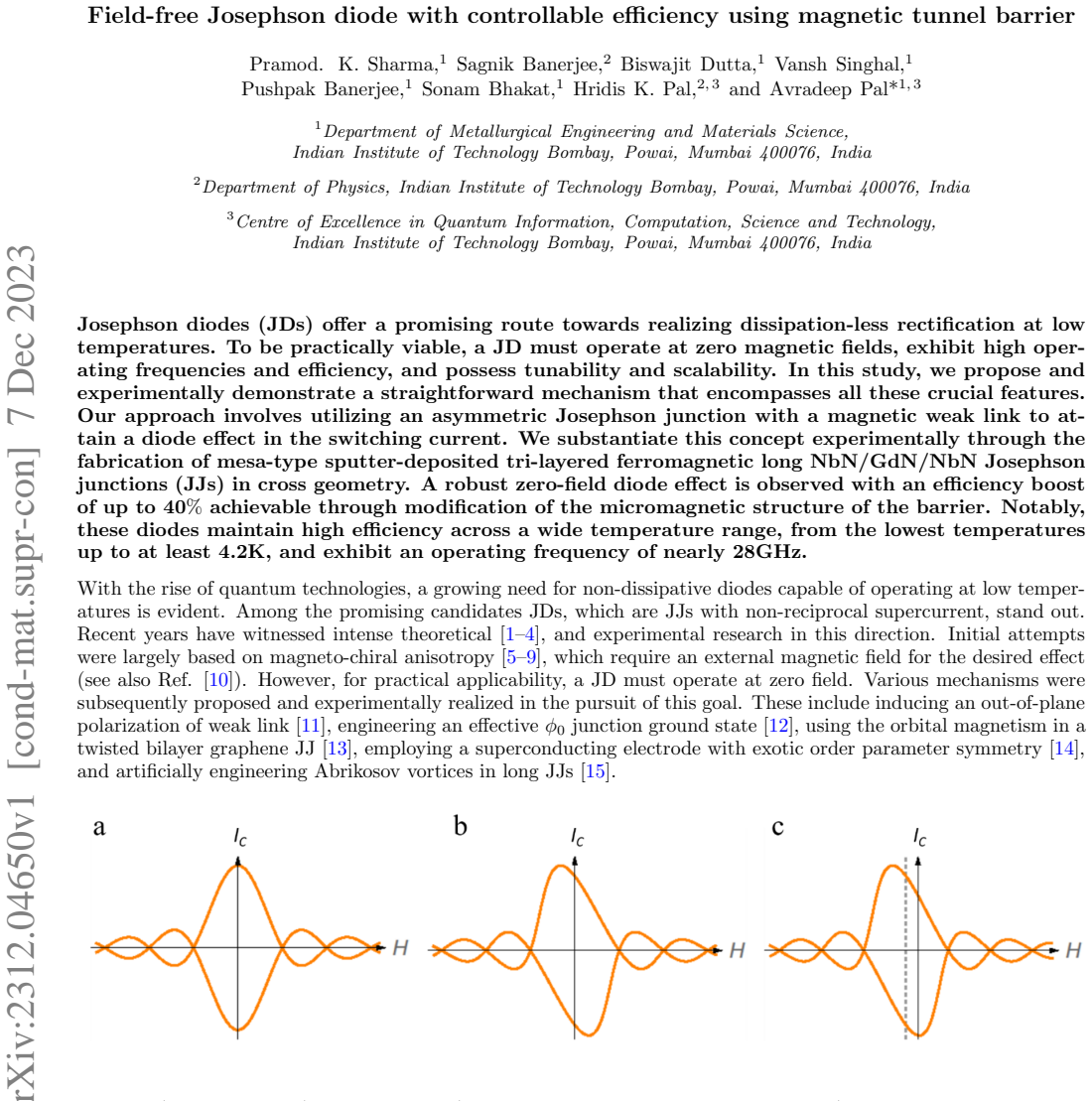
Josephson diodes (JDs) offer a promising route towards realizing dissipation-less rectification at low temperatures. To be practically viable, a JD must operate at zero magnetic fields, exhibit high operating frequencies and efficiency, and possess tunability and scalability. In this study, we propose and experimentally demonstrate a straightforward mechanism that encompasses all these crucial features. Our approach involves utilizing an asymmetric Josephson junction with a magnetic weak link to attain a diode effect in the switching current. We substantiate this concept experimentally through the fabrication of mesa-type sputter-deposited tri-layered ferromagnetic long NbN/GdN/NbN Josephson junctions (JJs) in cross geometry. A robust zero-field diode effect is observed with an efficiency boost of up to 40% achievable through modification of the micromagnetic structure of the barrier. Notably, these diodes maintain high efficiency across a wide temperature range, from the lowest temperatures up to at least 4.2K, and exhibit an operating frequency of nearly 28GHz.
Editorial analysis
A structured set of objections, weighed in public.
Referee Report
Summary. The manuscript experimentally demonstrates a field-free Josephson diode effect in sputter-deposited NbN/GdN/NbN tri-layer junctions fabricated in cross geometry. It reports a robust zero-field switching-current asymmetry whose efficiency can be boosted up to 40% by modifying the micromagnetic structure of the GdN barrier; the devices are stated to retain high efficiency from base temperature to at least 4.2 K and to operate at frequencies approaching 28 GHz.
Significance. If the micromagnetic origin of the asymmetry is confirmed, the work supplies a scalable, tunable, zero-field Josephson diode that simultaneously satisfies the practical requirements of high efficiency, wide temperature range, and GHz-range operation. The approach of using a magnetic tunnel barrier for both the diode effect and its controllability would constitute a clear advance over existing field-dependent or geometrically asymmetric designs.
major comments (2)
- [Description of the tri-layered ferromagnetic long junctions and associated results] The central claim that the observed switching-current asymmetry originates from the micromagnetic configuration of the GdN barrier (rather than from mesa geometry or trapped flux) is load-bearing for the entire interpretation. The manuscript describes the tri-layered long junctions and reports efficiency tuning via micromagnetic modification, yet presents no data from control devices (NbN/NbN or NbN/non-magnetic-barrier/NbN junctions fabricated in identical cross geometry). Without these controls the attribution remains an untested assumption.
- [Results on efficiency tuning] The reported efficiency boost of up to 40% is stated to arise from deliberate modification of the barrier's micromagnetic structure. No quantitative micromagnetic characterization (e.g., MFM images, hysteresis loops, or micromagnetic simulations correlated with the transport data) is provided to establish that the efficiency change tracks the intended magnetic reconfiguration rather than other junction parameters.
minor comments (2)
- [Abstract and results] The operating frequency of nearly 28 GHz is quoted without an accompanying measurement protocol or reference to the specific figure or supplementary section that reports the data.
- [Results] Error bars, number of devices measured, and statistics on the efficiency values are not mentioned in the abstract or the summary of results.
Simulated Author's Rebuttal
We thank the referee for their thorough review and constructive feedback. We address each major comment below and outline the revisions we plan to make to strengthen the manuscript.
read point-by-point responses
-
Referee: The central claim that the observed switching-current asymmetry originates from the micromagnetic configuration of the GdN barrier (rather than from mesa geometry or trapped flux) is load-bearing for the entire interpretation. The manuscript describes the tri-layered long junctions and reports efficiency tuning via micromagnetic modification, yet presents no data from control devices (NbN/NbN or NbN/non-magnetic-barrier/NbN junctions fabricated in identical cross geometry). Without these controls the attribution remains an untested assumption.
Authors: We agree that dedicated control devices would provide stronger evidence. However, the cross geometry is symmetric by design, and the zero-field diode effect together with its tunability via magnetic protocols is observed specifically with the GdN barrier; literature on non-magnetic junctions in comparable geometries shows no such asymmetry. The temperature range up to 4.2 K and near-28 GHz operation are also consistent with a magnetic origin. In revision we will add an explicit symmetry argument section plus references to prior non-magnetic control-like results. revision: partial
-
Referee: The reported efficiency boost of up to 40% is stated to arise from deliberate modification of the barrier's micromagnetic structure. No quantitative micromagnetic characterization (e.g., MFM images, hysteresis loops, or micromagnetic simulations correlated with the transport data) is provided to establish that the efficiency change tracks the intended magnetic reconfiguration rather than other junction parameters.
Authors: The efficiency changes are shown to be reproducible and to follow specific magnetic-field or current protocols applied to the GdN layer, whose ferromagnetic domain structure is known to be reconfigurable. While the present manuscript does not include direct micromagnetic imaging, the transport data correlate with magnetic history. We will add micromagnetic simulations in the revised manuscript that quantitatively connect the observed efficiency variations to changes in the GdN micromagnetic configuration. revision: yes
Circularity Check
No circularity: experimental measurements with no derivation chain
full rationale
The manuscript is an experimental report on fabricated NbN/GdN/NbN Josephson junctions. The central results (zero-field diode effect, efficiency values up to 40%, temperature and frequency performance) are obtained by direct measurement of switching currents in the devices. No equations, fitted parameters, or theoretical derivations are invoked that could reduce to self-definition or self-citation. The interpretation that the asymmetry originates from the GdN micromagnetic structure is an unverified assumption (as noted by the skeptic), but this is a question of experimental controls, not a circular reduction in any claimed derivation. The work is therefore self-contained against external benchmarks with score 0.
Axiom & Free-Parameter Ledger
Reference graph
Works this paper leans on
-
[1]
I ≥ 0: ϕs, β → ϕs, −β, ϕ p, α → −ϕp, −α (S34)
He + H0 ≤ 0. I ≥ 0: ϕs, β → ϕs, −β, ϕ p, α → −ϕp, −α (S34)
-
[2]
I ≤ 0: ϕs, β → −ϕs, −β, ϕ p, α → ϕp, −α (S35)
He + H0 ≥ 0. I ≤ 0: ϕs, β → −ϕs, −β, ϕ p, α → ϕp, −α (S35)
-
[3]
He + H0 ≤ 0. I ≤ 0: ϕs, β → −ϕs, β, ϕ p, α → −ϕp, α (S36) We now plot the variation of critical current Ic vs the external field He for various cases. Case 1: Fig. S2 (a). A short junction (L=0.2) with symmetric current injection ( a+ = a− = 0 .5) and a non- magnetic barrier ( M = 0). Case 2: Fig. S2 (b). A long junction (L=2) with symmetric current injec...
-
[4]
General theory of josephson diodes
Yi Zhang, Yuhao Gu, Pengfei Li, Jiangping Hu, and Kun Jiang. General theory of josephson diodes. Physical Review X, 12(4):041013, 2022. 15
work page 2022
-
[5]
Universal josephson diode effect
Margarita Davydova, Saranesh Prembabu, and Liang Fu. Universal josephson diode effect. Science advances , 8(23):eabo0309, 2022
work page 2022
-
[6]
Diode effects in current- biased josephson junctions
Jacob F Steiner, Larissa Melischek, Martina Trahms, Katharina J Franke, and Felix von Oppen. Diode effects in current- biased josephson junctions. Physical Review Letters, 130(17):177002, 2023
work page 2023
-
[7]
Tunable josephson diode effect on the surface of topological insulators
Bo Lu, Satoshi Ikegaya, Pablo Burset, Yukio Tanaka, and Naoto Nagaosa. Tunable josephson diode effect on the surface of topological insulators. Physical Review Letters, 131(9):096001, 2023
work page 2023
-
[8]
Electrical magnetochiral anisotropy
GLJA Rikken, J F¨ olling, and P Wyder. Electrical magnetochiral anisotropy. Physical review letters, 87(23):236602, 2001
work page 2001
-
[9]
Observation of superconducting diode effect
Fuyuki Ando, Yuta Miyasaka, Tian Li, Jun Ishizuka, Tomonori Arakawa, Yoichi Shiota, Takahiro Moriyama, Youichi Yanase, and Teruo Ono. Observation of superconducting diode effect. Nature, 584(7821):373–376, 2020
work page 2020
-
[10]
Supercurrent rectification and magnetochiral effects in symmetric josephson junctions
Christian Baumgartner, Lorenz Fuchs, Andreas Costa, Simon Reinhardt, Sergei Gronin, Geoffrey C Gardner, Tyler Linde- mann, Michael J Manfra, Paulo E Faria Junior, Denis Kochan, et al. Supercurrent rectification and magnetochiral effects in symmetric josephson junctions. Nature nanotechnology, 17(1):39–44, 2022
work page 2022
-
[11]
Josephson diode effect in high-mobility insb nanoflags
Bianca Turini, Sedighe Salimian, Matteo Carrega, Andrea Iorio, Elia Strambini, Francesco Giazotto, Valentina Zannier, Lucia Sorba, and Stefan Heun. Josephson diode effect in high-mobility insb nanoflags. Nano Letters, 22(21):8502–8508, 2022
work page 2022
-
[12]
Gate-tunable superconducting diode effect in a three-terminal josephson device
Mohit Gupta, Gino V Graziano, Mihir Pendharkar, Jason T Dong, Connor P Dempsey, Chris Palmstrøm, and Vlad S Prib- iag. Gate-tunable superconducting diode effect in a three-terminal josephson device. Nature communications, 14(1):3078, 2023
work page 2023
-
[13]
Josephson diode effect from cooper pair momentum in a topological semimetal
Banabir Pal, Anirban Chakraborty, Pranava K Sivakumar, Margarita Davydova, Ajesh K Gopi, Avanindra K Pandeya, Jonas A Krieger, Yang Zhang, Mihir Date, Sailong Ju, et al. Josephson diode effect from cooper pair momentum in a topological semimetal. Nature physics, 18(10):1228–1233, 2022
work page 2022
-
[14]
The field-free josephson diode in a van der waals heterostructure
Heng Wu, Yaojia Wang, Yuanfeng Xu, Pranava K Sivakumar, Chris Pasco, Ulderico Filippozzi, Stuart SP Parkin, Yu-Jia Zeng, Tyrel McQueen, and Mazhar N Ali. The field-free josephson diode in a van der waals heterostructure. Nature, 604(7907):653–656, 2022
work page 2022
-
[15]
Kun-Rok Jeon, Jae-Keun Kim, Jiho Yoon, Jae-Chun Jeon, Hyeon Han, Audrey Cottet, Takis Kontos, and Stuart SP Parkin. Zero-field polarity-reversible josephson supercurrent diodes enabled by a proximity-magnetized pt barrier. Nature Materials, 21(9):1008–1013, 2022
work page 2022
-
[16]
J D´ ıez-M´ erida, A D´ ıez-Carl´ on, SY Yang, Y-M Xie, X-J Gao, J Senior, K Watanabe, T Taniguchi, X Lu, Andrew P Higginbotham, et al. Symmetry-broken josephson junctions and superconducting diodes in magic-angle twisted bilayer graphene. Nature Communications, 14(1):2396, 2023
work page 2023
-
[17]
Spontaneous superconducting diode effect in non-magnetic nb/ru/sr2ruo4 topo- logical junctions
Muhammad Shahbaz Anwar, Taketomo Nakamura, Ryosuke Ishiguro, Shafaq Arif, Jason WA Robinson, Shingo Yonezawa, Manfred Sigrist, and Yoshiteru Maeno. Spontaneous superconducting diode effect in non-magnetic nb/ru/sr2ruo4 topo- logical junctions. Communications Physics, 6(1):290, 2023
work page 2023
-
[18]
Taras Golod and Vladimir M Krasnov. Demonstration of a superconducting diode-with-memory, operational at zero magnetic field with switchable nonreciprocity. Nature Communications, 13(1):3658, 2022
work page 2022
-
[19]
Diode effect in josephson junctions with a single magnetic atom
Martina Trahms, Larissa Melischek, Jacob F Steiner, Bharti Mahendru, Idan Tamir, Nils Bogdanoff, Olof Peters, Ga¨ el Reecht, Clemens B Winkelmann, Felix von Oppen, et al. Diode effect in josephson junctions with a single magnetic atom. Nature, 615(7953):628–633, 2023
work page 2023
-
[20]
Current flow in large josephson junctions
A Barone, WJ Johnson, and Ruggero Vaglio. Current flow in large josephson junctions. Journal of Applied Physics , 46(8):3628–3632, 1975
work page 1975
-
[21]
Vortex structure and critical currents in josephson junctions
CS Owen and DJ Scalapino. Vortex structure and critical currents in josephson junctions. Physical Review, 164(2):538, 1967
work page 1967
-
[22]
SV Kuplevakhsky and AM Glukhov. Exact analytical solution of the problem of current-carrying states of the josephson junction in external magnetic fields. Physical Review B, 76(17):174515, 2007
work page 2007
-
[23]
VM Krasnov, VA Oboznov, and Niels Falsig Pedersen. Fluxon dynamics in long josephson junctions in the presence of a temperature gradient or spatial nonuniformity. Physical Review B, 55(21):14486, 1997
work page 1997
-
[24]
Spin-filter josephson junctions
Kartik Senapati, Mark G Blamire, and Zoe H Barber. Spin-filter josephson junctions. Nature materials, 10(11):849–852, 2011
work page 2011
-
[25]
Pure second harmonic current-phase relation in spin-filter josephson junctions
Avradeep Pal, ZH Barber, JWA Robinson, and MG Blamire. Pure second harmonic current-phase relation in spin-filter josephson junctions. Nature Communications, 5(1):3340, 2014
work page 2014
-
[26]
Conductance and leakage in superconducting tunnel junctions
MS Goodchild, ZH Barber, and MG Blamire. Conductance and leakage in superconducting tunnel junctions. Journal of Vacuum Science & Technology A: Vacuum, Surfaces, and Films , 14(4):2427–2432, 1996
work page 1996
-
[27]
Electric-field-dependent spin polarization in gdn spin filter tunnel junctions
Avradeep Pal, K Senapati, ZH Barber, and MG Blamire. Electric-field-dependent spin polarization in gdn spin filter tunnel junctions. Advanced Materials, 25(39):5581–5585, 2013
work page 2013
-
[28]
Spin filter superconducting tunnel junctions
MG Blamire, A Pal, ZH Barber, and Kartik Senapati. Spin filter superconducting tunnel junctions. In Spintronics V, volume 8461, pages 49–54. SPIE, 2012
work page 2012
-
[29]
F Sebastian Bergeret, Alvise Verso, and Anatoly F Volkov. Spin-polarized josephson and quasiparticle currents in super- conducting spin-filter tunnel junctions. Physical Review B, 86(6):060506, 2012
work page 2012
-
[30]
Superconducting exchange coupling between ferromagnets
Yi Zhu, Avradeep Pal, Mark G Blamire, and Zoe H Barber. Superconducting exchange coupling between ferromagnets. Nature materials, 16(2):195–199, 2017
work page 2017
-
[31]
Introduction to superconductivity
Michael Tinkham. Introduction to superconductivity. Courier Corporation, 2004
work page 2004
-
[32]
Methods of mathematical physics (interscience publ., new york and london), vol
R Courant and D Hilbert. Methods of mathematical physics (interscience publ., new york and london), vol. 1. vol, 2:830, 1962
work page 1962
-
[33]
SV Kuplevakhsky and AM Glukhov. Static solitons of the sine-gordon equation and equilibrium vortex structure in 16 josephson junctions. Physical Review B, 73(2):024513, 2006
work page 2006
-
[34]
Sergey V Kuplevakhsky. Topological solitons of the lawrence–doniach model as equilibrium josephson vortices in layered superconductors. Low temperature physics, 30(7):646–660, 2004
work page 2004
-
[35]
Physics and applications of the Josephson effect
Antonio Barone, Gianfranco Paterno, et al. Physics and applications of the Josephson effect . 1982
work page 1982
-
[36]
Dynamics of Josephson junctions and circuits
Konstantin K Likharev. Dynamics of Josephson junctions and circuits . Routledge, 2022
work page 2022
-
[37]
Approximate analysis for stationary current flow in two-dimensional josephson tunnel junctions
Ruggero Vaglio. Approximate analysis for stationary current flow in two-dimensional josephson tunnel junctions. Journal of Low Temperature Physics, 25:299–315, 1976
work page 1976
discussion (0)
Sign in with ORCID, Apple, or X to comment. Anyone can read and Pith papers without signing in.