Geometric properties of integrable Kepler and Hooke billiards with conic section boundaries
Pith reviewed 2026-05-24 05:05 UTC · model grok-4.3
The pith
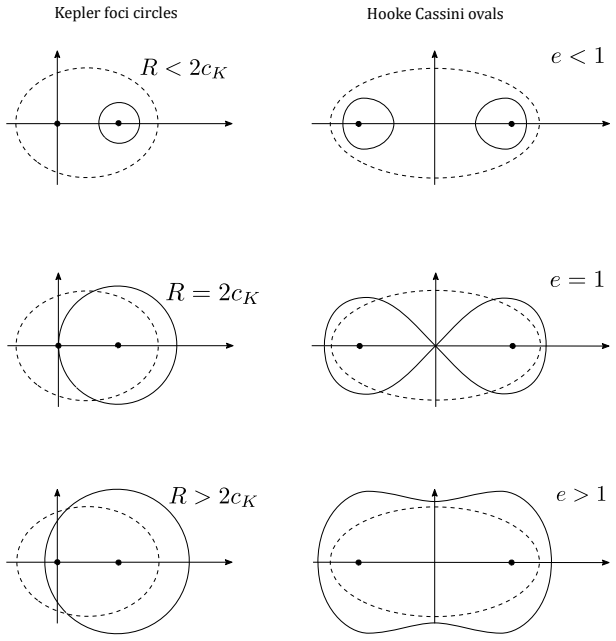
In Kepler billiards with conic boundaries the second foci of reflected orbits lie on a fixed circle.
A machine-rendered reading of the paper's core claim, the machinery that carries it, and where it could break.
Core claim
We show that the second foci of these orbits always lie on a circle in the Kepler case. In the Hooke case, we show that the foci of the orbits lie on a Cassini oval. For both systems we analyze the envelope of the directrices of the orbits as well.
What carries the argument
The loci traced by the foci of successive reflected conic orbits under the billiard reflection map.
If this is right
- The billiard map reduces to a simpler dynamics on the circle or Cassini oval.
- Periodic orbits correspond to closed trajectories on these fixed loci.
- The envelope of the directrices supplies an additional geometric invariant for the flow.
- The reflection law preserves the conic type of each orbit segment.
Where Pith is reading between the lines
- Angle coordinates on the circle could yield an explicit closed-form solution for the Kepler billiard map.
- The Cassini oval may encode a product-of-distances invariant that links directly to the Hooke energy.
- Similar focus loci might appear for other central forces whose level sets are conics.
Load-bearing premise
The conic boundary must share a focus with the Kepler center or its geometric center with the Hooke center.
What would settle it
Numerical iteration of the billiard map inside a specific ellipse under inverse-square force, with the second-focus coordinates plotted to test whether they satisfy the equation of one common circle.
Figures




read the original abstract
We study the geometry of reflection of a massive point-like particle at conic section boundaries. Thereby the particle is subjected to a central force associated with either a Kepler or Hooke potential. The conic section is assumed to have a focus at the Kepler center, or have its center at the Hookian center respectively. When the particle hits the boundary it is ideally reflected according to the law of reflection. These systems are known to be integrable. We describe the consecutive billiard orbits in terms of their foci. We show that the second foci of these orbits always lie on a circle in the Kepler case. In the Hooke case, we show that the foci of the orbits lie on a Cassini oval. For both systems we analyze the envelope of the directrices of the orbits as well.
Editorial analysis
A structured set of objections, weighed in public.
Referee Report
Summary. The manuscript studies billiard motion of a particle under Kepler or Hooke central forces reflecting from conic-section boundaries aligned so that a focus (Kepler) or center (Hooke) coincides with the force center. The systems are stated to be integrable. The central claims are that the second foci of successive reflected orbits lie on a circle in the Kepler case, that the foci lie on a Cassini oval in the Hooke case, and that the envelopes of the directrices can be analyzed explicitly for both systems.
Significance. If the geometric loci are rigorously derived from the reflection law and the given alignment of the conic, the results supply concrete, explicit descriptions of the foci and directrix envelopes in these integrable central-force billiards. Such descriptions could aid visualization of the caustic structure and the organization of periodic orbits without requiring numerical integration.
minor comments (2)
- [Abstract] The abstract asserts the main geometric results but does not outline the key steps or invoke specific properties of the reflection law or conic sections that are used in the derivations; a brief indication of the argument structure would improve readability.
- The manuscript relies on the prior knowledge that the systems are integrable; a short reference or one-sentence reminder of the conserved quantities would help readers who are not already familiar with the cited integrability results.
Simulated Author's Rebuttal
We thank the referee for their positive summary and recommendation of minor revision. No major comments appear in the report, so we have no points requiring response or revision at this time.
Circularity Check
No significant circularity detected
full rationale
The paper states that the systems are known to be integrable and then derives geometric loci (second foci on a circle for Kepler; foci on Cassini oval for Hooke) as consequences of the reflection law applied to conics with the stated focus/center condition at the force center. No equations reduce a claimed prediction to a fitted input by construction, no self-citation is load-bearing for the central geometric statements, and no ansatz or uniqueness theorem is smuggled in. The derivation chain is self-contained against standard conic-section and billiard-reflection properties.
Axiom & Free-Parameter Ledger
axioms (2)
- standard math Particle orbits under Kepler or Hooke central forces are conic sections sharing the force center as focus or center.
- domain assumption Reflection obeys the law that angle of incidence equals angle of reflection.
Lean theorems connected to this paper
-
IndisputableMonolith/Foundation/RealityFromDistinction.leanreality_from_one_distinction unclear?
unclearRelation between the paper passage and the cited Recognition theorem.
We show that the second foci of these orbits always lie on a circle in the Kepler case. In the Hooke case, we show that the foci of the orbits lie on a Cassini oval.
-
IndisputableMonolith/Cost/FunctionalEquation.leanwashburn_uniqueness_aczel unclear?
unclearRelation between the paper passage and the cited Recognition theorem.
the conformal mapping z ↦→ z² ... unparametrized trajectories of the Hooke system are mapped to ... Kepler problem
What do these tags mean?
- matches
- The paper's claim is directly supported by a theorem in the formal canon.
- supports
- The theorem supports part of the paper's argument, but the paper may add assumptions or extra steps.
- extends
- The paper goes beyond the formal theorem; the theorem is a base layer rather than the whole result.
- uses
- The paper appears to rely on the theorem as machinery.
- contradicts
- The paper's claim conflicts with a theorem or certificate in the canon.
- unclear
- Pith found a possible connection, but the passage is too broad, indirect, or ambiguous to say the theorem truly supports the claim.
Reference graph
Works this paper leans on
-
[1]
[Barrera et al.(2023)Barrera, Ruz-Cuen and Guti´ errez-Vega] Barrera, B., Ruz-Cuen, J.P., Guti´ errez-Vega, J.C.,
work page 2023
-
[2]
Elliptic bil liard with har- monic potential: Classical description. Phys. Rev. E 108, 0 34205. URL: https://link.aps.org/doi/10.1103/PhysRevE.108.034205, doi:10.1103/PhysRevE.108.034205. [Barutello and Blasi(2023)] Barutello, V.L., Blasi, I.D.,
-
[3]
A note on chaotic billiards with potentials. arXiv:2312.01312. [Barutello et al.(2023)Barutello, Blasi and Terracini] Ba rutello, V.L., Blasi, I.D., Terracini, S.,
-
[4]
Chaotic dynamics in re- fraction galactic billiards. Nonlinearity 36, 4209–4246. URL: https://doi.org/10.1088%2F1361-6544%2Facdec2, doi:10.1088/1361-6544/acdec2. [Boltzmann(1868)] Boltzmann, L.,
-
[5]
A Paris, de l’Imprimerie royale
El` ements d’astronomi e. A Paris, de l’Imprimerie royale. M. DCCXL. 22 [Fedorov(2001)] Fedorov, Y.N.,
work page 2001
-
[6]
An ellipsoidal billi ard with a quadratic potential. Funct. Anal. Appl. 35, 199–208. [Felder(2021)] Felder, G.,
work page 2021
-
[7]
[Gallavotti and Jauslin(2020)] Gallavotti, G., Jauslin, I .,
URL: https://doi.org/10.1007%2Fs11005-020-01348-z , doi:10.1007/s11005-020-01348-z . [Gallavotti and Jauslin(2020)] Gallavotti, G., Jauslin, I .,
-
[8]
A theo- rem on ellipses, an integrable system and a theorem of boltzm ann. arXiv:2008.01955. [Gasiorek and Radnovi´ c(2023)] Gasiorek, S., Radnovi´ c, M .,
-
[9]
Peri- odic trajectories and topology of the integrable boltzmann system. arXiv:2307.04991. [Goursat(1887)] Goursat, E.,
-
[10]
Vorlesungen ¨ uber Dy namik. Verlag von G. Reimer. [Jaud(2023)] Jaud, D.,
work page 2023
-
[11]
Journal of Geometry and Physics 194, 104998
Gravitational billiards boun c- ing inside general domains - foci curves and confined do- mains. Journal of Geometry and Physics 194, 104998. URL: https://www.sciencedirect.com/science/article/pii/S0393044023002504, doi:https://doi.org/10.1016/j.geomphys.2023.104998, arXiv:2211.03788. [Maclaurin(1742)] Maclaurin, C.,
-
[12]
[Masalovich(2014)] Masalovich, S.,
work page 2014
-
[13]
A remarkable foc using property of a parabolic mirror for neutrons in the gravita- tional field: Geometric proof. Nuclear Instruments and Meth - ods in Physics Research Section A: Accelerators, Spectrome - ters, Detectors and Associated Equipment 763, 517–520. URL : https://www.sciencedirect.com/science/article/pii/S0168900214008468, doi:https://doi.org/10...
-
[14]
[Takeuchi and Zhao(2022)] Takeuchi, A., Zhao, L.,
doi: 10.1007/BF02110789. [Takeuchi and Zhao(2022)] Takeuchi, A., Zhao, L.,
-
[15]
Pro - jective integrable mechanical billiards. Nonlinearity to ap- pear. doi: https://doi.org/10.1088/1361-6544/ad0d6f, arXiv:2203.12938. 23 [Takeuchi and Zhao(2024)] Takeuchi, A., Zhao, L.,
-
[16]
Advances in Mathematics 436, 109411
Con - formal transformations and integrable mechanical bil- liards. Advances in Mathematics 436, 109411. URL: https://www.sciencedirect.com/science/article/pii/S0001870823005546, doi:https://doi.org/10.1016/j.aim.2023.109411. [Zhao(2022)] Zhao, L.,
-
[17]
Communications in Contemporary Mathe matics 24, 2150085
Projective dynamics and an int egrable boltz- mann billiard model. Communications in Contemporary Mathe matics 24, 2150085. doi: 10.1142/s0219199721500851. 24
discussion (0)
Sign in with ORCID, Apple, or X to comment. Anyone can read and Pith papers without signing in.