Coverings and Non-Hausdorff Extensions of Misner Spacetime
Pith reviewed 2026-05-24 04:07 UTC · model grok-4.3
The pith
Misner spacetime admits a family of non-Hausdorff extensions from boost-compatible coverings of the punctured plane.
A machine-rendered reading of the paper's core claim, the machinery that carries it, and where it could break.
Core claim
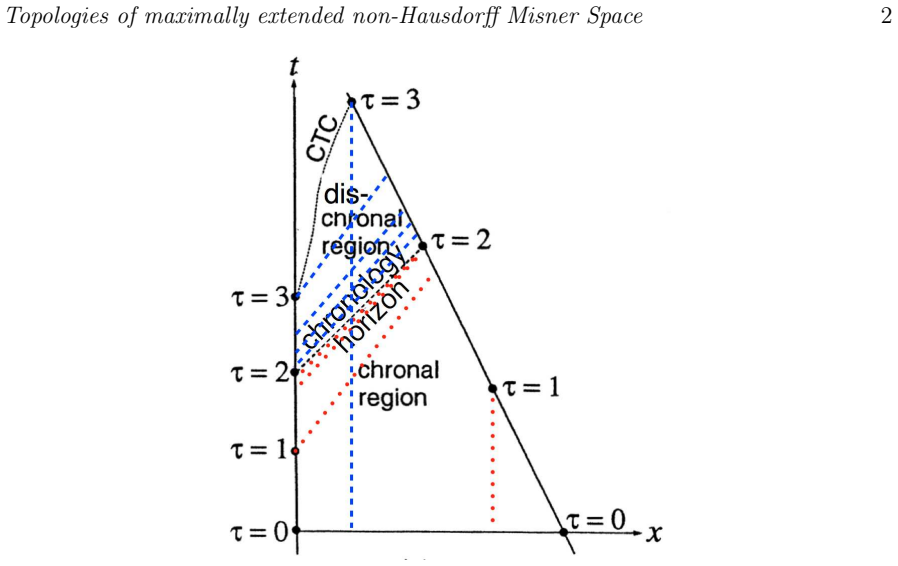
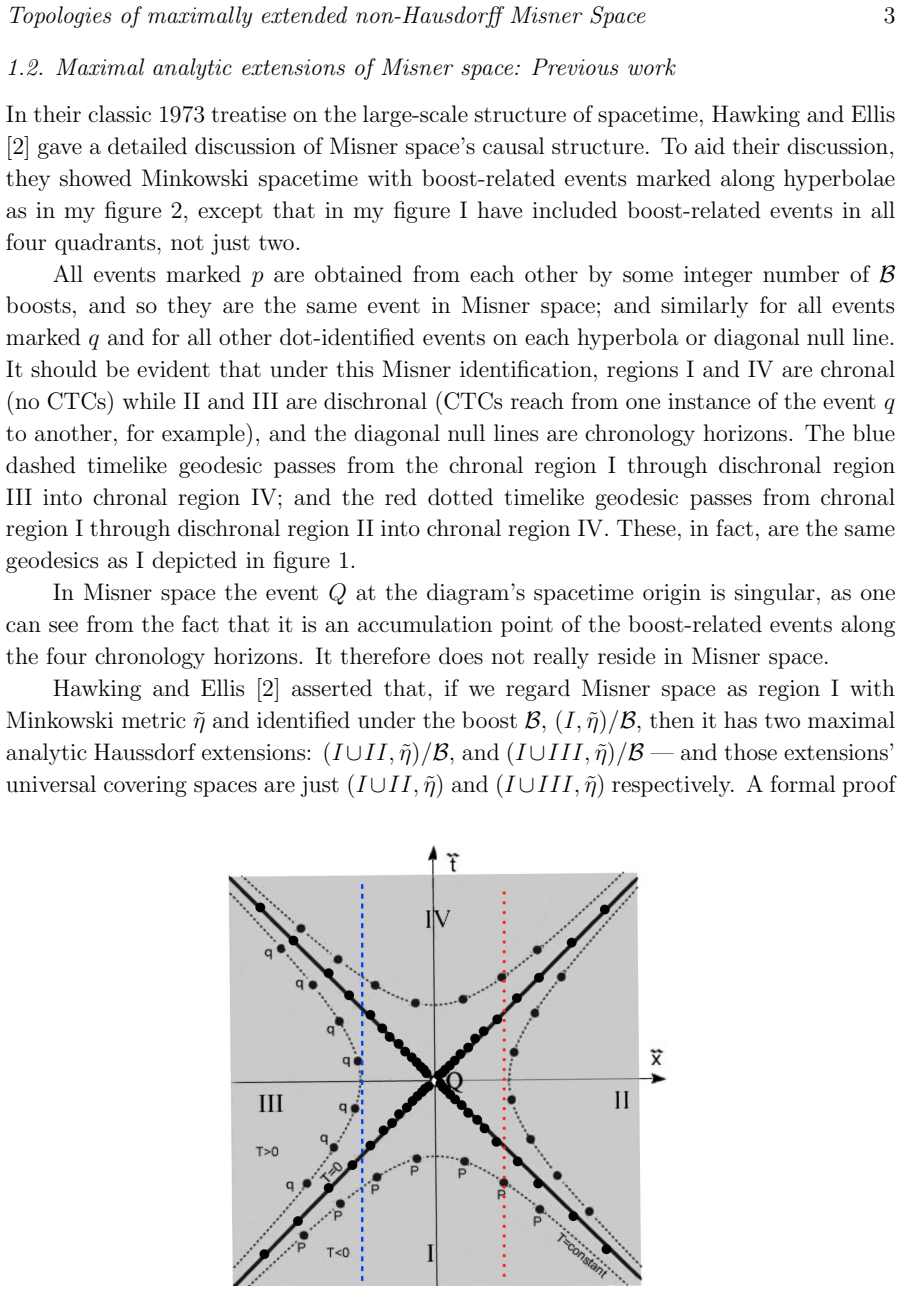
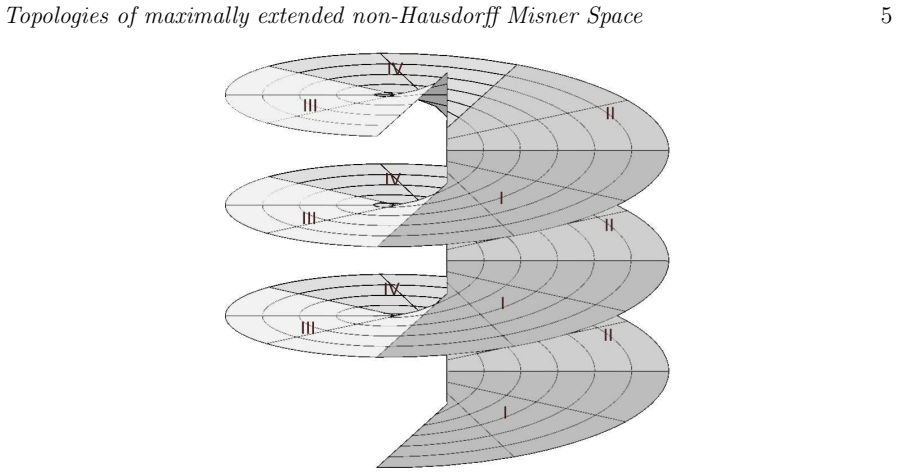
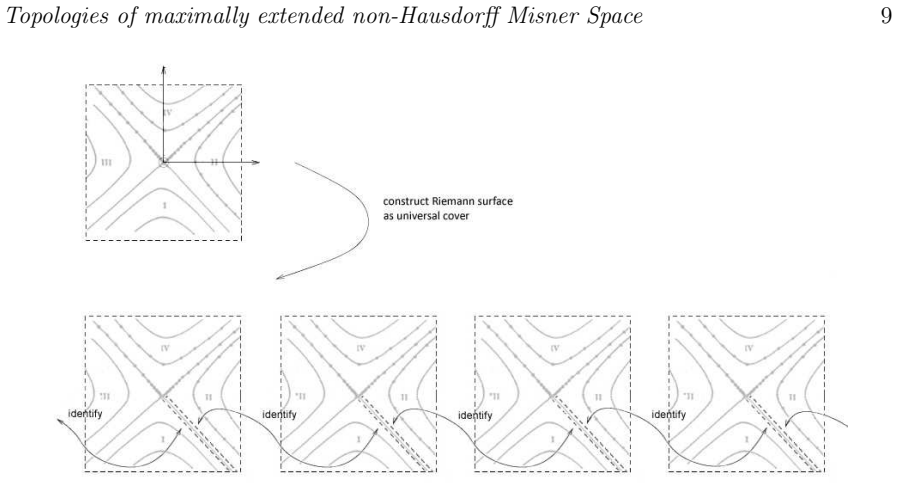
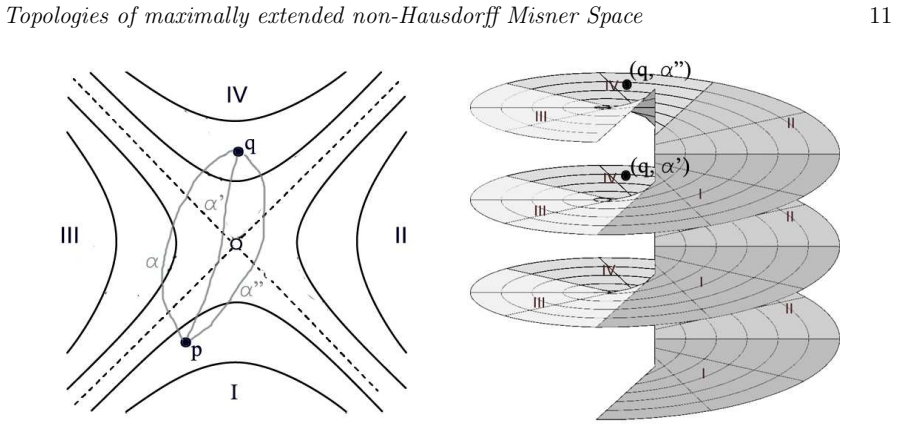
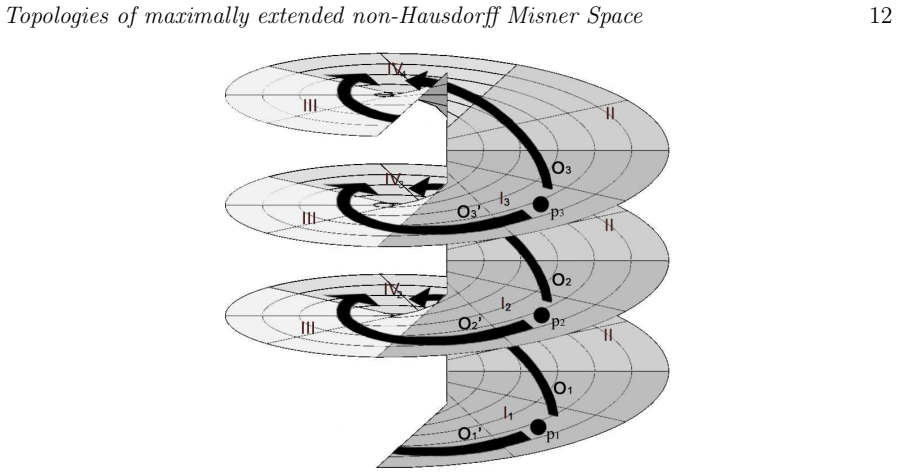
Misner spacetime is obtained by quotienting a timelike wedge of two-dimensional Minkowski spacetime by a discrete boost. The connected coverings of the punctured model that are compatible with the boost action induce a family of quotient spacetimes into which Misner spacetime embeds explicitly. This family consists of the Hawking-Ellis extension, its universal-cover analogue, and the intermediate finite cyclic coverings. A classification theorem holds within the covering-compatible class, along with a precise non-Hausdorffness statement for the punctured quotient and a causal adjacency invariant distinguishing finite-sheeted and universal-cover cases.
What carries the argument
The boost-compatible connected coverings of the punctured Minkowski plane, which induce the quotient spacetimes and allow explicit embeddings of Misner spacetime.
If this is right
- Explicit embeddings of Misner spacetime exist in each member of the family.
- The family is classified within the covering-compatible class.
- A causal adjacency invariant distinguishes the finite-sheeted cases from the universal-cover case.
- The spacetimes admit comparison to two-dimensional Schwarzschild-type metrics via isocausality.
Where Pith is reading between the lines
- The covering technique could extend to constructing extensions of other quotient spacetimes with discrete isometries.
- The causal adjacency invariant might offer a general tool for classifying non-Hausdorff spacetimes beyond this model.
- These extensions could affect the analysis of initial-value problems in spacetimes containing closed timelike curves.
Load-bearing premise
The connected coverings of the punctured model are compatible with the boost action.
What would settle it
A boost-compatible covering that produces an extension of Misner spacetime outside the described family of Hawking-Ellis, finite cyclic, and universal-cover cases would falsify the classification theorem.
Figures
read the original abstract
Misner spacetime is obtained by quotienting a timelike wedge of two-dimensional Minkowski spacetime by a discrete boost. The familiar Hausdorff extensions and the Hawking--Ellis non-Hausdorff extension are classical, but the passage from covering constructions of the punctured Minkowski plane to genuine extensions of Misner spacetime is subtler than is often stated. In this article we separate systematically the notions of covering and extension, classify the connected coverings of the punctured model that are compatible with the boost action, construct the induced quotient spacetimes, and exhibit explicit embeddings of Misner spacetime into each of them. This yields a natural family consisting of the Hawking--Ellis extension, its universal-cover analogue, and the intermediate finite cyclic coverings. We prove a precise non-Hausdorffness statement for the punctured quotient, formulate and prove a classification theorem for the resulting family within the covering-compatible class, and identify a causal adjacency invariant distinguishing the finite-sheeted and universal-cover cases. Finally, we compare these spacetimes with two-dimensional Schwarzschild-type metrics from the viewpoint of isocausality.
Editorial analysis
A structured set of objections, weighed in public.
Referee Report
Summary. The paper separates the notions of covering and extension for Misner spacetime (obtained by quotienting a timelike wedge of 2D Minkowski space by a discrete boost). It classifies the connected coverings of the punctured model that are compatible with the boost action, constructs the induced quotient spacetimes, exhibits explicit embeddings of Misner spacetime into each, proves a precise non-Hausdorffness statement for the punctured quotient, formulates and proves a classification theorem within the covering-compatible class, identifies a causal adjacency invariant distinguishing finite-sheeted and universal-cover cases, and compares the resulting family (including the Hawking–Ellis extension and its variants) with two-dimensional Schwarzschild-type metrics from the viewpoint of isocausality.
Significance. If the results hold, the work supplies a systematic, explicit classification of boost-compatible non-Hausdorff extensions of Misner spacetime together with a causal invariant that distinguishes the finite and universal cases. The explicit embeddings and quotient constructions, the separation of covering from extension, and the isocausality comparison constitute concrete strengths that clarify the structure of these spacetimes and may serve as a reference for similar constructions in Lorentzian geometry.
minor comments (2)
- [Abstract] Abstract: the phrase 'precise non-Hausdorffness statement' is used without a one-sentence indication of its content; adding a brief parenthetical description would improve immediate readability.
- The notation for the boost generator and the punctured model is introduced gradually; a short preliminary subsection collecting the basic objects and the compatibility condition would aid readers who wish to follow the classification theorem directly.
Simulated Author's Rebuttal
We thank the referee for the detailed and positive summary of our work, the assessment of its significance, and the recommendation to accept the manuscript.
Circularity Check
No significant circularity
full rationale
The derivation relies on standard covering-space constructions in differential geometry, explicitly scoped to boost-compatible coverings of the punctured model, followed by induced quotients and embeddings of Misner spacetime. The classification theorem, non-Hausdorffness statement, and causal adjacency invariant are obtained directly from these constructions without any reduction to fitted parameters, self-definitional loops, or load-bearing self-citations. The abstract and structure indicate a self-contained mathematical argument independent of the target results.
Axiom & Free-Parameter Ledger
Lean theorems connected to this paper
-
IndisputableMonolith/Foundation/AlexanderDuality.leanalexander_duality_circle_linking unclear?
unclearRelation between the paper passage and the cited Recognition theorem.
classify the connected coverings of the punctured model that are compatible with the boost action, construct the induced quotient spacetimes... helicoid of infinite copies S∞ ≡ (M∞ ∖ {Q}, η̃)
-
IndisputableMonolith/Foundation/RealityFromDistinction.leanreality_from_one_distinction unclear?
unclearRelation between the paper passage and the cited Recognition theorem.
maximal analytic non-Hausdorff extension... (M ∖ {Q}, η̃)/B
What do these tags mean?
- matches
- The paper's claim is directly supported by a theorem in the formal canon.
- supports
- The theorem supports part of the paper's argument, but the paper may add assumptions or extra steps.
- extends
- The paper goes beyond the formal theorem; the theorem is a base layer rather than the whole result.
- uses
- The paper appears to rely on the theorem as machinery.
- contradicts
- The paper's claim conflicts with a theorem or certificate in the canon.
- unclear
- Pith found a possible connection, but the passage is too broad, indirect, or ambiguous to say the theorem truly supports the claim.
Reference graph
Works this paper leans on
- [1]
-
[2]
Hawking S W and Ellis G F R 1973 The large scale structure of space-time (Cambridge: Cambridge Univ. Press)
work page 1973
-
[3]
Hiscock W A and Konkowski D A 1982 Phys. Rev. D 26 1225
work page 1982
-
[4]
Press, Directions in General Relativity Eds
Thorne K S 1993 Misner Space as a Prototype for Almost Any Pathology (Cambridge: Cambridge Univ. Press, Directions in General Relativity Eds. B. L. Hu et al., pp. 3 33-346)
work page 1993
-
[5]
Thorne K S 1993 Gen. Rel. Grav.; General Relativity and Gravitation; in 13t h Int. Conf. on General Relativity and Gravitation (Bristol: Institute of Physics Publishing, pp. 295-315)
work page 1993
-
[6]
Laurence D 1994 Phys. Rev. D 50 4957
work page 1994
-
[7]
Sushkov S V 1997 Gen. Rel. Grav. 14 523-534
work page 1997
-
[8]
Levanony D and Ori A 2011 Phys. Rev. D 83 044043
work page 2011
-
[9]
Margalef-Bentabol J and Villasenor E J S 2014 Gen. Rel. Grav. 46 1755
work page 2014
-
[10]
Ori A 2007 Phys. Rev. D 76 0440 3
work page 2007
- [11]
- [12]
-
[13]
Ellis G F R and Schmidt G B 1977 Gen. Rel. Grav. 8 915
work page 1977
-
[14]
Miller J, Kruskal M and Godfrey B 1971 Phys. Rev. D 4 2945
work page 1971
-
[15]
2011 Geometry of Minkowski Space–Time (SpringerBriefs in Physics)
Catoni F et al. 2011 Geometry of Minkowski Space–Time (SpringerBriefs in Physics)
work page 2011
-
[16]
Hatcher A 2002 Algebraic Topology (Cambridge: Cambridge Univ. Press)
work page 2002
-
[17]
Jerzak E 2008 Fundamental Groups and Covering Spaces (University of Chicago REU)
work page 2008
discussion (0)
Sign in with ORCID, Apple, or X to comment. Anyone can read and Pith papers without signing in.