Don't Look at the Camera: Achieving Perceived Eye Contact
Pith reviewed 2026-05-24 02:30 UTC · model grok-4.3
The pith
To create the perception of eye contact on a 2D screen, subjects should gaze just below the camera lens rather than directly into it.
A machine-rendered reading of the paper's core claim, the machinery that carries it, and where it could break.
Core claim
Through empirical user studies, we show that it is instead preferable to look just below the camera lens to optimize the perception that they are making eye contact. We quantitatively assess where subjects should direct their gaze relative to a camera lens to optimize the perception that they are making eye contact.
What carries the argument
User studies that rate perceived eye contact while systematically varying the subject's vertical gaze offset relative to the camera lens.
If this is right
- Participants in video calls can be directed to look slightly below the camera to increase the sense of eye contact.
- Camera placement and subject instructions in photography and videography may shift away from direct lens gaze.
- The optimal vertical offset can be measured and applied as a standard adjustment for single-subject 2D captures.
- The finding is specific to flat displays and does not address multi-person or 3D rendering cases.
Where Pith is reading between the lines
- Device makers could embed visual cues or software prompts that guide users to the below-lens position during recording.
- The same offset principle might interact with head angle or facial expression in ways not tested here.
- Remote education or therapy sessions could adopt the adjustment to strengthen perceived connection between speaker and viewer.
Load-bearing premise
The specific user studies and viewing conditions used accurately capture general human perception of eye contact and generalize beyond the tested setups and participant groups.
What would settle it
A replication with new participants, different screen sizes, or changed viewing distances that finds direct lens gaze receives higher eye-contact ratings than the below-lens position.
Figures
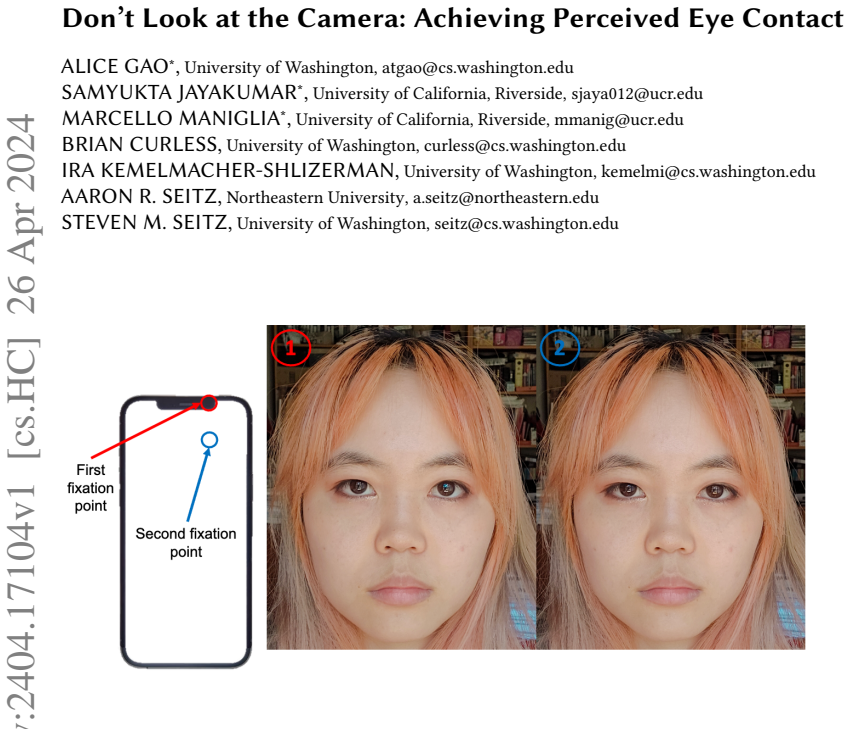


read the original abstract
We consider the question of how to best achieve the perception of eye contact when a person is captured by camera and then rendered on a 2D display. For single subjects photographed by a camera, conventional wisdom tells us that looking directly into the camera achieves eye contact. Through empirical user studies, we show that it is instead preferable to {\em look just below the camera lens}. We quantitatively assess where subjects should direct their gaze relative to a camera lens to optimize the perception that they are making eye contact.
Editorial analysis
A structured set of objections, weighed in public.
Referee Report
Summary. The paper claims that conventional advice to look directly into the camera for perceived eye contact on 2D displays is suboptimal. Through empirical user studies, it instead finds that directing gaze just below the camera lens optimizes the perception of eye contact, and it quantitatively assesses the preferred angular offset relative to the lens.
Significance. If the user studies are robust, this result could inform practical guidelines for video conferencing setups and camera placement in HCI systems. The work is purely empirical with no free parameters or derivations, so its value hinges on the quality and generalizability of the experiments.
major comments (1)
- [Abstract] Abstract and methods description: no information is supplied on participant count, demographics, statistical tests, exact angular offsets tested, display size, camera-to-face geometry, or controls for confounds such as lighting and vertical camera offset. This directly undermines assessment of whether the studies support the central claim or generalize beyond the tested setups, as highlighted by the stress-test concern.
Simulated Author's Rebuttal
We thank the referee for their review and for highlighting the need for greater methodological transparency. We address the single major comment below and will revise the manuscript accordingly.
read point-by-point responses
-
Referee: [Abstract] Abstract and methods description: no information is supplied on participant count, demographics, statistical tests, exact angular offsets tested, display size, camera-to-face geometry, or controls for confounds such as lighting and vertical camera offset. This directly undermines assessment of whether the studies support the central claim or generalize beyond the tested setups, as highlighted by the stress-test concern.
Authors: We agree that the abstract omits these details and that their absence limits evaluation of the work. In the revised manuscript we will expand the abstract to report participant count, demographics, statistical tests, exact angular offsets, display size, camera-to-face geometry, and controls for lighting and vertical offset. The methods section will be clarified and cross-referenced so that readers can fully assess robustness and generalizability. revision: yes
Circularity Check
No circularity: purely empirical user-study paper
full rationale
The paper's central claim is established through empirical user studies comparing gaze directions relative to a camera lens, with no equations, derivations, fitted parameters, or self-citation chains invoked to support the result. The abstract and described approach contain no load-bearing steps that reduce to self-definition, renaming, or imported uniqueness theorems. The derivation chain is therefore self-contained against external benchmarks (the studies themselves), warranting a score of 0.
Axiom & Free-Parameter Ledger
Reference graph
Works this paper leans on
-
[1]
Sean Andrist, Michael Gleicher, and Bilge Mutlu. 2017. Looking Coordinated: Bidirectional Gaze Mechanisms for Collaborative Interaction with Virtual Characters. In Proceedings of the 2017 CHI Conference on Human Factors in Computing Systems (Denver, Colorado, USA) (CHI ’17). Association for Computing Machinery, New York, NY, USA, 2571–2582. https://doi.or...
-
[2]
Stuart M Anstis, John W Mayhew, and Tania Morley. 1969. The perception of where a face or television’portrait’is looking. The American journal of psychology 82, 4 (1969), 474–489
work page 1969
-
[3]
Michael Argyle and Mark Cook. 1976. Gaze and mutual gaze. (1976)
work page 1976
-
[4]
Simon Baron-Cohen, Ruth Campbell, Annette Karmiloff-Smith, Julia Grant, and Jane Walker. 1995. Are children with autism blind to the mentalistic significance of the eyes? British Journal of Developmental Psychology 13, 4 (1995), 379–398
work page 1995
-
[5]
Andrew P Bayliss, Jessica Bartlett, Claire K Naughtin, and Ada Kritikos. 2011. A direct link between gaze perception and social attention. Journal of Experimental Psychology: Human Perception and Performance 37, 3 (2011), 634
work page 2011
-
[6]
David H Brainard and Spatial Vision. 1997. The psychophysics toolbox. Spatial vision 10, 4 (1997), 433–436
work page 1997
-
[7]
Andrew J Calder. 2003. Disgust discussed. Annals of Neurology (2003). 8 Gao, Jayakumar, Maniglia, et al
work page 2003
-
[8]
Milton Chen. 2002. Leveraging the Asymmetric Sensitivity of Eye Contact for Videoconference. In Proceedings of the SIGCHI Conference on Human Factors in Computing Systems (Minneapolis, Minnesota, USA) (CHI ’02). Association for Computing Machinery, New York, NY, USA, 49–56. https://doi.org/10.1145/503376.503386
-
[9]
Marvin G Cline. 1967. The perception of where a person is looking. The American journal of psychology 80, 1 (1967), 41–50
work page 1967
-
[10]
Caroline Gale and Andrew Monk. 2012. Where am I looking? The accuracy of video-mediated gaze awareness. Attention Perception & Psychophysics 62 (04 2012), 586–595. https://doi.org/10.3758/BF03212110
-
[11]
Matthias Gamer and Heiko Hecht. 2007. Are you looking at me? Measuring the cone of gaze. Journal of Experimental Psychology: Human Perception and Performance 33, 3 (2007), 705–715. https://doi.org/10.1037/0096-1523.33.3.705
-
[12]
James J Gibson and Anne D Pick. 1963. Perception of another person’s looking behavior. The American journal of psychology 76, 3 (1963), 386–394
work page 1963
-
[13]
VPixx Technologies Inc. 2022. Vpixx. https://https://vpixx.com/
work page 2022
-
[14]
Chiara Jongerius, Roy S. Hessels, Johannes A. Romijn, Ellen M. A. Smets, and Marij A. Hillen. 2020. The Measurement of Eye Contact in Human Interactions: A Scoping Review. Journal of Nonverbal Behavior 44, 3 (01 Sep 2020), 363–389. https://doi.org/10.1007/s10919-020-00333-3
-
[15]
Chris L Kleinke. 1986. Gaze and eye contact: a research review. Psychological bulletin 100, 1 (1986), 78
work page 1986
-
[16]
David J Knight, Daniel Langmeyer, and David C Lundgren. 1973. Eye-contact, distance, and affiliation: The role of observer bias. Sociometry (1973), 390–401
work page 1973
-
[17]
K Krüger and B Hückstedt. 1969. Evaluation of the direction of gazing. Zeitschrift fur Experimentelle und Angewandte Psychologie 16, 3 (1969), 452–472
work page 1969
-
[18]
P K Kuhl, K A Williams, F Lacerda, K N Stevens, and B Lindblom. 1992. Linguistic experience alters phonetic perception in infants by 6 months of age. Science 255, 5044 (Jan. 1992), 606–608
work page 1992
-
[19]
Chris Moore, Philip J Dunham, and Phil Dunham. 2014. Joint attention: Its origins and role in development . Psychology Press
work page 2014
-
[20]
Denis G Pelli and Spatial Vision. 1997. The VideoToolbox software for visual psychophysics: Transforming numbers into movies. Spatial vision 10 (1997), 437–442
work page 1997
-
[21]
Matthew F. Peterson and Miguel P. Eckstein. 2012. Looking just below the eyes is optimal across face recognition tasks. Proceedings of the National Academy of Sciences 109, 48 (2012), E3314–E3323. https://doi.org/10.1073/pnas.1214269109
-
[22]
Barry Stapley. 1972. Visual enhancement of telephone conversations. (1972)
work page 1972
-
[23]
Lisa J Stephenson, S Gareth Edwards, and Andrew P Bayliss. 2021. From gaze perception to social cognition: The shared-attention system. Perspectives on Psychological Science 16, 3 (2021), 553–576
work page 2021
-
[24]
R Stokes. 1969. Human factors and appearance design considerations of the mod II PICTUREPHONE® station set. IEEE Transactions on Communication Technology 17, 2 (1969), 318–323
work page 1969
-
[25]
Cambridge Research System. 2018. Display++ LCD Monitor. https://www.crsltd.com/
work page 2018
-
[26]
JH White, JR Hegarty, and NA Beasley. 1970. Eye contact and observer bias: A research note. British Journal of Psychology 61, 2 (1970), 271
work page 1970
discussion (0)
Sign in with ORCID, Apple, or X to comment. Anyone can read and Pith papers without signing in.