Large deviations of current for the symmetric simple exclusion process on a semi-infinite line, and on an infinite line with a slow bond
Pith reviewed 2026-05-24 01:49 UTC · model grok-4.3
The pith
The exact large deviation function for the current in the symmetric simple exclusion process on a semi-infinite line is obtained using macroscopic fluctuation theory.
A machine-rendered reading of the paper's core claim, the machinery that carries it, and where it could break.
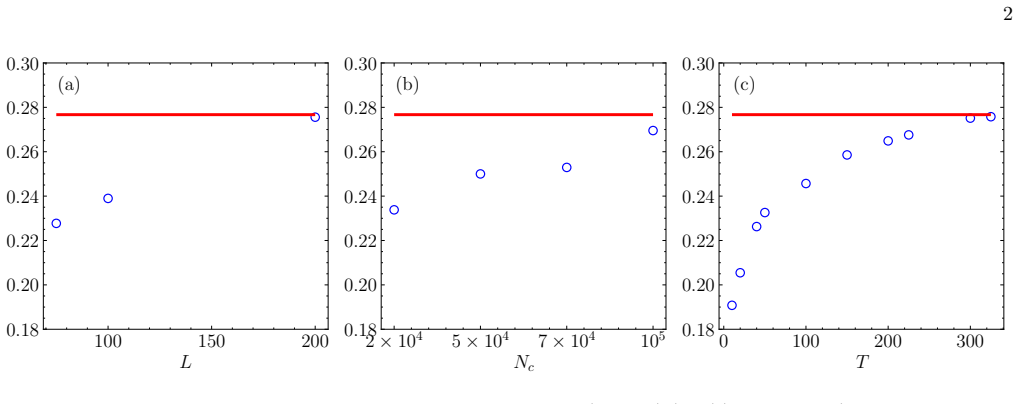
Core claim
The large deviation function for the integrated current in the symmetric simple exclusion process on a semi-infinite line coupled with a single reservoir is obtained exactly from the variational problem in macroscopic fluctuation theory.
What carries the argument
fluctuating hydrodynamics approach of macroscopic fluctuation theory, which computes the exact rate function for current large deviations.
If this is right
- The full counting statistics is solved in the presence of a defect bond.
- Current statistics are obtained for the exclusion process with localized injection.
- The survival of a tagged particle is determined in the presence of an absorbing boundary.
- The stretched exponential decay is characterized in a kinetically constrained model.
Where Pith is reading between the lines
- The same hydrodynamic derivation likely extends to the infinite line with a slow bond referenced in the title.
- The approach may apply to other boundary-driven diffusive systems where macroscopic fluctuation theory holds.
- Tagged particle survival results could connect to absorption problems in related kinetically constrained models.
Load-bearing premise
The fluctuating hydrodynamics approach of macroscopic fluctuation theory applies directly to give the exact large deviation function for the semi-infinite line with a single reservoir.
What would settle it
A cloning algorithm simulation computing the probability of atypical currents in the semi-infinite symmetric simple exclusion process that deviates from the predicted large deviation function would falsify the result.
Figures




read the original abstract
Two influential exact results in classical one-dimensional diffusive transport are about current statistics for the symmetric simple exclusion process: one in the stationary state on a finite line coupled with two unequal reservoirs at the boundaries, and the other in the non-stationary state on an infinite line. We present the corresponding result for the intermediate geometry of a semi-infinite line coupled with a single reservoir. This result is obtained using the fluctuating hydrodynamics approach of macroscopic fluctuation theory and confirmed by rare event simulations using a cloning algorithm. We apply our exact result for solving several related challenging problems, namely, the full counting statistics in presence of a defect bond, exclusion process with localized injection, survival of a tagged particle in presence of an absorbing boundary, and the stretched exponential decay in a kinetically constrained model.
Editorial analysis
A structured set of objections, weighed in public.
Referee Report
Summary. The paper derives the exact large-deviation function for the integrated current in the symmetric simple exclusion process (SSEP) on a semi-infinite line coupled to a single reservoir, using the fluctuating hydrodynamics of macroscopic fluctuation theory (MFT). It extends the result to an infinite line with a slow bond, confirms both via cloning-algorithm rare-event simulations, and applies the semi-infinite result to full counting statistics with a defect bond, exclusion with localized injection, tagged-particle survival with an absorbing boundary, and stretched-exponential decay in a kinetically constrained model.
Significance. If the central MFT derivation holds, the work supplies the missing intermediate geometry between the known stationary finite-line and non-stationary infinite-line cases, yielding parameter-free exact large-deviation functions that are directly usable for several open problems in one-dimensional diffusive transport. The combination of an established hydrodynamic framework with independent numerical confirmation, together with the explicit applications, adds concrete value to the literature on non-equilibrium current statistics.
minor comments (2)
- The abstract and introduction would benefit from a brief statement of the precise boundary conditions imposed on the density and current fields at the reservoir and at infinity, to make the MFT variational problem fully self-contained for readers.
- Figure captions for the cloning-simulation comparisons should include the number of clones, the observation time window, and a quantitative measure of statistical uncertainty on the sampled rate function.
Simulated Author's Rebuttal
We thank the referee for their careful reading and positive evaluation of the manuscript. We are grateful for the recommendation to accept and for recognizing the result as filling the intermediate geometry between the stationary finite-line and non-stationary infinite-line cases, together with the numerical confirmation and applications.
Circularity Check
No significant circularity; derivation relies on established external MFT framework
full rationale
The paper obtains its large-deviation result for the semi-infinite SSEP via the fluctuating hydrodynamics of macroscopic fluctuation theory, an independent, pre-existing framework whose validity for SSEP is established outside this work. The cloning-algorithm simulations serve as numerical confirmation rather than input to the derivation. No self-definitional steps, fitted parameters renamed as predictions, or load-bearing self-citations appear in the abstract or described chain. The central claim is therefore self-contained against external benchmarks and does not reduce to its own inputs by construction.
Axiom & Free-Parameter Ledger
axioms (1)
- domain assumption Macroscopic fluctuation theory yields the exact large deviation function for current in the semi-infinite SSEP geometry
Lean theorems connected to this paper
-
IndisputableMonolith/Cost/FunctionalEquation.leanwashburn_uniqueness_aczel unclear?
unclearRelation between the paper passage and the cited Recognition theorem.
The crucial idea behind MFT is to recognize the relevant hydrodynamic modes... Euler-Lagrange equations (12a,b) ... rotational symmetry of the least-Action ... ω(λ,ρ_a,ρ_b)
-
IndisputableMonolith/Foundation/RealityFromDistinction.leanreality_from_one_distinction unclear?
unclearRelation between the paper passage and the cited Recognition theorem.
mapping to the infinite-line problem ... symmetries of the Euler-Lagrange equations and the boundary conditions
What do these tags mean?
- matches
- The paper's claim is directly supported by a theorem in the formal canon.
- supports
- The theorem supports part of the paper's argument, but the paper may add assumptions or extra steps.
- extends
- The paper goes beyond the formal theorem; the theorem is a base layer rather than the whole result.
- uses
- The paper appears to rely on the theorem as machinery.
- contradicts
- The paper's claim conflicts with a theorem or certificate in the canon.
- unclear
- Pith found a possible connection, but the passage is too broad, indirect, or ambiguous to say the theorem truly supports the claim.
Forward citations
Cited by 2 Pith papers
-
Universal tracer statistics in single-file transport
Tracer position statistics in single-file hard-rod transport are universal across diffusive and ballistic dynamics for one-time distributions.
-
Macroscopic fluctuation theory of interacting Brownian particles
The authors combine macroscopic fluctuation theory with equilibrium statistical mechanics to obtain exact large-scale dynamical correlations for interacting Brownian particles in one and higher dimensions.
Reference graph
Works this paper leans on
-
[1]
The function R(ω ) has different representations
is consistent with an earlier result [ 51] in the low density limit. The function R(ω ) has different representations. For example, R(ω ) = − 1/ (2√ π )Li3/ 2(− 4ω (1 + ω )) in terms of the poly-logarithm function Lis(z) is similar to the ex- pression of the number of particles in Fermi-Dirac statis- tics. Another representation in terms of Fredholm deter-...
-
[2]
for a reason- ably large parameter range of λ. Deviations emerging at larger values of λ are a consequence of finite-size ef- fects [ 57]. LDF : The scaling in ( 2) corresponds to a large devia- tion asymptotics of the probability P ( QT = j √ T ) ∼ e− √ T ϕ si(j) (6) where ϕ si(j) is the ldf, related to µ si(λ) (reference to ρa(b) is ignored) by a Legendr...
-
[3]
(15) The Euler-Lagrange equations for the corresponding vari- ational problem (
with the condition qsi(x, 0) = 0 . (15) The Euler-Lagrange equations for the corresponding vari- ational problem (
-
[4]
The only difference comes in the initial condition in ( 13), which is now replaced by ( 15)
remains the same as in ( 12). The only difference comes in the initial condition in ( 13), which is now replaced by ( 15). This initial condition corresponds to the quenched averaging [ 32, 41]. We now show that this quenched semi-infinite line problem has a direct mapping to the quenched infinite line problem with (ρa, ρ b) ≡ (1, 0) and fugacity ˜λ = 2 λ. F...
-
[5]
1) as long as it is larger than O(T − 1/ 2)
is independent [ 51] of the cou- pling strength γ (see Fig. 1) as long as it is larger than O(T − 1/ 2). This is seen from the corresponding re- sult for slow coupling γ = Γ / √ T , where the boundary- fluctuations are significant, modifying the scgf ( 3a) to µ slow si (λ, ρ a, ρ b) = min z [ Γ sinh 2 (z − u) + Rsi(sinh2 z) ] (23) with sinh2 u = ω (λ, ρ a, ...
-
[6]
Compared to the latter examples, the scgf ( 3) exhibits a piecewise solu- tion ( 3b)
for SSEP on a semi-infinite line, which represents an inter- mediate non-equilibrium regime between the well-studied finite [ 2, 34] and infinite SSEP [ 39, 40]. Compared to the latter examples, the scgf ( 3) exhibits a piecewise solu- tion ( 3b). Our exact result not only solves the absorb- ing boundary problem relevant to target survival [ 88], but also le...
-
[7]
relates to the generating function of current ⟨ eλQ t ⟩ in SSEP. Noting that Qt takes only integer values, we see that for λ = iπ , ⟨ eiπQ t ⟩ = ∑ Qt P (Qt) eiπQ t = Pt(even Qt) − Pt(odd Qt). (29) From ( 28) and ( 29), it is evident that at large times, the spin-auto-correlation follows the asymptotics of the current statistics in SSEP. Using the results ...
-
[8]
M. Prähofer and H. Spohn, Current fluctuations for the totally asymmetric simple exclusion process, in In and Out of Equilibrium: Probability with a Physics Flavor , Vol. 51, edited by V. Sidoravicius (Birkhäuser Boston,
-
[9]
L. Bertini, A. De Sole, D. Gabrielli, G. Jona-Lasinio, and C. Landim, Current fluctuations in stochastic lat- tice gases, Phys. Rev. Lett. 94, 030601 (2005) ; Non equilibrium current fluctuations in stochastic lattice gases, J. Stat. Phys. 123, 237–276 (2006)
work page 2005
-
[10]
B. Derrida, Non-equilibrium steady states: Fluctuations and large deviations of the density and of the current, J. Stat. Mech. 2007, P07023 (2007)
work page 2007
-
[11]
A. Lazarescu, The physicist’s companion to current fluc- tuations: One-dimensional bulk-driven lattice gases, J. Phys. A: Math. Theor. 48, 503001 (2015)
work page 2015
-
[12]
T. Banerjee, S. N. Majumdar, A. Rosso, and G. Schehr, Current fluctuations in noninteracting run-and-tumble particles in one dimension, Phys. Rev. E 101, 052101 (2020)
work page 2020
-
[13]
C. Di Bello, A. K. Hartmann, S. N. Majumdar, F. Mori, A. Rosso, and G. Schehr, Current fluctuations in stochastically resetting particle systems, Phys. Rev. E 108, 014112 (2023)
work page 2023
-
[14]
H. Lee, L. S. Levitov, and A. Y. Yakovets, Universal statistics of transport in disordered conductors, Phys. Rev. B 51, 4079 (1995)
work page 1995
-
[15]
E. McCulloch, J. De Nardis, S. Gopalakrishnan, and R. Vasseur, Full counting statistics of charge in chaotic many-body quantum systems, Phys. Rev. Lett. 131, 210402 (2023)
work page 2023
-
[16]
J. F. Wienand, S. Karch, A. Impertro, C. Schweizer, E. McCulloch, R. Vasseur, S. Gopalakrishnan, M. Aidelsburger, and I. Bloch, Emergence of fluctuating hydrodynamics in chaotic quantum systems, Nat. Phys. 1, 031080 (2024)
work page 2024
-
[17]
X. Turkeshi, P. Calabrese, and A. De Luca, Quantum mpemba effect in random circuits, Phys. Rev. Lett. 135, 040403 (2025)
work page 2025
-
[18]
T. Bodineau and B. Derrida, Distribution of current in nonequilibrium diffusive systems and phase transitions, Phys. Rev. E 72, 066110 (2005)
work page 2005
-
[19]
T. Bodineau, B. Derrida, V. Lecomte, and F. van Wi- jland, Long range correlations and phase transitions in non-equilibrium diffusive systems, J. Stat. Phys. 133, 1013–1031 (2008)
work page 2008
-
[20]
Jona-Lasinio, From fluctuations in hydrodynamics to nonequilibrium thermodynamics, Prog
G. Jona-Lasinio, From fluctuations in hydrodynamics to nonequilibrium thermodynamics, Prog. Theor. Phys. Supp. 184, 262–275 (2010)
work page 2010
-
[21]
Touchette, The large deviation approach to statisti- cal mechanics, Phys
H. Touchette, The large deviation approach to statisti- cal mechanics, Phys. Rep. 478, 1–69 (2009)
work page 2009
-
[22]
L. Bertini, A. De Sole, D. Gabrielli, G. Jona-Lasinio, and C. Landim, Towards a nonequilibrium thermody- namics: A self-contained macroscopic description of driven diffusive systems, J. Stat. Phys. 135, 857–872 (2009)
work page 2009
-
[23]
P. I. Hurtado, C. Pérez-Espigares, J. J. del Pozo, and P. L. Garrido, Symmetries in fluctuations far from equi- librium, PNAS 108, 7704–7709 (2011)
work page 2011
-
[24]
Y. Baek, Y. Kafri, and V. Lecomte, Dynamical phase transitions in the current distribution of driven diffusive channels, J. Phys. A: Math. Theor. 51, 105001 (2018)
work page 2018
-
[25]
G. M. Schütz, Exactly solvable models for many-body systems far from equilibrium, in Phase Transitions and 8 Critical Phenomena , Vol. 19, edited by C. Domb and J. L. Lebowitz (Academic Press, 2001) p. see eq. (9.106)
work page 2001
-
[26]
K. Mallick, The exclusion process: A paradigm for non- equilibrium behaviour, Physica A 418, 17–48 (2015)
work page 2015
-
[27]
C. Giardinà, J. Kurchan, and L. Peliti, Direct evaluation of large-deviation functions, Phys. Rev. Lett. 96, 120603 (2006)
work page 2006
-
[28]
V. Lecomte and J. Tailleur, A numerical approach to large deviations in continuous time, J. Stat. Mech. 2007, P03004 (2007)
work page 2007
-
[29]
C. Giardinà, J. Kurchan, V. Lecomte, and J. Tailleur, Simulating rare events in dynamical processes, J. Stat. Phys. 145, 787–811 (2011)
work page 2011
-
[30]
C. Pérez-Espigares and P. I. Hurtado, Sampling rare events across dynamical phase transitions, Chaos 29, 083106 (2019)
work page 2019
-
[31]
A. K. Hartmann, Big Practical Guide to Computer Sim- ulations, 2nd ed. (World Scientific, 2015)
work page 2015
-
[32]
Spohn, Stretched exponential decay in a kinetic Ising model with dynamical constraint, Commun
H. Spohn, Stretched exponential decay in a kinetic Ising model with dynamical constraint, Commun. Math. Phys. 125, 3–12 (1989)
work page 1989
-
[33]
P. L. Krapivsky, Symmetric exclusion process with a localized source, Phys. Rev. E 86, 041103 (2012)
work page 2012
-
[34]
Phase transition in equilibrium fluctu- ations of symmetric slowed exclusion
T. Franco, P. Gonçalves, and A. Neumann, Phase tran- sition in equilibrium fluctuations of symmetric slowed exclusion, Stoch. Process. Their Appl. 123, 4156 (2013); Corrigendum to “Phase transition in equilibrium fluctu- ations of symmetric slowed exclusion” [Stochastic Pro- cess. Appl. 123(12) (2013) 4156–4185], Stoch. Process. Their Appl. 126, 3235 (2016)
work page 2013
-
[35]
Spohn, Large Scale Dynamics of Interacting Particles (Springer Berlin, Heidelberg, 1991)
H. Spohn, Large Scale Dynamics of Interacting Particles (Springer Berlin, Heidelberg, 1991)
work page 1991
-
[36]
C. Kipnis and C. Landim, Scaling Limits of Interacting Particle Systems (Springer Berlin, Heidelberg, 1999)
work page 1999
-
[37]
T. M. Liggett, Stochastic Interacting Systems: Contact, Voter and Exclusion Processes (Springer Berlin, Heidel- berg, 1999)
work page 1999
-
[38]
T. Chou, K. Mallick, and R. K. P. Zia, Non-equilibrium statistical mechanics: from a paradigmatic model to bi- ological transport, Rep. Prog. Phys. 74, 116601 (2011)
work page 2011
-
[39]
B. Derrida and A. Gerschenfeld, Current fluctuations in one dimensional diffusive systems with a step initial density profile, J. Stat. Phys. 137, 978–1000 (2009)
work page 2009
-
[40]
P. L. Krapivsky and B. Meerson, Fluctuations of current in nonstationary diffusive lattice gases, Phys. Rev. E 86, 031106 (2012)
work page 2012
-
[41]
T. Bodineau and B. Derrida, Current fluctuations in nonequilibrium diffusive systems: An additivity princi- ple, Phys. Rev. Lett. 92, 180601 (2004)
work page 2004
-
[42]
T. Bodineau and B. Derrida, Cumulants and large de- viations of the current through non-equilibrium steady states, C. R. Physique 8, 540–555 (2007)
work page 2007
-
[43]
B. Derrida, O. Hirschberg, and T. Sadhu, Large devi- ations in the symmetric simple exclusion process with slow boundaries, J. Stat. Phys. 182, 15 (2021)
work page 2021
-
[44]
B. Derrida, B. Douçot, and P. E. Roche, Current fluctu- ations in the one-dimensional symmetric exclusion pro- cess with open boundaries, J. Stat. Phys. 115, 717–748 (2004)
work page 2004
-
[45]
M. Gorissen, A. Lazarescu, K. Mallick, and C. Van- derzande, Exact current statistics of the asymmetric simple exclusion process with open boundaries, Phys. Rev. Lett. 109, 170601 (2012)
work page 2012
-
[46]
B. Derrida and A. Gerschenfeld, Current fluctuations of the one dimensional symmetric simple exclusion pro- cess with step initial condition, J. Stat. Phys. 136, 1–15 (2009)
work page 2009
-
[47]
K. Mallick, H. Moriya, and T. Sasamoto, Exact solu- tion of the macroscopic fluctuation theory for the sym- metric exclusion process, Phys. Rev. Lett. 129, 040601 (2022); Exact solutions to macroscopic fluctuation the- ory through classical integrable systems, J. Stat. Mech. 2024, 074001 (2024)
work page 2022
-
[48]
S. Saha and T. Sadhu, Large deviations in the symmet- ric simple exclusion process with slow boundaries: A hy- drodynamic perspective, SciPost Phys. 17, 033 (2024)
work page 2024
-
[49]
L. Bertini, A. De Sole, D. Gabrielli, G. Jona-Lasinio, and C. Landim, Macroscopic fluctuation theory, Rev. Mod. Phys. 87, 593 (2015)
work page 2015
-
[50]
Jona-Lasinio, Review article: Large fluctuations in non-equilibrium physics, Nonlin
G. Jona-Lasinio, Review article: Large fluctuations in non-equilibrium physics, Nonlin. Processes Geophys. 30, 253–262 (2023)
work page 2023
-
[51]
L. Bertini, A. De Sole, D. Gabrielli, G. Jona-Lasinio, and C. Landim, Fluctuations in stationary nonequilib- rium states of irreversible processes, Phys. Rev. Lett. 87, 040601 (2001) ; Macroscopic fluctuation theory for stationary non-equilibrium states, J. Stat. Phys. 107, 635–675 (2002)
work page 2001
-
[52]
J. Tailleur, J. Kurchan, and V. Lecomte, Mapping nonequilibrium onto equilibrium: The macroscopic fluc- tuations of simple transport models, Phys. Rev. Lett. 99, 150602 (2007) ; Mapping out-of-equilibrium into equilibrium in one-dimensional transport models, J. Phys. A: Math. Theor. 41, 505001 (2008)
work page 2007
-
[53]
E. Bettelheim, N. R. Smith, and B. Meerson, Inverse scattering method solves the problem of full statistics of nonstationary heat transfer in the Kipnis-Marchioro- Presutti model, Phys. Rev. Lett. 128, 130602 (2022) ; Full statistics of nonstationary heat transfer in the Kip- nis–Marchioro–Presutti model, J. Stat. Mech. 2022, 093103 (2022)
work page 2022
-
[54]
T. Agranov, S. Ro, Y. Kafri, and V. Lecomte, Macro- scopic fluctuation theory and current fluctuations in ac- tive lattice gases, SciPost Phys. 14, 045 (2023)
work page 2023
-
[55]
E. Bettelheim and B. Meerson, Complete integrability of the problem of full statistics of nonstationary mass transfer in the simple inclusion process, Phys. Rev. E 110, 014101 (2024)
work page 2024
-
[56]
T. M. Liggett, Ergodic theorems for the asymmetric simple exclusion process, Trans. Am. Math. Soc. 213, 237–261 (1975)
work page 1975
-
[57]
S. Grosskinsky, Phase transitions in nonequilibrium stochastic particle systems with local conservation laws , Ph.D. thesis, Technical University of Munich (2004)
work page 2004
-
[58]
S. Saha and T. Sadhu, Current fluctuations in a semi- infinite line, J. Stat. Mech. 2023, 073207 (2023)
work page 2023
-
[59]
P. L. Krapivsky and D. Stefanovic, Lattice gases with a point source, J. Stat. Mech. 2014, P09003 (2014)
work page 2014
-
[60]
L. Williams and T. Sasamoto, Combinatorics of the asymmetric exclusion process on a semi-infinite lattice, J. Comb. 5, 419–434 (2014)
work page 2014
-
[61]
C. A. Tracy and H. Widom, The asymmetric simple ex- clusion process with an open boundary, J. Math. Phys. 54, 103301 (2013)
work page 2013
-
[62]
H. G. Duhart, P. Mörters, and J. Zimmer, The semi- infinite asymmetric exclusion process: Large devia- tions via matrix products, Potential Anal. 48, 301–323 (2018). 9
work page 2018
-
[63]
B. Meerson, A. Vilenkin, and P. L. Krapivsky, Survival of a static target in a gas of diffusing particles with exclusion, Phys. Rev. E 90, 022120 (2014)
work page 2014
-
[64]
See Supplementary Material at [URL will be inserted by publisher] for the details about the cloning algorithm used and the steps involved in deriving the scgf of cur- rent in the semi-infinite geometry
-
[65]
V. Lecomte, A. Imparato, and F. van Wijland, Cur- rent fluctuations in systems with diffusive dynamics, in and out of equilibrium, Prog. Theor. Phys. Suppl. 184, 276–289 (2010)
work page 2010
-
[66]
Johansson, Shape fluctuations and random matrices, Comm
K. Johansson, Shape fluctuations and random matrices, Comm. Math. Phys. 209, 437–476 (2000)
work page 2000
-
[67]
C. A. Tracy and H. Widom, A fredholm determinant representation in ASEP, J. Stat. Phys. 132, 291–300 (2008)
work page 2008
-
[68]
C. A. Tracy and H. Widom, Total current fluctuations in the asymmetric simple exclusion process, J. Math. Phys. 50, 095204 (2009)
work page 2009
-
[69]
D. J. Evans, E. G. D. Cohen, and G. P. Morriss, Proba- bility of second law violations in shearing steady states, Phys. Rev. Lett. 71, 2401 (1993)
work page 1993
-
[70]
G. Gallavotti and E. G. D. Cohen, Dynamical ensem- bles in nonequilibrium statistical mechanics, Phys. Rev. Lett. 74, 2694 (1995)
work page 1995
-
[71]
Kurchan, Fluctuation theorem for stochastic dynam- ics, J
J. Kurchan, Fluctuation theorem for stochastic dynam- ics, J. Phys. A: Math. Gen. 31, 3719 (1998)
work page 1998
-
[72]
J. L. Lebowitz and H. Spohn, A Gallavotti-Cohen-type symmetry in the large deviation functional for stochastic dynamics, J. Stat. Phys. 95, 333–365 (1999)
work page 1999
-
[73]
P. C. Martin, E. D. Siggia, and H. A. Rose, Statisti- cal dynamics of classical systems, Phys. Rev. A 8, 423 (1973)
work page 1973
-
[74]
H. K. Janssen, On a Lagrangean for classical field dy- namics and renormalization group calculations of dy- namical critical properties, Z. Physik B 23, 377–380 (1976)
work page 1976
-
[75]
C. De Dominicis, Dynamics as a substitute for repli- cas in systems with quenched random impurities, Phys. Rev. B 18, 4913 (1978)
work page 1978
-
[76]
C. De Dominicis and L. Peliti, Field-theory renormal- ization and critical dynamics above Tc: Helium, anti- ferromagnets, and liquid-gas systems, Phys. Rev. B 18, 353 (1978)
work page 1978
-
[77]
M. J. Ablowitz and H. Segur, The inverse scattering transform: Semi-infinite interval, J. Math. Phys. 16, 1054–1056 (1975)
work page 1975
-
[78]
R. Baldasso, O. Menezes, A. Neumann, and R. R. Souza, Exclusion process with slow boundary, J. Stat. Phys. 167, 1112–1142 (2017)
work page 2017
- [79]
-
[80]
P. Gonçalves, M. Jara, O. Menezes, and A. Neumann, Non-equilibrium and stationary fluctuations for the SSEP with slow boundary, Stoch. Process. Their Appl. 130, 4326–4357 (2020)
work page 2020
discussion (0)
Sign in with ORCID, Apple, or X to comment. Anyone can read and Pith papers without signing in.