Massive MIMO-ISAC System With 1-Bit ADCs/DACs
Pith reviewed 2026-05-24 00:37 UTC · model grok-4.3
The pith
A massive MIMO-ISAC system with 1-bit ADCs and DACs maintains ISAC performance at much lower power and hardware cost.
A machine-rendered reading of the paper's core claim, the machinery that carries it, and where it could break.
Core claim
The paper shows that 1-bit quantization at both ends of a massive MIMO-ISAC link, when paired with transceiver designs derived from explicit post-quantization radar and communication metrics, yields practical joint sensing-communication performance while cutting power consumption and hardware complexity.
What carries the argument
1BitISAC joint transceiver designs that use 1-bit DACs at the transmitter and 1-bit ADCs at the sensing receiver, enabled by quantization-aware radar detection and BER metrics that simplify the original constrained optimization problems.
If this is right
- The quality-of-service constrained design guarantees target communication reliability while maximizing sensing quality under the 1-bit hardware limits.
- The quality-of-detection constrained design guarantees target radar performance while optimizing communication under the same limits.
- Majorization-minimization combined with integer linear programming yields tractable solutions for both designs.
- Numerical results confirm that the simplified metrics preserve accuracy relative to the original non-convex problems.
Where Pith is reading between the lines
- The approach may extend to other bit resolutions or hybrid analog-digital architectures where similar quantization analysis can reduce optimization complexity.
- Energy savings from 1-bit hardware could support longer battery life in mobile or distributed ISAC nodes.
- The same quantization-metric simplification technique might apply to related joint communication-radar problems that currently rely on full-precision assumptions.
Load-bearing premise
The derived metrics from 1-bit quantization analysis correctly predict radar detection and communication error behavior under realistic channel and noise conditions.
What would settle it
A hardware testbed measurement of achieved radar detection probability, communication BER, and total power draw for the proposed 1BitISAC designs versus a full-precision baseline would confirm or refute the claimed performance-energy tradeoff.
Figures



read the original abstract
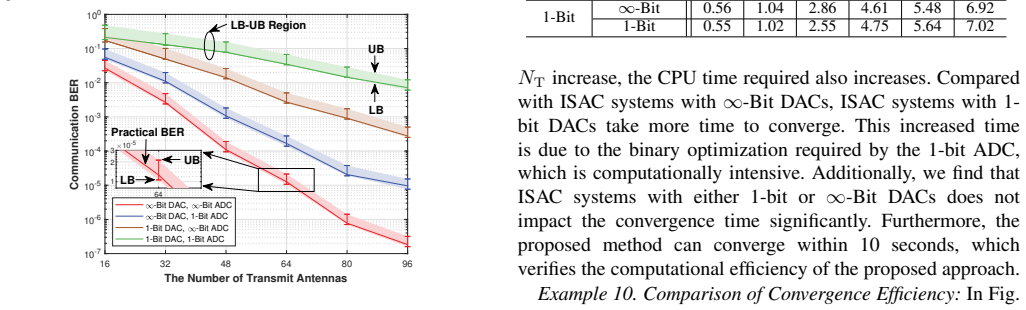
This paper investigates a hardware-efficient massive multiple-input multiple-output integrated sensing and communication (MIMO-ISAC) system with 1-bit analog-to-digital converters (ADCs)/digital-to-analog converters (DACs). The proposed system, referred to as 1BitISAC, employs 1-bit DACs at the ISAC transmitter and 1-bit ADCs at the sensing receiver, achieving significant reductions in power consumption and hardware costs. For such kind of systems, two 1BitISAC joint transceiver designs, i.e., i) quality of service constrained 1BitISAC design and ii) quality of detection constrained design, are considered and the corresponding problems are formulated. In order to address these problems, we thoroughly analyze the radar detection performance after 1-bit ADCs quantization and the communication bit error rate. This analysis yields new design insights and leads to unique radar and communication metrics, which enables us to simplify the original problems and employ majorization-minimization and integer linear programming methods to solve the problems. Numerical results are provided to validate the performance analysis of the proposed 1BitISAC and to compare with other ISAC configurations. The superiority of the proposed 1BitISAC system in terms of balancing ISAC performance and energy efficiency is also demonstrated.
Editorial analysis
A structured set of objections, weighed in public.
Referee Report
Summary. The manuscript proposes a hardware-efficient massive MIMO-ISAC system (1BitISAC) that uses 1-bit DACs at the transmitter and 1-bit ADCs at the sensing receiver. It formulates two joint transceiver design problems (QoS-constrained and QoD-constrained), analyzes the effects of 1-bit quantization on radar detection probability and communication BER via Bussgang linearization and closed-form expressions, derives simplified metrics that enable problem reduction, and solves the resulting problems with majorization-minimization and integer linear programming. Numerical results validate the analysis under both perfect and estimated CSI, include explicit power-consumption accounting, and demonstrate superiority over other ISAC configurations in the performance-energy efficiency trade-off.
Significance. If the derivations hold, the work is significant for practical ISAC deployment because it directly addresses power and hardware cost reduction in massive MIMO while preserving QoS/QoD trade-offs. Strengths include the explicit power accounting, comparisons across CSI cases, and substitution of closed-form quantized metrics into convex surrogates solved by standard MM/ILP methods.
minor comments (2)
- [Abstract] Abstract: the phrase 'new design insights' is repeated without specifying which simplifications go beyond the standard Bussgang substitution already used in the literature; a single clarifying sentence would help readers.
- The numerical results section would benefit from an explicit statement of the number of Monte-Carlo trials used to generate the BER and detection-probability curves.
Simulated Author's Rebuttal
We thank the referee for the positive summary, recognition of the work's significance for practical ISAC systems, and recommendation of minor revision. No major comments were raised in the report.
Circularity Check
No significant circularity in derivation chain
full rationale
The paper formulates two joint transceiver design problems for the 1BitISAC system and solves them via majorization-minimization and integer linear programming after substituting closed-form expressions for post-quantization radar detection probability and communication BER. These expressions are obtained from standard Bussgang linearization of 1-bit effects, which is an external established technique rather than a self-derived or fitted quantity. No step reduces a claimed prediction or uniqueness result to a parameter fit, self-citation chain, or definitional renaming; the simplifications preserve the original QoS/QoD constraints without internal equivalence by construction. Numerical results compare against other ISAC configurations with explicit power accounting, confirming the derivation remains self-contained against external benchmarks.
Axiom & Free-Parameter Ledger
Reference graph
Works this paper leans on
-
[1]
Joint transceiver design for massive MIMO DFRC systems with one-bit DACs/ADCs,
B. Wang, H. Li, and Z. Cheng, “Joint transceiver design for massive MIMO DFRC systems with one-bit DACs/ADCs,” in Proc. of 2023 IEEE Globecom Workshops (GC Wkshps) . IEEE, 2023, pp. 649–654
work page 2023
-
[2]
Seventy years of radar and communications: The road from separation to integration,
F. Liu, L. Zheng, Y . Cui, C. Masouros, A. P. Petropulu, H. Griffiths, and Y . C. Eldar, “Seventy years of radar and communications: The road from separation to integration,” IEEE Signal Process. Mag. , vol. 40, no. 5, pp. 106–121, 2023
work page 2023
-
[3]
An overview of signal processing techniques for joint communication and radar sensing,
J. A. Zhang, F. Liu, C. Masouros, R. W. Heath, Z. Feng, L. Zheng, and A. Petropulu, “An overview of signal processing techniques for joint communication and radar sensing,” IEEE J. Sel. Topics Signal Process. , vol. 15, no. 6, pp. 1295–1315, 2021
work page 2021
-
[4]
Joint radar and communication design: Applications, state-of-the-art, and the road ahead,
F. Liu, C. Masouros, A. P. Petropulu, H. Griffiths, and L. Hanzo, “Joint radar and communication design: Applications, state-of-the-art, and the road ahead,”IEEE Trans. Commun., vol. 68, no. 6, pp. 3834–3862, 2020
work page 2020
-
[5]
From torch to projector: Fundamental tradeoff of integrated sensing and communications,
Y . Xiong, F. Liu, K. Wan, W. Yuan, Y . Cui, and G. Caire, “From torch to projector: Fundamental tradeoff of integrated sensing and communications,” IEEE BITS the Inform. Theory Mag. , 2024
work page 2024
-
[6]
Received-signal- strength-based indoor positioning using compressive sensing,
C. Feng, W. S. A. Au, S. Valaee, and Z. Tan, “Received-signal- strength-based indoor positioning using compressive sensing,” IEEE Trans. Mobile Comput. , vol. 11, no. 12, pp. 1983–1993, 2011
work page 1983
-
[7]
IEEE 802.11 p: Towards an international standard for wireless access in vehicular environments,
D. Jiang and L. Delgrossi, “IEEE 802.11 p: Towards an international standard for wireless access in vehicular environments,” in Proc. of 2008 IEEE veh. technol. conf. (VTC Spring) . IEEE, 2008, pp. 2036–2040
work page 2008
-
[8]
IEEE 802.11 ad-based radar: An approach to joint vehicular communication-radar system,
P. Kumari, J. Choi, N. Gonz ´alez-Prelcic, and R. W. Heath, “IEEE 802.11 ad-based radar: An approach to joint vehicular communication-radar system,” IEEE Trans. Veh. Technol., vol. 67, no. 4, pp. 3012–3027, 2017
work page 2017
-
[9]
Frame structure and protocol design for sensing-assisted NR-V2X communications,
Y . Li, F. Liu, Z. Du, W. Yuan, Q. Shi, and C. Masouros, “Frame structure and protocol design for sensing-assisted NR-V2X communications,” IEEE Trans. Mobile Comput. , 2024
work page 2024
-
[10]
Co-designed radar- communication using linear frequency modulation waveform,
M. Nowak, M. Wicks, Z. Zhang, and Z. Wu, “Co-designed radar- communication using linear frequency modulation waveform,” IEEE Aerosp. Electron. Syst. Mag. , vol. 31, no. 10, pp. 28–35, 2016
work page 2016
-
[11]
Frequency-hopping MIMO radar-based communications: An overview,
K. Wu, J. A. Zhang, X. Huang, and Y . J. Guo, “Frequency-hopping MIMO radar-based communications: An overview,” IEEE Aerosp. Elec- tron. Syst. Mag. , vol. 37, no. 4, pp. 42–54, 2021
work page 2021
-
[12]
Dual-function radar- communications using QAM-based sidelobe modulation,
A. Ahmed, Y . D. Zhang, and Y . Gu, “Dual-function radar- communications using QAM-based sidelobe modulation,” Digital Signal Process., vol. 82, pp. 166–174, 2018
work page 2018
-
[13]
K. Meng, C. Masouros, G. Chen, and F. Liu, “Network-level integrated sensing and communication: Interference management and BS coordina- tion using stochastic geometry,” arXiv preprint arXiv:2311.09052, 2023
-
[14]
Faster-than-nyquist symbol- level precoding for wideband integrated sensing and communications,
Z. Liao, F. Liu, A. Li, and C. Masouros, “Faster-than-nyquist symbol- level precoding for wideband integrated sensing and communications,” IEEE Trans. Wireless Commun. , 2024
work page 2024
-
[15]
Joint transmit beamforming for multiuser MIMO communications and MIMO radar,
X. Liu, T. Huang, N. Shlezinger, Y . Liu, J. Zhou, and Y . C. Eldar, “Joint transmit beamforming for multiuser MIMO communications and MIMO radar,” IEEE Trans. Signal Process. , vol. 68, pp. 3929–3944, 2020
work page 2020
-
[16]
Dual-functional radar- communication waveform design: A symbol-level precoding approach,
R. Liu, M. Li, Q. Liu, and A. L. Swindlehurst, “Dual-functional radar- communication waveform design: A symbol-level precoding approach,” IEEE J. Sel. Topics Signal Process., vol. 15, no. 6, pp. 1316–1331, 2021
work page 2021
-
[17]
Cram ´er-Rao bound optimization for joint radar-communication beamforming,
F. Liu, Y .-F. Liu, A. Li, C. Masouros, and Y . C. Eldar, “Cram ´er-Rao bound optimization for joint radar-communication beamforming,” IEEE Trans. Signal Process., vol. 70, pp. 240–253, 2021
work page 2021
-
[18]
Bistatic MIMO DFRC system waveform design via symbol distance/direction discrimination,
B. Guo, J. Liang, B. Tang, L. Li, and H. C. So, “Bistatic MIMO DFRC system waveform design via symbol distance/direction discrimination,” IEEE Trans. Signal Process. , vol. 71, pp. 3996–4010, 2023
work page 2023
-
[19]
Z. Wei, J. Piao, X. Yuan, H. Wu, J. A. Zhang, Z. Feng, L. Wang, and P. Zhang, “Waveform design for MIMO-OFDM integrated sensing and communication system: An information theoretical approach,” IEEE Trans. Commun., vol. 72, no. 1, pp. 496–509, 2024
work page 2024
-
[20]
X. Wang, B. Tang et al., “Relative entropy-based waveform optimization for rician target detection with dual-function radar communication systems,” IEEE Sensors J. , vol. 23, no. 10, pp. 10 718–10 730, 2023
work page 2023
-
[21]
On low-resolution ADCs in practical 5G millimeter-wave massive MIMO systems,
J. Zhang, L. Dai, X. Li, Y . Liu, and L. Hanzo, “On low-resolution ADCs in practical 5G millimeter-wave massive MIMO systems,” IEEE Commun. Mag., vol. 56, no. 7, pp. 205–211, 2018
work page 2018
-
[22]
1-bit massive MU-MIMO precoding in VLSI,
O. Casta ˜neda et al. , “1-bit massive MU-MIMO precoding in VLSI,” IEEE J. on Emerging and Sel. Topics in Circuits and Syst. , vol. 7, no. 4, pp. 508–522, 2017
work page 2017
-
[23]
1-bit massive MIMO transmission: Embracing interference with symbol-level precod- ing,
A. Li, C. Masouros, A. L. Swindlehurst, and W. Yu, “1-bit massive MIMO transmission: Embracing interference with symbol-level precod- ing,” IEEE Commun. Mag. , vol. 59, no. 5, pp. 121–127, 2021
work page 2021
-
[24]
Channel estimation in broadband millimeter wave MIMO systems with few-bit ADCs,
J. Mo, P. Schniter, and R. W. Heath, “Channel estimation in broadband millimeter wave MIMO systems with few-bit ADCs,” IEEE Trans. Signal Process., vol. 66, no. 5, pp. 1141–1154, 2017. 15
work page 2017
-
[25]
A framework for one-bit and constant-envelope pre- coding over multiuser massive MISO channels,
M. Shao et al. , “A framework for one-bit and constant-envelope pre- coding over multiuser massive MISO channels,” IEEE Trans. Signal Process., vol. 67, no. 20, pp. 5309–5324, 2019
work page 2019
-
[26]
Z. Wu, B. Jiang, Y .-F. Liu, M. Shao, and Y .-H. Dai, “Efficient CI-based one-bit precoding for multiuser downlink massive MIMO systems with PSK modulation,” IEEE Trans. Wireless Commun. , vol. 23, no. 5, pp. 4861–4875, 2024
work page 2024
-
[27]
A generalized sparse bayesian learning algorithm for 1-bit DOA estimation,
X. Meng and J. Zhu, “A generalized sparse bayesian learning algorithm for 1-bit DOA estimation,”IEEE Communications Letters, vol. 22, no. 7, pp. 1414–1417, 2018
work page 2018
-
[28]
Z. Cheng, L. Wu, B. Wang, J. Xie, and H. Li, “Relative entropy- based constant-envelope beamforming for target detection in large-scale MIMO radar with low-resoultion ADCs,” IEEE Trans. Veh. Technol. , vol. 72, no. 8, pp. 10 090–10 106, 2023
work page 2023
-
[29]
Gridless parameter estimation for one-bit MIMO radar with time-varying thresholds,
F. Xi, Y . Xiang, S. Chen, and A. Nehorai, “Gridless parameter estimation for one-bit MIMO radar with time-varying thresholds,” IEEE Trans. Signal Process., vol. 68, pp. 1048–1063, 2020
work page 2020
-
[30]
One-bit target detection in collocated MIMO radar and performance degradation analysis,
Y .-H. Xiao, D. Ram ´ırez, P. J. Schreier et al. , “One-bit target detection in collocated MIMO radar and performance degradation analysis,” IEEE Trans. Veh. Technol., vol. 71, no. 9, pp. 9363–9374, 2022
work page 2022
-
[31]
One-bit ADCs/DACs based MIMO radar: Performance analysis and joint design,
M. Deng et al., “One-bit ADCs/DACs based MIMO radar: Performance analysis and joint design,” IEEE Trans. Signal Process. , vol. 70, pp. 2609–2624, 2022
work page 2022
-
[32]
Mixed-ADC based PMCW MIMO radar angle-Doppler imaging,
X. Shang, R. Lin, and Y . Cheng, “Mixed-ADC based PMCW MIMO radar angle-Doppler imaging,” IEEE Trans. Signal Process., vol. 72, pp. 883–895, 2024
work page 2024
-
[33]
X. Huang and B. Liao, “One-bit MUSIC,” IEEE Signal Process. Lett. , vol. 26, no. 7, pp. 961–965, 2019
work page 2019
-
[34]
On the performance of one-bit DoA estimation via sparse linear arrays,
S. Sedighi, B. S. Mysore R, M. Soltanalian, and B. Ottersten, “On the performance of one-bit DoA estimation via sparse linear arrays,” IEEE Trans. Signal Process., vol. 69, pp. 6165–6182, 2021
work page 2021
-
[35]
Transmit sequence design for dual-function radar-communication system with one-bit DACs,
Z. Cheng, S. Shi, Z. He, and B. Liao, “Transmit sequence design for dual-function radar-communication system with one-bit DACs,” IEEE Trans. Wireless Commun., vol. 20, no. 9, pp. 5846–5860, 2021
work page 2021
-
[36]
A precoding approach for dual-functional radar-communication system with one-bit DACs,
X. Yu, Q. Yang, Z. Xiao, H. Chen, V . Havyarimana, and Z. Han, “A precoding approach for dual-functional radar-communication system with one-bit DACs,” IEEE J. Sel. Areas Commun. , vol. 40, no. 6, pp. 1965–1977, 2022
work page 1965
-
[37]
One-bit transceiver optimization for mmwave integrated sensing and communication sys- tems,
Q. Lin, H. Shen, Z. Li, W. Xu, C. Zhao, and X. You, “One-bit transceiver optimization for mmwave integrated sensing and communication sys- tems,” IEEE Trans. Commun. , vol. 73, no. 2, pp. 800–816, 2025
work page 2025
-
[38]
Papoulis, Random variables and stochastic processes
A. Papoulis, Random variables and stochastic processes. McGraw Hill, 1965
work page 1965
-
[39]
Distributed base station cooperation with finite alphabet and QoS constraints,
M. Li, C. Liu, and S. V . Hanly, “Distributed base station cooperation with finite alphabet and QoS constraints,” in Proc. IEEE Int. Symp. Inf. Theory (ISIT), 2013 . IEEE, 2013, pp. 1157–1161
work page 2013
-
[40]
A. Salem and C. Masouros, “Error probability analysis and power allocation for interference exploitation over rayleigh fading channels,” IEEE Trans. Wireless Commun. , vol. 20, no. 9, pp. 5754–5768, 2021
work page 2021
-
[41]
A framework for one-bit and constant-envelope precoding over multiuser massive MISO channels,
M. Shao, Q. Li, W.-K. Ma, and A. M.-C. So, “A framework for one-bit and constant-envelope precoding over multiuser massive MISO channels,” IEEE Trans. Signal Process., vol. 67, no. 20, pp. 5309–5324, 2019
work page 2019
-
[42]
Quantized precoding for massive MU-MIMO,
S. Jacobsson, G. Durisi, M. Coldrey, T. Goldstein, and C. Studer, “Quantized precoding for massive MU-MIMO,” IEEE Trans. Commun., vol. 65, no. 11, pp. 4670–4684, 2017
work page 2017
-
[43]
MIMO radar waveform design with constant modulus and similarity constraints,
G. Cui, H. Li, and M. Rangaswamy, “MIMO radar waveform design with constant modulus and similarity constraints,” IEEE Trans. Signal Process., vol. 62, no. 2, pp. 343–353, 2013
work page 2013
-
[44]
Quantization- loss reduction for signal parameter estimation,
M. Stein, F. Wendler, A. Mezghani, and J. A. Nossek, “Quantization- loss reduction for signal parameter estimation,” in 2013 Proc. IEEE Int. Conf. Acoust., Speech, Signal Process. (ICASSP) . IEEE, 2013, pp. 5800–5804
work page 2013
-
[45]
Hybrid architectures with few-bit ADC receivers: Achiev- able rates and energy-rate tradeoffs,
J. Mo et al., “Hybrid architectures with few-bit ADC receivers: Achiev- able rates and energy-rate tradeoffs,” IEEE Trans. Wireless Commun. , vol. 16, no. 4, pp. 2274–2287, 2017
work page 2017
-
[46]
K. Roth and J. A. Nossek, “Achievable rate and energy efficiency of hybrid and digital beamforming receivers with low resolution ADC,” IEEE Journal on Selected Areas in Communications , vol. 35, no. 9, pp. 2056–2068, 2017
work page 2056
-
[47]
A. Li, F. Liu, C. Masouros, Y . Li, and B. Vucetic, “Interference exploitation 1-bit massive MIMO precoding: A partial branch-and- bound solution with near-optimal performance,” IEEE Trans. Wireless Commun., vol. 19, no. 5, pp. 3474–3489, 2020
work page 2020
-
[48]
Massive MIMO 1-bit DAC transmission: A low-complexity symbol scaling approach,
A. Li, C. Masouros, F. Liu, and A. L. Swindlehurst, “Massive MIMO 1-bit DAC transmission: A low-complexity symbol scaling approach,” IEEE Trans. Wireless Commun. , vol. 17, no. 11, pp. 7559–7575, 2018
work page 2018
-
[49]
Majorization-minimization algo- rithms in signal processing, communications, and machine learning,
Y . Sun, P. Babu, and D. P. Palomar, “Majorization-minimization algo- rithms in signal processing, communications, and machine learning,” IEEE Trans. Signal Process. , vol. 65, no. 3, pp. 794–816, 2016
work page 2016
-
[50]
Branch-and-bound precoding for multiuser MIMO systems with 1-bit quantization,
L. T. Landau and R. C. de Lamare, “Branch-and-bound precoding for multiuser MIMO systems with 1-bit quantization,” IEEE Wireless Commun. Lett., vol. 6, no. 6, pp. 770–773, 2017
work page 2017
-
[51]
S. Boyd and J. Mattingley, “Branch and bound methods,” Notes for EE364b, Stanford University , vol. 2006, p. 07, 2007
work page 2006
-
[52]
Analog-to-digital converter survey and analysis,
R. H. Walden, “Analog-to-digital converter survey and analysis,” IEEE J. Sel. Areas Commun. , vol. 17, no. 4, pp. 539–550, 1999
work page 1999
-
[53]
C. Gianelli, L. Xu, J. Li, and P. Stoica, “One-bit compressive sampling with time-varying thresholds: Maximum likelihood and the Cram ´er-Rao bound,” in 2016 50th Asilomar Conference on Signals, Systems and Computers. IEEE, 2016, pp. 399–403
work page 2016
-
[54]
Billingsley, Convergence of probability measures
P. Billingsley, Convergence of probability measures . John Wiley & Sons, 2013
work page 2013
-
[55]
Williams, Probability with martingales
D. Williams, Probability with martingales. Cambridge university press, 1991
work page 1991
-
[56]
Billingsley, Probability and measure
P. Billingsley, Probability and measure. John Wiley & Sons, 2008
work page 2008
discussion (0)
Sign in with ORCID, Apple, or X to comment. Anyone can read and Pith papers without signing in.