Private Electronic Payments with Self-Custody and Zero-Knowledge Verified Reissuance
Pith reviewed 2026-05-23 20:48 UTC · model grok-4.3
The pith
Zero-knowledge proofs on an audit log let consumers reissue private digital assets without revealing their identity or prior transactions.
A machine-rendered reading of the paper's core claim, the machinery that carries it, and where it could break.
Core claim
The modified protocol combines an audit log with zero-knowledge proofs so that a consumer spending an asset can demonstrate that there exists a valid entry on the audit log associated with the asset without specifying which entry it is. This property allows money to be reissued within the system without the involvement of system operators within the zone of control of the original issuer. The design strongly protects the anonymity of payers with respect to their payment transactions while preventing the creation of assets by any party other than the original issuer without destroying assets of equal value. Payers are not required to retain secrets arising from one transaction until the next,
What carries the argument
Audit log combined with zero-knowledge proofs that prove existence of a valid associated entry without revealing which entry or any identifying information.
If this is right
- Reissuance of assets can proceed without any action by operators under the original issuer's control.
- Payer anonymity holds even after assets move through reissuance steps.
- No party can create net new assets except the original issuer.
- Digital wallets need not store transaction secrets across payments, lowering coercion exposure.
- Recipient compliance checks remain enforceable while payer privacy is preserved.
Where Pith is reading between the lines
- The same audit-log-plus-ZK pattern could support other self-custodial systems that must enforce global rules without central oversight.
- Wallet software could be designed around the no-secret-retention property to reduce long-term data-at-rest risks.
- A simulation that injects malformed reissuance attempts would directly test whether the proof system blocks unauthorized creation.
Load-bearing premise
The zero-knowledge proof system can show that a spent asset has a matching valid audit-log entry without revealing which entry or any details about the payer or earlier transactions.
What would settle it
A concrete test in which a reissued asset appears on the ledger without a matching destruction of an equal-value asset elsewhere, or in which the proof system leaks enough information to link a specific payer to a transaction.
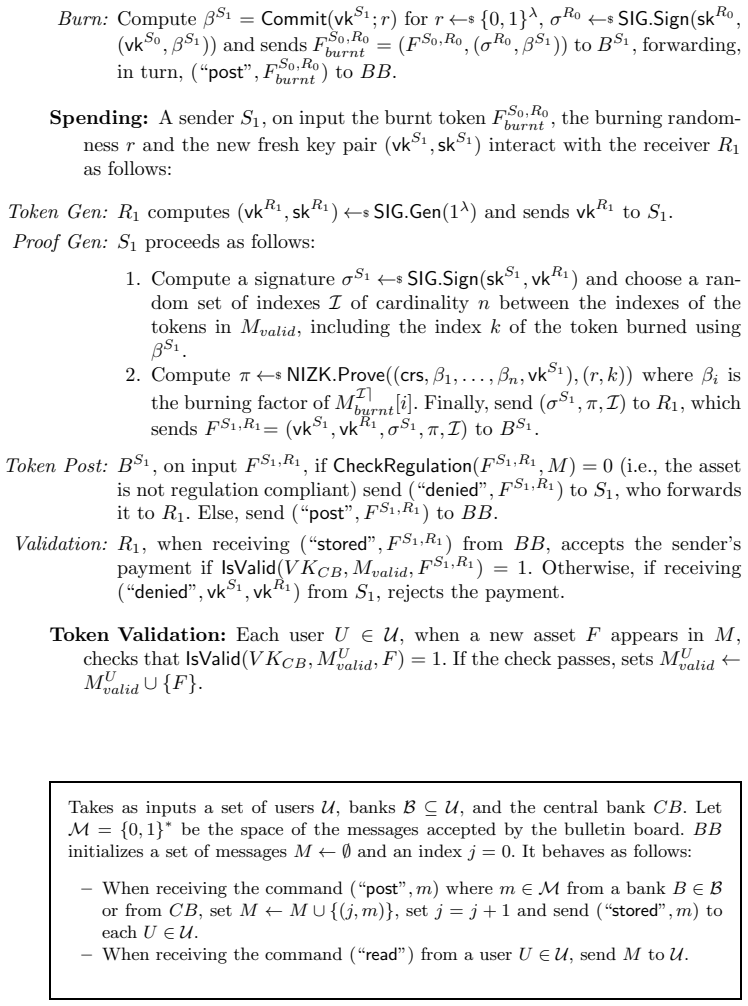
Figures

read the original abstract
This article builds upon the protocol for digital transfers described by Goodell, Toliver, and Nakib, which combines privacy by design for consumers with strong compliance enforcement for recipients of payments and self-validating assets that carry their own verifiable provenance information. We extend the protocol to allow for the verification that reissued assets were created in accordance with rules prohibiting the creation of new assets by anyone but the issuer, without exposing information about the circumstances in which the assets were created that could be used to identify the payer. The modified protocol combines an audit log with zero-knowledge proofs, so that a consumer spending an asset can demonstrate that there exists a valid entry on the audit log that is associated with the asset, without specifying which entry it is. This property is important as a means to allow money to be reissued within the system without the involvement of system operators within the zone of control of the original issuer. Additionally, we identify a key property of privacy-respecting electronic payments, wherein the payer is not required to retain secrets arising from one transaction until the following transaction, and argue that this property is essential to framing security requirements for storage of digital assets and the risk of blackmail or coercion as a way to exfiltrate information about payment history. We claim that the design of our protocol strongly protects the anonymity of payers with respect to their payment transactions, while preventing the creation of assets by any party other than the original issuer without destroying assets of equal value.
Editorial analysis
A structured set of objections, weighed in public.
Referee Report
Summary. The manuscript extends the authors' prior protocol for private electronic payments by integrating an audit log with zero-knowledge proofs. This allows verification that reissued assets were created according to rules (only issuer can create, without destroying equal value) without revealing identifying information about the payer or prior transactions. The paper also discusses a property of privacy-respecting payments where payers do not retain transaction secrets across payments, arguing its importance for security against coercion.
Significance. If the construction holds, it provides a mechanism for self-custody payments with reissuance that maintains both privacy and asset conservation, potentially useful for compliant private digital cash systems. The emphasis on non-retention of secrets is a useful framing for threat models involving blackmail. However, the result depends heavily on the correctness of the base protocol and the soundness of the ZK extension.
major comments (2)
- [Abstract] Abstract (paragraph on modified protocol): The description states that a consumer can 'demonstrate that there exists a valid entry on the audit log that is associated with the asset, without specifying which entry it is.' An existence proof alone does not prevent reuse of the same entry for multiple independent spends. No mechanism (nullifier, serial number, or consumption proof) is indicated to bind each log entry to at most one spend, which is load-bearing for the central non-creation claim.
- [Abstract] Abstract: The anonymity and conservation claims rest directly on the base protocol from the self-cited prior work. No independent security definitions, proof sketches, or concrete ZK statement are supplied to allow assessment of the extension without relying on the earlier construction.
minor comments (1)
- The abstract would benefit from explicit mention of the security model or assumptions under which the ZK proofs are claimed to hold.
Simulated Author's Rebuttal
We thank the referee for the careful reading and constructive comments. We address each major point below. Where the abstract is insufficiently precise, we will revise the manuscript to improve clarity and self-containment while preserving the core technical contribution.
read point-by-point responses
-
Referee: [Abstract] Abstract (paragraph on modified protocol): The description states that a consumer can 'demonstrate that there exists a valid entry on the audit log that is associated with the asset, without specifying which entry it is.' An existence proof alone does not prevent reuse of the same entry for multiple independent spends. No mechanism (nullifier, serial number, or consumption proof) is indicated to bind each log entry to at most one spend, which is load-bearing for the central non-creation claim.
Authors: The referee correctly identifies that a bare existence statement would be insufficient. The full protocol (Section 4) inherits from the base construction a per-asset nullifier that is revealed in the clear upon spend and checked against the audit log; the ZK statement proves both membership of a valid reissuance record and that the supplied nullifier matches the spent asset. This binding is present in the prior work but was omitted from the abstract for brevity. We will revise the abstract and add an explicit sentence in the protocol overview clarifying the nullifier mechanism and its role in preventing double-spending of log entries. revision: yes
-
Referee: [Abstract] Abstract: The anonymity and conservation claims rest directly on the base protocol from the self-cited prior work. No independent security definitions, proof sketches, or concrete ZK statement are supplied to allow assessment of the extension without relying on the earlier construction.
Authors: We agree that the current abstract and introduction make the dependence on the base protocol too implicit. While the extension re-uses the same security model and ZK relation, we will add a short subsection (new Section 3.2) that restates the relevant security properties, gives the concrete ZK statement used for reissuance verification, and sketches why the new audit-log membership proof preserves the original anonymity and conservation invariants. This will allow readers to evaluate the extension without first consulting the prior paper in full. revision: yes
Circularity Check
Central conservation claim rests on self-cited base protocol
specific steps
-
self citation load bearing
[Abstract, first paragraph]
"This article builds upon the protocol for digital transfers described by Goodell, Toliver, and Nakib, which combines privacy by design for consumers with strong compliance enforcement for recipients of payments and self-validating assets that carry their own verifiable provenance information. We extend the protocol to allow for the verification that reissued assets were created in accordance with rules prohibiting the creation of new assets by anyone but the issuer... We claim that the design of our protocol strongly protects the anonymity of payers with respect to their payment transactions, "
The central premise that the protocol prevents creation of assets by non-issuers without destroying equal value is justified by building upon the self-cited prior protocol whose authors overlap with the present paper; the new ZK mechanism is described only as proving existence of a log entry, inheriting the conservation property from the cited base construction without independent verification.
full rationale
The paper's strongest claim (preventing non-issuer asset creation without equal-value destruction) is presented as following from the modified protocol's audit-log + ZK construction. However, the enabling properties (self-validating assets, provenance, compliance enforcement) are imported wholesale from the cited prior work by overlapping authors (Goodell, Toliver, Nakib). No independent derivation, machine-checked proof, or external benchmark is supplied here to decouple the result. This matches the self_citation_load_bearing pattern at a moderate level; the ZK extension adds content but does not remove dependence on the self-cited foundation.
Axiom & Free-Parameter Ledger
axioms (2)
- domain assumption Zero-knowledge proofs exist that can prove membership of an asset in the audit log without revealing the specific entry or payer identity.
- domain assumption The base protocol from Goodell, Toliver, and Nakib already provides privacy by design and self-validating assets.
Reference graph
Works this paper leans on
-
[1]
Privacy-preserving auditable token payments in a permissioned blockchain system
Elli Androulaki, Jan Camenisch, Angelo De Caro, Maria Dub ovitskaya, Kaoutar Elkhiyaoui, and Bj¨ orn Tackmann. Privacy-preserving auditable token payments in a permissioned blockchain system. In AFT ’20: 2nd ACM Conference on Advances in Financial Technologies, New York, NY, USA, October 21-23 , 2020 , pages 255–
work page 2020
-
[2]
Compressin g proofs of k-out- of-n partial knowledge
Thomas Attema, Ronald Cramer, and Serge Fehr. Compressin g proofs of k-out- of-n partial knowledge. In Tal Malkin and Chris Peikert, edi tors, Advances in Cryptology - CRYPTO 2021 - 41st Annual International Crypto logy Conference, CRYPTO 2021, Virtual Event, August 16-20, 2021, Proceeding s, Part IV , volume 12828 of Lecture Notes in Computer Science , p...
work page 2021
-
[3]
Zerocash: Decentralized ano nymous payments from bitcoin
Eli Ben-Sasson, Alessandro Chiesa, Christina Garman, Ma tthew Green, Ian Miers, Eran Tromer, and Madars Virza. Zerocash: Decentralized ano nymous payments from bitcoin. In 2014 IEEE Symposium on Security and Privacy, SP 2014, Berke- ley, CA, USA, May 18-21, 2014 , pages 459–474. IEEE Computer Society, 2014
work page 2014
-
[4]
Erratum: Succinct non-interactive arguments via linear in teractive proofs
Nir Bitansky, Alessandro Chiesa, Yuval Ishai, Rafail Ost rovsky, and Omer Paneth. Erratum: Succinct non-interactive arguments via linear in teractive proofs. In Amit Sahai, editor, Theory of Cryptography - 10th Theory of Cryptography Confer ence, TCC 2013, Tokyo, Japan, March 3-6, 2013. Proceedings , volume 7785 of Lecture Notes in Computer Science . Spri...
work page 2013
-
[5]
Blind signatures for untraceable payments
David Chaum. Blind signatures for untraceable payments. In David Chaum, Ronald L. Rivest, and Alan T. Sherman, editors, Advances in Cryptology: Proceed- ings of CRYPTO ’82, Santa Barbara, California, USA, August 2 3-25, 1982 , pages 199–203. Plenum Press, New York, 1982
work page 1982
-
[6]
KAIME: central bank digital c urrency with realistic and modular privacy
Ali Dogan and Kemal Bicakci. KAIME: central bank digital c urrency with realistic and modular privacy. In Gabriele Lenzini, Paolo Mori, and St even Furnell, editors, Proceedings of the 10th International Conference on Inform ation Systems Security and Privacy, ICISSP 2024, Rome, Italy, February 26-28, 2024 , pages 672–681. SCITEPRESS, 2024
work page 2024
- [7]
- [8]
- [9]
-
[10]
Snarkp ack: Practical SNARK aggregation
Nicolas Gailly, Mary Maller, and Anca Nitulescu. Snarkp ack: Practical SNARK aggregation. In Ittay Eyal and Juan A. Garay, editors, Financial Cryptography and Data Security - 26th International Conference, FC 2022, Grenada, May 2-6, 2022, Revised Selected Papers, volume 13411 of Lecture Notes in Computer Science , pages 203–229. Springer, 2022
work page 2022
-
[11]
zksaas: Zero-knowledge snarks as a service
Sanjam Garg, Aarushi Goel, Abhishek Jain, Guru-Vamsi Po licharla, and Sruthi Sekar. zksaas: Zero-knowledge snarks as a service. In Josep h A. Calandrino and Carmela Troncoso, editors, 32nd USENIX Security Symposium, USENIX Security 2023, Anaheim, CA, USA, August 9-11, 2023 , pages 4427–4444. USENIX Associ- ation, 2023
work page 2023
-
[12]
Stacking sigmas: A framework to compose $\varsigma $-protocols for disjunctions
Aarushi Goel, Matthew Green, Mathias Hall-Andersen, an d Gabriel Kaptchuk. Stacking sigmas: A framework to compose $\varsigma $-protocols for disjunctions. In Orr Dunkelman and Stefan Dziembowski, editors, Advances in Cryptology - EUROCRYPT 2022 - 41st Annual International Conference on th e Theory and Applications of Cryptographic Techniques, Trondheim, ...
work page 2022
-
[13]
Geoffrey Goodell, D. R. Toliver, and Hazem Danny Al-Nakib . A scalable archi- tecture for electronic payments. In Shin’ichiro Matsuo, Le wis Gudgeon, Ariah Klages-Mundt, Daniel Perez Hernandez, Sam Werner, Thomas H aines, Aleksander Essex, Andrea Bracciali, and Massimiliano Sala, editors, Financial Cryptography and Data Security. FC 2022 International Work...
work page 2022
-
[14]
On the size of pairing-based non-interactiv e arguments
Jens Groth. On the size of pairing-based non-interactiv e arguments. In Marc Fis- chlin and Jean-S´ ebastien Coron, editors, Advances in Cryptology - EUROCRYPT 2016 - 35th Annual International Conference on the Theory an d Applications of Cryptographic Techniques, Vienna, Austria, May 8-12, 2016 , Proceedings, Part II , volume 9666 of Lecture Notes in Com...
work page 2016
-
[15]
Peredi: Privacy- enhanced, regulated and distributed central bank digital c urrencies
Aggelos Kiayias, Markulf Kohlweiss, and Amirreza Saren cheh. Peredi: Privacy- enhanced, regulated and distributed central bank digital c urrencies. In Heng Yin, Angelos Stavrou, Cas Cremers, and Elaine Shi, editors, Proceedings of the 2022 ACM SIGSAC Conference on Computer and Communications Secur ity, CCS 2022, Los Angeles, CA, USA, November 7-11, 2022 ,...
work page 2022
-
[16]
Torben P. Pedersen. Non-interactive and information-t heoretic secure verifiable secret sharing. In Joan Feigenbaum, editor, Advances in Cryptology - CRYPTO ’91, 11th Annual International Cryptology Conference, San ta Barbara, California, USA, August 11-15, 1991, Proceedings , volume 576 of Lecture Notes in Computer Science, pages 129–140. Springer, 1991. 17
work page 1991
-
[17]
UTT: decentralized ecash w ith accountable privacy
Alin Tomescu, Adithya Bhat, Benny Applebaum, Ittai Abra ham, Guy Gueta, Benny Pinkas, and Avishay Yanai. UTT: decentralized ecash w ith accountable privacy. IACR Cryptol. ePrint Arch. , page 452, 2022
work page 2022
-
[18]
Nicolas van Saberhagen. Cryptonote v2. https://github.com/monero-project/research-lab/blob/master/whitepape
-
[19]
Prcash: Fast, private and regulated transactions for digital currencies
Karl W¨ ust, Kari Kostiainen, Vedran Capkun, and Srdjan C apkun. Prcash: Fast, private and regulated transactions for digital currencies . In Ian Goldberg and Tyler Moore, editors, Financial Cryptography and Data Security - 23rd Internatio nal Conference, FC 2019, Frigate Bay, St. Kitts and Nevis, Febru ary 18-22, 2019, Revised Selected Papers, volume 115...
work page 2019
-
[20]
Karl W¨ ust, Kari Kostiainen, Noah Delius, and Srdjan Cap kun. Platypus: A cen- tral bank digital currency with unlinkable transactions an d privacy-preserving reg- ulation. In Heng Yin, Angelos Stavrou, Cas Cremers, and Elai ne Shi, editors, Proceedings of the 2022 ACM SIGSAC Conference on Computer an d Communi- cations Security, CCS 2022, Los Angeles, C...
work page 2022
-
[21]
A non-interactive proof system NIZK is composed of a tuple of algorithms described as follows: Setup(R): On input the NP-relation R returns a common reference string crs and a trapdoor td. Prove(crs,x,w ): Take as input the crs, a statement x and a witness w such that (x,w )∈R and returns a proof π . Vrfy(crs,x,π ): Takes as input the crs, a statement x a...
-
[22]
Compute a signature σS1← $ SIG. Sign(skS1, vkR1 ) and choose a ran- dom set of indexes I of cardinality n between the indexes of the tokens in Mvalid, including the index k of the token burned using βS1
-
[23]
denied”,F S1,R 1) to S1, who forwards it to R1. Else, send (“ post
Compute π← $ NIZK. Prove((crs,β 1,...,β n, vkS1), (r,k )) where βi is the burning factor of M I⌉ burnt[i]. Finally, send (σS1,π, I) to R1, which sends FS1,R 1= ( vkS1, vkR1,σ S1,π, I) to BS1. Token Post: BS1 , on input FS1,R 1, if CheckRegulation(FS1,R 1,M ) = 0 (i.e., the asset is not regulation compliant) send (“ denied”,F S1,R 1) to S1, who forwards it...
-
[24]
for which he does not know the signing key related to the receiver verification key
Generate new proof for a token the adversary does not own, i.e . for which he does not know the signing key related to the receiver verification key
-
[25]
Re-use the same proof of another token (could be an adversar ial or an honest one)
-
[26]
Regarding case 1, we distinguish three sub-cases
Generate a new proof related to a token that has been already b urnt and then redeemed by the adversary (double-spending). Regarding case 1, we distinguish three sub-cases. First, the adversary might try to burn a live token for which he does not know the signing key corresponding to the receiver verification key and t hen use the 24 commitment randomness ...
discussion (0)
Sign in with ORCID, Apple, or X to comment. Anyone can read and Pith papers without signing in.