Planning by Simulation: Motion Planning with Learning-based Parallel Scenario Prediction for Autonomous Driving
Pith reviewed 2026-05-23 17:33 UTC · model grok-4.3
The pith
A motion planner uses Monte Carlo Tree Search on a prediction network to simulate how its own candidate actions will reshape other drivers' future paths.
A machine-rendered reading of the paper's core claim, the machinery that carries it, and where it could break.
Core claim
The central claim is that Monte Carlo Tree Search can serve as the backbone for iteratively deducing cooperative scenarios from a prediction network, allowing the planner to calculate costs after the ego vehicle executes candidate actions while capturing the mutual influence between agents' trajectories and the ego plan via query-centric prediction.
What carries the argument
Monte Carlo Tree Search (MCTS) that explores and prunes action-scenario pairs drawn from a learning-based parallel scenario prediction network.
If this is right
- Unreasonable actions and scenarios are balanced and pruned during search.
- Scene generation captures the mutual influence between other agents' predictions and the ego vehicle's planning.
- The framework produces parallel ego-vehicle planning on the Argoverse 2 dataset.
Where Pith is reading between the lines
- The same loop could be applied to close the prediction-planning gap in other multi-agent robotics domains such as drone swarms.
- If the prediction network is updated online, the planner might adapt to distribution shift without retraining the entire system.
- Computational cost of repeated scene simulation may limit deployment to low-speed or structured environments unless further pruning heuristics are added.
Load-bearing premise
The query-centric prediction model accurately encodes how surrounding agents will alter their trajectories in response to the ego vehicle's chosen plan.
What would settle it
A controlled test in which the method outputs a collision-free plan that later collides because surrounding vehicles react differently from the predictions used inside the MCTS loop.
Figures


read the original abstract
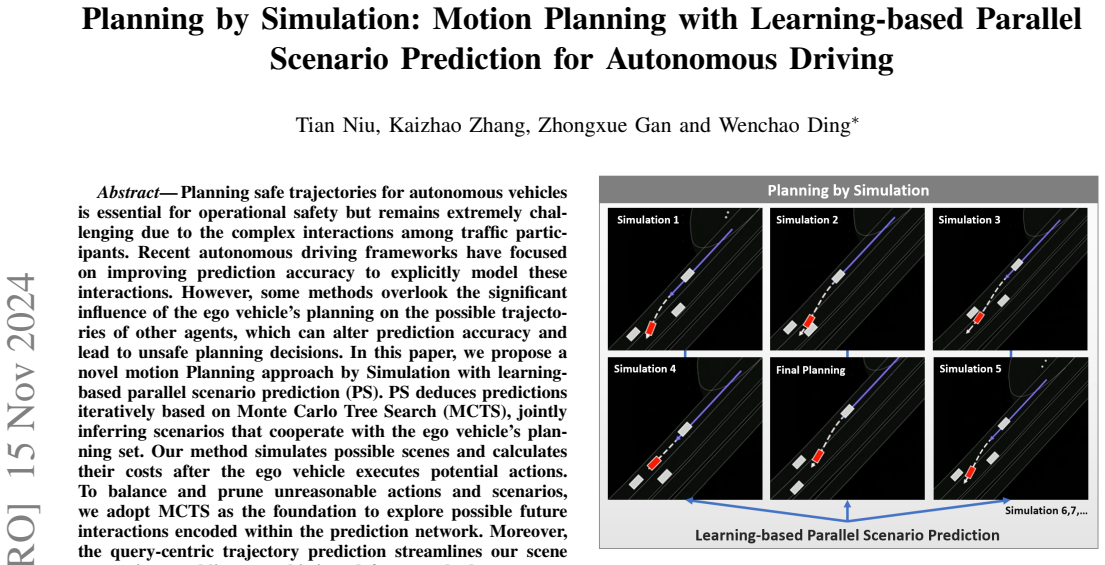
Planning safe trajectories for autonomous vehicles is essential for operational safety but remains extremely challenging due to the complex interactions among traffic participants. Recent autonomous driving frameworks have focused on improving prediction accuracy to explicitly model these interactions. However, some methods overlook the significant influence of the ego vehicle's planning on the possible trajectories of other agents, which can alter prediction accuracy and lead to unsafe planning decisions. In this paper, we propose a novel motion Planning approach by Simulation with learning-based parallel scenario prediction (PS). PS deduces predictions iteratively based on Monte Carlo Tree Search (MCTS), jointly inferring scenarios that cooperate with the ego vehicle's planning set. Our method simulates possible scenes and calculates their costs after the ego vehicle executes potential actions. To balance and prune unreasonable actions and scenarios, we adopt MCTS as the foundation to explore possible future interactions encoded within the prediction network. Moreover, the query-centric trajectory prediction streamlines our scene generation, enabling a sophisticated framework that captures the mutual influence between other agents' predictions and the ego vehicle's planning. We evaluate our framework on the Argoverse 2 dataset, and the results demonstrate that our approach effectively achieves parallel ego vehicle planning.
Editorial analysis
A structured set of objections, weighed in public.
Referee Report
Summary. The manuscript proposes a motion planning framework (PS) for autonomous driving that integrates Monte Carlo Tree Search (MCTS) with a query-centric learning-based trajectory prediction model. The method iteratively simulates ego-conditioned future scenarios, computes costs for candidate actions, and uses MCTS to prune unreasonable branches while capturing mutual influences between the ego vehicle and other agents. It claims effective performance on the Argoverse 2 dataset.
Significance. If the empirical results hold, the approach could meaningfully advance interaction-aware planning by explicitly conditioning scenario rollouts on ego actions inside the search tree, rather than treating prediction as a fixed upstream module. The query-centric formulation for scene generation is a plausible technical enabler for efficient parallel simulation.
major comments (2)
- Abstract: the claim of 'effective' results on Argoverse 2 is asserted without any reported metrics, baselines, ablation studies, or error analysis; this absence makes the central claim that MCTS-driven simulation yields safer planning unverifiable from the supplied text.
- No equations or derivation steps are visible for the cost calculation, scenario pruning, or how the prediction network is conditioned on candidate ego actions inside MCTS; without these, it is impossible to assess whether the joint inference reduces to a fitted quantity or introduces circularity.
minor comments (1)
- The abstract and available text contain no references to prior MCTS-based planners or query-centric predictors, making it difficult to situate the novelty.
Simulated Author's Rebuttal
We thank the referee for the constructive feedback. The comments highlight important areas for improving verifiability and technical clarity. We address each point below and commit to revisions that strengthen the manuscript without altering its core contributions.
read point-by-point responses
-
Referee: Abstract: the claim of 'effective' results on Argoverse 2 is asserted without any reported metrics, baselines, ablation studies, or error analysis; this absence makes the central claim that MCTS-driven simulation yields safer planning unverifiable from the supplied text.
Authors: We agree that the abstract should include concrete quantitative support. In the revised version we will expand the abstract to report key metrics (e.g., collision rate, success rate, and average cost) on Argoverse 2, name the primary baselines, and briefly reference ablation outcomes that demonstrate the benefit of MCTS-driven simulation over non-interactive prediction. revision: yes
-
Referee: No equations or derivation steps are visible for the cost calculation, scenario pruning, or how the prediction network is conditioned on candidate ego actions inside MCTS; without these, it is impossible to assess whether the joint inference reduces to a fitted quantity or introduces circularity.
Authors: The current manuscript text relies on prose descriptions of the cost function and MCTS integration. We will add explicit equations for (i) the ego-conditioned query input to the prediction model, (ii) the per-scenario cost computation, and (iii) the UCT-based pruning rule. A short derivation will clarify that conditioning occurs inside each tree expansion step using the already-trained query-centric predictor, thereby avoiding circularity: the network is never retrained on the ego actions being evaluated. revision: yes
Circularity Check
No significant circularity identified
full rationale
The provided abstract and description outline a framework that integrates MCTS with a query-centric prediction network to generate ego-conditioned scenarios for planning. No equations, derivation steps, or explicit parameter-fitting procedures are visible. The prediction network is treated as an input component whose outputs are used within MCTS for cost calculation and pruning; no reduction of the planning output to a fitted quantity from the same network is exhibited. No self-citations or uniqueness theorems are invoked in the given text. The method is therefore self-contained against external benchmarks with no load-bearing circular steps detectable.
Axiom & Free-Parameter Ledger
Forward citations
Cited by 1 Pith paper
-
What Will Happen Next: Large Models-Driven Deduction for Emergency Instances
WLDS applies large models with factual and logical calibration to produce diverse text-and-image deductions of emergency scenarios beyond what traditional fixed simulations can generate.
Reference graph
Works this paper leans on
-
[1]
Inter- pretable goal-based prediction and planning for autonomous driving
Stefano V Albrecht, Cillian Brewitt, John Wilhelm, Balint Gyevnar, Francisco Eiras, Mihai Dobre, and Subramanian Ramamoorthy. Inter- pretable goal-based prediction and planning for autonomous driving. In 2021 IEEE International Conference on Robotics and Automation (ICRA), pages 1043–1049. IEEE, 2021
work page 2021
-
[2]
Finite-time analysis of the multiarmed bandit problem
Peter Auer, Nicolo Cesa-Bianchi, and Paul Fischer. Finite-time analysis of the multiarmed bandit problem. Machine learning, 47:235– 256, 2002
work page 2002
-
[3]
Tinu Vellamattathil Baby and Baisravan HomChaudhuri. Monte carlo tree search based trajectory generation for automated vehicles in interactive traffic environments. In 2023 American Control Conference (ACC), pages 4431–4436. IEEE, 2023
work page 2023
-
[4]
Autonomous driving archi- tectures: insights of machine learning and deep learning algorithms
Mrinal R Bachute and Javed M Subhedar. Autonomous driving archi- tectures: insights of machine learning and deep learning algorithms. Machine Learning with Applications , 6:100164, 2021
work page 2021
-
[5]
A game-theoretic approach to replanning-aware interactive scene prediction and planning
Mohammad Bahram, Andreas Lawitzky, Jasper Friedrichs, Michael Aeberhard, and Dirk Wollherr. A game-theoretic approach to replanning-aware interactive scene prediction and planning. IEEE Transactions on V ehicular Technology, 65(6):3981–3992, 2015
work page 2015
-
[6]
Dec-mcts: Decentralized planning for multi-robot active perception
Graeme Best, Oliver M Cliff, Timothy Patten, Ramgopal R Mettu, and Robert Fitch. Dec-mcts: Decentralized planning for multi-robot active perception. The International Journal of Robotics Research , 38(2-3):316–337, 2019
work page 2019
-
[7]
Cillian Brewitt, Balint Gyevnar, Samuel Garcin, and Stefano V Al- brecht. Grit: Fast, interpretable, and verifiable goal recognition with learned decision trees for autonomous driving. In 2021 IEEE/RSJ International Conference on Intelligent Robots and Systems (IROS) , pages 1023–1030. IEEE, 2021
work page 2021
-
[8]
Driving maneuvers prediction based autonomous driving control by deep monte carlo tree search
Jienan Chen, Cong Zhang, Jinting Luo, Junfei Xie, and Yan Wan. Driving maneuvers prediction based autonomous driving control by deep monte carlo tree search. IEEE transactions on vehicular technology, 69(7):7146–7158, 2020
work page 2020
-
[9]
End-to-end autonomous driving: Challenges and frontiers
Li Chen, Penghao Wu, Kashyap Chitta, Bernhard Jaeger, Andreas Geiger, and Hongyang Li. End-to-end autonomous driving: Challenges and frontiers. IEEE Transactions on Pattern Analysis and Machine Intelligence, 2024
work page 2024
-
[10]
Forecast-mae: Self- supervised pre-training for motion forecasting with masked autoen- coders
Jie Cheng, Xiaodong Mei, and Ming Liu. Forecast-mae: Self- supervised pre-training for motion forecasting with masked autoen- coders. In Proceedings of the IEEE/CVF International Conference on Computer Vision, pages 8679–8689, 2023
work page 2023
-
[11]
Multimodal trajectory predictions for autonomous driving using deep convolutional networks
Henggang Cui, Vladan Radosavljevic, Fang-Chieh Chou, Tsung-Han Lin, Thi Nguyen, Tzu-Kuo Huang, Jeff Schneider, and Nemanja Djuric. Multimodal trajectory predictions for autonomous driving using deep convolutional networks. In 2019 international conference on robotics and automation (icra) , pages 2090–2096. IEEE, 2019
work page 2019
-
[12]
Qi Dai, Xunnong Xu, Wen Guo, Suzhou Huang, and Dimitar Filev. Towards a systematic computational framework for modeling multi- agent decision-making at micro level for smart vehicles in a smart world. Robotics and Autonomous Systems , 144:103859, 2021
work page 2021
-
[13]
Safe trajectory generation for complex urban environments using spatio- temporal semantic corridor
Wenchao Ding, Lu Zhang, Jing Chen, and Shaojie Shen. Safe trajectory generation for complex urban environments using spatio- temporal semantic corridor. IEEE Robotics and Automation Letters , 4(3):2997–3004, 2019
work page 2019
-
[14]
Epsilon: An efficient planning system for automated vehicles in highly interactive environments
Wenchao Ding, Lu Zhang, Jing Chen, and Shaojie Shen. Epsilon: An efficient planning system for automated vehicles in highly interactive environments. IEEE Transactions on Robotics , 38(2):1118–1138, 2021
work page 2021
-
[15]
Path planning for autonomous vehicles in unknown semi- structured environments
Dmitri Dolgov, Sebastian Thrun, Michael Montemerlo, and James Diebel. Path planning for autonomous vehicles in unknown semi- structured environments. The international journal of robotics re- search, 29(5):485–501, 2010
work page 2010
-
[16]
Deep interactive motion prediction and planning: Playing games with motion prediction models
Jose Luis Vazquez Espinoza, Alexander Liniger, Wilko Schwarting, Daniela Rus, and Luc Van Gool. Deep interactive motion prediction and planning: Playing games with motion prediction models. In Learning for Dynamics and Control Conference , pages 1006–1019. PMLR, 2022
work page 2022
-
[17]
Baidu Apollo EM Motion Planner
Haoyang Fan, Fan Zhu, Changchun Liu, Liangliang Zhang, Li Zhuang, Dong Li, Weicheng Zhu, Jiangtao Hu, Hongye Li, and Qi Kong. Baidu apollo em motion planner. arXiv preprint arXiv:1807.08048 , 2018
work page internal anchor Pith review Pith/arXiv arXiv 2018
-
[18]
Zeyu Gao, Yao Mu, Chen Chen, Jingliang Duan, Ping Luo, Yanfeng Lu, and Shengbo Eben Li. Enhance sample efficiency and robustness of end-to-end urban autonomous driving via semantic masked world model. IEEE Transactions on Intelligent Transportation Systems , 2024
work page 2024
-
[19]
Improving multi-agent motion prediction with heuristic goals and motion refinement
Carlos G ´omez-Hu´elamo, Marcos V Conde, Rafael Barea, and Luis M Bergasa. Improving multi-agent motion prediction with heuristic goals and motion refinement. In Proceedings of the IEEE/CVF Conference on Computer Vision and Pattern Recognition , pages 5323–5332, 2023
work page 2023
-
[20]
A review of motion planning techniques for automated vehicles
David Gonz ´alez, Joshu ´e P ´erez, Vicente Milan ´es, and Fawzi Nashashibi. A review of motion planning techniques for automated vehicles. IEEE Transactions on intelligent transportation systems , 17(4):1135–1145, 2015
work page 2015
-
[21]
Vip3d: End-to-end visual trajectory prediction via 3d agent queries
Junru Gu, Chenxu Hu, Tianyuan Zhang, Xuanyao Chen, Yilun Wang, Yue Wang, and Hang Zhao. Vip3d: End-to-end visual trajectory prediction via 3d agent queries. In Proceedings of the IEEE/CVF Conference on Computer Vision and Pattern Recognition , pages 5496– 5506, 2023
work page 2023
-
[22]
Yang Guan, Yangang Ren, Qi Sun, Shengbo Eben Li, Haitong Ma, Jingliang Duan, Yifan Dai, and Bo Cheng. Integrated decision and control: Toward interpretable and computationally efficient driving intelligence. IEEE transactions on cybernetics , 53(2):859–873, 2022
work page 2022
-
[23]
Peng Hang, Chen Lv, Chao Huang, Jiacheng Cai, Zhongxu Hu, and Yang Xing. An integrated framework of decision making and motion planning for autonomous vehicles considering social behaviors. IEEE transactions on vehicular technology , 69(12):14458–14469, 2020
work page 2020
-
[24]
Zhiyu Huang, Peter Karkus, Boris Ivanovic, Yuxiao Chen, Marco Pavone, and Chen Lv. Dtpp: Differentiable joint conditional prediction and cost evaluation for tree policy planning in autonomous driving. In 2024 IEEE International Conference on Robotics and Automation (ICRA), pages 6806–6812. IEEE, 2024
work page 2024
-
[25]
Zhiyu Huang, Haochen Liu, and Chen Lv. Gameformer: Game- theoretic modeling and learning of transformer-based interactive pre- diction and planning for autonomous driving. In Proceedings of the IEEE/CVF International Conference on Computer Vision , pages 3903– 3913, 2023
work page 2023
-
[26]
Multi-agent trajectory prediction by combining egocentric and allocentric views
Xiaosong Jia, Liting Sun, Hang Zhao, Masayoshi Tomizuka, and Wei Zhan. Multi-agent trajectory prediction by combining egocentric and allocentric views. In Conference on Robot Learning, pages 1434–1443. PMLR, 2022
work page 2022
-
[27]
Kb-tree: Learnable and continuous monte-carlo tree search for autonomous driving planning
Lanxin Lei, Ruiming Luo, Renjie Zheng, Jingke Wang, JianWei Zhang, Cong Qiu, Liulong Ma, Liyang Jin, Ping Zhang, and Junbo Chen. Kb-tree: Learnable and continuous monte-carlo tree search for autonomous driving planning. In 2021 IEEE/RSJ International Conference on Intelligent Robots and Systems (IROS) , pages 4493–
work page 2021
-
[28]
Planning-inspired hierarchi- cal trajectory prediction for autonomous driving
Ding Li, Qichao Zhang, Zhongpu Xia, Kuan Zhang, Menglong Yi, Wenda Jin, and Dongbin Zhao. Planning-inspired hierarchi- cal trajectory prediction for autonomous driving. arXiv preprint arXiv:2304.11295, 2023
-
[29]
Xiaohui Li, Zhenping Sun, Dongpu Cao, Zhen He, and Qi Zhu. Real- time trajectory planning for autonomous urban driving: Framework, algorithms, and verifications. IEEE/ASME Transactions on mecha- tronics, 21(2):740–753, 2015
work page 2015
-
[30]
Kaiwen Liu, Nan Li, H Eric Tseng, Ilya Kolmanovsky, and Anouck Girard. Interaction-aware trajectory prediction and planning for autonomous vehicles in forced merge scenarios. IEEE Transactions on Intelligent Transportation Systems , 24(1):474–488, 2022
work page 2022
-
[31]
Multi-head attention for multi-modal joint vehicle motion forecasting
Jean Mercat, Thomas Gilles, Nicole El Zoghby, Guillaume Sandou, Dominique Beauvois, and Guillermo Pita Gil. Multi-head attention for multi-modal joint vehicle motion forecasting. In 2020 IEEE International Conference on Robotics and Automation (ICRA) , pages 9638–9644. IEEE, 2020
work page 2020
-
[32]
Scene transformer: A unified architecture for predicting mul- tiple agent trajectories
Jiquan Ngiam, Benjamin Caine, Vijay Vasudevan, Zhengdong Zhang, Hao-Tien Lewis Chiang, Jeffrey Ling, Rebecca Roelofs, Alex Bewley, Chenxi Liu, Ashish Venugopal, et al. Scene transformer: A unified architecture for predicting multiple agent trajectories. arXiv preprint arXiv:2106.08417, 2021
-
[33]
Motion planning and control for multi vehicle autonomous racing at high speeds
Ayoub Raji, Alexander Liniger, Andrea Giove, Alessandro Toschi, Nicola Musiu, Daniele Morra, Micaela Verucchi, Danilo Caporale, and Marko Bertogna. Motion planning and control for multi vehicle autonomous racing at high speeds. In 2022 IEEE 25th International Conference on Intelligent Transportation Systems (ITSC) , pages 2775–
work page 2022
-
[34]
Luke Rowe, Martin Ethier, Eli-Henry Dykhne, and Krzysztof Czar- necki. Fjmp: Factorized joint multi-agent motion prediction over learned directed acyclic interaction graphs. In Proceedings of the IEEE/CVF Conference on Computer Vision and Pattern Recognition , pages 13745–13755, 2023
work page 2023
-
[35]
End-to-end au- tonomous driving risk analysis: A behavioural anomaly detection approach
Cian Ryan, Finbarr Murphy, and Martin Mullins. End-to-end au- tonomous driving risk analysis: A behavioural anomaly detection approach. IEEE Transactions on Intelligent Transportation Systems , 22(3):1650–1662, 2020
work page 2020
-
[36]
Renan Sarcinelli, R ˆanik Guidolini, Vinicius B Cardoso, Thiago M Paix˜ao, Rodrigo F Berriel, Pedro Azevedo, Alberto F De Souza, Claudine Badue, and Thiago Oliveira-Santos. Handling pedestrians in self-driving cars using image tracking and alternative path generation with fren ´et frames. Computers & Graphics , 84:173–184, 2019
work page 2019
-
[37]
Mastering the game of go without human knowledge
David Silver, Julian Schrittwieser, Karen Simonyan, Ioannis Antonoglou, Aja Huang, Arthur Guez, Thomas Hubert, Lucas Baker, Matthew Lai, Adrian Bolton, et al. Mastering the game of go without human knowledge. nature, 550(7676):354–359, 2017
work page 2017
-
[38]
Monte-carlo planning in large pomdps
David Silver and Joel Veness. Monte-carlo planning in large pomdps. Advances in neural information processing systems , 23, 2010
work page 2010
-
[39]
Despot: Online pomdp planning with regularization
Adhiraj Somani, Nan Ye, David Hsu, and Wee Sun Lee. Despot: Online pomdp planning with regularization. Advances in neural information processing systems , 26, 2013
work page 2013
-
[40]
Multi- robot region-of-interest reconstruction with dec-mcts
Fouad Sukkar, Graeme Best, Chanyeol Yoo, and Robert Fitch. Multi- robot region-of-interest reconstruction with dec-mcts. In 2019 Inter- national conference on robotics and automation (ICRA) , pages 9101–
work page 2019
-
[41]
On complementing end-to-end human behavior predictors with planning
Liting Sun, Xiaogang Jia, and Anca D Dragan. On complementing end-to-end human behavior predictors with planning. arXiv preprint arXiv:2103.05661, 2021
-
[42]
Mo- tion planning for autonomous driving: The state of the art and future perspectives
Siyu Teng, Xuemin Hu, Peng Deng, Bai Li, Yuchen Li, Yunfeng Ai, Dongsheng Yang, Lingxi Li, Zhe Xuanyuan, Fenghua Zhu, et al. Mo- tion planning for autonomous driving: The state of the art and future perspectives. IEEE Transactions on Intelligent V ehicles , 8(6):3692– 3711, 2023
work page 2023
-
[43]
Enhancing feedback steering controllers for autonomous vehicles with deep monte carlo tree search
Fangyin Tian, Fei-Yue Wang, and Li Li. Enhancing feedback steering controllers for autonomous vehicles with deep monte carlo tree search. IEEE Robotics and Automation Letters , 7(4):10438–10445, 2022
work page 2022
-
[44]
Autonomous vehicle perception: The technology of today and tomorrow
Jessica Van Brummelen, Marie O’brien, Dominique Gruyer, and Homayoun Najjaran. Autonomous vehicle perception: The technology of today and tomorrow. Transportation research part C: emerging technologies, 89:384–406, 2018
work page 2018
-
[45]
Monte carlo tree search with reinforcement learning for motion planning
Philippe Weingertner, Minnie Ho, Andrey Timofeev, S ´ebastien Aubert, and Guillermo Pita-Gil. Monte carlo tree search with reinforcement learning for motion planning. In 2020 IEEE 23rd international conference on intelligent transportation systems (ITSC) , pages 1–7. IEEE, 2020
work page 2020
-
[46]
Monte-carlo tree search for behavior planning in autonomous driving
Qianfeng Wen, Zhongyi Gong, Lifeng Zhou, and Zhongshun Zhang. Monte-carlo tree search for behavior planning in autonomous driving. arXiv preprint arXiv:2310.12075 , 2023
-
[47]
Optimal trajectory generation for dynamic street scenarios in a frenet frame
Moritz Werling, Julius Ziegler, S ¨oren Kammel, and Sebastian Thrun. Optimal trajectory generation for dynamic street scenarios in a frenet frame. In 2010 IEEE international conference on robotics and automation, pages 987–993. IEEE, 2010
work page 2010
-
[48]
Argoverse 2: Next Generation Datasets for Self-Driving Perception and Forecasting
Benjamin Wilson, William Qi, Tanmay Agarwal, John Lambert, Jagjeet Singh, Siddhesh Khandelwal, Bowen Pan, Ratnesh Kumar, Andrew Hartnett, Jhony Kaesemodel Pontes, et al. Argoverse 2: Next generation datasets for self-driving perception and forecasting. arXiv preprint arXiv:2301.00493, 2023
work page internal anchor Pith review Pith/arXiv arXiv 2023
-
[49]
Motion planning under uncertainty for on-road autonomous driving
Wenda Xu, Jia Pan, Junqing Wei, and John M Dolan. Motion planning under uncertainty for on-road autonomous driving. In 2014 IEEE International Conference on Robotics and Automation (ICRA) , pages 2507–2512. IEEE, 2014
work page 2014
-
[50]
Llm4drive: A survey of large language models for autonomous driving
Zhenjie Yang, Xiaosong Jia, Hongyang Li, and Junchi Yan. Llm4drive: A survey of large language models for autonomous driving. arXiv e- prints, pages arXiv–2311, 2023
work page 2023
-
[51]
Sparsead: Sparse query-centric paradigm for efficient end-to-end autonomous driving
Diankun Zhang, Guoan Wang, Runwen Zhu, Jianbo Zhao, Xiwu Chen, Siyu Zhang, Jiahao Gong, Qibin Zhou, Wenyuan Zhang, Ningzi Wang, et al. Sparsead: Sparse query-centric paradigm for efficient end-to-end autonomous driving. arXiv preprint arXiv:2404.06892 , 2024
-
[52]
Ai-tp: Attention-based interaction-aware trajectory prediction for autonomous driving
Kunpeng Zhang, Liang Zhao, Chengxiang Dong, Lan Wu, and Liang Zheng. Ai-tp: Attention-based interaction-aware trajectory prediction for autonomous driving. IEEE Transactions on Intelligent V ehicles , 8(1):73–83, 2022
work page 2022
-
[53]
Query- centric trajectory prediction
Zikang Zhou, Jianping Wang, Yung-Hui Li, and Yu-Kai Huang. Query- centric trajectory prediction. In Proceedings of the IEEE/CVF Con- ference on Computer Vision and Pattern Recognition , pages 17863– 17873, 2023
work page 2023
discussion (0)
Sign in with ORCID, Apple, or X to comment. Anyone can read and Pith papers without signing in.