REVIEW 4 major objections 6 minor 3 cited by
ADV2E: Bridging the Gap Between Analogue Circuit and Discrete Frames in the Video-to-Events Simulator
T0 review · 4 major / 6 minor · reviewed 2026-08-12 · deepseek-v4-flash
Pith's one-line read This paper claims that modelling DVS pixels as brightness-dependent low-pass filters makes synthetic events realistic enough that networks trained on them transfer to real event cameras.
desk verdict A plausible simulator extension with consistent downstream gains, but Eq. (4) has a real DC-gain error that undermines the 'faithful analogue' claim; worth a serious referee, not citable as-is. read the letter →
The pith
A machine-rendered reading of the paper's core claim, the machinery that carries it, and where it could break.
The reading
What carries the argument
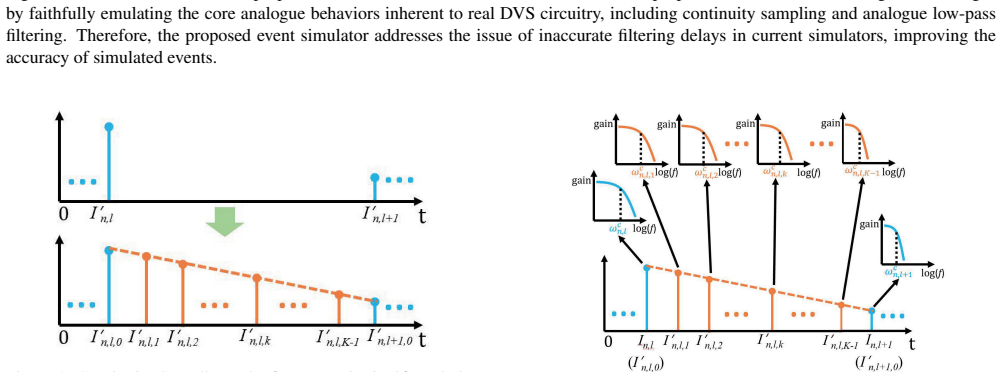
The load-bearing object is a time-varying first-order low-pass filter used as a model of the DVS pixel's analogue front-end. Its cutoff frequency $\omega_0(t)$ is taken to be proportional to instantaneous brightness $I(t)$, so bright regions filter faster than dark ones; the filter is discretised by impulse invariance, giving the recurrence $Y=e^{-\alpha}Y+\alpha I'_{n,l,k}$. The companion mechanism is continuity sampling: each interpolated frame is linearly over-sampled $K$ times so that the effective sampling rate $KLf_b$ exceeds the Nyquist rate implied by the filter's cutoff, which prevents aliasing and lets the cutoff frequency track brightness within each short interval.
What would settle it
Point a real event camera at a screen that suddenly jumps from dark to bright, and record the timestamps of the resulting events. If the event rate after the jump is not a single exponential whose time constant shrinks as the brightness rises, the first-order brightness-proportional filter model is wrong.
Extended reading notes
Core claim
The paper's central claim is that the visually obvious difference between synthetic and real events, especially at light-dark edges, is caused less by frame-rate interpolation than by the analogue low-pass filtering inside the DVS pixel. In a real DVS, brightness changes pass through a cascode feedback loop and a source follower whose finite bandwidth delays the signal; the paper models this delay as a first-order low-pass filter with system function $H_a(s)=\omega_0(t)/(s+\omega_0(t))$, where the cutoff frequency $\omega_0(t)$ is proportional to the current brightness. To apply this model to discrete frames without aliasing, ADV2E first linearly over-samples every interpolated frame by a factor $K$, making the effective sampling rate $KLf_b$, and then runs the filter through the recurrence $Y=e^{-\alpha}Y+\alpha I'_{n,l,k}$ with $\alpha=\omega_0^{n,l,k}T_b/(KL)$. The paper reports that this procedure yields synthetic events with the smallest temporal-bin distance to real DVS recordings (49.58) among the compared simulators, and that segmentation and reconstruction networks trained on ADV2E events achieve the best mIoU (51.20) and best MSE (0.02) and SSIM (0.55) on real test data.
Load-bearing premise
The argument rests on treating the DVS pixel's analogue behaviour as a first-order low-pass filter whose cutoff frequency is directly proportional to instantaneous brightness; the paper notes the exact filter order is unknown and defers the derivation to a supplementary file absent from this preprint.
Editorial extensions
If this is right
- Synthetic events from ordinary APS video become reliable training data for event-camera networks, reducing dependence on scarce and expensive real event datasets.
- High-contrast scenes, where prior simulators show events abruptly vanishing, should retain realistic event tails caused by the brightness-dependent filter delay.
- The simulator's only tunable parameter is the continuity sampling factor $K$, so the same pipeline can be applied to any frame-based video without per-scene calibration.
- If the first-order model is right, networks trained on ADV2E events should keep their advantage as more high-contrast driving and indoor sequences are added.
Reading between the lines
- Beyond the paper, the same analogue-first approach suggests that other DVS non-idealities, such as leakage noise, threshold mismatch, and temperature-dependent bandwidth, could be simulated by the same continuity-sampling discretisation rather than bolted on as post-processing.
- A testable extension the paper does not run is a controlled step-response experiment: exposing a real DVS to a sudden uniform brightness step and measuring the event-rate decay should show an exponential tail with time constant inversely proportional to brightness; a different functional form would locate where the first-order assumption breaks.
- An ablation that varies the over-sampling factor $K$ at fixed interpolation $L$ would isolate how much of the reported improvement comes from alias removal versus the brightness-dependent cutoff itself.
Signed reviews
Editorial analysis
A structured set of objections, weighed in public.
Referee Report
Summary. The paper proposes ADV2E, a video-to-events simulator that incorporates the analogue low-pass filtering behavior of DVS pixel circuits into the event generation pipeline. The method has two main components: continuity sampling, which over-samples interpolated video frames by a factor K to increase the effective sampling rate, and an analogue low-pass filter whose cutoff frequency is assumed proportional to instantaneous brightness, discretized with an impulse-invariance-style update. The authors evaluate ADV2E against four baselines (vid2e, v2e, v2ce, DVS-Voltmeter) on three tasks: direct event comparison using temporal-bin distance on the DAVIS240C 'urban' sequence, semantic segmentation on DDD17 using Ev-Segnet, and image reconstruction on DAVIS240C using E2VID trained on GOPRO-simulated events. ADV2E reports the best temporal-bin distance (49.58), best mIoU (51.20), best MSE (0.02), and best SSIM (0.55), with mixed LPIPS results. The paper claims that these results validate that modeling analogue circuit properties improves the realism of simulated events and sim-to-real generalization.
Significance. If the central modeling claim is correct, ADV2E addresses a genuine gap in video-to-events simulation: existing simulators treat event generation as a purely logical thresholding process and largely ignore the analogue low-pass filtering that is physically present in DVS pixels. The experimental protocol is appropriate and externally grounded: training on simulated events and testing on real event datasets (DDD17, DAVIS240C) is a meaningful sim-to-real test, and the temporal-bin distance on a real DAVIS sequence provides a direct event-level comparison. The paper also honestly notes in §2.1 that the exact filter order of the DVS pixel is unclear, and it names the assumptions underlying the first-order model. However, the current manuscript does not yet support the strong causal claim that the observed improvements come from the specific analogue filtering mechanism: the discretization in Eq. (4) is not the exact first-order ZOH update, the two proposed components are never ablated separately, and no error bars or statistical significance tests are reported. The contribution is promising but needs substantial strengthening before the claims can be accepted.
major comments (4)
- [§3.2.2, Eq. (4)] The discretization of the first-order low-pass filter is not the exact zero-order-hold update for H(s)=ω0/(s+ω0). With sample interval Δt=T_b/(KL), the correct recurrence with unity DC gain is Y ← e^{-α}Y + (1−e^{-α})I', where α=ω0Δt, whereas Eq. (4) uses Y = e^{-α}Y + αI'. These agree only when α≪1. At the paper's own settings (§4.1: 24 FPS, K=10, L=10), if the stated 250 Hz cutoff is interpreted as ω0=2π·250 rad/s, then α≈0.65 and the DC gain is α/(1−e^{-α})≈1.37, a 37% amplitude error that grows for brighter pixels because ω0∝I. If ω0 is instead read as 250 rad/s, the paper is ambiguous about Hz versus rad/s and the error is smaller but still systematic. This directly undermines the claim that the filter 'faithfully' replicates the analogue DVS response, and it means the reported gains over baselines may be contaminated by a brightness-dependent amplitude distortion. The derivation for the first-order model is also deferred to a supplementary file that is absent from this preprint, so the central model cannot be fully checked as printed.
- [§4.1 and Tables 1–3] The two main contributions—continuity sampling (K) and the brightness-dependent analogue low-pass filter—are never ablated separately. K=10 is set in §4.1, and all other parameters are inherited from v2e/vid2e, but no experiment removes the time-varying cutoff or varies K to show that the improvements in Table 1, Table 2, and Table 3 are due to the analogue filtering mechanism rather than simply to the higher effective sampling rate. Without such an ablation, the causal claim that 'the gap between analogue pixel circuit and discrete video frames' is the source of improvement is not established.
- [Tables 1–3 (all experiments)] No error bars, standard deviations, or numbers of random seeds are reported for any of the three evaluations. The margins in the headline results are small—mIoU 51.20 versus 50.60, SSIM 0.55 versus 0.53—and in Table 3 the LPIPS result is not even the best (0.44 versus vid2e's 0.41, and per-sequence LPIPS is worse for shapes6dof, 0.48 versus DVS-Voltmeter's 0.28). These differences may be within run-to-run variability when training Ev-Segnet and E2VID from scratch, so the current evidence does not support the strength of the claims without a significance analysis.
- [§3.2.2, §4.1] The proportionality ω0(t) ∝ I(t) is a load-bearing assumption, but the proportionality constant is never specified, calibrated, or studied for sensitivity. The paper states in §4.1 that K is the only parameter requiring adjustment, yet the brightness-to-cutoff mapping introduces at least one additional free parameter whose value is not reported. Since this parameter directly controls the magnitude of α in Eq. (4) and hence the amplitude distortion noted above, the quantitative results are not reproducible without this information.
minor comments (6)
- [§1, Abstract] The phrase 'as an infantile sensor' is nonstandard and should be replaced with, for example, 'as a nascent sensor technology'.
- [§3.2.1] The Nyquist argument is internally inconsistent: for a 250 Hz cutoff the text says the minimum sampling rate is 500 FPS, which with 24 FPS input requires an interpolation factor of at least 20.9, not 'at least 16x' as stated.
- [§4.1, captions and table headers] The names 'DA VIS240C' and 'DVS-V oltmeter' appear with broken spacing throughout, presumably from LaTeX control sequences; these should be rendered as 'DAVIS240C' and 'DVS-Voltmeter'.
- [Figure 3] Figure 3 is never cited in the body text; either add a reference at the appropriate point in §3.2.2 or remove the figure.
- [§4.4 and Table 3] The text says ADV2E achieves the second-best LPIPS, which matches Table 3, but the qualitative claim that ADV2E produces the most realistic events should be tempered given that vid2e has better average LPIPS and several per-sequence LPIPS comparisons favor other methods.
- [References] Reference [17] appears to be mislabeled: it cites a paper by Kim et al. but with the journal and page numbers of the DVS paper [21]; please verify the citation details.
Circularity Check
No circularity: the simulator parameters are set a priori or inherited from v2e, and all evaluations use external real-event benchmarks against independent baselines.
full rationale
The claimed derivation chain—bridging analogue pixel low-pass filtering to more realistic synthetic events—is not circular. The low-pass filter assumption (first-order, cutoff proportional to brightness) is imported from external sources [6, 11, 12, 24] (v2e and DVS pixel biasing literature), none of which share authors with the present paper, and the paper explicitly flags the exact filter order as unclear (§2.1). The only tunable parameter, K, is set a priori to 10, with all other parameters inherited from v2e and vid2e (§4.1), so no parameter is fitted to the evaluation targets (temporal-bin distance, mIoU, MSE/SSIM/LPIPS). Evaluation is conducted on external real-event benchmarks (DAVIS240C, DDD17, GOPRO) against four independent baselines; the improvements are therefore empirically contingent, not forced by construction. Two limitations are noted, but they are not circularity: (i) §3.2 states that the first-order filter derivation is 'demonstrated in the supplementary materials,' yet the supplementary file is absent from this preprint, leaving the core physical assumption unverified; and (ii) Eq. (4) discretizes H(s)=ω0/(s+ω0) as Y=e^{-α}Y+αI', whereas a unity-DC-gain zero-order-hold discretization would use 1-e^{-α} as the input coefficient, so the printed filter has a brightness-dependent DC-gain error (~1.37 at α=0.65). These are correctness and verifiability risks, not reductions of the result to its inputs.
Assumptions & free parameters
free parameters (2)
- Continuity sampling rate K =
10
- Brightness-to-cutoff proportionality constant =
unspecified
assumptions (5)
- domain assumption DVS pixel analogue behavior is a first-order low-pass filter
- domain assumption Filter cutoff frequency is directly proportional to current brightness (omega0(t) proportional to I(t))
- domain assumption Brightness changes linearly within each over-sampled interval Tb/(KL)
- standard math Nyquist-Shannon sampling theorem applies to the interpolated frame signal
- domain assumption Event threshold, noise model, and interpolation settings inherit from v2e and vid2e
Cite this review
Pith. "Pith review of ADV2E: Bridging the Gap Between Analogue Circuit and Discrete Frames in the Video-to-Events Simulator." pith.science (2026). https://pith.science/paper/UA43OMRB
@misc{pith2026241112250,
  author       = {Pith},
  title        = {Pith review of: ADV2E: Bridging the Gap Between Analogue Circuit and Discrete Frames in the Video-to-Events Simulator},
  year         = {2026},
  howpublished = {\url{https://pith.science/paper/UA43OMRB}},
  note         = {Machine review of arXiv:2411.12250}
}
read the original abstract
Event cameras operate fundamentally differently from traditional Active Pixel Sensor (APS) cameras, offering significant advantages. Recent research has developed simulators to convert video frames into events, addressing the shortage of real event datasets. Current simulators primarily focus on the logical behavior of event cameras. However, the fundamental analogue properties of pixel circuits are seldom considered in simulator design. The gap between analogue pixel circuit and discrete video frames causes the degeneration of synthetic events, particularly in high-contrast scenes. In this paper, we propose a novel method of generating reliable event data based on a detailed analysis of the pixel circuitry in event cameras. We incorporate the analogue properties of event camera pixel circuits into the simulator design: (1) analogue filtering of signals from light intensity to events, and (2) a cutoff frequency that is independent of video frame rate. Experimental results on two relevant tasks, including semantic segmentation and image reconstruction, validate the reliability of simulated event data, even in high-contrast scenes. This demonstrates that deep neural networks exhibit strong generalization from simulated to real event data, confirming that the synthetic events generated by the proposed method are both realistic and well-suited for effective training.
Figures


Figures from the paper (2 more)


Forward citations
Cited by 3 Pith papers
-
Hybrid Event Frame Sensors: Modeling, Calibration, and Simulation
A unified, calibrated noise model for hybrid event-frame sensors is implemented in H-ESIM, a simulator that generates realistic RAW frames and events and improves downstream frame interpolation and deblurring on real ...
-
Towards a physically realistic computationally efficient DVS pixel model
A DVS pixel model combining circuit-derived differential equations with first-passage-time stochastic event generation predicts noise event rates accurately with timesteps over 1000 times larger than prior methods.
-
How Real is CARLAs Dynamic Vision Sensor? A Study on the Sim-to-Real Gap in Traffic Object Detection
Training with more real event data monotonically improves detection on real eTram test scenes, while CARLA DVS synthetic training transfers poorly, but the paper's synthetic-heavy test claim is not directly measured.
Reference graph
Works this paper leans on
-
[1]
I ˜nigo Alonso and Ana C. Murillo. Ev-segnet: Semantic seg- mentation for event-based cameras. In2019 IEEE/CVF Con- 8 ference on Computer Vision and Pattern Recognition Work- shops (CVPRW), pages 1624–1633, 2019. 1, 2, 5, 7
work page 2019
-
[2]
A 5 meps $100 usb2.0 address-event monitor-sequencer interface
Raphael Berner, Tobi Delbruck, Ant ´on Civit Civit-Balcells, and Alejandro Linares-Barranco. A 5 meps $100 usb2.0 address-event monitor-sequencer interface. In 2007 IEEE International Symposium on Circuits and Systems (ISCAS) , pages 2451–2454, 2007. 5
work page 2007
-
[3]
Ddd17: End-to-end davis driving dataset
Jonathan Binas, Daniel Neil, Shih-Chii Liu, and Tobi Del- bruck. Ddd17: End-to-end davis driving dataset. arXiv preprint arXiv:1711.01458, 2017. 5, 6
arXiv 2017
-
[4]
A large scale event- based detection dataset for automotive
Pierre De Tournemire, Davide Nitti, Etienne Perot, Da- vide Migliore, and Amos Sironi. A large scale event- based detection dataset for automotive. arXiv preprint arXiv:2001.08499, 2020. 2
arXiv 2001
-
[5]
Adaptive photore- ceptor with wide dynamic range
Tobi Delbruck and Carver Andress Mead. Adaptive photore- ceptor with wide dynamic range. In Proceedings of IEEE International Symposium on Circuits and Systems - ISCAS ’94, pages 339–342 vol.4, 1994. 1
work page 1994
-
[6]
V2e: From video frames to realistic dvs event camera streams
Tobi Delbruck, Yuhuang Hu, and Zhe He. V2e: From video frames to realistic dvs event camera streams. arXiv e-prints, pages arXiv–2006, 2020. 3
work page 2006
-
[7]
Video frame interpolation: A comprehensive survey
Jiong Dong, Kaoru Ota, and Mianxiong Dong. Video frame interpolation: A comprehensive survey. ACM Trans. Multi- media Comput. Commun. Appl., 19(2s), 2023. 3
work page 2023
-
[8]
Davison, J ¨org Conradt, Kostas Daniilidis, and Davide Scaramuzza
Guillermo Gallego, Tobi Delbr ¨uck, Garrick Orchard, Chiara Bartolozzi, Brian Taba, Andrea Censi, Stefan Leutenegger, Andrew J. Davison, J ¨org Conradt, Kostas Daniilidis, and Davide Scaramuzza. Event-based vision: A survey. IEEE Transactions on Pattern Analysis and Machine Intelligence, 44(1):154–180, 2022. 1
work page 2022
Show all 38 references
-
[9]
Video to events: Recycling video datasets for event cameras
Daniel Gehrig, Mathias Gehrig, Javier Hidalgo-Carri ´o, and Davide Scaramuzza. Video to events: Recycling video datasets for event cameras. In 2020 IEEE/CVF Conference on Computer Vision and Pattern Recognition (CVPR), pages 3583–3592, 2020. 1, 2, 3, 4, 5, 7, 8
2020
-
[10]
Dsec: A stereo event camera dataset for driv- ing scenarios
Mathias Gehrig, Willem Aarents, Daniel Gehrig, and Davide Scaramuzza. Dsec: A stereo event camera dataset for driv- ing scenarios. IEEE Robotics and Automation Letters, 6(3): 4947–4954, 2021. 1
2021
-
[11]
Optimal biasing and physical limits of dvs event noise
Rui Graca, Brian McReynolds, and Tobi Delbruck. Optimal biasing and physical limits of dvs event noise. In2023 Inter- national Image Sensor Workshop. s.n., 2023. 2
2023
-
[12]
Shining light on the dvs pixel: A tutorial and discussion about biasing and optimization
Rui Grac ¸a, Brian McReynolds, and Tobi Delbruck. Shining light on the dvs pixel: A tutorial and discussion about biasing and optimization. In 2023 IEEE/CVF Conference on Com- puter Vision and Pattern Recognition Workshops (CVPRW), pages 4045–4053, 2023. 2
2023
-
[13]
Ddd20 end-to-end event camera driv- ing dataset: Fusing frames and events with deep learning for improved steering prediction
Yuhuang Hu, Jonathan Binas, Daniel Neil, Shih-Chii Liu, and Tobi Delbruck. Ddd20 end-to-end event camera driv- ing dataset: Fusing frames and events with deep learning for improved steering prediction. In 2020 IEEE 23rd Inter- national Conference on Intelligent Transportation ...
2020
-
[14]
v2e: From video frames to realistic dvs events
Yuhuang Hu, Shih-Chii Liu, and Tobi Delbruck. v2e: From video frames to realistic dvs events. In2021 IEEE/CVF Con- ference on Computer Vision and Pattern Recognition Work- shops (CVPRW), pages 1312–1321, 2021. 1, 2, 3, 5, 7, 8
2021
-
[15]
Super slomo: High quality estimation of multiple intermediate frames for video interpolation
Huaizu Jiang, Deqing Sun, Varan Jampani, Ming-Hsuan Yang, Erik Learned-Miller, and Jan Kautz. Super slomo: High quality estimation of multiple intermediate frames for video interpolation. In 2018 IEEE/CVF Conference on Com- puter Vision and Pattern Recognition , pages 9000–9008,
2018
-
[16]
Camilo Vasquez Tieck, Christian Hub- schneider, Peter Wolf, Michael Weber, Michael Hoff, Alexander Friedrich, Konrad Wojtasik, Arne Roennau, Ralf Kohlhaas, R¨udiger Dillmann, and J
Jacques Kaiser, J. Camilo Vasquez Tieck, Christian Hub- schneider, Peter Wolf, Michael Weber, Michael Hoff, Alexander Friedrich, Konrad Wojtasik, Arne Roennau, Ralf Kohlhaas, R¨udiger Dillmann, and J. Marius Z¨ollner. Towards a framework for end-to-end control of a simulated v...
2016
-
[17]
Simultaneous mosaicing and track- ing with an event camera
Hanme Kim, Ankur Handa, Ryad Benosman, Sio-Hoi Ieng, and Andrew J Davison. Simultaneous mosaicing and track- ing with an event camera. J. Solid State Circ , 43:566–576,
-
[18]
N-imagenet: Towards robust, fine-grained object recognition with event cameras
Junho Kim, Jaehyeok Bae, Gangin Park, Dongsu Zhang, and Young Min Kim. N-imagenet: Towards robust, fine-grained object recognition with event cameras. In 2021 IEEE/CVF International Conference on Computer Vision (ICCV), pages 2126–2136, 2021. 2
2021
-
[19]
Design and use paradigms for gazebo, an open-source multi-robot simulator
Nathan Koenig and Andrew Howard. Design and use paradigms for gazebo, an open-source multi-robot simulator. In 2004 IEEE/RSJ International Conference on Intelligent Robots and Systems (IROS) (IEEE Cat. No.04CH37566) , pages 2149–2154, 2004. 1
2004
-
[20]
Interiornet: Mega-scale multi- sensor photo-realistic indoor scenes dataset
Wenbin Li, Sajad Saeedi, John McCormac, Ronald Clark, Dimos Tzoumanikas, Qing Ye, Yuzhong Huang, Rui Tang, and Stefan Leutenegger. Interiornet: Mega-scale multi- sensor photo-realistic indoor scenes dataset. In British Ma- chine Vision Conference (BMVC), 2018. 1
2018
-
[21]
A 128× 128 120 db 15 µs latency asynchronous temporal con- trast vision sensor
Patrick Lichtsteiner, Christoph Posch, and Tobi Delbruck. A 128× 128 120 db 15 µs latency asynchronous temporal con- trast vision sensor. IEEE Journal of Solid-State Circuits, 43 (2):566–576, 2008. 1, 3
2008
-
[22]
Dvs- voltmeter: Stochastic process-based event simulator for dy- namic vision sensors
Songnan Lin, Ye Ma, Zhenhua Guo, and Bihan Wen. Dvs- voltmeter: Stochastic process-based event simulator for dy- namic vision sensors. In Computer Vision – ECCV 2022 , pages 578–593. Springer Nature Switzerland, 2022. 1, 2, 3, 5, 7, 8
2022
-
[23]
Learning optical flow from event camera with rendered dataset
Xinglong Luo, Kunming Luo, Ao Luo, Zhengning Wang, Ping Tan, and Shuaicheng Liu. Learning optical flow from event camera with rendered dataset. In 2023 IEEE/CVF In- ternational Conference on Computer Vision (ICCV) , pages 9813–9823, 2023. 2
2023
-
[24]
Demystifying event-based sensor biasing to optimize signal to noise for space domain awareness
Brian McReynolds, Rui Graca, Rachel Oliver, Masashi Nishiguchi, and Tobi Delbruck. Demystifying event-based sensor biasing to optimize signal to noise for space domain awareness. In AMOS Conference 2023. s.n., 2023. 2
2023
-
[25]
The event-camera dataset and simulator: Event-based data for pose estimation, visual odometry, and slam
Elias Mueggler, Henri Rebecq, Guillermo Gallego, Tobi Del- bruck, and Davide Scaramuzza. The event-camera dataset and simulator: Event-based data for pose estimation, visual odometry, and slam. The International Journal of Robotics Research, 36(2):142–149, 2017. 1, 2, 5, 6, 8
2017
-
[26]
How to calibrate your event camera
Manasi Muglikar, Mathias Gehrig, Daniel Gehrig, and Da- vide Scaramuzza. How to calibrate your event camera. In 9 2021 IEEE/CVF Conference on Computer Vision and Pat- tern Recognition Workshops (CVPRW) , pages 1403–1409,
2021
-
[27]
Deep multi-scale convolutional neural network for dynamic scene deblurring
Seungjun Nah, Tae Hyun Kim, and Kyoung Mu Lee. Deep multi-scale convolutional neural network for dynamic scene deblurring. In 2017 IEEE Conference on Computer Vision and Pattern Recognition (CVPR), pages 257–265, 2017. 5
2017
-
[28]
Image sensors and signal processing for digital still cameras
Junichi Nakamura. Image sensors and signal processing for digital still cameras. CRC Press, Florida, FL, 2016. 1
2016
-
[29]
Bringing a blurry frame alive at high frame-rate with an event camera
Liyuan Pan, Cedric Scheerlinck, Xin Yu, Richard Hart- ley, Miaomiao Liu, and Yuchao Dai. Bringing a blurry frame alive at high frame-rate with an event camera. In 2019 IEEE/CVF Conference on Computer Vision and Pat- tern Recognition (CVPR), pages 6813–6822, 2019. 1
2019
-
[30]
Learning to detect objects with a 1 megapixel event camera
Etienne Perot, Pierre de Tournemire, Davide Nitti, Jonathan Masci, and Amos Sironi. Learning to detect objects with a 1 megapixel event camera. In Advances in Neural Information Processing Systems, pages 16639–16652. Curran Associates, Inc., 2020. 1
2020
-
[31]
Esim: an open event camera simulator
Henri Rebecq, Daniel Gehrig, and Davide Scaramuzza. Esim: an open event camera simulator. InProceedings of The 2nd Conference on Robot Learning, pages 969–982. PMLR,
-
[32]
High speed and high dynamic range video with an event camera
Henri Rebecq, Ren ´e Ranftl, Vladlen Koltun, and Davide Scaramuzza. High speed and high dynamic range video with an event camera. IEEE Transactions on Pattern Analysis and Machine Intelligence, 43(6):1964–1980, 2021. 1, 5
1964
-
[33]
Communication in the presence of noise
Claude Elwood Shannon. Communication in the presence of noise. Proceedings of the IRE, 37(1):10–21, 1949. 3
1949
-
[34]
Reducing the sim-to-real gap for event cameras
Timo Stoffregen, Cedric Scheerlinck, Davide Scaramuzza, Tom Drummond, Nick Barnes, Lindsay Kleeman, and Robert” Mahony. Reducing the sim-to-real gap for event cameras. In Computer Vision – ECCV 2020, pages 534–549. Springer International Publishing, 2020. 1
2020
-
[35]
Simoncelli
Zhou Wang, Alan Conrad Bovik, Hamid Rahim Sheikh, and Eero P. Simoncelli. Image quality assessment: from error visibility to structural similarity. IEEE Transactions on Im- age Processing, 13(4):600–612, 2004. 5
2004
-
[36]
Efros, Eli Shecht- man, and Oliver Wang
Richard Zhang, Phillip Isola, Alexei A. Efros, Eli Shecht- man, and Oliver Wang. The unreasonable effectiveness of deep features as a perceptual metric. In 2018 IEEE/CVF Conference on Computer Vision and Pattern Recognition , pages 586–595, 2018. 5
2018
-
[37]
V2ce: Video to continuous events simulator
Zhongyang Zhang, Shuyang Cui, Kaidong Chai, Haowen Yu, Subhasis Dasgupta, Upal Mahbub, and Tauhidur Rah- man. V2ce: Video to continuous events simulator. In 2024 IEEE International Conference on Robotics and Automation (ICRA), pages 12455–12461, 2024. 1, 2, 3, 5, 7, 8
2024
-
[38]
The multi- vehicle stereo event camera dataset: An event camera dataset for 3d perception
Alex Zihao Zhu, Dinesh Thakur, Tolga ¨Ozaslan, Bernd Pfrommer, Vijay Kumar, and Kostas Daniilidis. The multi- vehicle stereo event camera dataset: An event camera dataset for 3d perception. IEEE Robotics and Automation Letters, 3 (3):2032–2039, 2018. 1 10
2018
Reviewed August 12, 2026 · model on record in the stance chip above.
Discussion (0). Continue with ORCID to comment.