REVIEW 5 major objections 5 minor 16 cited by
Learning Humanoid Locomotion with Perceptive Internal Model
T0 review · 5 major / 5 minor · reviewed 2026-08-12 · deepseek-v4-flash
Pith's one-line read A perception-augmented state predictor lets humanoid robots climb 15 cm stairs with over 90% success on two platforms.
desk verdict Perceptive extension of HIM that plausibly climbs 15 cm stairs on two humanoids, but the headline 90% success and online-map accuracy are unmeasured. read the letter →
The pith
A machine-rendered reading of the paper's core claim, the machinery that carries it, and where it could break.
The reading
What carries the argument
The key mechanism is the Perceptive Internal Model (PIM): a state predictor that ingests both the recent proprioceptive history and the current perceptive observation, a 96-point sampling of heights in a 0.8 m by 1.2 m grid around the robot's base link aligned to gravity. It produces a velocity estimate trained by regression to simulator ground truth and a latent next-proprioception variable trained by contrastive learning, and both feed the policy along with the current observation. During training the policy sees exact terrain heights; during deployment those heights come from a continuously updated elevation map built from point clouds and odometry, so the robot effectively perceives the terrain beneath its feet while remaining less affected by camera motion and noise than raw depth inputs.
What would settle it
Feed the policy an elevation map whose heights are corrupted by a known bias or latency, for example all step heights reduced by 5 cm or delayed by 200 ms, and measure the stair-climbing success rate; if the rate collapses or the robot stops lifting its feet, it would show that the reported performance depends on near-exact map heights rather than on the learned state predictor's robustness.
Extended reading notes
Core claim
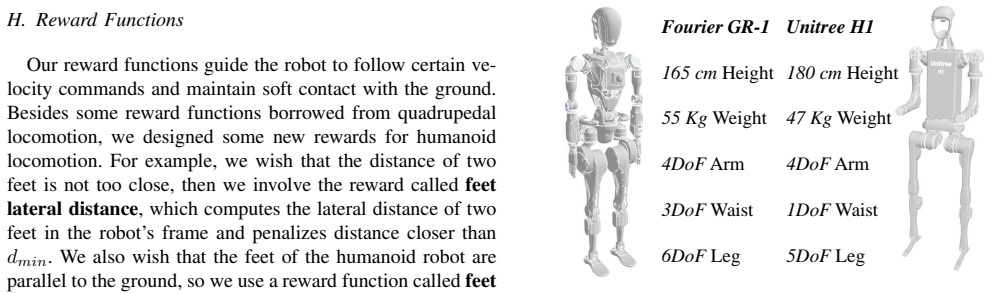
The central claim is that augmenting the learned state predictor with current terrain elevation leads to more accurate next-state estimates and therefore to locomotion policies that can handle fine-grained foothold tasks such as continuous 15 cm stair climbing. PIM builds on HIM, which estimates the robot's next linear velocity by regression and its next proprioceptive state by contrastive learning; PIM concatenates the current sampled elevation map with the proprioceptive history so that the predictor can use the ground under the feet. In simulation the policy is trained on exact obstacle heights, and at inference the same observation is filled from an onboard elevation map built from LiDAR or RGB-D data in a gravity-aligned map frame. The authors report that this single-stage training completes in about three hours on one RTX 4090 and deploys without fine-tuning on Unitree H1 and Fourier GR-1, including continuous stair climbing with success rate above 90% and jumps onto platforms and over gaps.
Load-bearing premise
The load-bearing premise is that the online elevation map reconstructed from LiDAR or RGB-D data and odometry reproduces the ground-truth obstacle heights used in simulation closely enough for zero-shot transfer, since the paper reports no quantitative error, latency, or drift analysis for the map.
Editorial extensions
If this is right
- Continuous 15 cm stair climbing at over 90% success becomes feasible, a capability the paper reports earlier methods cap at 10 cm.
- The same training pipeline transfers zero-shot to two physically different humanoids, suggesting the method is not tied to one robot's mass, height, joint configuration, or foot design.
- Because no depth-image rendering is needed in simulation, policy training runs in about three hours on a single RTX 4090 without a second training stage.
- Using the elevation map inside the state predictor, rather than only as a visual input, lowers next-state estimation loss and lets the policy handle harder terrain than the same policy with a non-perceptive internal model.
- The policy produces coordinated whole-body movements, including arm swings during jumps, without imitation data or prior motion trajectories.
Reading between the lines
- If the mechanism is as general as the cross-platform result suggests, the same elevation-map-augmented state predictor could be applied to other bipedal or quadrupedal platforms, but that transfer is an extrapolation beyond the paper's two robots.
- The reported sensitivity to foot-length versus stair-width suggests that foothold precision, not raw perception range, is the limiting factor; a testable corollary is that adding a foothold-planning head would push success further on taller stairs.
- The lack of reported map-error analysis means the practical ceiling of the method may be set by the elevation-map pipeline rather than by the learned policy; injecting calibrated map noise in simulation would quantify that ceiling.
- A natural extension is to let the policy also learn from uncertain or partial elevation maps during training, which would make the sim-to-real gap explicit instead of relying on the map being exact.
Signed reviews
Editorial analysis
A structured set of objections, weighed in public.
Referee Report
Summary. The paper proposes the Perceptive Internal Model (PIM), a modification of the Hybrid Internal Model (HIM) in which the current elevation-map observation is concatenated with proprioceptive history for next-state estimation and is also fed to the policy. Policies are trained in simulation with ground-truth obstacle heights and deployed zero-shot on Unitree H1 and Fourier GR-1 using elevation maps built from a Mid-360 LiDAR or a RealSense T265+D435 setup. The paper claims continuous stair climbing with 15 cm steps at "over 90%" success, traversal of high platforms, gaps, and slopes, cross-platform generalization, and a training time of 3 hours on an RTX 4090 without depth-image rendering.
Significance. If the empirical claims were fully supported, the paper would be a useful step toward perceptive humanoid locomotion: it combines a proprioceptive internal model with a robot-centered elevation map, avoids depth-image rendering in training, and reports deployment on two different humanoid platforms. The design is simple and the reported training efficiency is attractive. However, the current manuscript is primarily a qualitative demonstration: the headline success rate lacks trial counts and definitions, the perception pipeline is not validated against ground truth, and the PIM-versus-HIM comparison is presented without numerical results. The paper's contribution would be strengthened considerably by quantitative hardware evaluation, map-error analysis, and seeded simulation comparisons; these are within the scope of the paper and, in my view, necessary before the central claims can be accepted.
major comments (5)
- [Abstract and Section IV-B] The central quantitative claim, "a success rate of over 90%" for continuous stair climbing, is not supported by any reported trial count, failure definition, stopping criterion, per-run statistics, or sensor configuration. Because the paper uses this number as its headline result and compares against prior 10 cm stair results, the claim is not verifiable as written. Please add a hardware evaluation table with the number of attempts, success criteria, and confidence intervals for each robot and sensor setup.
- [Section III-D and Section IV-B] The training-to-inference perception gap is load-bearing but unmeasured. Policies are trained on exact ground-truth obstacle heights (Sections III-B and III-D), while inference uses heights sampled from an online elevation map reconstructed from LiDAR or RGB-D plus odometry. The manuscript describes gravity alignment and ground-point filtering but gives no error, latency, drift, or noise analysis and no comparison between reconstructed map heights and ground-truth terrain. Given the stated constraint that the stair width equals the foot length, small height or placement errors can plausibly cause failure. Please provide quantitative map-error evaluation (for example, height RMSE against ground truth under typical robot motion) and, if possible, a simulation study that perturbs the sampled heights to demonstrate policy robustness to the expected perception noise.
- [Section IV-A and Fig. 5] The PIM-versus-HIM comparison is only qualitative. Fig. 5 reports "estimation loss" and "terrain level" without axis labels, units, seeds, or numerical values, so the statement that PIM "achieves higher training efficiency and higher estimation accuracy" is not established. Please report quantitative velocity-estimation error, terrain-level progression over training, and final task success rates over multiple seeds, with error bars or confidence intervals.
- [Section IV-D] The cross-platform claim for the Fourier GR-1 is supported only by narrative descriptions and images. No task success rates, number of attempts, failure counts, or sensor specifications are given for GR-1 on stairs or other terrains. Please add per-platform quantitative results, including the sensor configuration used in each deployment, so that the claimed generality across robot platforms can be assessed.
- [Section IV-B] The claim of surpassing prior methods that achieve only 10 cm stairs is not supported by a direct comparison under matched conditions. Different robot hardware, training protocols, and evaluation procedures confound the comparison. Please either run baseline policies on the same robot and terrain, or soften the claim to a statement about demonstrated capability rather than comparative superiority.
minor comments (5)
- [Equation (1), Section III-F] The displayed equation for the symmetry loss has unbalanced parentheses and an unclear argument structure; please rewrite it with explicit closing parentheses and define each symmetry operator's output space.
- [Table I] Several reward entries are malformed or undefined, in particular the "Joint power" equation, the "Feet slip" term containing "~1new contact", and the "Joint tracking error" term with an ambiguous subscript. Please provide corrected equations and define all indicator functions and constants.
- [Section III-D and Fig. 3] The sampling procedure for the 96 elevation points is underspecified: no grid resolution, coordinate convention, or ordering is given. Please clarify how the 0.8 m x 1.2 m region is discretized and how the sampled points are aligned with the gravity-aligned map frame. Also, "Terrian" in the Fig. 3 caption is a typo.
- [Fig. 5] The axes of Fig. 5 are not labeled and the units are unclear; please label both axes and define "estimation loss" and "terrain level" in the caption or text.
- [General] The manuscript contains several grammatical errors and unconventional spellings (for example, "we concluded as PIM", "Realsense" instead of "RealSense", and "V ar" without a subscript). A careful proofreading pass would improve readability.
Circularity Check
No significant circularity: PIM extends the independently published HIM with elevation-map observations, and the central sim-to-real stair-climbing result is an empirical experiment, not a consequence of a fit or a self-citation chain.
full rationale
The paper's derivation chain is self-contained with respect to the circularity patterns under review. PIM is explicitly built on HIM, a prior ICLR publication by overlapping authors, but HIM is used as a component and not as evidence for the stair-climbing claim. The abstract states: 'We train the policy using ground-truth obstacle heights surrounding the robot in simulation, optimizing it based on the Hybrid Internal Model (HIM), and perform inference with heights sampled from the constructed elevation map.' This is a train/inference distribution shift, not a definitional equivalence: the policy is trained on exact heights and evaluated on reconstructed map heights, so the real-world result is not forced by construction. No equation in the paper reduces the claimed 90% stair-climbing success to a fitted parameter or to the definition of PIM. The comparison in Section IV-A ('PIM vs HIM') is an empirical measurement, not a mathematical identity. The self-citations to HIM are load-bearing as engineering foundation but are independently published and externally falsifiable; they do not forbid alternatives or smuggle in an unverified uniqueness claim. The main weakness is that Section IV-B asserts 'a success rate of over 90%' for continuous stair climbing without reporting trial counts, failures, or stopping criteria, and the perceptual assumption that online elevation maps match training heights is not validated with error statistics. However, missing empirical support is a correctness-risk concern, not circularity, because the claim is an experimental outcome rather than a derivation from its own inputs. Accordingly, the appropriate circularity score is 0.
Assumptions & free parameters
free parameters (5)
- Reward weights in Table I =
23 weights listed in Table I
- Elevation sampling configuration =
96 points over a 0.8 m by 1.2 m grid
- Action curriculum schedule =
not specified precisely
- PPO and network hyperparameters =
not reported
- Terrain curriculum progression =
only shown qualitatively in Fig. 5
assumptions (4)
- domain assumption The real-world elevation map, built from LiDAR or RGB-D plus odometry, is sufficiently close to the ground-truth terrain heights used in simulation.
- domain assumption Simulator dynamics and contact models are accurate enough that a policy trained with PPO transfers to real H1 and GR-1 hardware without fine-tuning.
- domain assumption HIM's contrastive state estimator, originally developed for quadrupeds, remains a valid state estimator when applied to humanoids with perceptive inputs.
- standard math Standard PPO and contrastive learning objectives are taken as correct optimization methods.
Cite this review
Pith. "Pith review of Learning Humanoid Locomotion with Perceptive Internal Model." pith.science (2026). https://pith.science/paper/X3HCLL4R
@misc{pith2026241114386,
  author       = {Pith},
  title        = {Pith review of: Learning Humanoid Locomotion with Perceptive Internal Model},
  year         = {2026},
  howpublished = {\url{https://pith.science/paper/X3HCLL4R}},
  note         = {Machine review of arXiv:2411.14386}
}
read the original abstract
In contrast to quadruped robots that can navigate diverse terrains using a "blind" policy, humanoid robots require accurate perception for stable locomotion due to their high degrees of freedom and inherently unstable morphology. However, incorporating perceptual signals often introduces additional disturbances to the system, potentially reducing its robustness, generalizability, and efficiency. This paper presents the Perceptive Internal Model (PIM), which relies on onboard, continuously updated elevation maps centered around the robot to perceive its surroundings. We train the policy using ground-truth obstacle heights surrounding the robot in simulation, optimizing it based on the Hybrid Internal Model (HIM), and perform inference with heights sampled from the constructed elevation map. Unlike previous methods that directly encode depth maps or raw point clouds, our approach allows the robot to perceive the terrain beneath its feet clearly and is less affected by camera movement or noise. Furthermore, since depth map rendering is not required in simulation, our method introduces minimal additional computational costs and can train the policy in 3 hours on an RTX 4090 GPU. We verify the effectiveness of our method across various humanoid robots, various indoor and outdoor terrains, stairs, and various sensor configurations. Our method can enable a humanoid robot to continuously climb stairs and has the potential to serve as a foundational algorithm for the development of future humanoid control methods.
Figures


Figures from the paper (3 more)


Forward citations
Cited by 16 Pith papers
-
Visual Imitation Enables Contextual Humanoid Control
A single policy trained from 123 monocular videos, fine-tuned in simulation, and distilled to heightmap plus root-direction inputs lets a Unitree G1 climb stairs and sit and stand on real furniture.
-
LangWBC: Language-directed Humanoid Whole-Body Control via End-to-end Learning
LangWBC maps text commands and proprioceptive history directly to humanoid actions via a conditional variational autoencoder distilled from an RL teacher, enabling diverse, smoothly transitioning whole-body motions on...
-
MuJoCo Playground
An open-source, MJX-based robot learning framework with integrated batch rendering that provides fast training and demonstrates sim-to-real transfer on six robot platforms.
-
KungfuBot: Physics-Based Humanoid Whole-Body Control for Learning Highly-Dynamic Skills
A robot control method that adaptively tightens motion-tracking reward tolerances achieves lower tracking errors on dynamic skills and transfers zero-shot to a real humanoid.
-
MoRE: Mixture of Residual Experts for Humanoid Lifelike Gaits Learning on Complex Terrains
A two-stage reinforcement learning pipeline with a mixture of latent residual experts gives a Unitree G1 humanoid multiple commanded human-like gaits over complex terrains.
-
Hold My Beer: Learning Gentle Humanoid Locomotion and End-Effector Stabilization Control
A slow-fast two-agent reinforcement learning architecture with separate upper- and lower-body policies reduces end-effector shaking during humanoid locomotion.
-
HuB: Learning Extreme Humanoid Balance
HuB combines reference motion refinement, balance shaping rewards, and robustness training to enable a G1 humanoid to hold extreme single-leg poses that prior tracking methods fail to maintain.
-
JAEGER: Dual-Level Humanoid Whole-Body Controller
JAEGER decouples upper- and lower-body control of a humanoid robot into two jointly trained policies and reports lower pose- and velocity-tracking errors than prior whole-body controllers in simulation.
-
Learning Humanoid Standing-up Control across Diverse Postures
HoST uses multi-critic reinforcement learning, a force curriculum, and smoothness constraints in simulation so a Unitree G1 humanoid can stand up from diverse postures in the real world without predefined motion trajectories.
-
A Unified and General Humanoid Whole-Body Controller for Versatile Locomotion
A single RL policy controls walking, jumping, and standing gaits of a humanoid with tunable foot and posture parameters, plus a separate policy for hopping, and supports real-time upper-body intervention for loco-mani...
-
KiVi: Kinesthetic-Visuospatial Integration for Dynamic and Safe Egocentric Legged Locomotion
A quadruped locomotion controller that explicitly separates proprioceptive and visual pathways stays stable under camera occlusion and visual corruption that destabilizes fused-vision policies.
-
Humanoid Occupancy: Enabling A Generalized Multimodal Occupancy Perception System on Humanoid Robots
A humanoid-specific multimodal occupancy perception system with a new dataset, sensor layout, and a fusion network that claims state-of-the-art results on its own benchmark.
-
Embrace Collisions: Humanoid Shadowing for Deployable Contact-Agnostics Motions
A whole-body reinforcement-learning controller, trained only in simulation, lets a Unitree G1 humanoid perform extreme contact-agnostic motions such as getting up from the ground and breaking-dance moves in the real world.
-
ASAP: Aligning Simulation and Real-World Physics for Learning Agile Humanoid Whole-Body Skills
ASAP trains a residual action model on real-world rollouts and fine-tunes simulation policies through it, reducing humanoid whole-body motion tracking error in sim-to-real transfer.
-
Robust RL Control for Bipedal Locomotion with Closed Kinematic Chains
A reinforcement-learning gait controller that explicitly models closed kinematic chains outperforms one trained on a simplified serial model, both in simulation and on the physical TopA robot.
-
A Survey: Learning Embodied Intelligence from Physical Simulators and World Models
Embodied intelligence learning is reviewed through the complementary lenses of physical simulators and world models, with a proposed IR-L0 to IR-L4 robot capability taxonomy.
Reference graph
Works this paper leans on
-
[1]
Learning agile and dynamic motor skills for legged robots,
J. Hwangbo, J. Lee, A. Dosovitskiy, D. Bellicoso, V . Tsounis, V . Koltun, and M. Hutter, “Learning agile and dynamic motor skills for legged robots,” Science Robotics, vol. 4, no. 26, p. eaau5872, 2019
2019
-
[2]
Learning quadrupedal locomotion over challenging terrain,
J. Lee, J. Hwangbo, L. Wellhausen, V . Koltun, and M. Hutter, “Learning quadrupedal locomotion over challenging terrain,” Science robotics, vol. 5, no. 47, p. eabc5986, 2020
2020
-
[3]
Hybrid internal model: Learning agile legged locomotion with simulated robot response,
J. Long, Z. Wang, Q. Li, L. Cao, J. Gao, and J. Pang, “Hybrid internal model: Learning agile legged locomotion with simulated robot response,” in The Twelfth International Conference on Learning Representations, 2024
work page 2024
-
[4]
Learning h-infinity locomotion control,
J. Long, W. Yu, Q. Li, Z. Wang, D. Lin, and J. Pang, “Learning h-infinity locomotion control,” in 8th Annual Conference on Robot Learning, 2024
work page 2024
-
[5]
Walk these ways: Tuning robot control for generalization with multiplicity of behavior,
G. B. Margolis and P. Agrawal, “Walk these ways: Tuning robot control for generalization with multiplicity of behavior,” in Conference on Robot Learning . PMLR, 2023, pp. 22–31
2023
-
[6]
Ad- vancing humanoid locomotion: Mastering challenging terrains with denoising world model learning,
X. Gu, Y .-J. Wang, X. Zhu, C. Shi, Y . Guo, Y . Liu, and J. Chen, “Ad- vancing humanoid locomotion: Mastering challenging terrains with denoising world model learning,” arXiv preprint arXiv:2408.14472 , 2024
arXiv 2024
-
[7]
Humanoid locomotion as next token prediction,
I. Radosavovic, B. Zhang, B. Shi, J. Rajasegaran, S. Kamat, T. Darrell, K. Sreenath, and J. Malik, “Humanoid locomotion as next token prediction,” arXiv preprint arXiv:2402.19469 , 2024
arXiv 2024
-
[8]
Berkeley humanoid: A research platform for learning-based control,
Q. Liao, B. Zhang, X. Huang, X. Huang, Z. Li, and K. Sreenath, “Berkeley humanoid: A research platform for learning-based control,” arXiv preprint arXiv:2407.21781 , 2024
arXiv 2024
Show all 32 references
-
[9]
Adapting humanoid locomotion over challenging terrain via two-phase training,
W. Cui, S. Li, H. Huang, B. Qin, T. Zhang, L. Zheng, Z. Tang, C. Hu, N. Yan, J. Chen et al. , “Adapting humanoid locomotion over challenging terrain via two-phase training,” in 8th Annual Conference on Robot Learning
-
[10]
Humanoid parkour learning,
Z. Zhuang, S. Yao, and H. Zhao, “Humanoid parkour learning,” arXiv preprint arXiv:2406.10759, 2024
2024 arXiv
-
[11]
Ex- pressive whole-body control for humanoid robots,
X. Cheng, Y . Ji, J. Chen, R. Yang, G. Yang, and X. Wang, “Ex- pressive whole-body control for humanoid robots,” arXiv preprint arXiv:2402.16796, 2024
2024 arXiv
-
[12]
Learning human-to-humanoid real-time whole-body teleoperation,
T. He, Z. Luo, W. Xiao, C. Zhang, K. Kitani, C. Liu, and G. Shi, “Learning human-to-humanoid real-time whole-body teleoperation,” arXiv preprint arXiv:2403.04436 , 2024
2024 arXiv
-
[13]
Learning multi-modal whole-body control for real-world humanoid robots,
P. Dugar, A. Shrestha, F. Yu, B. van Marum, and A. Fern, “Learning multi-modal whole-body control for real-world humanoid robots,” arXiv preprint arXiv:2408.07295 , 2024
2024 arXiv
-
[14]
Humanplus: Humanoid shadowing and imitation from humans,
Z. Fu, Q. Zhao, Q. Wu, G. Wetzstein, and C. Finn, “Humanplus: Humanoid shadowing and imitation from humans,” arXiv preprint arXiv:2406.10454, 2024
2024 arXiv
-
[15]
Humanoid-gym: Reinforcement learning for humanoid robot with zero-shot sim2real transfer,
X. Gu, Y .-J. Wang, and J. Chen, “Humanoid-gym: Reinforcement learning for humanoid robot with zero-shot sim2real transfer,” arXiv preprint arXiv:2404.05695, 2024
2024 arXiv
-
[16]
Hier- archical world models as visual whole-body humanoid controllers,
N. Hansen, J. SV , V . Sobal, Y . LeCun, X. Wang, and H. Su, “Hier- archical world models as visual whole-body humanoid controllers,” arXiv preprint arXiv:2405.18418 , 2024
2024 arXiv
-
[17]
Harmon: Whole-body motion generation of humanoid robots from language descriptions,
Z. Jiang, Y . Xie, J. Li, Y . Yuan, Y . Zhu, and Y . Zhu, “Harmon: Whole-body motion generation of humanoid robots from language descriptions,” in 8th Annual Conference on Robot Learning
-
[18]
Okami: Teaching humanoid robots manipulation skills through single video imitation,
J. Li, Y . Zhu, Y . Xie, Z. Jiang, M. Seo, G. Pavlakos, and Y . Zhu, “Okami: Teaching humanoid robots manipulation skills through single video imitation,” in 8th Annual Conference on Robot Learning
-
[19]
Revisiting reward design and evaluation for robust humanoid standing and walking,
B. van Marum, A. Shrestha, H. Duan, P. Dugar, J. Dao, and A. Fern, “Revisiting reward design and evaluation for robust humanoid standing and walking,” arXiv preprint arXiv:2404.19173 , 2024
2024 arXiv
-
[20]
Wococo: Learning whole- body humanoid control with sequential contacts,
C. Zhang, W. Xiao, T. He, and G. Shi, “Wococo: Learning whole- body humanoid control with sequential contacts,” arXiv preprint arXiv:2406.06005, 2024
2024 arXiv
-
[21]
Bi-level motion imitation for humanoid robots,
W. Zhao, Y . Zhao, J. Pajarinen, and M. Muehlebach, “Bi-level motion imitation for humanoid robots,” in 8th Annual Conference on Robot Learning
-
[22]
Omnih2o: Universal and dexterous human- to-humanoid whole-body teleoperation and learning,
T. He, Z. Luo, X. He, W. Xiao, C. Zhang, W. Zhang, K. Kitani, C. Liu, and G. Shi, “Omnih2o: Universal and dexterous human- to-humanoid whole-body teleoperation and learning,” arXiv preprint arXiv:2406.08858, 2024
2024 arXiv
-
[23]
Extreme parkour with legged robots,
X. Cheng, K. Shi, A. Agarwal, and D. Pathak, “Extreme parkour with legged robots,” in 2024 IEEE International Conference on Robotics and Automation (ICRA) . IEEE, 2024, pp. 11 443–11 450
2024
-
[24]
Legged locomotion in challenging terrains using egocentric vision,
A. Agarwal, A. Kumar, J. Malik, and D. Pathak, “Legged locomotion in challenging terrains using egocentric vision,” inConference on robot learning. PMLR, 2023, pp. 403–415
2023
-
[25]
Anymal parkour: Learning agile navigation for quadrupedal robots,
D. Hoeller, N. Rudin, D. Sako, and M. Hutter, “Anymal parkour: Learning agile navigation for quadrupedal robots,” Science Robotics , vol. 9, no. 88, p. eadi7566, 2024
2024
-
[26]
Learning robust perceptive locomotion for quadrupedal robots in the wild,
T. Miki, J. Lee, J. Hwangbo, L. Wellhausen, V . Koltun, and M. Hutter, “Learning robust perceptive locomotion for quadrupedal robots in the wild,” Science robotics, vol. 7, no. 62, p. eabk2822, 2022
2022
-
[27]
Elevation mapping for locomotion and navigation using gpu,
T. Miki, L. Wellhausen, R. Grandia, F. Jenelten, T. Homberger, and M. Hutter, “Elevation mapping for locomotion and navigation using gpu,” in 2022 IEEE/RSJ International Conference on Intelligent Robots and Systems (IROS) . IEEE, 2022, pp. 2273–2280
2022
-
[28]
Proximal policy optimization algorithms,
J. Schulman, F. Wolski, P. Dhariwal, A. Radford, and O. Klimov, “Proximal policy optimization algorithms,” arXiv preprint arXiv:1707.06347, 2017
2017 arXiv
-
[29]
Unsupervised learning of visual features by contrasting cluster assign- ments,
M. Caron, I. Misra, J. Mairal, P. Goyal, P. Bojanowski, and A. Joulin, “Unsupervised learning of visual features by contrasting cluster assign- ments,” Advances in neural information processing systems , 2020
2020
-
[30]
Fast-lio: A fast, robust lidar-inertial odometry package by tightly-coupled iterated kalman filter,
W. Xu and F. Zhang, “Fast-lio: A fast, robust lidar-inertial odometry package by tightly-coupled iterated kalman filter,” IEEE Robotics and Automation Letters, vol. 6, no. 2, pp. 3317–3324, 2021
2021
-
[31]
Fast-lio2: Fast direct lidar- inertial odometry,
W. Xu, Y . Cai, D. He, J. Lin, and F. Zhang, “Fast-lio2: Fast direct lidar- inertial odometry,” IEEE Transactions on Robotics , vol. 38, no. 4, pp. 2053–2073, 2022
2022
-
[32]
Leveraging symmetry in rl-based legged locomotion control,
Z. Su, X. Huang, D. Ordo ˜nez-Apraez, Y . Li, Z. Li, Q. Liao, G. Turrisi, M. Pontil, C. Semini, Y . Wu et al., “Leveraging symmetry in rl-based legged locomotion control,” arXiv preprint arXiv:2403.17320 , 2024
2024 arXiv
Reviewed August 12, 2026 · model on record in the stance chip above.
Discussion (0). Continue with ORCID to comment.