REVIEW 4 major objections 5 minor 3 cited by
Interleaved Scene Graphs for Interleaved Text-and-Image Generation Assessment
T0 review · 4 major / 5 minor · reviewed 2026-08-12 · deepseek-v4-flash
Pith's one-line read The paper's central claim is that interleaved text-and-image generation can be judged automatically at four levels of detail, and that this automated judgment tracks human judgment closely.
desk verdict A genuinely useful four-level evaluation framework and benchmark for interleaved text-and-image generation, but the fine-grained model rankings in Table 6 are contaminated by the structural-matching gate and should not be taken at face value. read the letter →
The pith
A machine-rendered reading of the paper's core claim, the machinery that carries it, and where it could break.
The reading
What carries the argument
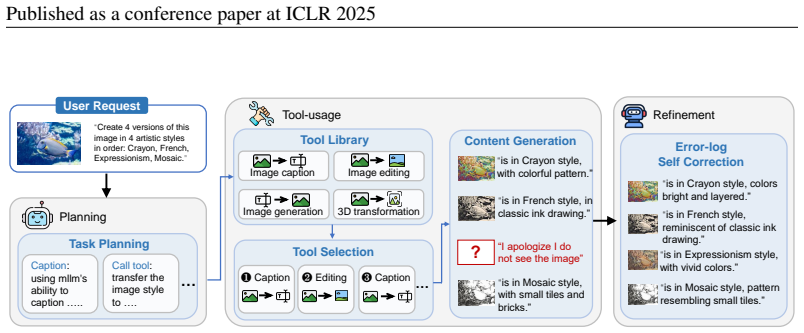
The load-bearing object is the Interleaved Scene Graph, a representation in which text blocks and image blocks are nodes and open-vocabulary relations (such as 'describes' or 'the next step after') are edges. ISG first has an LLM predict the response's required structure from the query and rejects with holistic-only scoring if the generated response does not match that structure exactly. For responses that pass, it generates questions from the graph at block level (subject-object-relation triples) and image level (entities, attributes, and relations), and answers them with an MLLM-based VQA module using a 1-10 score or yes/no. This multi-level question-answer machinery is what turns a graph parse into a human-aligned number.
What would settle it
Rephrase 100 ISG-Bench queries into new phrasings with identical intended output structure and run the structure predictor on them; any mispredicted structure (accuracy below 1.0) would show that responses with correct content but unusual wording are silently dropped from block and image scoring, undermining the reported alignment.
Extended reading notes
Core claim
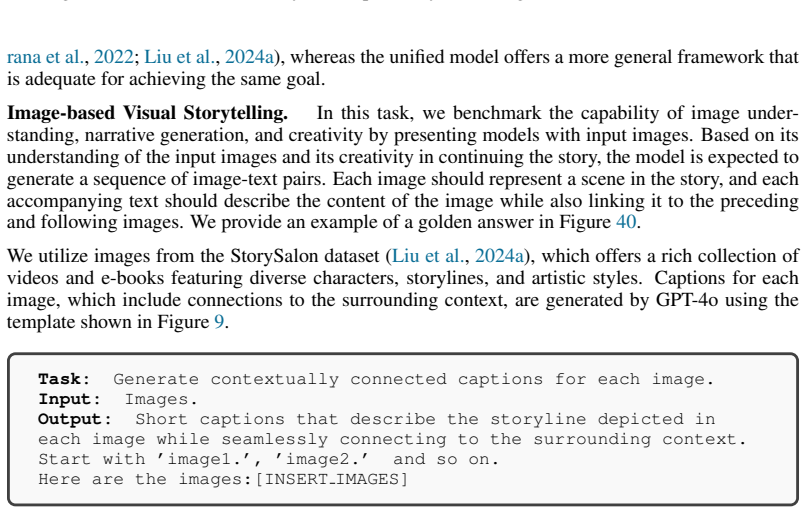
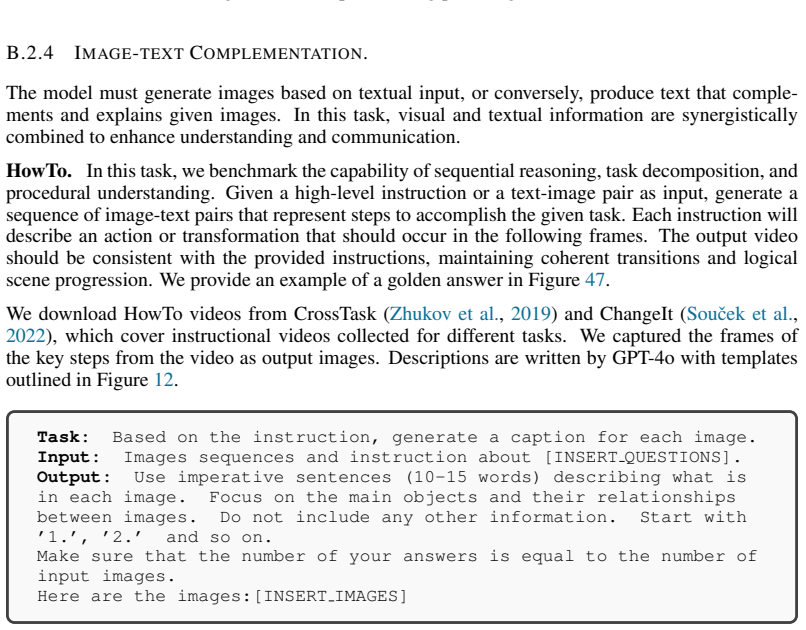
On its own terms, the paper establishes that a scene-graph representation of a user query can drive a four-level automatic evaluation that outperforms prior evaluation methods in agreement with human judgment. ISG parses the query into structure, block-relation tuples, and image entity-attribute-relation tuples; an MLLM converts each element into questions, and a VQA module answers them against the generated response. The paper reports structural match accuracy of 1.000 on golden answers and human-alignment numbers of 0.718 (block-level scoring) and 0.907 (image-level yes/no). The benchmark built on this machinery, ISG-Bench, contains 1,150 vision-dependent queries with golden answers across 21 subcategories, and the evaluation of ten models leads the authors to conclude that unified models are far behind compositional pipelines, that vision-dominated tasks are the hardest, and that a plan-execute-refine agent outperforms all baselines at all four levels.
Load-bearing premise
The framework assumes the LLM that predicts the required output structure is essentially perfect, so any response with a mismatched structure is excluded from fine-grained scoring rather than being scored on its content.
Editorial extensions
If this is right
- If ISG is accepted as a metric, fine-grained automatic evaluation of interleaved generation becomes practical: it produces interpretable question-answer feedback for each block and image, not just one holistic score.
- The benchmark results imply that current unified text-and-image models cannot yet follow structural or vision-centric instructions, so the bottleneck is instruction following and multi-image consistency, not raw generation ability.
- The large gap between unified and compositional pipelines suggests a concrete research direction: better interleaved training data and pipelines, possibly built with agent-based synthesis, could close most of the 111% holistic gap.
- Because golden answers substantially raise holistic judge agreement, any future interleaved benchmark should include reference answers rather than rely on free-form judging.
Reading between the lines
- Editorial inference: ISG's numbers are tied to GPT-4o as both question generator and VQA module; if the framework were re-run with an open-weight MLLM, the reported Pearson correlations and model rankings could change, so the metric is currently contingent on one proprietary judge.
- Editorial inference: the structural-match gate turns structure following into a binary on/off switch, zeroing block/image scores for any deviation; a graded or soft structural score would let the metric distinguish 'right content, wrong order' from 'no structure at all'.
- Editorial inference: the 111% and 122% improvement figures compare two families of models on ISG's own scoring scale; a direct human preference test between a unified model output and an ISG-Agent output would provide a check of whether the ranking reproduces human taste rather than just human-annotated question answers.
Editorial analysis
A structured set of objections, weighed in public.
Referee Report
Summary. The paper proposes ISG, an automatic multi-granularity evaluation framework for interleaved text-and-image generation. ISG parses a user query into a scene-graph-like structure, then evaluates generated responses at four levels: holistic, structural, block, and image. The authors introduce ISG-Bench, a benchmark of 1,150 manually collected samples across 8 categories and 21 subcategories with golden answers, and report that ISG aligns with human judgments (block-level Pearson 0.718, image-level accuracy 0.907, holistic agreement 0.730). They evaluate several unified and compositional generation systems, reporting that unified models underperform compositional pipelines, and present ISG-Agent, a plan-execute-refine agent that achieves the highest scores on the benchmark. The paper also provides extensive appendices with prompts, task definitions, case studies, cost analysis, and safety checks.
Significance. If the claims hold, this is a useful contribution to multimodal generation evaluation: it provides a fine-grained, interpretable alternative to holistic LLM-as-a-judge, a benchmark with golden answers and vision-centric tasks, and transparent evaluation prompts. The paper is also commendable for including ablation studies on vision input and few-shot prompting, cost estimates, safety filtering, and case studies. However, the headline claim that ISG outperforms previous evaluation methods is not directly supported by the experiments as reported, and the fine-grained model rankings in Table 6 are vulnerable to a sample-selection artifact. The moderate human-correlation numbers and the heavy reliance on GPT-4o and author annotations further temper the significance until these points are addressed.
major comments (4)
- [Section 3.1 and Algorithm 1 (Appendix D.1, lines 3-5)] The structural gate introduces a selection bias in Table 6. Algorithm 1 routes any response that fails StructureMatch to holistic-only evaluation, so block-level and image-level scores are computed only on the subset of responses whose structure matches the predicted structure. According to Table 5, the structural pass rates are 0.295 for Show-o, 0.323 for Claude+SD3, 0.385 for Gemini+SD3, and 0.871 for ISG-Agent, while all unified models except Show-o have 0.000 pass rates and are absent from the block/image rows entirely. The block and image averages in Table 6 are therefore not computed over a common set of samples, and if structural compliance correlates with task difficulty or with text-image consistency, the claimed rankings and the unified-versus-compositional gap are confounded. The paper should report per-model sample counts and pass rates alongside Table 6, explicitly state that the fine-grained scores are conditional on structural matching, or provide a matched-subset analysis as a robustness check.
- [Section 1 and Table 3] The central claim that ISG 'outperforms previous evaluation methods in alignment with humans' is not supported by the reported experiments. Table 3 reports Pearson correlations and accuracies for ISG's own modules, but there is no head-to-head comparison with previous evaluation methods (e.g., TIFA, VQAScore, CLIPScore, or GPT-4V-as-a-judge) on the same human-annotated samples. Without such a comparison, the claim of superiority cannot be verified. The authors should either add direct comparisons on the same annotations or revise the claim to state that ISG achieves these alignment numbers without claiming superiority over prior methods.
- [Section 3.1 and Table 3, 'Structural Direct Match Accuracy 1,150 1.000'] The structural parser is reported to achieve perfect accuracy on golden answers, yet this component is load-bearing because it gates all fine-grained evaluation in Algorithm 1. The paper does not provide error analysis, confidence scores, or per-category breakdowns for this perfect number, and a small parser miscalibration could either exclude valid responses or admit invalid ones, changing the block and image results in Table 6. The authors should report structural prediction accuracy on held-out or adversarial queries, show sensitivity to tolerance in block order and image count, and analyze how parser errors propagate to the final scores.
- [Appendix B.3 and Section 4.1] The human-alignment validation is weakened by the fact that the annotations were produced by six of the paper's authors, while GPT-4o was used both to generate benchmark questions and golden answers and to serve as the VQA judge. This creates a risk of systematic agreement between the evaluator and the benchmark construction process rather than independent evidence of validity. The authors should report inter-annotator agreement statistics, clarify the independence of the human annotators, and provide an analysis of how much of the reported alignment depends on using the same model family for question generation and answer judging.
minor comments (5)
- [Title and running header] The title in the arXiv metadata ('Interleaved Scene Graphs for Interleaved Text-and-Image Generation Assessment') differs from the running header in the PDF ('Interleaved Scene Graphs for Text-and-Image Generation Evaluation'); the two should be unified.
- [Figure 1 caption and Table 1] The figure caption and Table 1 contain unrendered LaTeX commands such as '/ctre/fnt' and 'MGHolistic', making the dominance classification and column labels hard to read.
- [Abstract] The example query 'How do to make egg fried rice?' contains a grammatical error; it should read 'How do I make egg fried rice?'
- [Section 4.1] The Q-Gen accuracy uses a BERTScore threshold of 0.8, but the paper does not report sensitivity to this threshold. Since it is a free parameter, a small sensitivity analysis would strengthen the claim that the question generation module is accurate.
- [Section 4.2 and Appendix D.3] Model names are inconsistent: the paper alternates between 'Seed-Llama-14b', 'SEED-LLaMA', and 'Seed-Llama-14B'; a single naming convention should be used throughout.
Circularity Check
No significant circularity: the central human-alignment claim rests on independent human annotations, and the overlapping use of GPT-4o as benchmark builder and judge does not reduce to a by-construction identity.
full rationale
The paper's central claim is that ISG's automated scores align with human judgment (Pearson 0.718 and 0.907, Section 4.1). This comparison is against human-annotated ground truth, not against ISG's own outputs, so it does not reduce to a by-construction identity. The main risk of self-reference is that GPT-4o is used both to build benchmark materials and as the VQA judge, and the validation annotations were produced by the paper's authors (Appendix B.3). That is a real methodological loop, but no quoted equation or algorithm step makes the reported correlation a logical consequence of the inputs; the human labels could disagree and the measured Pearson values are empirical. The structural module's 1.000 direct-match accuracy (Table 3) is likewise a prompt-parsing check: since ISG-Bench queries explicitly specify the required output structure, the LLM's extracted structure and the golden structure are both determined by the query text. This makes the 1.000 unsurprising, but the paper does not use it as a fitted prediction of model performance; it is a sanity check on the parser. Algorithm 1's routing of structurally mismatched responses to holistic-only scoring is a sample-comparability flaw for Table 6, not a circular reduction. The paper contains no load-bearing self-citation chain, no imported uniqueness theorem, and no ansatz smuggled via citation. The only explicit limitation passage (Appendix A) concedes LLM trustworthiness problems, which supports a correctness caveat rather than a circularity finding.
Assumptions & free parameters
free parameters (1)
- BERTScore threshold =
0.8
assumptions (4)
- domain assumption GPT-4o VQA answers are reliable proxies for human judgments on fine-grained content questions about generated images and text blocks.
- domain assumption The scene-graph tuple set (entities, attributes, relations) is sufficient to capture all task-relevant requirements in queries.
- domain assumption The LLM structural extractor predicts required output structure with perfect fidelity, and structure matching is a fair gate for block/image evaluation.
- ad hoc to paper Human-annotated golden answers and validation labels are accurate and unbiased, despite being produced by six of the paper's authors using GPT-4o assistance.
Cite this review
Pith. "Pith review of Interleaved Scene Graphs for Interleaved Text-and-Image Generation Assessment." pith.science (2026). https://pith.science/paper/Y4SI6AY4
@misc{pith2026241117188,
  author       = {Pith},
  title        = {Pith review of: Interleaved Scene Graphs for Interleaved Text-and-Image Generation Assessment},
  year         = {2026},
  howpublished = {\url{https://pith.science/paper/Y4SI6AY4}},
  note         = {Machine review of arXiv:2411.17188}
}
read the original abstract
Many real-world user queries (e.g. "How do to make egg fried rice?") could benefit from systems capable of generating responses with both textual steps with accompanying images, similar to a cookbook. Models designed to generate interleaved text and images face challenges in ensuring consistency within and across these modalities. To address these challenges, we present ISG, a comprehensive evaluation framework for interleaved text-and-image generation. ISG leverages a scene graph structure to capture relationships between text and image blocks, evaluating responses on four levels of granularity: holistic, structural, block-level, and image-specific. This multi-tiered evaluation allows for a nuanced assessment of consistency, coherence, and accuracy, and provides interpretable question-answer feedback. In conjunction with ISG, we introduce a benchmark, ISG-Bench, encompassing 1,150 samples across 8 categories and 21 subcategories. This benchmark dataset includes complex language-vision dependencies and golden answers to evaluate models effectively on vision-centric tasks such as style transfer, a challenging area for current models. Using ISG-Bench, we demonstrate that recent unified vision-language models perform poorly on generating interleaved content. While compositional approaches that combine separate language and image models show a 111% improvement over unified models at the holistic level, their performance remains suboptimal at both block and image levels. To facilitate future work, we develop ISG-Agent, a baseline agent employing a "plan-execute-refine" pipeline to invoke tools, achieving a 122% performance improvement.
Figures


Figures from the paper (57 more)












Forward citations
Cited by 3 Pith papers
-
M2IO-R1: An Efficient RL-Enhanced Reasoning Framework for Multimodal Retrieval Augmented Multimodal Generation
M2IO-R1 uses GRPO reinforcement learning to train a 3B model that selects and places retrieved images into generated text answers, improving MRAMG quality on several benchmarks.
-
Artificial Intelligence in Spectroscopy: Advancing Chemistry from Prediction to Generation and Beyond
A unified review of AI applications in spectroscopy, organizing forward and inverse tasks across MS, NMR, IR, Raman, and UV-Vis, with a curated resource repository.
-
Large Language Models for Planning: A Comprehensive and Systematic Survey
A structured survey of LLM planning methods, benchmarks, and interpretability work, organized around a three-way taxonomy.
Reference graph
Works this paper leans on
-
[1]
Prepare the orange juice: Combine the orange juice and orange juice shot glass
-
[2]
Cut the orange into wedges: Place the orange wedges into the glass
-
[4]
Garnish the orange juice: Add a slice of orange to the glass
-
[5]
Structure: Block: 4.1 Image: 5/21 Holistic: 4.0
Garnish the orange juice: Add a slice of orange to the glass. Structure: Block: 4.1 Image: 5/21 Holistic: 4.0
-
[6]
Please tell me next 4 steps on How to pour milk
Peel the orange and remove all seeds from it. 2. Cut an wedge out of half an orange. I have generated an image. Step 1: Cut an orange in half and remove the seeds. Step 2: Cut the orange into thin slices. Step 3: Arrange the orange slices in a single layer on a baking sheet. Structure: ✘ Block: ✘ Image: ✘ Holistic: 2.0 Please tell me next 5 steps on How t...
work page 2025
-
[7]
Format the extracted information into the specified JSON structure. 4. There will not be adjacent <gen text>, such as <gen textX> <gen textX+1>. 5. Only output the sequence of images and text noted by <gen text> and <gen img> in the “Query” and “Answer”. 6. Think before you output your final answer, you can format your thought in a key “Thought” in your o...
work page 2025
-
[8]
Generate a question that verifies the existence of the entity, the presence of the attribute, or the relationship between entities. 3. Ensure the question is clear, concise, and can be answered with a yes/no response. 4. Assign a unique numeric id to each question, starting from 0. 5. Determine any prerequisite questions and list their ids in the “Prelimi...
work page 2025
-
[9]
Content Accuracy: The factual correctness of both textual information and visual elements
Show all 11 references
-
[10]
Relevance and Responsiveness: How well the generated content addresses the given query
-
[11]
Visual-Textual Alignment: The degree to which generated images match and support the accompa- nying text
-
[12]
Task” Category (Only three labels Call tool, Caption and AddImage), “Input text
Creativity and Originality: The model’s ability to generate novel and imaginative content across both text and images. Output Requirement: Please output in JSON format, including scores for each dimension (on a scale of 1-10) and a final overall score (on a scale of 1-10). Als...
2024
Reviewed August 12, 2026 · model on record in the stance chip above.
Discussion (0). Continue with ORCID to comment.