REVIEW 4 major objections 5 minor 1 cited by
Natural Language Understanding and Inference with MLLM in Visual Question Answering: A Survey
T0 review · 4 major / 5 minor · reviewed 2026-08-12 · deepseek-v4-flash
Pith's one-line read This survey organizes visual question answering into understanding and inference, with multimodal large language models as the field's newest stage.
desk verdict Useful taxonomy, but contaminated references and a mixed-protocol performance table make it unreliable as a reference. read the letter →
The pith
A machine-rendered reading of the paper's core claim, the machinery that carries it, and where it could break.
The reading
What carries the argument
The carrying device is the paper's taxonomy of the VQA task (its Fig. 2), which splits the field along a perception-to-cognition axis: natural language understanding of image and text versus natural language inference, with knowledge reasoning and MLLM reasoning as sub-branches. This taxonomy does the work of the survey's argument: it gives every model, fusion module, knowledge source, and dataset a slot, so that the claimed up-to-date synthesis becomes a single map rather than a chronological list. The paper's secondary machinery is the distinction between internal and external knowledge, which organizes the knowledge-reasoning section.
What would settle it
Check each bibliographic entry for a corresponding in-text citation: entries such as a Clifford algebra software package, a LaTeX style manual, or sensor-network surveys that appear in the references but never in the body would show the bibliography is not load-bearing. Separately, inspect Table 6 to see whether each row states its dataset split and shot setting (zero-shot, few-shot, or fine-tuned); rows that mix settings without labels would invalidate the reported comparisons.
Extended reading notes
Core claim
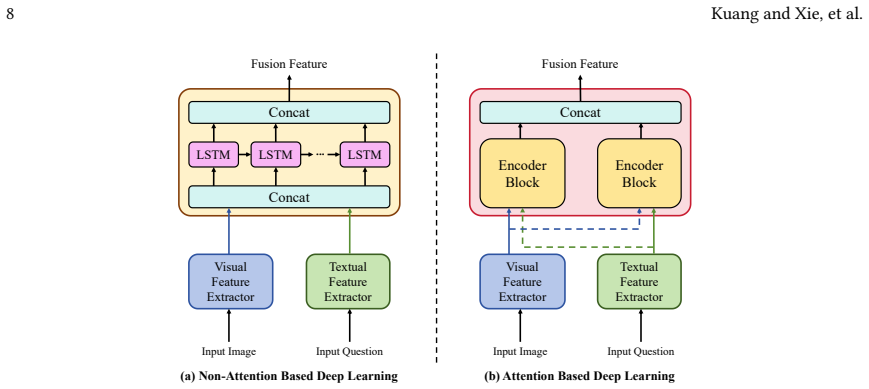
The paper's central claim is that VQA is best understood through one taxonomy: natural language understanding of images and text on the perception side, and natural language inference on the cognition side, with multimodal large language models as the newest stage of both. On the understanding side, the survey traces visual and textual feature extraction, embedding improvements, fusion by vector operations, attention and graph neural networks, and dual-stream versus single-stream pretraining. On the inference side, it distinguishes internal from external knowledge, entity-based from feature-based extraction, and conventional, one-hop, and multi-hop reasoning, including memory-based, graph-based, and implicit methods. The same taxonomy then places current MLLM techniques—instruction tuning, in-context learning, multimodal chain-of-thought, and tool-aided reasoning—as the latest answer to both perceptual and cognitive demands, with datasets and benchmarks as the evaluation layer.
Load-bearing premise
The survey's usefulness depends on the assumption that its bibliography and performance tables accurately represent the state of the field; if many listed references are irrelevant or its score comparisons mix incompatible test conditions, the claimed up-to-date synthesis is not established.
Editorial extensions
If this is right
- If the taxonomy is right, the historical VQA pipeline of separate visual and textual feature extractors is being absorbed into image-to-text alignment modules inside MLLMs, so fusion research has largely shifted to alignment architecture.
- On this account, knowledge-based VQA has two live routes—internal knowledge already stored in model parameters and external knowledge retrieved from knowledge bases or passages—and multi-hop reasoning is where most of the remaining difficulty lies.
- The survey's reading implies that MLLM benchmarks such as MME, SEED-Bench, and MathVista are becoming the de facto evaluation layer for VQA, testing perception, reasoning, hallucination, and specialized domains at once.
- If the stated open problems are taken seriously, the next round of VQA progress will need indirect visual information, dataset-debiasing, explainable answers, and generative rather than selection-based answer production.
Reading between the lines
- Editorial inference: if the perception/inference split is right, a testable prediction is that gains from new MLLMs on external-knowledge benchmarks will come more from better retrieval and tool use than from larger parameter counts, since the survey groups knowledge access separately from raw comprehension.
- Editorial inference: the taxonomy implies that classic VQA datasets will increasingly be treated as sub-benchmarks inside general MLLM evaluations, which may make benchmark-specific leaderboards less informative over time.
- Editorial inference: the survey's treatment of chain-of-thought and tool-aided reasoning suggests that reasoning in VQA may fragment into distinct skills such as symbolic, temporal, spatial, and commonsense reasoning, each needing its own evaluation rather than a single accuracy number.
Signed reviews
Editorial analysis
A structured set of objections, weighed in public.
Referee Report
Summary. The paper is a survey of Visual Question Answering (VQA), organized around a taxonomy of natural-language understanding of images and text and of natural-language inference/knowledge reasoning. It reviews feature extraction, fusion mechanisms, vision-language pretraining, multimodal large language models, knowledge sources and reasoning, datasets, evaluation metrics, and open challenges. The abstract claims to provide an up-to-date synthesis of VQA with particular attention to MLLMs. The presentation includes several large tables summarizing models, datasets, and comparative performance, along with figures and equations taken from or inspired by prior work.
Significance. If accurate, the survey could serve as a broad reference for VQA, especially for readers seeking a single entry point to the transition from conventional models to MLLMs and to knowledge-based reasoning. The proposed taxonomy in Fig. 2 and the coverage of recent MLLM techniques (Sections 3 and 4.4) are potentially useful organizing contributions. The paper also explicitly claims timeliness and exhaustiveness, which raises the bar for factual reliability. On the current submission, however, the central value of the survey is undermined by a contaminated bibliography, missing appendices referenced in the body, and comparative tables that mix incompatible evaluation protocols. These issues must be addressed before the survey can be used as a reference.
major comments (4)
- [Table 6 (Sec. 5.4)] The comparative performance table mixes fundamentally different evaluation settings without adequate qualification. VQAv2 rows include test-std results for models evaluated in zero-shot, few-shot, and fine-tuned settings; GQA rows separately list test-dev, Test2019, Test2020, and Test2021 without noting that these are different test splits; and VizWiz rows mix zero-shot and few-shot results across different dataset versions. The surrounding text only states that 'variation in experimental configurations' can lead to 'substantial diminution in performance' but does not tell the reader which numbers are directly comparable. As it stands, a reader cannot verify or use the comparative claims without returning to each original paper. The table should either be split by protocol and split, with the shot setting and dataset version stated per row, or removed.
- [References (whole bibliography)] The reference list contains many entries that are unrelated to VQA and never cited in the body, including the Clifford algebra package [5], the amsthm package [16], wireless sensor network surveys [10, 76], and ACM template artifacts such as [98], [99], [103], and [420]. There are also duplicate entries ([45]/[46], [68]/[69], [72]/[73], [436]/[437]) and near-identical repeated entries for the same work ([205]-[211]). This demonstrates that the bibliography was not systematically checked against the manuscript. Because a survey's value rests on its sourcing, the entire reference list needs to be reconstructed from the in-text citations, with each entry verified against the original source, and all irrelevant, duplicate, and template entries removed.
- [Appendices (Secs. 2.1.3, 2.2.3, 4.1, 4.2.2, 5.1, 5.3)] The body text repeatedly refers to appendices that are not present in the submission: Appendix A for embedding improvements, Appendix B for vision-language pretraining variants, Appendix C for knowledge sources, Appendix D for knowledge extraction, Appendix E for additional datasets, and Appendix F for additional metrics. For example, Sec. 2.1.3 says 'We give the detailed improvement methods in Appendix. A,' but no appendix follows. A survey that promises these details in the body is incomplete without them. Either include the appendices in the submission or remove all references to them and fold the necessary content into the main text.
- [Table 3 and Sec. 3.3.3] The table and surrounding text contain factual errors that undermine the paper's claim of providing reliable information about latest models. The model name 'mOLUG-owl2' in Table 3 should be 'mPLUG-OWL2'; the text in Sec. 3.3.3 refers to 'Genimi' instead of 'Gemini'; the LLaVA-1.5 row reports 78.5 on VQAv2 as 'few-shot,' which is misleading because LLaVA-1.5 is a fine-tuned model, not a few-shot method; and the InternVL2 row in Table 3 has blank performance entries, so the row provides no information. Every entry in Table 3 should be checked against the cited papers, and the text should be corrected accordingly.
minor comments (5)
- [Throughout] There are many typographical and spelling errors that should be corrected in copyediting: 'Accuruacy' in the Table 6 header, 'Knowldege' in Sec. 4.1, 'extrctor' in Sec. 2.1.2, 'applys' in Sec. 2.1.1, 'avarage' and 'Imgae' in Table 5, and 'breif' in Sec. 5.3.2.
- [Sec. 2.1.1] The description of VGG-Net is imprecise: 'VGG-Net increases the convolutional layers to 19' is only one configuration; VGG-16 is equally common. The phrase about ResNet 'weakening strong connections' is unclear and should be rewritten.
- [Sec. 2.2.2, Eq. (5)] The variables in Eq. (5) do not match the prose: the text says that textual tokens {x'_Q_i} are aligned with visual objects {x'_S_i}, but the same index i appears in both sequences. The equation should use different indices (e.g., i for the question node and j for the scene-graph node) so that the alignment is well defined.
- [Sec. 3.3.3] The sentence 'which has proven especially effective in sophisticated tasks like math reasoning' is a sentence fragment and the connection to InternVL is unclear; it should be rewritten as a complete sentence or merged with the preceding claim.
- [Table 2] The table lists 'AMN 2020 VGG-Net Word2Vec Attention MovieQA' but the year and architecture for AMN are not supported by the citation in the text; please verify the entry against the cited paper and correct the row or remove it.
Circularity Check
No load-bearing circularity: the survey summarizes external work, and the bibliography/table integrity issues are correctness risks, not circularity.
full rationale
This paper is a literature survey rather than a derivation or prediction paper, so the circularity patterns that apply to fitted-parameter or self-citation-driven arguments do not arise here. The survey's taxonomy, model descriptions, and comparative tables are summaries of externally published work, and the paper makes no claim to derive a new result from inputs it defines. The corresponding author's group appears among the references (e.g., [32] in the evaluation-metrics discussion, [256] in the document-image limitation discussion, and [372] in the knowledge-reasoning introduction), but these citations are illustrative or contextual, not load-bearing: none of them defines the survey's categories, none is invoked as a uniqueness theorem, and none forces the paper's organization or conclusions. The serious problems identified by the reader—unrelated template entries in the bibliography, duplicate references, and Table 6 mixing different evaluation splits and zero-shot/few-shot settings—are genuine correctness and verifiability concerns, but they do not make the survey's central claim equivalent to its own inputs by construction. No equation in the paper is claimed as a prediction that reduces to a fit, and no self-citation chain is used to exclude alternatives. Accordingly, the circularity score is 0, with the caveat that the unsupported bibliography and inconsistent performance table should be weighed as correctness risk rather than circularity.
Assumptions & free parameters
assumptions (2)
- domain assumption The cited references exist and support the statements attributed to them.
- domain assumption The taxonomy in Figure 2 is a faithful representation of the VQA literature.
Cite this review
Pith. "Pith review of Natural Language Understanding and Inference with MLLM in Visual Question Answering: A Survey." pith.science (2026). https://pith.science/paper/I5OBOOBF
@misc{pith2026241117558,
  author       = {Pith},
  title        = {Pith review of: Natural Language Understanding and Inference with MLLM in Visual Question Answering: A Survey},
  year         = {2026},
  howpublished = {\url{https://pith.science/paper/I5OBOOBF}},
  note         = {Machine review of arXiv:2411.17558}
}
read the original abstract
Visual Question Answering (VQA) is a challenge task that combines natural language processing and computer vision techniques and gradually becomes a benchmark test task in multimodal large language models (MLLMs). The goal of our survey is to provide an overview of the development of VQA and a detailed description of the latest models with high timeliness. This survey gives an up-to-date synthesis of natural language understanding of images and text, as well as the knowledge reasoning module based on image-question information on the core VQA tasks. In addition, we elaborate on recent advances in extracting and fusing modal information with vision-language pretraining models and multimodal large language models in VQA. We also exhaustively review the progress of knowledge reasoning in VQA by detailing the extraction of internal knowledge and the introduction of external knowledge. Finally, we present the datasets of VQA and different evaluation metrics and discuss possible directions for future work.
Figures


Figures from the paper (6 more)


Forward citations
Cited by 1 Pith paper
-
Refine Knowledge of Large Language Models via Adaptive Contrastive Learning
An adaptive contrastive learning strategy that uses a model's own sampled response accuracy to create per-region positive and negative training pairs improves LLM truthful rate by up to 6.9% over IDK-SFT.
Reference graph
Works this paper leans on
-
[5]
Clifford: a maple 11 package for clifford algebra computations, version 11, 2007
Rafal Ablamowicz and Bertfried Fauser. Clifford: a maple 11 package for clifford algebra computations, version 11, 2007. URL http://math.tntech. edu/rafal/cliff11/index.html
2007
-
[16]
American Mathematical Society, April 2015
Using the amsthm Package . American Mathematical Society, April 2015. http://www.ctan.org/pkg/amsthm
2015
-
[99]
The title of book two , chapter 100
Ian Editor, editor. The title of book two , chapter 100. The name of the series two. University of Chicago Press, Chicago, 2nd. edition, 2008. doi: 10.1007/3-540-09237-4. URL http://dx.doi.org/10.1007/3-540-09456-9
-
[103]
Publication quality tables in LATEX, April 2005
Simon Fear. Publication quality tables in LATEX, April 2005. http://www.ctan.org/pkg/booktabs
2005
-
[46]
Buss, Arnold L
Jonathan F. Buss, Arnold L. Rosenberg, and Judson D. Knott. Vertex types in book-embeddings. Technical report, Amherst, MA, USA, 1987
1987
-
[68]
Clarkson
Kenneth L. Clarkson. Algorithms for Closest-Point Problems (Computational Geometry) . PhD thesis, Stanford University, Palo Alto, CA, 1985. UMI Order Number: AAT 8506171
1985
-
[69]
Algorithms for Closest-Point Problems (Computational Geometry)
Kenneth Lee Clarkson. Algorithms for Closest-Point Problems (Computational Geometry) . PhD thesis, Stanford University, Stanford, CA, USA, 1985. AAT 8506171
1985
-
[72]
Mauro Conti, Roberto Di Pietro, Luigi V. Mancini, and Alessandro Mei. (old) distributed data source verification in wireless sensor networks. Inf. Fusion, 10(4):342–353, 2009. ISSN 1566-2535. doi: http://dx.doi.org/10.1016/j.inffus.2009.01.002
-
[73]
Mauro Conti, Roberto Di Pietro, Luigi V. Mancini, and Alessandro Mei. (new) distributed data source verification in wireless sensor networks. Inf. Fusion, 10(4):342–353, October 2009. ISSN 1566-2535. doi: 10.1016/j.inffus.2009.01.002. URL http://portal.acm.org/citation.cfm?id=1555009.1555162
-
[211]
E-commerce and cultural values (Inbook-num chap) , chapter (in type field) 22, pages 51–74
Wei-Chang Kong. E-commerce and cultural values (Inbook-num chap) , chapter (in type field) 22, pages 51–74. IGI Publishing, Hershey, PA, USA,
Show all 290 references
-
[1]
SIGCOMM Comput. Commun. Rev., 13-14(5-1), 1984. ISSN 0146-4833
1984
-
[2]
CHI ’08: CHI ’08 extended abstracts on Human factors in computing systems , New York, NY, USA, 2008. ACM. ISBN 978-1-60558-012-X. General Chair-Czerwinski, Mary and General Chair-Lund, Arnie and Program Chair-Tan, Desney
2008
-
[3]
Vqa-med: Overview of the medical visual question answering task at imageclef 2019
Asma Ben Abacha, Sadid A Hasan, Vivek V Datla, Joey Liu, Dina Demner-Fushman, and Henning Müller. Vqa-med: Overview of the medical visual question answering task at imageclef 2019. CLEF (Working Notes), 2(6), 2019
2019
-
[4]
Multimodal categorization of crisis events in social media
Mahdi Abavisani, Liwei Wu, Shengli Hu, Joel Tetreault, and Alejandro Jaimes. Multimodal categorization of crisis events in social media. In Proceedings of the IEEE/CVF Conference on Computer Vision and Pattern Recognition , pages 14679–14689, 2020
2020
-
[6]
Abril and Robert Plant
Patricia S. Abril and Robert Plant. The patent holder’s dilemma: Buy, sell, or troll? Communications of the ACM, 50(1):36–44, January 2007. doi: 10.1145/1188913.1188915. URL http://doi.acm.org/10.1145/1219092.1219093
2007
-
[7]
A. Adya, P. Bahl, J. Padhye, A.Wolman, and L. Zhou. A multi-radio unification protocol for IEEE 802.11 wireless networks. In Proceedings of the IEEE 1st International Conference on Broadnets Networks (BroadNets’04) , pages 210–217, Los Alamitos, CA, 2004. IEEE
2004
-
[8]
Lrs3-ted: a large-scale dataset for visual speech recognition
Triantafyllos Afouras, Joon Son Chung, and Andrew Zisserman. Lrs3-ted: a large-scale dataset for visual speech recognition. arXiv preprint arXiv:1809.00496, 2018
2018 arXiv
-
[9]
Don’t just assume; look and answer: Overcoming priors for visual question answering
Aishwarya Agrawal, Dhruv Batra, Devi Parikh, and Aniruddha Kembhavi. Don’t just assume; look and answer: Overcoming priors for visual question answering. In Proceedings of the IEEE conference on computer vision and pattern recognition , pages 4971–4980, 2018
2018
-
[10]
I. F. Akyildiz, W. Su, Y. Sankarasubramaniam, and E. Cayirci. Wireless sensor networks: A survey. Comm. ACM, 38(4):393–422, 2002
2002
-
[11]
I. F. Akyildiz, T. Melodia, and K. R. Chowdhury. A survey on wireless multimedia sensor networks. Computer Netw., 51(4):921–960, 2007
2007
-
[12]
Crisismmd: Multimodal twitter datasets from natural disasters
Firoj Alam, Ferda Ofli, and Muhammad Imran. Crisismmd: Multimodal twitter datasets from natural disasters. In Twelfth international AAAI conference on web and social media , 2018
2018
-
[13]
Automatic ontology-based knowledge extraction from web documents
Harith Alani, Sanghee Kim, David E Millard, Mark J Weal, Wendy Hall, Paul H Lewis, and Nigel R Shadbolt. Automatic ontology-based knowledge extraction from web documents. IEEE Intelligent Systems, 18(1):14–21, 2003
2003
-
[14]
Flamingo: a visual language model for few-shot learning
Jean-Baptiste Alayrac, Jeff Donahue, Pauline Luc, Antoine Miech, Iain Barr, Yana Hasson, Karel Lenc, Arthur Mensch, Katherine Millican, Malcolm Reynolds, et al. Flamingo: a visual language model for few-shot learning. Advances in neural information processing systems , 35:2371...
2022
-
[15]
Fusion of detected objects in text for visual question answering
Chris Alberti, Jeffrey Ling, Michael Collins, and David Reitter. Fusion of detected objects in text for visual question answering. In Proceedings of the 2019 Conference on Empirical Methods in Natural Language Processing and the 9th International Joint Conference on Natural La...
2019
-
[17]
Bottom-up and top-down attention for image captioning and visual question answering
Peter Anderson, Xiaodong He, Chris Buehler, Damien Teney, Mark Johnson, Stephen Gould, and Lei Zhang. Bottom-up and top-down attention for image captioning and visual question answering. In Proceedings of the IEEE conference on computer vision and pattern recognition , pages 6...
2018
-
[18]
Predicate path expressions
Sten Andler. Predicate path expressions. In Proceedings of the 6th. ACM SIGACT-SIGPLAN symposium on Principles of Programming Languages , POPL ’79, pages 226–236, New York, NY, 1979. ACM Press. doi: 10.1145/567752.567774. URL http://doi.acm.org/10.1145/567752.567774. Manuscrip...
1979
-
[19]
Andreas, M
J. Andreas, M. Rohrbach, T. Darrell, and K. Dan. Deep compositional question answering with neural module networks. Computer Science, 27: 55–56, 2015
2015
-
[20]
Learning to compose neural networks for question answering
Jacob Andreas, Marcus Rohrbach, Trevor Darrell, and Dan Klein. Learning to compose neural networks for question answering. In Proceedings of the 2016 Conference of the North American Chapter of the Association for Computational Linguistics: Human Language Technologies , pages ...
2016 doi
-
[21]
Neural module networks
Jacob Andreas, Marcus Rohrbach, Trevor Darrell, and Dan Klein. Neural module networks. In Proceedings of the IEEE conference on computer vision and pattern recognition, pages 39–48, 2016
2016
-
[22]
David A. Anisi. Optimal motion control of a ground vehicle. Master’s thesis, Royal Institute of Technology (KTH), Stockholm, Sweden, 2003
2003
-
[23]
Vqa: Visual question answering
Stanislaw Antol, Aishwarya Agrawal, Jiasen Lu, Margaret Mitchell, Dhruv Batra, C Lawrence Zitnick, and Devi Parikh. Vqa: Visual question answering. In Proceedings of the IEEE international conference on computer vision , pages 2425–2433, 2015
2015
-
[24]
UMass citation field extraction dataset, 2013
Sam Anzaroot and Andrew McCallum. UMass citation field extraction dataset, 2013. URL http://www.iesl.cs.umass.edu/data/data-umasscitationfield
2013
-
[25]
Learning soft linear constraints with application to citation field extraction, 2014
Sam Anzaroot, Alexandre Passos, David Belanger, and Andrew McCallum. Learning soft linear constraints with application to citation field extraction, 2014
2014
-
[26]
J. E. Archer, Jr., R. Conway, and F. B. Schneider. User recovery and reversal in interactive systems.ACM Trans. Program. Lang. Syst., 6(1):1–19, January 1984
1984
-
[27]
Dbpedia: A nucleus for a web of open data
Sören Auer, Christian Bizer, Georgi Kobilarov, Jens Lehmann, Richard Cyganiak, and Zachary Ives. Dbpedia: A nucleus for a web of open data. In The semantic web, pages 722–735. Springer, 2007
2007
-
[28]
Unsupervised speech recognition
Alexei Baevski, Wei-Ning Hsu, Alexis Conneau, and Michael Auli. Unsupervised speech recognition. Advances in Neural Information Processing Systems, 34:27826–27839, 2021
2021
-
[29]
Multimodal language analysis in the wild: CMU- MOSEI dataset and interpretable dynamic fusion graph
AmirAli Bagher Zadeh, Paul Pu Liang, Soujanya Poria, Erik Cambria, and Louis-Philippe Morency. Multimodal language analysis in the wild: CMU- MOSEI dataset and interpretable dynamic fusion graph. In Proceedings of the 56th Annual Meeting of the Association for Computational Li...
2018 doi
-
[30]
P. Bahl, R. Chancre, and J. Dungeon. SSCH: Slotted seeded channel hopping for capacity improvement in IEEE 802.11 ad-hoc wireless networks. In Proceeding of the 10th International Conference on Mobile Computing and Networking (MobiCom’04) , pages 112–117, New York, NY, 2004. ACM
2004
-
[31]
Qwen-vl: A versatile vision-language model for understanding, localization, text reading, and beyond
Jinze Bai, Shuai Bai, Shusheng Yang, Shijie Wang, Sinan Tan, Peng Wang, Junyang Lin, Chang Zhou, and Jingren Zhou. Qwen-vl: A versatile vision-language model for understanding, localization, text reading, and beyond. arXiv preprint arXiv:2308.12966, 2023
2023 arXiv
-
[32]
Infobox-to-text generation with tree-like planning based attention network
Yang Bai, Ziran Li, Ning Ding, Ying Shen, and Hai-Tao Zheng. Infobox-to-text generation with tree-like planning based attention network. In Proceedings of the Twenty-Ninth International Conference on International Joint Conferences on Artificial Intelligence , pages 3773–3779, 2021
2021
-
[33]
Multimodal machine learning: A survey and taxonomy
Tadas Baltrušaitis, Chaitanya Ahuja, and Louis-Philippe Morency. Multimodal machine learning: A survey and taxonomy. IEEE transactions on pattern analysis and machine intelligence , 41(2):423–443, 2018
2018
-
[34]
Meteor: An automatic metric for mt evaluation with improved correlation with human judgments
Satanjeev Banerjee and Alon Lavie. Meteor: An automatic metric for mt evaluation with improved correlation with human judgments. In Proceedings of the acl workshop on intrinsic and extrinsic evaluation measures for machine translation and/or summarization , pages 65–72, 2005
2005
-
[35]
Visual question answering: Which investigated applications? Pattern Recogn
Silvio Barra, Carmen Bisogni, Maria De Marsico, and Stefano Ricciardi. Visual question answering: Which investigated applications? Pattern Recogn. Lett., 151(C):325–331, nov 2021. ISSN 0167-8655
2021
-
[36]
Target detection and localization using mimo radars and sonars
Ilya Bekkerman and Joseph Tabrikian. Target detection and localization using mimo radars and sonars. IEEE Transactions on Signal Processing , 54 (10):3873–3883, 2006
2006
-
[37]
Mutan: Multimodal tucker fusion for visual question answering
Hedi Ben-Younes, Rémi Cadene, Matthieu Cord, and Nicolas Thome. Mutan: Multimodal tucker fusion for visual question answering. InProceedings of the IEEE international conference on computer vision , pages 2612–2620, 2017
2017
-
[38]
Noise reduction in speech processing , volume 2
Jacob Benesty, Jingdong Chen, Yiteng Huang, and Israel Cohen. Noise reduction in speech processing , volume 2. Springer Science & Business Media, 2009
2009
-
[39]
Translating embeddings for modeling multi- relational data
Antoine Bordes, Nicolas Usunier, Alberto Garcia-Duran, Jason Weston, and Oksana Yakhnenko. Translating embeddings for modeling multi- relational data. Advances in neural information processing systems , 26, 2013
2013
-
[40]
Brad Wray, and Robin Haunschild
Lutz Bornmann, K. Brad Wray, and Robin Haunschild. Citation concept analysis (CCA)—a new form of citation analysis revealing the usefulness of concepts for other researchers illustrated by two exemplary case studies including classic books by Thomas S. Kuhn and Karl R. Popper,...
2019
-
[41]
Debray, and Larry L
Mic Bowman, Saumya K. Debray, and Larry L. Peterson. Reasoning about naming systems. ACM Trans. Program. Lang. Syst. , 15(5):795–825, November 1993. doi: 10.1145/161468.161471
1993
-
[42]
Babel, a multilingual style-option system for use with latex’s standard document styles
Johannes Braams. Babel, a multilingual style-option system for use with latex’s standard document styles. TUGboat, 12(2):291–301, June 1991
1991
-
[43]
A statistical approach to machine translation
Peter F Brown, John Cocke, Stephen A Della Pietra, Vincent J Della Pietra, Frederick Jelinek, John Lafferty, Robert L Mercer, and Paul S Roossin. A statistical approach to machine translation. Computational linguistics, 16(2):79–85, 1990
1990
-
[44]
Tom B. Brown, Benjamin Mann, Nick Ryder, Melanie Subbiah, Jared Kaplan, Prafulla Dhariwal, Arvind Neelakantan, Pranav Shyam, Girish Sastry, Amanda Askell, Sandhini Agarwal, Ariel Herbert-Voss, Gretchen Krueger, Tom Henighan, Rewon Child, Aditya Ramesh, Daniel M. Ziegler, Jeffr...
2020
-
[47]
Benchlmm: Benchmarking cross-style visual capability of large multimodal models
Rizhao Cai, Zirui Song, Dayan Guan, Zhenhao Chen, Xing Luo, Chenyu Yi, and Alex Kot. Benchlmm: Benchmarking cross-style visual capability of large multimodal models. arXiv preprint arXiv:2312.02896, 2023
2023 arXiv
-
[48]
Recognition of human body motion using phase space constraints
Lee W Campbell and Aaron F Bobick. Recognition of human body motion using phase space constraints. In Proceedings of IEEE international conference on computer vision , pages 624–630. IEEE, 1995
1995
-
[49]
Bilateral cross-modality graph matching attention for feature fusion in visual question answering
Jianjian Cao, Xiameng Qin, Sanyuan Zhao, and Jianbing Shen. Bilateral cross-modality graph matching attention for feature fusion in visual question answering. IEEE Transactions on Neural Networks and Learning Systems , 2022
2022
-
[50]
Knowledge-routed visual question reasoning: Challenges for deep representation embedding
Qingxing Cao, Bailin Li, Xiaodan Liang, Keze Wang, and Liang Lin. Knowledge-routed visual question reasoning: Challenges for deep representation embedding. IEEE Transactions on Neural Networks and Learning Systems , 2021
2021
-
[51]
New paradigm for imaging systems
W Thomas Cathey and Edward R Dowski. New paradigm for imaging systems. Applied optics, 41(29):6080–6092, 2002
2002
-
[52]
Evaluation of text generation: A survey
Asli Celikyilmaz, Elizabeth Clark, and Jianfeng Gao. Evaluation of text generation: A survey. arXiv preprint arXiv:2006.14799, 2020
2006 arXiv
-
[53]
Learning question-guided video representation for multi-turn video question answering
Guan-Lin Chao, Abhinav Rastogi, Semih Yavuz, Dilek Hakkani-Tür, Jindong Chen, and Ian Lane. Learning question-guided video representation for multi-turn video question answering. arXiv preprint arXiv:1907.13280, 2019
1907 arXiv
-
[54]
X-llm: Bootstrapping advanced large language models by treating multi-modalities as foreign languages
Feilong Chen, Minglun Han, Haozhi Zhao, Qingyang Zhang, Jing Shi, Shuang Xu, and Bo Xu. X-llm: Bootstrapping advanced large language models by treating multi-modalities as foreign languages. arXiv preprint arXiv:2305.04160, 2023
2023 arXiv
-
[55]
Abc-cnn: An attention based convolutional neural network for visual question answering
Kan Chen, Jiang Wang, Liang-Chieh Chen, Haoyuan Gao, Wei Xu, and Ram Nevatia. Abc-cnn: An attention based convolutional neural network for visual question answering. arXiv preprint arXiv:1511.05960, 2015
2015 arXiv
-
[56]
Shikra: Unleashing multimodal llm’s referential dialogue magic
Keqin Chen, Zhao Zhang, Weili Zeng, Richong Zhang, Feng Zhu, and Rui Zhao. Shikra: Unleashing multimodal llm’s referential dialogue magic. arXiv preprint arXiv:2306.15195, 2023
2023 arXiv
-
[57]
Pali: A jointly-scaled multilingual language-image model
Xi Chen, Xiao Wang, Soravit Changpinyo, AJ Piergiovanni, Piotr Padlewski, Daniel Salz, Sebastian Goodman, Adam Grycner, Basil Mustafa, Lucas Beyer, et al. Pali: A jointly-scaled multilingual language-image model. arXiv preprint arXiv:2209.06794, 2022
2022 arXiv
-
[58]
Pali-3 vision language models: Smaller, faster, stronger, 2023
Xi Chen, Xiao Wang, Lucas Beyer, Alexander Kolesnikov, Jialin Wu, Paul Voigtlaender, Basil Mustafa, Sebastian Goodman, Ibrahim Alabdulmohsin, Piotr Padlewski, Daniel Salz, Xi Xiong, Daniel Vlasic, Filip Pavetic, Keran Rong, Tianli Yu, Daniel Keysers, Xiaohua Zhai, and Radu Sor...
2023
-
[59]
A review: Knowledge reasoning over knowledge graph
Xiaojun Chen, Shengbin Jia, and Yang Xiang. A review: Knowledge reasoning over knowledge graph. Expert Systems with Applications, 141:112948, 2020
2020
-
[60]
Uniter: Universal image-text representation learning
Yen-Chun Chen, Linjie Li, Licheng Yu, Ahmed El Kholy, Faisal Ahmed, Zhe Gan, Yu Cheng, and Jingjing Liu. Uniter: Universal image-text representation learning. In European conference on computer vision , pages 104–120. Springer, 2020
2020
-
[61]
How far are we to gpt-4v? closing the gap to commercial multimodal models with open-source suites
Zhe Chen, Weiyun Wang, Hao Tian, Shenglong Ye, Zhangwei Gao, Erfei Cui, Wenwen Tong, Kongzhi Hu, Jiapeng Luo, Zheng Ma, et al. How far are we to gpt-4v? closing the gap to commercial multimodal models with open-source suites. arXiv preprint arXiv:2404.16821, 2024
2024 arXiv
-
[62]
Internvl: Scaling up vision foundation models and aligning for generic visual-linguistic tasks
Zhe Chen, Jiannan Wu, Wenhai Wang, Weijie Su, Guo Chen, Sen Xing, Muyan Zhong, Qinglong Zhang, Xizhou Zhu, Lewei Lu, et al. Internvl: Scaling up vision foundation models and aligning for generic visual-linguistic tasks. In Proceedings of the IEEE/CVF Conference on Computer Vis...
2024
-
[63]
Zero-shot visual question answering using knowledge graph
Zhuo Chen, Jiaoyan Chen, Yuxia Geng, Jeff Z Pan, Zonggang Yuan, and Huajun Chen. Zero-shot visual question answering using knowledge graph. In International Semantic Web Conference, pages 146–162. Springer, 2021
2021
-
[64]
Color image segmentation: advances and prospects.Pattern recognition, 34(12):2259–2281, 2001
Heng-Da Cheng, X_ H_ Jiang, Ying Sun, and Jingli Wang. Color image segmentation: advances and prospects.Pattern recognition, 34(12):2259–2281, 2001
2001
-
[65]
Learning phrase representations using rnn encoder-decoder for statistical machine translation
Kyunghyun Cho, Bart Van Merriënboer, Caglar Gulcehre, Dzmitry Bahdanau, Fethi Bougares, Holger Schwenk, and Yoshua Bengio. Learning phrase representations using rnn encoder-decoder for statistical machine translation. arXiv preprint arXiv:1406.1078, 2014
2014 arXiv
-
[66]
Attention-based models for speech recognition
Jan K Chorowski, Dzmitry Bahdanau, Dmitriy Serdyuk, Kyunghyun Cho, and Yoshua Bengio. Attention-based models for speech recognition. Advances in neural information processing systems , 28, 2015
2015
-
[67]
Post congress tristesse
Malcolm Clark. Post congress tristesse. In TeX90 Conference Proceedings, pages 84–89. TeX Users Group, March 1991
1991
-
[70]
Special issue: Digital libraries, November 1996
Cohen. Special issue: Digital libraries, November 1996
1996
-
[71]
Deciding equivalances among conjunctive aggregate queries
Sarah Cohen, Werner Nutt, and Yehoshua Sagic. Deciding equivalances among conjunctive aggregate queries. J. ACM, 54(2), April 2007. doi: 10.1145/1219092.1219093. URL http://doi.acm.org/10.1145/1219092.1219093
2007
-
[74]
XBOW sensor motes specifications, 2008
CROSSBOW. XBOW sensor motes specifications, 2008. http://www.xbow.com. Manuscript submitted to ACM Natural Language Understanding and Inference with MLLM in Visual Question Answering: A Survey 31
2008
-
[75]
Holistic analysis of hallucination in gpt-4v (ision): Bias and interference challenges
Chenhang Cui, Yiyang Zhou, Xinyu Yang, Shirley Wu, Linjun Zhang, James Zou, and Huaxiu Yao. Holistic analysis of hallucination in gpt-4v (ision): Bias and interference challenges. arXiv preprint arXiv:2311.03287, 2023
2023 arXiv
-
[76]
Culler, D
D. Culler, D. Estrin, and M. Srivastava. Overview of sensor networks. IEEE Comput., 37(8 (Special Issue on Sensor Networks)):41–49, 2004
2004
-
[77]
Wenliang Dai, Junnan Li, Dongxu Li, Anthony Meng Huat Tiong, Junqi Zhao, Weisheng Wang, Boyang Li, Pascale Fung, and Steven C. H. Hoi. Instructblip: Towards general-purpose vision-language models with instruction tuning. In Alice Oh, Tristan Naumann, Amir Globerson, Kate Saenk...
2023
-
[78]
What is a knowledge representation? AI magazine, 14(1):17–17, 1993
Randall Davis, Howard Shrobe, and Peter Szolovits. What is a knowledge representation? AI magazine, 14(1):17–17, 1993
1993
-
[79]
Visual question answering: A survey on techniques and common trends in recent literature
Ana Claudia Akemi Matsuki de Faria, Felype de Castro Bastos, Jose Victor Nogueira Alves da Silva, Vitor Lopes Fabris, Valeska de Sousa Uchoa, Décio Gonçalves de Aguiar Neto, and Claudio Filipi Goncalves dos Santos. Visual question answering: A survey on techniques and common t...
2023 arXiv
-
[80]
The mathematics of statistical machine translation: Parameter estimation
Vincent J Della Pietra. The mathematics of statistical machine translation: Parameter estimation. Using Large Corpora, page 223, 1994
1994
-
[81]
Imagenet: A large-scale hierarchical image database
Jia Deng, Wei Dong, Richard Socher, Li-Jia Li, Kai Li, and Li Fei-Fei. Imagenet: A large-scale hierarchical image database. In 2009 IEEE conference on computer vision and pattern recognition , pages 248–255. Ieee, 2009
2009
-
[82]
Joint learning of answer selection and answer summary generation in community question answering
Yang Deng, Wai Lam, Yuexiang Xie, Daoyuan Chen, Yaliang Li, Min Yang, and Ying Shen. Joint learning of answer selection and answer summary generation in community question answering. In Proceedings of the AAAI Conference on Artificial Intelligence , volume 34, pages 7651–7658, 2020
2020
-
[83]
Bridging hierarchical and sequential context modeling for question- driven extractive answer summarization
Yang Deng, Wenxuan Zhang, Yaliang Li, Min Yang, Wai Lam, and Ying Shen. Bridging hierarchical and sequential context modeling for question- driven extractive answer summarization. In Proceedings of the 43rd International ACM SIGIR Conference on Research and Development in Info...
2020
-
[84]
Qlora: Efficient finetuning of quantized llms
Tim Dettmers, Artidoro Pagnoni, Ari Holtzman, and Luke Zettlemoyer. Qlora: Efficient finetuning of quantized llms. In A. Oh, T. Neumann, A. Globerson, K. Saenko, M. Hardt, and S. Levine, editors, Advances in Neural Information Processing Systems , volume 36, pages 10088–10115....
2023
-
[85]
Bert: Pre-training of deep bidirectional transformers for language understanding
Jacob Devlin, Ming-Wei Chang, Kenton Lee, and Kristina Toutanova. Bert: Pre-training of deep bidirectional transformers for language understanding. arXiv preprint arXiv:1810.04805, 2018
2018 arXiv
-
[86]
Dijkstra
E. Dijkstra. Go to statement considered harmful. In Classics in software engineering (incoll) , pages 27–33. Yourdon Press, Upper Saddle River, NJ, USA, 1979. ISBN 0-917072-14-6. URL http://portal.acm.org/citation.cfm?id=1241515.1241518
1979
-
[87]
Mukea: Multimodal knowledge extraction and accumulation for knowledge-based visual question answering
Yang Ding, Jing Yu, Bang Liu, Yue Hu, Mingxin Cui, and Qi Wu. Mukea: Multimodal knowledge extraction and accumulation for knowledge-based visual question answering. In Proceedings of the IEEE/CVF Conference on Computer Vision and Pattern Recognition , pages 5089–5098, 2022
2022
-
[88]
Vqa: A new dataset for real-world vqa on pdf documents
Yihao Ding, Siwen Luo, Hyunsuk Chung, and Soyeon Caren Han. Vqa: A new dataset for real-world vqa on pdf documents. In Joint European Conference on Machine Learning and Knowledge Discovery in Databases , pages 585–601. Springer, 2023
2023
-
[89]
A survey of natural language generation
Chenhe Dong, Yinghui Li, Haifan Gong, Miaoxin Chen, Junxin Li, Ying Shen, and Min Yang. A survey of natural language generation. ACM Comput. Surv., 55(8), dec 2022. ISSN 0360-0300. doi: 10.1145/3554727. URL https://doi.org/10.1145/3554727
2022 doi
-
[90]
A survey for in-context learning
Qingxiu Dong, Lei Li, Damai Dai, Ce Zheng, Zhiyong Wu, Baobao Chang, Xu Sun, Jingjing Xu, Lei Li, and Zhifang Sui. A survey for in-context learning. CoRR
-
[91]
A survey for in-context learning
Qingxiu Dong, Lei Li, Damai Dai, Ce Zheng, Zhiyong Wu, Baobao Chang, Xu Sun, Jingjing Xu, Lei Li, and Zhifang Sui. A survey for in-context learning. CoRR, abs/2301.00234, 2023
2023 arXiv
-
[92]
Knowledge vault: A web-scale approach to probabilistic knowledge fusion
Xin Dong, Evgeniy Gabrilovich, Geremy Heitz, Wilko Horn, Ni Lao, Kevin Murphy, Thomas Strohmann, Shaohua Sun, and Wei Zhang. Knowledge vault: A web-scale approach to probabilistic knowledge fusion. In Proceedings of the 20th ACM SIGKDD international conference on Knowledge dis...
2014
-
[93]
An image is worth 16x16 words: Transformers for image recognition at scale
Alexey Dosovitskiy, Lucas Beyer, Alexander Kolesnikov, Dirk Weissenborn, Xiaohua Zhai, Thomas Unterthiner, Mostafa Dehghani, Matthias Minderer, Georg Heigold, Sylvain Gelly, et al. An image is worth 16x16 words: Transformers for image recognition at scale. arXiv preprint arXiv...
2010 arXiv
-
[94]
An empirical study of training end-to-end vision-and-language transformers
Zi-Yi Dou, Yichong Xu, Zhe Gan, Jianfeng Wang, Shuohang Wang, Lijuan Wang, Chenguang Zhu, Pengchuan Zhang, Lu Yuan, Nanyun Peng, et al. An empirical study of training end-to-end vision-and-language transformers. In Proceedings of the IEEE/CVF Conference on Computer Vision and ...
2022
-
[95]
Douglass, David Harel, and Mark B
Bruce P. Douglass, David Harel, and Mark B. Trakhtenbrot. Statecarts in use: structured analysis and object-orientation. In Grzegorz Rozenberg and Frits W. Vaandrager, editors,Lectures on Embedded Systems , volume 1494 of Lecture Notes in Computer Science , pages 368–394. Spri...
1998 doi
-
[96]
Danny Driess, Fei Xia, Mehdi S. M. Sajjadi, Corey Lynch, Aakanksha Chowdhery, Brian Ichter, Ayzaan Wahid, Jonathan Tompson, Quan Vuong, Tianhe Yu, Wenlong Huang, Yevgen Chebotar, Pierre Sermanet, Daniel Duckworth, Sergey Levine, Vincent Vanhoucke, Karol Hausman, Marc Toussaint...
2023
-
[97]
D. D. Dunlop and V. R. Basili. Generalizing specifications for uniformly implemented loops. ACM Trans. Program. Lang. Syst., 7(1):137–158, January 1985. Manuscript submitted to ACM 32 Kuang and Xie, et al
1985
-
[100]
Survey on speech emotion recognition: Features, classification schemes, and databases
Moataz El Ayadi, Mohamed S Kamel, and Fakhri Karray. Survey on speech emotion recognition: Features, classification schemes, and databases. Pattern recognition, 44(3):572–587, 2011
2011
-
[101]
Every picture tells a story: Generating sentences from images
Ali Farhadi, Mohsen Hejrati, Mohammad Amin Sadeghi, Peter Young, Cyrus Rashtchian, Julia Hockenmaier, and David Forsyth. Every picture tells a story: Generating sentences from images. In European conference on computer vision , pages 15–29. Springer, 2010
2010
-
[102]
Two-frame motion estimation based on polynomial expansion
Gunnar Farnebäck. Two-frame motion estimation based on polynomial expansion. In Scandinavian conference on Image analysis , pages 363–370. Springer, 2003
2003
-
[104]
Mme: A comprehensive evaluation benchmark for multimodal large language models
Chaoyou Fu, Peixian Chen, Yunhang Shen, Yulei Qin, Mengdan Zhang, Xu Lin, Jinrui Yang, Xiawu Zheng, Ke Li, Xing Sun, Yunsheng Wu, and Rongrong Ji. Mme: A comprehensive evaluation benchmark for multimodal large language models. arXiv preprint arXiv:2306.13394, 2023
2023 arXiv
-
[105]
A challenger to gpt-4v? early explorations of gemini in visual expertise
Chaoyou Fu, Renrui Zhang, Haojia Lin, Zihan Wang, Timin Gao, Yongdong Luo, Yubo Huang, Zhengye Zhang, Longtian Qiu, Gaoxiang Ye, et al. A challenger to gpt-4v? early explorations of gemini in visual expertise. arXiv preprint arXiv:2312.12436, 2023
2023 arXiv
-
[107]
Multimodal compact bilinear pooling for visual question answering and visual grounding
Akira Fukui, Dong Huk Park, Daylen Yang, Anna Rohrbach, Trevor Darrell, and Marcus Rohrbach. Multimodal compact bilinear pooling for visual question answering and visual grounding. In Proceedings of the 2016 Conference on Empirical Methods in Natural Language Processing , page...
2016 doi
-
[108]
Large-scale adversarial training for vision-and-language representation learning
Zhe Gan, Yen-Chun Chen, Linjie Li, Chen Zhu, Yu Cheng, and Jingjing Liu. Large-scale adversarial training for vision-and-language representation learning. Advances in Neural Information Processing Systems , 33:6616–6628, 2020
2020
-
[109]
Transform-retrieve-generate: Natural language- centric outside-knowledge visual question answering
Feng Gao, Qing Ping, Govind Thattai, Aishwarya Reganti, Ying Nian Wu, and Prem Natarajan. Transform-retrieve-generate: Natural language- centric outside-knowledge visual question answering. In Proceedings of the IEEE/CVF Conference on Computer Vision and Pattern Recognition , ...
2022
-
[110]
Are you talking to a machine? dataset and methods for multilingual image question
Haoyuan Gao, Junhua Mao, Jie Zhou, Zhiheng Huang, Lei Wang, and Wei Xu. Are you talking to a machine? dataset and methods for multilingual image question. Advances in neural information processing systems , 28, 2015
2015
-
[111]
Lora: A logical reasoning augmented dataset for visual question answering
Jingying Gao, Qi Wu, Alan Blair, and Maurice Pagnucco. Lora: A logical reasoning augmented dataset for visual question answering. Advances in Neural Information Processing Systems , 36, 2024
2024
-
[112]
Motion-appearance co-memory networks for video question answering
Jiyang Gao, Runzhou Ge, Kan Chen, and Ram Nevatia. Motion-appearance co-memory networks for video question answering. In Proceedings of the IEEE Conference on Computer Vision and Pattern Recognition , pages 6576–6585, 2018
2018
-
[113]
Examine before you answer: Multi-task learning with adaptive- attentions for multiple-choice vqa
Lianli Gao, Pengpeng Zeng, Jingkuan Song, Xianglong Liu, and Heng Tao Shen. Examine before you answer: Multi-task learning with adaptive- attentions for multiple-choice vqa. In Proceedings of the 26th ACM international conference on Multimedia , pages 1742–1750, 2018
2018
-
[114]
Structured two-stream attention network for video question answering
Lianli Gao, Pengpeng Zeng, Jingkuan Song, Yuan-Fang Li, Wu Liu, Tao Mei, and Heng Tao Shen. Structured two-stream attention network for video question answering. In Proceedings of the AAAI Conference on Artificial Intelligence , volume 33, pages 6391–6398, 2019
2019
-
[115]
Question-guided hybrid convolution for visual question answering
Peng Gao, Hongsheng Li, Shuang Li, Pan Lu, Yikang Li, Steven CH Hoi, and Xiaogang Wang. Question-guided hybrid convolution for visual question answering. In Proceedings of the European Conference on Computer Vision (ECCV) , pages 469–485, 2018
2018
-
[116]
Dynamic fusion with intra-and inter-modality attention flow for visual question answering
Peng Gao, Zhengkai Jiang, Haoxuan You, Pan Lu, Steven CH Hoi, Xiaogang Wang, and Hongsheng Li. Dynamic fusion with intra-and inter-modality attention flow for visual question answering. In Proceedings of the IEEE/CVF conference on computer vision and pattern recognition , page...
2019
-
[117]
Conceptbert: Concept-aware representation for visual question answering
François Gardères, Maryam Ziaeefard, Baptiste Abeloos, and Freddy Lecue. Conceptbert: Concept-aware representation for visual question answering. In Findings of the Association for Computational Linguistics: EMNLP 2020 , pages 489–498, 2020
2020
-
[118]
Structured variational inference procedures and their realizations (as incol)
Dan Geiger and Christopher Meek. Structured variational inference procedures and their realizations (as incol). InProceedings of Tenth International Workshop on Artificial Intelligence and Statistics, The Barbados. The Society for Artificial Intelligence and Statistics, January 2005
2005
-
[119]
Automatic Parallelization for Distributed-Memory Multiprocessing Systems
Michael Gerndt. Automatic Parallelization for Distributed-Memory Multiprocessing Systems . PhD thesis, University of Bonn, Bonn, Germany, December 1989
1989
-
[120]
A bayesian framework for word segmentation: Exploring the effects of context.Cognition, 112(1):21–54, 2009
Sharon Goldwater, Thomas L Griffiths, and Mark Johnson. A bayesian framework for word segmentation: Exploring the effects of context.Cognition, 112(1):21–54, 2009
2009
-
[121]
Multimodal- gpt: A vision and language model for dialogue with humans
Tao Gong, Chengqi Lyu, Shilong Zhang, Yudong Wang, Miao Zheng, Qian Zhao, Kuikun Liu, Wenwei Zhang, Ping Luo, and Kai Chen. Multimodal- gpt: A vision and language model for dialogue with humans. CoRR, abs/2305.04790, 2023
2023 arXiv
-
[122]
Michel Goossens, S. P. Rahtz, Ross Moore, and Robert S. Sutor. The Latex Web Companion: Integrating TEX, HTML, and XML . Addison-Wesley Longman Publishing Co., Inc., Boston, MA, USA, 1st edition, 1999. ISBN 0201433117
1999
-
[123]
Making the v in vqa matter: Elevating the role of image understanding in visual question answering
Yash Goyal, Tejas Khot, Douglas Summers-Stay, Dhruv Batra, and Devi Parikh. Making the v in vqa matter: Elevating the role of image understanding in visual question answering. In Proceedings of the IEEE conference on computer vision and pattern recognition , pages 6904–6913, 2017
2017
-
[124]
Long short-term memory
Alex Graves. Long short-term memory. Supervised sequence labelling with recurrent neural networks , pages 37–45, 2012. Manuscript submitted to ACM Natural Language Understanding and Inference with MLLM in Visual Question Answering: A Survey 33
2012
-
[125]
The representation and use of focus in dialogue understanding
Barbara Jean Grosz. The representation and use of focus in dialogue understanding. University of California, Berkeley, 1977
1977
-
[126]
Catch me, if you can: Evading network signatures with web-based polymorphic worms
Matthew Van Gundy, Davide Balzarotti, and Giovanni Vigna. Catch me, if you can: Evading network signatures with web-based polymorphic worms. In Proceedings of the first USENIX workshop on Offensive Technologies , WOOT ’07, Berkley, CA, 2007. USENIX Association
2007
-
[127]
Catch me, if you can: Evading network signatures with web-based polymorphic worms
Matthew Van Gundy, Davide Balzarotti, and Giovanni Vigna. Catch me, if you can: Evading network signatures with web-based polymorphic worms. In Proceedings of the first USENIX workshop on Offensive Technologies , WOOT ’08, pages 99–100, Berkley, CA, 2008. USENIX Association
2008
-
[128]
Catch me, if you can: Evading network signatures with web-based polymorphic worms
Matthew Van Gundy, Davide Balzarotti, and Giovanni Vigna. Catch me, if you can: Evading network signatures with web-based polymorphic worms. In Proceedings of the first USENIX workshop on Offensive Technologies , WOOT ’09, pages 90–100, Berkley, CA, 2009. USENIX Association
2009
-
[129]
From images to textual prompts: Zero-shot visual question answering with frozen large language models
Jiaxian Guo, Junnan Li, Dongxu Li, Anthony Meng Huat Tiong, Boyang Li, Dacheng Tao, and Steven Hoi. From images to textual prompts: Zero-shot visual question answering with frozen large language models. In Proceedings of the IEEE/CVF Conference on Computer Vision and Pattern R...
2023
-
[130]
Visual programming: Compositional visual reasoning without training
Tanmay Gupta and Aniruddha Kembhavi. Visual programming: Compositional visual reasoning without training. In Proceedings of the IEEE/CVF Conference on Computer Vision and Pattern Recognition (CVPR) , pages 14953–14962, June 2023
2023
-
[131]
Visual programming: Compositional visual reasoning without training
Tanmay Gupta and Aniruddha Kembhavi. Visual programming: Compositional visual reasoning without training. In Proceedings of the IEEE/CVF Conference on Computer Vision and Pattern Recognition , pages 14953–14962, 2023
2023
-
[132]
Vizwiz grand challenge: Answering visual questions from blind people
Danna Gurari, Qing Li, Abigale J Stangl, Anhong Guo, Chi Lin, Kristen Grauman, Jiebo Luo, and Jeffrey P Bigham. Vizwiz grand challenge: Answering visual questions from blind people. In Proceedings of the IEEE conference on computer vision and pattern recognition , pages 3608–3...
2018
-
[133]
Ian Munro
Torben Hagerup, Kurt Mehlhorn, and J. Ian Munro. Maintaining discrete probability distributions optimally. In Proceedings of the 20th International Colloquium on Automata, Languages and Programming, volume 700 ofLecture Notes in Computer Science, pages 253–264, Berlin, 1993. S...
1993
-
[134]
Textural features for image classification
Robert M Haralick, Karthikeyan Shanmugam, and Its’ Hak Dinstein. Textural features for image classification. IEEE Transactions on systems, man, and cybernetics, (6):610–621, 1973
1973
-
[135]
Logics of programs: Axiomatics and descriptive power
David Harel. Logics of programs: Axiomatics and descriptive power. MIT Research Lab Technical Report TR-200, Massachusetts Institute of Technology, Cambridge, MA, 1978
1978
-
[136]
First-Order Dynamic Logic, volume 68 of Lecture Notes in Computer Science
David Harel. First-Order Dynamic Logic, volume 68 of Lecture Notes in Computer Science . Springer-Verlag, New York, NY, 1979. doi: 10.1007/3-540- 09237-4. URL http://dx.doi.org/10.1007/3-540-09237-4
1979 doi
-
[137]
CodeBlue: Sensor networks for medical care, 2008
Harvard CodeBlue. CodeBlue: Sensor networks for medical care, 2008. http://www.eecs.harvard.edu/mdw/ proj/codeblue/
2008
-
[138]
It’s not about the journey; it’s about the destination: Following soft paths under question-guidance for visual reasoning
Monica Haurilet, Alina Roitberg, and Rainer Stiefelhagen. It’s not about the journey; it’s about the destination: Following soft paths under question-guidance for visual reasoning. In Proceedings of the IEEE/CVF Conference on Computer Vision and Pattern Recognition , pages 193...
1930
-
[139]
Deep residual learning for image recognition
Kaiming He, Xiangyu Zhang, Shaoqing Ren, and Jian Sun. Deep residual learning for image recognition. In Proceedings of the IEEE conference on computer vision and pattern recognition , pages 770–778, 2016
2016
-
[140]
Lightgcn: Simplifying and powering graph convolution network for recommendation
Xiangnan He, Kuan Deng, Xiang Wang, Yan Li, Yongdong Zhang, and Meng Wang. Lightgcn: Simplifying and powering graph convolution network for recommendation. In Proceedings of the 43rd International ACM SIGIR conference on research and development in Information Retrieval , page...
2020
-
[141]
Pathvqa: 30000+ questions for medical visual question answering
Xuehai He, Yichen Zhang, Luntian Mou, Eric Xing, and Pengtao Xie. Pathvqa: 30000+ questions for medical visual question answering. arXiv preprint arXiv:2003.10286, 2020
2003 arXiv
-
[142]
Heering and P
J. Heering and P. Klint. Towards monolingual programming environments. ACM Trans. Program. Lang. Syst. , 7(2):183–213, April 1985
1985
-
[143]
Hypergraph transformer: Weakly-supervised multi-hop reasoning for knowledge-based visual question answering
Yu-Jung Heo, Eun-Sol Kim, Woo Suk Choi, and Byoung-Tak Zhang. Hypergraph transformer: Weakly-supervised multi-hop reasoning for knowledge-based visual question answering. arXiv preprint arXiv:2204.10448, 2022
2022 arXiv
-
[144]
Image captioning: Transforming objects into words.Advances in Neural Information Processing Systems, 32, 2019
Simao Herdade, Armin Kappeler, Kofi Boakye, and Joao Soares. Image captioning: Transforming objects into words.Advances in Neural Information Processing Systems, 32, 2019
2019
-
[145]
A methodology for implementing highly concurrent data objects
Maurice Herlihy. A methodology for implementing highly concurrent data objects. ACM Trans. Program. Lang. Syst. , 15(5):745–770, November
-
[146]
Let’s think frame by frame with VIP: A video infilling and prediction dataset for evaluating video chain-of-thought
Vaishnavi Himakunthala, Andy Ouyang, Daniel Rose, Ryan He, Alex Mei, Yujie Lu, Chinmay Sonar, Michael Saxon, and William Yang Wang. Let’s think frame by frame with VIP: A video infilling and prediction dataset for evaluating video chain-of-thought. In Houda Bouamor, Juan Pino,...
2023
-
[147]
Natural language question answering: the view from here
Lynette Hirschman and Robert Gaizauskas. Natural language question answering: the view from here. natural language engineering, 7(4):275–300, 2001
2001
-
[148]
C. A. R. Hoare. Chapter ii: Notes on data structuring. In O. J. Dahl, E. W. Dijkstra, and C. A. R. Hoare, editors, Structured programming (incoll), pages 83–174. Academic Press Ltd., London, UK, UK, 1972. ISBN 0-12-200550-3. URL http://portal.acm.org/citation.cfm?id=1243380.1243382
1972
-
[149]
Knowledge graphs
Aidan Hogan, Eva Blomqvist, Michael Cochez, Claudia d’Amato, Gerard De Melo, Claudio Gutierrez, Sabrina Kirrane, José Emilio Labra Gayo, Roberto Navigli, Sebastian Neumaier, et al. Knowledge graphs. ACM Computing Surveys (CSUR), 54(4):1–37, 2021
2021
-
[150]
Billy S. Hollis. Visual Basic 6: Design, Specification, and Objects with Other . Prentice Hall PTR, Upper Saddle River, NJ, USA, 1st edition, 1999. ISBN 0130850845. Manuscript submitted to ACM 34 Kuang and Xie, et al
1999
-
[151]
The analysis of linear partial differential operators
Lars Hörmander. The analysis of linear partial differential operators. IV , volume 275 of Grundlehren der Mathematischen Wissenschaften [Fundamental Principles of Mathematical Sciences] . Springer-Verlag, Berlin, Germany, 1985. ISBN 3-540-13829-3. Fourier integral operators
1985
-
[152]
The analysis of linear partial differential operators
Lars Hörmander. The analysis of linear partial differential operators. III , volume 275 of Grundlehren der Mathematischen Wissenschaften [Fundamental Principles of Mathematical Sciences] . Springer-Verlag, Berlin, Germany, 1985. ISBN 3-540-13828-5. Pseudodifferential operators
1985
-
[153]
A comprehensive survey of deep learning for image captioning
MD Zakir Hossain, Ferdous Sohel, Mohd Fairuz Shiratuddin, and Hamid Laga. A comprehensive survey of deep learning for image captioning. ACM Computing Surveys (CsUR), 51(6):1–36, 2019
2019
-
[154]
A human body posture recognition algorithm based on bp neural network for wireless body area networks
Fengye Hu, Lu Wang, Shanshan Wang, Xiaolan Liu, and Gengxin He. A human body posture recognition algorithm based on bp neural network for wireless body area networks. China Communications, 13(8):198–208, 2016
2016
-
[155]
MMGCN: Multimodal fusion via deep graph convolution network for emotion recognition in conversation
Jingwen Hu, Yuchen Liu, Jinming Zhao, and Qin Jin. MMGCN: Multimodal fusion via deep graph convolution network for emotion recognition in conversation. In Proceedings of the 59th Annual Meeting of the Association for Computational Linguistics and the 11th International Joint C...
2021 doi
-
[156]
Language-conditioned graph networks for relational reasoning
Ronghang Hu, Anna Rohrbach, Trevor Darrell, and Kate Saenko. Language-conditioned graph networks for relational reasoning. In Proceedings of the IEEE/CVF international conference on computer vision , pages 10294–10303, 2019
2019
-
[157]
Scaling up vision-language pre-training for image captioning
Xiaowei Hu, Zhe Gan, Jianfeng Wang, Zhengyuan Yang, Zicheng Liu, Yumao Lu, and Lijuan Wang. Scaling up vision-language pre-training for image captioning. In Proceedings of the IEEE/CVF Conference on Computer Vision and Pattern Recognition , pages 17980–17989, 2022
2022
-
[158]
Location-aware graph convolutional networks for video question answering
Deng Huang, Peihao Chen, Runhao Zeng, Qing Du, Mingkui Tan, and Chuang Gan. Location-aware graph convolutional networks for video question answering. In Proceedings of the AAAI Conference on Artificial Intelligence , volume 34, pages 11021–11028, 2020
2020
-
[159]
Densely connected convolutional networks
Gao Huang, Zhuang Liu, Laurens Van Der Maaten, and Kilian Q Weinberger. Densely connected convolutional networks. In Proceedings of the IEEE conference on computer vision and pattern recognition , pages 4700–4708, 2017
2017
-
[160]
Aligned dual channel graph convolutional network for visual question answering
Qingbao Huang, Jielong Wei, Yi Cai, Changmeng Zheng, Junying Chen, Ho-fung Leung, and Qing Li. Aligned dual channel graph convolutional network for visual question answering. In Proceedings of the 58th annual meeting of the association for computational linguistics , pages 716...
2020
-
[161]
Pixel-bert: Aligning image pixels with text by deep multi-modal transformers
Zhicheng Huang, Zhaoyang Zeng, Bei Liu, Dongmei Fu, and Jianlong Fu. Pixel-bert: Aligning image pixels with text by deep multi-modal transformers. arXiv preprint arXiv:2004.00849, 2020
2004 arXiv
-
[162]
Seeing out of the box: End-to-end pre-training for vision-language representation learning
Zhicheng Huang, Zhaoyang Zeng, Yupan Huang, Bei Liu, Dongmei Fu, and Jianlong Fu. Seeing out of the box: End-to-end pre-training for vision-language representation learning. In Proceedings of the IEEE/CVF Conference on Computer Vision and Pattern Recognition , pages 12976–12985, 2021
2021
-
[163]
Gqa: A new dataset for real-world visual reasoning and compositional question answering
Drew A Hudson and Christopher D Manning. Gqa: A new dataset for real-world visual reasoning and compositional question answering. In Proceedings of the IEEE/CVF conference on computer vision and pattern recognition , pages 6700–6709, 2019
2019
-
[164]
Ieee tcsc executive committee
IEEE. Ieee tcsc executive committee. In Proceedings of the IEEE International Conference on Web Services , ICWS ’04, pages 21–22, Washington, DC, USA, 2004. IEEE Computer Society. ISBN 0-7695-2167-3. doi: http://dx.doi.org/10.1109/ICWS.2004.64. URL http://dx.doi.org/10.1109/IC...
2004 doi
-
[165]
Generative attention model with adversarial self-learning for visual question answering
Ilija Ilievski and Jiashi Feng. Generative attention model with adversarial self-learning for visual question answering. In Proceedings of the on Thematic Workshops of ACM Multimedia 2017 , pages 415–423, 2017
2017
-
[166]
A focused dynamic attention model for visual question answering
Ilija Ilievski, Shuicheng Yan, and Jiashi Feng. A focused dynamic attention model for visual question answering. arXiv preprint arXiv:1604.01485, 2016
2016 arXiv
-
[167]
Farhan Ishmam, Md
Md. Farhan Ishmam, Md. Sakib Hossain Shovon, M.F. Mridha, and Nilanjan Dey. From image to language: A critical analysis of visual question answering (vqa) approaches, challenges, and opportunities. Information Fusion, 106:102270, 2024. ISSN 1566-2535
2024
-
[168]
Gpt-4o: The cutting-edge advancement in multimodal llm
Raisa Islam and Owana Marzia Moushi. Gpt-4o: The cutting-edge advancement in multimodal llm. Authorea Preprints, 2024
2024
-
[169]
Opt-iml: Scaling language model instruction meta learning through the lens of generalization
Srinivasan Iyer, Xi Victoria Lin, Ramakanth Pasunuru, Todor Mihaylov, Daniel Simig, Ping Yu, Kurt Shuster, Tianlu Wang, Qing Liu, Punit Singh Koura, et al. Opt-iml: Scaling language model instruction meta learning through the lens of generalization. arXiv preprint arXiv:2212.1...
2022 arXiv
-
[170]
Revisiting visual question answering baselines
Allan Jabri, Armand Joulin, and Laurens van der Maaten. Revisiting visual question answering baselines. In European conference on computer vision, pages 727–739. Springer, 2016
2016
-
[171]
Tgif-qa: Toward spatio-temporal reasoning in visual question answering
Yunseok Jang, Yale Song, Youngjae Yu, Youngjin Kim, and Gunhee Kim. Tgif-qa: Toward spatio-temporal reasoning in visual question answering. In Proceedings of the IEEE conference on computer vision and pattern recognition , pages 2758–2766, 2017
2017
-
[172]
Scaling up visual and vision-language representation learning with noisy text supervision
Chao Jia, Yinfei Yang, Ye Xia, Yi-Ting Chen, Zarana Parekh, Hieu Pham, Quoc Le, Yun-Hsuan Sung, Zhen Li, and Tom Duerig. Scaling up visual and vision-language representation learning with noisy text supervision. In International Conference on Machine Learning , pages 4904–4916...
2021
-
[173]
Compositional memory for visual question answering
Aiwen Jiang, Fang Wang, Fatih Porikli, and Yi Li. Compositional memory for visual question answering. arXiv preprint arXiv:1511.05676, 2015
2015 arXiv
-
[174]
In defense of grid features for visual question answering
Huaizu Jiang, Ishan Misra, Marcus Rohrbach, Erik Learned-Miller, and Xinlei Chen. In defense of grid features for visual question answering. In Proceedings of the IEEE/CVF Conference on Computer Vision and Pattern Recognition , pages 10267–10276, 2020
2020
-
[175]
Divide and conquer: Question-guided spatio-temporal contextual attention for video question answering
Jianwen Jiang, Ziqiang Chen, Haojie Lin, Xibin Zhao, and Yue Gao. Divide and conquer: Question-guided spatio-temporal contextual attention for video question answering. In Proceedings of the AAAI Conference on Artificial Intelligence , volume 34, pages 11101–11108, 2020
2020
-
[176]
Pythia v0
Yu Jiang, Vivek Natarajan, Xinlei Chen, Marcus Rohrbach, Dhruv Batra, and Devi Parikh. Pythia v0. 1: the winning entry to the vqa challenge 2018. arXiv preprint arXiv:1807.09956, 2018. Manuscript submitted to ACM Natural Language Understanding and Inference with MLLM in Visual...
2018 arXiv
-
[177]
Llms can find mathematical reasoning mistakes by pedagogical chain-of-thought
Zhuoxuan Jiang, Haoyuan Peng, Shanshan Feng, Fan Li, and Dongsheng Li. Llms can find mathematical reasoning mistakes by pedagogical chain-of-thought. CoRR, abs/2405.06705, 2024
2024 arXiv
-
[178]
Multi-interaction network with object relation for video question answering
Weike Jin, Zhou Zhao, Mao Gu, Jun Yu, Jun Xiao, and Yueting Zhuang. Multi-interaction network with object relation for video question answering. In Proceedings of the 27th ACM international conference on multimedia , pages 1193–1201, 2019
2019
-
[179]
Densecap: Fully convolutional localization networks for dense captioning
Justin Johnson, Andrej Karpathy, and Li Fei-Fei. Densecap: Fully convolutional localization networks for dense captioning. In Proceedings of the IEEE conference on computer vision and pattern recognition , pages 4565–4574, 2016
2016
-
[180]
Clevr: A diagnostic dataset for compositional language and elementary visual reasoning
Justin Johnson, Bharath Hariharan, Laurens Van Der Maaten, Li Fei-Fei, C Lawrence Zitnick, and Ross Girshick. Clevr: A diagnostic dataset for compositional language and elementary visual reasoning. In Proceedings of the IEEE conference on computer vision and pattern recognitio...
2017
-
[181]
Answer-type prediction for visual question answering
Kushal Kafle and Christopher Kanan. Answer-type prediction for visual question answering. In Proceedings of the IEEE conference on computer vision and pattern recognition , pages 4976–4984, 2016
2016
-
[182]
Visual question answering: Datasets, algorithms, and future challenges
Kushal Kafle and Christopher Kanan. Visual question answering: Datasets, algorithms, and future challenges. Computer Vision and Image Understanding, 163:3–20, 2017
2017
-
[183]
Mdetr-modulated detection for end-to-end multi-modal understanding
Aishwarya Kamath, Mannat Singh, Yann LeCun, Gabriel Synnaeve, Ishan Misra, and Nicolas Carion. Mdetr-modulated detection for end-to-end multi-modal understanding. In Proceedings of the IEEE/CVF International Conference on Computer Vision , pages 1780–1790, 2021
2021
-
[184]
Dense passage retrieval for open-domain question answering
Vladimir Karpukhin, Barlas Oguz, Sewon Min, Patrick Lewis, Ledell Wu, Sergey Edunov, Danqi Chen, and Wen-tau Yih. Dense passage retrieval for open-domain question answering. In Proceedings of the 2020 Conference on Empirical Methods in Natural Language Processing (EMNLP) , pag...
2020
-
[185]
Show, ask, attend, and answer: A strong baseline for visual question answering
Vahid Kazemi and Ali Elqursh. Show, ask, attend, and answer: A strong baseline for visual question answering. arXiv preprint arXiv:1704.03162, 2017
2017 arXiv
-
[186]
Multimodal neural graph memory networks for visual question answering
Mahmoud Khademi. Multimodal neural graph memory networks for visual question answering. In Proceedings of the 58th Annual Meeting of the Association for Computational Linguistics , pages 7177–7188, 2020
2020
-
[187]
Textbook question answering with multi-modal context graph understanding and self-supervised open-set comprehension
Daesik Kim, Seonhoon Kim, and Nojun Kwak. Textbook question answering with multi-modal context graph understanding and self-supervised open-set comprehension. In Proceedings of the 57th Annual Meeting of the Association for Computational Linguistics , pages 3568–3584, 2019
2019
-
[188]
Multimodal residual learning for visual qa
Jin-Hwa Kim, Sang-Woo Lee, Donghyun Kwak, Min-Oh Heo, Jeonghee Kim, Jung-Woo Ha, and Byoung-Tak Zhang. Multimodal residual learning for visual qa. Advances in neural information processing systems , 29, 2016
2016
-
[189]
Hadamard product for low-rank bilinear pooling
Jin-Hwa Kim, Kyoung-Woon On, Woosang Lim, Jeonghee Kim, Jung-Woo Ha, and Byoung-Tak Zhang. Hadamard product for low-rank bilinear pooling. In International Conference on Learning Representations , 2017. URL https://openreview.net/forum?id=r1rhWnZkg
2017
-
[190]
Bilinear attention networks
Jin-Hwa Kim, Jaehyun Jun, and Byoung-Tak Zhang. Bilinear attention networks. Advances in neural information processing systems , 31, 2018
2018
-
[191]
Deepstory: Video story qa by deep embedded memory networks
Kyung-Min Kim, Min-Oh Heo, Seong-Ho Choi, and Byoung-Tak Zhang. Deepstory: Video story qa by deep embedded memory networks. arXiv preprint arXiv:1707.00836, 2017
2017 arXiv
-
[192]
Multimodal dual attention memory for video story question answering
Kyung-Min Kim, Seong-Ho Choi, Jin-Hwa Kim, and Byoung-Tak Zhang. Multimodal dual attention memory for video story question answering. In Proceedings of the European Conference on Computer Vision (ECCV) , pages 673–688, 2018
2018
-
[193]
Vilt: Vision-and-language transformer without convolution or region supervision
Wonjae Kim, Bokyung Son, and Ildoo Kim. Vilt: Vision-and-language transformer without convolution or region supervision. In International Conference on Machine Learning , pages 5583–5594. PMLR, 2021
2021
-
[194]
Kipf and Max Welling
Thomas N. Kipf and Max Welling. Semi-supervised classification with graph convolutional networks. In International Conference on Learning Representations, 2017. URL https://openreview.net/forum?id=SJU4ayYgl
2017
-
[195]
Skip-thought vectors
Ryan Kiros, Yukun Zhu, Russ R Salakhutdinov, Richard Zemel, Raquel Urtasun, Antonio Torralba, and Sanja Fidler. Skip-thought vectors. Advances in neural information processing systems , 28, 2015
2015
-
[196]
Algorithmic enumeration of ideal classes for quaternion orders
Markus Kirschmer and John Voight. Algorithmic enumeration of ideal classes for quaternion orders. SIAM J. Comput., 39(5):1714–1747, January
-
[197]
Donald E. Knuth. Seminumerical Algorithms. Addison-Wesley, 1981
1981
-
[198]
Donald E. Knuth. Seminumerical Algorithms, volume 2 of The Art of Computer Programming. Addison-Wesley, Reading, MA, 2nd edition, 10 January 1981
1981
-
[199]
Donald E. Knuth. The TEXbook. Addison-Wesley, Reading, MA., 1984
1984
-
[200]
Donald E. Knuth. The Art of Computer Programming, Vol. 1: Fundamental Algorithms (3rd. ed.) . Addison Wesley Longman Publishing Co., Inc., 1997
1997
-
[201]
Donald E. Knuth. The Art of Computer Programming , volume 1 of Fundamental Algorithms. Addison Wesley Longman Publishing Co., Inc., 3rd edition, 1998. (book)
1998
-
[202]
Recent, rapid advancement in visual question answering: a review
Venkat Kodali and Daniel Berleant. Recent, rapid advancement in visual question answering: a review. In 2022 IEEE International Conference on Electro Information Technology (eIT), pages 139–146. IEEE, 2022
2022
-
[203]
Statistical machine translation
Philipp Koehn. Statistical machine translation. Cambridge University Press, 2009
2009
-
[204]
Generating images with multimodal language models
Jing Yu Koh, Daniel Fried, and Russ R Salakhutdinov. Generating images with multimodal language models. Advances in Neural Information Processing Systems, 36, 2024
2024
-
[212]
Korach, D
E. Korach, D. Rotem, and N. Santoro. Distributed algorithms for finding centers and medians in networks. ACM Trans. Program. Lang. Syst. , 6(3): 380–401, July 1984
1984
-
[213]
Mapping powerlists onto hypercubes
Jacob Kornerup. Mapping powerlists onto hypercubes. Master’s thesis, The University of Texas at Austin, 1994. (In preparation)
1994
-
[214]
Understanding Policy-Based Networking
David Kosiur. Understanding Policy-Based Networking. Wiley, New York, NY, 2nd. edition, 2001
2001
-
[215]
Visual genome: Connecting language and vision using crowdsourced dense image annotations
Ranjay Krishna, Yuke Zhu, Oliver Groth, Justin Johnson, Kenji Hata, Joshua Kravitz, Stephanie Chen, Yannis Kalantidis, Li-Jia Li, David A Shamma, et al. Visual genome: Connecting language and vision using crowdsourced dense image annotations. International journal of computer ...
2017
-
[216]
Imagenet classification with deep convolutional neural networks
Alex Krizhevsky, Ilya Sutskever, and Geoffrey E Hinton. Imagenet classification with deep convolutional neural networks. Communications of the ACM, 60(6):84–90, 2017
2017
-
[217]
Natural questions: a benchmark for question answering research
Tom Kwiatkowski, Jennimaria Palomaki, Olivia Redfield, Michael Collins, Ankur Parikh, Chris Alberti, Danielle Epstein, Illia Polosukhin, Jacob Devlin, Kenton Lee, et al. Natural questions: a benchmark for question answering research. Transactions of the Association for Computa...
2019
-
[218]
Conditional random fields: Probabilistic models for segmenting and labeling sequence data
John Lafferty, Andrew McCallum, and Fernando CN Pereira. Conditional random fields: Probabilistic models for segmenting and labeling sequence data. 2001
2001
-
[219]
LATEX: A Document Preparation System
Leslie Lamport. LATEX: A Document Preparation System . Addison-Wesley, Reading, MA., 1986
1986
-
[220]
Vietnamese elementary math reasoning using large language model with refined translation and dense-retrieved chain-of-thought
Nguyen-Khang Le, Dieu-Hien Nguyen, Dinh-Truong Do, Chau Nguyen, and Le Minh Nguyen. Vietnamese elementary math reasoning using large language model with refined translation and dense-retrieved chain-of-thought. In Toyotaro Suzumura and Mayumi Bono, editors, New Frontiers in Ar...
2024
-
[221]
Distributed representations of sentences and documents
Quoc Le and Tomas Mikolov. Distributed representations of sentences and documents. In International conference on machine learning , pages 1188–1196. PMLR, 2014
2014
-
[222]
Hierarchical conditional relation networks for video question answering
Thao Minh Le, Vuong Le, Svetha Venkatesh, and Truyen Tran. Hierarchical conditional relation networks for video question answering. In Proceedings of the IEEE/CVF conference on computer vision and pattern recognition , pages 9972–9981, 2020
2020
-
[223]
Backpropagation applied to handwritten zip code recognition
Yann LeCun, Bernhard Boser, John S Denker, Donnie Henderson, Richard E Howard, Wayne Hubbard, and Lawrence D Jackel. Backpropagation applied to handwritten zip code recognition. Neural computation, 1(4):541–551, 1989
1989
-
[224]
Transcript of question and answer session
Jan Lee. Transcript of question and answer session. In Richard L. Wexelblat, editor, History of programming languages I (incoll) , pages 68–71. ACM, New York, NY, USA, 1981. ISBN 0-12-745040-8. doi: http://doi.acm.org/10.1145/800025.1198348. URL http://doi.acm.org/10.1145/8000...
1981
-
[225]
Interview with bill kinder: January 13, 2005
Newton Lee. Interview with bill kinder: January 13, 2005. Comput. Entertain., 3(1):4, Jan.-March 2005. doi: 10.1145/1057270.1057278. URL http://doi.acm.org/10.1145/1057270.1057278
2005
-
[226]
Multi-question learning for visual question answering
Chenyi Lei, Lei Wu, Dong Liu, Zhao Li, Guoxin Wang, Haihong Tang, and Houqiang Li. Multi-question learning for visual question answering. In Proceedings of the AAAI Conference on Artificial Intelligence , volume 34, pages 11328–11335, 2020
2020
-
[227]
Tvqa: Localized, compositional video question answering
Jie Lei, Licheng Yu, Mohit Bansal, and Tamara L Berg. Tvqa: Localized, compositional video question answering. arXiv preprint arXiv:1809.01696, 2018
2018 arXiv
-
[228]
Viquae, a dataset for knowledge-based visual question answering about named entities
Paul Lerner, Olivier Ferret, Camille Guinaudeau, Hervé Le Borgne, Romaric Besançon, José G Moreno, and Jesús Lovón Melgarejo. Viquae, a dataset for knowledge-based visual question answering about named entities. In Proceedings of the 45th International ACM SIGIR Conference on ...
2022
-
[229]
Seed-bench-2: Benchmarking multimodal large language models
Bohao Li, Yuying Ge, Yixiao Ge, Guangzhi Wang, Rui Wang, Ruimao Zhang, and Ying Shan. Seed-bench-2: Benchmarking multimodal large language models. arXiv preprint arXiv:2311.17092, 2023
2023 arXiv
-
[230]
Seed-bench-2-plus: Benchmarking multimodal large language models with text-rich visual comprehension
Bohao Li, Yuying Ge, Yi Chen, Yixiao Ge, Ruimao Zhang, and Ying Shan. Seed-bench-2-plus: Benchmarking multimodal large language models with text-rich visual comprehension. arXiv preprint arXiv:2404.16790, 2024
2024 arXiv
-
[231]
Seed-bench: Benchmarking multimodal llms with generative comprehension
Bohao Li, Rui Wang, Guangzhi Wang, Yuying Ge, Yixiao Ge, and Ying Shan. Seed-bench: Benchmarking multimodal llms with generative comprehension. In CVPR, 2024
2024
-
[232]
Buyuktur, David K
Cheng-Lun Li, Ayse G. Buyuktur, David K. Hutchful, Natasha B. Sant, and Satyendra K. Nainwal. Portalis: using competitive online interactions to support aid initiatives for the homeless. In CHI ’08 extended abstracts on Human factors in computing systems , pages 3873–3878, New...
2008
-
[233]
Blip-diffusion: Pre-trained subject representation for controllable text-to-image generation and editing
Dongxu Li, Junnan Li, and Steven Hoi. Blip-diffusion: Pre-trained subject representation for controllable text-to-image generation and editing. Advances in Neural Information Processing Systems , 36, 2024
2024
-
[234]
Vision-language intelligence: Tasks, representation learning, and large models
Feng Li, Hao Zhang, Yi-Fan Zhang, Shilong Liu, Jian Guo, Lionel M Ni, PengChuan Zhang, and Lei Zhang. Vision-language intelligence: Tasks, representation learning, and large models. arXiv preprint arXiv:2203.01922, 2022
2022 arXiv
-
[235]
Unicoder-vl: A universal encoder for vision and language by cross-modal pre-training
Gen Li, Nan Duan, Yuejian Fang, Ming Gong, and Daxin Jiang. Unicoder-vl: A universal encoder for vision and language by cross-modal pre-training. In Proceedings of the AAAI Conference on Artificial Intelligence , volume 34, pages 11336–11344, 2020
2020
-
[236]
Incorporating external knowledge to answer open-domain visual questions with dynamic memory networks
Guohao Li, Hang Su, and Wenwu Zhu. Incorporating external knowledge to answer open-domain visual questions with dynamic memory networks. arXiv preprint arXiv:1712.00733, 2017
2017 arXiv
-
[237]
Boosting visual question answering with context-aware knowledge aggregation
Guohao Li, Xin Wang, and Wenwu Zhu. Boosting visual question answering with context-aware knowledge aggregation. In Proceedings of the 28th ACM International Conference on Multimedia , pages 1227–1235, 2020
2020
-
[238]
J. Li, R. R. Selvaraju, A. D. Gotmare, S. Joty, C. Xiong, and S. Hoi. Align before fuse: Vision and language representation learning with momentum distillation, 2021
2021
-
[239]
A survey on deep learning for named entity recognition
Jing Li, Aixin Sun, Jianglei Han, and Chenliang Li. A survey on deep learning for named entity recognition. IEEE Transactions on Knowledge and Data Engineering, 34(1):50–70, 2020
2020
-
[240]
Align before fuse: Vision and language representation learning with momentum distillation
Junnan Li, Ramprasaath Selvaraju, Akhilesh Gotmare, Shafiq Joty, Caiming Xiong, and Steven Chu Hong Hoi. Align before fuse: Vision and language representation learning with momentum distillation. Advances in neural information processing systems , 34:9694–9705, 2021
2021
-
[241]
Blip: Bootstrapping language-image pre-training for unified vision-language understanding and generation
Junnan Li, Dongxu Li, Caiming Xiong, and Steven Hoi. Blip: Bootstrapping language-image pre-training for unified vision-language understanding and generation. arXiv preprint arXiv:2201.12086, 2022
2022 arXiv
-
[242]
Blip-2: Bootstrapping language-image pre-training with frozen image encoders and large language models
Junnan Li, Dongxu Li, Silvio Savarese, and Steven Hoi. Blip-2: Bootstrapping language-image pre-training with frozen image encoders and large language models. In International conference on machine learning , pages 19730–19742. PMLR, 2023
2023
-
[243]
Videochat: Chat-centric video understanding
KunChang Li, Yinan He, Yi Wang, Yizhuo Li, Wenhai Wang, Ping Luo, Yali Wang, Limin Wang, and Yu Qiao. Videochat: Chat-centric video understanding. arXiv preprint arXiv:2305.06355, 2023
2023 arXiv
-
[245]
Relation-aware graph attention network for visual question answering
Linjie Li, Zhe Gan, Yu Cheng, and Jingjing Liu. Relation-aware graph attention network for visual question answering. In Proceedings of the IEEE/CVF international conference on computer vision , pages 10313–10322, 2019
2019
-
[246]
Visualbert: A simple and performant baseline for vision and language
Liunian Harold Li, Mark Yatskar, Da Yin, Cho-Jui Hsieh, and Kai-Wei Chang. Visualbert: A simple and performant baseline for vision and language. arXiv preprint arXiv:1908.03557, 2019
1908 arXiv
-
[247]
Dynamic key-value memory enhanced multi-step graph reasoning for knowledge-based visual question answering
Mingxiao Li and Marie-Francine Moens. Dynamic key-value memory enhanced multi-step graph reasoning for knowledge-based visual question answering. arXiv preprint arXiv:2203.02985, 2022
2022 arXiv
-
[248]
Inner knowledge-based img2doc scheme for visual question answering
Qun Li, Fu Xiao, Bir Bhanu, Biyun Sheng, and Richang Hong. Inner knowledge-based img2doc scheme for visual question answering. ACM Transactions on Multimedia Computing, Communications, and Applications (TOMM) , 18(3):1–21, 2022
2022
-
[249]
Inner Knowledge-based Img2Doc Scheme for Visual Question Answering
Qun Li, Fu Xiao, Bir Bhanu, Biyun Sheng, and Richang Hong. Inner Knowledge-based Img2Doc Scheme for Visual Question Answering. ACM Transactions on Multimedia Computing, Communications, and Applications , 18(3):1–21, 2022. ISSN 1551-6857, 1551-6865
2022
-
[250]
Visual question answering with question representation update (qru)
Ruiyu Li and Jiaya Jia. Visual question answering with question representation update (qru). Advances in Neural Information Processing Systems , 29, 2016
2016
-
[251]
Unimo: Towards unified-modal understanding and generation via cross-modal contrastive learning
Wei Li, Can Gao, Guocheng Niu, Xinyan Xiao, Hao Liu, Jiachen Liu, Hua Wu, and Haifeng Wang. Unimo: Towards unified-modal understanding and generation via cross-modal contrastive learning. arXiv preprint arXiv:2012.15409, 2020
2012 arXiv
-
[252]
Understanding the disharmony between dropout and batch normalization by variance shift
Xiang Li, Shuo Chen, Xiaolin Hu, and Jian Yang. Understanding the disharmony between dropout and batch normalization by variance shift. In Proceedings of the IEEE/CVF conference on computer vision and pattern recognition , pages 2682–2690, 2019
2019
-
[253]
Oscar: Object-semantics aligned pre-training for vision-language tasks
Xiujun Li, Xi Yin, Chunyuan Li, Pengchuan Zhang, Xiaowei Hu, Lei Zhang, Lijuan Wang, Houdong Hu, Li Dong, Furu Wei, et al. Oscar: Object-semantics aligned pre-training for vision-language tasks. In European Conference on Computer Vision , pages 121–137. Springer, 2020
2020
-
[254]
Mllm-sr: Conversational symbolic regression base multi-modal large language models
Yanjie Li, Weijun Li, Lina Yu, Min Wu, Jingyi Liu, Wenqiang Li, Shu Wei, and Yusong Deng. Mllm-sr: Conversational symbolic regression base multi-modal large language models. arXiv preprint arXiv:2406.05410, 2024
2024 arXiv
-
[255]
Visual question generation as dual task of visual question answering
Yikang Li, Nan Duan, Bolei Zhou, Xiao Chu, Wanli Ouyang, Xiaogang Wang, and Ming Zhou. Visual question generation as dual task of visual question answering. In Proceedings of the IEEE conference on computer vision and pattern recognition , pages 6116–6124, 2018
2018
-
[256]
Towards real-world writing assistance: A chinese character checking benchmark with faked and misspelled characters
Yinghui Li, Zishan Xu, Shaoshen Chen, Haojing Huang, Yangning Li, Yong Jiang, Zhongli Li, Qingyu Zhou, Hai-Tao Zheng, and Ying Shen. Towards real-world writing assistance: A chinese character checking benchmark with faked and misspelled characters. arXiv preprint arXiv:2311.11...
2023 arXiv
-
[257]
Eagle: Elevating geometric reasoning through llm-empowered visual instruction tuning
Zhihao Li, Yao Du, Yang Liu, Yan Zhang, Yufang Liu, Mengdi Zhang, and Xunliang Cai. Eagle: Elevating geometric reasoning through llm-empowered visual instruction tuning. arXiv preprint arXiv:2408.11397, 2024
2024
-
[258]
Focal visual-text attention for visual question answering
Junwei Liang, Lu Jiang, Liangliang Cao, Li-Jia Li, and Alexander G Hauptmann. Focal visual-text attention for visual question answering. In Proceedings of the IEEE Conference on Computer Vision and Pattern Recognition , pages 6135–6143, 2018
2018
-
[259]
Lrta: a transparent neural-symbolic reasoning framework with modular supervision for visual question answering
Weixin Liang, Feiyang Niu, Aishwarya Reganti, Govind Thattai, and Gokhan Tur. Lrta: a transparent neural-symbolic reasoning framework with modular supervision for visual question answering. arXiv preprint arXiv:2011.10731, 2020
2011 arXiv
-
[260]
Graphvqa: Language-guided graph neural networks for scene graph question answering.NAACL-HLT 2021, page 79, 2021
Weixin Liang, Yanhao Jiang, and Zixuan Liu. Graphvqa: Language-guided graph neural networks for scene graph question answering.NAACL-HLT 2021, page 79, 2021. Manuscript submitted to ACM 38 Kuang and Xie, et al
2021
-
[261]
Multi-modal contextual graph neural network for text visual question answering
Yaoyuan Liang, Xin Wang, Xuguang Duan, and Wenwu Zhu. Multi-modal contextual graph neural network for text visual question answering. In 2020 25th International Conference on Pattern Recognition (ICPR) , pages 3491–3498. IEEE, 2021
2020
-
[262]
Rouge: A package for automatic evaluation of summaries
Chin-Yew Lin. Rouge: A package for automatic evaluation of summaries. In Text summarization branches out, pages 74–81, 2004
2004
-
[263]
Interbert: Vision-and-language interaction for multi-modal pretraining
Junyang Lin, An Yang, Yichang Zhang, Jie Liu, Jingren Zhou, and Hongxia Yang. Interbert: Vision-and-language interaction for multi-modal pretraining. arXiv preprint arXiv:2003.13198, 2020
2003 arXiv
-
[264]
Microsoft coco: Common objects in context
Tsung-Yi Lin, Michael Maire, Serge Belongie, James Hays, Pietro Perona, Deva Ramanan, Piotr Dollár, and C Lawrence Zitnick. Microsoft coco: Common objects in context. In European conference on computer vision , pages 740–755. Springer, 2014
2014
-
[265]
Bilinear cnn models for fine-grained visual recognition
Tsung-Yu Lin, Aruni RoyChowdhury, and Subhransu Maji. Bilinear cnn models for fine-grained visual recognition. In Proceedings of the IEEE international conference on computer vision , pages 1449–1457, 2015
2015
-
[266]
Towards end-to-end unsupervised speech recognition
Alexander H Liu, Wei-Ning Hsu, Michael Auli, and Alexei Baevski. Towards end-to-end unsupervised speech recognition. arXiv preprint arXiv:2204.02492, 2022
2022 arXiv
-
[267]
Hallusionbench: You see what you think? or you think what you see? an image-context reasoning benchmark challenging for gpt-4v (ision), llava-1.5, and other multi-modality models
Fuxiao Liu, Tianrui Guan, Zongxia Li, Lichang Chen, Yaser Yacoob, Dinesh Manocha, and Tianyi Zhou. Hallusionbench: You see what you think? or you think what you see? an image-context reasoning benchmark challenging for gpt-4v (ision), llava-1.5, and other multi-modality models...
-
[268]
Few-shot parameter-efficient fine-tuning is better and cheaper than in-context learning
Haokun Liu, Derek Tam, Mohammed Muqeeth, Jay Mohta, Tenghao Huang, Mohit Bansal, and Colin A Raffel. Few-shot parameter-efficient fine-tuning is better and cheaper than in-context learning. Advances in Neural Information Processing Systems , 35:1950–1965, 2022
1950
-
[269]
Visual instruction tuning, 2023
Haotian Liu, Chunyuan Li, Qingyang Wu, and Yong Jae Lee. Visual instruction tuning, 2023
2023
-
[270]
Visual instruction tuning
Haotian Liu, Chunyuan Li, Qingyang Wu, and Yong Jae Lee. Visual instruction tuning. Advances in neural information processing systems , 36, 2024
2024
-
[271]
Conceptnet—a practical commonsense reasoning tool-kit
Hugo Liu and Push Singh. Conceptnet—a practical commonsense reasoning tool-kit. BT technology journal, 22(4):211–226, 2004
2004
-
[272]
Swin transformer: Hierarchical vision transformer using shifted windows
Ze Liu, Yutong Lin, Yue Cao, Han Hu, Yixuan Wei, Zheng Zhang, Stephen Lin, and Baining Guo. Swin transformer: Hierarchical vision transformer using shifted windows. In Proceedings of the IEEE/CVF International Conference on Computer Vision , pages 10012–10022, 2021
2021
-
[273]
Efficient low-rank multimodal fusion with modality-specific factors
Zhun Liu, Ying Shen, Varun Bharadhwaj Lakshminarasimhan, Paul Pu Liang, Amir Zadeh, and Louis-Philippe Morency. Efficient low-rank multimodal fusion with modality-specific factors. arXiv preprint arXiv:1806.00064, 2018
2018 arXiv
-
[274]
A survey of image classification methods and techniques for improving classification performance
Dengsheng Lu and Qihao Weng. A survey of image classification methods and techniques for improving classification performance. International journal of Remote sensing , 28(5):823–870, 2007
2007
-
[275]
Hierarchical question-image co-attention for visual question answering
Jiasen Lu, Jianwei Yang, Dhruv Batra, and Devi Parikh. Hierarchical question-image co-attention for visual question answering. Advances in neural information processing systems, 29, 2016
2016
-
[276]
Vilbert: Pretraining task-agnostic visiolinguistic representations for vision-and-language tasks
Jiasen Lu, Dhruv Batra, Devi Parikh, and Stefan Lee. Vilbert: Pretraining task-agnostic visiolinguistic representations for vision-and-language tasks. Advances in neural information processing systems , 32, 2019
2019
-
[277]
12-in-1: Multi-task vision and language representation learning
Jiasen Lu, Vedanuj Goswami, Marcus Rohrbach, Devi Parikh, and Stefan Lee. 12-in-1: Multi-task vision and language representation learning. In Proceedings of the IEEE/CVF Conference on Computer Vision and Pattern Recognition , pages 10437–10446, 2020
2020
-
[278]
R-vqa: learning visual relation facts with semantic attention for visual question answering
Pan Lu, Lei Ji, Wei Zhang, Nan Duan, Ming Zhou, and Jianyong Wang. R-vqa: learning visual relation facts with semantic attention for visual question answering. In Proceedings of the 24th ACM SIGKDD International Conference on Knowledge Discovery & Data Mining , pages 1880–1889, 2018
2018
-
[279]
Co-attending free-form regions and detections with multi-modal multiplicative feature embedding for visual question answering
Pan Lu, Hongsheng Li, Wei Zhang, Jianyong Wang, and Xiaogang Wang. Co-attending free-form regions and detections with multi-modal multiplicative feature embedding for visual question answering. In Proceedings of the AAAI Conference on Artificial Intelligence , volume 32, 2018
2018
-
[280]
Iconqa: A new benchmark for abstract diagram understanding and visual language reasoning
Pan Lu, Liang Qiu, Jiaqi Chen, Tanglin Xia, Yizhou Zhao, Wei Zhang, Zhou Yu, Xiaodan Liang, and Song-Chun Zhu. Iconqa: A new benchmark for abstract diagram understanding and visual language reasoning. In NeurIPS Datasets and Benchmarks , 2021
2021
-
[281]
Learn to explain: Multimodal reasoning via thought chains for science question answering
Pan Lu, Swaroop Mishra, Tanglin Xia, Liang Qiu, Kai-Wei Chang, Song-Chun Zhu, Oyvind Tafjord, Peter Clark, and Ashwin Kalyan. Learn to explain: Multimodal reasoning via thought chains for science question answering. In Sanmi Koyejo, S. Mohamed, A. Agarwal, Danielle Belgrave, K...
2022
-
[282]
Mathvista: Evaluating math reasoning in visual contexts with gpt-4v, bard, and other large multimodal models
Pan Lu, Hritik Bansal, Tony Xia, Jiacheng Liu, Chunyuan Li, Hannaneh Hajishirzi, Hao Cheng, Kai-Wei Chang, Michel Galley, and Jianfeng Gao. Mathvista: Evaluating math reasoning in visual contexts with gpt-4v, bard, and other large multimodal models. In ICLR, 2024
2024
-
[283]
Chameleon: Plug-and-play compositional reasoning with large language models
Pan Lu, Baolin Peng, Hao Cheng, Michel Galley, Kai-Wei Chang, Ying Nian Wu, Song-Chun Zhu, and Jianfeng Gao. Chameleon: Plug-and-play compositional reasoning with large language models. Advances in Neural Information Processing Systems , 36, 2024
2024
-
[284]
Fantastically ordered prompts and where to find them: Overcoming few-shot prompt order sensitivity
Yao Lu, Max Bartolo, Alastair Moore, Sebastian Riedel, and Pontus Stenetorp. Fantastically ordered prompts and where to find them: Overcoming few-shot prompt order sensitivity. In Proceedings of the 60th Annual Meeting of the Association for Computational Linguistics (Volume 1...
2022
-
[285]
Visual question answering with memory- augmented networks
Chao Ma, Chunhua Shen, Anthony Dick, Qi Wu, Peng Wang, Anton van den Hengel, and Ian Reid. Visual question answering with memory- augmented networks. In Proceedings of the IEEE conference on computer vision and pattern recognition , pages 6975–6984, 2018
2018
-
[286]
Robust visual question answering: Datasets, methods, and future challenges
Jie Ma, Pinghui Wang, Dechen Kong, Zewei Wang, Jun Liu, Hongbin Pei, and Junzhou Zhao. Robust visual question answering: Datasets, methods, and future challenges. IEEE Transactions on Pattern Analysis and Machine Intelligence , pages 1–20, 2024. doi: 10.1109/TPAMI.2024.3366154
2024
-
[287]
Learning to answer questions from image using convolutional neural network
Lin Ma, Zhengdong Lu, and Hang Li. Learning to answer questions from image using convolutional neural network. In Thirtieth AAAI Conference on Artificial Intelligence, 2016. Manuscript submitted to ACM Natural Language Understanding and Inference with MLLM in Visual Question A...
2016
-
[288]
A review of 3d reconstruction techniques in civil engineering and their applications.Advanced Engineering Informatics, 37:163–174, 2018
Zhiliang Ma and Shilong Liu. A review of 3d reconstruction techniques in civil engineering and their applications.Advanced Engineering Informatics, 37:163–174, 2018
2018
-
[289]
A multi-world approach to question answering about real-world scenes based on uncertain input
Mateusz Malinowski and Mario Fritz. A multi-world approach to question answering about real-world scenes based on uncertain input. Advances in neural information processing systems , 27, 2014
2014
-
[290]
Ask your neurons: A neural-based approach to answering questions about images
Mateusz Malinowski, Marcus Rohrbach, and Mario Fritz. Ask your neurons: A neural-based approach to answering questions about images. In Proceedings of the IEEE international conference on computer vision , pages 1–9, 2015
2015
-
[291]
The stanford corenlp natural language processing toolkit
Christopher D Manning, Mihai Surdeanu, John Bauer, Jenny Rose Finkel, Steven Bethard, and David McClosky. The stanford corenlp natural language processing toolkit. In Proceedings of 52nd annual meeting of the association for computational linguistics: system demonstrations , p...
2014
-
[292]
Ok-vqa: A visual question answering benchmark requiring external knowledge
Kenneth Marino, Mohammad Rastegari, Ali Farhadi, and Roozbeh Mottaghi. Ok-vqa: A visual question answering benchmark requiring external knowledge. In Proceedings of the IEEE/cvf conference on computer vision and pattern recognition , pages 3195–3204, 2019
2019
-
[293]
Krisp: Integrating implicit and symbolic knowledge for open-domain knowledge-based vqa
Kenneth Marino, Xinlei Chen, Devi Parikh, Abhinav Gupta, and Marcus Rohrbach. Krisp: Integrating implicit and symbolic knowledge for open-domain knowledge-based vqa. In Proceedings of the IEEE/CVF Conference on Computer Vision and Pattern Recognition , pages 14111–14121, 2021
2021
-
[294]
Docvqa: A dataset for vqa on document images
Minesh Mathew, Dimosthenis Karatzas, and CV Jawahar. Docvqa: A dataset for vqa on document images. In Proceedings of the IEEE/CVF winter conference on applications of computer vision , pages 2200–2209, 2021
2021
-
[295]
Infographicvqa
Minesh Mathew, Viraj Bagal, Rubèn Tito, Dimosthenis Karatzas, Ernest Valveny, and CV Jawahar. Infographicvqa. In Proceedings of the IEEE/CVF Winter Conference on Applications of Computer Vision , pages 1697–1706, 2022
2022
-
[296]
McCracken and Donald G
Daniel D. McCracken and Donald G. Golden. Simplified Structured COBOL with Microsoft/MicroFocus COBOL . John Wiley & Sons, Inc., New York, NY, USA, 1990. ISBN 0471514071
1990
-
[297]
Sentiment analysis algorithms and applications: A survey
Walaa Medhat, Ahmed Hassan, and Hoda Korashy. Sentiment analysis algorithms and applications: A survey. Ain Shams engineering journal , 5(4): 1093–1113, 2014
2014
-
[1993]
doi: 10.1145/161468.161469
-
[2006]
URL http://portal.acm.org/citation.cfm?id=887006.887010
ISBN 1-59140-056-2. URL http://portal.acm.org/citation.cfm?id=887006.887010
-
[2010]
doi: https://doi.org/10.1137/080734467
ISSN 0097-5397. doi: https://doi.org/10.1137/080734467. URL http://dx.doi.org/10.1137/080734467
Reviewed August 12, 2026 · model on record in the stance chip above.
Discussion (0). Continue with ORCID to comment.