REVIEW 5 major objections 6 minor 42 references
Integrative CAM: Adaptive Layer Fusion for Comprehensive Interpretation of CNNs
T0 review · 5 major / 6 minor · reviewed 2026-08-12 · deepseek-v4-flash
Pith's one-line read A heatmap method that reads every layer of a CNN, not just the last, claims sharper and more faithful saliency maps.
desk verdict Salvageable layer-scoring idea wrapped in a flawed softmax derivation and missing quantitative table. read the letter →
The pith
A machine-rendered reading of the paper's core claim, the machinery that carries it, and where it could break.
The reading
What carries the argument
The load-bearing object is Eq. 24, the derivative-reduction identity $\partial^n Y^c / (\partial A)^n = f^{(n)}(S^c)\,(\partial S^c/\partial A)^n$, justified by the assumption that the pre-softmax score $S^c$ is linear in each layer's activations. On top of it sit three mechanisms: a perturbation-based layer importance score that uses Gaussian-noise plus Bernoulli-mask perturbed images weighted by a structural variability metric and a probability-similarity metric; a 95% cumulative-importance filter with normalized layer weights; and a fusion formula that sums layer-specific CAMs weighted by those layer scores, with a channel bias term derived from the classification score. Together these convert a single-image CAM into an adaptively weighted multi-layer map.
What would settle it
Take a trained ResNet-50, pick an intermediate layer, and numerically compute both sides of Eq. 24, the true $n$-th derivative of the softmax output with respect to that layer's activations versus $f^{(n)}(S^c)$ times the first-derivative power. If they differ by more than numerical noise, the $\alpha$ simplification is not an identity for real networks.
Extended reading notes
Core claim
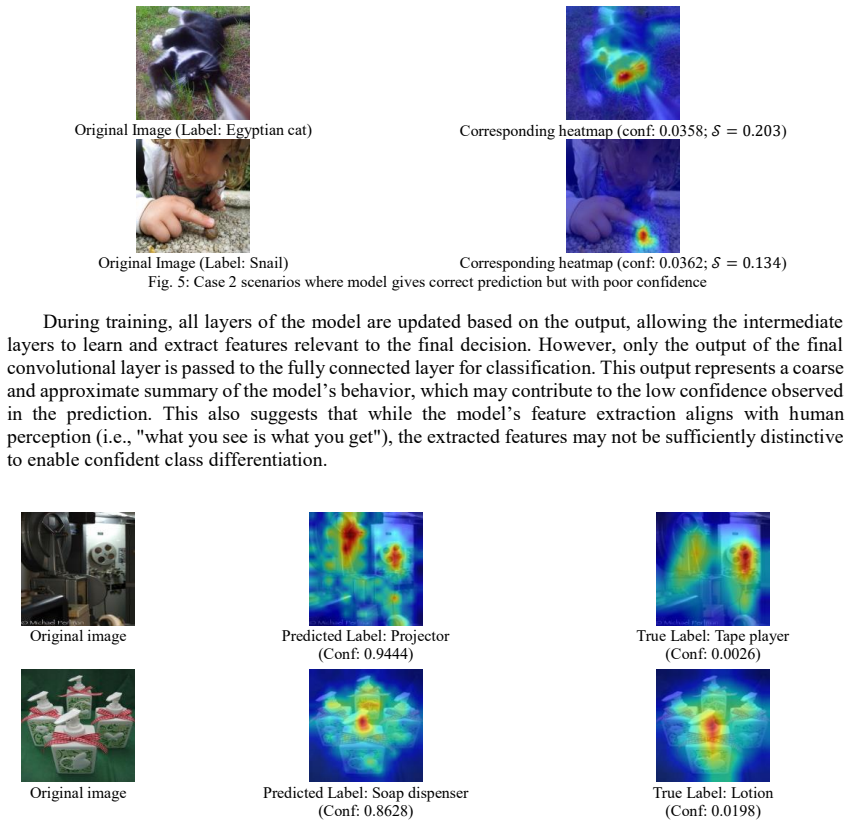
On its own terms, the paper's central discovery is that a CAM built from all layers, with each layer weighted by a perturbation-based importance score and combined with an explicit bias term, represents a CNN's decision better than maps drawn only from the last layer. The authors derive a derivative-reduction identity, claiming that for any smooth function $f$ and any layer activation $A$, the $n$-th derivative of the class output $Y^c$ with respect to $A$ equals $f^{(n)}(S^c)\,(\partial S^c/\partial A)^n$, and use it to reduce the $\alpha$ term of Grad-CAM++ to a simpler closed form. They support the method with qualitative surveys and IoU localization numbers on ImageNet with ResNet-50, and they show that the final convolutional layer is often not the most influential one for an image.
Load-bearing premise
The whole simplification of the alpha term assumes the model's pre-softmax score changes at a constant rate as you vary any layer's activations; for middle layers that rate itself changes, so the simplification is an approximation with no measured error.
Editorial extensions
If this is right
- I-CAM's heatmaps localize objects better than Grad-CAM, Grad-CAM++, and LayerCAM on ImageNet with ResNet-50, as measured by IoU on correct predictions.
- Layer importance scores reveal that the final convolutional layer is often not the primary contributor, so interpretation should weight intermediate layers rather than relying on the last one.
- The alpha simplification allows the method to apply to any smooth output function, such as softmax, rather than only exponentials, so long as the score is linear in the activations.
- The layer scoring system can guide model optimization tasks such as pruning or simplifying less critical layers, and combining I-CAM with example-based comparisons can explain high-confidence misclassifications.
Reading between the lines
- The identity in Eq. 24 is exact only when the pre-softmax score is linear in the layer's activations; for intermediate layers that linearity fails, making I-CAM's alpha an approximation whose error the paper does not quantify.
- If the layer scoring truly reflects causal relevance, it could be reused as a pruning or architecture-search signal, an application the paper mentions but does not develop.
- The same perturbation-scoring and fusion scheme could be tested on vision transformers or non-CNN architectures, where the notion of a layer differs and the bias term may behave differently.
- A concrete test would compare the approximate alpha of Eq. 25 with exact higher-order derivatives on a small network; large discrepancies would show the simplification is not generally valid.
Signed reviews
Editorial analysis
A structured set of objections, weighed in public.
Referee Report
Summary. The manuscript proposes Integrative CAM (I-CAM), a class activation mapping method that fuses features from multiple CNN layers using a perturbation-based layer importance score, a bias term in the saliency map, and a generalized alpha term derived from a claimed chain-rule simplification. The authors claim that I-CAM provides a more comprehensive and faithful visualization of CNN decisions than Grad-CAM, Grad-CAM++, and LayerCAM, supported by a qualitative survey, IoU localization results, and case studies on ImageNet with ResNet-50.
Significance. If the method were sound, the idea of principled multi-layer fusion with automatic layer weighting and a bias term would be a useful contribution to the interpretability literature. The paper also aims to provide a parameter-light alpha formula for any smooth output function, which could simplify higher-order gradient computations. However, the central theoretical derivation in Section 2.4 is incorrect for softmax outputs, the main quantitative evidence (Table 1) is missing from the manuscript, and the qualitative evaluation is based on a small, biased image selection with no statistical analysis. As presented, the central claims of superior fidelity and a generalized alpha formula are not established.
major comments (5)
- [§2.4, Eq. (24)] Equation (24) misapplies the chain rule for the softmax case used in Section 2.6. The softmax output Y^c depends on all logits S^j, not only on S^c, so the first derivative with respect to a layer activation A is ∂Y^c/∂A = Y^c(1−Y^c)∂S^c/∂A − Σ_{j≠c} Y^c Y^j ∂S^j/∂A. Equation (23) and the subsequent derivation in Eq. (24) keep only the diagonal term. Even under piecewise linearity of each S^j in A, the second derivative of softmax contains cross-logit terms such as ∂²Y^c/∂S^j∂S^k times products of first derivatives, which do not vanish. Therefore the simplified alpha in Eq. (25) and the weight formula in Eq. (31), which are used in every layer fusion, are not justified for the softmax function.
- [§2.4, final paragraph] The claim that any nonlinear function can be approximated as piecewise linear, and that the alpha simplification becomes valid if the approximation error is low, is not supported by any error bound or analysis of the multi-layer case. For intermediate layers, S^c depends on the layer activation through several subsequent nonlinear layers, so ∂S^c/∂A^k is not constant even when each individual activation function is piecewise linear; the derivative changes at the boundaries of the linear regions. The paper does not quantify the resulting error in the alpha term, so the central novelty of the method is asserted rather than proven.
- [§3.2, Table 1] The central quantitative claim that I-CAM achieves superior IoU localization accuracy is unverifiable because Table 1 is not included in the manuscript. The text states 'Table 1 presents the IoU evaluation results' but no such table appears. Since the paper's headline result is that I-CAM outperforms existing methods, the missing table is a load-bearing omission.
- [§3.1.1 and §3.1.2] The qualitative evaluation is not sufficient to support the claim of superior fidelity. The 50 images are drawn from only five classes selected by highest F1-scores, with the ten highest-confidence images per class, which biases the evaluation toward easy, unambiguous examples. The surveys involve 10 participants each, with no reported inter-rater agreement, statistical significance test, confidence intervals, or comparison against chance. The normalized scores (e.g., I-CAM 24.4 vs. LayerCAM 11.37) are presented as conclusive, but the experimental design does not rule out selection bias or participant noise.
- [§2.5, Eq. (27)] The bias term in Eq. (27) is defined as the residual S^c minus the weighted sum of activations. By construction, adding this bias term makes the layer's contribution sum exactly to the class score S^c, so any improvement in the resulting saliency map is not an independent test of the bias term's value. The paper reports that channel bias outperforms spatial bias but does not compare against a no-bias baseline where the residual is not added, so the claimed benefit of including a bias term is asserted rather than demonstrated.
minor comments (6)
- [§2.1, Eq. (3)] Equation (3) is difficult to parse: the norm subscripts and the summation indices are not fully defined, and the role of the weight α_i in the inner sum is unclear. Please clarify the notation.
- [§2.1.4, Eqs. (8)–(10)] The text says MDS 'diverges from traditional metrics such as JSD' but then states that MDD can also be conceptualized as symmetric Jensen-Shannon Divergence. This is contradictory and should be reconciled.
- [§3.1.1] The description of the survey scoring is incomplete: the text says 'Each method was scored based on the participants' evaluations' but does not specify the scale, the instructions given to participants, or whether participants were asked to rank or rate the outputs.
- [§3.1.3, Case 3 and Case 4] The examples in Figures 6–9 are presented as evidence that training-set similarity causes misclassification, but the comparisons are anecdotal and not quantified. Please provide a more systematic analysis or temper the causal language.
- [Abstract and Introduction] The paper repeatedly claims that I-CAM is 'comprehensive' and 'superior' without defining a precise notion of comprehensiveness or fidelity. A formal definition or at least an operationalized metric would help make these claims testable.
- [Throughout] There are numerous typographical and rendering issues in the equations (e.g., missing subscripts, garbled symbols in Eqs. (3), (8), and (27)). The manuscript would benefit from a careful proofreading pass.
Circularity Check
The bias term of I-CAM is defined as the residual S^c minus the same weighted activation sum used in the map, so its claimed benefit is an accounting identity rather than an independently tested component; the alpha simplification is mathematically unsupported but not circular.
-
self definitional
[Section 2.5, Eq. 27 (bias definition); applied in Eq. 20 and Eq. 21]
"considering that the model output S^c depends on a linear combination of activations from the k-th layer, we can express it as: S^c = Σ_{i,j} w_{ij,k}^c Σ_{i,j} A_{ij,k} + b_k^c ... b_k^c = S^c − Σ_{i,j} w_{ij,k}^c Σ_{i,j} A_{ij,k} (27)"
The bias term is not a separately estimated or independently validated model quantity; it is defined as the exact residual between the class score S^c and the same weighted activation sum that appears in the I-CAM layer map (Eq. 20). Substituting Eq. 27 into Eq. 20 therefore makes the layer map reproduce S^c by construction (up to the spatial fluctuation of the weighted activations around their summed value), and Eq. 21 then recombines these score-forced maps. The paper's claim that the bias term is 'essential' and 'captures more nuanced aspects' is not tested against I-CAM without the bias: Section 3.1.1 compares channel bias against spatial bias only, both of which already contain the residual construction.
full rationale
The only step that reduces to its own input by construction is the residual bias term: Eq. 27 defines b^c as S^c minus the weighted activation sum used in Eq. 20, so any saliency map built with that bias is partially forced to encode the class score. This is a real self-definitional component, but it does not make the whole method circular, because the spatial localization still comes from gradients and activations, and the paper reports independent IoU and human-survey evaluations. The generalized alpha derivation in Section 2.4 is not a circularity: it is an explicit, though mathematically incorrect, assumption that higher derivatives of S^c vanish and that the softmax can be treated as a univariate function of S^c. That is a correctness/validity risk rather than a reduction of a prediction to its input. There are no load-bearing self-citations in the reference list, and the layer importance score is computed from the very model being explained, which is by design for CAM methods rather than circular. Overall, the central empirical claim has independent content, so the circularity is partial rather than total.
Assumptions & free parameters
free parameters (4)
- layer retention threshold k =
0.95
- SVIM Gaussian width sigma =
not specified
- perturbation noise and masking intensity beta =
0.4 used in Fig 1
- number of perturbations N =
8 in Fig 1
assumptions (3)
- ad hoc to paper dS^c/dA^k is constant, so all higher-order derivatives of S^c with respect to layer activations vanish
- ad hoc to paper Any non-linear function can be approximated as piecewise linear with negligible error
- domain assumption Perturbation-based layer importance scores with SVIM and MDS weighting reliably rank layer relevance
invented entities (2)
-
SVIM metric
-
MDS metric
Cite this review
Pith. "Pith review of Integrative CAM: Adaptive Layer Fusion for Comprehensive Interpretation of CNNs." pith.science (2026). https://pith.science/paper/GOVXTXPP
@misc{pith2026241201354,
  author       = {Pith},
  title        = {Pith review of: Integrative CAM: Adaptive Layer Fusion for Comprehensive Interpretation of CNNs},
  year         = {2026},
  howpublished = {\url{https://pith.science/paper/GOVXTXPP}},
  note         = {Machine review of arXiv:2412.01354}
}
read the original abstract
With the growing demand for interpretable deep learning models, this paper introduces Integrative CAM, an advanced Class Activation Mapping (CAM) technique aimed at providing a holistic view of feature importance across Convolutional Neural Networks (CNNs). Traditional gradient-based CAM methods, such as Grad-CAM and Grad-CAM++, primarily use final layer activations to highlight regions of interest, often neglecting critical features derived from intermediate layers. Integrative CAM addresses this limitation by fusing insights across all network layers, leveraging both gradient and activation scores to adaptively weight layer contributions, thus yielding a comprehensive interpretation of the model's internal representation. Our approach includes a novel bias term in the saliency map calculation, a factor frequently omitted in existing CAM techniques, but essential for capturing a more complete feature importance landscape, as modern CNNs rely on both weighted activations and biases to make predictions. Additionally, we generalize the alpha term from Grad-CAM++ to apply to any smooth function, expanding CAM applicability across a wider range of models. Through extensive experiments on diverse and complex datasets, Integrative CAM demonstrates superior fidelity in feature importance mapping, effectively enhancing interpretability for intricate fusion scenarios and complex decision-making tasks. By advancing interpretability methods to capture multi-layered model insights, Integrative CAM provides a valuable tool for fusion-driven applications, promoting the trustworthy and insightful deployment of deep learning models.
Figures


Figures from the paper (5 more)



Reference graph
Works this paper leans on
-
[1]
Introduction The rapid development of machine learning, particularly through deep neural networks, has revolutionized artificial intelligence (AI), enabling advancements across a wide array of real-world applications, from autonomous systems to complex decision support systems [1]. Despite the exceptional capabilities of deep learning models in domains li...
-
[2]
Integrative CAM (I-CAM) I-CAM is an innovative gradient-based Class Activation Mapping (CAM) method that redefines core principles in deep learning interpretability. It introduces an automated, dynamically weighted layer selection mechanism, moving beyond the conventional manual selection approach. By incorporating a bias term in saliency map computations...
-
[3]
Experiments and Results To rigorously evaluate the performance and advantages of the proposed Integrative CAM (I-CAM) method, we conducted a series of experiments on the well-established ImageNet dataset, using the ResNet-50 architecture. This section provides an overview of the experimental setup, including dataset details, model configurations, and prep...
-
[4]
Conclusion In this work, we introduced Integrative CAM (I-CAM), a method designed to deepen our understanding of how convolutional neural networks (CNNs) perceive and process images. I-CAM uniquely combines information across multiple layers, using adaptive fusion to provide a comprehensive view of model behavior. By integrating channel-wise biases and as...
- [5]
-
[6]
A. A. Barredo, N. Díaz-Rodríguez, J. D. Ser, A. Bennetot, S. Tabik, A. Barbado, S. García et al, Explainable Artificial Intelligence (XAI): Concepts, taxonomies, opportunities and challenges toward responsible AI, Information fusion 58 (2020) 82-115
work page 2020
-
[7]
L. Pantelis, V. Papastefanopoulos, S. Kotsiantis, Explainable ai: A review of machine learning interpretability methods, Entropy 23 no. 1 (2020) 18
work page 2020
- [8]
Show all 42 references
-
[9]
Simin, S
C. Simin, S. Bateni, S. Grandhi, X. Li, C. Liu, W. Yang, Denas: automated rule generation by knowledge extraction from neural networks. In Proceedings of the 28th ACM joint meeting on European software engineering conference and symposium on the foundations of software enginee...
2020
-
[10]
Why should I trust you?
R. M. Tulio, S. Singh, C. Guestrin, "Why should I trust you?" Explaining the predictions of any classifier, In Proceedings of the 22nd ACM SIGKDD international conference on knowledge discovery and data mining, 2016, pp. 1135-1144
2016
-
[11]
Lundberg, Su-In Lee, A unified approach to interpreting model predictions, Advances in neural information processing systems 30 (2017)
S.M. Lundberg, Su-In Lee, A unified approach to interpreting model predictions, Advances in neural information processing systems 30 (2017)
2017
-
[12]
S. M. Muddamsetty, M. N. Jahromi, A. E. Ciontos, L. M. Fenoy, T. B. Moeslund, Visual explanation of black-box model: Similarity Difference and Uniqueness (SIDU) method, Pattern recognition 127 (2022) 108604
2022
-
[13]
Abusitta, M
A. Abusitta, M. Q. Li, B. C. Fung, Survey on explainable ai: techniques, challenges and open issues, Expert Systems with Applications 255 (2024) 124710
2024
-
[14]
S. Ali, T. Abuhmed, S. El-Sappagh, K. Muhammad, J. M. Alonso-Moral, R. Confalonieri, R. Guidotti, J. D. Ser, N. Díaz-Rodríguez, F. Herrera, Explainable Artificial Intelligence (XAI): What we know and what is left to attain Trustworthy Artificial Intelligence, Information fusio...
2023
-
[15]
L. H. Gilpin, D. Bau, B. Z. Yuan, A. Bajwa, M. Specter, L. Kagal, Explaining explanations: An overview of interpretability of machine learning, In 2018 IEEE 5th International Conference on data science and advanced analytics (DSAA), IEEE, 2018, pp. 80-89
2018
-
[16]
A. K. Dombrowski, C. J. Anders, K. R. Müller, P. Kessel, Towards robust explanations for deep neural networks, Pattern Recognition 121 (2022) 108194
2022
-
[17]
Miller, Explanation in artificial intelligence: Insights from the social sciences, Artificial intelligence 267 (2019) 1-38
T. Miller, Explanation in artificial intelligence: Insights from the social sciences, Artificial intelligence 267 (2019) 1-38
2019
-
[18]
Caruana, Y
R. Caruana, Y. Lou, J. Gehrke, P. Koch, M. Sturm, N. Elhadad, Intelligible models for healthcare: Predicting pneumonia risk and hospital 30-day readmission, In Proceedings of the 21st ACM SIGKDD international conference on knowledge discovery and data mining, 2015, pp. 1721-1730
2015
-
[19]
Biggio, F
B. Biggio, F. Roli, Wild patterns: Ten years after the rise of adversarial machine learning, In Proceedings of the 2018 ACM SIGSAC Conference on Computer and Communications Security, 2018, pp. 2154-2156
2018
-
[20]
M. D. Zeiler, Rob Fergus, Visualizing and understanding convolutional networks, In Computer Vision–ECCV 2014: 13th European Conference, Zurich, Switzerland, September 6-12, 2014, Proceedings, Part I 13, pp. 818-833, Springer International Publishing, 2014
2014
-
[21]
K. He, X. Zhang, S. Ren, J. Sun, Deep residual learning for image recognition, In Proceedings of the IEEE conference on computer vision and pattern recognition, 2016, pp. 770-778
2016
-
[22]
Z. Chen, Y. Bei, C. Rudin, Concept whitening for interpretable image recognition, Nature Machine Intelligence 2, no. 12 (2020) 772-782. 22
2020
-
[23]
Y. L. Chou, C. Moreira, P. Bruza, C. Ouyang, Joaquim Jorge, Counterfactuals and causability in explainable artificial intelligence: Theory, algorithms, and applications, Information Fusion 81 (2022) 59-83
2022
-
[24]
H. G. Ramaswamy, Ablation-cam: Visual explanations for deep convolutional network via gradient- free localization, In proceedings of the IEEE/CVF winter conference on applications of computer vision, 2020, pp. 983-991
2020
-
[25]
B. Zhou, A. Khosla, A. Lapedriza, A. Oliva, A. Torralba, Learning deep features for discriminative localization, In Proceedings of the IEEE conference on computer vision and pattern recognition, 2016, pp. 2921-2929
2016
-
[26]
R. R. Selvaraju, M. Cogswell, A. Das, R. Vedantam, D. Parikh, and D Batra, Grad-CAM: visual explanations from deep networks via gradient-based localization, International journal of computer vision 128 (2020) 336-359
2020
-
[27]
Chattopadhay, A
A. Chattopadhay, A. Sarkar, P. Howlader, V. N. Balasubramanian, Grad-cam++: Generalized gradient-based visual explanations for deep convolutional networks, In 2018 IEEE winter conference on applications of computer vision (WACV), IEEE, 2018, pp. 839-847
2018
-
[28]
P. T. Jiang, C. B. Zhang, Q. Hou, M. M. Cheng, Y. Wei, Layercam: Exploring hierarchical class activation maps for localization, IEEE Transactions on Image Processing 30 (2021) 5875-5888
2021
-
[29]
Zheng, Q
T. Zheng, Q. Wang, Y. Shen, X. Ma, X. Lin, High-resolution rectified gradient-based visual explanations for weakly supervised segmentation, Pattern Recognition 129 (2022) 108724
2022
-
[30]
Montavon, W
G. Montavon, W. Samek, K. R. Müller, Methods for interpreting and understanding deep neural networks, Digital signal processing 73 (2018) 1-15
2018
-
[31]
Y. Li, H. Liang, H. Zheng, R. Yu, CR-CAM: Generating explanations for deep neural networks by contrasting and ranking features, Pattern Recognition 149 (2024) 110251
2024
-
[32]
Arumugam, R
D. Arumugam, R. Kiran, Interpreting denoising autoencoders with complex perturbation approach, Pattern Recognition 136 (2023) 109212
2023
-
[33]
Brocki, N
L. Brocki, N. C. Chung, Feature perturbation augmentation for reliable evaluation of importance estimators in neural networks, Pattern Recognition Letters 176 (2023) 131-139
2023
-
[34]
Böttcher, D
A. Böttcher, D. Wenzel, The Frobenius norm and the commutator, Linear algebra and its applications 429, no. 8-9 (2008) 1864-1885
2008
-
[35]
J. Deng, W. Dong, R. Socher, L. J. Li, K. Li, L. Fei-Fei, Imagenet: A large-scale hierarchical image database, In 2009 IEEE conference on computer vision and pattern recognition, IEEE, 2009, pp. 248- 255
2009
-
[36]
Brunet, E
D. Brunet, E. R. Vrscay, Z. Wang, On the mathematical properties of the structural similarity index, IEEE Transactions on Image Processing 21, no. 4 (2011) 1488-1499
2011
-
[37]
M. L. Menéndez, J. A. Pardo, L. Pardo, M. C. Pardo, The jensen-shannon divergence, Journal of the Franklin Institute 334, no. 2 (1997) 307-318
1997
-
[38]
D. I. Belov, R. D. Armstrong, Distributions of the Kullback–Leibler divergence with applications, British Journal of Mathematical and Statistical Psychology 64, no. 2 (2011) 291-309
2011
-
[39]
B. M. S. Hasan, A. M. Abdulazeez, A review of principal component analysis algorithm for dimensionality reduction, Journal of Soft Computing and Data Mining 2, no. 1 (2021) 20-30
2021
-
[40]
S. K. Yeom, P. Seegerer, S. Lapuschkin, A. Binder, S. Wiedemann, K. R. Müller, W. Samek, Pruning by explaining: A novel criterion for deep neural network pruning, Pattern Recognition 115 (2021) 107899
2021
-
[41]
K. Yao, F. Cao, Y. Leung, J. Liang, Deep neural network compression through interpretability-based filter pruning, Pattern Recognition 119 (2021) 108056
2021
-
[42]
Abdar, F
M. Abdar, F. Pourpanah, S. Hussain, D. Rezazadegan, L. Liu, M. Ghavamzadeh, P. Fieguth, et al, A review of uncertainty quantification in deep learning: Techniques, applications and challenges, Information fusion 76 (2021) 243-297
2021
Reviewed August 12, 2026 · model on record in the stance chip above.
Discussion (0). Continue with ORCID to comment.