REVIEW 4 major objections 6 minor 96 references
Orbital anomalous Hall effect in the few-layer Weyl semimetal TaIrTe4
T0 review · 4 major / 6 minor · reviewed 2026-08-11 · deepseek-v4-flash
Pith's one-line read The paper reports that a direct current flowing in nonmagnetic few-layer TaIrTe4 induces an out-of-plane orbital magnetization and a linear anomalous Hall effect, and that all three observed Hall effects share one second-order response…
desk verdict A solid transport study with a clean unifying second-order response picture, but the 'orbital' label is an inference from theory, not a measurement. read the letter →
The pith
A machine-rendered reading of the paper's core claim, the machinery that carries it, and where it could break.
The reading
What carries the argument
The central object is the Berry curvature dipole $D$, the first moment (dipole) of the Berry curvature over occupied states, which is nonzero in few-layer TaIrTe4 because the few-layer form loses the glide-mirror symmetry of the bulk while preserving time-reversal symmetry. The dipole acts as a current-to-magnetization rectifier: a bias current tilts the occupation of Bloch states in momentum space, and because out-of-plane orbital moments are locked to momentum in this two-dimensional crystal, a net out-of-plane orbital magnetization $M^z_{\mathrm{orb}} \propto (D\cdot I)\hat{z}$ emerges. The measurement method is the second piece of machinery: a dc current generates the magnetization while a much smaller ac current probes it, so the magnetization appears as a first-harmonic signal linear in the probe current, with generation and detection channels independently controlled. The quantitative unification is carried by a single second-order response formula, $V^H_{\mathrm{tot}} = k\,I_{\mathrm{tot}}^2$, from which the linear AHE, the NLHE, and the NRHE follow with the fixed ratios $4 : -1 : 2$. The orbital-versus-spin assignment rests on the magnetoelectric susceptibility $\alpha_{xz}$, computed with the wave-packet orbital-moment formulas of the band theory.
What would settle it
Electrostatically gate or chemically dope the flake to scan the Fermi level: the calculation predicts that the orbital susceptibility $\alpha^{\mathrm{orb}}_{xz}(\mu)$ changes sign and magnitude in a specific way, so the measured slope $R^\omega_H/I_{dc}$ should track that orbital curve. If it tracks the spin susceptibility instead, or if a direct magnetization probe on the same device (for instance a torque or magneto-optical measurement) finds a moment far smaller than the Hall signal implies, the orbital attribution fails.
Extended reading notes
Core claim
On the paper's own terms, the discovery is this: in few-layer TaIrTe4 (pentalayer in the calculation), a type-II Weyl semimetal, an in-plane dc current along the crystal $a$ axis induces a magnetization along the $c$ axis that is dominated by the orbital magnetic moment of the Bloch electrons, not their spin. The nonzero Berry curvature dipole $D$ of the few-layer crystal makes the occupation imbalance produced by the bias translate into a net orbital moment, $M^z_{\mathrm{orb}} \propto (D\cdot I)\hat{z}$, which breaks time-reversal symmetry. Superposing a small ac current $I_\omega \ll I_{dc}$ then yields a first-harmonic transverse voltage $V^\omega_H \sin\omega t = 2k\,I_{dc}I_\omega \sin\omega t$, so the anomalous Hall resistance $R^\omega_H = V^\omega_H/I_\omega$ is linear in $I_{dc}$ and reverses sign with its polarity. The same coefficient $k$ produces the second-harmonic nonlinear Hall signal $V^{2\omega}_H = -\frac{1}{2}k I_\omega^2$ and the pure-dc quadratic Hall voltage $V^s_H = k I_{dc}^2$, and the measured generation ratios agree with the predicted $4 : -1 : 2$ relation. Density-functional and Wannier-based calculations place the orbital magnetoelectric susceptibility $\alpha^{\mathrm{orb}}_{xz}$ one to two orders of magnitude above the spin susceptibility $\alpha^{s}_{xz}$ at the estimated Fermi level $\mu = 0.037$ eV, which the authors take to establish that the observed Hall effects are dominantly orbital in origin.
Load-bearing premise
The claim that the effect is orbital rather than spin rests on a band-structure calculation saying the orbital response is 10 to 100 times stronger than the spin response at an estimated Fermi level, and on the assumption that the factor converting magnetization into Hall voltage is comparable for the two channels; the voltage measurements themselves cannot tell orbital and spin moments apart.
Editorial extensions
If this is right
- The linear AHE measured under dc+ac excitation is quantitatively tied to the nonlinear Hall and nonreciprocal Hall effects through one coefficient $k$, so a first-harmonic measurement can serve as a direct probe of Berry-curvature-dipole physics with known conversion factors.
- The induced out-of-plane orbital magnetization is set entirely by electrical means — magnitude by $I_{dc}$, direction by its polarity and by temperature — which the authors present as precise electric control of out-of-plane polarized orbit flow.
- The signal disappears when the generating current runs along the $b$ axis (perpendicular to the Berry curvature dipole), confirming that the effect is directional and tied to the dipole orientation rather than to sample-wide heating or contact artifacts.
- Since the mechanism is orbital rather than spin-based, the anomalous Hall effect appears here without any magnetic order, extending a phenomenon traditionally associated with ferromagnets to nonmagnetic two-dimensional materials.
- The consistency of the three effects implies that the previously reported nonlinear Hall effect in TaIrTe4 and the new current-induced linear AHE have a common origin in current-induced orbital magnetization.
Reading between the lines
- Extension: the same dc+ac protocol should work in other Berry-curvature-dipole materials, and because it separates the generation current from the probe current, it offers a way to compare orbital and spin contributions across materials without magnetic fields.
- Testable extension: a gate-tunable device sweeping the Fermi level would reproduce or falsify the calculated $\mu$-dependence of $\alpha^{\mathrm{orb}}_{xz}$; this is the cleanest experimental check of the orbital attribution.
- Consequence the authors leave implicit: if the induced out-of-plane orbital moment is real and switchable, a TaIrTe4 flake in contact with a magnetic layer should exert a current-controlled torque, giving this platform a spintronic application.
- The shared sign reversal near 100 K suggests the orbital polarization direction can be swept continuously through zero by temperature or gating, which would make the induced magnetization direction a tunable degree of freedom rather than a fixed property of the material.
Signed reviews
Editorial analysis
A structured set of objections, weighed in public.
Referee Report
Summary. The paper reports transport experiments on few-layer TaIrTe4 in which a dc current Idc and a small ac current Iω are applied simultaneously along the a axis. The first-harmonic transverse voltage Vω^H scales linearly with Iω, and the resulting Hall resistance Vω^H/Iω is proportional to Idc and changes sign when the polarity of Idc is reversed. The signal is vanishingly small when Idc is along the b axis, reverses sign near 100 K, and the dc Hall voltage measured with pure dc excitation is quadratic in Idc, constituting a nonreciprocal Hall effect. The authors present DFT-Wannier calculations of orbital and spin magnetoelectric susceptibilities, finding the orbital channel to be one to two orders of magnitude larger than the spin channel at the estimated Fermi level, and they argue via a common second-order coefficient k that the linear AHE, second-order NLHE, and NRHE share the same microscopic origin: current-induced out-of-plane orbital magnetization generated by a Berry curvature dipole.
Significance. If the orbital attribution holds, the paper demonstrates electric control of out-of-plane orbital magnetization in a nonmagnetic van der Waals semimetal and unifies three nominally distinct Hall responses under one second-order coefficient. The transport controls are well designed: the linear dependence on Idc, polarity reversal, the a-axis versus b-axis contrast, and the temperature sign reversal are internally consistent, and Appendix G provides a useful, parameter-free conversion between the AHE, NLHE, and NRHE normalizations. The DFT comparison of orbital and spin magnetoelectric susceptibilities is a valuable addition, and the cancellation of τ in the orbital-versus-spin ratio is a genuine strength. The main caveat is that the transport measurements measure voltages only, so the microscopic carrier angular momentum is not directly probed; the 'orbital' conclusion rests on the computed susceptibility hierarchy and on an unverified assumption about the Hall coefficients of the orbital and spin channels.
major comments (4)
- [Section III and Appendix H.3] The central claim that the observed Hall effect is orbital rather than spin is not established by the transport data alone, because the measured voltages cannot distinguish magnetization channels. The argument reduces to α_orb_xz ≫ α_s_xz at μ = 0.037 eV (Fig. 2(d)) followed by the assumption that the proportionality constant γ in R_H = γ M_z is comparable for orbital and spin magnetization. No computation or experimental bound for γ_orb versus γ_spin is provided, and the authors themselves note in Appendix H.3 that strong spin-orbit coupling makes the disentanglement difficult. Because this assumption is load-bearing for the title's 'orbital anomalous Hall effect,' the authors should either compute γ for both channels within the same model, provide an independent constraint on the relative Hall responses, or explicitly soften the attribution claim to 'orbital-dominated according to the calculated magnetoelectric susceptibilities.'
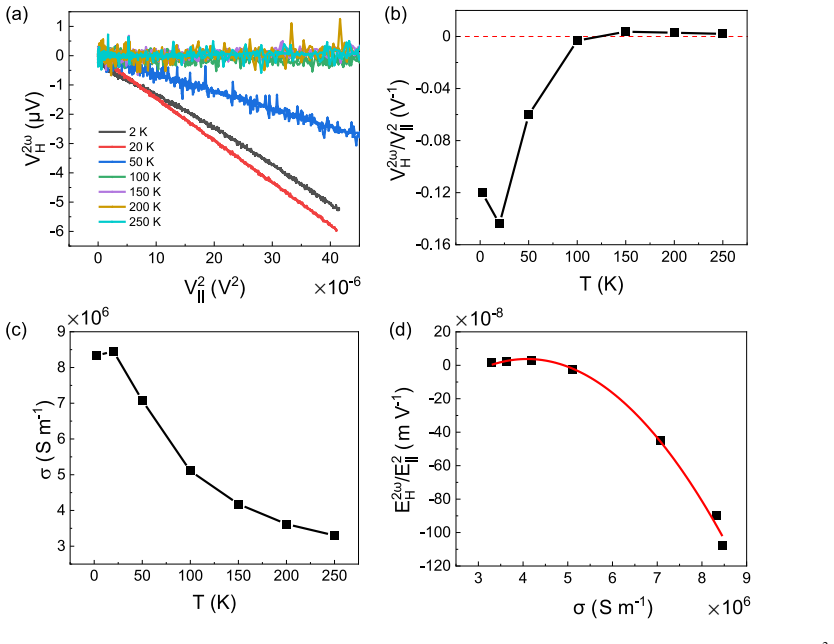
- [Section III, Fig. 4 vs Appendix E, Fig. 9(b)] The temperature-consistency argument contains an apparent quantitative mismatch. The main text states that Vω^H/Iω reverses sign above roughly 100 K 'consistent with the temperature-dependent NLHE,' but Appendix E reports that the NLHE slope V_H^{2ω}/V_||^2 reverses sign at approximately 150 K (Fig. 9(b)). Since the common-origin narrative relies on the same sign-change behavior, the discrepancy between ~100 K and ~150 K needs to be reconciled explicitly, for example by showing that the two measurements sample different Fermi-level shifts or by presenting both datasets with a common temperature axis in one figure.
- [Appendix G and Fig. 11] The quantitative consistency test in Appendix G is a self-consistency check built on the assumption that the same coefficient k governs all three effects, not an independent confirmation of the orbital mechanism. The measured ratios in Fig. 11 are presented without error bars and come from a single device, so the claimed factor-of-2 and factor-of-4 agreements cannot be assessed statistically. The authors should report uncertainties, the number of devices measured, or at least the device-to-device variation, especially because the comparison in Fig. 11 is one of the main supports for unifying AHE, NLHE, and NRHE.
- [Section II and Appendix A.2] The dc+ac protocol relies on the assumption that the current-induced magnetization follows the dc current adiabatically and that the lock-in first-harmonic response is not contaminated by Joule-heating-induced thermal gradients. The antisymmetrization procedure removes terms that are symmetric in Idc, but the possibility of a contribution that is antisymmetric in Idc but not proportional to the induced magnetization (for example a current-dependent contact asymmetry) is not discussed in detail. A control measurement with a second device of different geometry, or a check that the first-harmonic signal is independent of the ac frequency, would materially strengthen the interpretation.
minor comments (6)
- [Appendix F] The statement that the Hall nonreciprocity η_H diverges is a definitional artifact: for a purely antisymmetric signal the denominator R_s^H(+Idc)+R_s^H(-Idc) vanishes by construction. Please rephrase to avoid implying a physically divergent quantity.
- [Appendix C, Eq. (C5)] The second term of Eq. (C5) is written as (e/ħ) Im⟨∂_k u|×[ε(k)-E_F]|∂_k u⟩; the notation should clarify that the energy-dependent term is a scalar multiplying the cross product with the gradient, otherwise the expression appears dimensionally inconsistent.
- [Fig. 2(d) and Appendix C] The calculation temperature is stated as 50 K, while the transport experiments span from 2 K to 250 K. A sentence explaining why 50 K is representative, or a plot of α_orb_xz and α_s_xz at a few temperatures, would help the reader connect the calculation to the measured temperature dependence.
- [Appendix G, Eq. (G2)-(G4)] The conversion from voltage ratios to electric-field ratios involves the geometric factor L/R_a^2; this factor is mentioned only in passing before Fig. 11. Please define it explicitly in the main text or figure caption so that the reader can reproduce the plotted values.
- [Appendix C, first paragraph] The phrase 'constructed a density functional theory (DFT) based tight-binding model Hamilton' contains a typo; 'Hamilton' should be 'Hamiltonian.'
- [Section III, Fig. 4(c) caption] The figure caption describes the NLHE normalization as V_||^2 but does not specify whether V_|| is the first-harmonic longitudinal voltage at the same frequency as the drive; please state the frequency and the measurement configuration explicitly.
Circularity Check
No significant circularity: the AHE/NLHE/NRHE comparison is a self-consistency check with nontrivially predicted ratios, and the orbital-vs-spin attribution rests on independent DFT susceptibilities rather than on the measured Hall voltages.
full rationale
The paper's central experimental claim is that a dc current induces a first-harmonic transverse response whose generation ratio E_H^omega/(E_dc E_omega) matches the second-harmonic NLHE ratio E_H^{2omega}/(E_omega)^2 and the dc quadratic ratio E_H^s/(E_dc)^2 with the predicted 4:-1:2 ratios (Appendix G). These ratios are nontrivial predictions of the shared-coefficient model V_H^tot = k(I_tot)^2, not definitions of the measured quantities; the data could have disagreed, and the factors are derived from trigonometric/current-composition identities, not fitted. The orbital-vs-spin attribution is not circular: alpha_orb_xz and alpha_s_xz are computed from a DFT-Wannier tight-binding model (Appendix C) at a Fermi level mu = 0.037 eV estimated from Hall carrier densities, and the transport voltages are not used to adjust these susceptibilities. The step from alpha_orb >> alpha_s to a dominant orbital Hall signal uses the standard ansatz R_H = gamma M_z and implicitly assumes comparable gamma for orbital and spin channels; this is an unverified physical assumption and a sensitivity concern, but it is not a reduction of the prediction to a fitted input. Citations [27] and [23] include overlapping authors, but they are used only as external experimental/theoretical support for the Berry curvature dipole and its temperature behavior, not as a uniqueness theorem or as the sole justification for the central derivation. No step in the paper equates a 'prediction' to an input by construction.
Assumptions & free parameters
free parameters (2)
- Fermi level mu =
0.037 eV
- Effective scattering time tau =
not specified
assumptions (6)
- domain assumption Eq. C4 linear response with a single relaxation time tau describes current-induced orbital and spin magnetization.
- domain assumption The Fermi level mu = 0.037 eV extracted from Hall carrier densities is representative of the device under bias current.
- domain assumption R_H = gamma M_z with a single sample-dependent gamma for both orbital and spin magnetization.
- domain assumption Nonzero Berry curvature dipole along a causes M_z^orb proportional to D dot I, and current along b gives negligible magnetization.
- domain assumption Antisymmetrization and symmetrization of the measured voltages fully remove electrode misalignment, longitudinal-transverse coupling, and Joule-heating thermoelectric contributions.
- domain assumption The DFT-Wannier tight-binding model captures the low-energy bands and momentum-resolved magnetic moments of pentalayer TaIrTe4.
Cite this review
Pith. "Pith review of Orbital anomalous Hall effect in the few-layer Weyl semimetal TaIrTe4." pith.science (2026). https://pith.science/paper/BCC56W3O
@misc{pith2026241202937,
  author       = {Pith},
  title        = {Pith review of: Orbital anomalous Hall effect in the few-layer Weyl semimetal TaIrTe4},
  year         = {2026},
  howpublished = {\url{https://pith.science/paper/BCC56W3O}},
  note         = {Machine review of arXiv:2412.02937}
}
read the original abstract
We report on the observation of the linear anomalous Hall effect (AHE) in the nonmagnetic Weyl semimetal TaIrTe4. This is achieved by applying a direct current Idc and an alternating current Iac (Iac<<Idc) in TaIrTe4, where the former induces time-reversal symmetry breaking and the latter probes the triggered AHE. The anomalous Hall resistance VacH/Iac shows a linear dependence on Idc and changes sign with the polarity of Idc. In temperature-dependent measurements, VacH/Iac also experiences a sign reversal at 100 K, consistent with the temperature-dependent nonlinear Hall effect (NLHE). Furthermore, in measurements involving only dc transport, the dc Hall voltage exhibits a quadratic relationship with Idc. When the Idc direction is reversed, the Hall resistance changes sign, demonstrating a colossal nonreciprocal Hall effect (NRHE). Our theoretical calculations suggest that the observed linear AHE, NLHE, and NRHE all dominantly originate from the current-induced orbital magnetization compared to the minor spin contribution. This work provides deep insights into the orbital magnetoelectric effect and nonlinear Hall response, promising precise electric control of out-of-plane polarized orbit flow.
Figures


Figures from the paper (8 more)




Reference graph
Works this paper leans on
-
[1]
The process in- volved exfoliating the TaIrTe 4 crystal with Scotch Tape and transferring it onto a polydimethylsiloxane (PDMS) substrate
Sample growth and device fabrication Few-layer TaIrTe4 (8 nm thick) and hBN (∼10 −20 nm thick) flakes were obtained via the mechanical exfoliation method from bulk crystals (HQ Graphene). The process in- volved exfoliating the TaIrTe 4 crystal with Scotch Tape and transferring it onto a polydimethylsiloxane (PDMS) substrate. Subsequently, it was transferre...
-
[2]
Theoretical calculations indicate that the current-induced orbital magnetization is dominant over the spin magnetization in TaIrTe
-
[3]
Experimentally, we apply dc current to induce an out-of-plane magnetization, and employ the ac current to probe the induced AHE. The anomalous Hall resistance R ω H (Vω H /Iω) is found to scale linearly with the Idc and change sign with the polarity of Idc as expected from the proportional relation between orbital magnetization and bias current. Moreover,...
-
[4]
2(a)], consistent with the previous theoret- ical and experimental results [67–70]
Both the electron and hole would contribute to electronic transport (two-carrier trans- port) near the charge neutrality point [indicated by the red dashed line in Fig. 2(a)], consistent with the previous theoret- ical and experimental results [67–70]. The spatial distribution of orbital magnetic moment m z orb in the momentum space is calculated as shown...
-
[5]
To study the current-induced out-of-plane magnetization and AHE, two measurement methods were employed
Transport measurements Transport measurements were performed in a commercial Oxford cryostat system with a base temperature ∼1.4K . To study the current-induced out-of-plane magnetization and AHE, two measurement methods were employed. In the first method, where both dc and ac currents were simultaneously introduced into the sample (Fig. 3), a dc current (...
-
[6]
The sign of the Hall voltageV ω H should follow the sign of the dc current induced magnetization M
Antisymmetrization and symmetrization of the measured data In the measurement configuration combining dc and ac cur- rent sources, the dc current is used to produce an out-of-plane magnetization, while the ac current serves as the probe current to measure the corresponding anomalous Hall effect. The sign of the Hall voltageV ω H should follow the sign of t...
-
[7]
We constructed a density functional theory (DFT) based tight-binding model Hamilton of the T d -TaIrTe4 slab, where the tight-binding model matrix ele- ments are calculated by projecting onto the Wannier orbitals [72,73]. The d orbitals of the Ta atoms, the d orbitals of the Ir atoms, and the p orbitals of the Te atoms were used to con- struct Wannier fun...
-
[8]
2(a) in the main text
Band structure and carrier density The band structure of pentalayer Td -TaIrTe4 calculated from the DFT calculations is shown in Fig. 2(a) in the main text. The corresponding carrier densities of electrons (ne) and holes (nh)a r eg i v e ni nF i g .6(a). The carrier densities ne and nh are calculated by [27] ne = ∫ ∞ ϵc ge(E ) f0(E − μF )dE , nh = ∫ ϵv −∞...
Show all 96 references
-
[9]
Calculations of orbital and spin textures We can calculate the orbital and spin magnetic moment of each Bloch state according to the following formulas [9,74]: ⃗morb(⃗k) = e 2¯h Im⟨∂⃗k u(⃗k)|×[H (⃗k) − ε(⃗k)]|∂⃗k u(⃗k)⟩, (C2) ⃗ms(⃗k) =− ⟨∂⃗k u(⃗k)|1 2 gμbσ|∂⃗k u(⃗k)⟩, (C3) 6 F...
-
[10]
Calculations of magnetoelectric susceptibility αij The electric field induced magnetization can be described as M j = ∑ i αij Ei, where i, j = x, y, z; Ei is the external elec- tric field; and αij is the magnetoelectric susceptibility [75]. To calculate αij for TaIrTe4, we can u...
-
[11]
Figure 9(d) shows the slope E2ω H /E2ω ‖ as a function of the conductivity σ . It can be seen that the NLHE is dominated by a parabolic behavior, indicating that both the intrinsic Berry curvature and extrinsic disorder scattering make contributions to the nonlinear Hall respo...
-
[12]
AHE with coexisting dc and ac excitation In this case, both I1 = Idc and I2 = Iω remain nonzero, and the AHE of our interest corresponds to the first-harmonic amplitude of Eq. (G1). Explicitly, we have V ω H sin ωt = 2kI dcIω sin ωt. Thus, in AHE measurement, the generation of ...
-
[13]
Second-order NLHE with pure ac excitation In this case, I1 = 0 and I2 = Iω, and the NLHE of our inter- est corresponds to the second-harmonic part of Eq. ( G1). We have V tot H = k(Iω )2sin2ωt = k(Iω )2 1− cos 2ωt 2 , and the second- harmonic component becomes V 2ω H =− 1 2 k(...
-
[14]
Equation (G1) has no ac component and simply becomes V s H = k(Idc )2, leading to the quadratic generation, V s H (Idc )2 = k
NRHE with pure dc excitation In this case, I1 = Idc and I2 = 0. Equation (G1) has no ac component and simply becomes V s H = k(Idc )2, leading to the quadratic generation, V s H (Idc )2 = k. (G4) Equations ( G2)–(G4) reveal the fact that when carrying out a quantitative compar...
-
[15]
The Hall resistance exhibits a linearity with the dc current bias applied along the a axis [Fig
Current and angle dependences of AHE The current and angle dependences of dc-induced Hall effect are both consistent with the scenario of orbital magnetic moment. The Hall resistance exhibits a linearity with the dc current bias applied along the a axis [Fig. 3(c)], in accorda...
-
[16]
For example, the temperature-induced sign reversal is observed in both mea- surement methods [Figs
Good consistency with the second-order NLHE The observed linear Hall effect induced by a dc current is fully consistent with the results of second-order NLHE in- duced by an ac current in our TaIrTe 4 device. For example, the temperature-induced sign reversal is observed in bo...
-
[17]
Theoretical comparison of orbital and spin magnetization It is noteworthy that, owing to the presence of spin-orbit coupling in TaIrTe 4, the orbital magnetization gives rise to a spin polarization, leading to a corresponding spin anoma- lous Hall effect. While it can be chall...
-
[18]
Y .-Q. Ma, S. Chen, H. Fan, and W.-M. Liu, Abelian and non- Abelian quantum geometric tensor, Phys. Rev. B 81, 245129 (2010)
2010
-
[19]
O. Bleu, G. Malpuech, Y . Gao, and D. D. Solnyshkov, Effective theory of nonadiabatic quantum evolution based on the quantum geometric tensor, P h y s .R e v .L e t t .121, 020401 (2018)
2018
-
[20]
Zhang, Q.-H
D.-J. Zhang, Q.-H. Wang, and J. Gong, Quantum geometric tensor in PT -symmetric quantum mechanics, Phys. Rev. A 99, 042104 (2019)
2019
-
[21]
Gianfrate, O
A. Gianfrate, O. Bleu, L. Dominici, V . Ardizzone, M. De Giorgi, D. Ballarini, G. Lerario, K. W. West, L. N. Pfeiffer, D. D. Solnyshkov, D. Sanvitto, and G. Malpuech, Measurement of the quantum geometric tensor and of the anomalous Hall drift, Nature (London) 578, 381 (2020)
2020
-
[22]
Holder, D
T. Holder, D. Kaplan, and B. Yan, Consequences of time-reversal-symmetry breaking in the light-matter interac- tion: Berry curvature, quantum metric, and diabatic motion, Phys. Rev. Res. 2, 033100 (2020). 11
2020
-
[23]
Bhalla, K
P. Bhalla, K. Das, D. Culcer, and A. Agarwal, Resonant second-harmonic generation as a probe of quantum geometry, P h y s .R e v .L e t t .129, 227401 (2022)
2022
-
[24]
Michishita and N
Y . Michishita and N. Nagaosa, Dissipation and geometry in nonlinear quantum transports of multiband electronic systems, P h y s .R e v .B106, 125114 (2022)
2022
-
[25]
M. Wei, L. Wang, B. Wang, L. Xiang, F. Xu, B. Wang, and J. Wang, Quantum fluctuation of the quantum geometric tensor and its manifestation as intrinsic Hall signatures in time-reversal invariant systems, P h y s .R e v .L e t t .130, 036202 (2023)
2023
-
[26]
Sundaram and Q
G. Sundaram and Q. Niu, Wave-packet dynamics in slowly per- turbed crystals: Gradient corrections and Berry-phase effects, P h y s .R e v .B59, 14915 (1999)
1999
-
[27]
Chang and Q
M.-C. Chang and Q. Niu, Berry phase, hyperorbits, and the Hof- stadter spectrum: Semiclassical dynamics in magnetic Bloch bands, P h y s .R e v .B53, 7010 (1996)
1996
-
[28]
Xiao, M.-C
D. Xiao, M.-C. Chang, and Q. Niu, Berry phase effects on electronic properties, Rev. Mod. Phys. 82, 1959 (2010)
2010
-
[29]
Sodemann and L
I. Sodemann and L. Fu, Quantum nonlinear Hall effect induced by Berry curvature dipole in time-reversal invariant materials, P h y s .R e v .L e t t .115, 216806 (2015)
2015
-
[30]
Z. Z. Du, H.-Z. Lu, and X. C. Xie, Nonlinear Hall effects, Nat. Rev. Phys. 3, 744 (2021)
2021
-
[31]
C. Wang, Y . Gao, and D. Xiao, Intrinsic nonlinear Hall effect in antiferromagnetic tetragonal CuMnAs, P h y s .R e v .L e t t .127, 277201 (2021)
2021
-
[32]
K. Das, S. Lahiri, R. Burgos Atencia, D. Culcer, and A. Agarwal, Intrinsic nonlinear conductivities induced by the quantum metric, Phys. Rev. B 108, L201405 (2023)
2023
-
[33]
Gao, Y .-F
A. Gao, Y .-F. Liu, J.-X. Qiu, B. Ghosh, T. V . Trevisan, Y . Onishi, C. Hu, T. Qian, H.-J. Tien, S.-W. Chen, M. Huang, D. Bérubé, H. Li, C. Tzschaschel, T. Dinh, Z. Sun, S.-C. Ho, S.-W. Lien, B. Singh, K. Watanabeet al., Quantum metric nonlinear Hall effect in a topological a...
2023
-
[34]
N. Wang, D. Kaplan, Z. Zhang, T. Holder, N. Cao, A. Wang, X. Zhou, F. Zhou, Z. Jiang, C. Zhang, S. Ru, H. Cai, K. Watanabe, T. Taniguchi, B. Yan, and W. Gao, Quantum-metric- induced nonlinear transport in a topological antiferromagnet, Nature (London) 621, 487 (2023)
2023
-
[35]
Z. Z. Du, C. M. Wang, S. Li, H.-Z. Lu, and X. C. Xie, Disorder- induced nonlinear Hall effect with time-reversal symmetry, Nat. Commun. 10, 3047 (2019)
2019
-
[36]
K. Kang, T. Li, E. Sohn, J. Shan, and K. F. Mak, Nonlinear anomalous Hall effect in few-layer WTe 2, Nat. Mater. 18, 324 (2019)
2019
-
[37]
Q. Ma, S. Y . Xu, H. Shen, D. MacNeill, V . Fatemi, T. R. Chang, A. M. Mier Valdivia, S. Wu, Z. Du, C. H. Hsu, S. Fang, Q. D. Gibson, K. Watanabe, T. Taniguchi, R. J. Cava, E. Kaxiras, H. Z. Lu, H. Lin, L. Fu, N. Gedik et al., Observation of the nonlinear Hall effect under tim...
2019
-
[38]
J. Xiao, Y . Wang, H. Wang, C. D. Pemmaraju, S. Wang, P. Muscher, E. J. Sie, C. M. Nyby, T. P. Devereaux, X. Qian, X. Zhang, and A. M. Lindenberg, Berry curvature memory through electrically driven stacking transitions, Nat. Phys. 16, 1028 (2020)
2020
-
[39]
J. Son, K. H. Kim, Y . H. Ahn, H. W. Lee, and J. Lee, Strain engi- neering of the Berry curvature dipole and valley magnetization in monolayer MoS 2, Phys. Rev. Lett. 123, 036806 (2019)
2019
-
[40]
Qin, P.-F
M.-S. Qin, P.-F. Zhu, X.-G. Ye, W.-Z. Xu, Z.-H. Song, J. Liang, K. Liu, and Z.-M. Liao, Strain tunable Berry curvature dipole, orbital magnetization and nonlinear Hall effect in WSe 2 mono- layer, Chin. Phys. Lett. 38, 017301 (2021)
2021
-
[41]
Hu, C.-P
J.-X. Hu, C.-P. Zhang, Y .-M. Xie, and K. T. Law, Nonlinear Hall effects in strained twisted bilayer WSe2, Commun. Phys. 5, 255 (2022)
2022
-
[42]
Huang, Z
M. Huang, Z. Wu, J. Hu, X. Cai, E. Li, L. An, X. Feng, Z. Ye, N. Lin, K. T. Law, and N. Wang, Giant nonlinear Hall effect in twisted bilayer WSe 2, Natl. Sci. Rev. 10, nwac232 (2023)
2023
-
[43]
X. G. Ye, H. Liu, P. F. Zhu, W. Z. Xu, S. A. Yang, N. Shang, K. Liu, and Z. M. Liao, Control over Berry curvature dipole with electric field in WTe 2, Phys. Rev. Lett. 130, 016301 (2023)
2023
-
[44]
Kumar, C
D. Kumar, C. H. Hsu, R. Sharma, T. R. Chang, P. Yu, J. Wang, G. Eda, G. Liang, and H. Yang, Room-temperature nonlinear Hall effect and wireless radiofrequency rectification in Weyl semimetal TaIrTe 4, Nat. Nanotechnol. 16, 421 (2021)
2021
-
[45]
Ho, C.-H
S.-C. Ho, C.-H. Chang, Y .-C. Hsieh, S.-T. Lo, B. Huang, T.- H.-Y . Vu, C. Ortix, and T.-M. Chen, Hall effects in artificially corrugated bilayer graphene without breaking time-reversal symmetry, Nat. Electron. 4, 116 (2021)
2021
-
[46]
Huang, Z
M. Huang, Z. Wu, X. Zhang, X. Feng, Z. Zhou, S. Wang, Y . Chen, C. Cheng, K. Sun, Z. Y . Meng, and N. Wang, Intrinsic nonlinear Hall effect and gate-switchable Berry curvature slid- ing in twisted bilayer graphene, Phys. Rev. Lett. 131, 066301 (2023)
2023
-
[47]
P. He, H. Isobe, D. Zhu, C.-H. Hsu, L. Fu, and H. Yang, Quan- tum frequency doubling in the topological insulator Bi 2Se3, Nat. Commun. 12, 698 (2021)
2021
-
[48]
Tiwari, F
A. Tiwari, F. Chen, S. Zhong, E. Drueke, J. Koo, A. Kaczmarek, C. Xiao, J. Gao, X. Luo, Q. Niu, Y . Sun, B. Yan, L. Zhao, and A. W. Tsen, Giant c-axis nonlinear anomalous Hall effect in T d -MoTe2 and WTe2, Nat. Commun. 12, 2049 (2021)
2021
-
[49]
L. Min, H. Tan, Z. Xie, L. Miao, R. Zhang, S. H. Lee, V . Gopalan, C. X. Liu, N. Alem, B. Yan, and Z. Mao, Strong room-temperature bulk nonlinear Hall effect in a spin-valley locked Dirac material, Nat. Commun. 14, 364 (2023)
2023
-
[50]
Y . Gao, S. A. Yang, and Q. Niu, Field induced positional shift of Bloch electrons and its dynamical implications, Phys. Rev. Lett. 112, 166601 (2014)
2014
-
[51]
H. Liu, J. Zhao, Y .-X. Huang, X. Feng, C. Xiao, W. Wu, S. Lai, W.-B. Gao, and S. A. Yang, Berry connection polarizability tensor and third-order Hall effect, Phys. Rev. B 105, 045118 (2022)
2022
-
[52]
S. Lai, H. Liu, Z. Zhang, J. Zhao, X. Feng, N. Wang, C. Tang, Y . Liu, K. S. Novoselov, S. A. Yang, and W. B. Gao, Third-order nonlinear Hall effect induced by the Berry-connection polariz- ability tensor, Nat. Nanotechnol. 16, 869 (2021)
2021
-
[53]
Ye, P.-F
X.-G. Ye, P.-F. Zhu, W.-Z. Xu, Z. Zang, Y . Ye, and Z.-M. Liao, Orbital polarization and third-order anomalous Hall effect in WTe 2, P h y s .R e v .B106, 045414 (2022)
2022
-
[54]
C. Wang, R. C. Xiao, H. Liu, Z. Zhang, S. Lai, C. Zhu, H. Cai, N. Wang, S. Chen, Y . Deng, Z. Liu, S. A. Yang, and W. B. Gao, Room-temperature third-order nonlinear Hall ef- fect in Weyl semimetal TaIrTe 4, Natl. Sci. Rev. 9, nwac020 (2022)
2022
-
[55]
Zhao, A.-Q
T.-Y . Zhao, A.-Q. Wang, X.-G. Ye, X.-Y . Liu, X. Liao, and Z.-M. Liao, Gate-tunable Berry curvature dipole polarizabil- ity in Dirac semimetal Cd 3As2, Phys. Rev. Lett. 131, 186302 (2023). 12
2023
-
[56]
Jungwirth, Q
T. Jungwirth, Q. Niu, and A. H. MacDonald, Anomalous Hall effect in ferromagnetic semiconductors, Phys. Rev. Lett. 88, 207208 (2002)
2002
-
[57]
Onoda, N
S. Onoda, N. Sugimoto, and N. Nagaosa, Intrinsic versus ex- trinsic anomalous Hall effect in ferromagnets, Phys. Rev. Lett. 97, 126602 (2006)
2006
-
[58]
Nagaosa, J
N. Nagaosa, J. Sinova, S. Onoda, A. H. MacDonald, and N. P. Ong, Anomalous Hall effect, Rev. Mod. Phys. 82, 1539 (2010)
2010
-
[59]
C. Zeng, Y . Yao, Q. Niu, and H. H. Weitering, Linear mag- netization dependence of the intrinsic anomalous Hall effect, P h y s .R e v .L e t t .96, 037204 (2006)
2006
-
[60]
C. X. Liu, X. L. Qi, X. Dai, Z. Fang, and S. C. Zhang, Quantum anomalous Hall effect in Hg1−yMnyTe quantum wells, P h y s .R e v .L e t t .101, 146802 (2008)
2008
-
[61]
H. Chen, Q. Niu, and A. H. MacDonald, Anomalous Hall effect arising from noncollinear antiferromagnetism, Phys. Rev. Lett. 112, 017205 (2014)
2014
-
[62]
Nakatsuji, N
S. Nakatsuji, N. Kiyohara, and T. Higo, Large anomalous Hall effect in a non-collinear antiferromagnet at room temperature, Nature (London) 527, 212 (2015)
2015
-
[63]
Yasuda, R
K. Yasuda, R. Wakatsuki, T. Morimoto, R. Yoshimi, A. Tsukazaki, K. S. Takahashi, M. Ezawa, M. Kawasaki, N. Nagaosa, and Y . Tokura, Geometric Hall effects in topological insulator heterostructures, Nat. Phys. 12, 555 (2016)
2016
-
[64]
E. Liu, Y . Sun, N. Kumar, L. Muchler, A. Sun, L. Jiao, S. Y . Yang, D. Liu, A. Liang, Q. Xu, J. Kroder, V . Suss, H. Borrmann, C. Shekhar, Z. Wang, C. Xi, W. Wang, W. Schnelle, S. Wirth, Y. C h e net al., Giant anomalous Hall effect in a ferromagnetic kagome-lattice semimetal...
2018
-
[65]
Polshyn, J
H. Polshyn, J. Zhu, M. A. Kumar, Y . Zhang, F. Yang, C. L. Tschirhart, M. Serlin, K. Watanabe, T. Taniguchi, A. H. MacDonald, and A. F. Young, Electrical switching of magnetic order in an orbital Chern insulator, Nature (London) 588,6 6 (2020)
2020
-
[66]
T. Han, Z. Lu, G. Scuri, J. Sung, J. Wang, T. Han, K. Watanabe, T. Taniguchi, L. Fu, H. Park, and L. Ju, Orbital multiferroicity in pentalayer rhombohedral graphene, Nature (London) 623,4 1 (2023)
2023
-
[67]
Maryenko, A
D. Maryenko, A. S. Mishchenko, M. S. Bahramy, A. Ernst, J. Falson, Y . Kozuka, A. Tsukazaki, N. Nagaosa, and M. Kawasaki, Observation of anomalous Hall effect in a non- magnetic two-dimensional electron system, Nat. Commun. 8, 14777 (2017)
2017
-
[68]
Liang, J
T. Liang, J. Lin, Q. Gibson, S. Kushwaha, M. Liu, W. Wang, H. Xiong, J. A. Sobota, M. Hashimoto, P. S. Kirchmann, Z.-X. Shen, R. J. Cava, and N. P. Ong, Anomalous Hall effect in ZrTe 5, Nat. Phys. 14, 451 (2018)
2018
-
[69]
Z. Sun, Z. Cao, J. Cui, C. Zhu, D. Ma, H. Wang, W. Zhuo, Z. Cheng, Z. Wang, X. Wan, and X. Chen, Large Zeeman splitting induced anomalous Hall effect in ZrTe 5, npj Quantum Mater. 5, 36 (2020)
2020
-
[70]
J. H. Cullen, P. Bhalla, E. Marcellina, A. R. Hamilton, and D. Culcer, Generating a topological anomalous Hall effect in a nonmagnetic conductor: An in-plane magnetic field as a direct probe of the Berry curvature, Phys. Rev. Lett. 126, 256601 (2021)
2021
-
[71]
D. Xiao, W. Yao, and Q. Niu, Valley-contrasting physics in graphene: Magnetic moment and topological transport, P h y s .R e v .L e t t .99, 236809 (2007)
2007
-
[72]
X. Xu, W. Yao, D. Xiao, and T. F. Heinz, Spin and pseudospins in layered transition metal dichalcogenides, Nat. Phys. 10, 343 (2014)
2014
-
[73]
D. Xiao, J. Shi, and Q. Niu, Berry phase correction to elec- tron density of states in solids, P h y s .R e v .L e t t .95, 137204 (2005)
2005
-
[74]
B. A. Bernevig, T. L. Hughes, and S.-C. Zhang, Orbitronics: The intrinsic orbital current in p-doped silicon, P h y s .R e v .L e t t . 95, 066601 (2005)
2005
-
[75]
D. Go, D. Jo, C. Kim, and H. W. Lee, Intrinsic spin and orbital Hall effects from orbital texture, Phys. Rev. Lett. 121, 086602 (2018)
2018
-
[76]
Crasto de Lima, G
F. Crasto de Lima, G. J. Ferreira, and R. H. Miwa, Or- bital pseudospin-momentum locking in two-dimensional chiral borophene, Nano Lett. 19, 6564 (2019)
2019
-
[77]
D. Go, F. Freimuth, J. P. Hanke, F. Xue, O. Gomonay, K. J. Lee, S. Blugel, P. M. Haney, H. W. Lee, and Y . Mokrousov, Theory of current-induced angular momentum transfer dynamics in spin-orbit coupled systems, Phys. Rev. Res. 2, 033401 (2020)
2020
-
[78]
Y . G. Choi, D. Jo, K. H. Ko, D. Go, K. H. Kim, H. G. Park, C. Kim, B. C. Min, G. M. Choi, and H. W. Lee, Observation of the orbital Hall effect in a light metal Ti, Nature (London) 619,5 2 (2023)
2023
-
[79]
X. Zhou, Q. Liu, Q.S. Wu, T. Nummy, H. Li, J. Griffith, S. Parham, J. Waugh, E. Emmanouilidou, B. Shen, O. V . Yazyev, N. Ni, and D. Dessau, Coexistence of tunable Weyl points and topological nodal lines in ternary transition-metal telluride TaIrTe 4, Phys. Rev. B 97, 241102(R) (2018)
2018
-
[80]
Y . Liu, Q. Gu, Y . Peng, S. Qi, N. Zhang, Y . Zhang, X. Ma, R. Zhu, L. Tong, J. Feng, Z. Liu, and J. H. Chen, Raman signatures of broken inversion symmetry and in-plane anisotropy in type-II Weyl semimetal candidate TaIrTe 4, Adv. Mater. 30, e1706402 (2018)
2018
-
[81]
Zhang, H
Y . Zhang, H. Xu, K. Jia, G. Lan, Z. Huang, B. He, C. He, Q. Shao, Y . Wang, M. Zhao, T. Ma, J. Dong, C. Guo, C. Cheng, J. Feng, C. Wan, H. Wei, Y . Shi, G. Zhang, X. Han et al., Room temperature field-free switching of perpendicular magnetization through spin-orbit torque orig...
2023
-
[82]
Salemi, M
L. Salemi, M. Berritta, A. K. Nandy, and P. M. Oppeneer, Orbitally dominated Rashba-Edelstein effect in noncentrosym- metric antiferromagnets, Nat. Commun. 10, 5381 (2019)
2019
-
[83]
I. Baek, S. Han, S. Cheon, and H.-W. Lee, Nonlinear orbital and spin Edelstein effect in centrosymmetric metals,npj Spintronics 2, 33 (2024)
2024
-
[84]
S. Khim, K. Koepernik, D. V . Efremov, J. Klotz, T. Förster, J. Wosnitza, M. I. Sturza, S. Wurmehl, C. Hess, J. van den Brink, and B. Büchner, Magnetotransport and de Haas–van Alphen measurements in the type-II Weyl semimetal TaIrTe 4, Phys. Rev. B 94, 165145 (2016)
2016
-
[85]
Koepernik, D
K. Koepernik, D. Kasinathan, D. V . Efremov, S. Khim, S. Borisenko, B. Büchner, and J. van den Brink, TaIrTe 4:A ternary type-II Weyl semimetal, P h y s .R e v .B93, 201101(R) (2016)
2016
-
[86]
Haubold, K
E. Haubold, K. Koepernik, D. Efremov, S. Khim, A. Fedorov, Y . Kushnirenko, J. van den Brink, S. Wurmehl, B. Büchner, T. K. Kim, M. Hoesch, K. Sumida, K. Taguchi, T. Yoshikawa, A. Kimura, T. Okuda, and S. V . Borisenko, Experimental re- alization of type-II Weyl state in nonce...
2017
-
[87]
Belopolski, P
I. Belopolski, P. Yu, D. S. Sanchez, Y . Ishida, T.-R. Chang, S. S. Zhang, S.-Y . Xu, H. Zheng, G. Chang, G. Bian, H.-T. Jeng, T. Kondo, H. Lin, Z. Liu, S. Shin, and M. Z. Hasan, Signatures of a time-reversal symmetric Weyl semimetal with only four Weyl points, Nat. Commun. 8,...
2017
-
[88]
Y . Liu, G. Shi, D. Kumar, T. Kim, S. Shi, D. Yang, J. Zhang, C. Zhang, F. Wang, S. Yang, Y . Pu, P. Yu, K. Cai, and H. Yang, Field-free switching of perpendicular magnetization at room temperature using out-of-plane spins from TaIrTe 4, Nat. Electron. 6, 732 (2023)
2023
-
[89]
Souza, N
I. Souza, N. Marzari, and D. Vanderbilt, Maximally localized Wannier functions for entangled energy bands,Phys. Rev. B65, 035109 (2001)
2001
-
[90]
A. A. Mostofi, J. R. Yates, Y .-S. Lee, I. Souza, D. Vanderbilt, and N. Marzari, W ANNIER90: A tool for obtaining maximally- localised Wannier functions,Comput. Phys. Commun. 178, 685 (2008)
2008
-
[91]
D. Xiao, Y . Yao, Z. Fang, and Q. Niu, Berry-phase effect in anomalous thermoelectric transport, Phys. Rev. Lett. 97, 026603 (2006)
2006
-
[92]
He and K
W.-Y . He and K. T. Law, Magnetoelectric effects in gyrotropic superconductors, P h y s .R e v .R e s .2, 012073(R) (2020)
2020
-
[93]
Zhong, J
S. Zhong, J. E. Moore, and I. Souza, Gyrotropic magnetic effect and the magnetic moment on the Fermi surface,P h y s .R e v .L e t t . 116, 077201 (2016)
2016
-
[94]
T. Yoda, T. Yokoyama, and S. Murakami, Current-induced or- bital and spin magnetizations in crystals with helical structure, Sci. Rep. 5, 12024 (2015)
2015
-
[95]
Y . R. Shen,Principles of Nonlinear Optics (Wiley-Interscience, New York, 1984)
1984
-
[96]
J. Duan, Y . Jian, Y . Gao, H. Peng, J. Zhong, Q. Feng, J. Mao, and Y . Yao, Giant second-order nonlinear Hall effect in twisted bilayer graphene, Phys. Rev. Lett. 129, 186801 (2022). 14
2022
Reviewed August 11, 2026 · model on record in the stance chip above.
Discussion (0). Continue with ORCID to comment.