REVIEW 4 major objections 5 minor 32 references
Sparse Identification of Nonlinear Dynamics-based Model Predictive Control for Multirotor Collision Avoidance
T0 review · 4 major / 5 minor · reviewed 2026-08-11 · deepseek-v4-flash
Pith's one-line read SINDy learns a drone's changed payload model, and MPC uses it to dodge obstacles.
desk verdict The SINDy-MPC collision-avoidance idea is reasonable, but Table 3's rotational coefficients don't match the stated plant model, so the identification claim doesn't hold as written. read the letter →
The pith
A machine-rendered reading of the paper's core claim, the machinery that carries it, and where it could break.
The reading
What carries the argument
The enabling object is the sparse regression step of SINDy, where the time derivatives of the translational and rotational states are fit to a library of candidate functions built from prior physics knowledge plus polynomials. The prior functions encode the known thrust-allocation and gyroscopic structure, so the sparse coefficients recovered by sequential thresholded least squares correspond to physical parameters such as inverse mass, aerodynamic force coefficients, and moment coefficients. These coefficients define the approximate dynamics $\dot{x} = \hat{f}(x,u)$ that feed the MPC prediction, with the obstacle encoded as the inequality $\sqrt{(x_{ob}-x)^2+(y_{ob}-y)^2+(z_{ob}-z)^2} \ge D_{\min}$.
What would settle it
Record a closed-loop run on a trajectory with sustained yaw rotations, such as a figure-eight with heading changes, under the same 20% mass uncertainty; if position error remains small despite the identified yaw damping coefficient being 33% off, the under-excitation is harmless, while a large yaw error would show that the claim depends on not exercising that axis.
Extended reading notes
Core claim
The central claim is that a full-order nonlinear multirotor model, including payload-induced mass and inertia changes and lumped aerodynamic effects, can be recovered by SINDy from data collected with a simple PID controller on a rectangular trajectory, and that the recovered model is accurate enough to serve as the prediction model in MPC. The identified translational coefficients match the true values to within a few percent, while the yaw-axis aerodynamic damping coefficient is off by roughly thirty-three percent because that axis was not excited in training. In closed-loop simulation under twenty percent mass uncertainty and an unknown aerodynamic model, SINDy-MPC tracks the reference with RMSE of 0.81 m in x, 0.38 m in y, and 0.40 m in z, beating the nominal-MPC baseline of 0.91, 0.45, and 0.63 m, and it satisfies the obstacle-avoidance inequality. The paper states that this is the first SINDy-MPC formulation for multirotor collision avoidance.
Load-bearing premise
The load-bearing premise is that the rectangular PID training trajectory excites every dynamic mode the closed-loop task will use; the paper itself reports that the yaw axis was not excited, leaving the model's yaw accuracy unverified for flight regimes that demand yaw.
Editorial extensions
If this is right
- Under 20% mass uncertainty and an unknown aerodynamic payload model, SINDy-MPC tracks the reference with lower RMSE than nominal MPC on all three axes.
- The obstacle is avoided without a separate planning layer: the collision constraint is folded into the MPC optimization, and computation stays fast enough for a real-time loop.
- The data-driven model recovers physical coefficients (thrust, drag, gyroscopic coupling) that match the true values to within about 3%, so the model is interpretable rather than a black box.
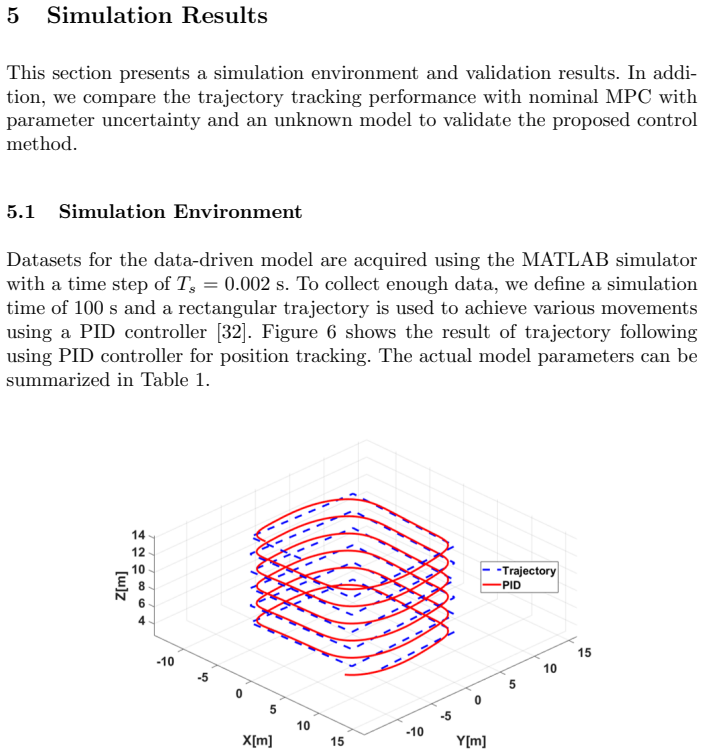
- Training data can be gathered by a standard PID controller following a rectangular path, which is practical for a real drone.
- The method extends SINDy-MPC from attitude and tracking tasks studied earlier to collision-avoidance flight.
Reading between the lines
- Because the training data under-excites yaw, the 33% yaw-damping error suggests the general claim depends on the test trajectory not stressing that axis; a testable extension is to quantify a persistence-of-excitation score for the data collection trajectory and verify closed-loop performance on trajectories that excite yaw.
- The same offline-identified model would likely degrade if the payload changes after learning; an implicit extension is to update the SINDy coefficients online with a sliding window, turning the method into an adaptive MPC.
- The obstacle constraint is a static spherical safe distance; extending to moving obstacles or multiple obstacles would require evaluating the inequality at every prediction step, which the current formulation can likely accommodate but the paper does not demonstrate.
- The comparison baseline is a nominal MPC without adaptation; a fairer practical test would compare against another adaptive or learning controller under the same uncertainty.
Signed reviews
Editorial analysis
A structured set of objections, weighed in public.
Referee Report
Summary. The paper proposes a data-driven model predictive control framework for multirotor trajectory tracking and static-obstacle avoidance. The authors collect flight data from a PID-controlled rectangular trajectory, use sparse identification of nonlinear dynamics (SINDy) with a physics-informed candidate library to identify a full-order translational and rotational model, and then embed the identified model in an MPC formulated with ACADO, adding an obstacle-avoidance inequality constraint. Simulation results are presented for a scenario with 20% mass uncertainty and an unknown aerodynamic model, where SINDy-MPC is reported to track a reference trajectory with lower RMSE than a nominal MPC baseline.
Significance. If the results are valid, the paper offers a useful integration of SINDy and MPC for multirotor collision avoidance under model uncertainty, and it provides a clear demonstration that a sparse, interpretable model can be used inside a constrained optimal-control loop. The use of a physics-informed library and the full-order rotational/translational formulation are reasonable choices, and the reported computation time being below the loop time is a positive indicator for real-time applicability. However, the significance is limited by the fact that the candidate library already contains the true functional forms, so the 'discovery' is largely a coefficient-estimation exercise, and by the lack of independent validation data. Most importantly, the internal consistency problem in the rotational identification table undermines the accuracy claim as written.
major comments (4)
- The true rotational coefficients in Table 3 are not consistent with the plant model defined in Eq. (4) and the parameter values in Table 1. Using Ixx=0.0281, Iyy=0.0286, Izz=0.0551 and KM=0.001, Eq. (4) gives for the p-dot row: L coefficient 1/Ixx=35.59, qr coefficient (Iyy-Izz)/Ixx=-0.943, and damping -KM/Ixx=-0.0356. Table 3 instead reports 32.258, +0.8065, and -0.0323, which correspond to a different inertia set of roughly I=[0.0310, 0.0380, 0.0630] kg*m^2. The q and r rows show the same discrepancy. Consequently, the claimed 'within about 3%' identification accuracy is not verifiable as written, and the closed-loop success in Section 5.3 cannot be traced to a validated identified model. This is a load-bearing internal inconsistency, not a matter of presentation.
- Table 3 reports identified and true coefficients for the terms p*Omega and q*Omega, but the rotational candidate library in Eq. (21) contains only L, M, N, pq, qr, pr, a constant, and polynomials in p, q, r; there is no Omega term anywhere in the library. As written, the SINDy regression in Eq. (23) cannot produce nonzero p*Omega or q*Omega coefficients. The authors should either add these terms to the library definition or explain why the table includes them. This mismatch makes the method unreproducible.
- The data-driven model is validated on the same simulator that generated the training data, and the closed-loop test does not appear to strongly excite the yaw axis, which is the axis for which the authors report a 33% identification error in the damping coefficient. To support the general claim that SINDy discovers the governing equation including aerodynamic effects, the paper should test the identified model on trajectories that differ from the rectangular training trajectory and that include meaningful yaw maneuvers, or should explicitly restrict the claim to the axes and motion regime that were actually excited during data collection.
- The MPC formulation and the simulation comparison are incompletely specified. The horizon N, the prediction sampling time, the weight matrices Q and R, the obstacle position and Dmin, and the control-input limits are not reported, so Table 4 cannot be reproduced. In addition, the collision-avoidance claim is supported only by a qualitative trajectory plot; the paper should report the minimum distance to the obstacle or another quantitative metric showing that the inequality constraint is satisfied.
minor comments (5)
- There is a typo in the Introduction: 'SIDNy' should be 'SINDy'.
- The word 'multitorotor' appears in the text describing the rotational model; it should be 'multirotor'.
- The z-translation row reports a constant term of +9.807, but Eq. (3) with the NED gravity vector g=[0,0,g]^T gives a -g term; the sign convention for the z-axis and thrust direction should be clarified.
- The allocation matrix in Eq. (7) uses signs and the coefficient c_T without defining the sign convention for the thrust forces T_i or the direction of positive moments; this should be stated to make the model unambiguous.
- Reference [20] lists the authors as 'S. L. Brunton E. Kaiser, J. N. Kutz'; the author order and punctuation appear incorrect and should be fixed.
Circularity Check
No significant circularity: the SINDy model is fitted on a rectangular training trajectory and then evaluated on a different reference/obstacle scenario, so the closed-loop result is not forced by construction.
full rationale
The paper's derivation chain is not circular. SINDy is used offline to fit coefficients from a PID-driven rectangular trajectory; the fitted model is then embedded in an MPC and tested on a different trajectory with a static obstacle. The identified coefficients are compared with analytic 'true' values, and a 33% error on the yaw damping coefficient is openly reported, demonstrating that the identification is not forced to match the truth. The physics-informed library terms encode known functional structure but not the coefficient values, so no self-definitional reduction is present. Self-citations ([15], [21], [29]) appear only as related-work context and do not carry the argument. The open-source ACADO solver and the SINDy baseline literature are independent external support. The main caveat is an internal-consistency issue, not a circularity: the 'true' rotational coefficients in Table 3 do not match the values implied by Eq. (4) and Table 1 (e.g., the p-dot L coefficient should be 1/Ixx = 35.59 rather than 32.258), and Table 3 includes pOmega/qOmega terms absent from the stated model. That is a correctness/reproducibility concern about how the simulated plant or the 'true' parameters were generated; it does not amount to a prediction reducing to its inputs by construction. No load-bearing self-citation chain or fitted-parameter-renamed-as-prediction step was found.
Assumptions & free parameters
free parameters (6)
- SINDy L1 regularization parameters (lambda_tr, lambda_ro)
- STLS sparsity threshold
- Polynomial library degrees (d, w)
- MPC horizon N
- MPC weight matrices Q and R
- Obstacle safety distance D_min
assumptions (5)
- domain assumption The multirotor dynamics in Eqs. (1)-(6) with lumped aerodynamic model (9) exactly describe the true plant.
- ad hoc to paper The candidate function library Psi in Eqs. (17)-(21) contains the true functional terms (thrust terms, gyroscopic couplings, and damping terms), so the true dynamics lie in its span.
- standard math The STLS algorithm converges to the global sparse solution of the L1 regression problem (22)-(23).
- domain assumption The ACADO solver returns a feasible locally optimal solution at each MPC step, including with the nonconvex obstacle inequality constraint.
- domain assumption The PID-collected training data are persistently exciting for all states relevant to the closed-loop task.
Cite this review
Pith. "Pith review of Sparse Identification of Nonlinear Dynamics-based Model Predictive Control for Multirotor Collision Avoidance." pith.science (2026). https://pith.science/paper/VF2CADBJ
@misc{pith2026241206388,
  author       = {Pith},
  title        = {Pith review of: Sparse Identification of Nonlinear Dynamics-based Model Predictive Control for Multirotor Collision Avoidance},
  year         = {2026},
  howpublished = {\url{https://pith.science/paper/VF2CADBJ}},
  note         = {Machine review of arXiv:2412.06388}
}
read the original abstract
This paper proposes a data-driven model predictive control for multirotor collision avoidance considering uncertainty and an unknown model from a payload. To address this challenge, sparse identification of nonlinear dynamics (SINDy) is used to obtain the governing equation of the multirotor system. The SINDy can discover the equations of target systems with low data, assuming that few functions have the dominant characteristic of the system. Model predictive control (MPC) is utilized to obtain accurate trajectory tracking performance by considering state and control input constraints. To avoid a collision during operation, MPC optimization problem is again formulated using inequality constraints about an obstacle. In simulation, SINDy can discover a governing equation of multirotor system including mass parameter uncertainty and aerodynamic effects. In addition, the simulation results show that the proposed method has the capability to avoid an obstacle and track the desired trajectory accurately.
Figures


Figures from the paper (7 more)




Reference graph
Works this paper leans on
-
[1]
J. Kim, Y. Choi, S. Jeon, J. Kang, and H. Cha. Optrone: Maximizing performance and energy resources of drone batteries. IEEE Transactions on Computer-Aided Design of Integrated Circuits and Systems, 39(11):3931–3943, 2020
work page 2020
-
[2]
K. Yang, G. Y. Yang, and S. I. H. Fu. Research of control system for plant protection uav based on pixhawk. Procedia Computer Science, 166:371–375, 2020
work page 2020
-
[3]
J. Kwak and Y. Sung. Autonomous uav flight control for gps-based navigation. IEEE Access, 6:37947–37955, 2018
work page 2018
-
[4]
S. Chowdhury, A. Emelogu, M. Marufuzzaman, S. G. Nurre, and L. Bian. Drones for disaster response and relief operations: A continuous approximation model. International Journal of Production Economics, 188:167–184, 2017
work page 2017
-
[5]
A. Khan, S. Gupta, and S. K. Gupta. Emerging uav technology for disaster detec- tion, mitigation, response, and preparedness. Journal of Field Robotics, 39(6):905– 955, 2022
work page 2022
-
[6]
S. Aggarwal and N. Kumar. Path planning techniques for unmanned aerial vehicles: A review, solutions, and challenges. Computer communications, 149:270–299, 2020
work page 2020
-
[7]
B. Rub ´ ı, R. P´ erez, and B. Morcego. A survey of path following control strategies for uavs focused on quadrotors. Journal of Intelligent & Robotic Systems, 98(2):241– 265, 2020
work page 2020
-
[8]
S. H. Mathisen, K. Gryte, T. Johansen, and T. I. Fossen. Non-linear model pre- dictive control for longitudinal and lateral guidance of a small fixed-wing uav in precision deep stall landing. In Aiaa infotech@ aerospace, page 0512. 2016
work page 2016
Show all 32 references
-
[9]
W. Jung, S. Lim, D. Lee, and H. Bang. Unmanned aircraft vector field path following with arrival angle control. Journal of Intelligent & Robotic Systems, 84:311–325, 2016
2016
-
[10]
Lee and H
H. Lee and H. J. Kim. Trajectory tracking control of multirotors from modelling to experiments: A survey. International Journal of Control, Automation and Systems, 15(1):281–292, 2017
2017
-
[11]
H. Ahn, J. Park, H. Bang, and Y. Kim. Model predictive control-based multirotor three-dimensional motion planning with point cloud obstacle. Journal of Aerospace Information Systems, 19(3):179–193, 2022
2022
-
[12]
J. L. Proctor, S. L. Brunton, and J. N. Kutz. Dynamic mode decomposition with control. SIAM Journal on Applied Dynamical Systems, 15(1):142–161, 2016
2016
-
[13]
M. O. Williams, I. G. Kevrekidis, and C. W. Rowley. A data–driven approximation of the koopman operator: Extending dynamic mode decomposition. Journal of Nonlinear Science, 25:1307–1345, 2015
2015
-
[14]
Sansica, J
A. Sansica, J. C. Loiseau, M. Kanamori, A. Hashimoto, and J. C. Robinet. System identification of two-dimensional transonic buffet. AIAA Journal, 60(5):3090–3106, 2022
2022
-
[15]
J. D. Lee, D. Seo, J. Shin, and H. Bang. Fast state-of-health estimation method for lithium-ion battery using sparse identification of nonlinear dynamics. arXiv, 2024
2024
-
[16]
He and D
X. He and D. R. Williams. Pressure feedback control of aerodynamic loads on a delta wing in transverse gusts. AIAA Journal, 61(4):1659–1674, 2023
2023
-
[17]
R. Cao, K. Lu, and Y. Liu. An interpretable data-driven learning approach for nonlinear aircraft systems with noisy interference.IEEE Transactions on Aerospace and Electronic Systems, pages 1–12, 2024
2024
-
[18]
Istiqphara, O
S. Istiqphara, O. Wahyunggoro, and A. I. Cahyadi. Enhanced equation discovery of 3-dof robotic manipulator dynamics using lasso model selection criteria with variable segregation algorithm. IEEE Access, 12:20574–20590, 2024
2024
-
[19]
A. Liu, Y. Xue, H. Qin, and Z. Zhu. Physics-informed identification of marine vehi- cle dynamics using hydrodynamic dictionary library-inspired adaptive regression. Ocean Engineering, 296:117013, 2024
2024
-
[20]
S. L. Brunton E. Kaiser, J. N. Kutz. Sparse identification of nonlinear dynamics for model predictive control in the low-data limit. Proceedings of The Royal Society A, 474(2219), 2018
2018
-
[21]
M. Kang, J. D. Lee, S. Yun, and H. Bang. Data-driven model discovery and control of high-performance trainer aircraft via sparse identification of nonlinear dynamics. 34th Congress of the International Council of the Aeronautical Sciences, 2024
2024
-
[22]
Bhadriraju, J
B. Bhadriraju, J. S. I. Kwon, and F. Khan. A data-driven framework integrating lyapunov-based mpc and oasis-based observer for control beyond training domains. Journal of Process Control, 138:103224, 2024
2024
-
[23]
Manzoor, H
T. Manzoor, H. Pei, Y. Xia, Z. Sun, and Y. Ali. Compound learning-based model predictive control approach for ducted-fan aerial vehicles. IEEE Transactions on Neural Networks and Learning Systems, pages 1–13, 2024
2024
-
[24]
Manzoor, T.and Pei, Z
H. Manzoor, T.and Pei, Z. Sun, and Z. Cheng. Model predictive control technique for ducted fan aerial vehicles using physics-informed machine learnwing. Drones, 7(1), 2023
2023
-
[25]
Bhattacharya, R
D. Bhattacharya, R. Hashem, L. K. Cheng, and W. Xu. Nonlinear model predictive control of a robotic soft esophagus. IEEE Transactions on Industrial Electronics, 69(10):10363–10373, 2022
2022
-
[26]
Kelm and S
B. Kelm and S. Myschik. Model-based control reconfiguration of a multirotor uav using online system identification by sparse regression (sindyc). AIAA A VIATION 2023 Forum
2023
-
[27]
Z. M. Manaa, M. R. Elbalshy, and A. M. Abdallah. Data-driven discovery of the quadrotor equations of motion via sparse identification of nonlinear dynamics. AIAA SCITECH 2024 Forum
2024
-
[28]
R. D. Vel´ azquez-S´ anchez, J. O. Escobedo-Alva, R. Pe˜ na-Garc ´ ıa, R. Tapia-Herrera, and J. A. Meda-Campa˜ na. Identification of high-order nonlinear coupled systems using a data-driven approach. Applied Sciences, 14(9), 2024
2024
-
[29]
J. D. Lee, S. Im, and H. Bang. Data-driven fault detection and isolation for quadro- tor using sparse identification of nonlinear dynamics and Thau observer. 2024 International Conference on Unmanned Aircraft Systems, pages 382–389, 2024
2024
-
[30]
H. Lee, J. Kim, and Y. Kim. Sliding surface-based integral reinforcement learn- ing for optimal tracking control of quadcopters considering uncertainties. IEEE Transactions on Aerospace and Electronic Systems, pages 1–15, 2024
2024
-
[31]
Houska, H
B. Houska, H. J. Ferreau, and M. Diehl. Acado toolkit–an open source framework for automatic control and dynamic optimization. Optimal Control Applications and Methods, 32:298 – 312, 05 2011
2011
-
[32]
Pid control of quadrotor uavs: A survey
Ivan Lopez-Sanchez and Javier Moreno-Valenzuela. Pid control of quadrotor uavs: A survey. Annual Reviews in Control, 56:100900, 2023
2023
Reviewed August 11, 2026 · model on record in the stance chip above.
Discussion (0). Continue with ORCID to comment.