REVIEW 2 major objections 4 minor 7 cited by
Did IceCube discover Dark Matter around Blazars?
T0 review · 2 major / 4 minor · reviewed 2026-08-11 · deepseek-v4-flash
Pith's one-line read The paper proposes that the 2017 IceCube neutrino from TXS 0506+056 came from deep inelastic collisions between protons in the blazar's jet and sub-GeV dark matter in a spike around its black hole, making it a candidate first…
desk verdict A novel, carefully executed mechanism for blazar neutrinos worth engaging, but the headline claim rests on a spike column density that DM annihilations can erode. read the letter →
The pith
A machine-rendered reading of the paper's core claim, the machinery that carries it, and where it could break.
The reading
What carries the argument
The load-bearing quantity is the line-of-sight dark matter column density through the spike, $\Sigma^{\rm spike}_{\mathrm{DM}} = \int_{r_{\min}}^{R_{\rm sp}}\rho_{\rm DM}(r')\,dr'$, where $\rho_{\rm DM}$ follows a Gondolo-Silk spike with $\rho_{\rm DM}\propto r^{-7/3}$ normalized so dark matter inside $R_{\star}\simeq 10^6 R_S$ amounts to about 10% of the black hole mass. The predicted neutrino flux is linearly proportional to this single integral, so its normalization controls the entire result. The particle-physics engine is a deep inelastic scattering cross section for a vector mediator coupling dark matter to first-generation quarks, folded with parton distribution functions and a Monte Carlo showering chain to obtain the number of neutrinos produced per collision as a function of energy.
What would settle it
Determine the dark matter column density inside $10^2\,R_S$ of the TXS 0506+056 black hole from independent astrophysical probes such as stellar kinematics, pulsar timing, or gravitational lensing; if it is more than an order of magnitude below $6.9\times10^{28}\,\mathrm{GeV\,cm^{-2}}$, the predicted neutrino signal cannot match the 2017 IceCube event without cross sections that direct-detection or big bang nucleosynthesis bounds already exclude.
Extended reading notes
Core claim
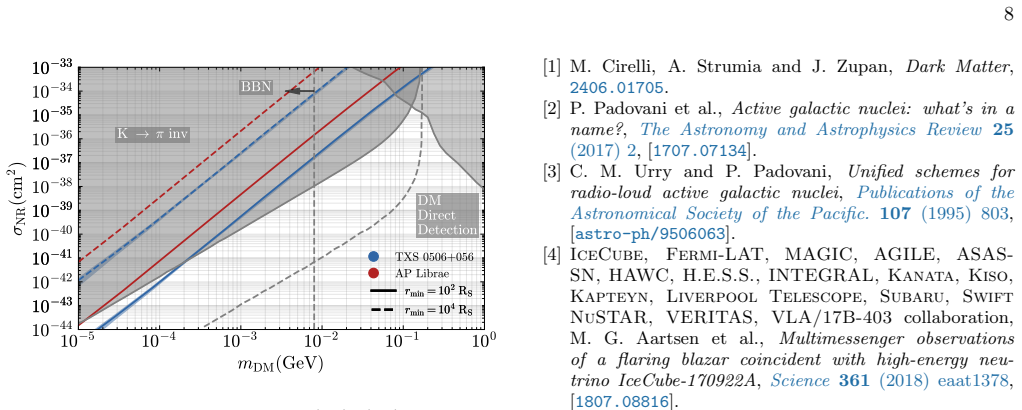
The central claim is that the PeV neutrino IceCube-170922A from TXS 0506+056, which standard lepto-hadronic jet models underpredict by about two orders of magnitude, can be explained by deep inelastic scattering of jet protons off a spike of sub-GeV dark matter around the black hole. The predicted flux is proportional to the line-of-sight column density of the spike, and with a fiducial spike starting at $10^2\,R_S$ the required non-relativistic dark matter-proton cross sections lie between roughly $10^{-45}$ and $10^{-35}\,\mathrm{cm}^2$ for dark matter masses from $10^{-5}$ to $1\,\mathrm{GeV}$, values that evade every current bound from direct detection, LEP searches, and big bang nucleosynthesis. The same mechanism also raises the neutrino flux from AP Librae, showing TXS 0506+056 is not an isolated case, and the conclusion survives the choice between the two fitted jet models for TXS 0506+056. The paper frames the result as the possibility that the first neutrino detected from a blazar is the first sign of a non-gravitational dark matter interaction.
Load-bearing premise
The load-bearing premise is that a dense cusp of dark matter around the black hole contains as much mass as the calculation assumes and begins at the assumed inner radius; if the cusp is eroded, starts farther out, or is lighter, the required interaction strength rises above what experiments currently allow.
Editorial extensions
If this is right
- If the proposal is correct, the 2017 IceCube event from TXS 0506+056 is a candidate first non-gravitational detection of dark matter rather than a purely hadronic jet neutrino.
- The mechanism generically predicts that dark matter-proton scattering dominates the neutrino flux from other blazars, not just TXS 0506+056, so stacking analyses of blazar neutrinos become dark matter searches.
- The energy shape of the dark matter-induced flux depends on the dark matter mass at low neutrino energies, so future coincident blazar-neutrino observations can discriminate this mechanism from conventional jet emission.
- The dark matter parameters needed are within the reach of current and next-generation direct detection and low-energy collider searches, meaning the scenario can be confirmed or refuted by non-astrophysical experiments.
- Including dark matter-proton scattering in jet fits could simultaneously relieve the too-large proton luminosities that plague lepto-hadronic models.
Reading between the lines
- Inference: because the dark matter column density is steady, the same mechanism would also explain the 2014/15 TXS 0506+056 neutrino flare without requiring a simultaneous photon flare, giving a second, independent observational handle.
- Inference: stacking many blazars and looking for the characteristic low-energy turnover of dark matter-proton deep inelastic scattering could measure the dark matter mass, since the flux shape depends on $m_{\mathrm{DM}}$ only at low $E_\nu$.
- Inference: if the scenario is right, proton jets that are not aimed at Earth would still scatter off the same dark matter spike, producing a population of upscattered dark matter particles and isotropic lower-energy neutrinos that existing neutrino telescopes could search for.
Signed reviews
Editorial analysis
A structured set of objections, weighed in public.
Referee Report
Summary. The paper proposes that the IceCube 2017 neutrino from TXS 0506+056 was produced by deep inelastic scattering between protons in the blazar jet and sub-GeV dark matter accumulated in a spike around the central supermassive black hole. Starting from existing lepto-hadronic jet models for TXS 0506+056 and AP Librae, the authors compute the neutrino flux from DM-proton DIS, normalize it to the IceCube event, and then compare the required DM-proton cross section with direct-detection, LEP, and BBN constraints. They find an allowed region for a vector-mediator model with m_DM in the sub-GeV range and claim that the mechanism is robust across two jet models for TXS 0506+056 and also viable for AP Librae.
Significance. If the claimed parameter region survives closer scrutiny, the paper would open a genuinely new and falsifiable channel for non-gravitational dark matter detection: high-energy neutrinos from blazar jets scattering on DM spikes. The manuscript has real strengths. The flux formula in Eq. (2) is transparent; the analytic DIS cross section in Eq. (B1) is checked against MadGraph5 at the 20% level; the calculation is repeated for two independent TXS jet models and one additional blazar; and the required couplings are compared with a broad set of laboratory, direct-detection, and cosmological bounds. The predicted spectral shape is distinct from standard jet neutrinos, so future multi-neutrino associations can test the proposal. The main weakness is not the collider or direct-detection side but the input dark matter column density, which is admittedly 'somewhat arbitrary' and controls the flux linearly.
major comments (2)
- [Sec. 3 and Appendix A, Eq. (A3)] The high-flux benchmark BMCI is not self-consistent for a dark matter candidate with a thermal s-wave annihilation cross section. Requiring r_ann < r_min, as stated after Eq. (1), imposes <sigma_ann v_rel> <~ 3.1 x 10^-30 (m_DM/GeV) cm^3/s for r_min = 10^2 R_S (Eq. (A3)); for m_DM = 30 MeV this is about 9 x 10^-32 cm^3/s, roughly five orders of magnitude below the canonical thermal value ~3 x 10^-26 cm^3/s. For a thermal candidate the annihilation plateau has r_ann > r_min, so the column density in Eq. (1) should be computed from the annihilation-modified profile (a core contribution rho_core r_ann plus the surviving outer spike) rather than from a geometric cutoff of the unmodified Gondolo-Silk profile. Since Eq. (2) makes the predicted flux linear in Sigma_spike_DM, the resulting upward shift in the required sigma_NR is the decisive check of the 'allowed by all searches' claim. I ask the authors to perform the calculation with the annihilation-modified profile, or alternatively to state explicitly and consistently that the BMCI claim applies only to non-thermal (e.g. freeze-in) dark matter with strongly suppressed annihilation.
- [Sec. 3, Eq. (1)] The normalization of the DM spike is not derived from observations: the paper fixes R_sp = R_star = 10^6 R_S and chooses N so that dark matter inside R_star is only O(10%) of M_BH, calling the normalization 'somewhat arbitrary.' Because the predicted neutrino flux is proportional to the column density, the central conclusion that the required dark matter parameters are allowed by all existing searches inherits the full uncertainty of this choice. The two benchmarks r_min = 10^2 R_S and r_min = 10^4 R_S bracket the geometric integration limit, but they do not cover profile-shape modifications induced by annihilations, mergers, or stellar heating, which change rho_DM(r) rather than only the lower integration limit. I recommend presenting the required sigma_NR as a function of Sigma_spike_DM (or of the integrated dark matter mass along the jet path), so that the reader can see how much spike erosion is tolerated before the model is excluded by direct-detection or BBN bounds.
minor comments (4)
- [After Eq. (1)] The threshold values 1.4 x 10^-25 and 3.1 x 10^-30 cm^3 s^-1 (m_DM/GeV) should be explicitly assigned to r_min = 10^4 R_S (BMCII) and r_min = 10^2 R_S (BMCI); the current parenthetical order is easy to misread, and the same ambiguity appears in Appendix A.
- [Fig. 4] The monochromatic-jet benchmark would be more reproducible if the text stated whether the same angular cone (1 - 10^-5 <= cos theta <= 1) and the same MadGraph/Pythia event-selection settings were used as in the main flux calculation.
- [Reference [96]] Reference [96] is a conference contribution without a stable archival identifier; please update it to the published KM3NeT paper or to a stable arXiv entry once available.
- [Summary and discussion] The phrase 'call out loud' is nonstandard; consider 'call for' or 'highlight.'
Circularity Check
No significant circularity: the TXS flux normalization is fitted to the observed event, but the paper's substantive checks (external limits and AP Librae) are independent.
full rationale
The derivation chain is: assume a GS DM spike with chosen normalization and rmin; compute DM-proton DIS neutrino flux via Eq. (2), which is proportional to the column density; for TXS 0506+056, choose mDM and sigma_NR so that the flux matches the IceCube 2017 event (Fig. 2 lines); then test these sigma_NR against direct detection, LEP, BBN, and the IceCube 1FLE stacking limit including AP Librae. The matching of the TXS amplitude is a fit, not a first-principles prediction, and the paper is transparent that the spike normalization is 'somewhat arbitrary' and that 'large uncertainties reside in rmin'. This weakens the claim but does not make it circular. The non-circular content is substantial: the required couplings are compared with independent external constraints, the spectral shape is computed from perturbative DIS plus Pythia8 (validated against MadGraph and analytic cross sections), the AP Librae flux is an independent prediction, and the results are shown for two jet models. The annihilation-consistency check in Appendix A and the BBN caveat are stated rather than hidden. Self-citations [7,8,94,95] provide formulas and companion studies but are not load-bearing; the central allowed-region check uses external data. Score 1 reflects only the minor self-citation content and the fitted normalization, which is acknowledged by the authors.
Assumptions & free parameters
free parameters (6)
- rmin benchmark =
10^2 R_S (BMCI), 10^4 R_S (BMCII)
- DM spike radius Rsp =
10^6 R_S (= R⋆)
- DM spike normalization N =
N ≈ 3 × 10^-6 M_sun / R_S^2
- Mediator mass m_V =
5 GeV
- Dark matter mass m_DM =
scanned over 10^-5 to 1 GeV in Fig. 2
- DM-proton coupling product (g_χV g_pV or σ_NR) =
values shown in Fig. 2 (lines matching the IceCube event)
assumptions (6)
- domain assumption Gondolo-Silk spike with initial NFW profile (γ = 1) and α_GS = 7/3 describes DM around the blazar BH.
- domain assumption The lepto-hadronic jet fits of [18-20,49] give the correct proton spectra and extend through the DM spike region.
- domain assumption DM is a Dirac fermion with a vector mediator (m_V = 5 GeV) coupling to first-generation quarks.
- domain assumption Deep inelastic scattering dominates DM-proton collisions; QCD resonances are neglected.
- domain assumption Every jet proton traverses the full DM column density from rmin to Rsp.
- domain assumption DM annihilations do not flatten the spike inside rmin for the benchmark annihilation cross sections.
invented entities (1)
-
Sub-GeV Dirac fermion dark matter χ with a 5 GeV vector mediator V coupled to u and d quarks
independent evidence
Cite this review
Pith. "Pith review of Did IceCube discover Dark Matter around Blazars?." pith.science (2026). https://pith.science/paper/MXHN76CH
@misc{pith2026241207861,
  author       = {Pith},
  title        = {Pith review of: Did IceCube discover Dark Matter around Blazars?},
  year         = {2026},
  howpublished = {\url{https://pith.science/paper/MXHN76CH}},
  note         = {Machine review of arXiv:2412.07861}
}
read the original abstract
Models of blazar jets, that explain observations of their photon spectra, typically predict too few neutrinos to be possibly seen by existing telescopes. In particular, they fall short in reproducing the first neutrino ever detected from a blazar, TXS 0506+056, by IceCube in 2017. We predict larger neutrino fluxes by using the same jet models, extended to include deep inelastic scatterings between protons within the jets and sub-GeV dark matter (DM) around the central black holes of blazars. In this way we succeed in explaining neutrino observations of TXS 0506+056, for DM parameters allowed by all laboratory, direct and indirect searches. Our proposal will be tested by DM searches, as well as by the observation of more neutrinos from blazars. Our findings motivate to implement DM-nuclei interactions in jet models and to improve our knowledge of DM spikes around active galactic nuclei.
Figures


Figures from the paper (2 more)

Forward citations
Cited by 7 Pith papers
-
Astrophysical Neutrino Sources as Colliders
Neutrino point-source observations (IceCube, KM3NeT) can bound inelastic pp and pγ cross sections from √s ≈ 1 GeV to ~10^5 GeV, extending beyond LHC/HERA and sometimes below unitarity limits.
-
Galactic Center Neutrinos from Cosmic Ray-Dark Matter Interactions
ANTARES Galactic Ridge neutrino observations constrain DM-nucleon elastic scattering cross sections down to keV-scale DM masses via cosmic ray–dark matter deep inelastic scattering.
-
Dark Matter Heating of Compact Stars Beyond Capture: A Relativistic Framework for Energy Deposition by Particle Beams
A new relativistic formalism computes capture and energy deposition of directed particle beams in compact stars, applied to blazar-boosted dark matter heating of white dwarfs and neutron stars.
-
`Dark' Matter Effect as a Novel Solution to the KM3-230213A Puzzle
Dark matter scattering in the Earth, sourced by a flaring blazar, can explain the KM3-230213A event while yielding few or no IceCube events in a viable parameter space.
-
Cosmic-ray boosted inelastic dark matter from neutrino-emitting active galactic nuclei
A cosmic-ray boosted, inelastic dark matter flux from two neutrino-emitting AGNs gives new Super-K and XENONnT limits that reach part of the thermal freeze-out target for sub-GeV dark matter.
-
Sub-GeV Dark Matter Under Pressure from Direct Detection
PandaX-4T S2-only data yields world-leading sub-GeV dark matter-electron scattering limits for heavy mediators in the 20-200 MeV range, although the result largely overlaps with the collaboration's own just-released analysis.
-
Blazar Boosted ALP and vector portal Dark matter confronting light mediator searches
Blazar-boosted dark matter scattering in Super-Kamiokande can exclude previously unconstrained parameter space for ALP- and vector-mediated sub-MeV dark matter, beating BaBar, NA64, beam dump, and stellar cooling limi...
Reference graph
Works this paper leans on
- [1]
-
[2]
P. Padovani et al., Active galactic nuclei: what’s in a name?, The Astronomy and Astrophysics Review 25 (2017) 2, [ 1707.07134]
arXiv 2017
-
[3]
C. M. Urry and P. Padovani, Unified schemes for radio-loud active galactic nuclei , Publications of the Astronomical Society of the Pacific. 107 (1995) 803, [astro-ph/9506063]
arXiv 1995
-
[4]
IceCube, Fermi-LAT, MAGIC, AGILE, ASAS- SN, HA WC, H.E.S.S., INTEGRAL, Kanata, Kiso, Kapteyn, Liverpool Telescope, Subaru, Swift NuSTAR, VERITAS, VLA/17B-403 collaboration, M. G. Aartsen et al., Multimessenger observations of a flaring blazar coincident with high-energy neu- trino IceCube-170922A , Science 361 (2018) eaat1378, [1807.08816]
arXiv 2018
-
[5]
P. Gondolo and J. Silk, Dark matter annihilation at the galactic center, Physical Review Letters 83 (1999) 1719– 1722, [astro-ph/9906391]
arXiv 1999
-
[6]
M. Gorchtein, S. Profumo and L. Ubaldi, Probing Dark Matter with AGN Jets , Physical Review D 82 (2010) 083514, [1008.2230]
arXiv 2010
-
[7]
J.-W. Wang, A. Granelli and P. Ullio, Direct Detection Constraints on Blazar-Boosted Dark Matter , Physical Review Letters 128 (2022) 221104, [ 2111.13644]
arXiv 2022
-
[8]
A. Granelli, P. Ullio and J.-W. Wang, Blazar-boosted dark matter at Super-Kamiokande , Journal of Cos- mology and Astroparticle Physics 07 (2022) 013, [2202.07598]
arXiv 2022
Show all 101 references
-
[9]
Essig et al., Snowmass2021 Cosmic Frontier: The landscape of low-threshold dark matter direct detec- tion in the next decade , in Snowmass 2021 , 3, 2022
R. Essig et al., Snowmass2021 Cosmic Frontier: The landscape of low-threshold dark matter direct detec- tion in the next decade , in Snowmass 2021 , 3, 2022. 2203.08297
2021 arXiv
-
[10]
Bringmann and M
T. Bringmann and M. Pospelov, Novel direct detection constraints on light dark matter, Physical Review Letters 122 (2019) 171801, [ 1810.10543]
2019 arXiv
-
[11]
Ning et al., Search for Light Dark Matter from the Atmosphere in PandaX-4T, Phys- ical Review Letters 131 (2023) 041001, [ 2301.03010]
PandaX collaboration, X. Ning et al., Search for Light Dark Matter from the Atmosphere in PandaX-4T, Phys- ical Review Letters 131 (2023) 041001, [ 2301.03010]
2023 arXiv
-
[12]
Y. Ema, F. Sala and R. Sato, Neutrino experiments probe hadrophilic light dark matter , SciPost Physics 10 (2021) 072, [ 2011.01939]
2021 arXiv
-
[13]
Abe et al., Search for Cosmic-Ray Boosted Sub-GeV Dark Mat- ter Using Recoil Protons at Super-Kamiokande, Physical Review Letters 130 (2023) 031802, [ 2209.14968]
Super-Kamiokande collaboration, K. Abe et al., Search for Cosmic-Ray Boosted Sub-GeV Dark Mat- ter Using Recoil Protons at Super-Kamiokande, Physical Review Letters 130 (2023) 031802, [ 2209.14968]
2023 arXiv
-
[14]
Y. Ema, F. Sala and R. Sato, Light Dark Matter at Neu- trino Experiments, Physical Review Letters 122 (2019) 181802, [1811.00520]
2019 arXiv
-
[15]
Alvey, M
J. Alvey, M. Campos, M. Fairbairn and T. You, De- tecting Light Dark Matter via Inelastic Cosmic Ray Collisions, Physical Review Letters 123 (2019) 261802, [1905.05776]
2019 arXiv
-
[16]
G. Cao, X. Geng, J. Wang and X. Yang, Progress in multi-messenger observations and emission models of blazars, New Astronomy Reviews 98 (2024) 101693
2024
-
[17]
S. Gao, A. Fedynitch, W. Winter and M. Pohl, Mod- elling the coincident observation of a high-energy neu- trino and a bright blazar flare , Nature Astronomy 3 (2019) 88–92, [ 1807.04275]
2019 arXiv
-
[18]
Cerruti, A
M. Cerruti, A. Zech, C. Boisson, G. Emery, S. In- oue and J. P. Lenain, Leptohadronic single-zone models for the electromagnetic and neutrino emission of TXS 9 0506+056, Monthly Notices of the Royal Astronomical Society 483 (2019) L12–L16, [ 1807.04335]
2019 arXiv
-
[19]
Cerruti, A
M. Cerruti, A. Zech, C. Boisson, G. Emery, S. Inoue and J.-P. Lenain, Erratum: Lepto-hadronic single-zone models for the electromagnetic and neutrino emission of TXS 0506+056 , Monthly Notices of the Royal Astro- nomical Society: Letters 502 (Jan, 2021) L21–L22
2021
-
[20]
A. Keivani et al., A Multimessenger Picture of the Flaring Blazar TXS 0506+056: implications for High- Energy Neutrino Emission and Cosmic Ray Accel- eration, The Astrophysical Journal 864 (2018) 84, [1807.04537]
2018 arXiv
-
[21]
Blandford, D
R. Blandford, D. Meier and A. Readhead, Relativis- tic Jets from Active Galactic Nuclei , Annual Review of Astronomy and Astrophysics 57 (2019) 467–509, [1812.06025]
2019 arXiv
-
[22]
C. D. Dermer and G. Menon, High Energy Radiation from Black Holes: Gamma Rays, Cosmic Rays, and Neutrinos. Princeton University Press, 10, 2009
2009
-
[23]
for a review). By allowing for ultra-relativistic pro- arXiv:2412.07861v3 [astro-ph.HE] 1 Sep 2025 2 tons, these models have the intrinsic property to predict high-energy secondary neutrinos from photo-meson and proton-proton interactions. Lepto-hadronic models at- tracted inc...
2025 arXiv
-
[24]
Cerruti, Leptonic and Hadronic Radiative Processes in Supermassive-Black-Hole Jets , Galaxies 8 (2020) 72, [2012.13302]
M. Cerruti, Leptonic and Hadronic Radiative Processes in Supermassive-Black-Hole Jets , Galaxies 8 (2020) 72, [2012.13302]
2020 arXiv
-
[25]
IceCube collaboration, M. G. Aartsen et al., Neutrino emission from the direction of the blazar TXS 0506+056 prior to the IceCube-170922A alert , Science 361 (2018) 147–151, [1807.08794]
2018 arXiv
-
[26]
Padovani, P
P. Padovani, P. Giommi, E. Resconi, T. Glauch, B. Arsioli, N. Sahakyan et al., Dissecting the region around IceCube-170922A: the blazar TXS 0506+056 as the first cosmic neutrino source , Monthly Notices of the Royal Astronomical Society 480 (2018) 192–203, [1807.04461]
2018 arXiv
-
[27]
Fermi-LAT, ASAS-SN, IceCube collaboration, S. Garrappa et al., Investigation of two Fermi-LAT gamma-ray blazars coincident with high-energy neu- trinos detected by IceCube , The Astrophysical Journal 880 (2019) 880:103, [ 1901.10806]
2019
-
[28]
MAGIC collaboration, S. Ansoldi et al., The blazar TXS 0506+056 associated with a high-energy neutrino: insights into extragalactic jets and cosmic ray accelera- tion, The Astrophysical Journal Letters 863 (2018) L10, [1807.04300]
2018
-
[29]
R.-Y. Liu, K. Wang, R. Xue, A. M. Taylor, X.-Y. Wang, Z. Li et al., Hadronuclear interpretation of a high-energy neutrino event coincident with a blazar flare , Physical Review D 99 (2019) 063008, [ 1807.05113]
2019 arXiv
-
[30]
Righi, F
C. Righi, F. Tavecchio and S. Inoue, Neutrino emission from BL Lac objects: the role of radiatively inefficient accretion flows, Monthly Notices of the Royal Astronom- ical Society 483 (2019) L127–L131, [ 1807.10506]
2019 arXiv
-
[31]
Sahakyan, Lepto-hadronic γ-ray and neutrino emis- sion from the jet of TXS 0506+056 , The Astrophysical Journal 866 (2018) 109, [ 1808.05651]
N. Sahakyan, Lepto-hadronic γ-ray and neutrino emis- sion from the jet of TXS 0506+056 , The Astrophysical Journal 866 (2018) 109, [ 1808.05651]
2018 arXiv
-
[32]
Rodrigues, S
X. Rodrigues, S. Gao, A. Fedynitch, A. Palladino and W. Winter, Leptohadronic Blazar Models Applied to the 2014–2015 Flare of TXS 0506+056 , The Astrophysical Journal Letters 874 (2019) L29, [ 1812.05939]
2019 arXiv
-
[33]
Zhang, K
H. Zhang, K. Fang, H. Li, D. Giannios, M. B¨ ottcher and S. Buson, Probing the Emission Mechanism and Mag- netic Field of Neutrino Blazars with Multiwavelength Polarization Signatures, The Astrophysical Journal 876 (2019) 109, [ 1903.01956]
2019 arXiv
-
[34]
Xue, R.-Y
R. Xue, R.-Y. Liu, M. Petropoulou, F. Oikonomou, Z.- R. Wang, K. Wang et al., A two-zone model for blazar emission: implications for TXS 0506+056 and the neu- trino event IceCube-170922A , 1908.10190
1908 arXiv
-
[35]
Oikonomou, K
F. Oikonomou, K. Murase, P. Padovani, E. Resconi and P. M´ esz´ aros,High energy neutrino flux from individual blazar flares, Monthly Notices of the Royal Astronomical Society 489 (2019) 4347–4366, [ 1906.05302]
2019 arXiv
-
[36]
Petropoulou et al., Multi-Epoch Modeling of TXS 0506+056 and Implications for Long-Term High-Energy Neutrino Emission , The Astrophysical Journal 891 (2020) 115, [ 1911.04010]
M. Petropoulou et al., Multi-Epoch Modeling of TXS 0506+056 and Implications for Long-Term High-Energy Neutrino Emission , The Astrophysical Journal 891 (2020) 115, [ 1911.04010]
2020 arXiv
-
[37]
Gasparyan, D
S. Gasparyan, D. B´ egu´ e and N. Sahakyan, Time- dependent lepto-hadronic modelling of the emission from blazar jets with SOPRANO: the case of TXS 0506 + 056, 3HSP J095507.9 + 355101, and 3C 279 , Monthly Notices of the Royal Astronomical Society 509 (2021) 2102–2121, [ 2110.01549]
2021 arXiv
-
[38]
Khatee Zathul, M
A. Khatee Zathul, M. Moulai, K. Fang and F. Halzen, An NGC 1068-Informed Understanding of Neutrino Emission of the Active Galactic Nucleus TXS 0506+056, 2411.14598
-
[39]
Kadler et al., Coincidence of a high-fluence blazar outburst with a PeV-energy neutrino event , Nature Physics 12 (2016) 807–814, [ 1602.02012]
M. Kadler et al., Coincidence of a high-fluence blazar outburst with a PeV-energy neutrino event , Nature Physics 12 (2016) 807–814, [ 1602.02012]
2016 arXiv
-
[40]
V. S. Paliya, M. B¨ ottcher, A. Olmo-Garc ´ ıa, A. Dom ´ ınguez, A. Gil de Paz, A. Franckowiak et al., Multifrequency Observations of the Candidate Neutrino-emitting Blazar BZB J0955+3551 , The Astrophysical Journal 902 (2020) 29, [ 2003.06012]
2020 arXiv
-
[41]
Rodrigues, S
X. Rodrigues, S. Garrappa, S. Gao, V. S. Paliya, A. Franckowiak and W. Winter, Multiwavelength and Neutrino Emission from Blazar PKS 1502 + 106 , The Astrophysical Journal 912 (2021) 54, [ 2009.04026]
2021 arXiv
-
[42]
Oikonomou, M
F. Oikonomou, M. Petropoulou, K. Murase, A. To- huvavohu, G. Vasilopoulos, S. Buson et al., Multi- messenger emission from the parsec-scale jet of the flat- spectrum radio quasar coincident with high-energy neu- trino IceCube-190730A, Journal of Cosmology and As- troparticle P...
2021 arXiv
-
[43]
Liao, Z.-F
N.-H. Liao, Z.-F. Sheng, N. Jiang, Y.-L. Chang, Y.-B. Wang, D.-L. Xu et al., GB6 J2113+1121: A Multiwave- length Flaring γ-Ray Blazar Temporally and Spatially Coincident with the Neutrino Event IceCube-191001A , The Astrophysical Journal Letters 932 (2022) L25, [2202.03788]
2022 arXiv
-
[44]
Sahakyan, P
N. Sahakyan, P. Giommi, P. Padovani, M. Petropoulou, D. B´ egu´ e, B. Boccardi et al.,A multimessenger study of the blazar PKS 0735+178: a new major neutrino source candidate, Monthly Notices of the Royal Astronomical Society 519 (2022) 1396–1408, [ 2204.05060]
2022 arXiv
-
[45]
Jiang, N.-H
X. Jiang, N.-H. Liao, Y.-B. Wang, R. Xue, N. Jiang and T.-G. Wang, The Awakening of a Blazar at Redshift 2.7 Temporally Coincident with the Arrival of Cospa- tial Neutrino Event IceCube-201221A , The Astrophysi- cal Journal Letters 965 (2024) L2, [ 2401.12122]
2024 arXiv
-
[46]
Ji and Z
S. Ji and Z. Wang, PKS 2254+074: A Blazar in Likely Association with the Neutrino Event IceCube-190619A , 2410.14079
-
[47]
S. Ji, Z. Wang and D. Zheng, PKS˜2332−017 and PMN J1916−1519: Candidate Blazar Counterparts to Two High-energy Neutrino Events , 2411.01448
-
[48]
Giommi and P
P. Giommi and P. Padovani, Astrophysical Neutrinos and Blazars , Universe 7 (2021) 492, [ 2112.06232]
2021 arXiv
-
[49]
Boettcher, M
M. Boettcher, M. Fu, T. Govenor, Q. King and P. Rous- tazadeh, Multiwavelength and Multimessenger Observa- 10 tions of Blazars and Theoretical Modeling: Blazars as Astrophysical Neutrino Sources, Acta Physics Polonica Supplement 15 (2022) 8, [ 2204.12242]
2022 arXiv
-
[50]
Rodrigues, V
X. Rodrigues, V. S. Paliya, S. Garrappa, A. Omeliukh, A. Franckowiak and W. Winter, Leptohadronic multi- messenger modeling of 324 gamma-ray blazars , Astron- omy & Astrophysics 681 (2024) A119, [ 2307.13024]
2024 arXiv
-
[51]
Abbasi et al., Search for Astrophysical Neutrinos from 1FLE Blazars with IceCube , The Astrophysical Journal 938 (2022) 38, [ 2207.04946]
R. Abbasi et al., Search for Astrophysical Neutrinos from 1FLE Blazars with IceCube , The Astrophysical Journal 938 (2022) 38, [ 2207.04946]
2022
-
[52]
Paiano, R
S. Paiano, R. Falomo, A. Treves and R. Scarpa, The redshift of the BL Lac object TXS 0506+056, The Astro- physical Journal Letters 854 (2018) L32, [1802.01939]
2018 arXiv
-
[53]
M. J. Disney, B. A. Peterson and A. W. Rodgers, The Redshift and Composite Nature of AP Librae (pks 1514- 24), The Astrophysical Journal 194 (Dec., 1974) L79
1974
-
[54]
Stickel, J
M. Stickel, J. W. Fried and H. Kuehr, The complete sample of 1 Jy BL Lac objects. II. Observational data. , Astronomy & Astrophysics 98 (1993) 393–442
1993
-
[55]
D. H. Jones, M. A. Read, W. Saunders, M. Colless, T. Jarrett, Q. A. Parker et al., The 6dF Galaxy Sur- vey: final redshift release (DR3) and southern large- scale structures , Monthly Notices of the Royal Astro- nomical Society 399 (Oct., 2009) 683–698, [0903.5451]
2009 arXiv
-
[56]
Navas et al., Review of particle physics , Physical Review D 110 (2024) 030001
Particle Data Groupcollaboration, S. Navas et al., Review of particle physics , Physical Review D 110 (2024) 030001
2024
-
[57]
Padovani, P
P. Padovani, P. Giommi, R. Falomo, F. Oikonomou, M. Petropoulou, T. Glauch et al.,The spectra of IceCube neutrino (SIN) candidate sources – II. Source charac- terization, Monthly Notices of the Royal Astronomical Society 510 (2022) 2671–2688, [ 2112.05394]
2022 arXiv
-
[58]
J.-H. Woo, C. M. Urry, R. P. van der Marel, P. Lira and J. Maza, Black Hole Masses and Host Galaxy Evolution of Radio-Loud Active Galactic Nuclei , The Astrophysical Journal 631 (Oct., 2005) 762–772, [astro-ph/0506316]
2005 arXiv
-
[59]
Abbasi et al., Improved Characterization of the As- trophysical Muon–neutrino Flux with 9.5 Years of Ice- Cube Data , The Astrophysical Journal 928 (2022) 50, [2111.10299]
R. Abbasi et al., Improved Characterization of the As- trophysical Muon–neutrino Flux with 9.5 Years of Ice- Cube Data , The Astrophysical Journal 928 (2022) 50, [2111.10299]
2022
-
[60]
Hagiwara et al., Search for Astronomical Neutrinos from Blazar TXS 0506+056 in Super-Kamiokande , The Astrophysical Journal Letters 887 (2019) L6, [ 1910.07680]
Super-Kamiokande collaboration, K. Hagiwara et al., Search for Astronomical Neutrinos from Blazar TXS 0506+056 in Super-Kamiokande , The Astrophysical Journal Letters 887 (2019) L6, [ 1910.07680]
2019
-
[61]
Reimann, Search for the sources of the astrophysical high-energy muon-neutrino flux with the IceCube neu- trino observatory
R. Reimann, Search for the sources of the astrophysical high-energy muon-neutrino flux with the IceCube neu- trino observatory. PhD thesis, R WTH Aachen U., 2019. 10.18154/R WTH-2019-11012
2019 doi
-
[62]
IceCube collaboration, M. G. Aartsen et al., Differ- ential limit on the extremely-high-energy cosmic neu- trino flux in the presence of astrophysical background from nine years of IceCube data , Physical Review D 98 (2018) 062003, [ 1807.01820]
2018 arXiv
-
[63]
Merritt, Single and binary black holes and their in- fluence on nuclear structure , in Carnegie Observatories Centennial Symposium
D. Merritt, Single and binary black holes and their in- fluence on nuclear structure , in Carnegie Observatories Centennial Symposium. 1. Coevolution of Black Holes and Galaxies , 1, 2003. astro-ph/0301257
2003 arXiv
-
[64]
J. F. Navarro, C. S. Frenk and S. D. M. White, The Structure of cold dark matter halos , The Astrophysical Journal 462 (1996) 563–575, [ astro-ph/9508025]
1996 arXiv
-
[65]
J. F. Navarro, C. S. Frenk and S. D. M. White, A Universal density profile from hierarchical cluster- ing, The Astrophysical Journal 490 (1997) 493–508, [astro-ph/9611107]
1997 arXiv
-
[66]
Sadeghian, F
L. Sadeghian, F. Ferrer and C. M. Will, Dark matter distributions around massive black holes: A general rel- ativistic analysis , Physical Review D 88 (2013) 063522, [1305.2619]
2013 arXiv
-
[67]
Kormendy and L
J. Kormendy and L. C. Ho, Coevolution (Or Not) of Supermassive Black Holes and Host Galaxies , Annual Review of Astronomy and Astrophysics 51 (2013) 511– 653, [1304.7762]
2013 arXiv
-
[68]
Labita, A
M. Labita, A. Treves, R. Falomo and M. Uslenghi, The BH mass of nearby QSOs: a comparison of the bulge luminosity and virial methods , Monthly Notices of the Royal Astronomical Society 373 (2006) 551–560, [astro-ph/0609185]
2006 arXiv
-
[69]
Z. Pei, J. Fan, J. Yang, D. Huang and Z. Li, The Esti- mation of Fundamental Physics Parameters for Fermi- LAT Blazars, The Astrophysical Journal 925 (2022) 97, [2112.00530]
2022 arXiv
-
[70]
J. M. Cline, S. Gao, F. Guo, Z. Lin, S. Liu, M. Puel et al., Blazar Constraints on Neutrino-Dark Matter Scattering, Physical Review Letters 130 (2023) 091402, [2209.02713]
2023 arXiv
-
[71]
Ferrer, G
F. Ferrer, G. Herrera and A. Ibarra, New constraints on the dark matter-neutrino and dark matter-photon scattering cross sections from TXS 0506+056 , Journal of Cosmology and Astroparticle Physics 05 (2023) 057, [2209.06339]
2023 arXiv
-
[72]
Bhowmick, D
S. Bhowmick, D. Ghosh and D. Sachdeva,Blazar boosted dark matter — direct detection constraints on σeχ: role of energy dependent cross sections , Journal of Cosmology and Astroparticle Physics 07 (2023) 039, [2301.00209]
2023 arXiv
-
[73]
J. M. Cline and M. Puel, NGC 1068 constraints on neutrino-dark matter scattering , Journal of Cosmology and Astroparticle Physics 06 (2023) 004, [2301.08756]
2023 arXiv
-
[74]
Herrera and K
G. Herrera and K. Murase, Probing light dark mat- ter through cosmic-ray cooling in active galactic nuclei , Physical Review D 110 (2024) L011701, [ 2307.09460]
2024 arXiv
-
[75]
Ullio, H
P. Ullio, H. Zhao and M. Kamionkowski, A Dark mat- ter spike at the galactic center? , Physical Review D 64 (2001) 043504, [ astro-ph/0101481]
2001 arXiv
-
[76]
Merritt, M
D. Merritt, M. Milosavljevic, L. Verde and R. Jimenez, Dark matter spikes and annihilation radiation from the galactic center , Physical Review Letters 88 (2002) 191301, [astro-ph/0201376]
2002 arXiv
-
[77]
O. Y. Gnedin and J. R. Primack, Dark Matter Profile in the Galactic Center , Physical Review Letters 93 (2004) 061302, [astro-ph/0308385]
2004 arXiv
-
[78]
Bertone and D
G. Bertone and D. Merritt, Time-dependent models for dark matter at the Galactic Center , Physical Review D 72 (2005) 103502, [ astro-ph/0501555]
2005 arXiv
-
[79]
S. L. Shapiro and J. Shelton, Weak annihilation cusp inside the dark matter spike about a black hole , Physical Review D 93 (2016) 123510, [ 1606.01248]
2016 arXiv
-
[80]
Profumo, L
S. Profumo, L. Ubaldi and M. Gorchtein, Gamma Rays from Cosmic-Ray Proton Scattering in AGN Jets: the Intra-Cluster Gas vastly outshines Dark Matter, Journal of Cosmology and Astroparticle Physics 04 (2013) 012, [1302.1915]
2013 arXiv
-
[81]
Alloul, N
A. Alloul, N. D. Christensen, C. Degrande, C. Duhr and B. Fuks, FeynRules 2.0 - A complete toolbox for tree-level phenomenology, Computer Physics Communi- cations 185 (2014) 2250–2300, [ 1310.1921]. 11
2014 arXiv
-
[82]
Alwall, R
J. Alwall, R. Frederix, S. Frixione, V. Hirschi, F. Mal- toni, O. Mattelaer et al., The automated computation of tree-level and next-to-leading order differential cross sections, and their matching to parton shower simula- tions, Journal of High Energy Physics 07 (2014) 079, [...
2014 arXiv
-
[83]
Bierlich et al., A comprehensive guide to the physics and usage of PYTHIA 8.3 , SciPost Phys
C. Bierlich et al., A comprehensive guide to the physics and usage of PYTHIA 8.3 , SciPost Phys. Codeb. 2022 (2022) 8, [ 2203.11601]
2022 arXiv
-
[84]
SuperCDMS Collaboration, Search for low-mass dark matter via bremsstrahlung radiation and the Migdal ef- fect in SuperCDMS , Physical Review D 107 (2023) 112013, [2302.09115]
2023 arXiv
-
[85]
SENSEI Collaboration, SENSEI: First Direct-Detection Results on sub-GeV Dark Matter from SENSEI at SNO- LAB, 2312.13342
-
[86]
CRESST Collaboration, First results from the CRESST-III low-mass dark matter program , Phys- ical Review D 100 (2019) 102002, [ 1904.00498]
2019 arXiv
-
[87]
DarkSide Collaboration, Low-Mass Dark Matter Search with the DarkSide-50 Experiment , Physical Review Let- ters 121 (2018) 081307, [ 1802.06994]
2018 arXiv
-
[88]
XENON Collaboration, First Dark Matter Search with Nuclear Recoils from the XENONnT Experiment, Phys- ical Review Letters 131 (2023) 041003, [ 2303.14729]
2023 arXiv
-
[89]
Acciarri et al., Search for new physics in energetic single photon production in e+e− annihilation at the Z resonance, Physics Letters B 412 (1997) 201–209
L3 collaboration, M. Acciarri et al., Search for new physics in energetic single photon production in e+e− annihilation at the Z resonance, Physics Letters B 412 (1997) 201–209
1997
-
[90]
Abreu et al., Search for neu- tral heavy leptons produced in Z decays , Zeitschrift f¨ ur Physik C Particles and Fields 74 (1997) 57–71
DELPHI collaboration, P. Abreu et al., Search for neu- tral heavy leptons produced in Z decays , Zeitschrift f¨ ur Physik C Particles and Fields 74 (1997) 57–71
1997
-
[91]
J. A. Dror, R. Lasenby and M. Pospelov, New con- straints on light vectors coupled to anomalous cur- rents, Physical Review Letters 119 (2017) 141803, [1705.06726]
2017 arXiv
-
[92]
M. Escudero, Neutrino decoupling beyond the Standard Model: CMB constraints on the Dark Matter mass with a fast and precise Neff evaluation, Journal of Cosmology and Astroparticle Physics 02 (2019) 007, [1812.05605]
2019 arXiv
-
[93]
Sabti, J
N. Sabti, J. Alvey, M. Escudero, M. Fairbairn and D. Blas, Refined Bounds on MeV-scale Thermal Dark Sectors from BBN and the CMB , Journal of Cos- mology and Astroparticle Physics 2020 (2020) 004, [1910.01649]
2020 arXiv
-
[94]
Berlin and N
A. Berlin and N. Blinov, Thermal neutrino portal to sub- MeV dark matter , Physical Review D 99 (2019) 095030, [1807.04282]
2019 arXiv
-
[95]
A. G. De Marchi, A. Granelli, J. Nava and F. Sala, Diffuse astrophysical neutrinos from dark matter around blazars, 2506.06416
-
[96]
A. G. De Marchi, A. Granelli, F. Sala and J. Nava, Boosted dark matter versus dark matter-induced neutri- nos from single and stacked blazars , 2507.12278
-
[97]
Coelho, Latest results from KM3NeT, Zenodo (June, 2024)
KM3NeT collaboration, J. Coelho, Latest results from KM3NeT, Zenodo (June, 2024)
2024
-
[98]
H.-L. Lai, M. Guzzi, J. Huston, Z. Li, P. M. Nadol- sky, J. Pumplin et al., New parton distributions for collider physics , Physical Review D 82 (2010) 074024, [1007.2241]
2010 arXiv
-
[99]
P. Cox, M. J. Dolan and J. Wood, New Limits on Light Dark Matter-Nucleon Scattering , 2408.12144
-
[100]
Batell, A
B. Batell, A. Freitas, A. Ismail and D. Mckeen, Probing Light Dark Matter with a Hadrophilic Scalar Mediator , Physical Review D 100 (2019) 095020, [ 1812.05103]
2019 arXiv
-
[101]
Hoferichter, J
M. Hoferichter, J. R. de Elvira, B. Kubis and U.- G. Meißner, On the role of isospin violation in the pion–nucleon σ-term, Physics Letters B 843 (2023) 138001, [2305.07045]
2023 arXiv
Reviewed August 11, 2026 · model on record in the stance chip above.
Discussion (0). Continue with ORCID to comment.