REVIEW 4 major objections 4 minor 10 references
Surveying Facial Recognition Models for Diverse Indian Demographics: A Comparative Analysis on LFW and Custom Dataset
T0 review · 4 major / 4 minor · reviewed 2026-08-11 · deepseek-v4-flash
Pith's one-line read A new Indian student face dataset shifts how recognition models rank, lifting LDA+kNN from 75.66% to 87.76%.
desk verdict A small new Indian face dataset is the only real contribution; the benchmark numbers are not reliable as reported because the split may leak identities and the authors call the results 'hypothetical'. read the letter →
The pith
A machine-rendered reading of the paper's core claim, the machinery that carries it, and where it could break.
The reading
What carries the argument
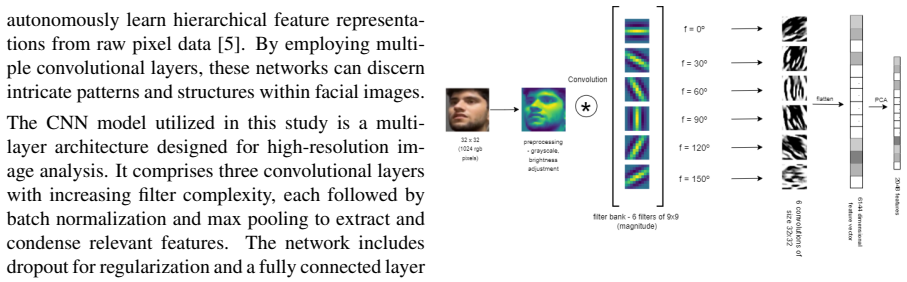
The load-bearing objects are the two datasets and the comparison protocol. JFAD, the new custom set, contains 400 images of 40 Indian students (ten per subject) captured under varied real-world conditions; the LFW subset mirrors that structure with 50 subjects and ten images each. After face detection, augmentation (rotation, shear, brightness/contrast/sharpness), and resizing, the images are split 80:20 into training and test sets, and each model is evaluated on both datasets. The model suite spans subspace projections (PCA, LDA, LPP), Gabor-filter features, a convolutional network, and a hybrid that combines Haar and edge features with a convolutional classifier. Running the same models on the two datasets is the mechanism that yields the paper's conclusions about dataset selection.
What would settle it
Re-run the same models with a subject-disjoint 80:20 split (all ten images of each subject on one side) and check whether CNN accuracy on JFAD stays near 98.4% and LDA+kNN stays near 87.76%; if accuracy drops substantially, the original numbers were inflated by identity leakage.
Extended reading notes
Core claim
On the paper's own terms, the central discovery is that the choice of evaluation dataset changes both the absolute accuracy and the ranking of face-recognition models. Using a newly collected set of 400 Indian student portraits (JFAD, expanded to 2,816 images after augmentation) alongside an LFW subset (3,508 images), the authors find that the CNN and a hybrid model that combines Haar and edge features with a convolutional network achieve near-perfect accuracy on both. The linear-discriminant model (LDA+kNN) improves markedly on JFAD, from 75.66% to 87.76%, and the hybrid model attains perfect accuracy on both datasets. The authors interpret these results as evidence that dataset composition—ethnic diversity, capture conditions, and image resolution—strongly affects recognition performance, and that population-specific benchmarks are needed to tune and validate systems for deployments in India.
Load-bearing premise
The reported accuracies assume the 80:20 train/test split keeps every person's images entirely in either training or testing, but the paper never states that the split is by identity.
Editorial extensions
If this is right
- If the results hold, model rankings on LFW cannot be assumed to transfer to Indian populations; the same model can appear weak or strong depending on the benchmark.
- The LDA+kNN jump from 75.66% to 87.76% suggests that classical linear methods can become competitive when the training and test faces come from a homogeneous, population-specific set.
- The CNN and hybrid models' near-perfect accuracy on both datasets implies that current deep architectures handle this Indian student sample at least as well as the LFW sample.
- The authors' conclusion that dataset selection is critical supports building and sharing more region-specific benchmarks and tuning systems per deployment context.
Reading between the lines
- As an editorial extension, because the paper does not state that its 80:20 split keeps all images of a subject on one side, the near-perfect accuracy figures may partly reflect within-person similarity rather than generalization to unseen identities.
- With 40 subjects in JFAD and 50 in LFW, the reported accuracy differences carry large sampling uncertainty, so a broader Indian cohort would be needed to confirm the ranking shifts.
- The dataset is drawn from a narrow academic age band (18–23), so treating JFAD as representing India's full ethnic and demographic diversity would overstate the paper's evidence.
- A direct test would be to re-evaluate all models on a subject-disjoint split and on a more varied multi-region Indian dataset to see whether the LDA+kNN jump and near-perfect CNN/hybrid scores persist.
Signed reviews
Editorial analysis
A structured set of objections, weighed in public.
Referee Report
Summary. The paper evaluates several face recognition approaches—PCA+kNN, LDA+kNN, LPP, Gabor+kNN, a CNN, and a hybrid Haar/edge+GoogLeNet model—on two datasets: a 50-subject subset of LFW and a newly collected 40-subject Indian student dataset (JFAD). It reports that the CNN and hybrid models achieve near-perfect accuracy on both datasets, and that most models perform better on JFAD than on the LFW subset, with LDA+kNN rising from 75.66% to 87.76%. The authors conclude that dataset selection significantly affects face recognition performance and that the JFAD is a useful benchmark for Indian demographics.
Significance. If the empirical claims were properly supported, the paper would offer a useful contribution: a new Indian-focused face dataset and a comparison of classical versus deep models on it. The motivation to study demographic diversity in face recognition is timely and important. However, the evaluation as described does not establish the central quantitative results. The train/test split is not stated to be identity-disjoint, the results are reported as single runs without error bars, and Section 6 refers to the reported numbers as 'hypothetical results.' These issues affect every comparative claim in Section 5 and prevent the paper from making a trustworthy empirical contribution in its current form.
major comments (4)
- [Section 4.4 and Section 5.3] The experimental procedure does not state that the 80:20 split is identity-disjoint. Section 4.4 says only 'The datasets were then split into training and testing sets with a 80:20 ratio' after augmentation. Since each subject has 10 original images and augmentation multiplies the data, a random image-level split will likely place images of the same subject in both training and testing. In that case, the high accuracies in Section 5.3 (e.g., CNN 98.404%, Hybrid 100%, LDA+kNN 87.76%) can reflect memorization of identities rather than generalization to unseen people. The paper must specify whether the split was by identity and, if not, re-run the experiments with an identity-disjoint split.
- [Section 6] The discussion states that the CNN 'emerged as the most promising in our hypothetical results.' The word 'hypothetical' directly contradicts the empirical framing of Section 5, where the numbers are presented as measured accuracy. The paper needs to clarify whether the results are actual experimental outcomes or illustrative/hypothetical; if they are hypothetical, the central claims of the paper are not supported by data.
- [Section 5 and Figure 7] All accuracy, precision, recall, and F1 values are reported as single-run point estimates with no variance, confidence intervals, or number of repeated trials. For small datasets (40 and 50 subjects) and high-capacity models, single-run accuracy is not a reliable basis for the comparative ranking claimed in Sections 5.2 and 5.3. The paper should report multiple runs, cross-validation, or at least error bars, and should make the raw numeric results available as a text table rather than only as the image in Figure 7.
- [Section 3.2 and Section 4.4] The preprocessing descriptions are incomplete and somewhat inconsistent. Section 3.2 states that JFAD images are resized to 250x250 for comparison, while Section 3.1 says the LFW subset images are 256x256. Section 4.4 reports that after preprocessing JFAD has 2816 images and LFW has 3508 images, but the augmentation parameters (number of augmented images per original, types and ranges of transformations) are not specified. Without these details, the experimental setup cannot be reproduced, which is especially important because the JFAD is claimed to be a new benchmark resource.
minor comments (4)
- [Section 4.1.1] There is a typo in 'correspoinding vector' and inconsistent spelling between 'Minimisation' and the American spellings used elsewhere; these should be corrected.
- [References] Several references appear unrelated to face recognition or dataset diversity, including [1] on ambient assisted living, [8] on COVID/vaccine discourse, and [10] on video action recognition. The paper should cite relevant fairness and face-recognition-benchmark literature instead.
- [Section 3.2] The JFAD dataset is released only as a Google Drive link with no license, no consent or IRB statement, and no demographic metadata beyond age range. For a dataset intended to serve as a benchmark, these details are important and should be added.
- [Section 4.4] The use of RetinaFace to remove images where no face is detected is described without quantifying how many images were removed or whether removal rates differed across demographics; this should be reported to assess potential bias in the preprocessing step.
Circularity Check
No significant circularity; the reported accuracies are empirical benchmark results, not derivations that reduce to their own inputs.
full rationale
The paper's central claims are comparative test accuracies of face recognition models on an LFW subset and the newly collected JFAD dataset. These are empirical measurements produced by training and testing pipelines, not mathematical derivations from fitted parameters or prior results. No parameter is fitted to the reported accuracy and then renamed as a prediction; no uniqueness theorem from the authors' prior work is invoked to force a choice; and no stated equation makes a claimed output equal to an input by construction. The cited references are standard external sources (Belhumeur, Deng, LeCun, Szegedy, etc.) and are not self-citations carrying the argument. The one methodological ambiguity is Section 4.4, which says only that 'The datasets were then split into training and testing sets with a 80:20 ratio' without stating that the split is identity-disjoint; this is a generalization-validity and soundness concern, not a circularity concern, because the model outputs are not defined in terms of the reported accuracies and the test performance could in principle differ. Similarly, the phrase 'hypothetical results' in Section 6 weakens the empirical framing but does not constitute a circular reduction. The derivation chain is therefore self-contained with respect to the circularity criteria, and the appropriate finding is no significant circularity.
Assumptions & free parameters
free parameters (5)
- k in k-NN
- Number of PCA/LDA components
- CNN architecture hyperparameters
- Gabor filter bank parameters
- Augmentation parameters
assumptions (4)
- standard math Standard subspace methods (PCA, LDA, LPP) and CNN operations are mathematically correct as applied.
- domain assumption JFAD with 40 subjects from IIT Jodhpur is representative of India's ethnic diversity.
- domain assumption The 80:20 train/test split yields independent training and test sets.
- ad hoc to paper Removing images where RetinaFace detects no face does not bias the dataset.
invented entities (1)
-
IITJ Faces of Academia Dataset (JFAD)
independent evidence
Cite this review
Pith. "Pith review of Surveying Facial Recognition Models for Diverse Indian Demographics: A Comparative Analysis on LFW and Custom Dataset." pith.science (2026). https://pith.science/paper/BIKNZJNC
@misc{pith2026241208048,
  author       = {Pith},
  title        = {Pith review of: Surveying Facial Recognition Models for Diverse Indian Demographics: A Comparative Analysis on LFW and Custom Dataset},
  year         = {2026},
  howpublished = {\url{https://pith.science/paper/BIKNZJNC}},
  note         = {Machine review of arXiv:2412.08048}
}
read the original abstract
Facial recognition technology has made significant advances, yet its effectiveness across diverse ethnic backgrounds, particularly in specific Indian demographics, is less explored. This paper presents a detailed evaluation of both traditional and deep learning-based facial recognition models using the established LFW dataset and our newly developed IITJ Faces of Academia Dataset (JFAD), which comprises images of students from IIT Jodhpur. This unique dataset is designed to reflect the ethnic diversity of India, providing a critical test bed for assessing model performance in a focused academic environment. We analyze models ranging from holistic approaches like Eigenfaces and SIFT to advanced hybrid models that integrate CNNs with Gabor filters, Laplacian transforms, and segmentation techniques. Our findings reveal significant insights into the models' ability to adapt to the ethnic variability within Indian demographics and suggest modifications to enhance accuracy and inclusivity in real-world applications. The JFAD not only serves as a valuable resource for further research but also highlights the need for developing facial recognition systems that perform equitably across diverse populations.
Figures


Figures from the paper (4 more)


Reference graph
Works this paper leans on
-
[1]
M. H. Abidi, M. K. Mohammed, et al. Ambient assisted living for enhanced elderly and differently abled care: A novel attention transfer learning-based crossover chimp optimization. Journal of Disability Research, 2024
work page 2024
-
[8]
N. Straton. Computational model of engagement with stigmatized sentiment: Covid and general vac- cine discourse on social media. Network Modeling Analysis in Health Informatics and Bioinformatics , 13(1):1–15, 2024. 6
work page 2024
- [10]
-
[2]
P. N. Belhumeur, J. P. Hespanha, and D. J. Krieg- man. Eigenfaces vs. fisherfaces: Recognition us- ing class specific linear projection. IEEE Transac- tions on Pattern Analysis and Machine Intelligence , 19(7):711–720, 1997
work page 1997
-
[3]
Retinaface: Single-stage dense face localisation in the wild
Jiankang Deng, Jia Guo, Yuxiang Zhou, Jinke Yu, Irene Kotsia, and Stefanos Zafeiriou. Retinaface: Single-stage dense face localisation in the wild. In IEEE Conference on Computer Vision and Pattern Recognition, 2019
work page 2019
-
[4]
A. Kumar and P. Bhattacharya. Diversity in facial recognition datasets: A case study in india. Journal of Computer Vision, 101(2):123–135, 2015
work page 2015
- [5]
- [6]
Show all 10 references
-
[7]
C. D. Manning, P. Raghavan, and H. Schütze. Intro- duction to Information Retrieval . Cambridge Uni- versity Press, 2008
2008
-
[9]
Going deeper with convolutions
Christian Szegedy, Wei Liu, Yangqing Jia, Pierre Sermanet, Scott Reed, Dragomir Anguelov, Du- mitru Erhan, Vincent Vanhoucke, and Andrew Ra- binovich. Going deeper with convolutions. In Pro- ceedings of the IEEE Conference on Computer Vi- sion and Pattern Recognition (CVPR) , ...
2015
Reviewed August 11, 2026 · model on record in the stance chip above.
Discussion (0). Continue with ORCID to comment.