Time-dependent Neural Galerkin Method for Quantum Dynamics
Pith reviewed 2026-05-23 07:05 UTC · model grok-4.3
The pith
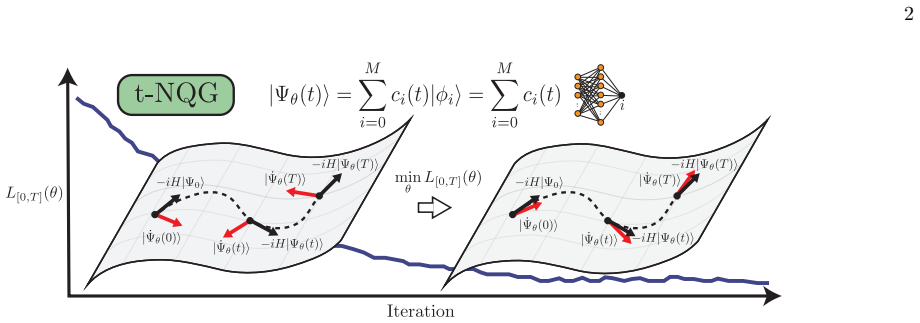
A global variational loss computes full quantum trajectories at once by optimizing a time-dependent combination of fixed neural states.
A machine-rendered reading of the paper's core claim, the machinery that carries it, and where it could break.
Core claim
The central claim is that a Galerkin-style ansatz consisting of a time-dependent linear combination of time-independent Neural Quantum States, when optimized by minimizing a loss that enforces the Schrödinger equation over a finite time window, produces an approximate quantum trajectory whose error relative to the exact evolution is bounded by the value of that global loss.
What carries the argument
The Galerkin-inspired ansatz: a time-dependent linear combination of time-independent Neural Quantum States, optimized globally via a loss enforcing the Schrödinger equation.
If this is right
- The global loss value directly supplies a rigorous error bound on the entire computed trajectory.
- Long-time dynamics become accessible because the optimization is performed over the whole interval rather than accumulated step by step.
- The same framework reproduces ergodicity-breaking signatures in two-dimensional quenches of the transverse-field Ising model.
- Accuracy remains competitive with state-of-the-art time-dependent variational methods on the tested quenches.
Where Pith is reading between the lines
- Because the optimization is global, the method could in principle be parallelized across time slices once the neural states are fixed.
- The error bound furnished by the loss might be tightened further by adding explicit penalty terms for known conservation laws.
- Extending the same global-loss idea to Lindblad master equations would require only replacing the Schrödinger residual with the appropriate dissipator residual.
Load-bearing premise
The chosen family of time-dependent coefficient functions multiplying fixed neural states is rich enough that the global minimization can reach a trajectory close to the true quantum evolution.
What would settle it
For a small system whose exact time evolution is known by other means, run the global minimization until the loss is near zero yet the resulting trajectory still differs measurably from the exact one.
Figures


read the original abstract
We introduce a classical computational method for quantum dynamics that relies on a global-in-time variational principle. Unlike conventional time-stepping approaches, our scheme computes the entire state trajectory over a finite time window by minimizing a loss function that enforces the Schr\"odinger's equation. The variational state is parametrized with a Galerkin-inspired ansatz based on a time-dependent linear combination of time-independent Neural Quantum States. This structure is particularly well-suited for exploring long-time dynamics and enables bounding the error with the exact evolution via the global loss function. We showcase the method by simulating global quantum quenches in the paradigmatic Transverse-Field Ising model in both 1D and 2D, uncovering signatures of ergodicity breaking and absence of thermalization in two dimensions. Overall, our method is competitive compared to state-of-the-art time-dependent variational approaches, while unlocking previously inaccessible dynamical regimes of strongly interacting quantum systems.
Editorial analysis
A structured set of objections, weighed in public.
Referee Report
Summary. The paper introduces a classical method for quantum dynamics based on a global-in-time variational principle. The state trajectory over a finite time window is obtained by minimizing a loss that enforces the Schrödinger equation, using a Galerkin ansatz consisting of a time-dependent linear combination of time-independent Neural Quantum States (NQS). The approach is applied to global quenches in the 1D and 2D transverse-field Ising model, where it is claimed to reveal signatures of ergodicity breaking and absence of thermalization in 2D while remaining competitive with state-of-the-art time-dependent variational methods; the global loss is asserted to provide an a-posteriori bound on the error relative to the exact evolution.
Significance. A reliable global variational scheme with a controllable error bound would be a useful addition to the toolkit for long-time quantum many-body dynamics, especially in regimes where local time-stepping accumulates errors or becomes unstable. The combination of NQS with a Galerkin structure is a natural extension of existing variational approaches and, if the completeness and convergence properties can be established, could enable systematic studies of ergodicity breaking and thermalization in higher-dimensional systems.
major comments (2)
- [Method and error-bound discussion (around the Galerkin ansatz and loss derivation)] The central claim that the global loss function enables bounding the trajectory error relative to the exact Schrödinger evolution (stated in the abstract and elaborated in the method section) holds only if the chosen span of time-independent NQS becomes dense in the relevant dynamical subspace as the number of basis functions increases. No completeness argument, representation theorem, or systematic basis-size extrapolation is supplied to justify this for the TFIM quenches; without it the minimizer can achieve low loss while still deviating from the true state.
- [Numerical results and figures (TFIM quench simulations)] The results on TFIM quenches (1D and 2D) assert competitiveness with state-of-the-art methods and the discovery of new physical signatures, yet the manuscript supplies no error bars on observables, no convergence plots versus number of NQS basis functions or network width, and no quantitative tables comparing, e.g., fidelity or energy deviation against t-VMC or other benchmarks. This absence makes the competitiveness claim and the ergodicity-breaking interpretation difficult to assess.
minor comments (2)
- [Method section] Notation for the time-dependent coefficients and the precise form of the global loss should be introduced with an explicit equation early in the method section to avoid ambiguity when the error bound is later invoked.
- [Abstract] The abstract states that the method 'unlocks previously inaccessible dynamical regimes' without specifying which regimes or which prior methods were limited; a brief concrete example would strengthen the claim.
Simulated Author's Rebuttal
We thank the referee for their constructive comments, which have helped us identify areas for improvement in our manuscript. We address each major comment below and indicate the revisions we will make.
read point-by-point responses
-
Referee: [Method and error-bound discussion (around the Galerkin ansatz and loss derivation)] The central claim that the global loss function enables bounding the trajectory error relative to the exact Schrödinger evolution (stated in the abstract and elaborated in the method section) holds only if the chosen span of time-independent NQS becomes dense in the relevant dynamical subspace as the number of basis functions increases. No completeness argument, representation theorem, or systematic basis-size extrapolation is supplied to justify this for the TFIM quenches; without it the minimizer can achieve low loss while still deviating from the true state.
Authors: We agree that the a-posteriori error bound to the exact evolution presupposes that the Galerkin ansatz can approximate the true solution arbitrarily well. Our derivation of the bound assumes the variational manifold is rich enough, but we did not explicitly discuss the completeness of the time-independent NQS basis for the dynamical subspace of the TFIM. We will revise the method section to clarify this assumption and its implications for the bound. We will also add systematic studies of the loss and observables as the number of basis functions increases to provide numerical support for convergence in the presented examples. revision: yes
-
Referee: [Numerical results and figures (TFIM quench simulations)] The results on TFIM quenches (1D and 2D) assert competitiveness with state-of-the-art methods and the discovery of new physical signatures, yet the manuscript supplies no error bars on observables, no convergence plots versus number of NQS basis functions or network width, and no quantitative tables comparing, e.g., fidelity or energy deviation against t-VMC or other benchmarks. This absence makes the competitiveness claim and the ergodicity-breaking interpretation difficult to assess.
Authors: We acknowledge the lack of quantitative error analysis and comparisons in the current manuscript. To address this, we will include error bars on all plotted observables, add convergence plots with respect to the number of NQS basis functions and network width, and provide tables with quantitative metrics such as fidelity and energy deviations compared to t-VMC and other methods. These additions will strengthen the claims regarding competitiveness and the physical interpretations. revision: yes
Circularity Check
No significant circularity detected
full rationale
The paper introduces a variational method that minimizes a global-in-time loss enforcing the Schrödinger equation using a Galerkin ansatz of time-dependent coefficients on fixed Neural Quantum States. This construction is presented as a direct application of the variational principle without any quoted reduction of the loss function or error bound to a fitted parameter by definition, nor any load-bearing self-citation of a uniqueness theorem. The error-bounding claim follows from the variational setup itself and is supported by explicit numerical demonstrations on the TFIM; no derivation step collapses to renaming inputs or smuggling an ansatz via prior self-work. The method remains self-contained as a computational proposal with external model benchmarks.
Axiom & Free-Parameter Ledger
free parameters (2)
- Neural network weights and biases
- Time-dependent coefficients
axioms (2)
- standard math The time evolution obeys the time-dependent Schrödinger equation
- domain assumption The Galerkin-style linear combination of fixed NQS is expressive enough for the target dynamics
Lean theorems connected to this paper
-
IndisputableMonolith/Cost/FunctionalEquation.leanwashburn_uniqueness_aczel unclear?
unclearRelation between the paper passage and the cited Recognition theorem.
minimizing a loss function that enforces the Schrödinger's equation... Galerkin-inspired ansatz based on a time-dependent linear combination of time-independent Neural Quantum States... | |e^{-itH}|Ψ0⟩ − |Ψθ(t)⟩| | ≤ t √L[0,t]
-
IndisputableMonolith/Foundation/RealityFromDistinction.leanreality_from_one_distinction unclear?
unclearRelation between the paper passage and the cited Recognition theorem.
global-in-time variational principle... L[0,T](θ) = 1/T ∫ L(|Ψθ(t)⟩) dt
What do these tags mean?
- matches
- The paper's claim is directly supported by a theorem in the formal canon.
- supports
- The theorem supports part of the paper's argument, but the paper may add assumptions or extra steps.
- extends
- The paper goes beyond the formal theorem; the theorem is a base layer rather than the whole result.
- uses
- The paper appears to rely on the theorem as machinery.
- contradicts
- The paper's claim conflicts with a theorem or certificate in the canon.
- unclear
- Pith found a possible connection, but the passage is too broad, indirect, or ambiguous to say the theorem truly supports the claim.
Forward citations
Cited by 2 Pith papers
-
Recursion method for out-of-equilibrium many-body dynamics: strengths and limitations
Recursion method extension to quench dynamics is limited by state-dependent quench coefficients c_n lacking universal structure, restricting accurate timescales except for favorable initial states.
-
QCommute: a tool for symbolic computation of nested commutators in quantum many-body spin-1/2 systems
QCommute is a new C++ tool for algebraic symbolic computation of nested commutators in quantum spin-1/2 many-body systems on hypercubic lattices in the thermodynamic limit.
Reference graph
Works this paper leans on
-
[1]
S. R. White, Density matrix formulation for quantum renormalization groups, Phys. Rev. Lett.69, 2863 (1992)
work page 1992
-
[2]
A. J. Daley, C. Kollath, U. Schollwock, and G. Vidal, Time-dependent density-matrix renormalization-group using adaptive effective Hilbert spaces, Journal of Statis- tical Mechanics-Theory and Experiment , P04005 (2004)
work page 2004
-
[3]
G. Carleo and M. Troyer, Solving the quantum many- body problem with artificial neural networks, Science 355, 602 (2017)
work page 2017
- [4]
- [5]
-
[6]
K. Donatella, Z. Denis, A. Le Boit´ e, and C. Ciuti, Dy- namics with autoregressive neural quantum states: Ap- plication to critical quench dynamics, Phys. Rev. A108, 022210 (2023)
work page 2023
-
[7]
A. Sinibaldi, C. Giuliani, G. Carleo, and F. Vicentini, Unbiasing time-dependent Variational Monte Carlo by projected quantum evolution, Quantum7, 1131 (2023)
work page 2023
-
[8]
J. Nys, G. Pescia, A. Sinibaldi, and G. Carleo, Ab-initio variational wave functions for the time-dependent many- electron schr¨ odinger equation, Nature Communications 15, 9404 (2024)
work page 2024
-
[9]
L. Gravina, V. Savona, and F. Vicentini, Neural Pro- jected Quantum Dynamics: a systematic study, arXiv preprint (2024), arXiv:2410.10720
-
[10]
I. Lagaris, A. Likas, and D. Fotiadis, Artificial neu- ral networks for solving ordinary and partial differen- tial equations, IEEE Transactions on Neural Networks 9, 987–1000 (1998)
work page 1998
-
[11]
J. Sirignano and K. Spiliopoulos, DGM: A deep learning algorithm for solving partial differential equations, Jour- nal of Computational Physics375, 1339–1364 (2018)
work page 2018
-
[12]
Universal Differential Equations for Scientific Machine Learning
C. Rackauckas, Y. Ma, J. Martensen, C. Warner, K. Zubov, R. Supekar, D. Skinner, A. Ramadhan, and A. Edelman, Universal Differential Equations for Scientific Machine Learning, arXiv preprint (2020), arXiv:2001.04385
work page internal anchor Pith review Pith/arXiv arXiv 2020
-
[13]
S. Cai, Z. Mao, Z. Wang, M. Yin, and G. E. Karniadakis, Physics-informed neural networks (PINNs) for fluid me- chanics: a review, Acta Mechanica Sinica37, 1727–1738 (2021)
work page 2021
- [14]
-
[15]
S. Wang, Y. Teng, and P. Perdikaris, Understanding and Mitigating Gradient Flow Pathologies in Physics- Informed Neural Networks, SIAM Journal on Scientific Computing43, A3055–A3081 (2021)
work page 2021
-
[16]
A. Krishnapriyan, A. Gholami, S. Zhe, R. Kirby, and M. W. Mahoney, Characterizing possible failure modes in physics-informed neural networks, inAdvances in Neu- ral Information Processing Systems, Vol. 34, edited by 8 M. Ranzato, A. Beygelzimer, Y. Dauphin, P. Liang, and J. W. Vaughan (Curran Associates, Inc., 2021) pp. 26548–26560
work page 2021
-
[17]
S. Wang, X. Yu, and P. Perdikaris, When and why PINNs fail to train: A neural tangent kernel perspective, Journal of Computational Physics449, 110768 (2022)
work page 2022
-
[18]
S. Wang, H. Wang, and P. Perdikaris, On the eigenvec- tor bias of Fourier feature networks: From regression to solving multi-scale PDEs with physics-informed neural networks, Computer Methods in Applied Mechanics and Engineering384, 113938 (2021)
work page 2021
-
[19]
A. M. Kaufman, M. E. Tai, A. Lukin, M. Rispoli, R. Schittko, P. M. Preiss, and M. Greiner, Quantum ther- malization through entanglement in an isolated many- body system, Science353, 794 (2016)
work page 2016
-
[20]
P. Reimann, Typical fast thermalization processes in closed many-body systems, Nature communications7, 10821 (2016)
work page 2016
-
[21]
D. A. Abanin, E. Altman, I. Bloch, and M. Serbyn, Col- loquium: Many-body localization, thermalization, and entanglement, Rev. Mod. Phys.91, 021001 (2019)
work page 2019
-
[22]
T. Saha, P. Ghosal, P. Bej, A. Banerjee, and P. Deb, Thermalization of isolated quantum many-body system and the role of entanglement, Physics Letters A509, 129501 (2024)
work page 2024
- [23]
- [24]
-
[25]
R. Nandkishore and D. A. Huse, Many-Body Localization and Thermalization in Quantum Statistical Mechanics, Annu. Rev. Condens. Matter Phys.6, 15 (2015)
work page 2015
- [26]
-
[27]
J.-y. Choi, S. Hild, J. Zeiher, P. Schauß, A. Rubio- Abadal, T. Yefsah, V. Khemani, D. A. Huse, I. Bloch, and C. Gross, Exploring the many-body localization transition in two dimensions, Science352, 1547 (2016)
work page 2016
-
[28]
P. Sierant, M. Lewenstein, A. Scardicchio, L. Vidmar, and J. Zakrzewski, Many-body localization in the age of classical computing, Reports on Progress in Physics 10.1088/1361-6633/ad9756 (2024)
-
[29]
´A. S. Sanz, S. Miret-Art´ es, ´A. S. Sanz, and S. Miret- Art´ es, Many-Body Systems and Quantum Hydrodynam- ics, A Trajectory Description of Quantum Processes. II. Applications: A Bohmian Perspective , 271 (2014)
work page 2014
-
[30]
O. A. Castro-Alvaredo, B. Doyon, and T. Yoshimura, Emergent Hydrodynamics in Integrable Quantum Sys- tems Out of Equilibrium, Physical Review X6, 041065 (2016)
work page 2016
-
[31]
T. Banks and A. Lucas, Emergent entropy production and hydrodynamics in quantum many-body systems, Physical Review E99, 022105 (2019)
work page 2019
-
[32]
X. Yuan, S. Endo, Q. Zhao, Y. Li, and S. C. Benjamin, Theory of variational quantum simulation, Quantum3, 191 (2019)
work page 2019
-
[33]
I. L. Guti´ errez and C. B. Mendl, Real time evolution with neural-network quantum states, Quantum6, 627 (2022)
work page 2022
-
[34]
Neural-network states for the classical simulation of quantum computing
B. J´ onsson, B. Bauer, and G. Carleo, Neural- network states for the classical simulation of quantum computing, arXiv preprint arXiv:1808.05232 (2018), arXiv:1808.05232
work page internal anchor Pith review Pith/arXiv arXiv 2018
-
[35]
M. Medvidovi´ c and G. Carleo, Classical variational sim- ulation of the quantum approximate optimization algo- rithm, npj Quantum Information7, 1 (2021)
work page 2021
-
[36]
Our derivation would be equivalent in the case of a time- dependent Hamiltonian
-
[37]
However, imposing this invariance comes at a negligible computa- tional cost
By working with normalized ans¨ atze, such as autoregres- sive NQS, we could forego this requirement. However, imposing this invariance comes at a negligible computa- tional cost
-
[38]
See Supplemental Material for details on the loss func- tion, the time-dependent linear variational method, the optimal number of basis states, the error with the exact dynamics, and the role of some hyperparameters in the optimization
- [39]
-
[40]
W. H. Press, S. A. Teukolsky, W. T. Vetterling, and B. P. Flannery,Numerical Recipes 3rd Edition: The Art of Sci- entific Computing, 3rd ed. (Cambridge University Press, USA, 2007)
work page 2007
-
[41]
D. P. Kingma and J. Ba, Adam: A Method for Stochastic Optimization, arXiv preprint (2014), arXiv:1412.6980
work page internal anchor Pith review Pith/arXiv arXiv 2014
-
[42]
L. C. Evans,Partial Differential Equations, Vol. 19 (American Mathematical Society, 2022)
work page 2022
-
[43]
M. Hibat-Allah, M. Ganahl, L. E. Hayward, R. G. Melko, and J. Carrasquilla, Recurrent neural network wave func- tions, Physical Review Research2, 023358 (2020)
work page 2020
-
[44]
C. Roth, Iterative Retraining of Quantum Spin Mod- els Using Recurrent Neural Networks, arXiv preprint (2020), arXiv:2003.06228
-
[45]
M. Hibat-Allah, E. M. Inack, R. Wiersema, R. G. Melko, and J. Carrasquilla, Variational neural annealing, Nature Machine Intelligence3, 952 (2021)
work page 2021
-
[46]
M. Hibat-Allah, R. G. Melko, and J. Carrasquilla, Sup- plementing Recurrent Neural Network Wave Functions with Symmetry and Annealing to Improve Accuracy, arXiv preprint (2022), arXiv:2207.14314
-
[47]
D. Wu, R. Rossi, F. Vicentini, and G. Carleo, From tensor-network quantum states to tensorial recurrent neural networks, Phys. Rev. Res.5, L032001 (2023)
work page 2023
-
[48]
E. Ibarra-Garc´ ıa-Padilla, H. Lange, R. G. Melko, R. T. Scalettar, J. Carrasquilla, A. Bohrdt, and E. Khatami, Autoregressive neural quantum states of Fermi Hubbard models, arXiv preprint (2024), arXiv:2411.07144
-
[49]
X. Liang, W.-Y. Liu, P.-Z. Lin, G.-C. Guo, Y.-S. Zhang, and L. He, Solving frustrated quantum many-particle models with convolutional neural networks, Physical Re- view B98, 104426 (2018)
work page 2018
-
[50]
C. Roth and A. H. MacDonald, Group Convolutional Neural Networks Improve Quantum State Accuracy, arXiv preprint (2021), arXiv:2104.05085
-
[51]
C. Roth, A. Szab´ o, and A. H. MacDonald, High-accuracy variational Monte Carlo for frustrated magnets with deep neural networks, Phys. Rev. B108, 054410 (2023)
work page 2023
-
[52]
C. Fu, X. Zhang, H. Zhang, H. Ling, S. Xu, and S. Ji, Lat- tice Convolutional Networks for Learning Ground States 9 of Quantum Many-Body Systems, inProceedings of the 2024 SIAM International Conference on Data Mining (SDM)(SIAM, 2024) pp. 490–498
work page 2024
- [53]
-
[54]
Y.-H. Zhang and M. Di Ventra, Transformer quantum state: A multipurpose model for quantum many-body problems, Physical Review B107, 075147 (2023)
work page 2023
-
[55]
K. Sprague and S. Czischek, Variational Monte Carlo with large patched transformers, Communications Physics7, 90 (2024)
work page 2024
- [56]
- [57]
- [58]
-
[59]
G. B. Mbeng, A. Russomanno, and G. E. Santoro, The quantum ising chain for beginners, SciPost Physics Lec- ture Notes , 082 (2024)
work page 2024
-
[60]
H. W. J. Bl¨ ote and Y. Deng, Cluster Monte Carlo sim- ulation of the transverse Ising model, Phys. Rev. E66, 066110 (2002)
work page 2002
-
[61]
M. Schmitt and M. Heyl, Quantum Many-Body Dynam- ics in Two Dimensions with Artificial Neural Networks, Phys. Rev. Lett.125, 100503 (2020)
work page 2020
-
[62]
D. Wu, R. Rossi, F. Vicentini, N. Astrakhantsev, F. Becca, X. Cao, J. Carrasquilla, F. Ferrari, A. Georges, M. Hibat-Allah,et al., Variational benchmarks for quan- tum many-body problems, Science386, 296 (2024)
work page 2024
-
[63]
Srednicki, Chaos and quantum thermalization, Phys
M. Srednicki, Chaos and quantum thermalization, Phys. Rev. E50, 888 (1994)
work page 1994
-
[64]
B. Blaß and H. Rieger, Test of quantum thermalization in the two-dimensional transverse-field Ising model, Sci- entific Reports6, 38185 (2016)
work page 2016
-
[65]
S. Todo and K. Kato, Cluster Algorithms for General- SQuantum Spin Systems, Phys. Rev. Lett.87, 047203 (2001)
work page 2001
-
[66]
A. F. Albuquerqueet al., The ALPS project release 1.3: Open-source software for strongly correlated systems, Journal of Magnetism and Magnetic Materials310, 1187 (2007), wOS:000247618700217
work page 2007
-
[67]
B. Baueret al., The ALPS project release 2.0: open source software for strongly correlated systems, Journal of Statistical Mechanics: Theory and Experiment2011, P05001 (2011)
work page 2011
-
[68]
G. Carleoet al., NetKet: A machine learning toolkit for many-body quantum systems, SoftwareX , 100311 (2019)
work page 2019
-
[69]
Vicentiniet al., NetKet 3: Machine Learning Toolbox for Many-Body Quantum Systems, SciPost Phys
F. Vicentiniet al., NetKet 3: Machine Learning Toolbox for Many-Body Quantum Systems, SciPost Phys. Code- bases , 7 (2022)
work page 2022
-
[70]
P. Weinberg and M. Bukov, QuSpin: a Python package for dynamics and exact diagonalisation of quantum many body systems. Part II: bosons, fermions and higher spins, SciPost Physics7, 020 (2019)
work page 2019
-
[71]
M. Motta, W. Kirby, I. Liepuoniute, K. J. Sung, J. Cohn, A. Mezzacapo, K. Klymko, N. Nguyen, N. Yoshioka, and J. E. Rice, Subspace methods for electronic structure sim- ulations on quantum computers, Electronic Structure6, 013001 (2024). 10 SUPPLEMENTAL MATERIAL A. Loss function Here we provide the complete derivation of the loss function used in this wor...
work page 2024
discussion (0)
Sign in with ORCID, Apple, or X to comment. Anyone can read and Pith papers without signing in.