REVIEW 4 major objections 3 minor 1 cited by
Climate Aware Deep Neural Networks (CADNN) for Wind Power Simulation
T0 review · 4 major / 3 minor · reviewed 2026-08-11 · deepseek-v4-flash
Pith's one-line read The paper claims that LSTM networks trained on CMIP6 climate data can accurately simulate wind power at German wind farm sites, outperforming MLP and Transformer-enhanced LSTM models.
desk verdict Useful CMIP6-to-site data pipeline and open package, but the evaluation contradicts its own split protocol and never measures error against real wind power. read the letter →
The pith
A machine-rendered reading of the paper's core claim, the machinery that carries it, and where it could break.
The reading
What carries the argument
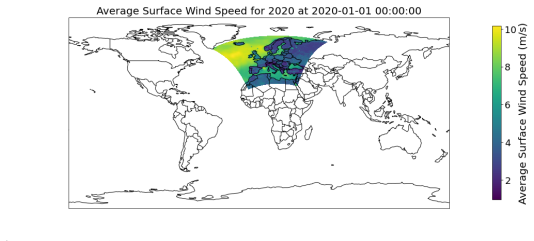
The central mechanism is a data pipeline plus an LSTM regressor. CMIP6 wind speed and surface pressure fields on a rotated-pole grid are transformed to geographic coordinates, matched to wind farm locations by KD-tree nearest-neighbor search, linearly interpolated to the farm points, resampled to the target time grid, and min-max scaled to $[-1,1]$. The LSTM takes five inputs (time, latitude, longitude, wind speed, surface pressure) through six stacked LSTM layers with 128 hidden units and outputs one wind power value. The SIREN-based MLP and the Transformer-enhanced LSTM use the same inputs, providing the comparison.
What would settle it
Retrain the same LSTM on publicly reported wind farm power measurements using a chronological train/test split and compare against the simulation-target version and against a persistence forecast; if accuracy drops sharply or fails to beat persistence, the claim that the models accurately forecast wind power is falsified.
Extended reading notes
Core claim
The paper claims that LSTM networks trained on processed CMIP6 climate variables can accurately simulate wind power generation, and that this climate-aware approach significantly improves forecasting accuracy over the alternatives considered. The target values used for training and evaluation are not direct measurements but outputs of the wind power simulation model [60], so the demonstration is that the LSTM learns to reproduce that simulation from wind speed and surface pressure inputs. The LSTM outperforms the MLP and the Transformer-enhanced LSTM, which the authors attribute to the LSTM's gating mechanisms for sequential and long-term dependencies.
Load-bearing premise
The load-bearing premise is that the outputs of the wind power simulation model [60] can stand in for true wind power values; if that simulation is inaccurate or unrepresentative, the reported forecasting accuracy has no real-world meaning, and the random 90/10 split adds leakage risk because wind power is autocorrelated.
Editorial extensions
If this is right
- If the claim holds, LSTM networks can act as fast surrogate models that map CMIP6 climate output directly to wind power, avoiding heavy physics-based simulation at individual farm sites.
- The preprocessing recipe, including rotated-pole coordinate transformation, KD-tree nearest-neighbor matching, linear interpolation, and min-max scaling, becomes a reusable template for other regions with CMIP6 coverage.
- The result suggests that adding climate model inputs rather than only historical power measurements is a viable route for forecasting under changing climate conditions.
- The comparison indicates that the extra complexity of Transformer attention over an LSTM does not pay off for this dataset, guiding architecture choice for similar climate-to-power tasks.
Reading between the lines
- Editorial inference: because the evaluation target is the simulation model [60] rather than observed wind farm output, the paper's accuracy claim is strictly about reproducing that simulation; a real-world validation against measurements is a necessary next step.
- Editorial inference: the random 90/10 split likely inflates reported accuracy, since wind power is strongly autocorrelated and nearby time steps probably appear in both training and testing sets; a chronological split would be a stricter test.
- Editorial inference: a direct test of practical value would be the same LSTM trained on observed wind power data with a chronological split and benchmarked against a persistence forecast; if it cannot beat persistence, its forecasting advantage is unproven.
Signed reviews
Editorial analysis
A structured set of objections, weighed in public.
Referee Report
Summary. This paper presents a framework, CADNN, for emulating wind power generation at 232 German wind farm locations using CMIP6 3-hourly wind speed and surface pressure data. After spatial interpolation and temporal resampling, three deep architectures are trained and compared: a SIREN-based MLP, a stacked LSTM, and a Transformer-enhanced LSTM. The abstract and Section 2.1 claim that the climate-aware DNNs 'significantly enhance forecasting accuracy' and that LSTM networks are the superior architecture. The authors also release a Python package with code and data-processing tools. A central complication is that the target values are not observed wind power time series: Figure 10 and related captions identify the 'true measurement model' as the simulation model of Lehneis and Thrän [60].
Significance. The general idea of using CMIP6 predictors to emulate a regional wind power model is potentially useful for climate-scenario studies, and the manuscript has concrete strengths: publicly released code, a reproducible data-processing pipeline, and a comparison of several deep architectures on a substantial dataset. However, the evaluation as written does not support the central claim. The paper reports no quantitative error metrics, describes a contradictory train/test split (random in Section 5.4 versus chronological in Section 5.1 and Algorithm 3), and uses the outputs of a simulation model rather than observed wind power as the target. The claimed 'significant enhancement' of forecasting accuracy is therefore not established. These issues are correctable through re-analysis and careful reframing, but they are load-bearing and require substantial revision.
major comments (4)
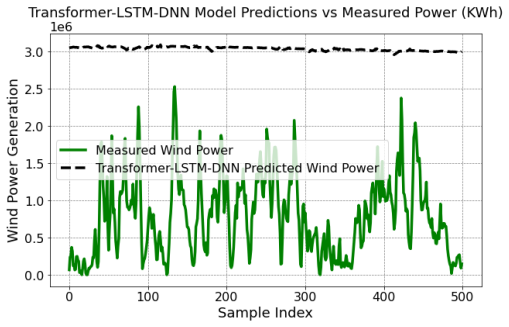
- [§5.4 vs §5.1 and Algorithm 3] The train/test split protocol is contradictory. Section 5.1 states that the split 'is carried out chronologically to maintain the sequential nature of the data and avoid potential data leakage,' and Algorithm 3 Step 1 says to partition the data while 'preserving the time order of samples.' Section 5.4, however, states that 'out of total number of 679296 samples ... 90% is randomly chosen for training the DNN structures and remaining 10% for testing the results.' These statements cannot both be true. A random split of a 3-hourly, strongly autocorrelated wind power series interleaves test samples with training samples, so the LSTM can succeed by interpolating or copying temporally adjacent values rather than forecasting unseen periods. This invalidates the qualitative evidence offered for LSTM superiority; a single, clearly specified chronological split must be used and reported.
- [§5.4, Figures 9–17] The paper reports no quantitative forecast error metrics. The evaluation consists of scatter plots, histograms of residuals, and line plots; there is no RMSE, MAE, R², MAPE, skill score, or persistence baseline anywhere in Section 5. The abstract's claim that the DNN models 'significantly enhance forecasting accuracy' and Section 2.1's assertion that 'LSTM networks outperform others' therefore have no numerical basis. At minimum, each architecture should be evaluated with a standard error metric on a chronologically held-out test set, and the comparison should include a persistence or climatology baseline.
- [§5.4, Figure 10 caption] The target variable is not observed wind power. The captions of Figures 10, 12, 13, 16, and 17 state that 'the true measurement model came from Lehneis and Thrän [60]'; reference [60] is itself a simulation model of wind power generation in Germany. The abstract, by contrast, describes capturing relationships between CMIP data and 'actual wind power generation at wind farms located in Germany.' Training and evaluating against outputs of [60] measures how well the DNNs emulate that reference model, not how well they forecast real-world wind power. The authors should either reframe the contribution as emulation of the reference model or validate the approach against independent wind power observations.
- [§2.1 and §5.4] The architecture-comparison claim is not supported by the reported evidence. Section 2.1 asserts that LSTM networks outperform other architectures, but the supporting discussion in Section 5.4 is qualitative ('the scatter plot demonstrates a strong correlation,' 'a weak correlation,' etc.). No numerical comparisons, convergence curves, repeated-seed variability, or statistical tests are provided, and the random-split problem affects all three models equally. The conclusion that LSTM is the preferred architecture is an assertion rather than a demonstrated result.
minor comments (3)
- [Figure captions 10, 12, 13, 16, 17] These captions contain the duplicated phrase 'came came'; they should be corrected and should refer to 'reference model output' rather than 'true measurement model,' which conflates observation with simulation.
- [Title and Sections 1–6] The terminology is inconsistent between 'wind power simulation' (title, Section 5.1, Algorithm 3) and 'forecasting'/'prediction' (abstract, Sections 2.1, 5, and 6). The authors should choose one task definition and apply it consistently.
- [Throughout] Several language and formatting issues remain, including Figure 7's 'Wind power generation power,' Section 5.4's 'The histogram of prediction in fig. 11 errors,' and the keyword list ending with a dangling comma ('LSTM)-DNN, .'). A careful copyedit is needed.
Circularity Check
No formal circularity: the DNNs learn a mapping from CMIP6 climate variables to the Lehneis–Thrän simulation output, which is not equal to the input by construction; the main caveats are a co-authored simulation used as the 'true' target and an internal split inconsistency that is a leakage/correctness issue rather than circularity.
-
other
[Figure 10 caption and Section 5.4 ('DNN simulation setups')]
"It is worth to highlight that the true measurement model came came from Lehneis and Thr¨ an [60]."
This sentence reveals that the evaluation target is not observed wind power but the output of [60], a wind-power simulation co-authored by D. Thrän, a co-author of the present paper. Since the DNN inputs are CMIP6 wind speed and surface pressure—the same meteorological drivers that feed [60]—the benchmark measures self-referential fit to an in-group simulation rather than validation against independent measurements. This is scored as a minor self-citation/self-referential validation issue, not as a formal tautology: the DNN predictions are not equal to their inputs by construction, and the models can still fail to reproduce [60]'s outputs. The random 90/10 split described in §5.4 is a separate temporal-leakage/correctness concern, not a circularity.
full rationale
The derivation chain is: CMIP6 wind speed and surface pressure are spatially interpolated to 232 German wind-farm locations, resampled to 3-hourly steps, normalized, and fed to MLP/LSTM/LSTM-Transformer models whose target is wind power from the Lehneis–Thrän simulation [60]. No equation in the paper defines the predicted wind power as the input, and no fitted parameter is relabeled as a prediction. The central comparison among architectures is an empirical fitting exercise, so the claim that LSTM performs best is not forced by construction. The main self-referential element is that the 'true measurement model' is [60], which shares an author with this paper; nevertheless, fitting a DNN to a simulation output is a surrogate-modeling task with genuine learning content, so this is at most a minor self-citation issue. The contradiction between the chronological split promised in §5.1 and Algorithm 3 and the random 90/10 split executed in §5.4 is serious—wind power at 3-hour resolution is autocorrelated, so random splitting can leak near-duplicate temporal information into the test set—but it is a validity/leakage flaw, not circularity, and is outside the enumerated circularity patterns. No uniqueness theorem, ansatz-via-citation, or renaming of a known result is present. Overall circularity score: 2.
Assumptions & free parameters
free parameters (3)
- DNN hyperparameters (layers, hidden units, learning rate, epochs) =
6 layers, 128 hidden units (MLP/LSTM), 64 units (LSTM-Transformer), 30000 epochs, LR 1e-5 (MLP) / 1e-3 (LSTM…
- Train/test split ratio and random seed =
90% train / 10% test, random split, seed not reported
- Temporal resampling interval =
3-hour
assumptions (3)
- domain assumption The Lehneis and Thrän [60] simulation output provides ground truth for wind power generation.
- domain assumption Wind power at each site is a deterministic function of time, coordinates, CMIP6 wind speed, and surface pressure.
- ad hoc to paper A random split of a time series into 90% training and 10% testing does not leak information.
Cite this review
Pith. "Pith review of Climate Aware Deep Neural Networks (CADNN) for Wind Power Simulation." pith.science (2026). https://pith.science/paper/ON4BSUX5
@misc{pith2026241212160,
  author       = {Pith},
  title        = {Pith review of: Climate Aware Deep Neural Networks (CADNN) for Wind Power Simulation},
  year         = {2026},
  howpublished = {\url{https://pith.science/paper/ON4BSUX5}},
  note         = {Machine review of arXiv:2412.12160}
}
read the original abstract
Wind power forecasting plays a critical role in modern energy systems, facilitating the integration of renewable energy sources into the power grid. Accurate prediction of wind energy output is essential for managing the inherent intermittency of wind power, optimizing energy dispatch, and ensuring grid stability. This paper proposes the use of Deep Neural Network (DNN)-based predictive models that leverage climate datasets, including wind speed, atmospheric pressure, temperature, and other meteorological variables, to improve the accuracy of wind power simulations. In particular, we focus on the Coupled Model Intercomparison Project (CMIP) datasets, which provide climate projections, as inputs for training the DNN models. These models aim to capture the complex nonlinear relationships between the CMIP-based climate data and actual wind power generation at wind farms located in Germany. Our study compares various DNN architectures, specifically Multilayer Perceptron (MLP), Long Short-Term Memory (LSTM) networks, and Transformer-enhanced LSTM models, to identify the best configuration among these architectures for climate-aware wind power simulation. The implementation of this framework involves the development of a Python package (CADNN) designed to support multiple tasks, including statistical analysis of the climate data, data visualization, preprocessing, DNN training, and performance evaluation. We demonstrate that the DNN models, when integrated with climate data, significantly enhance forecasting accuracy. This climate-aware approach offers a deeper understanding of the time-dependent climate patterns that influence wind power generation, providing more accurate predictions and making it adaptable to other geographical regions.
Figures


Figures from the paper (14 more)



Forward citations
Cited by 1 Pith paper
-
Synthetic Time Series Forecasting with Transformer Architectures: Extensive Simulation Benchmarks
Autoformer and PatchTST outperform Informer across synthetic forecasting benchmarks, while a proposed Koopman-Transformer hybrid is illustrated on Van der Pol and Lorenz systems.
Reference graph
Works this paper leans on
-
[60]
R. Lehneis, D. Thr¨ an, Temporally and spatially resolved simulation of the wind power generation in germany, Energies 16 (2023) 3239. 41
work page 2023
-
[1]
S. Oberth¨ ur, Hard or soft governance? the eu’s climate and energy policy framework for 2030, Politics and Governance 7 (2019) 17–27
work page 2019
-
[2]
S. Asiaban, N. Kayedpour, A. E. Samani, D. Bozalakov, J. D. De Koon- ing, G. Crevecoeur, L. Vandevelde, Wind and solar intermittency and the associated integration challenges: A comprehensive review including the status in the belgian power system, Energies 14 (2021) 2630
work page 2021
- [3]
-
[4]
D. Carvalho, A. Rocha, M. G´ omez-Gesteira, C. S. Santos, Potential impacts of climate change on european wind energy resource under the cmip5 future climate projections, Renewable Energy 101 (2017) 29–40
work page 2017
-
[5]
D. Carvalho, A. Rocha, M. G´ omez-Gesteira, Ocean surface wind sim- ulation forced by different reanalyses: Comparison with observed data along the iberian peninsula coast, Ocean Modelling 56 (2012) 31–42. 32 Figure 11: Prediction errors versus ground truth values in LSTM-DNN
work page 2012
-
[6]
S. C. Pryor, R. J. Barthelmie, Climate change impacts on wind energy: A review, Renewable and sustainable energy reviews 14 (2010) 430–437
work page 2010
-
[7]
A. Ahmadalipour, A. Rana, H. Moradkhani, A. Sharma, Multi-criteria evaluation of cmip5 gcms for climate change impact analysis, Theoretical and applied climatology 128 (2017) 71–87
work page 2017
Show all 60 references
-
[8]
Eyring, S
V. Eyring, S. Bony, G. A. Meehl, C. A. Senior, B. Stevens, R. J. Stouffer, K. E. Taylor, Overview of the coupled model intercomparison project phase 6 (cmip6) experimental design and organization, Geoscientific Model Development 9 (2016) 1937–1958
2016
-
[9]
Lovato, D
T. Lovato, D. Peano, M. Butensch¨ on, S. Materia, D. Iovino, E. Scoc- cimarro, P. Fogli, A. Cherchi, A. Bellucci, S. Gualdi, et al., Cmip6 simulations with the cmcc earth system model (cmcc-esm2), Journal of Advances in Modeling Earth Systems 14 (2022) e2021MS002814
2022
-
[10]
Reyers, J
M. Reyers, J. Moemken, J. G. Pinto, Future changes of wind energy potentials over europe in a large cmip5 multi-model ensemble., Interna- tional Journal of Climatology 36 (2016)
2016
-
[11]
deCastro, X
M. deCastro, X. Costoya, S. Salvador, D. Carvalho, M. G´ omez-Gesteira, F. J. Sanz-Larruga, L. Gimeno, An overview of offshore wind energy 33 Figure 12: Comparing LSTM based DNN versus true measurements for wind power power simulation. It is worth to highlight that the true me...
2019
-
[12]
Santos, M
F. Santos, M. G´ omez-Gesteira, M. DeCastro, J. A˜ nel, D. Carvalho, X. Costoya, J. Dias, On the accuracy of cordex rcms to project fu- ture winds over the iberian peninsula and surrounding ocean, Applied Energy 228 (2018) 289–300
2018
-
[13]
Costoya, A
X. Costoya, A. Rocha, D. Carvalho, Using bias-correction to improve future projections of offshore wind energy resource: A case study on the iberian peninsula, Applied Energy 262 (2020) 114562
2020
-
[14]
Chen, Impacts of climate change on wind resources over north america based on na-cordex, Renewable energy 153 (2020) 1428–1438
L. Chen, Impacts of climate change on wind resources over north america based on na-cordex, Renewable energy 153 (2020) 1428–1438
2020
-
[15]
Costoya, M
X. Costoya, M. DeCastro, D. Carvalho, M. G´ omez-Gesteira, On the suitability of offshore wind energy resource in the united states of amer- ica for the 21st century, Applied Energy 262 (2020) 114537
2020
-
[16]
Costoya, M
X. Costoya, M. DeCastro, D. Carvalho, Z. Feng, M. G´ omez-Gesteira, Climate change impacts on the future offshore wind energy resource in china, Renewable Energy 175 (2021) 731–747. 34 Figure 13: Comparing LSTM based DNN versus true measurements for wind power simula- tion. It...
2021
-
[17]
A. A. Akinsanola, K. O. Ogunjobi, A. T. Abolude, S. Salack, Projected changes in wind speed and wind energy potential over west africa in cmip6 models, Environmental Research Letters 16 (2021) 044033
2021
-
[18]
Akhtar, B
N. Akhtar, B. Geyer, B. Rockel, P. S. Sommer, C. Schrum, Accelerating deployment of offshore wind energy alter wind climate and reduce future power generation potentials, Scientific reports 11 (2021) 11826
2021
-
[19]
P. M. Soares, D. C. Lima, A. Semedo, W. Cabos, D. V. Sein, Climate change impact on northwestern african offshore wind energy resources, Environmental Research Letters 14 (2019) 124065
2019
-
[20]
Carvalho, A
D. Carvalho, A. Rocha, X. Costoya, M. DeCastro, M. G´ omez-Gesteira, Wind energy resource over europe under CMIP6 future climate projec- tions: What changes from CMIP5 to CMIP6, Renewable and Sustain- able Energy Reviews 151 (2021) 111594
2021
-
[21]
B. G. Brown, R. W. Katz, A. H. Murphy, Time series models to simulate and forecast wind speed and wind power, Journal of Applied Meteorol- ogy and Climatology 23 (1984) 1184–1195
1984
-
[22]
Y. Liu, J. Shi, Y. Yang, W.-J. Lee, Short-term wind-power predic- tion based on wavelet transform–support vector machine and statistic- 35 Figure 14: Prediction errors versus ground truth values in Transformer-based LSTM-DNN. Figure 15: Comparing Transformer-LSTM based DNN ver...
2012
-
[23]
X. Yuan, C. Chen, Y. Yuan, Y. Huang, Q. Tan, Short-term wind power prediction based on lssvm–gsa model, Energy Conversion and Manage- ment 101 (2015) 393–401
2015
-
[24]
D. Lee, R. Baldick, Short-term wind power ensemble prediction based on gaussian processes and neural networks, IEEE Transactions on Smart Grid 5 (2013) 501–510
2013
-
[25]
Pinson, H
P. Pinson, H. A. Nielsen, H. Madsen, G. Kariniotakis, Skill forecasting from ensemble predictions of wind power, Applied Energy 86 (2009) 1326–1334
2009
-
[26]
M. G. De Giorgi, A. Ficarella, M. Tarantino, Error analysis of short term wind power prediction models, Applied Energy 88 (2011) 1298–1311
2011
-
[27]
Bhaskar, S
K. Bhaskar, S. N. Singh, A WNN-assisted wind power forecasting using feed-forward neural network, IEEE transactions on sustainable energy 3 (2012) 306–315
2012
-
[28]
Abedinia, N
O. Abedinia, N. Amjady, Short-term wind power prediction based on hy- brid neural network and chaotic shark smell optimization, International journal of precision engineering and manufacturing-green technology 2 (2015) 245–254
2015
-
[29]
M. C. Mabel, E. Fernandez, Analysis of wind power generation and prediction using ANN: A case study, Renewable energy 33 (2008) 986– 992
2008
-
[30]
Chitsaz, N
H. Chitsaz, N. Amjady, H. Zareipour, Wind power forecast using wavelet neural network trained by improved clonal selection algorithm, Energy conversion and Management 89 (2015) 588–598
2015
-
[31]
Grassi, P
G. Grassi, P. Vecchio, Wind energy prediction using a two-hidden layer neural network, Communications in Nonlinear Science and Numerical Simulation 15 (2010) 2262–2266
2010
-
[32]
T. Hong, P. Pinson, S. Fan, Global energy forecasting competition 2012, 2014. 38
2012
-
[33]
M. Lei, L. Shiyan, J. Chuanwen, L. Hongling, Z. Yan, A review on the forecasting of wind speed and generated power, Renewable and sustainable energy reviews 13 (2009) 915–920
2009
-
[34]
Y. Bao, H. Wang, B. Wang, Short-term wind power prediction using differential emd and relevance vector machine, Neural Computing and Applications 25 (2014) 283–289
2014
-
[35]
Costa, A
A. Costa, A. Crespo, J. Navarro, G. Lizcano, H. Madsen, E. Feitosa, A review on the young history of the wind power short-term prediction, Renewable and Sustainable Energy Reviews 12 (2008) 1725–1744
2008
-
[36]
A. M. Foley, P. G. Leahy, A. Marvuglia, E. J. McKeogh, Current meth- ods and advances in forecasting of wind power generation, Renewable energy 37 (2012) 1–8
2012
-
[37]
Tascikaraoglu, M
A. Tascikaraoglu, M. Uzunoglu, A review of combined approaches for prediction of short-term wind speed and power, Renewable and Sustain- able Energy Reviews 34 (2014) 243–254
2014
-
[38]
H. Peng, F. Liu, X. Yang, A hybrid strategy of short term wind power prediction, Renewable Energy 50 (2013) 590–595
2013
-
[39]
Pinson, H
P. Pinson, H. Madsen, H. A. Nielsen, G. Papaefthymiou, B. Kl¨ ockl, From probabilistic forecasts to statistical scenarios of short-term wind power production, Wind Energy: An International Journal for Progress and Applications in Wind Power Conversion Technology 12 (2009) 51–62
2009
-
[40]
H. A. Nielsen, H. Madsen, T. S. Nielsen, Using quantile regression to extend an existing wind power forecasting system with probabilistic forecasts, Wind Energy: An International Journal for Progress and Applications in Wind Power Conversion Technology 9 (2006) 95–108
2006
-
[41]
Salcedo-Sanz, A
S. Salcedo-Sanz, A. M. Perez-Bellido, E. G. Ortiz-Garc ´ ıa, A. Portilla- Figueras, L. Prieto, F. Correoso, Accurate short-term wind speed pre- diction by exploiting diversity in input data using banks of artificial neural networks, Neurocomputing 72 (2009) 1336–1341
2009
-
[42]
Troncoso, S
A. Troncoso, S. Salcedo-Sanz, C. Casanova-Mateo, J. Riquelme, L. Pri- eto, Local models-based regression trees for very short-term wind speed prediction, Renewable Energy 81 (2015) 589–598. 39
2015
-
[43]
E. G. Ortiz-Garc ´ ıa, S. Salcedo-Sanz, ´A. M. P´ erez-Bellido, J. Gasc´ on- Moreno, J. A. Portilla-Figueras, L. Prieto, Short-term wind speed pre- diction in wind farms based on banks of support vector machines, Wind Energy 14 (2011) 193–207
2011
-
[44]
Zhang, J
W. Zhang, J. Wang, J. Wang, Z. Zhao, M. Tian, Short-term wind speed forecasting based on a hybrid model, Applied Soft Computing 13 (2013) 3225–3233
2013
-
[45]
X. Ma, Y. Jin, Q. Dong, A generalized dynamic fuzzy neural network based on singular spectrum analysis optimized by brain storm optimiza- tion for short-term wind speed forecasting, Applied Soft Computing 54 (2017) 296–312
2017
-
[46]
J. Jung, R. P. Broadwater, Current status and future advances for wind speed and power forecasting, Renewable and Sustainable Energy Reviews 31 (2014) 762–777
2014
-
[47]
Esmaeili Aliabadi, N
D. Esmaeili Aliabadi, N. Wulff, R. Lehneis, M. Sadr, F. Reutter, M. Jor- dan, P. Lehmann, D. Thr¨ an, Climate change may impair the transition to a fully renewable energy system, Available at SSRN 4960744 (????)
-
[48]
Lehneis, D
R. Lehneis, D. Manske, B. Schinkel, D. Thr¨ an, Power generation from variable renewable energies (VRE), Helmholtz Climate Initiative (2022) 213–215
2022
-
[49]
Forootani, A
A. Forootani, A. Yazdizadeh, A. Aliabadi, Fault detection of gas unit of gilan combined cycle power plant using neural network, in: The 3rd Conference on Thermal Power Plants, IEEE, 2011, pp. 1–5
2011
-
[50]
Huang, C
R. Huang, C. Wei, B. Wang, J. Yang, X. Xu, S. Wu, S. Huang, Well performance prediction based on long short-term memory (lstm) neu- ral network, Journal of Petroleum Science and Engineering 208 (2022) 109686
2022
-
[51]
Vaswani, N
A. Vaswani, N. Shazeer, N. Parmar, J. Uszkoreit, L. Jones, A. N. Gomez, L. Kaiser, I. Polosukhin, Attention is all you need, Advances in neural information processing systems 30 (2017). 40
2017
-
[52]
Forootani, D
A. Forootani, D. E. Aliabadi, D. Thraen, Bio-eng-lmm ai assist chat- bot: A comprehensive tool for research and education, arXiv preprint arXiv:2409.07110 (2024)
2024 arXiv
-
[53]
Weiser, S
A. Weiser, S. E. Zarantonello, A note on piecewise linear and multilinear table interpolation in many dimensions, Mathematics of Computation 50 (1988) 189–196
1988
-
[54]
M. R. Grose, S. Narsey, R. Trancoso, C. Mackallah, F. Delage, A. Dowdy, G. Di Virgilio, I. Watterson, P. Dobrohotoff, H. A. Rashid, et al., A cmip6-based multi-model downscaling ensemble to underpin climate change services in australia, Climate Services 30 (2023) 100368
2023
-
[55]
Virtanen, R
P. Virtanen, R. Gommers, T. E. Oliphant, M. Haberland, T. Reddy, D. Cournapeau, E. Burovski, P. Peterson, W. Weckesser, J. Bright, et al., Scipy 1.0: fundamental algorithms for scientific computing in python, Nature methods 17 (2020) 261–272
2020
-
[56]
Sitzmann, J
V. Sitzmann, J. Martel, A. Bergman, D. Lindell, G. Wetzstein, Implicit neural representations with periodic activation functions, Advances in neural information processing systems 33 (2020) 7462–7473
2020
-
[57]
Forootani, P
A. Forootani, P. Benner, GN-SINDy: Greedy sampling neural network in sparse identification of nonlinear partial differential equations, arXiv preprint arXiv:2405.08613 (2024)
2024
-
[58]
Forootani, P
A. Forootani, P. Goyal, P. Benner, A robust sindy approach by combining neural networks and an integral form, arXiv preprint arXiv:2309.07193 (2023)
2023 arXiv
-
[59]
Forootani, H
A. Forootani, H. Kapadia, S. Chellappa, P. Goyal, P. Benner, Gs-pinn: Greedy sampling for parameter estimation in partial differential equa- tions, arXiv preprint arXiv:2405.08537 (2024)
2024 arXiv
Reviewed August 11, 2026 · model on record in the stance chip above.
Discussion (0). Continue with ORCID to comment.