REVIEW 4 major objections 6 minor 36 references
Autonomous Navigation in Dynamic Human Environments with an Embedded 2D LiDAR-based Person Tracker
T0 review · 4 major / 6 minor · reviewed 2026-08-11 · deepseek-v4-flash
Pith's one-line read A modular 2D-LiDAR tracking pipeline lets a quadruped robot track people at 85.45% MOTA and avoid collisions in real time at 20 Hz, using a detector pretrained on a different sensor.
desk verdict A modest but genuine embedded-systems integration with a real Vicon benchmark; the headline MOTA is internally consistent, but one reported average in the text is wrong and the avoidance result is a single run. read the letter →
The pith
A machine-rendered reading of the paper's core claim, the machinery that carries it, and where it could break.
The reading
What carries the argument
The pipeline chains three components. Detection uses DR-SPAAM, a 1D convolutional network that processes a fixed one-meter window around each LiDAR point and votes on person locations; because the window is resampled to a fixed sample count, the detector is claimed to be independent of angular resolution and distance. Tracking uses a lightweight SORT-style multi-object tracker: a Kalman filter with a constant-velocity model for motion, Hungarian assignment with an Euclidean cost for data association, and counters that initiate tracks after enough consecutive matches and delete them after enough misses; detections are transformed into the robot's odometry frame first. Planning uses the TEB local planner, which optimizes trajectories and can incorporate dynamic obstacles with estimated velocities; the authors filter out static obstacles around the tracked person so the planner does not see the person as a fixed wall.
What would settle it
Record a new dataset with the same robot and sensor in a larger, more cluttered space where people are tracked at distances beyond the 4 m by 4 m arena and frequently leave the field of view; if Config-3's MOTA drops well below 85% or track initiation becomes too slow to support 0.5 m/s avoidance, the no-retraining transfer claim fails.
Extended reading notes
Core claim
On the paper's own terms, the central claim is that a detection-tracker-planner pipeline can be assembled from existing components—a pretrained 1D-convolutional person detector, a lightweight SORT-style tracker with constant-velocity Kalman filtering, and the TEB local planner—and run entirely on an embedded GPU at 20 Hz while tracking people accurately enough for collision avoidance. The benchmark results give an average MOTA of 85.45% for the favored configuration across three newly recorded close-range datasets, and the navigation experiments show that feeding the tracker's velocity estimates into TEB lets the robot begin an avoidance maneuver early enough to avoid a frontal collision, whereas treating all obstacles as static does not. The authors take the high scores on a new 270° LiDAR without retraining as experimental confirmation that the detector is resolution- and distance-independent.
Load-bearing premise
The whole approach stands on the assumption that the pretrained detector, trained on a different 360° LiDAR dataset, keeps detecting people accurately from a new 270° sensor mounted 45 cm high on a moving robot without retraining; the benchmarks only demonstrate this inside a 4 m by 4 m room.
Editorial extensions
If this is right
- Two of the three configurations sustain the full detection-tracking pipeline at 20 Hz on a Jetson-class embedded GPU, so person-aware avoidance does not require off-board computation.
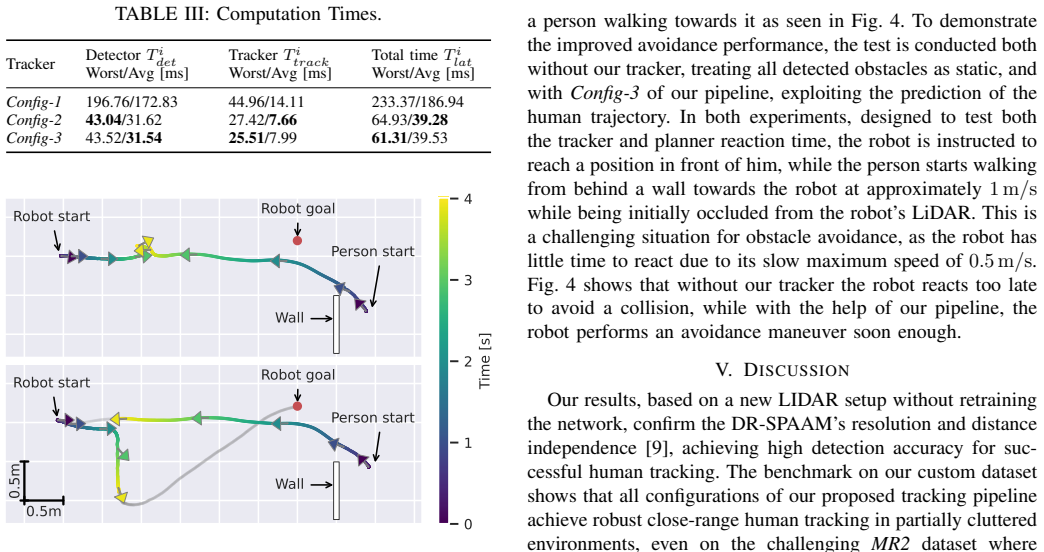
- In the navigation test, the tracker-equipped robot starts its avoidance maneuver early enough to prevent collision with a person walking at roughly 1 m/s, while the static-obstacle version reacts too late.
- Config-3's fast track initiation lets the system react when a person emerges from behind a wall, which is the critical case for close-range safety.
- Config-1 and Config-2 achieve nearly equal MOTA, showing that skipping detection windows has little effect at close range, so the faster configuration loses almost no tracking quality.
Reading between the lines
- If the detector really is sensor-independent as claimed, the same modular pipeline should transfer to other 2D LiDARs with different resolutions and mounting heights, but only for the close-range distances tested; longer-range behavior remains unverified.
- The constant-velocity motion model is the paper's weakest motion assumption: sudden stops, sharp turns, or socially interactive movement could break both tracking association and the planner's predicted obstacle trajectories.
- Because the planner removes static obstacles around a tracked person, a lost track during occlusion could leave the person effectively invisible to the costmap; identity maintenance under re-entry is therefore the practical bottleneck for safety.
- A direct testable extension is to filter detections near walls with the local costmap, which the paper names as a limitation; doing so should reduce the false positives observed while the robot is moving and raise MOTA in the moving-robot datasets.
Signed reviews
Editorial analysis
A structured set of objections, weighed in public.
Referee Report
Summary. The paper reports a modular 2D LiDAR person-tracking pipeline that combines the DR-SPAAM detector with a Norfair/SORT multi-object tracker, runs at 20 Hz on a Jetson Xavier NX, and is integrated with the TEB local planner on a Unitree A1 quadruped. Tracking accuracy is evaluated against Vicon motion-capture ground truth in three newly recorded indoor datasets (SR, MR1, MR2) for three tracker configurations; Config-3 is reported to achieve an average MOTA of 85.45%. The integrated navigation experiment compares TEB behavior with and without the tracker in a frontal-collision scenario. The central claims are real-time embedded operation, reliable person tracking, and improved collision avoidance.
Significance. If the numbers held, this would be a useful systems contribution: it demonstrates reuse of an open-source 2D LiDAR person detector without retraining on a new sensor, validates tracking against independent motion-capture ground truth, reports raw error counts and computation times, and integrates with a widely used local planner. The modular treatment of detection, tracking, and planning is a strength, and the detailed configuration table aids reproducibility. However, the headline MOTA figures are not internally consistent with the paper's own Eq. (1), and the avoidance claim rests on a single qualitative trial. These issues currently undermine the quantitative support for the main claims, although they appear addressable with corrections and additional experiments.
major comments (4)
- [Table II, Eq. (1)] The MOTA values in Table II cannot be reproduced from the reported Valid/ID/Miss/FP counts using Eq. (1). For example, MR2 Config-1 gives 1−(47+1052+338)/5667 = 74.65%, not the reported 78.76%; even the most stable row, SR Config-1, gives 94.07%, not 94.40%. Recomputing the Config-3 average from the counts in the table gives approximately 84.72%, not the stated 85.45%, and the stated Config-2 average of 89.99% matches neither the average of the reported row values (88.77%) nor the count-based row values (87.46%). Unless a non-standard aggregation (e.g., per-frame MOTA averaging with special handling of zero-GT frames) is disclosed and justified, the headline MOTA figure is unsupported and must be corrected or explained.
- [Section IV-D, Fig. 4] The avoidance experiment is a single trial per condition and reports no quantitative outcome measures. The claim that the integrated tracker 'enhances collision avoidance' is supported only by two illustrative trajectories; there is no minimum-distance metric, no success rate over repeated trials, and no statistical comparison. This is load-bearing for the integrated-system contribution, and the paper should either add repeated runs with a quantitative safety or clearance metric or substantially soften the claim.
- [Section IV-B, Table II] Each dataset is evaluated only once, so no error bars or run-to-run variability are reported. As a result, the configuration comparison—for instance, the statement that Config-1 and Config-2 have similar scores, or that Config-3's lower misses are worth its higher false positives—is not statistically grounded. At minimum, the authors should state explicitly that these are single-run observations and, ideally, report repeated trials or a sensitivity analysis over the hand-tuned parameters listed in Table I.
- [Section III-B] The transfer of DR-SPAAM without retraining is a key enabling assumption for the claimed modularity and transferability, but it is not directly tested: there is no comparison against a detector fine-tuned on the Hokuyo sensor, and all evaluation is confined to one 4 m × 4 m arena with three participants. The Discussion acknowledges the open stride question for larger ranges, but the specific claim of 'resolution and distance independence' is only indirectly supported by the tracking benchmark. The authors should state this limitation more prominently and, if feasible, report detector-level results or a second, larger environment.
minor comments (6)
- [Section IV-B, Table II] The text says MOTP remains below 0.2 m/s, but MOTP is a distance and the table header correctly lists it in meters; please correct the units in the text.
- [Section IV-C] The sentence 'both Config-2 and Config-3 maintain an average processing time well under the scan period T_i_det of 50 ms' appears to use the wrong symbol: T_i_det is the detector inference time, not the scan period. Use T_scan or a clearly defined scan-period variable.
- [Table III] The column headers of Table III are easy to misread: 'Tracker Detector T_i_det' is not a clear header. Please restructure the table so that Detector T_i_det, Tracker T_i_track, and Total T_i_lat are separate, unambiguous columns.
- [Section III-C] The description of the Norfair adaptation would benefit from a short pseudocode block or a precise parameter list (e.g., the matching threshold, Kalman process noise, and the exact logic for Cinit and Cdel), since these values are central to reproducing the benchmark.
- [References] Reference [32] contains a space in the URL ('2D lidar person detection'), which may break the link; please provide the correct URL.
- [Throughout] There are several typographical issues, such as '20 Hzon' in the abstract and 'all configurations of our achieve' in Section IV-B; a careful proofreading pass is needed.
Circularity Check
No circularity: the tracking benchmark is measured against independent Vicon ground truth, and the planning benefit is an externally evaluated comparison; reported MOTA arithmetic is a consistency issue, not circularity.
full rationale
The paper's central claims are empirical measurements rather than derivations from assumptions. Tracking accuracy is computed with the standard CLEAR MOT definition (Eq. 1) using error counts and ground-truth reference data from an independent Vicon motion-capture system; the detector, tracker, and planner are not fitted to the benchmark outcome. The three configurations in Table I are explicitly enumerated parameter sets, and all of their results are reported, so the preferred configuration is selected after benchmarking rather than predicted from a fitted input. DR-SPAAM is an external pretrained detector [9]; the authors state they did not retrain it for the new LiDAR, and the transfer claim is supported by newly recorded datasets, not by the paper's own equations. The TEB avoidance comparison is a controlled real-world experiment with and without the tracker, and the success criterion is observed trajectory geometry, not a quantity derived from the tracker's own parameters. There are no load-bearing self-citations: references to DR-SPAAM, Norfair, SORT, TEB, and the Leigh benchmark are all external works. The only mild selection concern is that Config-3 is identified post hoc as preferred for low track initiation time; this is ordinary model selection and is fully disclosed with all configurations' numbers, so the 85.45% headline is not produced by construction. The skeptical observation that Table II's MOTA values do not trivially recompute from the displayed error counts with the denominator set equal to 'Valid' is a numerical-reporting or definitional-consistency issue for correctness review, not a circular reduction: the paper does not state that 'Valid' equals the total ground-truth count g_k, and the formula leaves the aggregation to the benchmark framework. The authors' stated limitations (false positives while moving, occlusion handling, and limited avoidance experiments) are scope acknowledgments, not circular steps.
Assumptions & free parameters
free parameters (6)
- Detector confidence threshold =
0.85 (Config-1/2); 0.8 (Config-3)
- Track initiation counter Cinit =
10 (Config-1/2); 5 (Config-3)
- Track deletion counter Cdel =
15 (all configs)
- Window stride =
1 (Config-1); 10 (Config-2/3)
- Dynamic obstacle velocity threshold =
0.05 m/s
- MOT matching threshold =
0.75 m
assumptions (5)
- domain assumption DR-SPAAM detector pretrained on JRDB transfers to the new Hokuyo 270-degree, 0.25-degree LiDAR at 45 cm height without retraining.
- domain assumption Vicon motion capture system provides accurate ground truth for both robot and people.
- domain assumption Constant-velocity Kalman filter is adequate to predict human motion for avoidance.
- domain assumption TEB planner with dynamic obstacle velocities improves collision avoidance.
- standard math Annotations and estimations outside the LiDAR field of view are correctly excluded from evaluation.
Cite this review
Pith. "Pith review of Autonomous Navigation in Dynamic Human Environments with an Embedded 2D LiDAR-based Person Tracker." pith.science (2026). https://pith.science/paper/EESUU4PZ
@misc{pith2026241215000,
  author       = {Pith},
  title        = {Pith review of: Autonomous Navigation in Dynamic Human Environments with an Embedded 2D LiDAR-based Person Tracker},
  year         = {2026},
  howpublished = {\url{https://pith.science/paper/EESUU4PZ}},
  note         = {Machine review of arXiv:2412.15000}
}
read the original abstract
In the rapidly evolving landscape of autonomous mobile robots, the emphasis on seamless human-robot interactions has shifted towards autonomous decision-making. This paper delves into the intricate challenges associated with robotic autonomy, focusing on navigation in dynamic environments shared with humans. It introduces an embedded real-time tracking pipeline, integrated into a navigation planning framework for effective person tracking and avoidance, adapting a state-of-the-art 2D LiDAR-based human detection network and an efficient multi-object tracker. By addressing the key components of detection, tracking, and planning separately, the proposed approach highlights the modularity and transferability of each component to other applications. Our tracking approach is validated on a quadruped robot equipped with 270{\deg} 2D-LiDAR against motion capture system data, with the preferred configuration achieving an average MOTA of 85.45% in three newly recorded datasets, while reliably running in real-time at 20 Hz on the NVIDIA Jetson Xavier NX embedded GPU-accelerated platform. Furthermore, the integrated tracking and avoidance system is evaluated in real-world navigation experiments, demonstrating how accurate person tracking benefits the planner in optimizing the generated trajectories, enhancing its collision avoidance capabilities. This paper contributes to safer human-robot cohabitation, blending recent advances in human detection with responsive planning to navigate shared spaces effectively and securely.
Figures


Figures from the paper (1 more)
Reference graph
Works this paper leans on
-
[1]
Proximity perception in human- centered robotics: A survey on sensing systems and applications,
S. E. Navarro, S. M ¨uhlbacher-Karrer, H. Alagi, H. Zangl, K. Koyama, B. Hein, C. Duriez, and J. R. Smith, “Proximity perception in human- centered robotics: A survey on sensing systems and applications,” IEEE Transactions on Robotics , vol. 38, no. 3, pp. 1599–1620, 2021
2021
-
[2]
Perceived safety in physical human–robot interac- tion—a survey,
M. Rubagotti, I. Tusseyeva, S. Baltabayeva, D. Summers, and A. Sandygulova, “Perceived safety in physical human–robot interac- tion—a survey,” Robotics and Autonomous Systems , vol. 151, p. 104047, 2022
work page 2022
-
[3]
Review of vision-based safety systems for human-robot collaboration,
R.-J. Halme, M. Lanz, J. K ¨am¨ar¨ainen, R. Pieters, J. Latokartano, and A. Hietanen, “Review of vision-based safety systems for human-robot collaboration,” Procedia Cirp, vol. 72, pp. 111–116, 2018
work page 2018
-
[4]
Towards more efficient navigation for robots and humans,
D. V . Lu and W. D. Smart, “Towards more efficient navigation for robots and humans,” in 2013 IEEE/RSJ International Conference on Intelligent Robots and Systems . IEEE, 2013, pp. 1707–1713
work page 2013
-
[5]
Systematic analysis of global and local planners for optimal trajectory planning,
M. Pittner, M. Hiller, F. Particke, L. Patino-Studencki, and J. Thielecke, “Systematic analysis of global and local planners for optimal trajectory planning,” in ISR 2018; 50th International Symposium on Robotics . VDE, 2018, pp. 1–4
work page 2018
-
[6]
C. Medina S ´anchez, M. Zella, J. Capit ´an, and P. J. Marr ´on, “From per- ception to navigation in environments with persons: An indoor evaluation of the state of the art,” Sensors, vol. 22, no. 3, p. 1191, 2022
work page 2022
-
[7]
N. S. Punn, S. K. Sonbhadra, S. Agarwal, and G. Rai, “Monitoring covid- 19 social distancing with person detection and tracking via fine-tuned yolo v3 and deepsort techniques,” 2021
work page 2021
-
[8]
Onboard dynamic-object detection and tracking for autonomous robot navigation with RGB-D camera
Z. Xu, X. Zhan, Y . Xiu, C. Suzuki, and K. Shimada, “Onboard dynamic- object detection and tracking for autonomous robot navigation with rgb-d camera,” arXiv preprint arXiv:2303.00132 , 2023
work page Pith review arXiv 2023
Show all 36 references
-
[9]
Dr-spaam: A spatial-attention and auto-regressive model for person detection in 2d range data,
D. Jia, A. Hermans, and B. Leibe, “Dr-spaam: A spatial-attention and auto-regressive model for person detection in 2d range data,” in 2020 IEEE/RSJ International Conference on Intelligent Robots and Systems (IROS). IEEE, 2020, pp. 10 270–10 277
2020
-
[10]
Deep person detection in 2d range data,
L. Beyer, A. Hermans, T. Linder, K. O. Arras, and B. Leibe, “Deep person detection in 2d range data,” arXiv preprint arXiv:1804.02463 , 2018
2018 arXiv
-
[11]
Development of a laser-range-finder-based human tracking and control algorithm for a marathoner service robot,
E.-J. Jung, J. H. Lee, B.-J. Yi, J. Park, S.-T. Noh et al. , “Development of a laser-range-finder-based human tracking and control algorithm for a marathoner service robot,” IEEE/ASME transactions on mechatronics , vol. 19, no. 6, pp. 1963–1976, 2013
1963
-
[12]
Efficient detection and tracking of human using 3d lidar sensor,
J. G ´omez, O. Aycard, and J. Baber, “Efficient detection and tracking of human using 3d lidar sensor,” Sensors, vol. 23, no. 10, 2023. [Online]. Available: https://www.mdpi.com/1424-8220/23/10/4720
2023
-
[13]
2d vs. 3d lidar-based person detection on mobile robots,
D. Jia, A. Hermans, and B. Leibe, “2d vs. 3d lidar-based person detection on mobile robots,” in 2022 IEEE/RSJ International Conference on Intelligent Robots and Systems (IROS) . IEEE, 2022, pp. 3604–3611
2022
-
[14]
Lidar-based detection, tracking, and property estimation: A contemporary review,
M. Hasan, J. Hanawa, R. Goto, R. Suzuki, H. Fukuda, Y . Kuno, and Y . Kobayashi, “Lidar-based detection, tracking, and property estimation: A contemporary review,” Neurocomputing, vol. 506, pp. 393–405,
-
[15]
Jrdb-pose: A large-scale dataset for multi-person pose estimation and tracking,
E. Vendrow, D. T. Le, J. Cai, and H. Rezatofighi, “Jrdb-pose: A large-scale dataset for multi-person pose estimation and tracking,” in Proceedings of the IEEE/CVF Conference on Computer Vision and Pattern Recognition , 2023
2023
-
[16]
Jrdb: A dataset and bench- mark of egocentric robot visual perception of humans in built environ- ments,
R. Martin-Martin, M. Patel, H. Rezatofighi, A. Shenoi, J. Gwak, E. Frankel, A. Sadeghian, and S. Savarese, “Jrdb: A dataset and bench- mark of egocentric robot visual perception of humans in built environ- ments,” IEEE transactions on pattern analysis and machine intelligence , 2021
2021
-
[17]
Person tracking and following with 2d laser scanners,
A. Leigh, J. Pineau, N. Olmedo, and H. Zhang, “Person tracking and following with 2d laser scanners,” in 2015 IEEE international conference on robotics and automation (ICRA) . IEEE, 2015, pp. 726–733
2015
-
[18]
Self-supervised person detection in 2d range data using a calibrated camera,
D. Jia, M. Steinweg, A. Hermans, and B. Leibe, “Self-supervised person detection in 2d range data using a calibrated camera,” in 2021 IEEE International Conference on Robotics and Automation (ICRA) . IEEE, 2021, pp. 13 301–13 307
2021
-
[19]
Pedestrian detection and tracking based on 2d lidar,
J. Chen, P. Ye, and Z. Sun, “Pedestrian detection and tracking based on 2d lidar,” in 2019 6th International Conference on Systems and Informatics (ICSAI). IEEE, 2019, pp. 421–426
2019
-
[20]
Towards real-time multi- object tracking,
Z. Wang, L. Zheng, Y . Liu, Y . Li, and S. Wang, “Towards real-time multi- object tracking,” in European conference on computer vision . Springer, 2020, pp. 107–122
2020
-
[21]
Motr: End-to-end multiple-object tracking with transformer,
F. Zeng, B. Dong, Y . Zhang, T. Wang, X. Zhang, and Y . Wei, “Motr: End-to-end multiple-object tracking with transformer,” in European Con- ference on Computer Vision . Springer, 2022, pp. 659–675
2022
-
[22]
Simple online and realtime tracking,
A. Bewley, Z. Ge, L. Ott, F. Ramos, and B. Upcroft, “Simple online and realtime tracking,” in 2016 IEEE international conference on image processing (ICIP). IEEE, 2016, pp. 3464–3468
2016
-
[23]
Reliable, robust, accurate and real-time 2d lidar human tracking in cluttered environment: A social dynamic filtering approach,
H. Bozorgi, X. T. Truong, and T. D. Ngo, “Reliable, robust, accurate and real-time 2d lidar human tracking in cluttered environment: A social dynamic filtering approach,” IEEE Robotics and Automation Letters , vol. 7, no. 4, pp. 11 689–11 696, 2022
2022
-
[24]
Online trajectory prediction and planning for social robot navigation,
C. R ¨osmann, M. Oeljeklaus, F. Hoffmann, and T. Bertram, “Online trajectory prediction and planning for social robot navigation,” in 2017 IEEE International Conference on Advanced Intelligent Mechatronics (AIM). IEEE, 2017, pp. 1255–1260
2017
-
[25]
navigation,
E. Marder-Eppstein, “navigation,” 2022, [Online; accessed 07-November- 2023]. [Online]. Available: http://wiki.ros.org/navigation
2022
-
[26]
Integrated online trajectory planning and optimization in distinctive topologies,
C. R ¨osmann, F. Hoffmann, and T. Bertram, “Integrated online trajectory planning and optimization in distinctive topologies,” Robotics and Autonomous Systems , vol. 88, pp. 142–153, 2017. [Online]. Available: https://www.sciencedirect.com/science/article/pii/S0921889016300495
2017
-
[27]
A study on the effect of parameters for ros motion planer and navigation system for indoor robot,
C. Z. Looi and D. W. K. Ng, “A study on the effect of parameters for ros motion planer and navigation system for indoor robot,” International Journal of Electrical and Computer Engineering Research , vol. 1, no. 1, pp. 29–36, 2021
2021
-
[28]
A survey on human-aware robot navigation,
R. M ¨oller, A. Furnari, S. Battiato, A. H ¨arm¨a, and G. M. Farinella, “A survey on human-aware robot navigation,” Robotics and Autonomous Systems, vol. 145, p. 103837, 2021
2021
-
[29]
Human-aware navigation planner for diverse human-robot interaction contexts,
P. T. Singamaneni, A. Favier, and R. Alami, “Human-aware navigation planner for diverse human-robot interaction contexts,” in 2021 IEEE/RSJ International Conference on Intelligent Robots and Systems (IROS) . IEEE, 2021, pp. 5817–5824
2021
-
[30]
Socially aware motion planning with deep reinforcement learning,
Y . F. Chen, M. Everett, M. Liu, and J. P. How, “Socially aware motion planning with deep reinforcement learning,” in 2017 IEEE/RSJ Interna- tional Conference on Intelligent Robots and Systems (IROS) . IEEE, 2017, pp. 1343–1350
2017
-
[31]
Ros: an open-source robot operating system,
M. Quigley, B. Gerkey, K. Conley, J. Faust, T. Foote, J. Leibs, E. Berger, R. Wheeler, and A. Ng, “Ros: an open-source robot operating system,” in Proc. of the IEEE Intl. Conf. on Robotics and Automation (ICRA) Workshop on Open Source Robotics , Kobe, Japan, May 2009
2009
-
[32]
2d lidar person detection,
Visual Computing Institute Aachen, “2d lidar person detection,” 2020, [Online; accessed 07-November-2023]. [Online]. Available: https: //github.com/VisualComputingInstitute/2D lidar person detection
2020
-
[33]
Crowdbot data sets / softwares,
CROWDBOT, “Crowdbot data sets / softwares,” 2021, [Online; accessed 07-November-2023]. [Online]. Available: https://crowdbot.eu/ data-sets-softwares/
2021
-
[34]
tryolabs/norfair: v2.2.0,
J. Alori, A. Descoins, javier, F. Lezama, KotaYuhara, D. Fern ´andez, A. Castro, fatih, David, F. Kurucz, B. R ´ıos, shafu.eth, K. Nar, D. Huh, and Moises, “tryolabs/norfair: v2.2.0,” Jan. 2023. [Online]. Available: https://doi.org/10.5281/zenodo.7504727
2023 doi
-
[35]
Evaluating multiple object tracking performance: the clear mot metrics,
K. Bernardin and R. Stiefelhagen, “Evaluating multiple object tracking performance: the clear mot metrics,” EURASIP Journal on Image and Video Processing, vol. 2008, pp. 1–10, 2008
2008
-
[2022]
Available: https://www.sciencedirect.com/science/article/ pii/S0925231222009365
[Online]. Available: https://www.sciencedirect.com/science/article/ pii/S0925231222009365
Reviewed August 11, 2026 · model on record in the stance chip above.
Discussion (0). Continue with ORCID to comment.