A Systems Thinking Approach to Algorithmic Fairness
Pith reviewed 2026-05-23 06:42 UTC · model grok-4.3
The pith
Encoding assumptions about bias as causal graphs lets systems thinking connect AI fairness to political and legal trade-offs.
A machine-rendered reading of the paper's core claim, the machinery that carries it, and where it could break.
Core claim
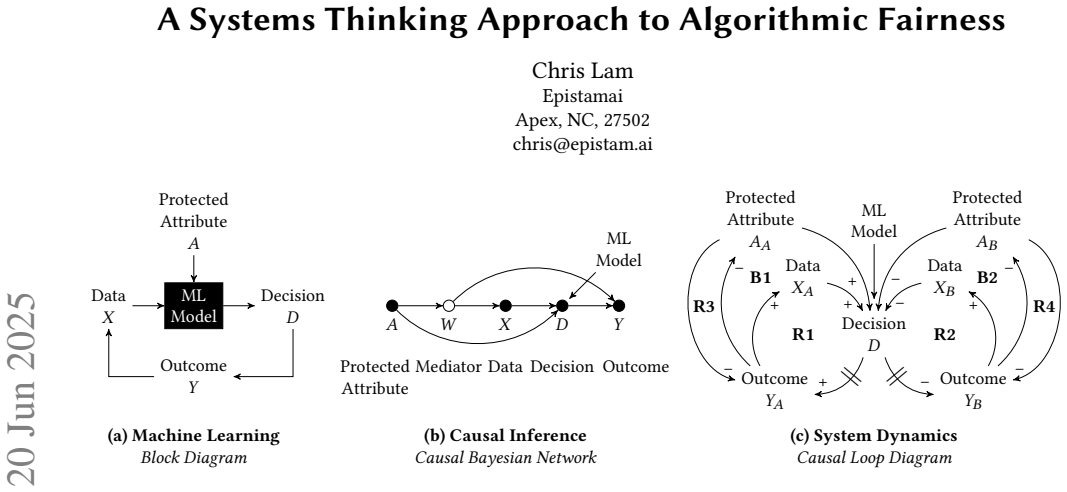
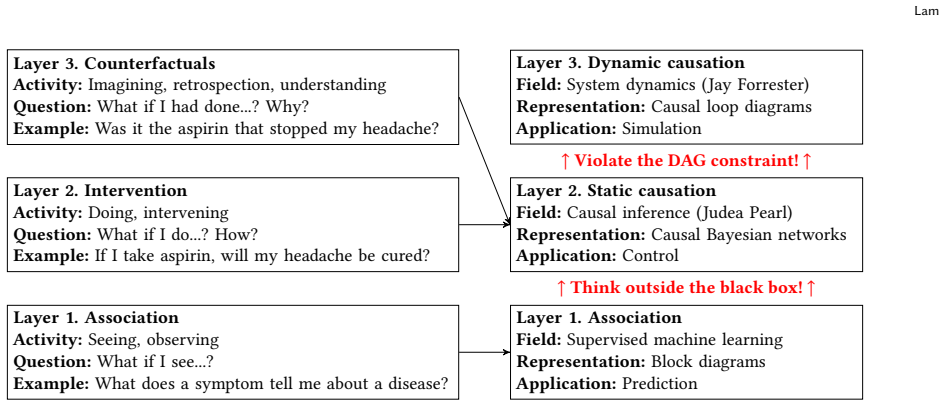
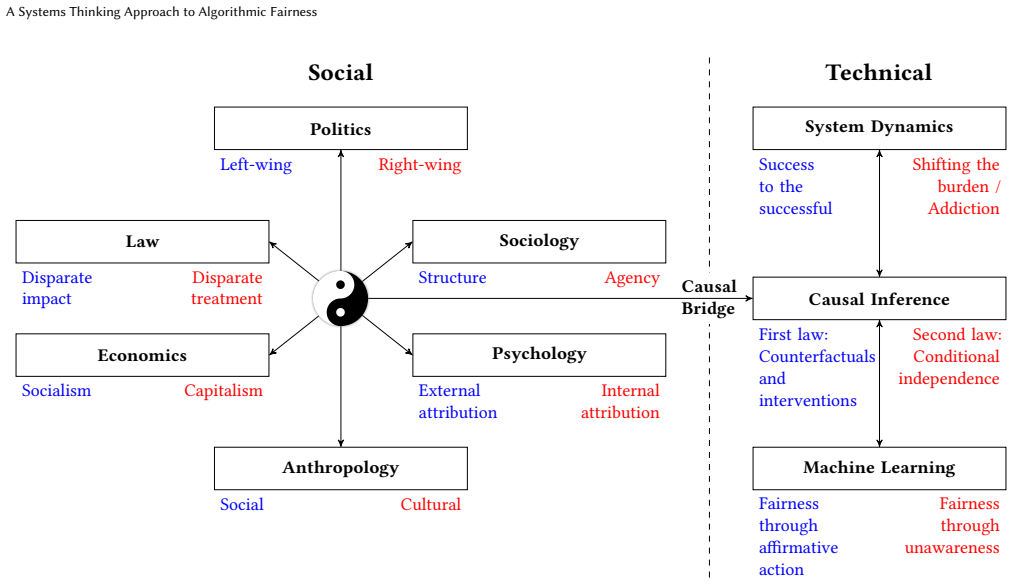
Systems thinking provides a way to model the algorithmic fairness problem by allowing us to encode prior knowledge and assumptions about where we believe bias might exist in the data generating process. We can then encode these beliefs as a series of causal graphs, enabling us to link AI/ML systems to politics and the law. This allows us to combine techniques from machine learning, causal inference, and system dynamics in order to capture different emergent aspects of the fairness problem.
What carries the argument
Causal graphs that encode prior knowledge and assumptions about bias locations in the data generating process.
If this is right
- Policymakers gain a method to visualize and compare trade-offs among different fairness definitions.
- AI policy design can draw on integrated machine learning, causal inference, and system dynamics models.
- The same framework can serve political agendas on either side of the aisle while referencing shared democratic values.
- Emergent aspects of fairness problems become visible that isolated technical metrics would miss.
Where Pith is reading between the lines
- The graphs could be used to run policy simulations in concrete domains such as credit scoring or hiring before laws are enacted.
- If the encoded assumptions prove stable, the approach might help resolve conflicts between incompatible fairness metrics by showing their systemic interactions.
- Validation would require comparing graph-derived recommendations against outcomes in deployed systems where bias locations are independently measured.
Load-bearing premise
That encoding prior knowledge about bias as causal graphs will reliably link AI systems to politics and law in a way that supports effective policy design.
What would settle it
A demonstration that causal-graph models of fairness produce policy recommendations that systematically overlook documented real-world biases or misalign with the political values they claim to serve.
Figures


read the original abstract
Systems thinking provides us with a way to model the algorithmic fairness problem by allowing us to encode prior knowledge and assumptions about where we believe bias might exist in the data generating process. We can then encode these beliefs as a series of causal graphs, enabling us to link AI/ML systems to politics and the law. This allows us to combine techniques from machine learning, causal inference, and system dynamics in order to capture different emergent aspects of the fairness problem. We can use systems thinking to help policymakers on both sides of the political aisle to understand the complex trade-offs that exist from different types of fairness policies, providing a sociotechnical foundation for designing AI policy that is aligned to their political agendas and with society's shared democratic values.
Editorial analysis
A structured set of objections, weighed in public.
Referee Report
Summary. The paper proposes a systems thinking approach to algorithmic fairness by encoding prior knowledge and assumptions about bias locations in the data generating process as causal graphs. This is claimed to link AI/ML systems to politics and the law, enabling the combination of machine learning, causal inference, and system dynamics techniques to capture emergent fairness aspects and help policymakers on both sides of the political aisle understand trade-offs in fairness policies, thereby providing a sociotechnical foundation for AI policy aligned with political agendas and democratic values.
Significance. If operationalized with concrete demonstrations, the approach could offer an interdisciplinary bridge between technical fairness modeling and sociopolitical considerations in AI policy, extending causal modeling ideas to support value-aligned decision-making. The manuscript highlights potential for integrating established techniques but currently presents these as high-level assertions.
major comments (2)
- [Abstract] Abstract: The central claim that encoding assumptions as causal graphs 'enables us to link AI/ML systems to politics and the law' and supplies a 'sociotechnical foundation' for policy design is load-bearing, yet the manuscript provides no concrete causal graph, no system-dynamics simulation, and no output metrics or policy mappings to substantiate how trade-offs would be surfaced or aligned with political agendas.
- [Abstract] Abstract: The assertion that the method will 'help policymakers on both sides of the political aisle' depends on the untested premise that user-encoded causal graphs will reliably produce actionable, cross-aisle insights; without an example workflow or validation step, this reduces to an assertion rather than a demonstrated capability.
minor comments (2)
- The abstract would be strengthened by a brief illustrative example of a causal graph for a fairness domain (e.g., hiring or lending) to ground the proposed workflow.
- Clarify the specific integration points between causal inference and system dynamics, as the high-level mention of combining the three techniques leaves the mechanics unspecified.
Simulated Author's Rebuttal
We thank the referee for their constructive comments, which correctly identify that several claims in the abstract are not supported by concrete demonstrations in the manuscript. The work is a conceptual proposal for a systems-thinking framework rather than an operationalized method with examples. We will revise the abstract accordingly to better align claims with the manuscript's scope.
read point-by-point responses
-
Referee: [Abstract] Abstract: The central claim that encoding assumptions as causal graphs 'enables us to link AI/ML systems to politics and the law' and supplies a 'sociotechnical foundation' for policy design is load-bearing, yet the manuscript provides no concrete causal graph, no system-dynamics simulation, and no output metrics or policy mappings to substantiate how trade-offs would be surfaced or aligned with political agendas.
Authors: We agree with this assessment. The manuscript presents a high-level framework for encoding prior beliefs about bias via causal graphs and combining ML, causal inference, and system dynamics techniques, but does not include any concrete graphs, simulations, metrics, or policy mappings. We will revise the abstract to qualify these statements as potential benefits of future operationalization of the approach, rather than capabilities demonstrated in the current work. revision: yes
-
Referee: [Abstract] Abstract: The assertion that the method will 'help policymakers on both sides of the political aisle' depends on the untested premise that user-encoded causal graphs will reliably produce actionable, cross-aisle insights; without an example workflow or validation step, this reduces to an assertion rather than a demonstrated capability.
Authors: The referee is correct that this claim rests on an untested premise and lacks an example workflow or validation. The manuscript does not provide such elements. We will revise the abstract to remove or substantially qualify this assertion, framing it as a possible outcome of applying the framework rather than a demonstrated result. revision: yes
Circularity Check
No significant circularity detected
full rationale
The manuscript presents a high-level conceptual proposal for applying systems thinking to algorithmic fairness via causal graphs and combined techniques, without any mathematical derivation chain, equations, fitted parameters, or self-citations that reduce outputs to inputs by construction. The central claims concern the potential utility of encoding assumptions for policy insight rather than any derived result shown to be equivalent to those assumptions. No load-bearing steps matching the enumerated circularity patterns are present in the text.
Axiom & Free-Parameter Ledger
axioms (1)
- domain assumption Prior knowledge about bias locations in the data generating process can be accurately encoded as causal graphs that connect technical systems to political and legal domains.
Reference graph
Works this paper leans on
-
[1]
Julia Angwin, Jeff Larson, Surya Mattu, and Lauren Kirchner. 2016. Machine Bias. Pro Publica Inc. https://www.propublica.org/article/machine-bias-risk- assessments-in-criminal-sentencing
work page 2016
-
[2]
Chris Barker. 2005. Cultural Studies: Theory and Practice . Sage, London, UK
work page 2005
-
[3]
Solon Barocas, Moritz Hardt, and Arvind Narayanan. 2023. Fairness and Machine Learning: Limitations and Opportunities . MIT Press, Cambridge, MA
work page 2023
-
[4]
Gary S. Becker. 1964. Human Capital: A Theoretical and Empirical Analysis, with Special Reference to Education . The University of Chicago Press, London, UK
work page 1964
-
[5]
Marianne Bertrand and Sendhil Mullainathan. 2003. Are Emily and Greg More Employable than Lakisha and Jamal? A Field Experiment on Labor Market Dis- crimination. Working Paper 9873. National Bureau of Economic Research. https://doi.org/10.3386/w9873
- [6]
-
[7]
Paul Carus. 1910. Person and personality. The Monist 20 (1910), 379
work page 1910
-
[8]
Alessandro Castelnovo, Riccardo Crupi, Greta Greco, Daniele Regoli, Ilaria Giuseppina Penco, and Andrea Claudio Cosentini. 2022. A clarification of the nuances in the fairness metrics landscape. Scientific Reports 12, 1 (2022), 1–21
work page 2022
-
[9]
Silvia Chiappa and William S. Isaac. 2019. A Causal Bayesian Networks Viewpoint on Fairness. Springer International Publishing, Cham, Switzerland, 3–20. https: //doi.org/10.1007/978-3-030-16744-8_1
-
[10]
Heather Mac Donald. 2023. When Race Trumps Merit: How the Pursuit of Equity Sacrifices Excellence, Destroys Beauty, and Threatens Lives . DW Books, Nashville, TN
work page 2023
-
[11]
Carol S. Dweck. 2007. Mindset: The New Psychology of Success . Ballantine Books, New York
work page 2007
-
[12]
Jay Forrester. 1971. Counterintuitive behavior of social systems. Technology Review 53, 3 (1971), 52–68
work page 1971
-
[13]
Joshua Grossman, Sabina Tomkins, Lindsay C Page, and Sharad Goel. 2023. The Disparate Impacts of College Admissions Policies on Asian American Applicants . Working Paper 31527. National Bureau of Economic Research. https://doi.org/ 10.3386/w31527
-
[14]
Fritz Heider. 1958. The Psychology of Interpersonal Relations . Lawrence Erlbaum Associates, Hillsdale, NJ
work page 1958
-
[15]
Donald Martin Jr. 2021. Applying Community-Based System Dynamics to Com- bat AI Bias . System Dynamics Society. https://www.youtube.com/watch?v= LpOZXYlQOFw
work page 2021
-
[16]
Donald Martin Jr. 2023. Using societal context knowledge to foster the responsible application of AI. Google Research. https://research.google/blog/using-societal- context-knowledge-to-foster-the-responsible-application-of-ai/
work page 2023
-
[17]
Shelly Kagan. 2012. Moral Desert. In The Geometry of Desert . Oxford Univer- sity Press, New York, NY. https://doi.org/10.1093/acprof:oso/9780199895595. 003.0001 arXiv:https://academic.oup.com/book/0/chapter/150310098/chapter-ag- pdf/44982224/book_6467_section_150310098.ag.pdf
-
[18]
Scott Barry Kaufman. 2020. Unraveling the Mindset of Victimhood. Scientific American 30, 5 (2020), 14
work page 2020
-
[19]
H. H. Kelley. 1967. Attribution Theory in Social Psychology.Nebraska Symposium on Motivation 15 (1967), 192–238
work page 1967
-
[20]
Ibram X. Kendi. 2017. Stamped from the Beginning: The Definitive History of Racist Ideas in America. Bold Type Books, New York, NY
work page 2017
-
[21]
Niki Kilbertus, Mateo Rojas-Carulla, Giambattista Parascandolo, Moritz Hardt, Dominik Janzing, and Bernhard Schölkopf. 2017. Avoiding discrimination through causal reasoning. In Proceedings of the 31st International Conference on Neural Information Processing Systems (Long Beach, California, USA) (NIPS’17). Curran Associates Inc., Red Hook, NY, USA, 656–666
work page 2017
-
[22]
Daniel H. Kim. 1992. Systems Archetypes I: Diagnosing Systemic Issues and De- signing High-Leverage Interventions. Pegasus Communications, Inc, Waltham, MA
work page 1992
-
[23]
Rakesh Kochnar and Mohamad Moslimani. 2023. Wealth Surged in the Pandemic, but Debt Endures for Poorer Black and Hispanic Families . Technical Report. Pew Research Center. Lam
work page 2023
-
[24]
Matt J Kusner, Joshua Loftus, Chris Russell, and Ricardo Silva. 2017. Counterfactual Fairness. In Advances in Neural Information Processing Systems, I. Guyon, U. Von Luxburg, S. Bengio, H. Wallach, R. Fergus, S. Vishwanathan, and R. Garnett (Eds.), Vol. 30. Curran Associates, Inc., Red Hook, NY. https://proceedings.neurips.cc/paper_files/paper/2017/file/ ...
work page 2017
- [25]
-
[26]
Glenn C. Loury. 2002. The Anatomy of Racial Inequality . Harvard University Press, Cambridge, MA
work page 2002
-
[27]
Donella H. Meadows. 2008. Thinking in Systems . Chelsea Green Publishing Company, White River Junction, VT
work page 2008
-
[28]
Ninareh Mehrabi, Fred Morstatter, Nripsuta Saxena, Kristina Lerman, and Aram Galstyan. 2021. A Survey on Bias and Fairness in Machine Learning.ACM Comput. Surv. 54, 6, Article 115 (July 2021), 35 pages. https://doi.org/10.1145/3457607
-
[29]
Charles W. Mills. 1997. The Racial Contract . Cornell University Press, Ithaca, NY
work page 1997
-
[30]
Arvind Narayanan. 2018. 21 fairness definitions and their politics . ACM Confer- ence on Fairness, Accountability, and Transparency. https://www.youtube.com/ embed/jIXIuYdnyyk
work page 2018
- [31]
-
[32]
US Department of Justice Civil Rights Division. 2024. Title VI Legal Manual . US Department of Justice, Washington, DC
work page 2024
-
[33]
Judea Pearl. 2000. Causality. Cambridge University Press, Cambridge, UK
work page 2000
-
[34]
Judea Pearl. 2001. Direct and indirect effects. In Proceedings of the Seventeenth Conference on Uncertainty in Artificial Intelligence (Seattle, Washington) (UAI’01). Morgan Kaufmann Publishers Inc., San Francisco, CA, USA, 411–420
work page 2001
-
[35]
Judea Pearl, Madelyn Glymour, and Nicholas P. Jewell. 2016. Causal Inference in Statistics. Wiley, West Sussex, UK
work page 2016
-
[36]
Judea Pearl and Dana Mackenzie. 2018. The Book of Why: The New Science of Cause and Effect. Basic Books, New York, NY
work page 2018
- [37]
-
[38]
Julian B Rotter. 1966. Generalized expectancies for internal versus external control of reinforcement. Psychological Monographs: General and Applied 80, 1 (1966), 1–28
work page 1966
-
[39]
Richard H. Sander and Stuart Taylor. 2012. Mismatch: How Affirmative Action Hurts Students It’s Intended to Help, and Why Universities Won’t Admit It. Basic Books, New York
work page 2012
-
[40]
M E P Seligman. 1972. Learned Helplessness. Annual Review of Medicine 23, Volume 23, 1972 (1972), 407–412. https://doi.org/10.1146/annurev.me.23.020172. 002203
-
[41]
Peter M. Senge. 1990. The Fifth Discipline: The Art and Practice of The Learning Organization. Doubleday Publishing Group, New York, NY
work page 1990
-
[42]
Thomas Sowell. 2004. Affirmative Action Around the World: An Empirical Study. Yale University Press, New Haven, CT
work page 2004
-
[43]
Thomas Sowell. 2019. Discrimination and Disparities. Basic Books, New York, NY
work page 2019
-
[44]
John D. Sterman. 2000. Business Dynamics: Systems Thinking and Modeling for a Complex World. McGraw-Hill, Boston, MA
work page 2000
-
[45]
American Community Survey. 2021. S0201: Selected Population Profile in the United States. Technical Report. United States Census Bureau
work page 2021
-
[46]
Matthew Talbert. 2024. Moral Responsibility. In The Stanford Encyclopedia of Philosophy (Fall 2024 ed.), Edward N. Zalta and Uri Nodelman (Eds.). Metaphysics Research Lab, Stanford University, Stanford, CA
work page 2024
-
[47]
Sahil Verma and Julia Rubin. 2018. Fairness definitions explained. InProceedings of the International Workshop on Software Fairness (Gothenburg, Sweden) (FairWare ’18). Association for Computing Machinery, New York, NY, USA, 1–7. https: //doi.org/10.1145/3194770.3194776
-
[48]
Bernard Weiner. 1986. An Attributional Theory of Motivation and Emotion . Springer, New York. NY. Received 25 June 2025
work page 1986
discussion (0)
Sign in with ORCID, Apple, or X to comment. Anyone can read and Pith papers without signing in.