REVIEW 4 major objections 6 minor 15 references
Multilingual Mathematical Reasoning: Advancing Open-Source LLMs in Hindi and English
T0 review · 4 major / 6 minor · reviewed 2026-08-11 · deepseek-v4-flash
Pith's one-line read WizardMath-7B beats Gemini Pro in English math, matches it in Hindi.
desk verdict Honest dataset work and useful English-benchmark gains, but the Hindi headline is contradicted by its own tables and the train/test split is the load-bearing risk. read the letter →
The pith
A machine-rendered reading of the paper's core claim, the machinery that carries it, and where it could break.
The reading
What carries the argument
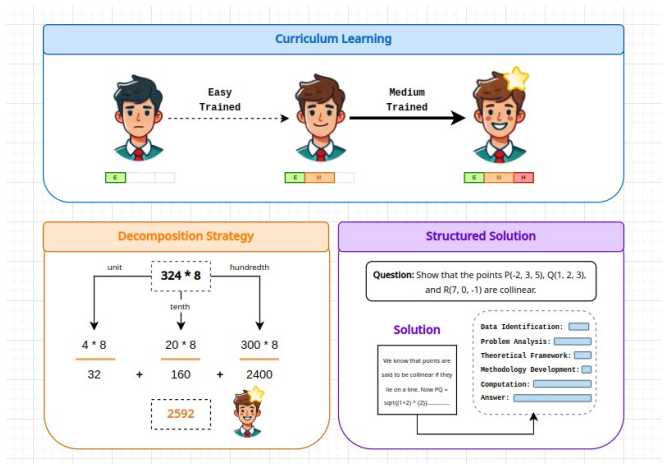
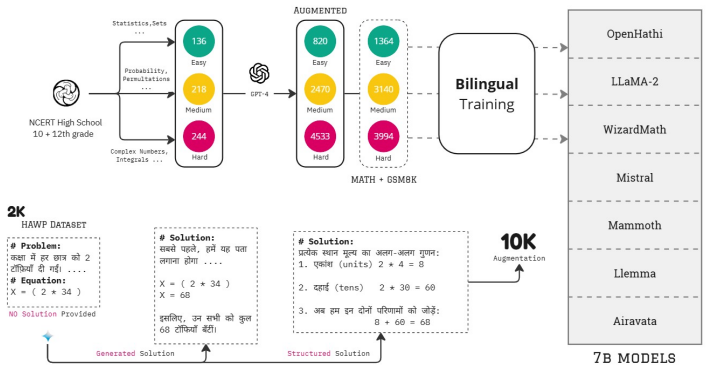
The central mechanism is a fixed six-phase answer scaffold the authors call the Structured Solution Design: every fine-tuning example is rewritten under the headings Data Identification, Problem Analysis, Theoretical Framework, Methodology Development, Computation, and Answer, so the model is trained to state what it knows and plans before it calculates. Around this scaffold, the paper organizes training with Curriculum Learning, fine-tuning first on easy problems (SFT Easy) and then on easy plus medium problems (SFT Easy+Medium) before any hard-problem evaluation, and it adds Bilingual Combined Training, in which English and Hindi versions of the same problems appear together in the batch. A fourth, smaller mechanism, the Decomposition Strategy, applies only to multiplication and division on the HAWP dataset, where numbers are split into place-value parts (e.g., $543 = 500 + 40 + 3$) and the parts are handled and summed separately. These mechanisms are carried by the new IndiMathQA dataset (7,823 NCERT-sourced questions in 14 topics, annotated easy/medium/hard by five human experts with a Fleiss' kappa of 0.58) and by augmented solutions generated with GPT-4 and translated with LLaMA-3-405B.
What would settle it
Re-run the curriculum fine-tuning after deduplicating the English and Hindi versions of the 70/30 training and test splits (checking for exact and paraphrased overlaps across all difficulty levels), then evaluate on a fresh Hindi math test set written by humans and never generated or translated by GPT-4 or LLaMA-3-405B; if accuracy falls to near the base-model level, the reported gains are inflated by leakage.
Extended reading notes
Core claim
The paper's central claim is that a carefully structured fine-tuning regime can make a 7B open-source model competitive with, and in English superior to, Gemini 1.0 Pro on school-level and competition-level math. The regime has three load-bearing parts: curriculum learning, which trains sequentially on easy then medium problems before evaluating on hard ones; structured solution design, which rewrites every solution into six named phases (data identification, problem analysis, theoretical framework, methodology development, computation, answer); and bilingual combined training, which fine-tunes on the English and Hindi versions of the same question–answer pairs together. On this recipe WizardMath-7B reaches 80% on GSM8K, 45% on MATH, and 73%/66%/47% on easy/medium/hard English IndiMathQA splits, while its Hindi results (72%/57%/45%) are close enough to Gemini 1.0 Pro that the paper reports them as comparable, with the detailed tables showing a roughly 3-point gap on medium and hard Hindi splits. A separate decomposition strategy breaks multiplication and division into place-value subtasks on the Hindi HAWP dataset, which the paper credits with reducing arithmetic errors and hallucinations in models like LLeMMA. The IndiMathQA dataset itself, 598 expert-curated problems augmented to 7,823, is offered as a new bilingual benchmark.
Load-bearing premise
The load-bearing premise is that the GPT-4-generated and LLaMA-3-405B-translated training data are correct, free of duplicates, and strictly separated into the 70/30 training and test splits, so the reported accuracy gains reflect generalization rather than memorization or translation noise.
Editorial extensions
If this is right
- A 7-billion-parameter open-source model can beat a much larger closed model on English math benchmarks after this fine-tuning recipe, which changes the cost-performance trade-off for math assistants.
- Training on parallel English–Hindi question–answer pairs helps Hindi math accuracy more than training on Hindi alone, indicating cross-lingual transfer of mathematical reasoning.
- Curriculum learning produces its clearest gains on medium-difficulty problems (reported at 11–18% in the bilingual setting), with small gains on hard problems, making it a targeted tool rather than a universal fix.
- The decomposition strategy for multiplication and division reduces arithmetic errors and hallucinations on Hindi word problems, and the paper positions it as a stepping stone for more complex datasets.
Reading between the lines
- The six-phase solution scaffold may itself function as a weak curriculum by forcing the model to plan before computing; an ablation that substitutes plain chain-of-thought solutions of equal length would isolate how much of the gain comes from the structure versus the pedagogy.
- The bilingual benefit probably extends beyond Hindi to other low-resource languages and to romanized Hindi, which the paper explicitly leaves out; the same recipe could be tested on Indic languages like Tamil or Bengali.
- The reported gains could be sensitive to the quality of the GPT-4-generated solutions and LLaMA-3-405B translations; a clean test would re-run the fine-tuning on human-written solutions only and check whether the curriculum ordering still helps.
Signed reviews
Editorial analysis
A structured set of objections, weighed in public.
Referee Report
Summary. The paper proposes a combination of curriculum learning, structured six-phase solution generation, a decomposition strategy for arithmetic operations, and bilingual combined training to improve mathematical reasoning in 7B open-source LLMs for English and Hindi. It introduces IndiMathQA, a dataset of 598 NCERT problems augmented with GPT-4 to 7,823 items, and reports evaluations on GSM8K, MATH, PRM800K, HAWP, and the new EMKB/HMKB benchmarks for several open-source and closed-source models. The central claim is that WizardMath-7B, after SFT Easy+Medium and bilingual training, exceeds Gemini 1.0 Pro on English benchmarks by about 5-6% and matches it on Hindi. The paper includes human verification efforts, an ablation study, and an appendix with prompts, hyperparameters, and error analyses.
Significance. If the reported results are robust, the paper would make a practically valuable contribution: a 7B open-source model beating a much larger closed model on English math benchmarks and approaching it in Hindi would be an important step for resource-efficient multilingual math reasoning. The new IndiMathQA dataset, the systematic comparison across five open and two closed models, and the promised release of code and data are further strengths. The human-review pipeline for generated solutions and the transparent reporting of hyperparameters also speak in the paper's favor. However, the significance is conditional on resolving the train/test leakage risk in the augmented dataset and on correcting the overstatement in the abstract regarding Hindi performance.
major comments (4)
- [IndiMathQA; Curriculum Learning based Fine-Tuning] The 7,823-item IndiMathQA set is generated from 598 seed problems using a GPT-4 prompt that asks for 'a similar conceptual question and answer' (Appendix, Data Augmentation Prompt). The paper states that each difficulty subset is split 70/30 for training and testing, but it does not state that the split is performed at the seed level or that generated variants are deduplicated. A random item-level split will place near-duplicates of the same seed on both sides with near-certainty, and because both folds receive structured solutions from the same GPT-4 pipeline, the EMKB/HMKB gains in Tables 2-4 could reflect memorization of near-duplicate solution structures rather than generalization. Please clarify the split level and, if necessary, re-run the experiments with a seed-level split and/or deduplication.
- [Abstract; Result & Analysis] The abstract's claim that WizardMath 'matches Gemini's performance on Hindi datasets' is contradicted by the paper's own tables: Gemini 1.0 Pro obtains 72/60/48 on HMKB Easy/Medium/Hard in Table 2, while WizardMath-7B after SFT Easy+Medium obtains 72/57/45 in Table 4, and the text in 'SLLMs vs LLMs' concedes a lag of about 3% on Medium and Hard. Please correct the abstract and any related claims.
- [Structured Solution Generation and Language Translations; Curriculum Learning based Fine-Tuning] The paper does not specify whether the GSM8K and MATH items used for fine-tuning are drawn exclusively from the official train splits. Since the reported GSM8K/MATH/PRM800K improvements are part of the headline comparison with Gemini, the provenance of the easy/medium/hard subsets (e.g., the 700 'easy' GSM8K questions and the MATH Level 1-5 buckets) must be stated; if any test-set items are included in fine-tuning, the English benchmark numbers in Tables 2-4 are inflated.
- [Ablation Study; Table 2] The 'Base' rows in Table 2 are described in the text as 'fine-tuned on the entire English dataset without distinguishing problem complexity,' while the Ablation Study describes Table 1 as base models using zero-shot and few-shot prompting. The status of the base rows (untuned checkpoint versus fine-tuned on the full dataset) is therefore unclear, which makes the incremental gains attributed to curriculum learning hard to interpret. Please define each setting precisely in both the text and the table.
minor comments (6)
- [Table 1] The model name 'Mistal-7B' is a typo for 'Mistral-7B'.
- [Appendix, Figure 3] The figure caption area contains the stray instruction 'remove Math dataset'; this should be deleted.
- [Table 2] The column headers are ambiguous: the grouping of GSM8K, MATH, PRM800K, EMKB Easy/Medium/Hard, HAWP, and HMKB Easy/Medium/Hard should be displayed with clear horizontal separators or explicit subheadings.
- [Appendix, Model Parameters] The hyperparameter list omits the learning rate, batch size, optimizer, and the exact answer-extraction/evaluation procedure; add these details for reproducibility.
- [Structured Solution Generation and Language Translations] The claim that 'all data have been reviewed by human experts' is not supported for the Hindi versions produced by LLaMA-3-405B; clarify whether the translations were also human-verified.
- [Decomposition Strategy] The Decomposition Strategy is evaluated only on the HAWP dataset and is not part of the IndiMathQA/GSM8K/MATH pipeline, so it should be presented as a separate component rather than as a driver of the headline improvements reported in Tables 2-4.
Circularity Check
No circularity: the paper reports benchmark measurements of training interventions, not fitted derivations.
full rationale
The paper's central claims are empirical: curriculum learning, a decomposition strategy, structured solutions, and bilingual combined training are interventions whose effects are measured on fixed benchmarks (GSM8K, MATH, PRM800K) and on a newly created IndiMathQA set. No headline number is obtained by fitting a parameter to the same quantity it is later said to predict; the reported accuracy gains are table readings on held-out splits. The easy/medium/hard complexity labels are input annotations used to structure training, not fitted parameters, and the evaluation is based on final-answer correctness rather than on reproducing the training-format labels. Self-citations to prior work by the same group appear in related-work and motivation contexts (Anand et al. 2023a,b; 2024a-d) but are not load-bearing: no uniqueness theorem or methodological premise is imported from those papers to force the present conclusions. The nearest concern is data hygiene rather than circularity: IndiMathQA was expanded from 598 manually curated problems to 7,823 items using GPT-4 prompts asking for a 'similar conceptual question and answer,' and the paper does not state whether the 70/30 train/test split was performed at the seed level or whether generated variants were deduplicated. If variants of the same seed appear in both folds, the reported gains could reflect memorization rather than generalization. That is a plausible correctness and contamination risk, but it is not circularity by construction: the models' outputs are still compared against independently defined answer correctness, and the claimed improvements are not equivalent to the training objective by definition. No circular step can be exhibited from the paper's text, so the appropriate circularity score is 0.
Assumptions & free parameters
free parameters (7)
- Fine-tuning epochs =
3
- Sampling temperature =
0.8
- Top-p =
0.90
- Top-k =
40
- Difficulty mapping for MATH =
L1 easy, L2-3 medium, L4-5 hard
- GSM8K easy subset size =
700
- Train/test split ratio =
70/30
assumptions (4)
- standard math Distributive property of multiplication and division over addition
- domain assumption LLaMA-3-405B Hindi translations preserve mathematical meaning and correctness
- domain assumption GPT-4-generated augmented problems and structured solutions, after human review, are correct and non-duplicative
- domain assumption No test leakage between the 70% training folds and 30% testing folds of GSM8K, MATH, and IndiMathQA
Cite this review
Pith. "Pith review of Multilingual Mathematical Reasoning: Advancing Open-Source LLMs in Hindi and English." pith.science (2026). https://pith.science/paper/HLC4BATD
@misc{pith2026241218415,
  author       = {Pith},
  title        = {Pith review of: Multilingual Mathematical Reasoning: Advancing Open-Source LLMs in Hindi and English},
  year         = {2026},
  howpublished = {\url{https://pith.science/paper/HLC4BATD}},
  note         = {Machine review of arXiv:2412.18415}
}
read the original abstract
Large Language Models (LLMs) excel in linguistic tasks but struggle with mathematical reasoning, particularly in non English languages like Hindi. This research aims to enhance the mathematical reasoning skills of smaller, resource efficient open-source LLMs in both Hindi and English. We evaluate models like OpenHathi 7B, LLaMA-2 7B, WizardMath 7B, Mistral 7B, LLeMMa 7B, MAmmoTH 7B, Gemini Pro, and GPT-4 using zero-shot, few-shot chain-of-thought (CoT) methods, and supervised fine-tuning. Our approach incorporates curriculum learning, progressively training models on increasingly difficult problems, a novel Decomposition Strategy to simplify complex arithmetic operations, and a Structured Solution Design that divides solutions into phases. Our experiments result in notable performance enhancements. WizardMath 7B exceeds Gemini's accuracy on English datasets by +6% and matches Gemini's performance on Hindi datasets. Adopting a bilingual approach that combines English and Hindi samples achieves results comparable to individual language models, demonstrating the capability to learn mathematical reasoning in both languages. This research highlights the potential for improving mathematical reasoning in open-source LLMs.
Figures

Figures from the paper (1 more)

Reference graph
Works this paper leans on
-
[1]
Language Understanding: Assesses the complexity of the language used. Problems with straightforward, clear language are classified as easy, while those with technical or complex phrasing are considered medium or hard
-
[2]
Mathematical Complexity: Assesses the nature of mathematical operations required. Problems involving fundamental concepts are easy, whereas those requiring multiple or intricate operations are medium or hard
-
[3]
Reasoning Complexity: Evaluates the complexity of reasoning needed. Problems requiring straightforward application of concepts are easy, while those needing de- tailed logic or multi-step reasoning are medium or hard
-
[4]
Number of Variables: Evaluates the number of vari- ables involved. Problems with a few variables are easy, whereas those with many or complex variables are medium or hard
-
[5]
Basic conceptual understanding is easy, while advanced or abstract concepts are medium or hard
Conceptual Complexity: Assesses the depth of un- derstanding required. Basic conceptual understanding is easy, while advanced or abstract concepts are medium or hard. Structured Problem Solving: Examples of Data Transformation We have raw data in the format of Question and Final Answer, which is then converted into a Refined Solution. These examples span ...
-
[7]
Identify a: a = √ 11 2
-
[8]
Apply the relationship c2 = a2 + b2: c2 = a2 + b2 =⇒ 32 = √ 11 2 !2 + b2
-
[9]
Compute a2: a2 = √ 11 2 !2 = 11 4
Show all 15 references
-
[10]
What is the probability that the committee will have (a) no man? (b) one man? (c) two men? Raw Solution: The total number of persons = 2 + 2 = 4
Solve for b2: 9 = 11 4 + b2 =⇒ 9 − 11 4 = b2 =⇒ 36 4 − 11 4 = b2 =⇒ 25 4 = b2 Therefore, b2 = 25 4 Therefore, b2 = 25 4 Solution: Using the values of a2 and b2, the equation of the hyperbola is: Using the values of a2 and b2, the equation of the hyperbola is: y2 √ 11 2 2 − x2 ...
-
[11]
Total number of ways to form a committee of 2 out of 4 people: C(4, 2)
-
[12]
• One man: C(2, 1) × C(2, 1) (choosing 1 man out of 2 and 1 woman out of 2)
Number of ways to form a committee with: • No man: C(2, 2) (choosing 2 women out of 2). • One man: C(2, 1) × C(2, 1) (choosing 1 man out of 2 and 1 woman out of 2). • Two men: C(2, 2) (choosing 2 men out of 2). Computation:
-
[13]
Total number of ways to form the committee: C(4, 2) = 4! 2!(4 − 2)! = 4 × 3 2 × 1 = 6
-
[14]
Number of favorable outcomes: • No man: C(2, 2) = 2! 2! × 0! = 1 • One man: C(2, 1) × C(2, 1) = 2! 1! × (2 − 1)! × 2! 1! × (2 − 1)! = 2× 2 = 4 • Two men: C(2, 2) = 2! 2! × 0! = 1
-
[15]
• The probability that the committee will have one man is 2 3
Calculate the probabilities: • No man: P (No man) = Number of outcomes for no man Total number of ways = 1 6 • One man: P (One man) = Number of outcomes for one man Total number of ways = 4 6 = 2 3 • Two men: P (Two men) = Number of outcomes for two men Total number of ways = ...
2000
-
[2009]
In Proceedings of the 26th an- nual international conference on machine learning, 41–48
Curriculum learning. In Proceedings of the 26th an- nual international conference on machine learning, 41–48. Cobbe, K.; Kosaraju, V .; Bavarian, M.; Chen, M.; Jun, H.; Kaiser, L.; Plappert, M.; Tworek, J.; Hilton, J.; Nakano, R.; et al. 2021. Training verifiers to solve math ...
2021 arXiv
Reviewed August 11, 2026 · model on record in the stance chip above.
Discussion (0). Continue with ORCID to comment.