REVIEW 4 major objections 5 minor 1 cited by
STITCH: Surface reconstrucTion using Implicit neural representations with Topology Constraints and persistent Homology
T0 review · 4 major / 5 minor · reviewed 2026-08-11 · deepseek-v4-flash
Pith's one-line read A persistent-homology loss added to a signed-distance-field reconstruction makes sparse, irregular point clouds resolve into a single connected 2-manifold surface, with a convergence proof for stochastic gradient descent.
desk verdict An incremental but well-executed application of Dong et al.'s topological loss to Neural-Pull; the theoretical claims don't survive contact with the paper. read the letter →
The pith
A machine-rendered reading of the paper's core claim, the machinery that carries it, and where it could break.
The reading
What carries the argument
The central object is the persistence diagram of 0-dimensional homology (connected components) of a cubical complex filtered by the predicted SDF. The mechanism that carries the argument is coface-based gradient routing: a coface of a cell is a higher-dimensional cell containing it, and for each birth or death event the coface stores the grid indices whose SDF values define the feature's birth and death times. The topological loss gradients are assembled by looking up those coface indices, which makes the persistent-homology loss end-to-end differentiable. The other load-bearing piece is the definability assumption, stated through o-minimal structures, that lets the paper invoke a tame-function convergence theorem for SGD.
What would settle it
Numerically compare the analytic topological-loss gradient from Equations 8 and 9 against central finite differences of the persistence loss along random SDF perturbations; a substantial mismatch at any non-degenerate filtration point would show that the coface route is not the true derivative and would break the differentiability premise of Theorem 1.
Extended reading notes
Core claim
On its own terms, the paper's central claim is that topology can be controlled during neural implicit surface reconstruction by making persistent homology differentiable through the coface structure of a cubical complex. Using the predicted SDF as the filtration function, every birth and death event in a persistence diagram is assigned to the cell whose addition created or destroyed the feature, and that cell's SDF value carries the gradient. This yields two loss terms, one suppressing noisy features near the diagonal and one preserving significant features, which are added to the Neural-Pull pull-loss. The paper further claims that the combined loss is definable and continuously differentiable under stated assumptions, so SGD converges almost surely to a critical point, and that the converged solution yields a single connected component rather than islands or gaps.
Load-bearing premise
The load-bearing premise is that the combined loss is smooth enough everywhere for the coface-based gradient to be a true descent direction, even though the persistence-diagram part of the loss is only piecewise differentiable and the coface assignment is a heuristic.
Editorial extensions
If this is right
- Reconstructed surfaces from sparse point clouds become watertight single-component 2-manifolds, so downstream meshing and physical simulation can use them directly.
- The topological loss can be added to any SDF-based implicit reconstruction method, not only the Neural-Pull architecture used in the experiments.
- The convergence proof extends persistence-optimization results beyond subgradient descent to stochastic gradient descent for a unified reconstruction-plus-topology loss.
- The significant-feature topological loss is reduced by large margins relative to tested baselines on thin structures and plant geometries, which the authors attribute to the connectivity constraint.
- Since only 0-dimensional features are used, the same framework is naturally extendable to loops and voids, at higher computational cost, as the paper notes.
Reading between the lines
- If the coface-gradient construction truly captures the persistence derivatives, the same mechanism could be applied to 1-dimensional and 2-dimensional persistent features, allowing a user to prescribe a full topological signature rather than just connectivity.
- The convergence and connectivity claims are stated for the trained SDF, yet the final mesh is extracted at a much higher resolution than the coarse cubical complex used during training; testing whether the one-component guarantee survives that resolution gap would bound the practical claim.
- The bias toward a single connected component means genuinely disconnected objects could be merged, so a natural testable extension is a user-specified component-count prior instead of always one.
- The authors empirically use a negative level set to reduce inflation on some shapes, which suggests the connectivity guarantee may depend on the level-set value; probing that dependence would clarify how robust the topological conclusion is.
Signed reviews
Editorial analysis
A structured set of objections, weighed in public.
Referee Report
Summary. The paper proposes STITCH, a neural implicit surface reconstruction method that augments the Neural-Pull signed-distance-function loss with two persistent-homology-based topological losses computed from a cubical complex filtration. The stated contributions are a differentiable topological loss term that enforces connectivity, a convergence guarantee for stochastic (sub)gradient descent on the unified loss, and a theoretical guarantee that the optimized reconstruction has a single connected component. The evaluation compares STITCH against Poisson surface reconstruction, Neural-Pull, IGR, DiGS, OG-INR, and NSH on SRB, DFAUST, plant, and thin-structure datasets, reporting Chamfer and Hausdorff distances together with a 'significant features' topological loss; ablations of the loss components and geometric initialization are provided in the supplement.
Significance. The application area is timely and the proposed framework is clean: combining a pull-based SDF loss with a persistence-based connectivity term is a natural idea, and the experimental study is broad, including thin structures and plant geometries where topological preservation is important. The paper also provides ablations and detailed supplementary tables. However, the central theoretical claim—a provable guarantee of a single connected component—is not established. Definition 2 is vacuous, Theorems 2 and 3 are point-set density statements that never refer to the learned SDF or its level sets, and the convergence theorem rests on an unjustified differentiability assumption. The primary topology metric is the same loss being optimized, so the reported topological improvements are expected and do not constitute independent verification. If the connectivity guarantee were removed and the evaluation corrected, the paper would still be a useful empirical contribution, but not at the level claimed.
major comments (4)
- [Section 4.2 / Definition 2 / Theorems 2–3] The abstract and Section 1 claim that optimizing the loss 'provably' leads to 'reconstructing shapes with a single connected component.' This is not supported by Section 4.2. Definition 2 defines an alpha~beta-connected set D by taking alpha = min_i xi_i and beta = max_i xi_i over pairwise distances; as printed, every finite set with at least two points satisfies this condition, so the definition carries no information about the number of connected components. Theorem 2 concludes only that M is (m-k+1)~beta-dense, a neighborhood-count bound, and Theorem 3 concludes that M is not epsilon-separated under a cardinality condition. Neither theorem refers to the cubical complex C_K, the SDF f_theta, the persistence diagram, or the extracted marching-cubes mesh. No lemma shows that a critical point of L (Eq. 4) has small L_c, nor that small L_c implies a single H_0 feature at the zero level set. The Limitations section at the end of Section 6 acknowledges edge cases and restriction to H_0 features but does not disclose the absence of a theorem connecting the optimized loss to a single connected component. Therefore the central connectivity guarantee is unsupported.
- [Appendix C.2 / Theorem 1 / Section 4.1] The proof of Theorem 1 is not sound as written. The proof asserts that 'L = L_g + L_c continuously differentiable' and Section 4.1 states that 'L_c is definable since it is differentiable.' However, persistent homology maps are only piecewise differentiable, and the coface-based gradient in Eqs. (8)–(9) is asserted to be the partial derivative of the topological loss without proof that it is a valid (sub)gradient. If L_c is not differentiable, the chain rule in Eqs. (6)–(7) is not justified, and the appeal to Corollary 5.9 of Davis et al. [21] requires hypotheses—tameness/definability and a correct subgradient calculus for persistence functions—that are not established for the specific L_c in Eq. (3). Thus Theorem 1, even if its conclusion were accepted, does not deliver a valid convergence guarantee for the STITCH objective.
- [Section D.4 / Tables 3, 16, 21, 26] The primary topological evaluation metric is the 'significant features topological loss term' L_S, which is exactly the loss term being minimized in Eq. (3). The lower values reported for STITCH in Tables 3, 16, 21, and 26 are therefore expected from the optimization and do not independently verify the claim of a single connected component. The paper needs an independent topology measure—for instance, the number of connected components of the extracted 256^3 marching-cubes mesh, or the number of H_0 features in the persistence diagram of the final SDF at a fixed threshold—to support the experimental connectivity claims.
- [Definition 7 / Theorem 3 (Appendix C.2)] Definition 7 states that a set D is epsilon-separated if for all distinct z, z' in D, ||z - z'|| <= epsilon. This is the opposite of the standard separation condition, which requires distances at least epsilon (or greater than epsilon). The proof of Theorem 3 uses the metric entropy N_epsilon with this definition, and the paragraph following Theorem 3 states the conclusion as 'there exist at least two points with distance smaller than epsilon,' which is the negation of the standard definition but not of the printed one. The misstatement makes Theorem 3 vacuous or ambiguous as written and needs correction.
minor comments (5)
- [Section 4.1, Assumption 1(a)] Assumption 1(a) contains a typesetting error: 'Σ_{t=1}^∞ = +∞' should read 'Σ_{t=1}^∞ α_t = +∞'.
- [Section 3.3] The sentence 'Set |N|= N and |S| = S' overloads N and S as both set names and cardinalities, which is confusing; consider using cardinalities n_N and n_S.
- [Section 3.4, Eqs. (8)–(9)] The symbols 'a' in Eq. (8) and 'ϑ' in Eq. (9) are never defined; the magnitudes of the gradients should be given explicitly or their derivation described.
- [Supplement F] The sentence 'due to the new CVPR policy on presenting additional dataset results in the supplement' is irrelevant to the technical content and should be removed from the arXiv supplement.
- [Definition 2] The notation 'ξ_i' is introduced as the increasing sequence of pairwise distances, but the definition of 'α ~ β-connected' then simply restates the definitions of α and β; the condition should be reformulated to express a nontrivial connectivity requirement, or the concept should be replaced with a standard connectedness notion.
Circularity Check
The provable-connectivity claim collapses into a self-definitional property of Definition 2, and the headline topological metric is the same LS term being optimized.
-
self definitional
[Section 4.2, Definition 2 and following paragraph]
"Definition 2. (α ∼ β-connected set[28]) Let D ⊂ R3 be a finite set and let {ξi}|CK | i=1 be the increasing sequence of pairwise distance values of D. Hence, D is α ∼ β-connected if and only if: α = mini∈[|CK |]ξi and β = maxi∈[|CK |]ξi. Based on the above definition, it implies that during training L controls properties of Q explicitly, and at the convergence, P is α ∼ β-connected."
α and β are defined as the minimum and maximum of the pairwise distances of D, so any finite point set with at least two points satisfies the condition 'D is α ∼ β-connected' automatically. The paper then converts this vacuous property into its central guarantee: 'at the convergence, P is α ∼ β-connected' and Theorem 2/3 are called a 'theoretical guarantee for connectivity.' Neither theorem mentions the cubical complex CK, the SDF fθ, the persistence diagram, or the number of H0 features; they conclude only that M is (m-k+1)∼β-dense or not ε-separated.
-
fitted input called prediction
[Section D.4 Evaluation metrics; Section 5 (Tables 3, 16, 21, 26)]
"Furthermore, to assess the effect of our proposed topological losses, we compute LS from the predicted signed distance field. This serves as a measure of preserving significant topological features, with lower magnitudes of the loss corresponding to high preservation of connected features."
LS in Eq. 3 is exactly the significant-feature loss being minimized in the unified objective L = Lg + λ1LS + λ2LN (Eq. 4). Section D.4 instructs that LS be computed 'to assess the effect of our proposed topological losses,' and the main text interprets STITCH's lower LS (Tables 3, 16, 21, 26) as evidence that it 'produce[s] a single connected component.' Because STITCH is explicitly trained to minimize LS (with the topological losses introduced in the last 500 iterations), low LS is the training objective itself, not an independent measurement of topology. Comparing STITCH's LS against baselines that never optimize LS is therefore expected and does not verify connectivity.
full rationale
STITCH's geometric reconstruction quality is tested against external benchmarks (Chamfer and Hausdorff distances against PSR, NP, IGR, DiGS, OG-INR, NSH), and those comparisons are not circular. The convergence theorem is a direct application of Corollary 5.9 of Davis et al. [21] under definability/Lipschitz assumptions, so it is an imported external result rather than a self-citation; it is not circular, although its assumptions (e.g., continuous differentiability of Lc) are questionable. The circularity is concentrated in the connectivity claim. Definition 2 defines α∼β-connectedness via min/max pairwise distances, making it automatically true for every finite set; the paper then relies on this definition to assert that P becomes α∼β-connected at convergence and presents Theorems 2–3 as a 'theoretical guarantee for connectivity,' even though those theorems only establish point-set density and non-separatedness. No statement links a critical point of L to a single H0 feature on the zero-level set. The empirical topology evidence is likewise circular: the reported 'significant features topological loss' is the very LS term minimized during training, so its low values are expected and do not independently confirm a single connected component. Overall, the central provable-connectivity claim reduces to a definitional artifact plus a re-used training objective, while the geometric accuracy evaluation remains externally grounded.
Assumptions & free parameters
free parameters (4)
- lambda_1 (weight of significant-feature loss LS) =
not specified in main text
- lambda_2 (weight of noise-feature loss LN) =
not specified in main text
- cubical complex grid resolution =
16^3
- curriculum insertion step =
last 500 of 40,000 iterations
assumptions (4)
- domain assumption The persistent homology map M is definable in an o-minimal structure and locally Lipschitz (Lemma 1, Appendix C.1).
- ad hoc to paper The coface-based assignment in Equations 8-9 yields the true (sub)gradient of the topological loss.
- domain assumption Optimizing the grid-SDF topological loss at 16^3 resolution controls the connectivity of the 256^3 marching-cubes mesh.
- standard math Standard SGD assumptions (Assumption 1): square-summable learning rate, bounded iterates, zero-mean bounded-variance noise.
Cite this review
Pith. "Pith review of STITCH: Surface reconstrucTion using Implicit neural representations with Topology Constraints and persistent Homology." pith.science (2026). https://pith.science/paper/IWPZZNRN
@misc{pith2026241218696,
  author       = {Pith},
  title        = {Pith review of: STITCH: Surface reconstrucTion using Implicit neural representations with Topology Constraints and persistent Homology},
  year         = {2026},
  howpublished = {\url{https://pith.science/paper/IWPZZNRN}},
  note         = {Machine review of arXiv:2412.18696}
}
read the original abstract
We present STITCH, a novel approach for neural implicit surface reconstruction of a sparse and irregularly spaced point cloud while enforcing topological constraints (such as having a single connected component). We develop a new differentiable framework based on persistent homology to formulate topological loss terms that enforce the prior of a single 2-manifold object. Our method demonstrates excellent performance in preserving the topology of complex 3D geometries, evident through both visual and empirical comparisons. We supplement this with a theoretical analysis, and provably show that optimizing the loss with stochastic (sub)gradient descent leads to convergence and enables reconstructing shapes with a single connected component. Our approach showcases the integration of differentiable topological data analysis tools for implicit surface reconstruction.
Figures
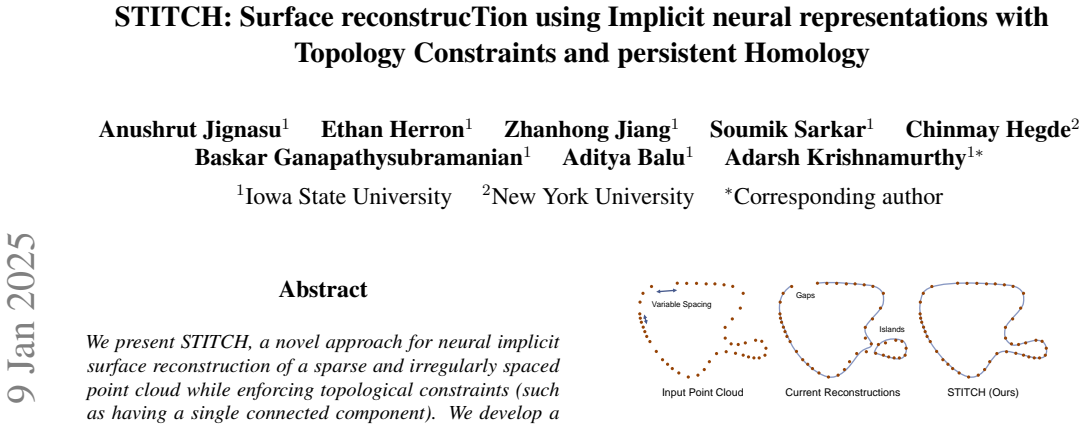


Figures from the paper (9 more)


Forward citations
Cited by 1 Pith paper
-
Mechanics Simulation with Implicit Neural Representations of Complex Geometries
A framework that uses neural implicit geometry representations to feed shifted-boundary finite element simulations, removing explicit surface meshing for linear elasticity on complex shapes.
Reference graph
Works this paper leans on
-
[21]
Stochastic subgradient method converges on tame functions
Damek Davis, Dmitriy Drusvyatskiy, Sham Kakade, and Ja- son D Lee. Stochastic subgradient method converges on tame functions. Foundations of computational mathematics, 20(1): 119–154, 2020. 3
work page 2020
-
[1]
Crossing patterns of semi-algebraic sets
Noga Alon, J´anos Pach, Rom Pinchasi, Radoˇs Radoiˇci´c, and Micha Sharir. Crossing patterns of semi-algebraic sets. Jour- nal of Combinatorial Theory, Series A, 111(2):310–326, 2005. 2
work page 2005
-
[2]
A new voronoi-based surface reconstruction algorithm
Nina Amenta, Marshall Bern, and Manolis Kamvysselis. A new voronoi-based surface reconstruction algorithm. In Pro- ceedings of the 25th annual conference on Computer graphics and interactive techniques, pages 415–421, 1998. 1
work page 1998
-
[3]
Sal: Sign agnostic learn- ing of shapes from raw data
Matan Atzmon and Yaron Lipman. Sal: Sign agnostic learn- ing of shapes from raw data. In Proceedings of the IEEE/CVF conference on computer vision and pattern recognition, pages 2565–2574, 2020. 1, 2, 4
work page 2020
-
[4]
SALD: sign agnostic learning with derivatives
Matan Atzmon and Yaron Lipman. SALD: sign agnostic learning with derivatives. In 9th International Conference on Learning Representations, ICLR 2021, 2021
work page 2021
-
[5]
DiGS : Divergence guided shape implicit neural representation for unoriented point clouds
Yizhak Ben-Shabat, Chamin Hewa Koneputugodage, and Stephen Gould. Digs: Divergence guided shape implicit neu- ral representation for unoriented point clouds. arXiv preprint arXiv:2106.10811, 2021. 2, 7, 1
work page Pith review arXiv 2021
-
[6]
A benchmark for surface reconstruction
Matthew Berger, Joshua A Levine, Luis Gustavo Nonato, Gabriel Taubin, and Claudio T Silva. A benchmark for surface reconstruction. ACM Transactions on Graphics (TOG), 32 (2):1–17, 2013. 7
work page 2013
-
[7]
Geometry-informed neural networks
Arturs Berzins, Andreas Radler, Eric V olkmann, Sebas- tian Sanokowski, Sepp Hochreiter, and Johannes Brandstet- ter. Geometry-informed neural networks. arXiv preprint arXiv:2402.14009, 2024. 2
arXiv 2024
Show all 55 references
-
[8]
The persistent homology of dual digital image constructions
Bea Bleile, Ad ´elie Garin, Teresa Heiss, Kelly Maggs, and Vanessa Robins. The persistent homology of dual digital image constructions. In Research in Computational Topology 2, pages 1–26. Springer, 2022. 4
2022
-
[9]
Dynamic faust: Registering human bodies in motion
Federica Bogo, Javier Romero, Gerard Pons-Moll, and Michael J Black. Dynamic faust: Registering human bodies in motion. In Proceedings of the IEEE conference on com- puter vision and pattern recognition, pages 6233–6242, 2017. 7, 5
2017
-
[10]
Geometric structures for three- dimensional shape representation
Jean-Daniel Boissonnat. Geometric structures for three- dimensional shape representation. ACM Transactions on Graphics (TOG), 3(4):266–286, 1984. 1
1984
-
[11]
Large-scale machine learning with stochastic gradient descent
L´eon Bottou. Large-scale machine learning with stochastic gradient descent. In Proceedings of COMPSTAT’2010: 19th International Conference on Computational StatisticsParis France, August 22-27, 2010 Keynote, Invited and Contributed Papers, pages 177–186. Springer, 2010. 6
2010
-
[12]
Optimiza- tion methods for large-scale machine learning
L´eon Bottou, Frank E Curtis, and Jorge Nocedal. Optimiza- tion methods for large-scale machine learning. SIAM review, 60(2):223–311, 2018. 5, 6
2018
-
[13]
A topology layer for machine learning
Rickard Br¨uel-Gabrielsson, Bradley J Nelson, Anjan Dwarak- nath, Primoz Skraba, Leonidas J Guibas, and Gunnar Carls- son. A topology layer for machine learning. arXiv preprint arXiv:1905.12200, 2019. 2
1905 arXiv
-
[14]
Topology-aware surface reconstruction for point clouds
Rickard Br¨uel-Gabrielsson, Vignesh Ganapathi-Subramanian, Primoz Skraba, and Leonidas J Guibas. Topology-aware surface reconstruction for point clouds. InComputer Graphics Forum, pages 197–207. Wiley Online Library, 2020. 2, 3
2020
-
[15]
Persistence barcodes for shapes
Gunnar Carlsson, Afra Zomorodian, Anne Collins, and Leonidas J Guibas. Persistence barcodes for shapes. Inter- national Journal of Shape Modeling, 11(02):149–187, 2005. 2
2005
-
[16]
Reconstruction and representation of 3d objects with radial basis functions
Jonathan C Carr, Richard K Beatson, Jon B Cherrie, Tim J Mitchell, W Richard Fright, Bruce C McCallum, and Tim R Evans. Reconstruction and representation of 3d objects with radial basis functions. In Proceedings of the 28th annual conference on Computer graphics and interactiv...
2001
-
[17]
Optimizing persistent homology based functions
Mathieu Carriere, Fr´ed´eric Chazal, Marc Glisse, Yuichi Ike, Hariprasad Kannan, and Yuhei Umeda. Optimizing persistent homology based functions. In International conference on machine learning, pages 1294–1303. PMLR, 2021. 5, 6, 1, 2
2021
-
[18]
Towards persistence- based reconstruction in euclidean spaces
Fr´ed´eric Chazal and Steve Yann Oudot. Towards persistence- based reconstruction in euclidean spaces. In Proceedings of the twenty-fourth annual symposium on Computational geometry, pages 232–241, 2008. 2
2008
-
[19]
Learning implicit fields for generative shape modeling
Zhiqin Chen and Hao Zhang. Learning implicit fields for generative shape modeling. In Proceedings of the IEEE/CVF Conference on Computer Vision and Pattern Recognition , pages 5939–5948, 2019. 1
2019
-
[20]
Implicit functions in feature space for 3D shape reconstruction and completion
Julian Chibane, Thiemo Alldieck, and Gerard Pons-Moll. Implicit functions in feature space for 3D shape reconstruction and completion. In Proceedings of the IEEE/CVF Conference on Computer Vision and Pattern Recognition, pages 6970– 6981, 2020. 1
2020
-
[22]
Topology- controllable implicit surface reconstruction based on persis- tent homology
Zhetong Dong, Jinhao Chen, and Hongwei Lin. Topology- controllable implicit surface reconstruction based on persis- tent homology. Computer-Aided Design, 150:103308, 2022. 2, 3, 4, 6
2022
-
[23]
Locally o-minimal structures with tame topo- logical properties
Masato Fujita. Locally o-minimal structures with tame topo- logical properties. The Journal of Symbolic Logic , 88(1): 219–241, 2023. 1
2023
-
[24]
Implicit geometric regularization for learning shapes
Amos Gropp, Lior Yariv, Niv Haim, Matan Atzmon, and Yaron Lipman. Implicit geometric regularization for learning shapes. arXiv preprint arXiv:2002.10099, 2020. 1, 2, 7, 4
2002 arXiv
-
[25]
Andjar Guerrero. P. cardinality of definable families of sets in o-minimal structures. arXiv preprint arXiv:2305.12294,
-
[26]
Mutual information, metric entropy and cumulative relative entropy risk
David Haussler and Manfred Opper. Mutual information, metric entropy and cumulative relative entropy risk. The Annals of Statistics, 25(6):2451–2492, 1997. 3
1997
-
[27]
A survey of topological machine learning methods
Felix Hensel, Michael Moor, and Bastian Rieck. A survey of topological machine learning methods. Frontiers in Artificial Intelligence, 4:681108, 2021. 2
2021
-
[28]
Connectivity-optimized representation learning via persistent homology
Christoph Hofer, Roland Kwitt, Marc Niethammer, and Man- dar Dixit. Connectivity-optimized representation learning via persistent homology. In International Conference on Machine Learning, pages 2751–2760. PMLR, 2019. 2, 6, 3
2019
-
[29]
Surface reconstruction from unorga- nized points
Hugues Hoppe, Tony DeRose, Tom Duchamp, John McDon- ald, and Werner Stuetzle. Surface reconstruction from unorga- nized points. In Proceedings of the 19th annual conference on 9 computer graphics and interactive techniques, pages 71–78,
-
[30]
Topology- aware latent diffusion for 3d shape generation
Jiangbei Hu, Ben Fei, Baixin Xu, Fei Hou, Weidong Yang, Shengfa Wang, Na Lei, Chen Qian, and Ying He. Topology- aware latent diffusion for 3d shape generation. arXiv preprint arXiv:2401.17603, 2024. 4
2024 arXiv
-
[31]
Pois- son surface reconstruction
Michael Kazhdan, Matthew Bolitho, and Hugues Hoppe. Pois- son surface reconstruction. In Proceedings of the fourth Eu- rographics symposium on Geometry processing , 2006. 7, 1
2006
-
[32]
Spectral surface reconstruction from noisy point clouds
Ravikrishna Kolluri, Jonathan Richard Shewchuk, and James F O’Brien. Spectral surface reconstruction from noisy point clouds. In Proceedings of the 2004 Eurographics/ACM SIGGRAPH symposium on Geometry processing, pages 11– 21, 2004. 1
2004
-
[33]
Phase transitions, distance functions, and implicit neural representations
Yaron Lipman. Phase transitions, distance functions, and implicit neural representations. In Proceedings of the 38th International Conference on Machine Learning, pages 6702–
-
[34]
Learning smooth neural functions via lipschitz regularization
Hsueh-Ti Derek Liu, Francis Williams, Alec Jacobson, Sanja Fidler, and Or Litany. Learning smooth neural functions via lipschitz regularization. In ACM SIGGRAPH 2022 Confer- ence Proceedings, pages 1–13, 2022. 2, 1
2022
-
[35]
Stable vectorization of multiparameter persistent homology using signed barcodes as measures
David Loiseaux, Luis Scoccola, Mathieu Carri `ere, Mag- nus Bakke Botnan, and Steve Oudot. Stable vectorization of multiparameter persistent homology using signed barcodes as measures. Advances in Neural Information Processing Systems, 36, 2024. 2
2024
-
[36]
Marching cubes: A high resolution 3D surface construction algorithm
William E Lorensen and Harvey E Cline. Marching cubes: A high resolution 3D surface construction algorithm. InSeminal graphics: pioneering efforts that shaped the field, pages 347–
-
[37]
Neural-pull: Learning signed distance functions from point clouds by learning to pull space onto surfaces
Baorui Ma, Zhizhong Han, Yu-Shen Liu, and Matthias Zwicker. Neural-pull: Learning signed distance functions from point clouds by learning to pull space onto surfaces. arXiv preprint arXiv:2011.13495, 2020. 2, 3, 7
2011 arXiv
-
[38]
Occupancy networks: Learning 3d reconstruction in function space, 2019
Lars Mescheder, Michael Oechsle, Michael Niemeyer, Se- bastian Nowozin, and Andreas Geiger. Occupancy networks: Learning 3d reconstruction in function space, 2019. 1
2019
-
[39]
Physically-aware generative network for 3d shape modeling
Mariem Mezghanni, Malika Boulkenafed, Andre Lieutier, and Maks Ovsjanikov. Physically-aware generative network for 3d shape modeling. In Proceedings of the IEEE/CVF Conference on Computer Vision and Pattern Recognition , pages 9330–9341, 2021. 3
2021
-
[40]
Nerf: Representing scenes as neural radiance fields for view syn- thesis
Ben Mildenhall, Pratul P Srinivasan, Matthew Tancik, Jonathan T Barron, Ravi Ramamoorthi, and Ren Ng. Nerf: Representing scenes as neural radiance fields for view syn- thesis. In European conference on computer vision, pages 405–421. Springer, 2020. 1
2020
-
[41]
Instant neural graphics primitives with a multireso- lution hash encoding
Thomas M¨uller, Alex Evans, Christoph Schied, and Alexan- der Keller. Instant neural graphics primitives with a multireso- lution hash encoding. ACM Transactions on Graphics (TOG), 41(4):1–15, 2022. 1
2022
-
[42]
Position: Topological deep learning is the new frontier for relational learning
Theodore Papamarkou, Tolga Birdal, Michael M Bronstein, Gunnar E Carlsson, Justin Curry, Yue Gao, Mustafa Hajij, Roland Kwitt, Pietro Lio, Paolo Di Lorenzo, et al. Position: Topological deep learning is the new frontier for relational learning. In Forty-first International Con...
2024
-
[43]
Differentiability and optimiza- tion of multiparameter persistent homology
Luis Scoccola, Siddharth Setlur, David Loiseaux, Mathieu Carri`ere, and Steve Oudot. Differentiability and optimiza- tion of multiparameter persistent homology. arXiv preprint arXiv:2406.07224, 2024. 2, 5
2024 arXiv
-
[44]
Leveraging continu- ously differentiable activation functions for learning in quan- tized noisy environments
Vivswan Shah and Nathan Youngblood. Leveraging continu- ously differentiable activation functions for learning in quan- tized noisy environments. arXiv preprint arXiv:2402.02593,
-
[45]
Implicit neural representa- tions with periodic activation functions
Vincent Sitzmann, Julien Martel, Alexander Bergman, David Lindell, and Gordon Wetzstein. Implicit neural representa- tions with periodic activation functions. Advances in Neural Information Processing Systems, 33, 2020. 1, 2, 3
2020
-
[46]
Persistence-based segmentation of de- formable shapes
Primoz Skraba, Maks Ovsjanikov, Frederic Chazal, and Leonidas Guibas. Persistence-based segmentation of de- formable shapes. In 2010 IEEE Computer Society Confer- ence on Computer Vision and Pattern Recognition-Workshops, pages 45–52. IEEE, 2010. 2
2010
-
[47]
Curve skeleton extraction from incomplete point cloud
Andrea Tagliasacchi, Hao Zhang, and Daniel Cohen-Or. Curve skeleton extraction from incomplete point cloud. In SIGGRAPH, pages 1–9. ACM, 2009. 1
2009
-
[48]
Capturing shape information with multi-scale topological loss terms for 3d reconstruction
Dominik JE Waibel, Scott Atwell, Matthias Meier, Carsten Marr, and Bastian Rieck. Capturing shape information with multi-scale topological loss terms for 3d reconstruction. In International Conference on Medical Image Computing and Computer-Assisted Intervention, pages 150–159...
-
[49]
Bao Wang and G. Wei. Object-oriented persistent homology. Journal of computational physics, 305:276–299, 2016. 4
2016
-
[50]
Neus: Learning neural implicit surfaces by volume rendering for multi-view reconstruction
Peng Wang, Lingjie Liu, Yuan Liu, Christian Theobalt, Taku Komura, and Wenping Wang. Neus: Learning neural implicit surfaces by volume rendering for multi-view reconstruction. arXiv preprint arXiv:2106.10689, 2021. 1
2021 arXiv
-
[51]
Neural-singular-hessian: Implicit neural representation of unoriented point clouds by enforcing singu- lar hessian
Zixiong Wang, Yunxiao Zhang, Rui Xu, Fan Zhang, Peng- Shuai Wang, Shuangmin Chen, Shiqing Xin, Wenping Wang, and Changhe Tu. Neural-singular-hessian: Implicit neural representation of unoriented point clouds by enforcing singu- lar hessian. ACM Transactions on Graphics (TOG), ...
2023
-
[52]
Deep geomet- ric prior for surface reconstruction
Francis Williams, Teseo Schneider, Claudio Silva, Denis Zorin, Joan Bruna, and Daniele Panozzo. Deep geomet- ric prior for surface reconstruction. In Proceedings of the IEEE/CVF Conference on Computer Vision and Pattern Recognition, pages 10130–10139, 2019. 7, 5
2019
-
[53]
PixelNeRF: Neural radiance fields from one or few images
Alex Yu, Vickie Ye, Matthew Tancik, and Angjoo Kanazawa. PixelNeRF: Neural radiance fields from one or few images. In Proceedings of the IEEE/CVF Conference on Computer Vision and Pattern Recognition, pages 4578–4587, 2021. 1
2021
-
[54]
Fast surface reconstruction using the level set method
Hong-Kai Zhao, Stanley Osher, and Ronald Fedkiw. Fast surface reconstruction using the level set method. In Proceed- ings IEEE Workshop on Variational and Level Set Methods in Computer Vision, pages 194–201. IEEE, 2001. 1
2001
-
[55]
scan” point cloud (normals in- cluded) that simulates noisy range scanning with missing regions and misalignment. They also provide a “ground truth
Wenjie Zhao and Guangming Zhou. Hausdorff distance be- tween convex semialgebraic sets. Journal of Global Optimiza- tion, 88(2):409–429, 2024. 2 10 STITCH: Surface reconstrucTion using Implicit neural representations with Topology Constraints and persistent Homology Supplement...
2024
Reviewed August 11, 2026 · model on record in the stance chip above.
Discussion (0). Continue with ORCID to comment.