REVIEW 3 major objections 5 minor 4 cited by
Improved measurements of neutron lifetime with cold neutron beam at J-PARC
T0 review · 3 major / 5 minor · reviewed 2026-08-11 · deepseek-v4-flash
Pith's one-line read Counting decay electrons rather than protons, this beam method reports a neutron lifetime of 877.2 ± 1.7 (stat.) +4.0/−3.6 (sys.) seconds, matching bottle-method averages and 2.3σ below the proton-beam average.
desk verdict New J-PARC electron-beam neutron lifetime has real improvements, but the central value sits on an unexplained disagreement among four running conditions, so the paper needs referee work on the combination. read the letter →
The pith
A machine-rendered reading of the paper's core claim, the machinery that carries it, and where it could break.
The reading
What carries the argument
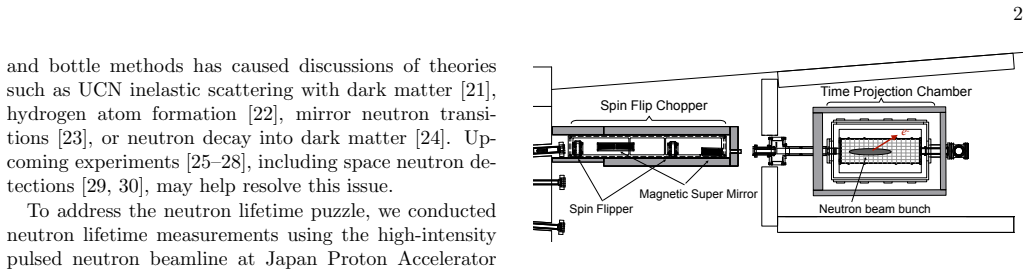
The load-bearing object is the ratio identity of Eq. (1), which turns a count ratio into a lifetime using the $^3$He number density $\rho$, the 2200 m/s cross section $\sigma_0$, and velocity $v_0$, with detection efficiencies $\varepsilon_\beta$, $\varepsilon_{\mathrm{He}}$ computed by Monte Carlo. The second mechanism is the background-subtraction scheme based on the track-shape variables $X_E$ and $X_C$: events with $X_C \ge 5$ define a background region, and a two-energy gamma-ray simulation (200 keV and 5 MeV) whose fractions are fitted to the two-dimensional $X_E$–$X_C$ distribution scales that background into the signal region. A third mechanism is the running of four conditions and their combination after applying globally correlated systematic shifts, with the $^3$He density blinded by a random $\pm 10\%$ offset until the analysis procedure was finalized.
What would settle it
Measure the actual gamma-ray spectrum produced by neutrons scattered in the TPC gas and check whether it is consistent with the two-line model (200 keV at 91.9%, 5 MeV at 8.1%) used for subtraction; if the true spectrum changes the subtracted background by more than the assigned +1.1/−2.0 s, the lifetime moves beyond its quoted systematic uncertainty.
Extended reading notes
Core claim
The paper's central claim is that the neutron lifetime is fixed by the ratio of $\beta$-decay electron counts to $^3$He(n,p)$^3$H reaction counts, exactly as in Eq. (1): $\tau_{\mathrm{n}} = (\rho\,\sigma_0 v_0)^{-1}\,(S_{\mathrm{He}}/\varepsilon_{\mathrm{He}})/(S_\beta/\varepsilon_\beta)$, with detection efficiencies $\varepsilon_\beta$ and $\varepsilon_{\mathrm{He}}$ supplied by Monte Carlo simulation. All acquired data from four running conditions (two gas pressures and two chopper apertures) combine to $\tau_{\mathrm{n}} = 877.2 \pm 1.7$ (stat.) $^{+4.0}_{-3.6}$ (sys.) s, which the paper presents as a fivefold precision improvement over its earlier run. The dominant systematic is the gamma-ray background from neutrons scattered in the TPC gas; the paper models it with a two-line gamma spectrum (200 keV at 91.9(8)% and 5 MeV at 8.1(8)%) fitted to the background region, because the measured background is four to five times larger than the original simulation predicted and its cause remains unclear. The paper also reports that the four conditions disagree beyond statistics ($\chi^2/\mathrm{DOF}=15.8/3$) without an identified cause, and that the combined value is dominated by the 50 kPa/new-chopper condition at 884.8 s.
Load-bearing premise
The result stands on two linked assumptions: that the two-component gamma-ray background model fitted outside the signal region correctly extrapolates inside, even though the measured background is several times larger than the initial simulation predicted, and that the four running conditions, which disagree more than statistics alone would allow, can be combined into one number.
Editorial extensions
If this is right
- The beam method no longer forms a single block above the bottle method: this electron-based beam point agrees with the bottle average, and the persistent offset becomes specific to proton-counting beam experiments.
- Combining this result with the other beam measurements shifts the beam average to $886.0 \pm 1.8$ s and reduces the beam-bottle discrepancy from 4.6$\sigma$ to 4.0$\sigma$.
- The main systematic, gamma rays from gas-scattered neutrons, is expected to fall by roughly a factor of 50 in the next-generation TPC with a solenoidal magnetic field, which would also cut the required beam time and the pileup uncertainty by about a factor of three.
- Operating the TPC at 50 kPa rather than 100 kPa is what let the $^3$He density be determined to 0.13% and reduced the $^{12}$C(n,$\gamma$)$^{13}$C background, so the improvement is tied to the low-pressure running mode.
Reading between the lines
- A natural extension of the paper's logic: if the electron-based value is the true beam lifetime, the proton-beam average is biased high by about 10 s, and the decisive check would be a dedicated search for proton losses such as charge exchange with residual gas or incomplete proton collection.
- The unexplained internal disagreement among the four running conditions suggests a testable condition-dependent systematic: removing or re-weighting the 50 kPa/new-chopper point moves the combined value from 877 s toward the 868 s where the other three conditions cluster.
- The background model can be probed with data already in hand by lowering the $X_E$ cut and comparing the predicted and observed track distributions inside the signal region; any mismatch would feed directly into the lifetime.
- If the shorter lifetime is the correct input, it shifts $V_{ud}$ and Big Bang nucleosynthesis calculations at roughly the one-percent level, an effect comparable in size to the 2018 radiative-correction revision that first raised the CKM unitarity question.
Editorial analysis
A structured set of objections, weighed in public.
Referee Report
Summary. The paper reports a new measurement of the neutron lifetime at the J-PARC BL05/NOP beamline using a pulsed cold neutron beam and a time projection chamber. The lifetime is obtained from Eq. (1), the ratio of beta-decay electron counts to 3He(n,p)3H reaction counts, with detection efficiencies determined by Geant4 Monte Carlo simulations. The data consist of 49 gas fills under four running conditions (100 kPa and 50 kPa with old and new spin flip choppers). The combined result is tau_n = 877.2 +/- 1.7(stat.) +4.0/-3.6(sys.) s, which is consistent with bottle-method values and shows a 2.3 sigma tension with the average proton-beam result. The paper claims a fivefold improvement in precision over the 2020 J-PARC result and attributes the improvement to a larger chopper aperture and reduced systematic uncertainties.
Significance. If the result is correct, it provides an independent electron-detection beam-method measurement of the neutron lifetime and sharpens the internal inconsistency between beam and bottle methods. The paper has genuine strengths: the count-ratio formula in Eq. (1) is clean and avoids fitting the lifetime as a free parameter; the analysis uses a blind offset on the 3He density to reduce human bias; the 3He density is cross-checked by an independent 14N-based method; and the pileup and quenching treatments are more detailed than in the previous publication. However, the significance of the central claim is currently limited by two unresolved issues: the four running-condition averages are not statistically consistent, and the dominant background model is extrapolated from a fitted two-energy gamma model with an unexplained normalization discrepancy.
major comments (3)
- [Results, Table II] The combined result is not robust because the four condition averages are internally inconsistent: the paper reports chi2/DOF = 15.8/3 for the combining average and states that the underlying cause remains undetermined. The 50 kPa/new SFC point (884.8 +/- 2.4 s) carries the smallest statistical error and therefore dominates the weighted average, while the other three conditions cluster near 868-871 s. Excluding the 50 kPa/new SFC data shifts the central value by about 7-8 s, substantially larger than the quoted total uncertainty. The paper should either identify the cause of this discrepancy, incorporate a condition-dependent systematic that reconciles the averages, or present the per-condition values as the primary result rather than a combined lifetime with a chi2/DOF of 5.3.
- [Analysis, gamma-background model] The central value depends on subtracting a gas-scattering gamma background that is modeled by a two-component Monte Carlo (200 keV at 91.9% and 5000 keV at 8.1%) fitted to the XE-XC distribution in the background region. The paper states that the observed background is 4.9-5.4% of S_beta at 100 kPa versus a predicted 1.2-1.3%, and that the cause remains unclear, with leakage through 6LiF tile gaps suspected. No evidence is provided that the fitted two-energy model extrapolates reliably into the signal region, and the assigned systematic (+1.1/-2.0 s) appears to be based on internal variations of this model rather than on a comparison with an independent background estimate. The authors should quantify the model uncertainty more directly, for example by varying the gamma energies and fractions over the full plausible range, using alternative background shapes, or validating the extrapolation with a control sample.
- [Results, Table II and Table III] The quoted combined statistical uncertainty (1.7 s) is not inflated for the obvious inconsistency among the four conditions. Interpreting the chi2/DOF = 15.8/3 as a Birge factor would increase the effective statistical error by about a factor of 2.3, which would materially change the significance of the comparison with the proton-beam average. At minimum, the paper should clarify whether the combining algorithm accounts for condition-to-condition fluctuations and should present the result both with and without a scale factor, or should justify why the large chi2 can be ignored in the error budget.
minor comments (5)
- [Author affiliations] The affiliation line for ref. 12 contains a typo: 'Fuculty of Sciences' should read 'Faculty of Sciences'.
- [Abstract and Introduction] The phrase 'This experiment belongs to the beam method but differs from previous experiments that measured protons, as it instead detects electrons' is repeated nearly verbatim in the abstract and the introduction; consider avoiding the duplication.
- [Updates] The abstract says the improvement comes from 'enlarging the beam transport system,' while the Updates section says the SFC aperture was enlarged; please make the wording consistent.
- [Figure 4 caption] The caption says 'The open circle represents the measurement from this work at J-PARC,' but the main text refers to filled red circles and filled blue squares; please clarify the marker style so the figure is readable in printed and grayscale versions.
- [Fig. 3] The horizontal axis of Fig. 3 is labeled 'DCValue' while the text describes it as the XE distribution; the label and units should be made consistent and self-explanatory.
Circularity Check
No significant circularity: the lifetime is obtained from a measured count ratio with independently known 3He density and cross section; the self-citations are not load-bearing.
full rationale
Equation (1), tau_n = (1/(rho sigma0 v0)) (S_He/epsilon_He)/(S_beta/epsilon_beta), computes the lifetime from the measured count ratio S_He/S_beta. The density rho is determined from the injected 3He pressure, the buffer-vessel volume ratio, and the independently calibrated 3He/4He content of the gas, while sigma0 is taken from the external 3He(n,p)3H cross-section average. The lifetime is not a fitted parameter, and no equation in the paper defines an input in terms of tau_n. The two-component gamma background model (200 keV at 91.9% and 5000 keV at 8.1%) is fit to the background region XC >= 5 and then extrapolated into the signal region XE < 5; this is a calibration of a background model, not a fit of the lifetime itself. Likewise, the SRIM-based quenching values for protons affect the Monte Carlo detection efficiency but are not adjusted to force the final tau_n. The self-citations [32], [43], and [44] document the prior method, the 14N(n,p) cross-section measurement, and the 3He/4He calibration method; [43] is an independent measurement of a different reaction, not of tau_n, so the self-citation chain is not load-bearing in a circular sense. The paper itself flags limitations: 'The combining average yielded chi2/DOF = 15.8/3, though the underlying cause of this deviation remains undetermined' and, regarding the gas-scattered background, 'While the cause remains unclear, leakage of scattered neutrons through gaps in the 6LiF tile is suspected.' These are internal-consistency and systematic-modeling concerns, not circularity, and therefore do not raise the circularity score beyond the minor self-citation level.
Assumptions & free parameters
free parameters (3)
- Two-component gamma background energy fractions =
200 keV: 91.9(8)%, 5000 keV: 8.1(8)%
- Proton ionization quenching factor q(E) =
0.2 to 0.6 for 25-750 eV protons (SRIM)
- XE signal cut position =
5 wire-spacing units (baseline)
assumptions (5)
- domain assumption 3He(n,p)3H cross section follows the 1/v law over the cold neutron spectrum, so Eq. (1) with sigma_0 at v_0 = 2200 m/s is valid.
- ad hoc to paper Background events in the signal region scale from the background region by an MC-computed ratio, and the fitted two-energy gamma model describes the true background.
- ad hoc to paper The four running-condition averages can be combined into one lifetime even though chi2/DOF = 15.8/3.
- domain assumption Beta-decay events are confined to the beam region, so XE < 5 and XC >= 5 separate signal from background.
- domain assumption Pileup classification MC accurately models events triggered by a beta decay followed by a 3He event.
Cite this review
Pith. "Pith review of Improved measurements of neutron lifetime with cold neutron beam at J-PARC." pith.science (2026). https://pith.science/paper/PEJW6FJO
@misc{pith2026241219519,
  author       = {Pith},
  title        = {Pith review of: Improved measurements of neutron lifetime with cold neutron beam at J-PARC},
  year         = {2026},
  howpublished = {\url{https://pith.science/paper/PEJW6FJO}},
  note         = {Machine review of arXiv:2412.19519}
}
abstract
The ``neutron lifetime puzzle'' arises from the discrepancy between neutron lifetime measurements obtained using the beam method, which measures decay products, and the bottle method, which measures the disappearance of neutrons. To resolve this puzzle, we conducted an experiment using a pulsed cold neutron beam at J-PARC. In this experiment, the neutron lifetime is determined from the ratio of neutron decay counts to $^3$He(n,p)$^3$H reactions in a gas detector. This experiment belongs to the beam method but differs from previous experiments that measured protons, as it instead detects electrons, enabling measurements with distinct systematic uncertainties. By enlarging the beam transport system and reducing systematic uncertainties, we achieved a fivefold improvement in precision. Analysis of all acquired data yielded a neutron lifetime of $\tau_{\rm n}=877.2~\pm~1.7_{\rm(stat.)}~^{+4.0}_{-3.6}{}_{\rm (sys.)}$ s. This result is consistent with bottle method measurements but exhibits a 2.3$\sigma$ tension with the average value obtained from the proton-detection-based beam method.
Figures


Figures from the paper (1 more)

Forward citations
Cited by 4 Pith papers
-
PolyJarvis: An LLM-Orchestrated Agent for Automated All-Atom Molecular Dynamics of Amorphous Homopolymers
PolyJarvis autonomously runs polymer MD simulations from natural language input, producing density predictions within 0.1-4.8% and other properties consistent with expert simulations on four tested polymers.
-
Implications of the recent neutron decay measurements on the properties of compact objects -- a dark star with nucleonic shell ?
A neutron star mixed with dark fermions from a hypothesized neutron decay branch can match observed masses and radii only for dark matter mass 370-400 MeV and vector coupling near 0.01 MeV^-1, producing a dark star wi...
-
The Role of Ab Initio Beta-Decay Calculations in Light Nuclei for Probes of Physics Beyond the Standard Model
A status report showing ab initio beta-decay corrections now reach the 1e-4 level needed for precision Standard-Model tests, with key uncertainties from undetermined EFT low-energy constants.
-
Fundamental Nuclear and Particle Physics At Neutron Sources
A community whitepaper makes the case that ESS and neutron sources offer a competitive, complementary route to search for new physics, with proposed experiments in neutron decay, EDM, baryon number violation, neutrino...
Reference graph
Works this paper leans on
-
[1]
G. J. Mathews, T. Kajino, and T. Shima, Big bang nu- cleosynthesis with a new neutron lifetime, Phys. Rev. D 71, 021302 (2005)
work page 2005
-
[2]
T. Chowdhury and S. Ipek, Neutron lifetime anomaly and Big Bang nucleosynthesis, Can. J. Phys. 102, 96 (2024)
work page 2024
-
[3]
C. L. Bennett, D. Larson, J. L. Weiland, N. Jarosik, G. Hinshaw, N. Odegard, K. Smith, R. Hill, B. Gold, M. Halpern, et al. , Nine-year Wilkinson Microwave Anisotropy Probe (WMAP) observations: final maps and results, Astrophys. J., Suppl. Ser. 208, 20 (2013)
work page 2013
-
[4]
N. Aghanim, Y. Akrami, F. Arroja, M. Ashdown, J. Au- mont, C. Baccigalupi, M. Ballardini, A. J. Banday, R. Barreiro, N. Bartolo, et al. , Planck 2018 results-I. Overview and the cosmological legacy of Planck, Astron. Astrophys. 641, A1 (2020)
work page 2020
-
[5]
C.-Y. Seng, M. Gorchtein, H. H. Patel, and M. J. Ramsey-Musolf, Reduced Hadronic Uncertainty in the Determination of Vud, Phys. Rev. Lett. 121, 241804 (2018)
work page 2018
-
[6]
S. Navas et al. (Particle Data Group Collaboration), Review of Particle Physics, Phys. Rev. D 110, 030001 (2024)
work page 2024
- [7]
- [8]
Show all 52 references
-
[9]
A. T. Yue, M. S. Dewey, D. M. Gilliam, G. L. Greene, A. B. Laptev, J. S. Nico, W. M. Snow, and F. E. Wiet- feldt, Improved Determination of the Neutron Lifetime, Phys. Rev. Lett. 111, 222501 (2013)
2013
-
[10]
Serebrov, V
A. Serebrov, V. Varlamov, A. Kharitonov, A. Fomin, Y. Pokotilovski, P. Geltenbort, J. Butterworth, I. Krasnoschekova, M. Lasakov, R. Tal’Daev, A. Vassil- jev, and O. Zherebtsov, Measurement of the neutron life- time using a gravitational trap and a low-temperature Fomblin coat...
2005
-
[11]
Pichlmaier, V
A. Pichlmaier, V. Varlamov, K. Schreckenbach, and P. Geltenbort, Neutron lifetime measurement with the UCN trap-in-trap MAMBO II, Phys. Lett. B 693, 221 (2010)
2010
-
[12]
Steyerl, J
A. Steyerl, J. Pendlebury, C. Kaufman, S. S. Malik, and A. Desai, Quasielastic scattering in the interaction of ul- tracold neutrons with a liquid wall and application in a reanalysis of the Mambo I neutron-lifetime experiment, Phys. Rev. C: Nucl. Phys. 85, 065503 (2012)
2012
-
[13]
Arzumanov, L
S. Arzumanov, L. Bondarenko, S. Chernyavsky, P. Gel- tenbort, V. Morozov, V. Nesvizhevsky, Y. Panin, and A. Strepetov, A measurement of the neutron lifetime us- ing the method of storage of ultracold neutrons and de- tection of inelastically up-scattered neutrons, Phys. Lett. ...
2015
-
[14]
A. P. Serebrov, E. A. Kolomensky, A. K. Fomin, I. A. 6 Krasnoshchekova, A. V. Vassiljev, D. M. Prudnikov, I. V. Shoka, A. V. Chechkin, M. E. Chaikovskiy, V. E. Var- lamov, et al., Neutron lifetime measurements with a large gravitational trap for ultracold neutrons, Phys. Rev. ...
2018
-
[15]
R. W. Pattie, N. B. Callahan, C. Cude-Woods, E. R. Adamek, L. J. Broussard, S. M. Clayton, S. A. Currie, E. B. Dees, X. Ding, E. M. Engel, et al., Measurement of the neutron lifetime using a magneto-gravitational trap and in situ detection, Science 360, 627 (2018)
2018
-
[16]
V. F. Ezhov, A. Andreev, G. Ban, B. Bazarov, P. Gel- tenbort, A. Glushkov, V. Knyazkov, N. A. Kovrizhnykh, G. Krygin, O. Naviliat-Cuncic, et al. , Measurement of the neutron lifetime with ultracold neutrons stored in a magneto-gravitational trap, JETP Lett. 107, 671 (2018)
2018
-
[17]
F. M. Gonzalez, E. Fries, C. Cude-Woods, T. Bailey, M. Blatnik, L. Broussard, N. Callahan, J. Choi, S. Clay- ton, S. Currie, et al. (UCNτ Collaboration), Improved neutron lifetime measurement with UCN τ , Phys. Rev. Lett. 127, 162501 (2021)
2021
-
[18]
Greene and P
G. Greene and P. Geltenbort, A puzzle lies at the heart of the atom, Sci. Am. 314, 36 (2016)
2016
-
[19]
Serebrov, M
A. Serebrov, M. Chaikovskii, G. Klyushnikov, O. Zherebtsov, and A. Chechkin, Search for expla- nation of the neutron lifetime anomaly, Phys. Rev. D 103, 074010 (2021)
2021
-
[20]
Search for explanation of the neutron lifetime anomaly
F. E. Wietfeldt, R. Biswas, J. Caylor, B. Crawford, M. S. Dewey, N. Fomin, G. L. Greene, C. C. Haddock, S. F. Hoogerheide, H. P. Mumm, et al. , Comment on “Search for explanation of the neutron lifetime anomaly”, Phys. Rev. D 107, 118501 (2023)
2023
-
[21]
Rajendran and H
S. Rajendran and H. Ramani, Composite solution to the neutron lifetime anomaly, Phys. Rev. D 103, 035014 (2021)
2021
-
[22]
Oks, New results on the two-body decay of neu- trons shed new light on neutron stars, New Astron
E. Oks, New results on the two-body decay of neu- trons shed new light on neutron stars, New Astron. 113, 102275 (2024)
2024
-
[23]
Berezhiani, Neutron lifetime puzzle and neutron– mirror neutron oscillation, Eur
Z. Berezhiani, Neutron lifetime puzzle and neutron– mirror neutron oscillation, Eur. Phys. J. C 79, 1 (2019)
2019
-
[24]
Fornal and B
B. Fornal and B. Grinstein, Dark matter interpretation of the neutron decay anomaly, Phys Rev. Lett. 120, 191801 (2018)
2018
-
[25]
Materne, R
S. Materne, R. Picker, I. Altarev, H. Angerer, B. Franke, E. Gutsmiedl, F. Hartmann, A. M¨ uller, S. Paul, and R. Stoepler, PENeLOPE—on the way towards a new neutron lifetime experiment with magnetic storage of ultra-cold neutrons and proton extraction, Nucl. Instrum. Methods ...
2009
-
[26]
Wei, A new neutron lifetime experiment with cold neutron beam decay in superfluid helium-4, J
W. Wei, A new neutron lifetime experiment with cold neutron beam decay in superfluid helium-4, J. Phys. G:Nucl. Part. Phys. 47, 125101 (2020)
2020
-
[27]
Auler, M
J. Auler, M. Engler, K. Franz, J. Kahlenberg, J. Karch, N. Pfeifer, K. Roß, C. Strid, N. Yazdandoost, E. Adamek, et al. , τ SPECT: a spin-flip loaded magnetic ultracold neutron trap for a determination of the neutron lifetime, J. Phys. G:Nucl. Part. Phys. 51, 115103 (2024)
2024
-
[28]
Krivoˇ s, N
M. Krivoˇ s, N. Floyd, Z. Tang, C. Morris, M. Blatnik, S. Clayton, C. Cude-Woods, A. Holley, D. Hooks, T. Ito, et al. , Cerium doped yttrium aluminum perovskite scin- tillator as an absolute ultracold neutron detector, Review of Scientific Instruments 95, 10.1063/5.0211059 (2024)
2024 doi
-
[29]
J. T. Wilson, D. J. Lawrence, P. N. Peplowski, V. R. Eke, and J. A. Kegerreis, Measurement of the free neutron life- time using the neutron spectrometer on NASA’s Lunar Prospector mission, Phys. Rev. C 104, 045501 (2021)
2021
-
[30]
Tsuji, T
N. Tsuji, T. Enoto, H. Nagaoka, Y. Kato, K. Taniguchi, M. Hareyama, Y. Otake, Y. Wakabayashi, T. Takanashi, C. Iwamoto, et al. , Moon Moisture Targeting Observa- tory (MoMoTarO) for basic science application to neu- tron lifetime measurement, in Proceedings of 38th Inter- nati...
2023
-
[31]
Kossakowski, P
R. Kossakowski, P. Grivot, P. Liaud, K. Schreckenbach, and G. Azuelos, Neutron lifetime measurement with a helium-filled time projection chamber, Nucl. Phys. A 503, 473 (1989)
1989
-
[32]
Hirota, G
K. Hirota, G. Ichikawa, S. Ieki, T. Ino, Y. Iwashita, M. Kitaguchi, R. Kitahara, J. Koga, K. Mishima, T. Mogi, K. Morikawa, A. Morishita, N. Nagakura, H. Oide, H. Okabe, H. Otono, Y. Seki, D. Sek- iba, T. Shima, H. M. Shimizu, N. Sumi, H. Sum- ino, T. Tomita, H. Uehara, T. Yam...
2020
-
[33]
Mishima, T
K. Mishima, T. Ino, K. Sakai, T. Shinohara, K. Hirota, K. Ikeda, H. Sato, Y. Otake, H. Ohmori, S. Muto, et al., Design of neutron beamline for fundamental physics at J-PARC BL05, Nucl. Instrum. Methods Phys. Res., Sect. A 600, 342 (2009)
2009
-
[34]
Nakajima, Y
K. Nakajima, Y. Kawakita, S. Itoh, J. Abe, K. Aizawa, H. Aoki, H. Endo, M. Fujita, K. Funakoshi, W. Gong, et al. , Materials and Life Science Experimental Facility (MLF) at the Japan Proton Accelerator Research Com- plex II: Neutron Scattering Instruments, Quantum Beam Sci. 1,...
2017
-
[35]
Taketani, T
K. Taketani, T. Ebisawa, M. Hino, K. Hirota, T. Ino, M. Kitaguchi, K. Mishima, S. Muto, H. Oide, T. Oku, et al. , A high S/N ratio spin flip chopper system for a pulsed neutron source, Nucl. Instrum. Methods Phys. Res., Sect. A 634, S134 (2011)
2011
-
[36]
Ichikawa, Y
G. Ichikawa, Y. Fuwa, T. Hasegawa, M. Hino, K. Hirota, T. Ino, Y. Iwashita, M. Kitaguchi, J. Koga, S. Matsuzaki, et al., Neutron lifetime experiment with pulsed cold neu- trons at J-PARC, in Proceedings of Particles and Nu- clei International Conference 2021 — PoS(PANIC2021), ...
2022
-
[37]
Mishima, G
K. Mishima, G. Ichikawa, Y. Fuwa, T. Hasegawa, M. Hino, R. Hosokawa, T. Ino, Y. Iwashita, M. Kitaguchi, S. Matsuzaki, et al. , Performance of the Fully Equipped Spin Flip Chopper for the Neutron Life- time Experiment at J-PARC, Prog. Theor. Exp. Phys. 2024, 093G01 (2024)
2024
-
[38]
Arimoto, N
Y. Arimoto, N. Higashi, Y. Igarashi, Y. Iwashita, T. Ino, R. Katayama, M. Kitaguchi, R. Kitahara, H. Matsumura, K. Mishima, et al., Development of time projection cham- ber for precise neutron lifetime measurement using pulsed cold neutron beams, Nucl. Instrum. Methods Phys. R...
2015
-
[39]
J. Koga, S. Ieki, A. Kimura, M. Kitaguchi, R. Kita- hara, K. Mishima, N. Nagakura, T. Okudaira, H. Otono, H. Shimizu, et al. , Measurement of gamma rays from 6LiF tile as an inner wall of a neutron-decay detector, J. Instrum. 16, P02001 (2021)
2021
-
[40]
Allison, K
J. Allison, K. Amako, J. Apostolakis, P. Arce, M. Asai, T. Aso, E. Bagli, A. Bagulya, S. Banerjee, G. Barrand, et al. , Recent developments in Geant4, Nucl. Instrum. Methods Phys. Res., Sect. A 835, 186 (2016). 7
2016
-
[41]
Sumino, K
H. Sumino, K. Nagao, and K. Notsu, Highly sensitive and precise measurement of helium isotopes using a mass spectrometer with double collector system, J. Mass Spec- trom. Soc. Jpn. 49, 61 (2001)
2001
-
[42]
Mishima, H
K. Mishima, H. Sumino, T. Yamada, S. Ieki, N. Na- gakura, H. Otono, and H. Oide, Accurate determination of the absolute 3He/4He ratio of a synthesized helium standard gas (helium standard of Japan, HESJ): toward revision of the atmospheric 3He/4He ratio, Geochem. Geophys. Geos...
2018
-
[43]
Kitahara, K
R. Kitahara, K. Hirota, S. Ieki, T. Ino, Y. Iwashita, M. Kitaguchi, J. Koga, K. Mishima, A. Morishita, N. Na- gakura, et al. , Improved accuracy in the determination of the thermal cross section of 14N(n, p)14C for neutron lifetime measurement, Prog. Theor. Exp. Phys. 2019, 09...
2019
-
[44]
T. Mogi, T. Hasegawa, K. Hirota, G. Ichikawa, S. Ieki, T. Ino, Y. Iwashita, S. Kajiwara, Y. Kato, M. Kitaguchi, et al. , Improvement of systematic uncertainties for the neutron lifetime experiment at J-PARC, in Proceedings of Particles and Nuclei International Conference 2021 ...
2022
-
[45]
Katsioulas, P
I. Katsioulas, P. Knights, and K. Nikolopoulos, Ionisation quenching factors from w-values in pure gases for rare event searches, Astropart. Phys. 141, 102707 (2022)
2022
-
[46]
J. F. Ziegler, M. D. Ziegler, and J. P. Biersack, SRIM– The stopping and range of ions in matter (2010), Nucl. Instrum. Methods Phys. Res., Sect. B 268, 1818 (2010)
2010
-
[47]
Tatsuhiko Sato and Yosuke Iwamoto and Shintaro Hashimoto and Tatsuhiko Ogawa and Takuya Furuta and Shin-ichiro Abe and Takeshi Kai and Pi-En Tsai and Norihiro Matsuda and Hiroshi Iwase and Nobuhiro Shigyo and Lembit Sihver and Koji Niita, Features of Particle and Heavy Ion Tra...
2018
-
[48]
S. F. Mughabghab, Atlas of Neutron Resonances: Reso- nance Parameters and Thermal Cross Sections. Z= 1-100 (Elsevier, Amsterdam, 2006)
2006
-
[49]
Als-Nielsen and O
J. Als-Nielsen and O. Dietrich, Slow Neutron Cross Sec- tions for He 3, B, and Au, Phys. Rev. 133, B925 (1964)
1964
-
[50]
V. P. Alfimenkov, G. G. Akopyan, J. Wierzbicki, A. M. Govorov, L. B. Pikel’ner, and E. Sharapov, Neutron scat- tering lengths for 3He, Yad. Fiz. 25, 1145 (1977), [Sov. J. Nucl. Phys. 25, 1145 (1977) (English translation)]
1977
-
[51]
Otono, LiNA–Lifetime of neutron apparatus with time projection chamber and solenoid coil, Nucl
H. Otono, LiNA–Lifetime of neutron apparatus with time projection chamber and solenoid coil, Nucl. Instrum. Methods Phys. Res., Sect. A 845, 278 (2017)
2017
-
[52]
N. Sumi, G. Ichikawa, K. Mishima, Y. Makida, M. Kitaguchi, S. Makise, S. Matsuzaki, T. Nagano, M. Tanida, H. Uehara, et al. , The LiNA experiment: Development of multi-layered time projection chamber, Nucl. Instrum. Methods Phys. Res., Sect. A 1045, 167586 (2023)
2023
Reviewed August 11, 2026 · model on record in the stance chip above.
Discussion (0). Continue with ORCID to comment.