REVIEW 3 major objections 3 minor 3 cited by
How does non-metricity affect particle creation and evaporation in bumblebee gravity?
T0 review · 3 major / 3 minor · reviewed 2026-08-10 · deepseek-v4-flash
Pith's one-line read This paper claims that non-metricity in bumblebee gravity changes black-hole emission: boson densities and most greybody factors rise, fermion densities fall, and evaporation accelerates.
desk verdict A competent set of semiclassical calculations, let down by unsupported constraints in Section VI; the fermionic-density contradiction the reader saw is not real. read the letter →
The pith
A machine-rendered reading of the paper's core claim, the machinery that carries it, and where it could break.
The reading
What carries the argument
The load-bearing object is the controlled pair of spacetimes: the metric-formalism bumblebee black hole with Lorentz-violating parameter $\ell$ and the metric-affine bumblebee black hole with parameter $X$; non-metricity here means the metric-affine connection's failure to be metric-compatible, which is what distinguishes the $X$ background from the $\ell$ background. Each line element is fed through the same chain of tools: Bogoliubov-coefficient derivation of the Hawking temperature from scalar-field modes; the Parikh-Wilczek tunneling prescription, where the imaginary part of the action is evaluated by contour integration around the shifted horizon; the bound $T_b \ge \mathrm{sech}^2\left(\int G\,dr_*\right)$ for greybody factors; and Stefan-Boltzmann integration for the evaporation time. The comparison isolates what the non-metricity of the metric-affine connection adds to each observable.
What would settle it
Take Eq. (104) or Eq. (134) and compute $dM/(M\,dt)$ for a $10\,M_\odot$ black hole with $\ell = X = 10^{-25}$; if the result is orders of magnitude below $10\,$Hz (the gravitational-wave bound in Eq. (156)), the quoted constraints do not follow from the paper's evaporation equations, and a re-derivation of the bounds would be needed.
Extended reading notes
Core claim
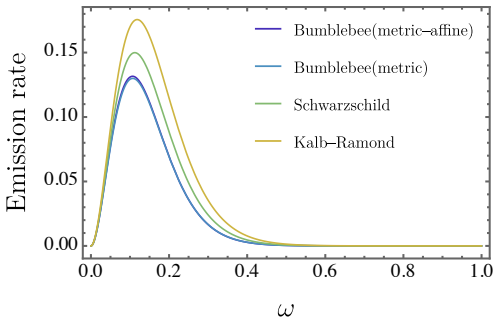
In its own terms, the paper shows that replacing the metric-formalism bumblebee line element $$$ds^{2}$ = -\left(1-\frac{2M}{r}\right)$dt^{2}$ + (1+\ell)\left(1-\frac{2M}{r}\right)^{-1}$dr^{2}$ + $r^{2}$d\$\Omega$^2$$ with the metric-affine solution changes the quantum emission in a definite direction. Solving the Klein-Gordon equation on each background gives the Bogoliubov coefficients and the temperatures $T_{\rm metric}=1/(8\pi\sqrt{1+\ell}\,M)$ and $T_{\rm metric\text{-}affine}\approx 1/(8\pi M)-X/(16\pi M)$; the tunneling calculation then yields boson densities $n=1/(e^{8\pi\sqrt{1+\ell}\,\omega(M-\omega/2)}-1)$ and fermion densities $n_\psi=1/(e^{8\pi\sqrt{1+\ell}\,M\omega}+1)$, with metric-affine analogues. The central finding is that the metric-affine background produces a larger boson density, larger greybody bounds for scalar, vector, and fermion perturbations, and a larger emission rate than the metric background, while the tensor greybody factor runs the other way; the evaporation times obey $t_{\rm metric}>t_{\rm metric\text{-}affine}$, so non-metricity accelerates evaporation. The same comparison is used to quote bounds $\ell, X \lesssim 10^{-25}$-$10^{-38}$ from black-hole lifetime observations.
Load-bearing premise
The Section VI constraints assume that the astrophysical upper limits on $dM/(M\,dt)$ translate directly into the quoted upper bounds on $\ell$ and $X$, even though the paper never writes that translation and its own evaporation equations predict mass-loss rates far too small to saturate those limits for stellar-mass and supermassive black holes.
Editorial extensions
If this is right
- If the central comparison is right, Hawking spectra carry a non-metricity fingerprint: boson counts and most greybody factors sit higher in the metric-affine solution, fermion counts lower, so the boson-to-fermion ratio distinguishes the two formulations.
- The evaporation hierarchy $t_{\rm KR} < t_{\rm Schw} < t_{\rm metric\text{-}affine} < t_{\rm metric}$ implies that measured black-hole lifetimes could, in principle, indicate which Lorentz-violating gravity is realized.
- The quoted constraints $\ell, X \lesssim 10^{-25}$-$10^{-38}$ would push bumblebee Lorentz violation far beyond current laboratory reach, making astrophysical evaporation the primary probe of these parameters.
- The greybody-quasinormal-mode correspondence predicts a frequency-dependent reversal for scalar metric-affine perturbations, with the effect of $X$ changing sign near $\omega\approx0.336$; that inflection is a concrete ringdown feature to look for.
Reading between the lines
- A direct consistency check the paper leaves implicit: inserting the derived evaporation rates into the cited astrophysical bounds may show that $\dot M/M$ is far too small to saturate them, in which case the Section VI limits are an upper bound on observability, not on $\ell$ and $X$.
- The same comparison could be run for rotating Kerr-like bumblebee solutions; if the boson/fermion asymmetry persists there, gravitational-wave ringdown from spinning remnants would be a sharper discriminator than the spherically symmetric emission considered here.
- Because the metric-affine temperature is lower than the Schwarzschild value for $X>0$ yet the lifetime is shorter, the faster evaporation must be driven by the modified cross-section and greybody factors; separating those contributions would show which quantity actually controls the lifetime.
Editorial analysis
A structured set of objections, weighed in public.
Referee Report
Summary. This paper compares Hawking radiation, particle creation, greybody factors, emission rates, and evaporation times for two bumblebee-gravity black-hole solutions: the metric-formalism solution of Ref. [1] and the metric-affine solution of Ref. [2]. It derives Hawking temperatures from Bogoliubov coefficients and from surface gravity, computes bosonic and fermionic particle densities via the tunneling method, obtains greybody bounds, estimates evaporation lifetimes, and relates greybody factors to quasinormal modes. The paper's advertised conclusions are that non-metricity raises bosonic particle density, lowers fermionic particle density, increases greybody factors except for tensor perturbations, accelerates evaporation, and that astrophysical lifetime data constrain the Lorentz-violating parameters to levels of about 10^{-25} to 10^{-38}.
Significance. If the results held, the analytic comparison between metric and metric-affine bumblebee gravity would be useful: the paper provides closed-form expressions for temperatures, densities, greybody bounds, and lifetimes with no free parameters introduced at the level of the derivations from the published metrics. However, two load-bearing claims are not supported by the manuscript's own equations. First, the Section VI constraints on ℓ and X do not follow from the paper's evaporation rates. Second, the abstract and conclusion state that non-metricity reduces fermionic particle density, while Eqs. (54) and (123) show the opposite, and Eq. (123) also disagrees with the thermal exponent implied by Eq. (116). These issues must be resolved before the central message can be accepted.
major comments (3)
- [Section VI, Eqs. (104), (134), (155), and Table I] The claimed bounds ℓ, X ≲ 10^{-25}, 10^{-36}, 10^{-35}, and 10^{-38} do not follow from the paper's own evaporation equations. The paper never writes the relation between the astrophysical limits on dM/(M dt) and ℓ or X. Using Eq. (104), dM/dt = -27ξ/[4096π^3(1+ℓ)^2 M^2], so dM/(M dt) ≈ -C/[(1+ℓ)^2 M^3]. For a 10 M_⊙ black hole with ℓ=0, M ≈ 10^{38} in Planck units, giving a fractional mass-loss rate of order 10^{-118} Planck^{-1} ≈ 10^{-75} s^{-1}. This is decades of orders of magnitude below all four limits quoted in Section VI (10 Hz, 2×10^{-10} Hz, 10^{-9} Hz, and 6×10^{-12} Hz). Therefore the inequalities in Eqs. (153)-(162) are already satisfied for any ℓ or X and impose no upper bound on these parameters. The sentence "which yields the following constraint" after Eq. (155) is a gap; the numbers in Table I do not appear in any equation of the paper. The section should either be removed or replaced by a genuine derivation of bounds from the derived lifetimes.
- [Abstract, Section IV B, Eqs. (54) and (123)] The abstract and conclusion claim that non-metricity reduces the fermionic particle density. This is contradicted by the manuscript's own formulas. For ℓ = X = 0.1 and fixed M and ω, the exponent in Eq. (54) is 8πMω√(1+ℓ) = 8πMω × 1.049, while the exponent in Eq. (123) as written is 8πMω(4-X)/(3X+4) = 8πMω × 0.907. Since the Fermi-Dirac density decreases with increasing exponent, n^ψ_met-aff is larger than n^ψ_metric, not smaller. In addition, the exponent in Eq. (123) does not match the Hawking temperature T of Eq. (116): the correct thermal factor from Eq. (116) would be exp(8πMω√(3X+4)/√(4-X)), which for X = 0.1 gives 8πMω × 1.054, whereas the written Eq. (123) gives 8πMω × 0.907. The ratio of the two exponents is ((4-X)/(3X+4))^{3/2}, so this is not a typo in prefactor alone. The fermionic sector must be recalculated or the statements in the abstract and conclusion corrected accordingly.
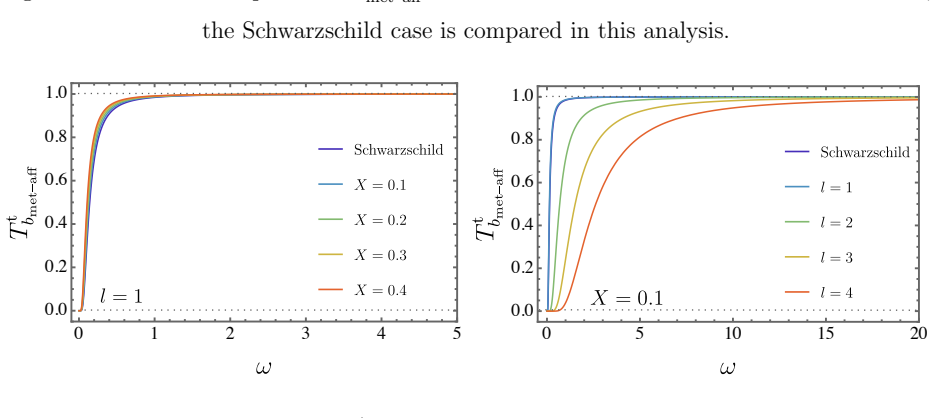
- [Section IV F, Eq. (139)] There is a contradictory sentence immediately after Eq. (139). The equation gives t_metric = 1.00899 × t_met-aff, which means t_metric > t_met-aff, i.e., the metric-formalism black hole takes longer to evaporate. The text states that this "confirms that t_metric corresponds to a faster evaporation process compared to t_met-aff". The word "faster" should be "slower"; otherwise the sentence disagrees with both Eq. (138) and the ordering t_KR < t_Schw < t_met-aff < t_metric stated in the conclusion.
minor comments (3)
- [Section V B 3] The text says the tensor-perturbation calculation relies on Eq. (23), but the relevant effective potential is given in Eq. (128); Eq. (23) is the Bogoliubov relation. Please fix the cross-reference.
- [General presentation] There are numerous typographical errors, including "greybody facotrs" in Section III C 3, "ir reads" before Eq. (121), and repeated "the the top panel" in several figure captions. A careful proofreading pass is needed.
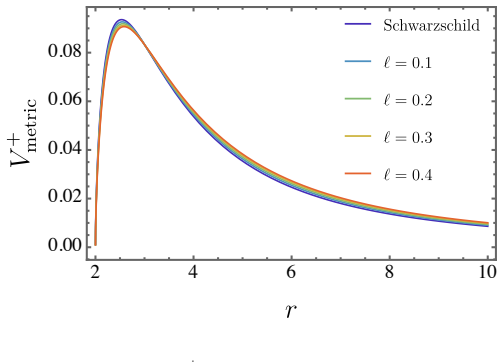
- [Section III C 2 and Section IV A 1] In the metric case the vector effective potential is said to be unchanged from Schwarzschild, but in the metric-affine case the vector potential is claimed to depend on X. This asymmetry in treatment is not discussed, and it would help to clarify why the tetrad procedure yields a nontrivial X-dependence in one formalism but not the other.
Circularity Check
No significant circularity; the Section VI bounds are an unsupported non sequitur, not a circular reduction.
full rationale
The paper's central derivations (Hawking temperatures, tunneling rates, particle densities, greybody bounds, emission rates, evaporation times) are obtained by standard QFT-in-curved-spacetime, tunneling, and WKB calculations applied directly to the two input metrics, Eq. (1) from Ref. [1] and Eq. (2) from Ref. [2]. Taking a previously published spacetime as input is not circular even when the present author is also an author of the solution paper, because the target results are not assumed anywhere in the derivation; they are computed from the metric. The self-citations to Refs. [2], [111], and [114] supply background solutions and cross-sections, but the paper re-derives the Hawking temperature (Eqs. (27) and (116)) and the evaporation equations (Eqs. (104) and (134)) from the metrics, so those citations are not load-bearing in a circular sense. The one serious weakness is Section VI: after Eq. (155), the phrase 'which yields the following constraint on the parameters ℓ and X' introduces no equation connecting the astrophysical dM/(M dt) bounds to ℓ or X. The paper's own fractional mass-loss rates from Eqs. (104) and (134) are many orders of magnitude below the quoted upper limits (for a 10-solar-mass Schwarzschild black hole the fractional rate is roughly 10^-75 s^-1, while the weakest limit used is about 10 Hz), so the numbers 10^-25, 10^-36, 10^-35, and 10^-38 in Table I do not follow from any displayed relation. This is an omitted derivation or non sequitur, not a circular reduction: the constraints are not equivalent to the inputs by construction, they are simply unsubstantiated. Under the hard rule that circularity requires a specific equation-to-equation reduction or a fitted parameter renamed as a prediction, no such step is present.
Assumptions & free parameters
assumptions (5)
- domain assumption The bumblebee black hole metrics (Eqs. (1) and (2)) are exact vacuum solutions of bumblebee gravity, as claimed in Refs. [1] and [2].
- domain assumption Hawking radiation can be computed via the tunneling method (Parikh-Wilczek) and the Bogoliubov coefficient approach as presented.
- domain assumption The greybody factor bound T_b ≥ sech^2(∫ G dr*) with ξ = ω is a valid lower bound for the transmission probability.
- domain assumption The Stefan-Boltzmann law with geometric optics cross-section σ = π(3√3 M)^2 governs the black hole evaporation rate.
- ad hoc to paper The astrophysical ˙M/M limits from Ref. [168] can be directly applied to constrain ℓ and X.
Cite this review
Pith. "Pith review of How does non-metricity affect particle creation and evaporation in bumblebee gravity?." pith.science (2026). https://pith.science/paper/CN7SJJXO
@misc{pith2026250100927,
  author       = {Pith},
  title        = {Pith review of: How does non-metricity affect particle creation and evaporation in bumblebee gravity?},
  year         = {2026},
  howpublished = {\url{https://pith.science/paper/CN7SJJXO}},
  note         = {Machine review of arXiv:2501.00927}
}
abstract
In this work, we analyze the impact of non-metricity on particle creation and the evaporation process of black holes within the framework of bumblebee gravity. In general lines, we compare black holes in the metric formalism [1] and the metric-affine approach [2]. Initially, we focus on bosonic particle modes to investigate Hawking radiation. Using the Klein-Gordon equation, we compute the Bogoliubov coefficients and derive the Hawking temperature. Subsequently, we examine Hawking radiation as a tunneling process, resolving divergent integrals through the residue method. The analysis is then extended to fermionic particle modes, also within the tunneling framework. Particle creation densities are calculated for both bosonic and fermionic cases. Additionally, greybody bounds are estimated for bosonic and fermionic particles. Furthermore, we explore the evaporation process, considering the final state of the black holes and we also investigate the correlation between the greybody factors and the quasinormal modes. Finally, constraints on the Lorentz-violating parameters $\ell$ (for the metric case) and $X$ (for the metric-affine case) are established using recent astrophysical data on black hole lifetimes. In a general panorama, non-metricity (except for the tensor perturbations) in bumblebee gravity raises particle density for bosons while reducing it for fermions, increases greybody factors (for both bosons and fermions), amplifies the emission rate, and accelerates the evaporation process.
Figures


Figures from the paper (34 more)








Forward citations
Cited by 3 Pith papers
-
Regular Black Holes in General Relativity from Nonlinear Electrodynamics with de Sitter Cores
Two new regular black-hole solutions with de Sitter cores, supported by magnetic nonlinear electrodynamics, are constrained by Sgr A* shadows and shown to be linearly stable under scalar perturbations.
-
Lorentz violating quadratic gravity
Bumblebee–quadratic gravity needs new Lorentz-violating counterterms at one loop, but the displayed computation has a gauge-parameter inconsistency and the classical Schwarzschild/de Sitter solutions are the robust part.
-
Quasinormal Modes and Dynamical Evolution of Scalar Fields in the Einstein-Bumblebee Theory with a Cosmological Constant
For scalar perturbations of Einstein-Bumblebee black holes in de Sitter spacetime, increasing the Lorentz-violation parameter or the cosmological constant generally lowers the quasinormal mode frequency and damping rate.
Reference graph
Works this paper leans on
-
[168]
A. Arbey, J. Auffinger, M. Geiller, E. R. Livine, and F. Sartini, “Hawking radiation by spherically-symmetric static black holes for all spins: Teukolsky equations and potentials,” Physical Review D , vol. 103, no. 10, p. 104010, 2021
work page 2021
-
[1]
Specifi- cally, analogous to Eq
The Hawking radiation Following a similar approach to the one employed in the previous section for the bumble- bee model in the metric formalism, we now focus on the metric–affine framework. Specifi- cally, analogous to Eq. (18), we write rmet–aff = 2M − 1 4 Eλ 4√ 4 − X 4 p −(X − 4)3, (107) where the negative solution of the square root in Eq. (14) is als...
-
[2]
(118) is cast below Im Smet–aff = Im ˆ ω 0 −dω′ ˆ rf ri dr 4 r √ −(X−4)3 (4−X)7/2 1 − q ∆(r)met–aff r
The tunneling process Following the methodology employed in the previous section for the bumblebee black hole, we now focus on: ∆(r)met–aff = 1 4 r 2 p −(X − 4)3(M − ω′) r √ 3X + 4 − p −(X − 4)3 √ 3X + 4 + 4 ! (117) in a such way that the integral present in Eq. (118) is cast below Im Smet–aff = Im ˆ ω 0 −dω′ ˆ rf ri dr 4 r √ −(X−4)3 (4−X)7/2 1 − q ∆(r)me...
-
[3]
Scalar perturbations Using the same methodology applied in the metric approach, we now derive the effective potential for the metric–affine bumblebee black hole V s met–aff = A(r) " l(l + 1) r2 + 1 r p A(r)B(r)−1 d dr p A(r)B(r) # = 4l2(r − 2M ) + 4l(r − 2M ) − 2M (X − 4) q 4−X 3X+4 q (r−2M )2 r2 r3 p −((X − 4)(3X + 4)) , (124) 37 0.0 0.2 0.4 0.6 0.8 1.0 ...
-
[4]
(126) 39 2 4 6 8 100.00 0.02 0.04 0.06 0.08 0.10 Figure 21: The effective potential V v met–aff is shown for different values of X
Vector perturbations Following the analogy with the scalar perturbation in the metric–affine framework, the effective potential is expressed as V v met–aff = − 4l(l + 1)(2M − r) r3 p −((X − 4)(3X + 4)) . (126) 39 2 4 6 8 100.00 0.02 0.04 0.06 0.08 0.10 Figure 21: The effective potential V v met–aff is shown for different values of X. Also, the Schwarzschi...
-
[5]
Tensor perturbations Following the analogy with the scalar and vector perturbations in themetric–affine frame- work, the effective potential is expressed as V t met–aff = 1 − 2M r l(l + 1) r2 + 6M (X − 4)2 − 2r(X − 4)2 + 8r p −((X − 4)(3X + 4)) r3(X − 4)(3X + 4) ! . (128) 40 0 1 2 3 4 5 0.0 0.2 0.4 0.6 0.8 1.0 0 5 10 15 20 0.0 0.2 0.4 0.6 0.8 1.0 Figure 2...
-
[6]
To this end, we employ Eq
Scalar perturbations In this subsection, the correspondence between the greybody factors and the quasinormal modes is derived specifically for scalar perturbations in the metric case. To this end, we employ Eq. (58) to carry out the calculations. Fig. 33 presents the greybody factors Γ S metric(ω) as functions of the frequency ω for l = 1 and M = 1, inclu...
-
[7]
(70), the Lorentz–violating contribution to the effective potential for vector perturbations vanishes, implying that only the trivial contribution remains
Vector perturbations As discussed in the previous section and consistent with Eq. (70), the Lorentz–violating contribution to the effective potential for vector perturbations vanishes, implying that only the trivial contribution remains
Show all 181 references
-
[8]
To carry out this computation, Eq
Tensor perturbations The analysis now turns to tensor perturbations within the metric framework, aiming to establish the connection between greybody factors and quasinormal modes. To carry out this computation, Eq. (85) is employed. In Fig. 34, the greybody factors Γ t metric(...
-
[9]
The starting point for this analysis is the scalar potential given by Eq
Scalar perturbations We now explore how greybody factors relate to quasinormal modes in the context of scalar perturbations governed by the metric–affine geometry. The starting point for this analysis is the scalar potential given by Eq. (124), which forms the basis for the ca...
-
[10]
The analysis is based on Eq
Vector perturbations This subsection examines the connection between greybody factors and quasinormal modes in the context of vector perturbations within the metric–affine framework. The analysis is based on Eq. (126), which provides the necessary effective potential for carry...
-
[11]
The calculation relies on the effective potential defined by Eq
Tensor perturbations Finally, the correspondence between greybody factors and quasinormal modes is now investigated in the context of tensor perturbations within the metric–affine setting. The calculation relies on the effective potential defined by Eq. (23), which serves as t...
1993
-
[12]
Exact schwarzschild-like solution in a bumblebee gravity model,
R. Casana, A. Cavalcante, F. Poulis, and E. Santos, “Exact schwarzschild-like solution in a bumblebee gravity model,” Phys. Rev., vol. 97, p. 104001, 2018
2018
-
[13]
Vacuum solution within a metric-affine bumblebee gravity,
A. A. Ara´ ujo Filho, J. R. Nascimento, A. Y. Petrov, and P. J. Porf ´ ırio, “Vacuum solution within a metric-affine bumblebee gravity,” Physical Review D , vol. 108, no. 8, p. 085010, 2023
2023
-
[14]
Quantum gravity at a lifshitz point,
P. Horava, “Quantum gravity at a lifshitz point,” Phys. Rev., vol. 79, p. 084008, 2009
2009
-
[15]
Massive graviton as a testable cold dark matter candidate,
S. Dubovsky, P. Tinyakov, and I. Tkachev, “Massive graviton as a testable cold dark matter candidate,” Phys. Rev. Lett. , vol. 94, p. 181102, 2005. 59
2005
-
[16]
Spontaneous breaking of lorentz symmetry in string theory,
V. Kostelecky and S. Samuel, “Spontaneous breaking of lorentz symmetry in string theory,” Phys. Rev. D , vol. 39, p. 683, 1989
1989
-
[17]
Gravity with a dynamical preferred frame,
T. Jacobson and D. Mattingly, “Gravity with a dynamical preferred frame,” Phys. Rev. D , vol. 64, p. 024028, 2001
2001
-
[18]
Loop quantum gravity and light propagation,
J. Alfaro, H. Morales-Tecotl, and L. Urrutia, “Loop quantum gravity and light propagation,” Phys. Rev. D , vol. 65, p. 103509, 2002
2002
-
[19]
Dark torsion as the cosmic speed-up,
G. Bengochea and R. Ferraro, “Dark torsion as the cosmic speed-up,” Phys. Rev. D , vol. 79, p. 124019, 2009
2009
-
[20]
Very special relativity,
A. Cohen and S. Glashow, “Very special relativity,” Phys. Rev. Lett. , vol. 97, p. 021601, 2006
2006
-
[21]
Overview of the standard model extension: implications and phenomenology of lorentz violation,
R. Bluhm, “Overview of the standard model extension: implications and phenomenology of lorentz violation,” in Special Relativity: Will it Survive the Next 101 Years? , pp. 191–226, Springer, 2006
2006
-
[22]
Spontaneous lorentz and diffeomorphism violation, massive modes, and gravity,
R. Bluhm, S.-H. Fung, and V. A. Kosteleck` y, “Spontaneous lorentz and diffeomorphism violation, massive modes, and gravity,” Physical Review D , vol. 77, no. 6, p. 065020, 2008
2008
-
[23]
Hubble tension as a guide for refining the early universe: Cosmologies with explicit local lorentz and diffeomorphism violation,
M. Khodadi and M. Schreck, “Hubble tension as a guide for refining the early universe: Cosmologies with explicit local lorentz and diffeomorphism violation,” Physics of the Dark Universe, vol. 39, p. 101170, 2023
2023
-
[24]
Constraints and stability in vector theories with spontaneous lorentz violation,
R. Bluhm, N. Gagne, R. Potting, and A. Vrublevskis, “Constraints and stability in vector theories with spontaneous lorentz violation,” Phys. Rev. D , vol. 77, p. 125007, 2008
2008
-
[25]
Signals for lorentz violation in post-newtonian gravity,
Q. Bailey and V. Kostelecky, “Signals for lorentz violation in post-newtonian gravity,” Phys. Rev. D, vol. 74, p. 045001, 2006
2006
-
[26]
Gravitational phenomenology in higher dimensional theories and strings,
V. Kostelecky and S. Samuel, “Gravitational phenomenology in higher dimensional theories and strings,” Phys. Rev. D , vol. 40, p. 1886, 1989
1989
-
[27]
Gravity, lorentz violation, and the standard model,
V. Kostelecky, “Gravity, lorentz violation, and the standard model,” Phys. Rev. D , vol. 69, p. 105009, 2004
2004
-
[28]
Constraining the lorentz-violating bumblebee vector field with big bang nucleosynthesis and gravitational baryogenesis,
M. Khodadi, G. Lambiase, and A. Sheykhi, “Constraining the lorentz-violating bumblebee vector field with big bang nucleosynthesis and gravitational baryogenesis,” The European Physical Journal C , vol. 83, no. 5, p. 386, 2023
2023
-
[29]
Spontaneous lorentz symmetry breaking effects on grbs jets arising from neutrino pair annihilation process near a black hole,
M. Khodadi, G. Lambiase, and L. Mastrototaro, “Spontaneous lorentz symmetry breaking effects on grbs jets arising from neutrino pair annihilation process near a black hole,” The 60 European Physical Journal C , vol. 83, no. 3, p. 239, 2023
2023
-
[30]
Magnetic reconnection and energy extraction from a spinning black hole with broken lorentz symmetry,
M. Khodadi, “Magnetic reconnection and energy extraction from a spinning black hole with broken lorentz symmetry,” Physical Review D , vol. 105, no. 2, p. 023025, 2022
2022
-
[31]
Phenomenological gravitational constraints on strings and higher dimensional theories,
V. Kostelecky and S. Samuel, “Phenomenological gravitational constraints on strings and higher dimensional theories,” Phys. Rev. Lett. , vol. 63, p. 224, 1989
1989
-
[32]
Dark matter spike around bumblebee black holes,
S. Capozziello, S. Zare, D. Mota, and H. Hassanabadi, “Dark matter spike around bumblebee black holes,” Journal of Cosmology and Astroparticle Physics , vol. 2023, no. 05, p. 027, 2023
2023
-
[33]
Thermodynamic properties in higher-derivative elec- trodynamics,
A. A. Ara´ ujo Filho and R. V. Maluf, “Thermodynamic properties in higher-derivative elec- trodynamics,” Brazilian Journal of Physics , vol. 51, no. 3, pp. 820–830, 2021
2021
-
[34]
Lorentz-violating dimension-five operator contribution to the black body radiation,
M. Anacleto, F. Brito, E. Maciel, A. Mohammadi, E. Passos, W. Santos, and J. Santos, “Lorentz-violating dimension-five operator contribution to the black body radiation,”Physics Letters B, vol. 785, pp. 191–196, 2018
2018
-
[35]
Higher-derivative lorentz-breaking dispersion relations: a thermal description,
A. A. Ara´ ujo Filho and A. Y. Petrov, “Higher-derivative lorentz-breaking dispersion relations: a thermal description,” The European Physical Journal C , vol. 81(9), 843 (2021)
2021
-
[36]
Particles in loop quantum gravity formalism: a thermodynamical de- scription,
A. A. Ara´ ujo Filho, “Particles in loop quantum gravity formalism: a thermodynamical de- scription,” Annalen der Physik , p. 2200383, 2022
2022
-
[37]
A. A. Ara´ ujo Filho,Thermal aspects of field theories . Amazon. com, 2022
2022
-
[38]
Thermodynamics of massless particles in curved spacetime,
A. A. Ara´ ujo Filho, “Thermodynamics of massless particles in curved spacetime,” arXiv preprint arXiv:2201.00066, 2021
2021 arXiv
-
[39]
Lorentz-violating scenarios in a thermal reservoir,
A. A. Ara´ ujo Filho, “Lorentz-violating scenarios in a thermal reservoir,”The European Phys- ical Journal Plus , vol. 136(4), 417 (2021)
2021
-
[40]
How does geometry affect quantum gases?,
A. A. Ara´ ujo Filho and J. Reis, “How does geometry affect quantum gases?,” International Journal of Modern Physics A , vol. 37, no. 11n12, p. 2250071, 2022
2022
-
[41]
Bouncing universe in a heat bath,
A. A. Ara´ ujo Filho and A. Y. Petrov, “Bouncing universe in a heat bath,” Inter- national Journal of Modern Physics A , vol. 36, no. 34 & 35, (2021) 2150242. DOI: doi.org/10.1142/S0217751X21502420
2021 doi
-
[42]
Thermal aspects of interacting quantum gases in lorentz-violating scenarios,
J. Reis et al., “Thermal aspects of interacting quantum gases in lorentz-violating scenarios,” The European Physical Journal Plus , vol. 136, no. 3, pp. 1–30, 2021
2021
-
[43]
Thermal analysis of photon– like particles in rainbow gravity,
A. A. Ara´ ujo Filho, J. Furtado, H. Hassanabadi, and J. Reis, “Thermal analysis of photon– like particles in rainbow gravity,” Physics of Dark Universe , vol. 42, no. 8, p. 101310, 2023
2023
-
[44]
Gravitational lensing under the effect of weyl and 61 bumblebee gravities: Applications of gauss-bonnet theorem,
A. Ovgun, K. Jusufi, and I. Sakalli, “Gravitational lensing under the effect of weyl and 61 bumblebee gravities: Applications of gauss-bonnet theorem,” Annals Phys., vol. 399, p. 193, 2018
2018
-
[45]
Accretion of the vlasov gas onto a schwarzschild-like black hole,
Z. Cai and R.-J. Yang, “Accretion of the vlasov gas onto a schwarzschild-like black hole,”
-
[46]
Effects of lorentz breaking on the accretion onto a schwarzschild-like black hole,
R.-J. Yang, H. Gao, Y. Zheng, and Q. Wu, “Effects of lorentz breaking on the accretion onto a schwarzschild-like black hole,” Commun. Theor. Phys. , vol. 71, p. 568, 2019
2019
-
[47]
Quasinormal frequencies for a black hole in a bumblebee gravity,
R. Oliveira, D. Dantas, and C. Almeida, “Quasinormal frequencies for a black hole in a bumblebee gravity,” EPL, vol. 135, p. 10003, 2021
2021
-
[48]
Gup modified hawking radiation in bumblebee gravity,
S. Kanzi and ˙I. Sakallı, “Gup modified hawking radiation in bumblebee gravity,” Nuclear Physics B , vol. 946, p. 114703, 2019
2019
-
[49]
Black holes with a cosmological constant in bumblebee gravity,
R. Maluf and J. Neves, “Black holes with a cosmological constant in bumblebee gravity,” Phys. Rev. D , vol. 103, p. 044002, 2021
2021
-
[50]
Bumblebee black holes in light of event horizon telescope observations,
R. Xu, D. Liang, and L. Shao, “Bumblebee black holes in light of event horizon telescope observations,” Astrophys. J., vol. 945, p. 148, 2023
2023
-
[51]
Static spherical vacuum solutions in the bumblebee gravity model,
R. Xu, D. Liang, and L. Shao, “Static spherical vacuum solutions in the bumblebee gravity model,” Phys. Rev. D , vol. 107, p. 024011, 2023
2023
-
[52]
Probing vector hair of black holes with extreme- mass-ratio inspirals,
D. Liang, R. Xu, Z.-F. Mai, and L. Shao, “Probing vector hair of black holes with extreme- mass-ratio inspirals,” Phys. Rev. D , vol. 107, p. 044053, 2023
2023
-
[53]
Extended thermodynamics of the bumblebee black holes,
Z.-F. Mai, R. Xu, D. Liang, and L. Shao, “Extended thermodynamics of the bumblebee black holes,” Phys. Rev. D , vol. 108, p. 024004, 2023
2023
-
[54]
Particle creation by black holes,
S. W. Hawking, “Particle creation by black holes,” Communications in mathematical physics, vol. 43, no. 3, pp. 199–220, 1975
1975
-
[55]
Black hole explosions?,
S. W. Hawking, “Black hole explosions?,” Nature, vol. 248, no. 5443, pp. 30–31, 1974
1974
-
[56]
Black holes and thermodynamics,
S. W. Hawking, “Black holes and thermodynamics,” Physical Review D, vol. 13, no. 2, p. 191, 1976
1976
-
[57]
The Effect of the Gauss-Bonnet term to Hawking Radiation from arbitrary dimensional Black Brane,
X.-M. Kuang, J. Saavedra, and A. ¨Ovg¨ un, “The Effect of the Gauss-Bonnet term to Hawking Radiation from arbitrary dimensional Black Brane,” Eur. Phys. J. C , vol. 77, no. 9, p. 613, 2017
2017
-
[58]
Cosmological event horizons, thermodynamics, and particle creation,
G. W. Gibbons and S. W. Hawking, “Cosmological event horizons, thermodynamics, and particle creation,” Physical Review D , vol. 15, no. 10, p. 2738, 1977
1977
-
[59]
Hawking Radiation via Gauss-Bonnet Theorem,
A. ¨Ovg¨ un and I. Sakallı, “Hawking Radiation via Gauss-Bonnet Theorem,” Annals Phys. , vol. 413, p. 168071, 2020. 62
2020
-
[60]
Shadow cast of noncommutative black holes in Rastall gravity,
A. ¨Ovg¨ un, I. Sakallı, J. Saavedra, and C. Leiva, “Shadow cast of noncommutative black holes in Rastall gravity,” Mod. Phys. Lett. A , vol. 35, no. 20, p. 2050163, 2020
2020
-
[61]
Massive vector particles tunneling from noncommutative charged black holes and their GUP-corrected thermodynamics,
A. ¨Ovg¨ un and K. Jusufi, “Massive vector particles tunneling from noncommutative charged black holes and their GUP-corrected thermodynamics,” Eur. Phys. J. Plus , vol. 131, no. 5, p. 177, 2016
2016
-
[62]
Nonlinear electrodynamics AdS black hole and related phenomena in the extended thermodynamics,
X.-M. Kuang, B. Liu, and A. ¨Ovg¨ un, “Nonlinear electrodynamics AdS black hole and related phenomena in the extended thermodynamics,” Eur. Phys. J. C , vol. 78, no. 10, p. 840, 2018
2018
-
[63]
The modified first laws of thermodynamics of anti-de sitter and de sitter space–times,
D. Chen, J. Tao, et al. , “The modified first laws of thermodynamics of anti-de sitter and de sitter space–times,” Nuclear Physics B , vol. 918, pp. 115–128, 2017
2017
-
[64]
Implications of a simpson–visser solution in verlinde’s framework,
A. A. Ara´ ujo Filho, “Implications of a simpson–visser solution in verlinde’s framework,”The European Physical Journal C , vol. 84, no. 1, pp. 1–22, 2024
2024
-
[65]
Thermodynamic consequences of well-known regular black holes under modified first law,
A. Jawad and A. Khawer, “Thermodynamic consequences of well-known regular black holes under modified first law,” The European Physical Journal C , vol. 78, pp. 1–10, 2018
2018
-
[66]
Universality of p- v criticality in horizon ther- modynamics,
D. Hansen, D. Kubizˇ n´ ak, and R. B. Mann, “Universality of p- v criticality in horizon ther- modynamics,” Journal of High Energy Physics , vol. 2017, no. 1, pp. 1–24, 2017
2017
-
[67]
Thermodynamical properties of a deformed schwarzschild black hole via dunkl generalization,
P. Sedaghatnia, H. Hassanabadi, P. J. Porf ´ ırio, W. S. Chung, et al. , “Thermodynamical properties of a deformed schwarzschild black hole via dunkl generalization,” arXiv preprint arXiv:2302.11460, 2023
2023 arXiv
-
[68]
Canonical quantization and the statistical entropy of the schwarzschild black hole,
C. Vaz, “Canonical quantization and the statistical entropy of the schwarzschild black hole,” Physical Review D , vol. 61, no. 6, p. 064017, 2000
2000
-
[69]
Criticality and surface tension in rotating horizon thermodynamics,
D. Hansen, D. Kubizˇ n´ ak, and R. B. Mann, “Criticality and surface tension in rotating horizon thermodynamics,” Classical and Quantum Gravity , vol. 33, no. 16, p. 165005, 2016
2016
-
[70]
Statistical mechanics of black holes,
B. Harms and Y. Leblanc, “Statistical mechanics of black holes,” Physical Review D, vol. 46, no. 6, p. 2334, 1992
1992
-
[71]
Analysis of a regular black hole in verlinde’s gravity,
A. A. Ara´ ujo Filho, “Analysis of a regular black hole in verlinde’s gravity,” Classical and Quantum Gravity, vol. 41, no. 1, p. 015003, 2023
2023
-
[72]
Dark matter signatures of black holes with yukawa potential,
A. A. Ara´ ujo Filho, K. Jusufi, B. Cuadros-Melgar, and G. Leon, “Dark matter signatures of black holes with yukawa potential,” Physics of the Dark Universe , vol. 44, p. 101500, 2024
2024
-
[73]
Self-interaction correction to black hole radiance,
P. Kraus and F. Wilczek, “Self-interaction correction to black hole radiance,”Nuclear Physics B, vol. 433, no. 2, pp. 403–420, 1995
1995
-
[75]
A secret tunnel through the horizon,
M. Parikh, “A secret tunnel through the horizon,” International Journal of Modern Physics D, vol. 13, no. 10, pp. 2351–2354, 2004
2004
-
[76]
Hawking radiation as tunneling,
M. K. Parikh and F. Wilczek, “Hawking radiation as tunneling,” Physical review letters , vol. 85, no. 24, p. 5042, 2000
2000
-
[77]
Particle creation and evaporation in kalb-ramond gravity,
A. A. Ara´ ujo Filho, “Particle creation and evaporation in kalb-ramond gravity,” arXiv preprint arXiv:2411.06841, 2024
2024 arXiv
-
[78]
Tunnelling methods and hawking’s radiation: achievements and prospects,
L. Vanzo, G. Acquaviva, and R. Di Criscienzo, “Tunnelling methods and hawking’s radiation: achievements and prospects,” Classical and Quantum Gravity, vol. 28, no. 18, p. 183001, 2011
2011
-
[79]
Static limit analysis of a nonlinear electromagnetic generalization of the Kerr-Newman black hole,
A. A. Ara´ ujo Filho, “Static limit analysis of a nonlinear electromagnetic generalization of the Kerr-Newman black hole,” 10 2024
2024
-
[80]
Quantum gravitational corrections to particle creation by black holes,
X. Calmet, S. D. Hsu, and M. Sebastianutti, “Quantum gravitational corrections to particle creation by black holes,” Physics Letters B , vol. 841, p. 137820, 2023
2023
-
[81]
Tunneling method for hawking quanta in analogue gravity,
F. Del Porro, S. Liberati, and M. Schneider, “Tunneling method for hawking quanta in analogue gravity,” arXiv preprint arXiv:2406.14603 , 2024
2024 arXiv
-
[82]
New coordinates for kerr–newman black hole radiation,
J. Zhang and Z. Zhao, “New coordinates for kerr–newman black hole radiation,” Physics Letters B, vol. 618, no. 1-4, pp. 14–22, 2005
2005
-
[83]
Remarks on a nonlinear electromagnetic extension in ads reissner-nordstr \
A. AA Filho, “Remarks on a nonlinear electromagnetic extension in ads reissner-nordstr \” om spacetime,” arXiv preprint arXiv:2410.23165 , 2024
2024 arXiv
-
[84]
Tunneling of rotational black string with nonlinear electromagnetic fields,
F. Mirekhtiary, A. Abbasi, K. Hosseini, and F. Tulucu, “Tunneling of rotational black string with nonlinear electromagnetic fields,” Physica Scripta, vol. 99, no. 3, p. 035005, 2024
2024
-
[85]
The bocharova–bronnikov–melnikov–bekenstein black hole’s exact quasibound states and hawking radiation,
D. Senjaya, “The bocharova–bronnikov–melnikov–bekenstein black hole’s exact quasibound states and hawking radiation,” The European Physical Journal C, vol. 84, no. 6, p. 607, 2024
2024
-
[86]
Hawking radiation of extended objects,
G. Johnson and J. March-Russell, “Hawking radiation of extended objects,” Journal of High Energy Physics, vol. 2020, no. 4, pp. 1–16, 2020
2020
-
[87]
Hawking temperature from tunnelling formalism,
P. Mitra, “Hawking temperature from tunnelling formalism,” Physics Letters B , vol. 648, no. 2-3, pp. 240–242, 2007
2007
-
[88]
Radiation via tunneling from a de sitter cosmological horizon,
A. Medved, “Radiation via tunneling from a de sitter cosmological horizon,” Physical Review D, vol. 66, no. 12, p. 124009, 2002
2002
-
[89]
Quantum tunneling radiation from self-dual black holes,
C. Silva and F. Brito, “Quantum tunneling radiation from self-dual black holes,” Physics Letters B, vol. 725, no. 4-5, pp. 456–462, 2013. 64
2013
-
[90]
Quantum-corrected self-dual black hole entropy in tunneling formalism with gup,
M. Anacleto, F. Brito, and E. Passos, “Quantum-corrected self-dual black hole entropy in tunneling formalism with gup,” Physics Letters B , vol. 749, pp. 181–186, 2015
2015
-
[91]
Palatini quadratic gravity: spontaneous breaking of gauged scale symme- try and inflation,
D. M. Ghilencea, “Palatini quadratic gravity: spontaneous breaking of gauged scale symme- try and inflation,” Eur. Phys. J. C , vol. 80, p. 1147, 4 2020
2020
-
[92]
Gauging scale symmetry and inflation: Weyl versus Palatini gravity,
D. M. Ghilencea, “Gauging scale symmetry and inflation: Weyl versus Palatini gravity,” Eur. Phys. J. C , vol. 81, no. 6, p. 510, 2021
2021
-
[93]
Torsional birefringence in metric- affine Chern-Simons gravity: gravitational waves in late-time cosmology,
S. Boudet, F. Bombacigno, F. Moretti, and G. J. Olmo, “Torsional birefringence in metric- affine Chern-Simons gravity: gravitational waves in late-time cosmology,” JCAP, vol. 01, p. 026, 2023
2023
-
[94]
Regular black holes in Palatini gravity,
G. J. Olmo and D. Rubiera-Garcia, “Regular black holes in Palatini gravity,” 9 2022
2022
-
[95]
Conformal metric-affine gravities,
G. J. Olmo, E. Orazi, and G. Pradisi, “Conformal metric-affine gravities,” JCAP, vol. 10, p. 057, 2022
2022
-
[96]
Metric-affine f(R,T) theories of gravity and their applications,
E. Barrientos, F. S. N. Lobo, S. Mendoza, G. J. Olmo, and D. Rubiera-Garcia, “Metric-affine f(R,T) theories of gravity and their applications,” Phys. Rev. D , vol. 97, no. 10, p. 104041, 2018
2018
-
[97]
Metric-affine bumblebee gravity: classical aspects,
A. Delhom, J. R. Nascimento, G. J. Olmo, A. Y. Petrov, and P. J. Porf ´ ırio, “Metric-affine bumblebee gravity: classical aspects,” Eur. Phys. J. C , vol. 81, no. 4, p. 287, 2021
2021
-
[98]
Probing Schwarzschild-like black holes in metric-affine bumblebee gravity with accretion disk, deflection angle, greybody bounds, and neutrino propagation,
G. Lambiase, L. Mastrototaro, R. C. Pantig, and A. Ovgun, “Probing Schwarzschild-like black holes in metric-affine bumblebee gravity with accretion disk, deflection angle, greybody bounds, and neutrino propagation,” JCAP, vol. 12, p. 026, 2023
2023
-
[99]
Study of quasinormal modes, greybody bounds, and sparsity of Hawking radiation within the metric-affine bumblebee gravity framework,
S. K. Jha and A. Rahaman, “Study of quasinormal modes, greybody bounds, and sparsity of Hawking radiation within the metric-affine bumblebee gravity framework,” 10 2023
2023
-
[100]
Gravitational traces of bumblebee gravity in metric–affine formalism,
A. A. A. Filho, H. Hassanabadi, N. Heidari, J. Kriz, and S. Zare, “Gravitational traces of bumblebee gravity in metric–affine formalism,” Class. Quant. Grav., vol. 41, no. 5, p. 055003, 2024
2024
-
[101]
Radiative corrections in metric-affine bumblebee model,
A. Delhom, J. R. Nascimento, G. J. Olmo, A. Y. Petrov, and P. J. Porf ´ ırio, “Radiative corrections in metric-affine bumblebee model,” Phys. Lett. B , vol. 826, p. 136932, 2022
2022
-
[102]
An exact stationary axisymmetric vacuum solution within a metric-affine bumblebee gravity,
A. A. Ara´ ujo Filho, J. R. Nascimento, A. Y. Petrov, and P. J. Porf ´ ırio, “An exact stationary axisymmetric vacuum solution within a metric-affine bumblebee gravity,” JCAP, vol. 07, p. 004, 2024
2024
-
[103]
Spontaneous Lorentz symmetry breaking and one-loop effective action in the metric-affine bumblebee gravity,
A. Delhom, T. Mariz, J. R. Nascimento, G. J. Olmo, A. Y. Petrov, and P. J. Porf ´ ırio, 65 “Spontaneous Lorentz symmetry breaking and one-loop effective action in the metric-affine bumblebee gravity,” JCAP, vol. 07, no. 07, p. 018, 2022
2022
-
[104]
Vacuum solution within a metric-affine bumblebee gravity,
A. A. Ara´ ujo Filho, J. R. Nascimento, A. Y. Petrov, and P. J. Porf ´ ırio, “Vacuum solution within a metric-affine bumblebee gravity,” Phys. Rev. D , vol. 108, no. 8, p. 085010, 2023
2023
-
[105]
Gravitational lensing under the effect of Weyl and bum- blebee gravities: Applications of Gauss–Bonnet theorem,
A. Ovg¨ un, K. Jusufi, and I. Sakalli, “Gravitational lensing under the effect of Weyl and bum- blebee gravities: Applications of Gauss–Bonnet theorem,” Annals Phys. , vol. 399, pp. 193– 203, 2018
2018
-
[106]
Effects of Lorentz breaking on the accretion onto a Schwarzschild-like black hole,
R.-J. Yang, H. Gao, Y. Zheng, and Q. Wu, “Effects of Lorentz breaking on the accretion onto a Schwarzschild-like black hole,” Commun. Theor. Phys. , vol. 71, no. 5, pp. 568–572, 2019
2019
-
[107]
Thermodynamics of Schwarzschild-like black holes in modified gravity models,
D. A. Gomes, R. V. Maluf, and C. A. S. Almeida, “Thermodynamics of Schwarzschild-like black holes in modified gravity models,” Annals Phys., vol. 418, p. 168198, 2020
2020
-
[108]
Hawking Radiation via Gauss-Bonnet Theorem,
A. ¨Ovg¨ un and I. Sakallı, “Hawking Radiation via Gauss-Bonnet Theorem,” Annals Phys. , vol. 413, p. 168071, 2020
2020
-
[109]
GUP Modified Hawking Radiation in Bumblebee Gravity,
S. Kanzi and I. Sakallı, “GUP Modified Hawking Radiation in Bumblebee Gravity,” Nucl. Phys. B , vol. 946, p. 114703, 2019
2019
-
[110]
Ricci dark energy in bumblebee gravity model,
W. D. R. Jesus and A. F. Santos, “Ricci dark energy in bumblebee gravity model,” Mod. Phys. Lett. A , vol. 34, no. 22, p. 1950171, 2019
2019
-
[111]
Exact Kerr-like solution and its shadow in a gravity model with spontaneous Lorentz symmetry breaking,
C. Ding, C. Liu, R. Casana, and A. Cavalcante, “Exact Kerr-like solution and its shadow in a gravity model with spontaneous Lorentz symmetry breaking,” Eur. Phys. J. C , vol. 80, no. 3, p. 178, 2020
2020
-
[112]
Thin accretion disk around a rotating Kerr-like black hole in Einstein-bumblebee gravity model,
C. Liu, C. Ding, and J. Jing, “Thin accretion disk around a rotating Kerr-like black hole in Einstein-bumblebee gravity model,” 10 2019
2019
-
[113]
Circular Orbit of a Particle and Weak Gravitational Lens- ing,
Z. Li, G. Zhang, and A. ¨Ovg¨ un, “Circular Orbit of a Particle and Weak Gravitational Lens- ing,” Phys. Rev. D , vol. 101, no. 12, p. 124058, 2020
2020
-
[114]
Bumblebee gravity and particle motion in Snyder noncommutative spacetime structures,
S. Kumar Jha, H. Barman, and A. Rahaman, “Bumblebee gravity and particle motion in Snyder noncommutative spacetime structures,” JCAP, vol. 04, p. 036, 2021
2021
-
[115]
Schwarzschild-like black hole with a topological defect in bumblebee gravity,
I. G¨ ull¨ u and A.¨Ovg¨ un, “Schwarzschild-like black hole with a topological defect in bumblebee gravity,” Annals Phys., vol. 436, p. 168721, 2022
2022
-
[116]
Quasinormal frequencies for a black hole in a bumblebee gravity,
R. Oliveira, D. M. Dantas, and C. A. S. Almeida, “Quasinormal frequencies for a black hole in a bumblebee gravity,” EPL, vol. 135, no. 1, p. 10003, 2021. 66
2021
-
[117]
Polarizations of gravitational waves in the bumblebee gravity model,
D. Liang, R. Xu, X. Lu, and L. Shao, “Polarizations of gravitational waves in the bumblebee gravity model,” Phys. Rev. D , vol. 106, no. 12, p. 124019, 2022
2022
-
[118]
Kasner cosmology in bumblebee gravity,
J. C. S. Neves, “Kasner cosmology in bumblebee gravity,” Annals Phys., vol. 454, p. 169338, 2023
2023
-
[119]
Stars and quark stars in bumblebee gravity,
J. C. S. Neves and F. G. Gardim, “Stars and quark stars in bumblebee gravity,” 9 2024
2024
-
[120]
Lorentz violation alleviates gravitationally induced entan- glement degradation,
W. Liu, C. Wen, and J. Wang, “Lorentz violation alleviates gravitationally induced entan- glement degradation,” JHEP, vol. 01, p. 184, 2025
2025
-
[121]
Gravitational traces of bumblebee gravity in metric–affine formalism,
A. A. Ara´ ujo Filho, H. Hassanabadi, N. Heidari, J. Kriz, and S. Zare, “Gravitational traces of bumblebee gravity in metric–affine formalism,” Classical and Quantum Gravity , vol. 41, no. 5, p. 055003, 2024
2024
-
[122]
Gravitational lensing by a lorentz-violating black hole,
A. A. Ara´ ujo Filho, J. Nascimento, A. Y. Petrov, P. J. Porfırio,et al., “Gravitational lensing by a lorentz-violating black hole,” arXiv preprint arXiv:2404.04176 , 2024
2024
-
[123]
Gravitational lensing and shadow by a Schwarzschild-like black hole in metric- affine bumblebee gravity,
X.-J. Gao, “Gravitational lensing and shadow by a Schwarzschild-like black hole in metric- affine bumblebee gravity,” Eur. Phys. J. C , vol. 84, no. 9, p. 973, 2024
2024
-
[124]
Strange Quark Stars and Condensate Dark Stars in Bum- blebee Gravity,
G. Panotopoulos and A. ¨Ovg¨ un, “Strange Quark Stars and Condensate Dark Stars in Bum- blebee Gravity,” 9 2024
2024
-
[125]
Scattering effects of bumblebee gravity in metric-affine formalism,
N. Heidari, C. F. B. Macedo, A. A. Ara´ ujo Filho, and H. Hassanabadi, “Scattering effects of bumblebee gravity in metric-affine formalism,” The European Physical Journal C , vol. 84, no. 11, p. 1221, 2024
2024
-
[126]
Static neutral black holes in Kalb-Ramond gravity,
W. Liu, D. Wu, and J. Wang, “Static neutral black holes in Kalb-Ramond gravity,” JCAP, vol. 09, p. 017, 2024
2024
-
[127]
Particle creation by black holes,
S. W. Hawking, “Particle creation by black holes,” in Euclidean quantum gravity , pp. 167– 188, World Scientific, 1975
1975
-
[128]
Quantum gravity effects on particle creation and evaporation in a non-commutative black hole via mass deformation,
A. A. Ara´ ujo Filho, N. Heidari, and A.¨Ovg¨ un, “Quantum gravity effects on particle creation and evaporation in a non-commutative black hole via mass deformation,” arXiv preprint arXiv:2409.03566, 2024
2024 arXiv
-
[129]
Parker and D
L. Parker and D. Toms, Quantum field theory in curved spacetime: quantized fields and gravity. Cambridge university press, 2009
2009
-
[130]
Quantum fields in curved spacetime,
S. Hollands and R. M. Wald, “Quantum fields in curved spacetime,”Physics Reports, vol. 574, pp. 1–35, 2015
2015
-
[131]
R. M. Wald, Quantum field theory in curved spacetime and black hole thermodynamics . Uni- 67 versity of Chicago press, 1994
1994
-
[132]
S. A. Fulling, Aspects of quantum field theory in curved spacetime . No. 17, Cambridge university press, 1989
1989
-
[133]
Energy conservation and hawking radiation,
M. K. Parikh, “Energy conservation and hawking radiation,” arXiv preprint hep-th/0402166, 2004
2004 arXiv
-
[134]
Fermions tunnelling from black holes,
R. Kerner and R. B. Mann, “Fermions tunnelling from black holes,” Classical and Quantum Gravity, vol. 25, no. 9, p. 095014, 2008
2008
-
[135]
Charged fermions tunneling from accelerating and rotating black holes,
M. Rehman and K. Saifullah, “Charged fermions tunneling from accelerating and rotating black holes,” Journal of Cosmology and Astroparticle Physics , vol. 2011, no. 03, p. 001, 2011
2011
-
[136]
Fermion tunneling from a vaidya black hole,
H.-L. Li, S.-Z. Yang, T.-J. Zhou, and R. Lin, “Fermion tunneling from a vaidya black hole,” Europhysics Letters, vol. 84, no. 2, p. 20003, 2008
2008
-
[137]
Fermion tunneling from dynamical horizons,
R. Di Criscienzo and L. Vanzo, “Fermion tunneling from dynamical horizons,” Europhysics Letters, vol. 82, no. 6, p. 60001, 2008
2008
-
[138]
Gravitinos tunneling from black holes,
A. Yale and R. B. Mann, “Gravitinos tunneling from black holes,” Physics Letters B, vol. 673, no. 2, pp. 168–172, 2009
2009
-
[139]
Charged fermions tunnelling from kerr–newman black holes,
R. Kerner and R. B. Mann, “Charged fermions tunnelling from kerr–newman black holes,” Physics letters B , vol. 665, no. 4, pp. 277–283, 2008
2008
-
[140]
Exact hawking radiation of scalars, fermions, and bosons using the tunneling method without back-reaction,
A. Yale, “Exact hawking radiation of scalars, fermions, and bosons using the tunneling method without back-reaction,” Physics Letters B , vol. 697, no. 4, pp. 398–403, 2011
2011
-
[141]
There are no quantum corrections to the hawking temperature via tunneling from a fixed background,
A. Yale, “There are no quantum corrections to the hawking temperature via tunneling from a fixed background,” The European Physical Journal C , vol. 71, pp. 1–4, 2011
2011
-
[142]
Hawking temperature and higher order calculations,
B. Chatterjee and P. Mitra, “Hawking temperature and higher order calculations,” Physics Letters B, vol. 675, no. 2, pp. 240–242, 2009
2009
-
[143]
Supersymmetries and the pseudoclassical relativistic electron,
A. Barducci, R. Casalbuoni, and L. Lusanna, “Supersymmetries and the pseudoclassical relativistic electron,” Nuovo Cimento. A , vol. 35, no. 3, pp. 377–399, 1976
1976
-
[144]
On the lagrangian formulation of a charged spinning particle in an external electromagnetic field,
G. Cognola, L. Vanzo, S. Zerbini, and R. Soldati, “On the lagrangian formulation of a charged spinning particle in an external electromagnetic field,” Physics Letters B , vol. 104, no. 1, pp. 67–69, 1981
1981
-
[145]
Horizon-scale tests of gravity theories and fundamental physics from the event horizon telescope image of sagittarius a,
S. Vagnozzi, R. Roy, Y.-D. Tsai, L. Visinelli, M. Afrin, A. Allahyari, P. Bambhaniya, D. Dey, S. G. Ghosh, P. S. Joshi, et al. , “Horizon-scale tests of gravity theories and fundamental physics from the event horizon telescope image of sagittarius a,” Classical and Quantum 68 ...
2022
-
[146]
Topical review: greybody factors and quasinormal modes for black holes invarious theories-fingerprints of invisibles,
˙I. Sakalli and S. Kanzi, “Topical review: greybody factors and quasinormal modes for black holes invarious theories-fingerprints of invisibles,” Turkish Journal of Physics , vol. 46, no. 2, pp. 51–103, 2022
2022
-
[147]
Greybody factor for black string in drgt massive gravity,
P. Boonserm, T. Ngampitipan, and P. Wongjun, “Greybody factor for black string in drgt massive gravity,” The European Physical Journal C , vol. 79, pp. 1–9, 2019
2019
-
[148]
Shadow and greybody bounding of a regular scale-dependent black hole solution,
A. ¨Ovg¨ un, R. C. Pantig, and ´A. Rinc´ on, “Shadow and greybody bounding of a regular scale-dependent black hole solution,” Annals of Physics , vol. 463, p. 169625, 2024
2024
-
[149]
The fermionic greybody factor and quasinormal modes of hairy black holes, as well as hawking radiation’s power spectrum and sparsity,
A. Al-Badawi, S. K. Jha, and A. Rahaman, “The fermionic greybody factor and quasinormal modes of hairy black holes, as well as hawking radiation’s power spectrum and sparsity,” The European Physical Journal C , vol. 84, no. 2, p. 145, 2024
2024
-
[150]
Transmission probabilities and the miller–good transforma- tion,
P. Boonserm and M. Visser, “Transmission probabilities and the miller–good transforma- tion,” Journal of Physics A: Mathematical and Theoretical , vol. 42, no. 4, p. 045301, 2008
2008
-
[151]
Chandrasekhar, The mathematical theory of black holes , vol
S. Chandrasekhar, The mathematical theory of black holes , vol. 69. Oxford university press, 1998
1998
-
[152]
A consistent model of non-singular Schwarzschild black hole in loop quantum gravity and its quasinormal modes,
M. Bouhmadi-L´ opez, S. Brahma, C.-Y. Chen, P. Chen, and D.-h. Yeom, “A consistent model of non-singular Schwarzschild black hole in loop quantum gravity and its quasinormal modes,” JCAP, vol. 07, p. 066, 2020
2020
-
[153]
Quasinormal modes of black holes in f(Q) gravity,
D. J. Gogoi, A. ¨Ovg¨ un, and M. Koussour, “Quasinormal modes of black holes in f(Q) gravity,” Eur. Phys. J. C , vol. 83, no. 8, p. 700, 2023
2023
-
[154]
Expansion formulas and addition theorems for gegenbauer functions,
L. Durand, P. M. Fishbane, and L. Simmons Jr, “Expansion formulas and addition theorems for gegenbauer functions,” Journal of Mathematical Physics , vol. 17, no. 11, pp. 1933–1948, 1976
1933
-
[155]
Gegenbauer polynomials and bi-univalent functions,
A. Amourah, A. Alamoush, and M. Al-Kaseasbeh, “Gegenbauer polynomials and bi-univalent functions,” Palestine Journal of Mathematics , vol. 10, no. 2, pp. 625–632, 2021
2021
-
[156]
Inequalities for legendre functions and gegenbauer functions,
G. Loh¨ ofer, “Inequalities for legendre functions and gegenbauer functions,” Journal of ap- proximation theory, vol. 64, no. 2, pp. 226–234, 1991
1991
-
[157]
On a generalization of the generating function for gegenbauer polynomials,
H. S. Cohl, “On a generalization of the generating function for gegenbauer polynomials,” Integral Transforms and special functions, vol. 24, no. 10, pp. 807–816, 2013
2013
-
[158]
Asymptotics of the generalized gegenbauer functions of fractional degree,
W. Liu and L.-L. Wang, “Asymptotics of the generalized gegenbauer functions of fractional degree,” Journal of Approximation Theory , vol. 253, p. 105378, 2020. 69
2020
-
[159]
Particle production induced by a Lorentzian non-commutative space- time,
A. A. Ara´ ujo Filho, “Particle production induced by a Lorentzian non-commutative space- time,” 2 2025
2025
-
[160]
Quantum transfiguration of kruskal black holes,
A. Ashtekar, J. Olmedo, and P. Singh, “Quantum transfiguration of kruskal black holes,” Physical review letters , vol. 121, no. 24, p. 241301, 2018
2018
-
[161]
Quantum extension of the kruskal spacetime,
A. Ashtekar, J. Olmedo, and P. Singh, “Quantum extension of the kruskal spacetime,” Phys- ical Review D , vol. 98, no. 12, p. 126003, 2018
2018
-
[162]
Quasinormal modes, grebody factors, and hawking radiation sparsity of black holes influenced by a global monopole charge in kalb-ramond gravity,
A. Baruah, Y. Sekhmani, S. K. Maurya, A. Deshamukhya, and M. K. Jasim, “Quasinormal modes, grebody factors, and hawking radiation sparsity of black holes influenced by a global monopole charge in kalb-ramond gravity,” arXiv preprint arXiv:2502.13496 , 2025
2025 arXiv
-
[163]
Gravitational perturbations of nonsingular black holes in conformal gravity,
C.-Y. Chen and P. Chen, “Gravitational perturbations of nonsingular black holes in conformal gravity,” Physical Review D , vol. 99, no. 10, p. 104003, 2019
2019
-
[164]
An approach to gravitational radiation by a method of spin coefficients,
E. Newman and R. Penrose, “An approach to gravitational radiation by a method of spin coefficients,” Journal of Mathematical Physics , vol. 3, no. 3, pp. 566–578, 1962
1962
-
[165]
The mathematical theory of black holes,
S. Chandrasekhar, “The mathematical theory of black holes,” in General Relativity and Gravitation: Invited Papers and Discussion Reports of the 10th International Conference on General Relativity and Gravitation, Padua, July 3–8, 1983 , pp. 5–26, Springer, 1984
1983
-
[166]
Massless dirac perturbations in a consistent model of loop quantum gravity black hole: quasinormal modes and particle emission rates,
S. Albuquerque, I. P. Lobo, and V. B. Bezerra, “Massless dirac perturbations in a consistent model of loop quantum gravity black hole: quasinormal modes and particle emission rates,” Classical and Quantum Gravity , vol. 40, no. 17, p. 174001, 2023
2023
-
[167]
Massless dirac perturbations of black holes in f (q) gravity: quasinormal modes and a weak deflection angle,
A. Al-Badawi and S. K. Jha, “Massless dirac perturbations of black holes in f (q) gravity: quasinormal modes and a weak deflection angle,” Communications in Theoretical Physics , vol. 76, no. 9, p. 095403, 2024
2024
-
[169]
S. Devi, R. Roy, and S. Chakrabarti, “Quasinormal modes and greybody factors of the novel four dimensional gauss–bonnet black holes in asymptotically de sitter space time: scalar, electromagnetic and dirac perturbations,” The European Physical Journal C , vol. 80, no. 8, p. 760, 2020
2020
-
[170]
Universality of high-energy absorption cross sections for black holes,
Y. D´ ecanini, G. Esposito-Farese, and A. Folacci, “Universality of high-energy absorption cross sections for black holes,” Physical Review D , vol. 83, no. 4, p. 044032, 2011. 70
2011
-
[171]
Rotating charged black hole in 4d einstein–gauss–bonnet gravity: Photon motion and its shadow,
U. Papnoi and F. Atamurotov, “Rotating charged black hole in 4d einstein–gauss–bonnet gravity: Photon motion and its shadow,” Physics of the Dark Universe , vol. 35, p. 100916, 2022
2022
-
[172]
Gravi- tational signatures of a non–commutative stable black hole,
N. Heidari, H. Hassanabadi, A. A. Ara´ ujo Filho, J. Kriz, S. Zare, and P. J. Porf ´ ırio, “Gravi- tational signatures of a non–commutative stable black hole,” Physics of the Dark Universe , p. 101382, 2023
2023
-
[173]
Black-hole normal modes: A wkb approach. i. foundations and application of a higher-order wkb analysis of potential-barrier scattering,
S. Iyer and C. M. Will, “Black-hole normal modes: A wkb approach. i. foundations and application of a higher-order wkb analysis of potential-barrier scattering,” Physical Review D, vol. 35, no. 12, p. 3621, 1987
1987
-
[174]
Black-hole normal modes: A wkb approach. ii. schwarzschild black holes,
S. Iyer, “Black-hole normal modes: A wkb approach. ii. schwarzschild black holes,” Physical Review D, vol. 35, no. 12, p. 3632, 1987
1987
-
[175]
Higher order WKB formula for quasi- normal modes and grey-body factors: recipes for quick and accurate calculations,
R. A. Konoplya, A. Zhidenko, and A. F. Zinhailo, “Higher order WKB formula for quasi- normal modes and grey-body factors: recipes for quick and accurate calculations,” Class. Quant. Grav., vol. 36, p. 155002, 2019
2019
-
[176]
Quasinormal modes of black holes: From astrophysics to string theory,
R. Konoplya and A. Zhidenko, “Quasinormal modes of black holes: From astrophysics to string theory,” Reviews of Modern Physics , vol. 83, no. 3, p. 793, 2011
2011
-
[177]
Quasinormal modes of schwarzschild–anti-de sitter black holes: Electromagnetic and gravitational perturbations,
V. Cardoso and J. P. Lemos, “Quasinormal modes of schwarzschild–anti-de sitter black holes: Electromagnetic and gravitational perturbations,” Physical Review D , vol. 64, no. 8, p. 084017, 2001
2001
-
[178]
Correspondence between grey-body factors and quasi- normal modes,
R. A. Konoplya and A. Zhidenko, “Correspondence between grey-body factors and quasi- normal modes,” JCAP, vol. 09, p. 068, 2024
2024
-
[179]
Constraints on the maximal number of dark degrees of freedom from black hole evaporation, cosmic rays, colliders, and supernovae,
C. Ewasiuk and S. Profumo, “Constraints on the maximal number of dark degrees of freedom from black hole evaporation, cosmic rays, colliders, and supernovae,” Phys. Rev. D, vol. 111, no. 1, p. 015008, 2025
2025
-
[180]
Refined orbital solution and quiescent variability in the black hole transient gs 1354–64 (= bw cir),
J. Casares, J. A. Orosz, C. Zurita, T. Shahbaz, J. Corral-Santana, J. E. McClintock, M. Gar- cia, I. G. Mart ´ ınez-Pais, P. A. Charles, R. P. Fender, et al. , “Refined orbital solution and quiescent variability in the black hole transient gs 1354–64 (= bw cir),” The Astrophys...
2009
-
[181]
A black hole in the x-ray nova velorum 1993,
A. V. Filippenko, D. C. Leonard, T. Matheson, W. Li, E. C. Moran, and A. G. Riess, “A black hole in the x-ray nova velorum 1993,” Publications of the Astronomical Society of the Pacific, vol. 111, no. 762, p. 969, 1999. 71
1993
-
[182]
Towards a larger sample of radio jets from quiescent black hole X-ray binaries,
R. M. Plotkin, A. Bahramian, J. C. A. Miller-Jones, M. T. Reynolds, P. Atri, T. J. Maccarone, A. W. Shaw, and P. Gandhi, “Towards a larger sample of radio jets from quiescent black hole X-ray binaries,” Mon. Not. Roy. Astron. Soc. , vol. 503, no. 3, pp. 3784–3795, 2021. 72
2021
Reviewed August 10, 2026 · model on record in the stance chip above.
Discussion (0). Continue with ORCID to comment.