REVIEW 3 major objections 6 minor 59 references
Attribute-Based Robotic Grasping with Data-Efficient Adaptation
T0 review · 3 major / 6 minor · reviewed 2026-08-10 · deepseek-v4-flash
Pith's one-line read The paper claims that an end-to-end visual-textual grasping model, pretrained self-supervised on 36 simulated basic blocks and adapted with unlabeled target images plus one successful grasp per target, attains 86.0% instance grasping…
desk verdict Solid empirical follow-up; the adversarial adaptation gain is likely inflated because the unlabeled images come from the exact test objects. read the letter →
The pith
A machine-rendered reading of the paper's core claim, the machinery that carries it, and where it could break.
The reading
What carries the argument
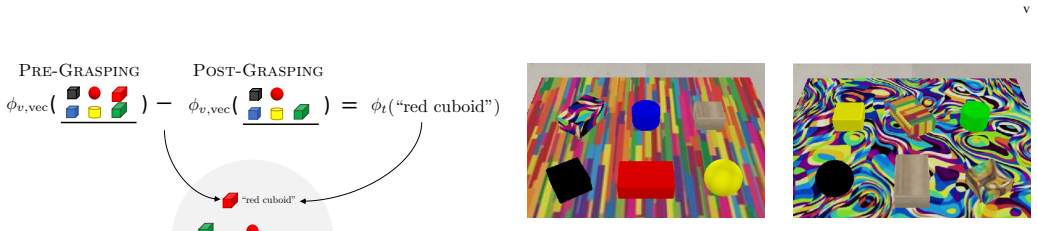
The load-bearing machinery is a gated-attention fusion of a convolutional visual encoder and a deep-averaging text encoder, followed by a fully convolutional affordance decoder that is evaluated over $N=6$ rotations of the fused feature map. The joint embedding is trained with a triplet loss that encodes the equation of object persistence: the visual embedding difference between the pre-grasp and post-grasp heightmaps is enforced to equal the text embedding of the query, written as $\phi_{v,\text{vec}}(v_{\text{pre}}) - \phi_{v,\text{vec}}(v_{\text{post}}) \approx \phi_t(t)$. For adaptation, a gradient reversal layer makes the image encoder learn domain-invariant features from augmented unlabeled images, while one-grasp adaptation rotates a single successful grasp into $N$ training views and fine-tunes the whole encoder-decoder with the grasping loss $L_{\text{grasp}}$.
What would settle it
Run the same pipeline with a genuine natural-language interface that produces free-form nouns, synonyms, and unseen attribute words, and measure instance grasping success on the same target objects; a large drop from the reported 81.7% would expose the system's dependence on hand-chosen phrases rather than on attribute learning itself.
Extended reading notes
Core claim
The core claim is that object attributes can serve as the shared currency between vision and language for instance grasping, and that a metric space learned from the persistence of objects before and after grasping gives the model a structure that supports very-shot adaptation. With only basic synthetic objects as pretraining data, the model localizes the target by text-conditioned attention and predicts pixel-wise grasping affordances; after combining adversarial adaptation on unlabeled images and end-to-end fine-tuning on one rotated grasp, it grasps novel targets 81.7% of the time in the real world. The paper further asserts that both adaptation mechanisms are independently useful, that their gains are additive, and that the one-grasp method outperforms a zero-shot foundation-model baseline at grounding attribute descriptions in multi-object scenes.
Load-bearing premise
The load-bearing premise is that every user query can be reduced to the paper's small attribute vocabulary (color, shape, and category name) and that the text encoder correctly grounds those words, because the experiments never evaluate a real language parser.
Editorial extensions
If this is right
- If the 86.0% and 81.7% rates hold, a robot can be deployed for a new object with roughly one grasp's worth of interaction and a handful of unlabeled images, rather than a large labeled dataset.
- The additive gains of adversarial and one-grasp adaptation imply that recognition-level transfer and manipulation-level fine-tuning address different failure modes and can be stacked.
- The structured attribute metric space is what makes one-grasp adaptation work; without the metric loss, the adaptation gains are much smaller.
- Rotation augmentation of one grasp is sufficient to make the model approximately rotation-invariant for both recognition and grasping.
- The comparison with a zero-shot foundation model suggests that text-image matching alone does not reliably pick the target in clutter, while the adapted model's affordance map does.
Reading between the lines
- One extension the authors leave implicit is whether the same pretrain-and-adapt recipe transfers to other manipulation primitives such as suction, pushing, or placing, which they state should in principle be possible but do not test.
- Because the experiments use hand-chosen attribute phrases, a testable boundary is whether a real language parser producing synonyms, negation, or novel attribute words would preserve the reported success rates.
- If the attribute metric space is as generic as claimed, attribute words absent from the pretraining vocabulary, such as 'striped' or 'shiny', should require a new one-grasp adaptation rather than working zero-shot; this is a direct, checkable consequence.
- The paper's comparison with a zero-shot foundation model hints that fine-tuning such a model with the same one-grasp data might combine broad pretraining with task-specific grounding, but that combination is not tested.
Signed reviews
Editorial analysis
A structured set of objections, weighed in public.
Referee Report
Summary. The paper proposes an end-to-end attribute-based instance grasping system. A visual-textual encoder-decoder is pre-trained in simulation on 36 basic colored/shaped blocks, using self-supervised grasp outcomes and a triplet loss that enforces object persistence between pre- and post-grasp scene embeddings. To transfer to novel objects and real scenes, the paper introduces two data-efficient adaptations: adversarial adaptation, which uses unlabeled target-domain images with object-level augmentation, and one-grasp adaptation, which fine-tunes the whole model from one successful grasp of a target object with rotation augmentation. Experiments in simulation and on a real robot report a generic model achieving 72.1% and 63.1% instance grasping success on simulated novel and real novel objects, respectively, and an adapted Adversarial+One-Grasp model achieving 86.0% and 81.7%, outperforming several baselines. The paper concludes that these results are obtained on unknown objects.
Significance. If the claims hold, the paper is a valuable contribution to data-efficient language-conditioned robotic grasping. The self-supervised pretraining on basic blocks, the object-persistence metric learning, and the two stackable adaptation methods are coherent and well-motivated. The experimental scale is substantial: 1,200 and 3,400 simulation test cases for basic and novel objects, respectively, and 252 real-world trials per method. The ablations of the two augmentation schemes (Tables IV and V) and the attention/confusion-matrix analyses are informative. I agree with the reader's main concern: the adversarial adaptation evaluation is confounded because the unlabeled target set Dt is the same set of objects used for testing. This weakens the headline generalization claim. The natural-language assumption is also not evaluated. These issues are fixable with additional experiments and careful rephrasing, so the central idea remains defensible.
major comments (3)
- [Sec. V-A, VII-B, VII-C, Table III, Fig. 13] The target-domain dataset Dt is defined in Sec. V-A as unlabeled images of 'all conceivable objects in the target domain,' and in the experiments this set coincides exactly with the 34 simulated novel objects (Sec. VII-B) and 21 real-world objects (Sec. VII-C) on which the adapted models are later tested. The Adversarial and Adversarial+One-Grasp models in Table III and Fig. 13 have therefore already seen every test instance through unlabeled images before the reported trials. The concluding statement in Sec. VIII that these results are 'both on unknown objects' is misleading: the adversarial component is evaluated only on objects contained in its adaptation set, and the one-grasp component is per-target supervision by design. The observed gains (72.1 to 86.0 in simulation; 63.1 to 81.7 in the real world) conflate domain-invariant feature learning with instance memorization. The manuscript should add an object-disjoint evaluation in which Dt is built from a held-out object set and the test objects are different instances of the same domain, reporting those numbers separately. This is essential to support the central generalization claim.
- [Sec. III, VII-B, VII-C, VIII] Assumption 1, which states that a language attribute parser extracts color, shape, and category keywords from query text, is never evaluated. All experiments use hand-chosen attribute phrases for each object, so the reported grasping success rates assume an oracle parser. The abstract and conclusion describe the system as responding to user commands and query text without this caveat. The authors should either evaluate an actual parser on free-form commands or explicitly state in the abstract and conclusion that all results assume the parser succeeds; without this, the natural-language interface claim is not supported.
- [Table III, Fig. 13, Sec. VII-E] The adaptation results are reported as point estimates without confidence intervals or significance tests. The margins that motivate the combined Adversarial+One-Grasp method over One-Grasp alone are modest (86.0% vs 83.7% in simulation; 81.7% vs 76.6% in the real world). With 252 real-world trials per method, a difference of 5.1 percentage points is within sampling variability, so the claim that the combined method is 'consistently the best' is not statistically supported. Please provide confidence intervals, exact trial counts, or repeated-run statistics for the adaptation comparisons.
minor comments (6)
- [Sec. IV-C, Algorithm 1] The training description says the model is trained for 5k iterations and then 'we replay the entire data for 100 epochs'; please clarify whether the 100 epochs occur once after the 5k online iterations or interleaved with collection, as this affects reproducibility.
- [Sec. V-A] The phrase 'all conceivable objects in the target domain' is imprecise; please specify how the object set for Dt is selected and whether it is intended to be the same as or disjoint from the test objects.
- [Sec. VII-D] The CLIP comparison is asymmetric: the proposed method is evaluated on multi-object workspace images while CLIP is evaluated on single-object crops. This makes the comparison favorable to the proposed method and should be acknowledged or corrected.
- [Sec. V-B] The sentence 'The token embedding of the object name is initialized properly to keep the embedding vector of the query text unchanged' needs details; for reproducibility, please specify how out-of-vocabulary category names are embedded in the Word2Vec CBOW vocabulary.
- [Eqs. (1) and (5)] Equations (1) and (5) contain typographical artifacts (NsX and |T |X) that should be corrected.
- [Fig. 10] The bar label 'One-Grasp, w/o attr.' does not correspond to a method name in Table III; please align the label with a described baseline.
Circularity Check
No circular derivation; the main empirical claims are self-contained, with only a validation-protocol overlap that is not circularity.
full rationale
The paper's core claims are empirical and are not derived from their inputs by construction. Pre-training is self-supervised from simulator interaction data (Algorithm 1), with the multimodal embedding supervised by the object-persistence constraint, not by the test results. The grasping label q_e is assigned as the attribute similarity between the query and the grasped object (Sec. IV-C), which is a reward/ground-truth definition used for training, not a prediction equivalent to the evaluation metric. The two adaptation methods, adversarial adaptation and one-grasp adaptation, are concrete loss-based updates (Eqs. 9-10 and Sec. V-B) and are evaluated by physical grasping trials; they do not reduce by definition to the reported success rates. The only self-citation, reference [1] for One-Grasp, is used as a baseline and as prior description of that adaptation component, but the method is also fully described in the present paper, so the citation is not load-bearing. The most significant concern is evaluative rather than circular: the adversarial target dataset Dt is described as containing all conceivable objects in the target domain (Sec. V-A), and the experiments then test on the same 34 simulated novel objects and 21 real objects that supplied adaptation images (Secs. VII-B and VII-C), so the adapted results may overstate generalization to unseen instances. This is a validation-protocol issue, not a circular derivation, and it does not make the claimed 86.0%/81.7% numbers equivalent to the model's training inputs by construction.
Assumptions & free parameters
free parameters (7)
- triplet margin alpha =
not reported
- metric loss weight lambda_a =
not reported
- background mask weight lambda_M =
not reported
- GRL reversal constant lambda_r =
not reported
- exploration epsilon =
not reported
- number of grasp orientations N =
6
- object-level augmentation parameters =
not reported
assumptions (6)
- domain assumption Query text is parsed into keywords of object attributes by an external parser.
- domain assumption Objects are stably placed within the workspace and there is no stacking between objects.
- domain assumption Object persistence: the visual embedding difference before and after grasping equals the textual embedding of the grasped object.
- standard math Word2Vec CBOW embeddings plus a deep averaging network adequately represent attribute text.
- domain assumption Domain-adversarial training with a gradient reversal layer learns domain-invariant features that improve grasp decoding.
- domain assumption Simulator-generated ground-truth grasp labels and attribute similarity labels are reliable.
Cite this review
Pith. "Pith review of Attribute-Based Robotic Grasping with Data-Efficient Adaptation." pith.science (2026). https://pith.science/paper/ZVPSF7KK
@misc{pith2026250102149,
  author       = {Pith},
  title        = {Pith review of: Attribute-Based Robotic Grasping with Data-Efficient Adaptation},
  year         = {2026},
  howpublished = {\url{https://pith.science/paper/ZVPSF7KK}},
  note         = {Machine review of arXiv:2501.02149}
}
read the original abstract
Robotic grasping is one of the most fundamental robotic manipulation tasks and has been the subject of extensive research. However, swiftly teaching a robot to grasp a novel target object in clutter remains challenging. This paper attempts to address the challenge by leveraging object attributes that facilitate recognition, grasping, and rapid adaptation to new domains. In this work, we present an end-to-end encoder-decoder network to learn attribute-based robotic grasping with data-efficient adaptation capability. We first pre-train the end-to-end model with a variety of basic objects to learn generic attribute representation for recognition and grasping. Our approach fuses the embeddings of a workspace image and a query text using a gated-attention mechanism and learns to predict instance grasping affordances. To train the joint embedding space of visual and textual attributes, the robot utilizes object persistence before and after grasping. Our model is self-supervised in a simulation that only uses basic objects of various colors and shapes but generalizes to novel objects in new environments. To further facilitate generalization, we propose two adaptation methods, adversarial adaption and one-grasp adaptation. Adversarial adaptation regulates the image encoder using augmented data of unlabeled images, whereas one-grasp adaptation updates the overall end-to-end model using augmented data from one grasp trial. Both adaptation methods are data-efficient and considerably improve instance grasping performance. Experimental results in both simulation and the real world demonstrate that our approach achieves over 81% instance grasping success rate on unknown objects, which outperforms several baselines by large margins.
Figures


Figures from the paper (8 more)


Reference graph
Works this paper leans on
-
[1]
Attribute-based robotic grasping with one-grasp adaptation,
Y . Yang, Y . Liu, H. Liang, X. Lou, and C. Choi, “Attribute-based robotic grasping with one-grasp adaptation,” in IEEE International Conference on Robotics and Automation (ICRA) . IEEE, 2021
work page 2021
-
[2]
Multi-task domain adaptation for deep learning of instance grasping from simulation,
K. Fang, Y . Bai, S. Hinterstoisser, S. Savarese, and M. Kalakrishnan, “Multi-task domain adaptation for deep learning of instance grasping from simulation,” in IEEE International Conference on Robotics and Automation (ICRA). IEEE, 2018, pp. 3516–3523
work page 2018
-
[3]
A deep learning approach to grasping the invisible,
Y . Yang, H. Liang, and C. Choi, “A deep learning approach to grasping the invisible,” IEEE Robotics and Automation Letters , vol. 5, no. 2, pp. 2232–2239, 2020
work page 2020
-
[4]
Covariate shift and local learning by distribution matching,
J. Qui ˜nonero-Candela, M. Sugiyama, A. Schwaighofer, and N. Lawrence, “Covariate shift and local learning by distribution matching,” pp. 131–160, 2008
work page 2008
-
[5]
Analysis of representations for domain adaptation,
S. Ben-David, J. Blitzer, K. Crammer, F. Pereira et al. , “Analysis of representations for domain adaptation,” Advances in Neural Information Processing Systems (NIPS) , vol. 19, p. 137, 2007
work page 2007
-
[6]
Learning visual affordances for robotic manipulation,
A. Zeng, “Learning visual affordances for robotic manipulation,” Ph.D. dissertation, Princeton University, 2019
2019
-
[7]
An overview of 3d object grasp synthesis algorithms,
A. Sahbani, S. El-Khoury, and P. Bidaud, “An overview of 3d object grasp synthesis algorithms,” Robotics and Autonomous Systems, vol. 60, no. 3, pp. 326–336, 2012
work page 2012
-
[8]
Data-driven grasp synthesis—a survey,
J. Bohg, A. Morales, T. Asfour, and D. Kragic, “Data-driven grasp synthesis—a survey,” IEEE Transactions on Robotics , vol. 30, no. 2, pp. 289–309, 2013
work page 2013
Show all 59 references
-
[9]
Learning to generate 6-dof grasp poses with reachability awareness,
X. Lou, Y . Yang, and C. Choi, “Learning to generate 6-dof grasp poses with reachability awareness,” in IEEE International Conference on Robotics and Automation (ICRA) . IEEE, 2020, pp. 1532–1538
2020
-
[10]
Learning synergies between pushing and grasping with self-supervised deep reinforcement learning,
A. Zeng, S. Song, S. Welker, J. Lee, A. Rodriguez, and T. Funkhouser, “Learning synergies between pushing and grasping with self-supervised deep reinforcement learning,” in IEEE/RSJ International Conference on Intelligent Robots and Systems (IROS) . IEEE, 2018, pp. 4238–4245
2018
-
[11]
Self-supervised interactive object segmentation through a singulation-and-grasping approach,
H. Yu and C. Choi, “Self-supervised interactive object segmentation through a singulation-and-grasping approach,” in Computer Vision– ECCV 2022: 17th European Conference, Tel Aviv, Israel, October 23–27, 2022, Proceedings, Part XXXIX . Springer, 2022, pp. 621–637
2022
-
[12]
Mechanical search: Multi-step retrieval of a target object occluded by clutter,
M. Danielczuk, A. Kurenkov, A. Balakrishna, M. Matl, D. Wang, R. Mart´ın-Mart´ın, A. Garg, S. Savarese, and K. Goldberg, “Mechanical search: Multi-step retrieval of a target object occluded by clutter,” in International Conference on Robotics and Automation (ICRA) . IEEE, 2019...
2019
-
[13]
Grasp2vec: Learning object representations from self-supervised grasping,
E. Jang, C. Devin, V . Vanhoucke, and S. Levine, “Grasp2vec: Learning object representations from self-supervised grasping,” in Conference on Robot Learning (CoRL) , 2018, pp. 99–112
2018
-
[14]
End- to-end learning of semantic grasping,
E. Jang, S. Vijayanarasimhan, P. Pastor, J. Ibarz, and S. Levine, “End- to-end learning of semantic grasping,” in Conference on Robot Learning (CoRL), 2017, pp. 119–132
2017
-
[15]
Ccan: Constraint co-attention network for instance grasping,
J. Cai, X. Tao, H. Cheng, and Z. Zhang, “Ccan: Constraint co-attention network for instance grasping,” in IEEE International Conference on Robotics and Automation (ICRA) . IEEE, 2020, pp. 8353–8359
2020
-
[16]
Describing objects by their attributes,
A. Farhadi, I. Endres, D. Hoiem, and D. Forsyth, “Describing objects by their attributes,” in IEEE Conference on Computer Vision and Pattern Recognition (CVPR). IEEE, 2009, pp. 1778–1785
2009
-
[17]
Object localization using color, texture and shape,
Y . Zhong and A. K. Jain, “Object localization using color, texture and shape,” Pattern Recognition, vol. 33, no. 4, pp. 671–684, 2000
2000
-
[18]
Attribute based object identification,
Y . Sun, L. Bo, and D. Fox, “Attribute based object identification,” in IEEE International Conference on Robotics and Automation (ICRA) . IEEE, 2013, pp. 2096–2103
2013
-
[19]
Affordance prediction via learned object attributes,
T. Hermans, J. M. Rehg, and A. Bobick, “Affordance prediction via learned object attributes,” in IEEE International Conference on Robotics and Automation (ICRA): Workshop on Semantic Perception, Mapping, and Exploration. Citeseer, 2011, pp. 181–184
2011
-
[20]
Online learn- ing of object representations by appearance space feature alignment,
S. Pirk, M. Khansari, Y . Bai, C. Lynch, and P. Sermanet, “Online learn- ing of object representations by appearance space feature alignment,” in IEEE International Conference on Robotics and Automation (ICRA) . IEEE, 2020
2020
-
[21]
Grounding language attributes to objects using bayesian eigenobjects,
V . Cohen, B. Burchfiel, T. Nguyen, N. Gopalan, S. Tellex, and G. Konidaris, “Grounding language attributes to objects using bayesian eigenobjects,” in IEEE/RSJ International Conference on Intelligent Robots and Systems (IROS) . IEEE, 2019, pp. 1187–1194
2019
-
[22]
Interactive text2pickup networks for natural language-based human–robot collaboration,
H. Ahn, S. Choi, N. Kim, G. Cha, and S. Oh, “Interactive text2pickup networks for natural language-based human–robot collaboration,” IEEE Robotics and Automation Letters , vol. 3, no. 4, pp. 3308–3315, 2018
2018
-
[23]
Cad2rl: Real single-image flight without a single real image,
F. Sadeghi and S. Levine, “Cad2rl: Real single-image flight without a single real image,” in Robotics: Science and Systems (RSS) , 2017
2017
-
[24]
Domain randomization for transferring deep neural networks from simulation to the real world,
J. Tobin, R. Fong, A. Ray, J. Schneider, W. Zaremba, and P. Abbeel, “Domain randomization for transferring deep neural networks from simulation to the real world,” in IEEE/RSJ international conference on intelligent robots and systems (IROS) . IEEE, 2017, pp. 23–30
2017
-
[25]
Domain ran- domization and generative models for robotic grasping,
J. Tobin, L. Biewald, R. Duan, M. Andrychowicz, A. Handa, V . Kumar, B. McGrew, A. Ray, J. Schneider, P. Welinder et al. , “Domain ran- domization and generative models for robotic grasping,” in IEEE/RSJ International Conference on Intelligent Robots and Systems (IROS) . IEEE,...
2018
-
[26]
Active domain randomization,
B. Mehta, M. Diaz, F. Golemo, C. J. Pal, and L. Paull, “Active domain randomization,” in Conference on Robot Learning (CoRL) . PMLR, 2020, pp. 1162–1176
2020
-
[27]
A survey on transfer learning,
S. J. Pan and Q. Yang, “A survey on transfer learning,” IEEE Transac- tions on Knowledge and Data Dngineering , vol. 22, no. 10, pp. 1345– 1359, 2009
2009
-
[28]
Adversarial discrim- inative domain adaptation,
E. Tzeng, J. Hoffman, K. Saenko, and T. Darrell, “Adversarial discrim- inative domain adaptation,” in IEEE conference on computer vision and pattern recognition (CVPR) , 2017, pp. 7167–7176
2017
-
[29]
Deep grasp adaptation through domain transfer,
Y . Chen, J. Jiang, R. Lei, Y . Bekiroglu, F. Chen, and M. Li, “Deep grasp adaptation through domain transfer,” in IEEE International Conference on Robotics and Automation (ICRA) , 2023
2023
-
[30]
One-shot learning of object categories,
L. Fei-Fei, R. Fergus, and P. Perona, “One-shot learning of object categories,” IEEE Transactions on Pattern Analysis and Machine In- telligence, vol. 28, no. 4, pp. 594–611, 2006
2006
-
[31]
Siamese neural networks for one-shot image recognition,
G. Koch, R. Zemel, and R. Salakhutdinov, “Siamese neural networks for one-shot image recognition,” in ICML Deep Learning Workshop, vol. 2. Lille, 2015
2015
-
[32]
Prototypical networks for few- shot learning,
J. Snell, K. Swersky, and R. Zemel, “Prototypical networks for few- shot learning,” in Advances in Neural Information Processing Systems (NIPS), 2017, pp. 4077–4087
2017
-
[33]
Few-shot adver- sarial domain adaptation,
S. Motiian, Q. Jones, S. Iranmanesh, and G. Doretto, “Few-shot adver- sarial domain adaptation,” in Advances in Neural Information Processing Systems (NIPS), 2017, pp. 6670–6680
2017
-
[34]
A baseline for few-shot image classification,
G. S. Dhillon, P. Chaudhari, A. Ravichandran, and S. Soatto, “A baseline for few-shot image classification,” in International Conference on Learning Representations (ICLR) , 2019
2019
-
[35]
Referitgame: Referring to objects in photographs of natural scenes,
S. Kazemzadeh, V . Ordonez, M. Matten, and T. Berg, “Referitgame: Referring to objects in photographs of natural scenes,” in Conference on Empirical Methods in Natural Language Processing (EMNLP), 2014, pp. 787–798
2014
-
[36]
Imagenet: A large-scale hierarchical image database,
J. Deng, W. Dong, R. Socher, L.-J. Li, K. Li, and L. Fei-Fei, “Imagenet: A large-scale hierarchical image database,” in IEEE conference on computer vision and pattern recognition (CVPR) . IEEE, 2009, pp. 248–255
2009
-
[37]
Deep residual learning for image recognition,
K. He, X. Zhang, S. Ren, and J. Sun, “Deep residual learning for image recognition,” in IEEE Conference on Computer Vision and Pattern Recognition (CVPR), 2016, pp. 770–778
2016
-
[38]
Deep unordered composition rivals syntactic methods for text classification,
M. Iyyer, V . Manjunatha, J. Boyd-Graber, and H. Daum ´e III, “Deep unordered composition rivals syntactic methods for text classification,” in Association for Computational Linguistics (ACL) , 2015, pp. 1681– 1691
2015
-
[39]
Rectified linear units improve restricted boltzmann machines,
V . Nair and G. E. Hinton, “Rectified linear units improve restricted boltzmann machines,” in International conference on machine learning (ICML), 2010, pp. 807–814
2010
-
[40]
Efficient estimation of word representations in vector space,
T. Mikolov, K. Chen, G. Corrado, and J. Dean, “Efficient estimation of word representations in vector space,” arXiv preprint arXiv:1301.3781 , 2013. xiv
2013 arXiv
-
[41]
Gated-attention architectures for task-oriented language grounding,
D. S. Chaplot, K. M. Sathyendra, R. K. Pasumarthi, D. Rajagopal, and R. Salakhutdinov, “Gated-attention architectures for task-oriented language grounding,” in Thirty-Second AAAI Conference on Artificial Intelligence (AAAI), 2018
2018
-
[42]
Fully convolutional networks for semantic segmentation,
J. Long, E. Shelhamer, and T. Darrell, “Fully convolutional networks for semantic segmentation,” in IEEE Conference on Computer Vision and Pattern Recognition (CVPR), 2015, pp. 3431–3440
2015
-
[43]
Learning visual affordances with target-orientated deep q-network to grasp objects by harnessing environmental fixtures,
H. Liang, X. Lou, Y . Yang, and C. Choi, “Learning visual affordances with target-orientated deep q-network to grasp objects by harnessing environmental fixtures,” in IEEE International Conference on Robotics and Automation (ICRA) . IEEE, 2021, pp. 2562–2568
2021
-
[44]
Network in network,
M. Lin, Q. Chen, and S. Yan, “Network in network,” arXiv preprint arXiv:1312.4400, 2013
2013 arXiv
-
[45]
Learning deep features for discriminative localization,
B. Zhou, A. Khosla, A. Lapedriza, A. Oliva, and A. Torralba, “Learning deep features for discriminative localization,” in IEEE Conference on Computer Vision and Pattern Recognition (CVPR) , 2016, pp. 2921– 2929
2016
-
[46]
Facenet: A unified em- bedding for face recognition and clustering,
F. Schroff, D. Kalenichenko, and J. Philbin, “Facenet: A unified em- bedding for face recognition and clustering,” in IEEE Conference on Computer Vision and Pattern Recognition (CVPR) , 2015, pp. 815–823
2015
-
[47]
R. S. Sutton and A. G. Barto, Reinforcement learning: An introduction . MIT press, 2018
2018
-
[48]
Hindsight expe- rience replay,
M. Andrychowicz, F. Wolski, A. Ray, J. Schneider, R. Fong, P. Welinder, B. McGrew, J. Tobin, O. P. Abbeel, and W. Zaremba, “Hindsight expe- rience replay,” in Advances in Neural Information Processing Systems (NIPS), 2017, pp. 5048–5058
2017
-
[49]
Generative adversarial nets,
I. Goodfellow, J. Pouget-Abadie, M. Mirza, B. Xu, D. Warde-Farley, S. Ozair, A. Courville, and Y . Bengio, “Generative adversarial nets,” Advances in Neural Information Processing Systems (NIPS) , vol. 27, 2014
2014
-
[50]
Domain-adversarial training of neural networks,
Y . Ganin, E. Ustinova, H. Ajakan, P. Germain, H. Larochelle, F. Lavio- lette, M. Marchand, and V . Lempitsky, “Domain-adversarial training of neural networks,” The Journal of Machine Learning Research , vol. 17, no. 1, pp. 2096–2030, 2016
2016
-
[51]
M-adda: Unsupervised domain adaptation with deep metric learning,
I. H. Laradji and R. Babanezhad, “M-adda: Unsupervised domain adaptation with deep metric learning,” in Domain adaptation for visual understanding. Springer, 2020, pp. 17–31
2020
-
[52]
Spatial transformer networks,
M. Jaderberg, K. Simonyan, A. Zisserman et al. , “Spatial transformer networks,” in Advances in Neural Information Processing Systems (NIPS), 2015, pp. 2017–2025
2015
-
[53]
Revisiting data augmentation for rotational invariance in convolutional neural networks,
F. Quiroga, F. Ronchetti, L. Lanzarini, and A. F. Bariviera, “Revisiting data augmentation for rotational invariance in convolutional neural networks,” in International Conference on Modelling and Simulation in Management Sciences . Springer, 2018, pp. 127–141
2018
-
[54]
V-rep: A versatile and scalable robot simulation framework,
E. Rohmer, S. P. Singh, and M. Freese, “V-rep: A versatile and scalable robot simulation framework,” in IEEE/RSJ International Conference on Intelligent Robots and Systems (IROS) . IEEE, 2013, pp. 1321–1326
2013
-
[55]
The ycb object and model set: Towards common benchmarks for manipulation research,
B. Calli, A. Singh, A. Walsman, S. Srinivasa, P. Abbeel, and A. M. Dollar, “The ycb object and model set: Towards common benchmarks for manipulation research,” in International Conference on Advanced Robotics (ICAR). IEEE, 2015, pp. 510–517
2015
-
[56]
Chopra, Introduction to google sketchup
A. Chopra, Introduction to google sketchup. John Wiley & Sons, 2012
2012
-
[57]
Visp for visual servoing: a generic software platform with a wide class of robot control skills,
´E. Marchand, F. Spindler, and F. Chaumette, “Visp for visual servoing: a generic software platform with a wide class of robot control skills,” IEEE Robotics & Automation Magazine, vol. 12, no. 4, pp. 40–52, 2005
2005
-
[58]
Moveit![ros topics],
S. Chitta, I. Sucan, and S. Cousins, “Moveit![ros topics],” IEEE Robotics & Automation Magazine , vol. 19, no. 1, pp. 18–19, 2012
2012
-
[59]
Learning transferable visual models from natural language supervision,
A. Radford, J. W. Kim, C. Hallacy, A. Ramesh, G. Goh, S. Agarwal, G. Sastry, A. Askell, P. Mishkin, J. Clark et al., “Learning transferable visual models from natural language supervision,” in International conference on machine learning . PMLR, 2021, pp. 8748–8763. Yang Yang ...
2021
Reviewed August 10, 2026 · model on record in the stance chip above.
Discussion (0). Continue with ORCID to comment.