REVIEW 4 major objections 6 minor 49 references
GraphDART: Graph Distillation for Efficient Advanced Persistent Threat Detection
T0 review · 4 major / 6 minor · reviewed 2026-08-10 · deepseek-v4-flash
Pith's one-line read GraphDART claims that graph distillation can shrink provenance graphs to 5% or less of their original size while preserving enough structure for GNN-based APT detection to match or beat full-graph baselines.
desk verdict First graph-distillation-for-APT-detection paper with a real efficiency claim, but the missing decision rule for anomaly flags makes the headline numbers hard to trust as reported. read the letter →
The pith
A machine-rendered reading of the paper's core claim, the machinery that carries it, and where it could break.
The reading
What carries the argument
The load-bearing component is the graph distillation module, which takes the provenance graph (nodes, adjacency, node features, node-type labels) and produces a condensed graph $S_{PG}$ whose size is controlled by a reduction rate $r$ ($r \le 0.01$ for the main experiments). It wraps six distillation algorithms: random, herding, and kcenter coreset selection; GCDM (receptive-field distribution matching); and GCond and SGDD (gradient matching). Node features are built like the full-graph baseline: Word2Vec embeddings plus positional encoding of a node's attributes and the types of its timestamp-sorted incident edges. Classes with fewer than 1% of nodes are dropped before distillation, and the condensed benign graph trains the GNN for node-type classification; malicious nodes are detected as classification failures.
What would settle it
Run GraphDART with a pre-registered decision rule—for example, flag any node whose predicted type differs from its benign type, with ties broken by a fixed confidence threshold chosen on training data only—and recompute the metrics on the three benchmark test splits. If the precision and recall numbers in the tables cannot be reproduced without post hoc threshold selection, or if the distilled-graph model fails to flag a held-out attack campaign, the 5%-size claim is falsified.
Extended reading notes
Core claim
The central discovery is that provenance graphs can be distilled—condensed into a synthetic graph via optimization—so that a GNN trained only on benign distilled nodes still flags malicious nodes through misclassification: the distilled graph is synthesized exclusively from benign system activity, and at inference malicious nodes deviate from the learned benign neighborhood patterns and are misclassified, with that misclassification serving as the detection signal. On three benchmark provenance-graph datasets, GraphDART with gradient-matching and distribution-matching distillation achieves accuracy and F1 comparable to the full-graph GNN baseline, with near-perfect recall, while the smaller graphs reduce GNN training time from minutes to a few seconds on the largest dataset.
Load-bearing premise
The reported precision and recall rest on an unspecified rule for turning the GNN's per-node type predictions into a malicious/benign verdict; if that rule is tuned after looking at test labels, the central efficiency-accuracy trade-off is not demonstrated out-of-sample.
Editorial extensions
If this is right
- GNN-based APT detection can be trained on provenance graphs reduced to 5% or less of the original node count with detection performance comparable to full-graph training.
- Training time on large datasets drops dramatically: on the largest dataset, from 282 seconds with the full graph to about 6–9 seconds with distilled graphs, with the gap widening as training epochs increase.
- The framework's modularity means the distillation method can be selected per dataset; gradient-matching and distribution-matching methods give stable results, while coreset methods fluctuate.
- The benign-only distillation strategy removes the need for labeled attack data during distillation, since the distilled graph is synthesized from benign logs alone and attacks are detected by deviation at inference.
- Recall stays near-perfect across all datasets, while precision is the limiting factor; improvements in false-positive control would directly raise F1.
Reading between the lines
- If the central trade-off holds, graph distillation could be applied not just to training but to streaming inference-time provenance graphs, enabling real-time APT detection without retaining full audit history.
- The benign-only strategy suggests a data-augmentation view: distillation may act as a form of regularization, and the 1% class-drop heuristic could be replaced by a learned class-weighting scheme to preserve rare node types that might matter for stealthy attacks.
- The 5% claim is tied to the specific feature representation (Word2Vec plus positional encoding); a testable prediction is that richer node embeddings would preserve detection quality at even lower reduction rates.
- The near-perfect recall across methods hints that almost any node deviating from benign structure is flagged, so the real bottleneck is precision; future work should focus on scoring suspicious nodes rather than binary misclassification.
Signed reviews
Editorial analysis
A structured set of objections, weighed in public.
Referee Report
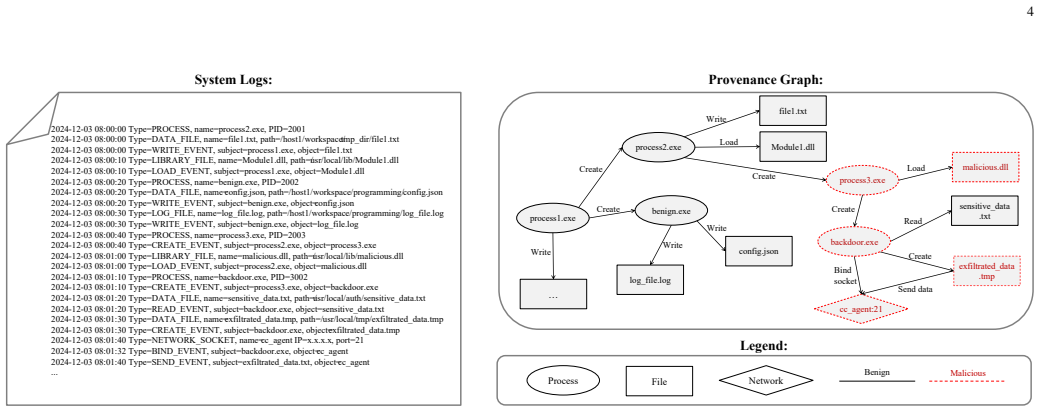
Summary. GraphDART proposes a modular graph-distillation framework for APT detection on provenance graphs. The pipeline constructs a provenance graph from system logs, develops node features following FLASH, applies one of six distillation methods (random, herding, kcenter, GCDM, GCond, SGDD) to condense the benign training graph, and then trains a GNN on the condensed graph to detect malicious nodes by misclassification of their benign node types. The paper evaluates detection accuracy, precision, recall, F1, and GNN training time on the DARPA TC E3 Cadets, Theia, and FiveDirections datasets, and claims that GraphDART matches or exceeds FLASH while using a condensed graph of 5% or less of the original size.
Significance. If the empirical claims hold, the paper would make a useful contribution: it is, to my knowledge, the first systematic application of graph distillation to provenance-graph APT detection, and the modular treatment of several distillation methods is a practical strength. The benign-only distillation strategy is an interesting idea that could reduce the cost of GNN-based detectors. The paper also reports training-time savings on public datasets and gives a reasonably detailed description of the experimental environment. However, the central efficiency-accuracy claim currently rests on an undefined detection decision rule, on an ad hoc removal of rare node classes, and on an incomplete accounting of runtime, so the reported metrics are not yet interpretable as evidence for the claimed trade-off.
major comments (4)
- [V-B4 and VI-C] The paper never defines the decision rule that maps the GNN's per-node type predictions to the binary malicious/benign decisions used to compute TP, FP, FN, and TN. Section V-B4 says the GNN learns benign node types and 'misclassifies malicious ones,' and Section VI-C says predictions are 'evaluated against the actual node labels in the ground truth,' but no sentence specifies whether a node is flagged malicious when the predicted type differs from the ground-truth type, when the softmax confidence is below a threshold, or via some other scoring function. Since the model is trained on benign data only, the detector is an anomaly detector, and an anomaly detector is well-defined only with an explicit scoring and thresholding step. Without this step, the precision, recall, and F1 values in Tables III-V (e.g., GraphDART_gcdm at r=0.006 on Cadets: precision 0.58, recall 1.00, F1 0.73) are not reproducible, and if the rule was chosen after inspecting test labels, they are not out-of-sample metrics. This is load-bearing because the central claim of 'comparable or better performance at 5% or less graph size' cannot be assessed without well-defined detection decisions.
- [V-B3 and Table II] The paper removes all node classes that account for less than 1% of nodes before graph distillation, calling them outliers, but provides no evidence that these classes are irrelevant to APT detection. In FiveDirections, for example, classes 1, 3, 4, 5, and 7 are removed, including FILE OBJECT CHAR, SRCSINK DATABASE, FILE OBJECT UNIX SOCKET, FILE OBJECT BLOCK, and SRCSINK PROCESS MANAGEMENT; some of these could plausibly carry attack-relevant activity. Since the stated goal is to preserve 'essential structural and contextual information' for detecting malicious nodes, the 1% threshold is an ad hoc free parameter, and the paper does not report whether any malicious nodes in the ground truth belong to removed classes, nor does it provide a sensitivity analysis over this threshold. This omission directly affects the validity of the claim that the distilled graph retains the information needed for APT detection.
- [VI-D and Tables III-V] The reported training time t covers only the GNN training phase on the condensed graph, not the time spent on graph distillation itself. The paper's efficiency argument, however, is about the total computational overhead of GraphDART relative to processing the original provenance graph. For Theia, FLASH takes 282 seconds for GNN training while GraphDART takes 6-12 seconds, but if the distillation step (e.g., GCDM or SGDD on a graph with 300k nodes and 9M edges) takes substantially longer, the end-to-end saving may be much smaller or even negative. The paper should report the distillation time or total end-to-end time, at least for the reduction rates used in the main comparisons.
- [VI-C] The FLASH baseline comparison is weakened by the paper's own admission that it could not reproduce FLASH's original results. Section V-B4 states that 'some discrepancies in the results were observed and we were unable to replicate exactly the original results presented in FLASH,' but no details are given about the reproduced FLASH configuration, the magnitude of the discrepancies, or how the FLASH numbers in Figure 4 and Tables III-V were obtained. Since FLASH is the sole detection baseline and the paper's headline claim is 'comparable to FLASH,' the reader needs to know which FLASH results are being compared against and whether the discrepancy affects the comparison. At minimum, the reproduced FLASH metric values should be reported alongside the original published values.
minor comments (6)
- [V-B3] There is a typo: 'accounts for less that 1%' should read 'accounts for less than 1% of the total nodes.'
- [VI-A] The paper says 'Labels from ThreaTrace [49] are utilized as ground truth' but does not explain how ThreaTrace's labels are mapped to the binary malicious/benign distinction used in the metrics. A precise mapping would improve reproducibility.
- [Figure 4] The caption says 'Average results with r ∈ {0.006, 0.004, 0.002}' but it is not clear whether the averages are over reduction rates for each variant or over repeated runs; the main text also does not report variance across the nondeterministic coreset methods.
- [Tables III-V] Many cells for the random, herding, and kcenter variants are marked '-' without explanation; the paper should state whether these configurations were not run or failed, and if not run, why the comparison is incomplete.
- [Equation (4)] The word 'bellow' should be 'below' in the sentence introducing the performance-matching objective.
- [References] The FLASH reference [27] lists page numbers as 'pp. 139-139,' which appears to be a truncated or erroneous page range and should be corrected.
Circularity Check
No significant circularity: GraphDART's efficiency-accuracy claim is an empirical result tested on held-out DARPA data against an external baseline; the distillation objective matches training loss by construction, but test-time APT detection is not derived from that objective.
full rationale
The central derivation is not circular. Graph distillation optimizes Eq. (6), S = argmin_S L_T(theta_S) with theta_S = argmin_theta L_S(theta), which by construction makes the distilled graph mimic the original graph on the training loss; however, the paper's headline claim about 5%-scale APT detection is evaluated on held-out test graph data T' against ThreaTrace ground truth labels in Section VI-C, so the test-set metrics are not entailed by the distillation objective. The detection model and node features are adopted from FLASH and compared against FLASH as an external baseline on the same DARPA TC E3 datasets, meaning the contribution is a genuine empirical ablation rather than a renamed input. Self-citations such as [11] and [36] are background surveys and are not load-bearing; no uniqueness theorem or prior-work assertion is invoked to force the framework's design. The main weakness is that Section V-B4 never defines the decision rule converting per-node type predictions into the binary malicious/benign positives used for precision, recall, and F1, which makes the reported numbers hard to reproduce, but this is a specification gap and correctness risk, not a circularity, because nothing in the paper's equations or cited prior work defines those metrics to be equal to the distillation loss. Accordingly, the paper receives a low circularity score.
Assumptions & free parameters
free parameters (3)
- Outlier class removal threshold =
1% of total nodes
- Reduction rate r =
Evaluated at 0.05, 0.03, 0.01, 0.008, 0.006, 0.004, 0.002
- Anomaly decision threshold =
Not reported
assumptions (4)
- domain assumption System logs are tamper-proof and capture all attack actions.
- domain assumption Node type prediction confidence (or misclassification) is a valid anomaly score for APT detection.
- domain assumption Distilled graphs preserve the information needed for anomaly detection, even for nodes and classes not explicitly represented in the distilled set.
- ad hoc to paper Classes with less than 1% of nodes are outliers and can be removed without losing attack signal.
Cite this review
Pith. "Pith review of GraphDART: Graph Distillation for Efficient Advanced Persistent Threat Detection." pith.science (2026). https://pith.science/paper/2P2AX4IT
@misc{pith2026250102796,
  author       = {Pith},
  title        = {Pith review of: GraphDART: Graph Distillation for Efficient Advanced Persistent Threat Detection},
  year         = {2026},
  howpublished = {\url{https://pith.science/paper/2P2AX4IT}},
  note         = {Machine review of arXiv:2501.02796}
}
read the original abstract
Cyber-physical-social systems (CPSSs) have emerged in many applications over recent decades, requiring increased attention to security concerns. The rise of sophisticated threats like Advanced Persistent Threats (APTs) makes ensuring security in CPSSs particularly challenging. Provenance graph analysis has proven effective for tracing and detecting anomalies within systems, but the sheer size and complexity of these graphs hinder the efficiency of existing methods, especially those relying on graph neural networks (GNNs). To address these challenges, we present GraphDART, a modular framework designed to distill provenance graphs into compact yet informative representations, enabling scalable and effective anomaly detection. GraphDART can take advantage of diverse graph distillation techniques, including classic and modern graph distillation methods, to condense large provenance graphs while preserving essential structural and contextual information. This approach significantly reduces computational overhead, allowing GNNs to learn from distilled graphs efficiently and enhance detection performance. Extensive evaluations on benchmark datasets demonstrate the robustness of GraphDART in detecting malicious activities across cyber-physical-social systems. By optimizing computational efficiency, GraphDART provides a scalable and practical solution to safeguard interconnected environments against APTs.
Figures


Figures from the paper (1 more)

Reference graph
Works this paper leans on
-
[1]
Semiparallel service systems in cpss: Theory and application,
R. Wang, Y . Zhang, and L. Li, “Semiparallel service systems in cpss: Theory and application,” IEEE Transactions on Computational Social Systems, vol. 10, no. 5, pp. 2335–2349, 2023
work page 2023
-
[2]
Cyber-physical-social systems: The state of the art and perspectives,
J. J. Zhang, F.-Y . Wang, X. Wang, G. Xiong, F. Zhu, Y . Lv, J. Hou, S. Han, Y . Yuan, Q. Lu, and Y . Lee, “Cyber-physical-social systems: The state of the art and perspectives,” IEEE Transactions on Computational Social Systems, vol. 5, no. 3, pp. 829–840, 2018
work page 2018
-
[3]
Beeinfo: Interest-based forwarding using artificial bee colony for socially aware networking,
F. Xia, L. Liu, J. Li, A. M. Ahmed, L. T. Yang, and J. Ma, “Beeinfo: Interest-based forwarding using artificial bee colony for socially aware networking,” IEEE Transactions on Vehicular Technology, vol. 64, no. 3, pp. 1188–1200, 2015
work page 2015
-
[4]
Cyber-physical-social systems: A state-of-the-art survey, challenges and opportunities,
Y . Zhou, F. R. Yu, J. Chen, and Y . Kuo, “Cyber-physical-social systems: A state-of-the-art survey, challenges and opportunities,” IEEE Commu- nications Surveys & Tutorials , vol. 22, no. 1, pp. 389–425, 2020
work page 2020
-
[5]
Safety challenges and solutions in mobile social networks,
Y . Najaflou, B. Jedari, F. Xia, L. T. Yang, and M. S. Obaidat, “Safety challenges and solutions in mobile social networks,” IEEE Systems Journal, vol. 9, no. 3, pp. 834–854, 2015
work page 2015
-
[6]
Malicious control system cyber security attack case study–maroochy water services, australia,
M. Abrams and J. Weiss, “Malicious control system cyber security attack case study–maroochy water services, australia,” The MITRE Corporation, 2008. 10
work page 2008
-
[7]
A survey on advanced persistent threats: Techniques, solutions, challenges, and research opportunities,
A. Alshamrani, S. Myneni, A. Chowdhary, and D. Huang, “A survey on advanced persistent threats: Techniques, solutions, challenges, and research opportunities,” IEEE Communications Surveys & Tutorials , vol. 21, no. 2, pp. 1851–1877, 2019
2019
-
[8]
Ukraine cyber- induced power outage: Analysis and practical mitigation strategies,
D. E. Whitehead, K. Owens, D. Gammel, and J. Smith, “Ukraine cyber- induced power outage: Analysis and practical mitigation strategies,” in 2017 70th Annual Conference for Protective Relay Engineers (CPRE) , pp. 1–8, 2017
work page 2017
Show all 49 references
-
[9]
Detecting the cyber-physical-social cooperated apts in high-der-penetrated smart grids: Threats, current work and challenges,
Q. Lu, J. Li, Z. Peng, L. Wu, M. Ni, and J. Luo, “Detecting the cyber-physical-social cooperated apts in high-der-penetrated smart grids: Threats, current work and challenges,” Computer Networks, p. 110776, 2024
2024
-
[10]
Sok: History is a vast early warning system: Auditing the provenance of system intrusions,
M. A. Inam, Y . Chen, A. Goyal, J. Liu, J. Mink, N. Michael, S. Gaur, A. Bates, and W. U. Hassan, “Sok: History is a vast early warning system: Auditing the provenance of system intrusions,” in 2023 IEEE Symposium on Security and Privacy (SP) , pp. 2620–2638, IEEE, 2023
2023
-
[11]
Graph lifelong learning: A survey,
F. G. Febrinanto, F. Xia, K. Moore, C. Thapa, and C. Aggarwal, “Graph lifelong learning: A survey,” IEEE Computational Intelligence Magazine, vol. 18, no. 1, pp. 32–51, 2023
2023
-
[12]
Darpa engagement 3
DARPA, “Darpa engagement 3.” https://github.com/darpa-i2o/ Transparent-Computing/blob/master/README-E3.md. Accessed: 2024-12-23
2024
-
[13]
Unicorn: Runtime provenance-based detector for advanced persistent threats,
X. Han, T. Pasquier, A. Bates, J. Mickens, and M. Seltzer, “Unicorn: Runtime provenance-based detector for advanced persistent threats,” in Proceedings of the Network and Distributed System Security Symposium (NDSS), 2020
2020
-
[14]
{ATLAS}: A sequence-based learning approach for attack investigation,
A. Alsaheel, Y . Nan, S. Ma, L. Yu, G. Walkup, Z. B. Celik, X. Zhang, and D. Xu, “ {ATLAS}: A sequence-based learning approach for attack investigation,” in 30th USENIX security symposium (USENIX security 21), pp. 3005–3022, 2021
2021
-
[15]
Holmes: real-time apt detection through correlation of suspicious information flows,
S. M. Milajerdi, R. Gjomemo, B. Eshete, R. Sekar, and V . Venkatakrish- nan, “Holmes: real-time apt detection through correlation of suspicious information flows,” in 2019 IEEE Symposium on Security and Privacy (SP), pp. 1137–1152, IEEE, 2019
2019
-
[16]
Towards a timely causality analysis for enterprise security.,
Y . Liu, M. Zhang, D. Li, K. Jee, Z. Li, Z. Wu, J. Rhee, and P. Mittal, “Towards a timely causality analysis for enterprise security.,” in Pro- ceedings of the Network and Distributed System Security Symposium (NDSS), 2018
2018
-
[17]
Combating dependence ex- plosion in forensic analysis using alternative tag propagation semantics,
M. N. Hossain, S. Sheikhi, and R. Sekar, “Combating dependence ex- plosion in forensic analysis using alternative tag propagation semantics,” in 2020 IEEE Symposium on Security and Privacy (SP) , pp. 1139–1155, IEEE, 2020
2020
-
[18]
Back-propagating system dependency impact for attack investigation,
P. Fang, P. Gao, C. Liu, E. Ayday, K. Jee, T. Wang, Y . F. Ye, Z. Liu, and X. Xiao, “Back-propagating system dependency impact for attack investigation,” in 31st USENIX Security Symposium (USENIX Security 22), pp. 2461–2478, 2022
2022
-
[19]
Nodemerge: Template based efficient data reduction for big-data causality analysis,
Y . Tang, D. Li, Z. Li, M. Zhang, K. Jee, X. Xiao, Z. Wu, J. Rhee, F. Xu, and Q. Li, “Nodemerge: Template based efficient data reduction for big-data causality analysis,” in Proceedings of the 2018 ACM SIGSAC Conference on Computer and Communications Security, pp. 1324–1337, 2018
2018
-
[20]
High fidelity data reduction for big data security dependency analyses,
Z. Xu, Z. Wu, Z. Li, K. Jee, J. Rhee, X. Xiao, F. Xu, H. Wang, and G. Jiang, “High fidelity data reduction for big data security dependency analyses,” in Proceedings of the 2016 ACM SIGSAC conference on computer and communications security , pp. 504–516, 2016
2016
-
[21]
Dependence- preserving data compaction for scalable forensic analysis,
M. N. Hossain, J. Wang, O. Weisse, R. Sekar, D. Genkin, B. He, S. D. Stoller, G. Fang, F. Piessens, E. Downing, et al. , “Dependence- preserving data compaction for scalable forensic analysis,” in 27th USENIX Security Symposium (USENIX Security 18) , pp. 1723–1740, 2018
2018
-
[22]
Advanced persistent threats (apt): evolution, anatomy, attribution and countermea- sures,
A. Sharma, B. B. Gupta, A. K. Singh, and V . Saraswat, “Advanced persistent threats (apt): evolution, anatomy, attribution and countermea- sures,” Journal of Ambient Intelligence and Humanized Computing , vol. 14, no. 7, pp. 9355–9381, 2023
2023
-
[23]
Early detection of the advanced persistent threat attack using performance analysis of deep learning,
J. H. Joloudari, M. Haderbadi, A. Mashmool, M. GhasemiGol, S. S. Band, and A. Mosavi, “Early detection of the advanced persistent threat attack using performance analysis of deep learning,”IEEE Access, vol. 8, pp. 186125–186137, 2020
2020
-
[24]
Harnessing machine learning for advanced threat detection in cybersecurity,
S. Lad, “Harnessing machine learning for advanced threat detection in cybersecurity,” Innovative Computer Sciences Journal , vol. 10, no. 1, 2024
2024
-
[25]
MAGIC: Detecting advanced persistent threats via masked graph representation learning,
Z. Jia, Y . Xiong, Y . Nan, Y . Zhang, J. Zhao, and M. Wen, “MAGIC: Detecting advanced persistent threats via masked graph representation learning,” in 33rd USENIX Security Symposium (USENIX Security 24) , (Philadelphia, PA), pp. 5197–5214, Aug. 2024
2024
-
[26]
Raptor: advanced persistent threat detection in industrial iot via attack stage correlation,
A. Kumar and V . L. Thing, “Raptor: advanced persistent threat detection in industrial iot via attack stage correlation,” in 2023 20th Annual International Conference on Privacy, Security and Trust (PST) , pp. 1– 12, IEEE, 2023
2023
-
[27]
Flash: A comprehensive approach to intrusion detection via provenance graph representation learning,
M. U. Rehman, H. Ahmadi, and W. U. Hassan, “Flash: A comprehensive approach to intrusion detection via provenance graph representation learning,” in 2024 IEEE Symposium on Security and Privacy (SP) , pp. 139–139, IEEE Computer Society, 2024
2024
-
[28]
Efficient estimation of word representations in vector space,
T. Mikolov, K. Chen, G. Corrado, and J. Dean, “Efficient estimation of word representations in vector space,” in 1st International Conference on Learning Representations (ICLR 2013) (Y . Bengio and Y . LeCun, eds.), (Scottsdale, Arizona, USA), pp. 1–12, Workshop Track Proceedi...
2013
-
[29]
Kairos: Practical intrusion detection and investigation using whole- system provenance,
Z. Cheng, Q. Lv, J. Liang, Y . Wang, D. Sun, T. Pasquier, and X. Han, “Kairos: Practical intrusion detection and investigation using whole- system provenance,” in 2024 IEEE Symposium on Security and Privacy (SP), pp. 3533–3551, 2024
2024
-
[30]
Graph condensation for graph neural networks,
W. Jin, L. Zhao, S. Zhang, Y . Liu, J. Tang, and N. Shah, “Graph condensation for graph neural networks,” in Proceedings of the Tenth International Conference on Learning Representations (ICLR) , 2022
2022
-
[31]
Graph condensation via receptive field distribution matching,
M. Liu, S. Li, X. Chen, and L. Song, “Graph condensation via receptive field distribution matching,” arXiv preprint arXiv:2206.13697 , 2022
2022 arXiv
-
[32]
Knowledge distillation: A survey,
J. Gou, B. Yu, S. J. Maybank, and D. Tao, “Knowledge distillation: A survey,” International Journal of Computer Vision , vol. 129, no. 6, pp. 1789–1819, 2021
2021
-
[33]
One-for-all: Bridge the gap between heterogeneous architectures in knowledge distillation,
Z. Hao, J. Guo, K. Han, Y . Tang, H. Hu, Y . Wang, and C. Xu, “One-for-all: Bridge the gap between heterogeneous architectures in knowledge distillation,” Advances in Neural Information Processing Systems, vol. 36, 2024
2024
-
[34]
Fair graph distillation,
Q. Feng, Z. S. Jiang, R. Li, Y . Wang, N. Zou, J. Bian, and X. Hu, “Fair graph distillation,” Advances in Neural Information Processing Systems , vol. 36, pp. 80644–80660, 2023
2023
-
[35]
Dgsd: Dynamical graph self-distillation for eeg-based auditory spatial attention detection,
C. Fan, H. Zhang, W. Huang, J. Xue, J. Tao, J. Yi, Z. Lv, and X. Wu, “Dgsd: Dynamical graph self-distillation for eeg-based auditory spatial attention detection,” Neural Networks, vol. 179, p. 106580, 2024
2024
-
[36]
Graph learning: A survey,
F. Xia, K. Sun, S. Yu, A. Aziz, L. Wan, S. Pan, and H. Liu, “Graph learning: A survey,” IEEE Transactions on Artificial Intelligence, vol. 2, no. 2, pp. 109–127, 2021
2021
-
[37]
Ac- celerating molecular graph neural networks via knowledge distillation,
F. Ekstr ¨om Kelvinius, D. Georgiev, A. Toshev, and J. Gasteiger, “Ac- celerating molecular graph neural networks via knowledge distillation,” Advances in Neural Information Processing Systems , vol. 36, 2024
2024
-
[38]
Does graph distillation see like vision dataset counterpart?,
B. Yang, K. Wang, Q. Sun, C. Ji, X. Fu, H. Tang, Y . You, and J. Li, “Does graph distillation see like vision dataset counterpart?,” Advances in Neural Information Processing Systems (NeurIPS) , vol. 36, 2024
2024
-
[39]
Reconstructed graph neural network with knowledge distillation for lightweight anomaly detection,
X. Zhou, J. Wu, W. Liang, I. Kevin, K. Wang, Z. Yan, L. T. Yang, and Q. Jin, “Reconstructed graph neural network with knowledge distillation for lightweight anomaly detection,” IEEE Transactions on Neural Networks and Learning Systems , 2024
2024
-
[40]
Threat detection and investigation with system-level provenance graphs: A survey,
Z. Li, Q. A. Chen, R. Yang, Y . Chen, and W. Ruan, “Threat detection and investigation with system-level provenance graphs: A survey,” Computers and Security , vol. 106, p. 102282, 2021
2021
-
[41]
Provenance-based in- trusion detection systems: A survey,
M. Zipperle, F. Gottwalt, E. Chang, and T. Dillon, “Provenance-based in- trusion detection systems: A survey,” ACM Computing Surveys, vol. 55, no. 7, pp. 1–36, 2022
2022
-
[42]
A comprehensive survey of dataset distillation,
S. Lei and D. Tao, “A comprehensive survey of dataset distillation,” IEEE Transactions on Pattern Analysis and Machine Intelligence , vol. 46, no. 1, pp. 17–32, 2024
2024
-
[43]
Omegalog: High-fidelity attack investigation via transparent multi-layer log anal- ysis,
W. U. Hassan, M. A. Noureddine, P. Datta, and A. Bates, “Omegalog: High-fidelity attack investigation via transparent multi-layer log anal- ysis,” in Proceedings of the Network and Distributed System Security Symposium (NDSS), 2020
2020
-
[44]
Watson: Abstracting behaviors from audit logs via aggregation of contextual semantics.,
J. Zeng, Z. L. Chua, Y . Chen, K. Ji, Z. Liang, and J. Mao, “Watson: Abstracting behaviors from audit logs via aggregation of contextual semantics.,” in Proceedings of the Network and Distributed System Security Symposium (NDSS) , 2021
2021
-
[45]
Attention is all you need,
A. Vaswani, N. Shazeer, N. Parmar, J. Uszkoreit, L. Jones, A. N. Gomez, L. u. Kaiser, and I. Polosukhin, “Attention is all you need,” in Advances in Neural Information Processing Systems (I. Guyon, U. V . Luxburg, S. Bengio, H. Wallach, R. Fergus, S. Vishwanathan, and R. Garne...
2017
-
[46]
Active learning for convolutional neural networks: A core-set approach,
O. Sener and S. Savarese, “Active learning for convolutional neural networks: A core-set approach,” in Proceedings of the International Conference on Learning Representations (ICLR) , 2018
2018
-
[47]
Herding dynamical weights to learn,
M. Welling, “Herding dynamical weights to learn,” in Proceedings of the 26th annual international conference on machine learning (ICML) , pp. 1121–1128, 2009
2009
-
[48]
Graph condensation benchmark (gc-bench)
RingBDStack, “Graph condensation benchmark (gc-bench).” https:// github.com/RingBDStack/GC-Bench, 2024. An Open and Unified 11 Benchmark for Graph Condensation, submitted to NeurIPS 2024 Datasets and Benchmarks Track
2024
-
[49]
Threatrace: Detecting and tracing host-based threats in node level through provenance graph learning,
S. Wang, Z. Wang, T. Zhou, H. Sun, X. Yin, D. Han, H. Zhang, X. Shi, and J. Yang, “Threatrace: Detecting and tracing host-based threats in node level through provenance graph learning,” IEEE Transactions on Information Forensics and Security , vol. 17, pp. 3972–3987, 2022. Sab...
2022
Reviewed August 10, 2026 · model on record in the stance chip above.
Discussion (0). Continue with ORCID to comment.