Resilience of Quantum Teleportation Fidelity for Bipartite Mixed States near Schwarzschild and Dilaton Black Holes
Pith reviewed 2026-05-23 05:31 UTC · model grok-4.3
The pith
Teleportation fidelity stays above the classical threshold for W-class states but falls below it for GHZ states near black hole horizons.
A machine-rendered reading of the paper's core claim, the machinery that carries it, and where it could break.
Core claim
After tracing out one observer, the bipartite channels obtained from W-class tripartite states retain teleportation fidelity above the classical bound of 2/3 near both Schwarzschild and GHS dilaton black holes, while the corresponding channels from GHZ states fall below this bound, even though entanglement degrades in both cases due to Hawking radiation.
What carries the argument
Bogoliubov transformations on quantized Dirac fields that produce the final bipartite mixed states from the initial tripartite GHZ or W-class states after one observer is traced out.
If this is right
- Teleportation remains feasible near event horizons when the initial state is of W-class type.
- GHZ-derived channels lose their quantum advantage for teleportation in the same curved-spacetime setting.
- The survival of useful bipartite entanglement depends on the entanglement class of the starting tripartite state.
- Hawking radiation affects the two classes of states differently with respect to their utility for quantum information tasks.
Where Pith is reading between the lines
- W-class states may prove more suitable than GHZ states for maintaining quantum communication links near compact objects.
- The distinction between state classes could guide preparation of resources for proposed tests in analog gravity systems.
- Similar class-dependent resilience might appear in other protocols such as quantum key distribution performed near black holes.
Load-bearing premise
The Bogoliubov transformations applied to the Dirac fields correctly capture how the black hole spacetime mixes the modes and degrades the initial states into the final bipartite channels.
What would settle it
An explicit calculation of the teleportation fidelity for a W-class derived channel at a chosen black hole mass or dilaton parameter that returns a value below 2/3.
Figures




read the original abstract
We investigate the robustness of quantum teleportation in the presence of strong gravitational fields by analysing bipartite mixed states derived from tripartite GHZ and W-class states near black hole event horizons. Considering a scenario where two observers approach the horizon of either a Schwarzschild or a Garfinkle Horowitz Strominger (GHS) Dilaton black hole while a third remains in flat space, we quantify the teleportation fidelity of the resulting bipartite channels after tracing out one party. Through the quantization of Dirac fields and Bogoliubov transformations, we compute the teleportation fidelity under the influence of Hawking radiation and spacetime curvature. Our results show that while entanglement degrades, teleportation fidelity remains above the classical threshold of $f>\frac{2}{3}$ for channels derived from W-class states, but not for GHZ-derived states. This indicates that quantum teleportation can remain feasible near black holes provided the initial entangled state retains useful bipartite entanglement.
Editorial analysis
A structured set of objections, weighed in public.
Referee Report
Summary. The manuscript analyzes the teleportation fidelity of bipartite mixed states obtained by tracing one observer from tripartite GHZ and W-class states, where two observers approach the horizon of a Schwarzschild or GHS dilaton black hole. Dirac fields are quantized and Bogoliubov transformations are applied to incorporate Hawking radiation effects; the resulting fidelities are reported to remain above the classical threshold f > 2/3 for W-class-derived channels but fall below it for GHZ-derived channels.
Significance. If the numerical results hold, the work shows that entanglement class determines resilience of teleportation under gravitational decoherence, providing a concrete distinction between GHZ and W states in curved-spacetime quantum information tasks. The reliance on standard Bogoliubov techniques for Dirac fields in black-hole backgrounds is a methodological strength, though the findings remain specific to the chosen vacua and tracing procedure.
major comments (2)
- [Results / fidelity computation section] The central claim rests on the reduced bipartite density operators obtained after Bogoliubov transformation and tracing. The manuscript must supply the explicit matrix elements of these operators (or the fidelity formula in terms of the Bogoliubov coefficients) for both GHZ and W states; without them the reported threshold crossing cannot be independently verified and the off-diagonal coherence degradation remains opaque.
- [Methods / Bogoliubov transformation subsection] The choice of which observer is traced and the specific positive/negative frequency mode definitions enter the final fidelity values. The paper should state the precise vacuum (Unruh or Hartle-Hawking) and the numerical ranges of the surface gravity or dilaton parameter at which the W-class fidelity stays above 2/3 while the GHZ fidelity does not.
minor comments (2)
- Figure captions should explicitly label the curves corresponding to Schwarzschild versus GHS backgrounds and to GHZ versus W initial states.
- [Abstract] The abstract states the threshold result but omits the range of black-hole parameters or the number of modes retained; adding these would improve reproducibility.
Simulated Author's Rebuttal
We thank the referee for the constructive comments and the recommendation for major revision. We address each major comment below and will revise the manuscript to supply the requested explicit expressions, clarifications, and numerical details.
read point-by-point responses
-
Referee: [Results / fidelity computation section] The central claim rests on the reduced bipartite density operators obtained after Bogoliubov transformation and tracing. The manuscript must supply the explicit matrix elements of these operators (or the fidelity formula in terms of the Bogoliubov coefficients) for both GHZ and W states; without them the reported threshold crossing cannot be independently verified and the off-diagonal coherence degradation remains opaque.
Authors: We agree that the explicit matrix elements are required for independent verification. In the revised manuscript we will add the full 4x4 reduced density matrices for the GHZ-derived and W-class-derived channels, written explicitly in terms of the Bogoliubov coefficients that arise after the mode transformations and the partial trace. We will also present the teleportation fidelity formula directly in terms of those coefficients so that the suppression of the off-diagonal coherences is transparent. revision: yes
-
Referee: [Methods / Bogoliubov transformation subsection] The choice of which observer is traced and the specific positive/negative frequency mode definitions enter the final fidelity values. The paper should state the precise vacuum (Unruh or Hartle-Hawking) and the numerical ranges of the surface gravity or dilaton parameter at which the W-class fidelity stays above 2/3 while the GHZ fidelity does not.
Authors: The calculations employ the Hartle-Hawking vacuum for the Dirac fields in both the Schwarzschild and GHS dilaton geometries; the observer traced out is the one that remains in the asymptotically flat region. We will state these choices explicitly in the methods section. In addition, we will report the concrete numerical intervals of surface gravity and dilaton charge for which the W-class fidelity remains above 2/3 while the GHZ-derived fidelity drops below the threshold, as obtained from our numerical evaluation of the fidelity expressions. revision: yes
Circularity Check
No circularity; standard Bogoliubov + fidelity computation is self-contained
full rationale
The derivation applies established quantization of Dirac fields, Bogoliubov transformations between asymptotic and near-horizon modes, and the standard teleportation fidelity formula to the reduced bipartite density operators obtained by tracing one observer. These steps are independent calculations from the initial tripartite GHZ/W states and the metric; no parameter is fitted to the target fidelity, no result is renamed as a prediction, and no load-bearing premise rests on self-citation. The reported distinction (W-class above 2/3, GHZ below) follows directly from the explicit matrix elements after tracing, without reduction to the inputs by construction.
Axiom & Free-Parameter Ledger
axioms (1)
- domain assumption Dirac fields can be quantized in Schwarzschild and GHS dilaton geometries using standard Bogoliubov transformations between asymptotic observers.
Reference graph
Works this paper leans on
-
[1]
one party from it, the resultant bipartite state is mixed
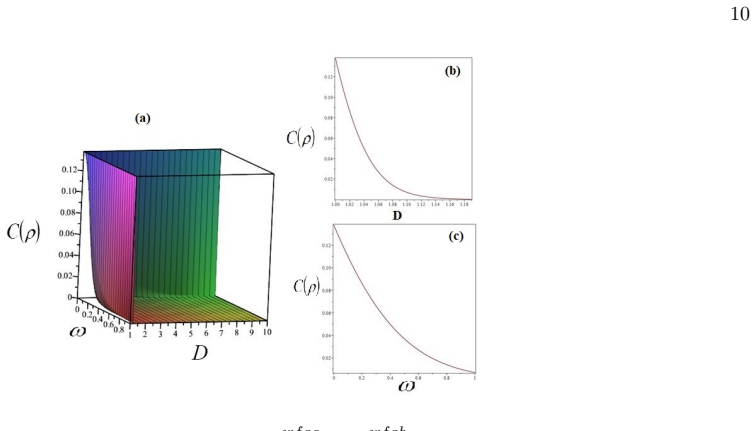
Fig.(b) is the 2D plot of concurrence against D and fig.(c) is the 2D plot concurrence against ω. one party from it, the resultant bipartite state is mixed. This mixed state can be successfully used as quantum teleportation channel, whereas, the teleportation fidelity of the state is 7 9 exceeding the classical teleportation fidelity 2 3[9, 20]. Now consi...
-
[2]
Hence our conjecture is that such states can still be used as quantum teleportation channels. Next we plot the teleportation fidelity of ρwfac W (and ρwfab W ) against the Dilaton parameter ( D) and monochro- matic frequency (ω) fixing black hole mass M = 1. Figure 6: Variation of teleportation fidelity of bipartite mixed states ρwfac W (or ρwfab W ) deri...
-
[3]
Similar is the case regarding the teleportation fidelity of ρwfab W
In the context of Schwarzschild black hole, 0.715<f T (ρwfac W )< 0.745 while in case of Dilaton black hole 0 .709<f T (ρwfac W )< 0.712. Similar is the case regarding the teleportation fidelity of ρwfab W . Hence we can conjecture that derived bipartite mixed states from the tripartite prototype W state, which is exposed to Schwarzschild or Dilaton black...
-
[4]
Experimental studies of black holes
R. Genzel, F. Eisenhauer and S. Gillessed, “Experimental studies of black holes” status and future prospect”, Astron. Astrophys. Rev., 32(1), 3, (2024)
work page 2024
-
[5]
Teleporting an unknown quantum state via dual classical and Einstein-Podolsky-Rosen channels
C.H. Bennett, G. Brassard, C. Cr´ epeau, R. Jozsa, A. Peres, and Wootters, W. K., Phys. Rev. Lett., “Teleporting an unknown quantum state via dual classical and Einstein-Podolsky-Rosen channels” , 70, 1895, (1993)
work page 1993
-
[6]
Bell’s inequalities versus teleportation: What is nonlocality?
S. Popescu,“Bell’s inequalities versus teleportation: What is nonlocality?”, Phys. Rev. Lett., 72, 797, (1994)
work page 1994
-
[7]
On the Einstein-Podolsky-Rosen paradox
J. S. Bell,“On the Einstein-Podolsky-Rosen paradox”, Phys. 1, 195, (1964)
work page 1964
-
[8]
R. Horodecki., M. Horodecki. and P. Horodecki.,“Quantum Entanglement”, Rev. Mod. Phys., 81, 865, (2009)
work page 2009
-
[9]
Communication via one- and two-particle operators on Einstein-Podolsky-Rosen states
C.H. Bennett and S.J.Wiesner,“Communication via one- and two-particle operators on Einstein-Podolsky-Rosen states”, Phys. Rev. Lett., 69, 2881, (1992)
work page 1992
-
[10]
Quantum cryptography: Public key distribution and coin tossing
C.H. Bennett and G. Brassard,“Quantum cryptography: Public key distribution and coin tossing”, Theor. Comp. Sc., 560(1), 7, (2014) 1
work page 2014
-
[11]
Quantum computation and quantum information
M.A. Nielsen and I. L. Chuang, “Quantum computation and quantum information”, Cambridge University Press, ISBN 978-1-107-00217-3 Hardback , (2010)
work page 2010
-
[12]
Teleportation via maximally and non-maximally entangled mixed states
S. Adhikari, A. S. Majumdar, B. Ghosh and N. Nayak, “Teleportation via maximally and non-maximally entangled mixed states”, Quant. Inf. & Comp., 10(5), 0398, (2010)
work page 2010
-
[13]
Coherence of multipartite quantum states in the black hole quantum atmosphere
A. Z. Kaczmarek, D. Szcz´ esniak and Z. Bak, “Coherence of multipartite quantum states in the black hole quantum atmosphere”, arxiv:quantph,2405.08167, (2024)
-
[14]
G-W. Mei, X. Huang, S-M. Fei and T. Zhang, “Impact of the Hawking Effect on the Fully Entangled Fraction of Three-qubit States in Schwarzschild Spacetime”, arxiv:quantph,2412.02927, (2024)
-
[15]
Genuine tripartite entanglement of W state subject to Hawking effect of a Schwarzschild black hole
S-M. Wu, X-W. Fan, X-L.Huang and H-S.Zang, “Genuine tripartite entanglement of W state subject to Hawking effect of a Schwarzschild black hole”, Europhysics Letters.,141(1), 18001, (2023)
work page 2023
-
[16]
Entanglement preservation in tripartite quantum systems under dephasing dynamics
C. Radhakrishnan, S.Roy, R. Chinnarasu and M-M. Ali, “Entanglement preservation in tripartite quantum systems under dephasing dynamics”, Europhysics Letters.,146(3), 38001, (2024)
work page 2024
-
[17]
Teleportation of unknown qubit via Star type tripartite states
A. Bhattacharjee, A. Mandal and S. Roy, “Teleportation of unknown qubit via Star type tripartite states”, arxiv:quantph,2407.11519, (2024)
-
[18]
Dephasing-Induced Distribution of Entanglement in Tripartite Quantum Systems
S.Roy, M-M.Ali, A.Mandal and C. Radhakrishnan, “Dephasing-Induced Distribution of Entanglement in Tripartite Quantum Systems”, arxiv:quantph,2408.09801, (2024)
-
[19]
Reservoir engineering to protect quantum coherence in tripartite systems under dephasing noise
S.Roy, M-M.Ali, A.Mandal and C. Radhakrishnan, “Reservoir engineering to protect quantum coherence in tripartite systems under dephasing noise”, arxiv:quantph, 2412.15082 Search , (2024)
-
[20]
Bell’s theorem, Quantum theory and conceptions of the universe
D.M. Greenberger, M. A. Horne and A. Zeilinger, “Bell’s theorem, Quantum theory and conceptions of the universe”, ed. M. Kafatos (Kluwer, Dordrecht, p.69), (1989)
work page 1989
-
[21]
Classification of multiqubit mixed states: Separability and distillability properties
W. D¨ur, and J.I. Cirac, “Classification of multiqubit mixed states: Separability and distillability properties”, Phys. Rev. A, 61, 042314, (2000)
work page 2000
-
[22]
V.Coffman, J. Kundu and W. K.Wootters, “Distributed entanglement”, Phys. Rev. A, 61, 052306, (2000)
work page 2000
-
[23]
Exploring quantum properties of bipartite mixed states under coherent and incoherent basis
S. Roy, A. Bhattacharjee, C. Radhakrishnan, M. M. Ali and B. Ghosh, “Exploring quantum properties of bipartite mixed states under coherent and incoherent basis”, Int. Jour. Quant. Inf., 21(2), 2350010, (2023)
work page 2023
-
[24]
Non-maximally Entangled Mixed States of X and Non-X Types as Teleportation Channels
A. Bhattacharjee, S. Roy, M. M. Ali and B. Ghosh, “Non-maximally Entangled Mixed States of X and Non-X Types as Teleportation Channels”, Int. Jour. Theor. Phys.,63, 113, (2024)
work page 2024
-
[25]
Black holes in general relativity
S. W. Hawking, “Black holes in general relativity”, Comm. Math. Phys., 25, 152, (1972)
work page 1972
-
[26]
Particle Creation by Black Holes,
S. W. Hawking, “Particle Creation by Black Holes,” Commun. Math. Phys. 43,199, (1975)
work page 1975
-
[27]
Breakdown of Predictability in Gravitational Collapse,
S. W. Hawking, “Breakdown of Predictability in Gravitational Collapse,” Phys. Rev. D, 14, 2460, (1976)
work page 1976
-
[28]
A Quantum Source of Entropy for Black Holes,
L. Bombelli, R. K. Koul, J. Lee and R. D. Sorkin, “A Quantum Source of Entropy for Black Holes,” Phys. Rev. D, 34, 373, (1986)
work page 1986
-
[29]
Alice falls into a black hole: Entanglement in non-inertial frames,
I. Fuentes-Schuller and R. B. Mann, “Alice falls into a black hole: Entanglement in non-inertial frames,” Phys. Rev. Lett. 95,120404, (2005)
work page 2005
-
[30]
Q. Pan and J. Jing, “Hawking radiation, Entanglement and Teleportation in background of an asymptotically flat static black hole,” Phys. Rev. D, 78, 065015, (2008)
work page 2008
-
[31]
Continuous variable entanglement sharing in non-inertial frames,
G. Adesso, I. Fuentes-Schuller and M. Ericsson, “Continuous variable entanglement sharing in non-inertial frames,” Phys. Rev. A, 76, 062112, (2007)
work page 2007
-
[32]
Entanglement of Dirac fields in non-inertial frames,
P. M. Alsing, I. Fuentes-Schuller, R. B. Mann and T. E. Tessier, “Entanglement of Dirac fields in non-inertial frames,” Phys. Rev. A, 74, 032326, (2006). 1 The original protocol was read by the authors in the Bangalore conference in 1984, later in 2014 it was made online. 16
work page 2006
-
[33]
Unveiling quantum entanglement degradation near a Schwarzschild black hole,
E. Martin-Martinez, L. J. Garay and J. Leon, “Unveiling quantum entanglement degradation near a Schwarzschild black hole,” Phys. Rev. D, 82, 064006, (2010)
work page 2010
-
[34]
K. Akiyama et.al, “First M87 Event Horizon Telescope Results. VIII. Magnetic Field Structure near The Event Horizon [Event Horizon Telescope Collaboration]”, The Astro. Phys. Jour. Lett., 910(1), 13, (2021)
work page 2021
-
[35]
K. Akiyama et.al, “First Sagittarius A* Event Horizon Telescope Results. I. The Shadow of the Supermassive Black Hole in the Center of the Milky Way [Event Horizon Telescope Collaboration]”, The Astro. Phys. Jour. Lett., 930(2), 12, (2022)
work page 2022
-
[36]
K. Akiyama et.al, “First Sagittarius A* Event Horizon Telescope Results. V. Testing Astrophysical Models of the Galactic Center Black Hole [Event Horizon Telescope Collaboration]”, The Astro. Phys. Jour. Lett., 930(2), 16, (2022)
work page 2022
-
[37]
Genuine tripartite entanglement of W state subject to Hawking effect of a Schwarzschild black hole
S-M. Wu, X-W. Fan, X-L. Huang and H-S. Zeng, “Genuine tripartite entanglement of W state subject to Hawking effect of a Schwarzschild black hole”, Europhys. Lett., 141(1), 18001, (2023)
work page 2023
-
[38]
Genuinely accessible and inaccessible entanglement in Schwarzschild black hole
S. M. Wu, X. W. Teng, J. X. Li, S. H. Li, T. H. Liu and J . C. Wang, “Genuinely accessible and inaccessible entanglement in Schwarzschild black hole”, Phys. Lett. B, 848, 138334, (2024)
work page 2024
-
[39]
S. M. Wu, Y. T. Cai, W. J. Peng and H. S. Zeng, “Genuine N-partite entanglement and distributed relationships in the background of Dilaton black holes”, Euro. Phys. Jour. C, 82, 412, (2022)
work page 2022
-
[40]
Black Hole Evaporation in the Klein-Sauter-Heisenberg-Euler Formalism,
T. Damour and R. Ruffini, “Black Hole Evaporation in the Klein-Sauter-Heisenberg-Euler Formalism,” Phys. Rev. D, 14, 332, (1976)
work page 1976
-
[41]
Interaction of Neutrinos and Gravitational Fields
D. R. Brill and J. A. Wheeler, “Interaction of Neutrinos and Gravitational Fields”, Rev. Mod. Phys., 29, 465, (1957)
work page 1957
-
[42]
Projective measurements and generation of entangled Dirac particles in Schwarzschild Spacetime,
J. Wang, Q. Pan and J. Jing, “Projective measurements and generation of entangled Dirac particles in Schwarzschild Spacetime,” Annals Phys., 325, 1190, (2010)
work page 2010
-
[43]
S. Xu, X. k. Song, J. d. Shi and L. Ye, “How the Hawking effect affects multipartite entanglement of Dirac particles in the background of a Schwarzschild black hole,” Phys. Rev. D, 89(6), 065022, (2014)
work page 2014
-
[44]
Entropic uncertainty relation in Garfinkle-Horowitz-Strominger dilation black hole
F. Shahbazi, S. Haseli, H. Dolatkhah and S. Salimi, “Entropic uncertainty relation in Garfinkle-Horowitz-Strominger dilation black hole”, Phys. Rev. D, 82, 064006, (2010)
work page 2010
-
[45]
Quasinormal Modes of Dilaton Black Holes: Analytic Approximations
Z. Malik,“Quasinormal Modes of Dilaton Black Holes: Analytic Approximations”, Int. Jour. Theor. Phys., 63, 128, (2024)
work page 2024
-
[46]
S-M. Wu, Y-T. Cai, W-J. Peng. and H-S. Zeng,“Genuine N-partite entanglement and distributed relationships in the background of dilation black holes”, Euro. Phys. Jour. C, 82, 128, (2022)
work page 2022
-
[47]
Charged black holes in string theory,
D. Garfinkle, G. T. Horowitz and A. Strominger, “Charged black holes in string theory,” Phys. Rev. D, 43, 3140, (1991)
work page 1991
-
[48]
Class of stationary axisymmetric solutions of the Einstein-Maxwell Dilaton - axion field equations,
A. Garcia, D. Galtsov and O. Kechkin, “Class of stationary axisymmetric solutions of the Einstein-Maxwell Dilaton - axion field equations,” Phys. Rev. Lett., 74, 1276, (1995)
work page 1995
-
[49]
Entanglement of Formation of an Arbitrary State of Two Qubits
W.K.Wootters,“Entanglement of Formation of an Arbitrary State of Two Qubits”, Phys. Rev. Lett., 80, 2245, (1998)
work page 1998
-
[50]
Perfect teleportation and superdense coding with W states
P. Agrawal and A.K.Pati,“Perfect teleportation and superdense coding with W states”, Phys. Rev. A., 74, 062320, (2006)
work page 2006
-
[51]
Optimal Extraction of Information from Finite Quantum Ensembles
S. Massar and S. Popescu,“Optimal Extraction of Information from Finite Quantum Ensembles”, Phys. Rev. Lett., 74, 1259, (1995)
work page 1995
-
[52]
Nonlocality criteria for quantum teleportation
N. Gisin,“Nonlocality criteria for quantum teleportation”, Phys. Lett. A., 210, 157, (1996)
work page 1996
-
[53]
Teleportation, Bell’s inequalities and inseparability
R. Horodecki., M. Horodecki. and P. Horodecki.,“Teleportation, Bell’s inequalities and inseparability”, Phys. Lett. A, 222, 21, (1996)
work page 1996
discussion (0)
Sign in with ORCID, Apple, or X to comment. Anyone can read and Pith papers without signing in.