Symmetric tensor scars with tunable entanglement from volume to area law
Pith reviewed 2026-05-23 05:06 UTC · model grok-4.3
The pith
Symmetric superpositions of antipodal triplet states yield exact zero-energy scar eigenstates with tunable entanglement in non-integrable spin-1/2 models.
A machine-rendered reading of the paper's core claim, the machinery that carries it, and where it could break.
Core claim
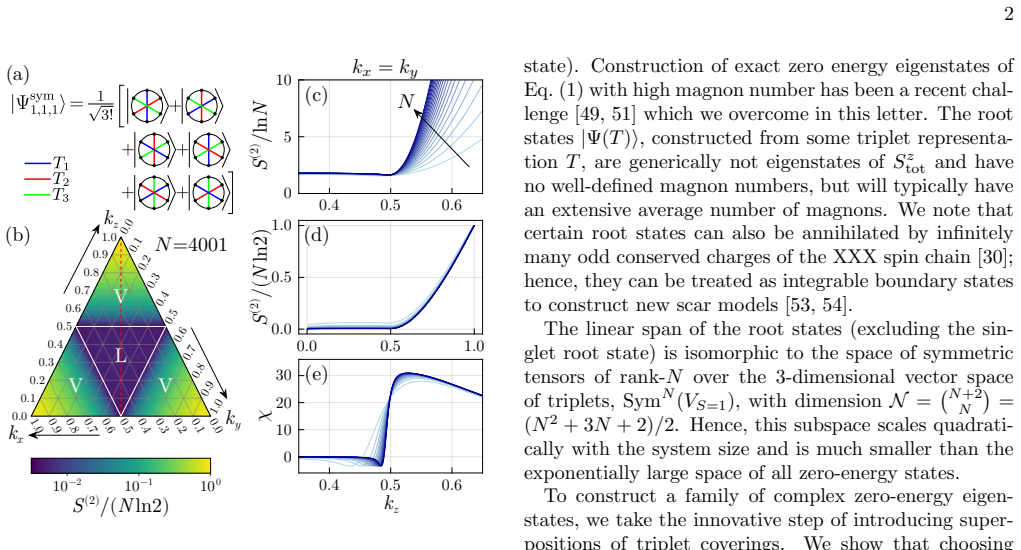
Using a symmetric superposition of the antipodal triplet states, we construct polynomially many exact zero-energy eigenstates for a class of non-integrable spin-1/2 Hamiltonians with two-body interactions. These states exhibit non-thermal correlations, hence, are genuine quantum many-body scars. By tuning the distribution of triplets we induce extensive, logarithmic, or area-law entanglement, and can observe a second-order entanglement phase transition. Quasiparticle excitations in this manifold converge to be exact quantum many-body scars in the thermodynamic limit. This framework has a natural extension to higher dimensions, where entangled states controlled by lattice geometry andinternal
What carries the argument
Symmetric superposition of antipodal triplet states, which are annihilated by the two-body interactions to produce zero-energy eigenstates whose entanglement can be tuned by the triplet distribution.
If this is right
- Quasiparticle excitations within the manifold become exact scars in the thermodynamic limit.
- The construction extends naturally to higher dimensions with states controlled by lattice geometry and internal symmetries.
- The states supply a medium for long-distance quantum information transmission via tunable long-range entanglement.
- The approach supplies a new route to entanglement control and quantum state construction in out-of-equilibrium matter.
Where Pith is reading between the lines
- The polynomial degeneracy of the scar manifold could be exploited to protect quantum information if the states remain stable under small perturbations.
- Geometry-controlled entanglement in higher dimensions might produce phases whose correlations are dictated by lattice symmetry rather than energetics.
- Tuning across the entanglement transition offers a controllable setting in which to study how different entanglement scalings affect transport or thermalization rates.
Load-bearing premise
The two-body Hamiltonians belonging to the unspecified class must exactly annihilate the symmetric triplet superpositions.
What would settle it
Explicit construction of one Hamiltonian from the claimed class followed by direct computation of its action on the symmetric superposition to check whether the eigenvalue is exactly zero.
Figures

read the original abstract
Teleportation of quantum information over long distances requires robust entanglement on the macroscopic scale. The construction of highly energetic eigenstates with tunable long-range entanglement can provide a new medium for information transmission. Using a symmetric superposition of the antipodal triplet states, we construct polynomially many exact zero-energy eigenstates for a class of non-integrable spin-1/2 Hamiltonians with two-body interactions. These states exhibit non-thermal correlations, hence, are genuine quantum many-body scars. By tuning the distribution of triplets we induce extensive, logarithmic, or area-law entanglement, and can observe a second-order entanglement phase transition. Quasiparticle excitations in this manifold converge to be exact quantum many-body scars in the thermodynamic limit. This framework has a natural extension to higher dimensions, where entangled states controlled by lattice geometry and internal symmetries can result in new classes of correlated out-of-equilibrium quantum matter. Our results provide a new avenue for entanglement control and quantum state constructions.
Editorial analysis
A structured set of objections, weighed in public.
Referee Report
Summary. The manuscript constructs polynomially many exact zero-energy eigenstates for a class of non-integrable spin-1/2 Hamiltonians with two-body interactions by taking symmetric superpositions of antipodal triplet states. These states are identified as quantum many-body scars due to their non-thermal correlations. By tuning the distribution of triplets, the entanglement entropy is shown to follow volume, logarithmic, or area laws, with an observed second-order entanglement phase transition; quasiparticle excitations become exact scars in the thermodynamic limit. The framework extends naturally to higher dimensions via lattice geometry and symmetries.
Significance. If the central claims hold, the work supplies an explicit symmetry-based construction of scars with controllable entanglement scaling (volume to area law) in non-integrable systems, supported by direct verification that the Hamiltonians annihilate the states via bond-wise cancellation. This offers a concrete route to engineering long-range entangled states relevant to quantum information and out-of-equilibrium dynamics, with the polynomial subspace size and level-spacing diagnostics providing falsifiable support.
minor comments (3)
- [§II] §II: the explicit two-body Hamiltonian forms are given, but a short table summarizing the interaction terms for the 1D and 2D cases would improve readability when verifying the symmetry cancellation.
- [Fig. 3] Fig. 3 (entanglement scaling): the finite-size data for the second-order transition would benefit from an inset showing the derivative of S with respect to the tuning parameter to make the critical point more visible.
- [Abstract] The abstract uses 'symmetric tensor scars' in the title but does not define the term; a one-sentence clarification in the abstract or introduction would help readers unfamiliar with the construction.
Simulated Author's Rebuttal
We thank the referee for their positive assessment of the manuscript, including the summary of our construction of polynomially many exact zero-energy scar states with tunable entanglement scaling, and for recommending minor revision. No major comments were provided in the report.
Circularity Check
No significant circularity; derivation self-contained via explicit construction
full rationale
The paper defines explicit two-body Hamiltonians (Sec. II) whose action on the symmetric antipodal-triplet superpositions vanishes identically by bond-wise symmetry cancellation. Non-integrability follows from independent level-spacing statistics, scar character from the polynomially large zero-energy subspace embedded in a thermal spectrum, and tunable entanglement from direct computation on the superposition. No fitted inputs are renamed as predictions, no self-citation chains bear the central claims, and no ansatz or uniqueness theorem is smuggled in; all load-bearing steps are externally verifiable computations or definitions independent of the target scar/entanglement results.
Axiom & Free-Parameter Ledger
axioms (1)
- domain assumption There exists a class of non-integrable two-body spin-1/2 Hamiltonians for which the symmetric antipodal triplet superpositions are exact zero-energy eigenstates.
Reference graph
Works this paper leans on
- [1]
-
[2]
L. D’Alessio, Y. Kafri, A. Polkovnikov, and M. Rigol, Adv. Phys.65, 239 (2016)
work page 2016
-
[3]
H. Kim, T. N. Ikeda, and D. A. Huse, Phys. Rev. E90, 052105 (2014)
work page 2014
-
[4]
C. J. Turner, A. A. Michailidis, D. A. Abanin, M. Serbyn, and Z. Papi´ c, Nat. Phys.14, 745 (2018)
work page 2018
-
[5]
C. J. Turner, A. A. Michailidis, D. A. Abanin, M. Serbyn, and Z. Papi´ c, Phys. Rev. B98, 155134 (2018)
work page 2018
-
[6]
S. Moudgalya, S. Rachel, B. A. Bernevig, and N. Reg- nault, Phys. Rev. B98, 235155 (2018)
work page 2018
- [7]
- [8]
-
[9]
K. Lee, R. Melendrez, A. Pal, and H. J. Changlani, Phys. Rev. B101, 241111 (2020)
work page 2020
-
[10]
J. Wildeboer, A. Seidel, N. S. Srivatsa, A. E. B. Nielsen, and O. Erten, Phys. Rev. B104, L121103 (2021)
work page 2021
-
[11]
N. S. Srivatsa, J. Wildeboer, A. Seidel, and A. E. B. Nielsen, Phys. Rev. B102, 235106 (2020)
work page 2020
- [12]
- [13]
-
[14]
B. A. B. Sanjay Moudgalya and N. Regnault, Rep. Prog. Phys.85, 086501 (2022)
work page 2022
-
[15]
A. Chandran, T. Iadecola, V. Khemani, and R. Moessner, Annu. Rev. Condens. Matter Phys.14, 443 (2023)
work page 2023
-
[16]
H. Bernien, S. Schwartz, A. Keesling, H. Levine, A. Om- ran, H. Pichler, S. Choi, A. S. Zibrov, M. Endres, M. Greiner, V. Vuletic, and M. D. Lukin, Nature551, 579 (2017)
work page 2017
- [17]
- [18]
-
[19]
C. M. Langlett, Z.-C. Yang, J. Wildeboer, A. V. Gor- shkov, T. Iadecola, and S. Xu, Phys. Rev. B105, L060301 (2022)
work page 2022
-
[20]
G. Vitagliano, A. Riera, and J. I. Latorre, New J. Phys. 12, 113049 (2010)
work page 2010
-
[21]
G. Ram´ ırez, J. Rodr´ ıguez-Laguna, and G. Sierra, J. Stat. Mech.: Theory Exp.2014(10), P10004
work page 2014
-
[22]
G. Ram´ ırez, J. Rodr´ ıguez-Laguna, and G. Sierra, J. Stat. Mech.: Theory Exp.2015(6), P06002
work page 2015
- [23]
- [24]
- [25]
-
[26]
W. Cottrell, B. Freivogel, D. M. Hofman, and S. F. Lokhande, J. High Energy Phys.2019(2), 1
work page 2019
- [27]
-
[28]
S. Mohapatra, S. Moudgalya, and A. C. Balram, Phys. Rev. Lett.134, 210403 (2025)
work page 2025
-
[29]
A. N. Ivanov and O. I. Motrunich, Phys. Rev. Lett.134, 050403 (2025)
work page 2025
- [30]
-
[31]
Gombor, arXiv 10.48550/arXiv.2207.10598 (2022), 2207.10598
T. Gombor, arXiv 10.48550/arXiv.2207.10598 (2022), 2207.10598
-
[32]
Ekman, arXiv 10.48550/arXiv.2207.12354 (2022), 2207.12354
C. Ekman, arXiv 10.48550/arXiv.2207.12354 (2022), 2207.12354
- [33]
-
[34]
ISHIBASHI, Modern Physics Letters A04, 251 (1989), https://doi.org/10.1142/S0217732389000320
N. ISHIBASHI, Modern Physics Letters A04, 251 (1989), https://doi.org/10.1142/S0217732389000320
-
[35]
C. K. Majumdar and D. K. Ghosh, J. Math. Phys.10, 1388 (1969)
work page 1969
-
[36]
C. K. Majumdar and D. K. Ghosh, J. Math. Phys.10, 1399 (1969)
work page 1969
-
[37]
P. W. Anderson, Mater. Res. Bull.8, 153 (1973)
work page 1973
-
[38]
P. W. Anderson, Science235, 1196 (1987)
work page 1987
-
[39]
P. W. Anderson, G. Baskaran, Z. Zou, and T. Hsu, Phys. Rev. Lett.58, 2790 (1987)
work page 1987
-
[40]
G. Baskaran, Z. Zou, and P. W. Anderson, Solid State Commun.88, 853 (1993)
work page 1993
-
[41]
D. S. Rokhsar and S. A. Kivelson, Phys. Rev. Lett.61, 2376 (1988)
work page 1988
-
[42]
S. A. Kivelson, D. S. Rokhsar, and J. P. Sethna, Phys. Rev. B35, 8865 (1987). 6
work page 1987
- [43]
- [44]
- [45]
- [46]
- [47]
- [48]
-
[49]
C. J. Turner, M. Szyniszewski, B. Mukherjee, R. Melendrez, H. J. Changlani, and A. Pal, arXiv 10.48550/arXiv.2407.11956 (2024), 2407.11956
-
[50]
N. Swain, H.-K. Tang, D. C. W. Foo, B. J. J. Khor, G. Lemari´ e, F. F. Assaad, P. Sengupta, and S. Adam, arXiv 10.48550/arXiv.2106.08587 (2021), relevant results in v3, published August 2024, 2106.08587
-
[51]
R. Melendrez, B. Mukherjee, M. Szyniszewski, C. J. Turner, A. Pal, and H. J. Changlani, arXiv 10.48550/arXiv.2501.14017 (2025), 2501.14017
-
[52]
Here we addition- ally refer to Refs
See Supplemental Material, which includes details of proofs related to symmetric tensor scars (Appendix A), calculation of R´ enyi-2 entropy (Appendix B) and corre- lation functions (Appendix C), details on von Neumann entropy (Appendix D), and discussion on the stability against perturbations (Appendix E). Here we addition- ally refer to Refs. [71–73]
- [53]
-
[54]
H. K. Kazuyuki Sanada, Yuan Miao, arXiv https://doi.org/10.48550/arXiv.2411.01270 (2024), 2411.01270v1
- [55]
-
[56]
R. Vasseur, A. C. Potter, Y.-Z. You, and A. W. W. Lud- wig, Phys. Rev. B100, 134203 (2019)
work page 2019
- [57]
-
[58]
Y. Li, X. Chen, and M. P. A. Fisher, Phys. Rev. B98, 205136 (2018)
work page 2018
-
[59]
A. Chan, R. M. Nandkishore, M. Pretko, and G. Smith, Phys. Rev. B99, 224307 (2019)
work page 2019
-
[60]
M. Szyniszewski, A. Romito, and H. Schomerus, Phys. Rev. B100, 064204 (2019)
work page 2019
-
[61]
E. Chitambar, D. Leung, L. Manˇ cinska, M. Ozols, and A. Winter, Commun. Math. Phys.328, 303 (2014)
work page 2014
-
[62]
D. A. Huse, R. Nandkishore, V. Oganesyan, A. Pal, and S. L. Sondhi, Phys. Rev. B88, 014206 (2013)
work page 2013
- [63]
-
[64]
J.-Y. Desaules, F. Pietracaprina, Z. Papi´ c, J. Goold, and S. Pappalardi, Phys. Rev. Lett.129, 020601 (2022)
work page 2022
- [65]
-
[66]
W. W. Ho, S. Choi, H. Pichler, and M. D. Lukin, Phys. Rev. Lett.122, 040603 (2019)
work page 2019
-
[67]
C. J. Turner, J.-Y. Desaules, K. Bull, and Z. Papi´ c, Phys. Rev. X11, 021021 (2021)
work page 2021
-
[68]
I.-C. Chen, B. Burdick, Y. Yao, P. P. Orth, and T. Iadecola, Phys. Rev. Res.4, 043027 (2022)
work page 2022
-
[69]
E. J. Gustafson, A. C. Y. Li, A. Khan, J. Kim, D. M. Kurkcuoglu, M. S. Alam, P. P. Orth, A. Rahmani, and T. Iadecola, Quantum7, 1171 (2023)
work page 2023
-
[70]
H. Dong, J.-Y. Desaules, Y. Gao, N. Wang, Z. Guo, J. Chen, Y. Zou, F. Jin, X. Zhu, P. Zhang, H. Li, Z. Wang, Q. Guo, J. Zhang, L. Ying, and Z. Papi´ c, Sci. Adv.9, 10.1126/sciadv.adj3822 (2023)
-
[71]
V. Bergholm and J. D. Biamonte, J. Phys. A: Math. Theor.44, 245304 (2011)
work page 2011
- [72]
-
[73]
Exact quantum many-body scars tunable from volume to area law
C.-J. Lin, A. Chandran, and O. I. Motrunich, Phys. Rev. Res.2, 033044 (2020). Supplemental material for “Exact quantum many-body scars tunable from volume to area law” Bhaskar Mukherjee, 1, 2 Christopher J. Turner, 2 Marcin Szyniszewski, 2, 3 and Arijeet Pal 2 1S. N. Bose National Centre for Basic Sciences, Block JD, Sector III, Salt Lake, Kolkata 700106,...
work page 2020
-
[74]
(B1) This operation is similar to thereshapingof a vector into a matrix – however, unlike reshaping, it is a basis- independent operation and reveals the symmetry of the resulting algebra. We have,S (2) =−ln tr[ρ 2] whereρis the reduced den- sity matrix of the subsystemA, given by ρ= tr B(|Ψ⟩ ⟨Ψ|) = ΨΨ†.(B2) HereBrepresents the environment,|Ψ⟩and Ψ are re...
-
[75]
(B13) (multiplyinge −f(a)) is almost a constant (= 16/nX 3) arounda=n X /2
We also note that the function in the integrand in Eq. (B13) (multiplyinge −f(a)) is almost a constant (= 16/nX 3) arounda=n X /2. This gives ||ρ||2 ≈ (nX!)4 2N N! 16eN e−f(a 0) (2π)3nX 3 Z nX 0 e− 1 2 (a−a0)2f ′′(a0)da ≈ (2πnX)2( nX e )4nX 2N √ 2πN( N e )N 16eN24nX nX −2nX (2π)3nX 3 √πnX 2 Erf[√nX] ≈ 4 πN ,(B15) where on the last line we have used Erf[x]...
-
[76]
+ √ 2 ln(3−2 √ 2) + ln(6 + 4 √ 2)−2 lnN)/2, f ′′(k0) = (8 + 6 √ 2)/N, w(k0) = πN 5 464 + 328 √ 2 1/2 .(B31) which yields S(2) ≈Nln 2(2− √ 2) (3−2 √ 2) 1√ 2 (1 + √ 2) √ 2 ! + 1 2 lnN−0.06. (B32) We numerically calculateS (2) for the state (N− 1,0, N+ 1)/2 and fitting with the formS (2) =c 1N+ c2 lnN+c 3 yields (c 1, c2) = (0.15837,0.492) which are very clo...
discussion (0)
Sign in with ORCID, Apple, or X to comment. Anyone can read and Pith papers without signing in.