REVIEW 3 major objections 5 minor 2 cited by
Open Materials Generation with Stochastic Interpolants
T0 review · 3 major / 5 minor · reviewed 2026-08-09 · deepseek-v4-flash
Pith's one-line read OMatG applies stochastic interpolants to inorganic crystal generation and claims state-of-the-art results over diffusion and flow-matching baselines.
desk verdict A careful, well-verified framework for crystal generation whose genuine contribution—interpolation choice matters—is undercut by an overstated SOTA claim and missing error bars. read the letter →
The pith
A machine-rendered reading of the paper's core claim, the machinery that carries it, and where it could break.
The reading
What carries the argument
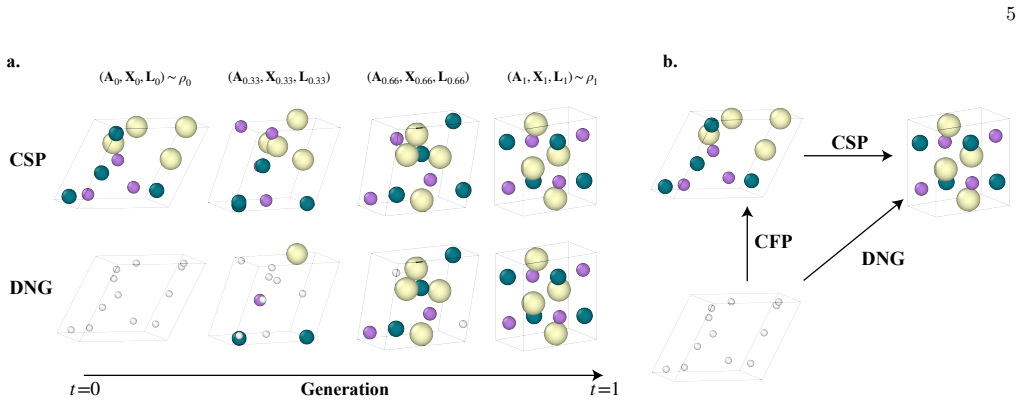
The load-bearing object is the stochastic interpolant $x_t = \alpha(t)x_0 + \beta(t)x_1 + \gamma(t)z$, with loss functions that learn the velocity $b_\theta(t,x)$ and, for SDE sampling, the denoiser $z_\theta(t,x)$. The interpolation coefficients are flexible except for endpoint constraints, and the paper tests linear, trigonometric, encoder-decoder, and score-based-diffusion (VP/VE) interpolants, with ODE or SDE sampling and a tunable latent-noise amplitude $\gamma(t)$. For periodic fractional coordinates, the path is defined by unwrapping $x_1$ to its closest periodic image, interpolating in Euclidean space along the shortest geodesic, and wrapping the result back onto the torus; atomic species are generated by discrete flow matching through a continuous-time Markov chain. This mechanism is what lets the same code reproduce conditional flow matching (linear interpolant, ODE, $\gamma=0$) and score-based diffusion (VP/VE interpolants with Gaussian base) while also exploring new in-between schemes.
What would settle it
On a one-dimensional torus, take a uniform base $\rho_0$, a target density whose exact form is known, and a nonlinear or stochastic interpolant with $\gamma(t) > 0$; numerically integrate the learned ODE/SDE and compare the empirical endpoint density with the exact wrapped target marginal. A mismatch would mean the wrapped process is not sampling the target distribution, so the training objective itself is unsound.
Extended reading notes
Core claim
OMatG is described as the first implementation of stochastic interpolants for inorganic crystal generation, and as such it unifies conditional flow matching and score-based diffusion as special cases inside a single, tunable framework. The paper's central empirical claim is that by optimizing the interpolation functions for the fractional coordinates and lattice vectors separately, and by coupling the continuous flow with discrete flow matching for atomic species, OMatG reaches a new state of the art: higher structural match rates than DiffCSP and FlowMM on perov-5, MP-20, and MPTS-52, the first CSP baseline on Alex-MP-20, and higher S.U.N. (stable, unique, novel) rates than MatterGen-MP in de novo generation. The best OMatG models also generate structures with lower average energy above the convex hull and closer match to reference coordination-number and crystal-system distributions. The authors interpret the results as evidence that the choice of interpolant, latent noise, sampling scheme, and per-degree-of-freedom tuning is a decisive axis of model design for materials generation.
Load-bearing premise
The load-bearing assumption is that interpolating fractional coordinates in unwrapped Euclidean space along the shortest periodic image and then wrapping back onto the torus gives the correct marginal distribution on the torus for nonlinear and stochastic interpolants with $\gamma(t)>0$; the paper uses this construction for all interpolants but proves it only for the linear geodesic case.
Editorial extensions
If this is right
- If the SOTA claim holds, any new generative model for crystals should be compared against OMatG under the same refined metrics, including validity filters and the coordination-number benchmark, before claiming improvement.
- The reported CSP gains on MP-20 and MPTS-52 mean that specified-composition structure prediction can be run at generative-model speed with better starting candidates for downstream DFT relaxation.
- The DNG improvements in stability and S.U.N. rate mean that a larger fraction of generated structures should survive DFT screening, cutting the cost of de novo materials discovery pipelines.
- Because OMatG's linear/ODE setting reproduces FlowMM and its SBD interpolants reproduce diffusion models, the framework gives a single code base for fair comparisons and ablations across previously separate methods.
Reading between the lines
- The periodic-boundary construction, based on the same unwrap-interpolate-wrap recipe, could carry over to other periodic or compact manifolds such as angle variables or SO(3) orientations, although the paper does not develop that generalization.
- If the match-rate/RMSE trade-off observed on perov-5 is generic, then match rate alone may over-reward models that find the right chemical environment but miss exact symmetric sites; a combined metric penalizing both errors would sharpen future comparisons.
- The framework's arbitrary base distributions suggest a direct way to inject prior knowledge, such as LLM-suggested compositions or machine-learned-potential relaxed motifs, as the base $\rho_0$, which the paper only begins to explore with LLM-generated structures.
Signed reviews
Editorial analysis
A structured set of objections, weighed in public.
Referee Report
Summary. The paper introduces OMatG, a generative model for inorganic crystal structures built on stochastic interpolants (SI), jointly modeling lattice vectors, fractional coordinates, and atomic species (via discrete flow matching). It extends SI to periodic boundary conditions by an unwrap–interpolate–wrap procedure, and evaluates the method on crystal structure prediction (CSP) on perov-5, MP-20, MPTS-52, and Alex-MP-20, and on de novo generation (DNG) on MP-20, claiming a new state of the art against DiffCSP, FlowMM, and MatterGen-MP. The paper also releases code, recomputes baseline metrics with SMACT 3.0, and adds a new average-coordination-number metric and a MatterSim/DFT stability pipeline.
Significance. The paper makes a valuable contribution to the materials-generation literature by demonstrating the practical flexibility of the stochastic-interpolants framework, with an open-source implementation and careful attention to evaluation (recomputed baselines, updated SMACT rules, DFT relaxation for stability metrics, and a new coordination-number metric). If the technical concerns below are resolved, the work would constitute a strong benchmark contribution. However, the headline state-of-the-art claim is currently not robustly supported: it rests on single-run, best-of-hyperparameter-optimization results with no seed variance, and no single OMatG configuration dominates across metrics. The torus extension of SI is also asserted without proof, leaving the soundness of the training objective unresolved for nonlinear and stochastic interpolants.
major comments (3)
- [Section I.B, Table III, Appendix C.3] The central claim that OMatG outperforms DiffCSP, FlowMM, and MatterGen in DNG is not established as stated, because no single OMatG configuration dominates across the reported metrics: MatterGen-MP achieves a markedly lower RMSD (0.1038 Å versus the best OMatG value of 0.4187 Å in Table III), DiffCSP achieves higher structural validity (99.91% versus the best OMatG 99.04% in Table II), and the best OMatG S.U.N. rate (22.48%) exceeds MatterGen-MP (20.30%) by only 2.18 points without any seed variance. Since each configuration is selected from 27–32 Bayesian HPO trials per interpolant (Appendix C.3) and reported once, the observed margin could be favorable noise. Please report multiple seeds with standard errors for the headline metrics, or revise the claim to a per-metric best-configuration statement.
- [Section III.B.1, Appendix B.5, Eq. (2)] The unwrap–interpolate–wrap procedure for periodic boundary conditions is asserted to extend stochastic interpolants to the torus, including the latent term γ(t)z, but no proof is given that the wrapped stochastic process x_t = wrap(α(t)x0 + β(t)x1' + γ(t)z) satisfies the SI velocity or Fokker–Planck equations on the torus. For the linear interpolant with γ=0 this reduces to the FlowMM geodesic, but for nonlinear interpolants (trig, enc-dec, VP/VE SBD) and for SDE sampling with γ>0 the path crosses the boundary and the time derivative of the wrapped path is not simply the wrapped derivative; hence the conditional velocity in Eq. (2) may not be the correct one for the target density on the torus. Please provide a proof or direct numerical validation (e.g., exact density recovery on a known toroidal target); without this, the training objective is not shown to be sound.
- [Appendix B.7, Table VII] Velocity annealing, which rescales the learned velocity as b_theta(t,x) → (1+st)b_theta(t,x), is applied with large coefficients (e.g., s=14 for positions in Table VII) and is acknowledged to lack theoretical justification. Because this ad-hoc modification changes the generative ODE/SDE dynamics, the reported SOTA results cannot be attributed solely to the SI framework, and the rescaling may invalidate the marginal density guaranteed by the SI construction. Please provide an ablation with s=0 or a demonstration that the annealed flow still samples the target distribution, or treat velocity annealing as a core component of the method and provide a theoretical or systematic empirical justification.
minor comments (5)
- [Table I] There is a formatting error in the DiffCSP row of the MPTS-52 columns: the text reads "15.79 / 14.290.1533/ 0.1489" without a separator between the match rate and RMSE; this should be corrected.
- [Section III.B.1 and Appendix B.5] The manuscript repeatedly refers to the "four-dimensional torus" for fractional coordinates in three dimensions; please clarify whether a three-dimensional torus is intended or explain the extra dimension.
- [Table III] The column header "⟨E⟩/N(↓) RMSD" is ambiguous; the energy above hull is reported in eV/atom and should be labeled clearly, with the RMSD unit (Å) separated.
- [Section V.C and Appendix C.3] The manuscript does not state explicitly how the single OMatG configuration shown in Tables II and III is chosen (e.g., best validation evalDNG, or best S.U.N. on a hold-out set), nor whether any test-set information was used in the selection; please make this selection rule explicit.
- [Figure 6 caption] The phrase "score based diffusion" should be hyphenated as "score-based diffusion".
Circularity Check
No significant circularity: OMatG's derivation is self-contained and externally benchmarked; the SOTA claim's per-metric HPO selection is a robustness concern, not a circular reduction.
full rationale
The central derivation chain is not circular. The SI losses in Eqs. (2)-(4) are taken from Albergo et al. [33] and are minimized against analytically defined interpolants; no target metric enters the loss as a fitted constant. The torus extension (Sec. III.B.1, App. B.5) is an asserted construction, not a theorem: unwrapping x1 along the shortest geodesic, computing the interpolant in Euclidean space, and wrapping back is a definition, and the paper does not prove that the wrapped nonlinear/SDE process has the correct torus marginal. That is an omitted proof and a correctness risk, but it does not assume the paper's conclusions. Lattice base distributions and center-of-mass removal follow Miller et al. [32] (FlowMM), an external method. CSP/DNG benchmarks use DiffCSP and FlowMM public code, MatterGen checkpoints, SMACT 3.0, MatterSim, and DFT relaxation via the MatterGen codebase; none of these are fitted by OMatG. The S.U.N. metric is evaluated against the external Alex-MP-20 reference set. Tables II-III show no single OMatG configuration dominates all metrics (e.g., MatterGen-MP has RMSD 0.1038 Å vs. best OMatG 0.4187 Å; DiffCSP structural validity 99.91% vs. best OMatG 99.04%), and each reported number is a best-of-HPO single run without seed variance; this weakens the Section I.B 'state of the art' claim as an empirical overclaim, but it does not make any prediction equivalent to its input by construction. Self-citations [17,18] support background statements about simulation databases and are not load-bearing. Score 1 reflects only these minor non-circular caveats.
Assumptions & free parameters
free parameters (8)
- lambda_x,b (fractional-coordinate velocity loss weight) =
0.9729 (perov-5 Linear ODE); 0.9994 (MP-20 Linear ODE)
- Velocity annealing coefficients s (positions and cell) =
14.11/2.90 (perov-5 Linear ODE); 8.20/1.46 (perov-5 Linear SDE)
- gamma(t) latent amplitude a =
0.034 (perov-5 Linear ODE); 0.258 (MP-20 Linear ODE)
- DFM species-noise eta =
7.08 (MP-20 Linear ODE DNG); 0.19 (MP-20 Linear SDE DNG)
- VP SBD base width sigma0 =
0.28 (perov-5 VP SBD ODE); 0.22 (MP-20 VP SBD ODE)
- VE SBD schedule endpoints (sigma_min, sigma_max) =
0.0078, 0.5165 (perov-5); 0.0047, 0.9967 (MP-20)
- Integration steps =
820 (perov-5 Linear ODE); 130 (MP-20 VP SBD ODE)
- Encoder-decoder switch time and exponent (T_switch, p) =
(0.80, 1) perov-5 Enc-Dec ODE; (0.65, 1) MP-20
assumptions (7)
- standard math Stochastic interpolant theory (Albergo et al.): for interpolants satisfying Eq. (B1), the losses in Eqs. (2)-(3) learn the velocity and denoiser of a process transporting rho0 to rho1.
- standard math CSPNet equivariance: message passing with sinusoidal positional embeddings yields permutation-equivariant, rotation-equivariant, translation-invariant embeddings (Jiao et al.).
- standard math Discrete flow matching / CTMC theory (Campbell et al.): the conditional rate matrix in Eq. (B6) and the update in Eq. (B9) sample from the target discrete distribution.
- domain assumption Shortest-path geodesic unwrapping gives a well-defined periodic interpolant for all interpolant choices, including the latent variable gamma(t)z (Section III.B.1, Appendix B.5).
- domain assumption The MatterSim potential followed by DFT relaxation gives stability labels accurate enough to compare methods (Appendix D.4).
- domain assumption Benchmark splits used for hyperparameter optimization do not leak into the reported test results (Appendix C.3).
- ad hoc to paper Velocity annealing improves generation and does not invalidate the learned flow (Appendix B.7).
Cite this review
Pith. "Pith review of Open Materials Generation with Stochastic Interpolants." pith.science (2026). https://pith.science/paper/YKNCFFTS
@misc{pith2026250202582,
  author       = {Pith},
  title        = {Pith review of: Open Materials Generation with Stochastic Interpolants},
  year         = {2026},
  howpublished = {\url{https://pith.science/paper/YKNCFFTS}},
  note         = {Machine review of arXiv:2502.02582}
}
read the original abstract
The discovery of new materials is essential for enabling technological advancements. Computational approaches for predicting novel materials must effectively learn the manifold of stable crystal structures within an infinite design space. We introduce Open Materials Generation (OMatG), a unifying framework for the generative design and discovery of inorganic crystalline materials. OMatG employs stochastic interpolants (SI) to bridge an arbitrary base distribution to the target distribution of inorganic crystals via a broad class of tunable stochastic processes, encompassing both diffusion models and flow matching as special cases. In this work, we adapt the SI framework by integrating an equivariant graph representation of crystal structures and extending it to account for periodic boundary conditions in unit cell representations. Additionally, we couple the SI flow over spatial coordinates and lattice vectors with discrete flow matching for atomic species. We benchmark OMatG's performance on two tasks: Crystal Structure Prediction (CSP) for specified compositions, and 'de novo' generation (DNG) aimed at discovering stable, novel, and unique structures. In our ground-up implementation of OMatG, we refine and extend both CSP and DNG metrics compared to previous works. OMatG establishes a new state of the art in generative modeling for materials discovery, outperforming purely flow-based and diffusion-based implementations. These results underscore the importance of designing flexible deep learning frameworks to accelerate progress in materials science. The OMatG code is available at https://github.com/FERMat-ML/OMatG.
Figures


Figures from the paper (9 more)




Forward citations
Cited by 2 Pith papers
-
Multimodal Crystal Flow: Any-to-Any Modality Generation for Unified Crystal Modeling
MCFlow uses decoupled flow time axes for atom types and crystal structures so a single model handles crystal structure prediction, de novo generation, and atom-type generation.
-
FlowMol3: Flow Matching for 3D De Novo Small-Molecule Generation
Combining self-conditioning, fake atoms, and late-stage geometry distortion lets a compact flow-matching model generate nearly always valid 3D drug-like molecules and match training-data chemistry better than existing...
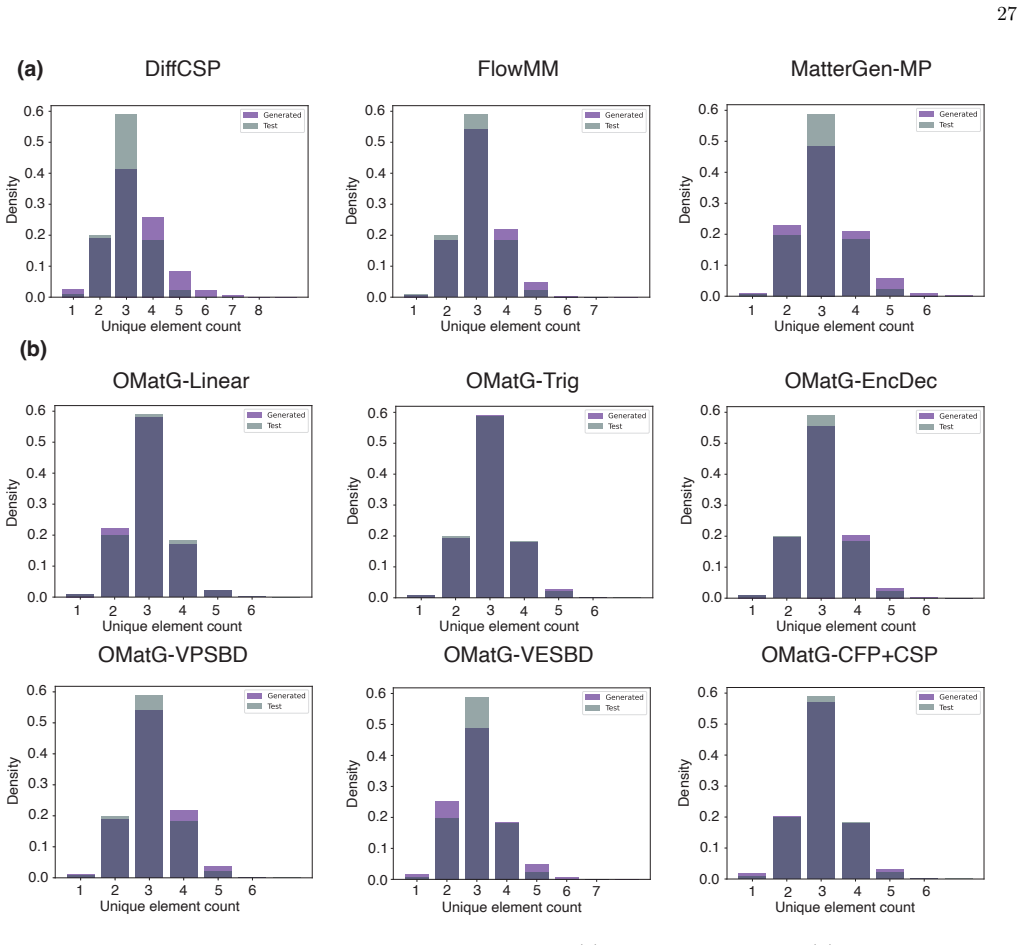
Reference graph
Works this paper leans on
-
[1]
Boeri, R
L. Boeri, R. Hennig, P. Hirschfeld, G. Profeta, A. Sanna, E. Zurek, W. E. Pickett, M. Amsler, R. Dias, M. I. Eremets, C. Heil, R. J. Hemley, H. Liu, Y. Ma, C. Pier- leoni, A. N. Kolmogorov, N. Rybin, D. Novoselov, V. Anisimov, A. R. Oganov, C. J. Pickard, T. Bi, R. Arita, I. Errea, C. Pellegrini, R. Requist, E. K. U. Gross, E. R. Margine, S. R. Xie, Y. Qu...
2022
-
[2]
Gludovatz, A
B. Gludovatz, A. Hohenwarter, D. Catoor, E. H. Chang, E. P. George, and R. O. Ritchie, Science 345, 1153 (2014)
2014
-
[3]
Gludovatz, A
B. Gludovatz, A. Hohenwarter, K. V. S. Thurston, H. Bei, Z. Wu, E. P. George, and R. O. Ritchie, Nat. Commun. 7, 10602 (2016)
2016
-
[4]
E. P. George, D. Raabe, and R. O. Ritchie, Nat. Rev. Mater. 4, 515 (2019)
2019
-
[5]
Strmcnik, P
D. Strmcnik, P. P. Lopes, B. Genorio, V. R. Stamenkovic, and N. M. Markovic, Nano Energy Electrocatalysis, 29, 29 (2016)
2016
-
[6]
Nakaya and S
Y. Nakaya and S. Furukawa, Chem. Rev.123, 5859 (2023)
2023
-
[7]
C. Liu, F. Li, L.-P. Ma, and H.-M. Cheng, Advanced Materials 22, E28 (2010)
2010
-
[8]
G. J. Snyder and E. S. Toberer, Nature Mater 7, 105 (2008)
2008
Show all 94 references
-
[9]
Cantor, Progress in Materials Science 120, 100754 (2021)
B. Cantor, Progress in Materials Science 120, 100754 (2021)
2021
-
[10]
Potyrailo, K
R. Potyrailo, K. Rajan, K. Stoewe, I. Takeuchi, B. Chisholm, and H. Lam, ACS Comb. Sci. 13, 579 (2011)
2011
-
[11]
W. F. Maier, ACS Comb. Sci. 21, 437 (2019)
2019
-
[12]
A. Jain, G. Hautier, C. Moore, S. Ong, C. Fischer, T. Mueller, K. Persson, and G. Ceder, Comput. Mater. Sci. 50, 2295 (2011)
2011
-
[13]
Curtarolo, G
S. Curtarolo, G. L. W. Hart, M. B. Nardelli, N. Mingo, S. Sanvito, and O. Levy, Nat. Mater. 12, 191 (2013)
2013
-
[14]
Bergerhoff, R
G. Bergerhoff, R. Hundt, R. Sievers, and I. D. Brown, J. Chem. Inf. Comput. Sci. 23, 66 (1983)
1983
-
[15]
M. J. Mehl, D. Hicks, C. Toher, O. Levy, R. M. Hanson, G. Hart, and S. Curtarolo, Comput. Mater. Sci. 136, S1 (2017)
2017
-
[16]
Blaiszik, K
B. Blaiszik, K. Chard, J. Pruyne, R. Ananthakrishnan, S. Tuecke, and I. Foster, JOM 68, 2045 (2016)
2016
-
[17]
J. A. Vita, E. G. Fuemmeler, A. Gupta, G. P. Wolfe, A. Q. Tao, R. S. Elliott, S. Martiniani, and E. B. Tadmor, J. Chem. Phys. 159, 154802 (2023)
2023
-
[18]
Fuemmeler, G
E. Fuemmeler, G. Wolfe, A. Gupta, J. A. Vita, E. B. Tadmor, and S. Martiniani, inAI for Accelerated Materials Design-NeurIPS 2024 (2024)
2024
-
[19]
Batzner, A
S. Batzner, A. Musaelian, L. Sun, M. Geiger, J. P. Mailoa, M. Kornbluth, N. Molinari, T. E. Smidt, and B. Kozinsky, Nature Communications 13, 2453 (2022)
2022
-
[20]
Batatia, D
I. Batatia, D. P. Kovacs, G. Simm, C. Ortner, and G. Csanyi, Advances in Neural Information Processing Systems 35, 11423 (2022)
2022
-
[21]
Chen and S
C. Chen and S. P. Ong, Nature Computational Science 2, 718 (2022)
2022
-
[22]
G. H. Booth, A. Gr¨ uneis, G. Kresse, and A. Alavi, Nature 493, 365 (2013)
2013
-
[23]
N. Zaki, H. Park, R. M. Osgood, A. J. Millis, and C. A. Marianetti, Phys. Rev. B 89, 205427 (2014)
2014
-
[24]
E. B. Isaacs and C. A. Marianetti, Phys. Rev. B 102, 045146 (2020)
2020
-
[25]
C. J. Pickard and R. J. Needs, J. Phys.: Condens. Matter 23, 053201 (2011)
2011
-
[26]
W. W. Tipton and R. G. Hennig, Journal of Physics: Condensed Matter 25, 495401 (2013)
2013
-
[27]
A. R. Oganov, C. J. Pickard, Q. Zhu, and R. J. Needs, Nat Rev Mater 4, 331 (2019)
2019
-
[28]
Merchant, S
A. Merchant, S. Batzner, S. S. Schoenholz, M. Aykol, G. Cheon, and E. D. Cubuk, Nature 624, 80 (2023)
2023
-
[29]
T. Xie, X. Fu, O.-E. Ganea, R. Barzilay, and T. Jaakkola, Crystal Diffusion Variational Autoencoder for Periodic Material Generation (2022), arXiv:2110.06197 [cs]
2022 arXiv
-
[30]
R. Jiao, W. Huang, P. Lin, J. Han, P. Chen, Y. Lu, and Y. Liu, Crystal Structure Prediction by Joint Equivariant Diffusion (2023)
2023
-
[31]
C. Zeni, R. Pinsler, D. Z¨ ugner, A. Fowler, M. Hor- ton, X. Fu, Z. Wang, A. Shysheya, J. Crabb´ e, S. Ueda, R. Sordillo, L. Sun, J. Smith, B. Nguyen, H. Schulz, S. Lewis, C.-W. Huang, Z. Lu, Y. Zhou, H. Yang, H. Hao, J. Li, C. Yang, W. Li, R. Tomioka, and T. Xie, Nature 10.10...
2025 doi
-
[32]
B. K. Miller, R. T. Q. Chen, A. Sriram, and B. M. Wood, FlowMM: Generating Materials with Rieman- nian Flow Matching (2024), arXiv:2406.04713 [cond-mat, physics:physics, stat]
2024 arXiv
-
[33]
M. S. Albergo, N. M. Boffi, and E. Vanden-Eijnden, Stochastic Interpolants: A Unifying Framework for Flows and Diffusions (2023), arXiv:2303.08797 [cond-mat]
2023 arXiv
-
[34]
Sohl-Dickstein, E
J. Sohl-Dickstein, E. A. Weiss, N. Maheswaranathan, and S. Ganguli, Deep Unsupervised Learning using Nonequi- librium Thermodynamics (2015), arXiv:1503.03585 [cond- mat, q-bio, stat]
2015 arXiv
-
[35]
Y. Song, J. Sohl-Dickstein, D. P. Kingma, A. Kumar, S. Ermon, and B. Poole, Score-Based Generative Mod- eling through Stochastic Differential Equations (2021), arXiv:2011.13456 [cs]
2021 arXiv
-
[36]
Saharia, W
C. Saharia, W. Chan, S. Saxena, L. Li, J. Whang, E. Den- ton, S. K. S. Ghasemipour, B. K. Ayan, S. S. Mah- davi, R. G. Lopes, T. Salimans, J. Ho, D. J. Fleet, and M. Norouzi, Photorealistic Text-to-Image Diffu- sion Models with Deep Language Understanding (2022), arXiv:2205.11487 [cs]
2022 arXiv
-
[37]
Corso, H
G. Corso, H. St¨ ark, B. Jing, R. Barzilay, and T. Jaakkola, DiffDock: Diffusion Steps, Twists, and Turns for Molecu- lar Docking (2023), arXiv:2210.01776 [q-bio]
2023 arXiv
-
[38]
Liu, Rectified Flow: A Marginal Preserving Approach to Optimal Transport (2022), arXiv:2209.14577 [stat]
Q. Liu, Rectified Flow: A Marginal Preserving Approach to Optimal Transport (2022), arXiv:2209.14577 [stat]. 11
2022 arXiv
-
[39]
Lipman, R
Y. Lipman, R. T. Q. Chen, H. Ben-Hamu, M. Nickel, and M. Le, Flow Matching for Generative Modeling (2023), arXiv:2210.02747 [cs, stat]
2023 arXiv
-
[40]
M. S. Albergo and E. Vanden-Eijnden, Building Nor- malizing Flows with Stochastic Interpolants (2023), arXiv:2209.15571 [cs, stat]
2023 arXiv
-
[41]
A. Tong, K. Fatras, N. Malkin, G. Huguet, Y. Zhang, J. Rector-Brooks, G. Wolf, and Y. Bengio, Improving and generalizing flow-based generative models with minibatch optimal transport (2024), arXiv:2302.00482
2024 arXiv
-
[42]
R. T. Q. Chen and Y. Lipman, Flow Matching on General Geometries (2024), arXiv:2302.03660 [cs, stat]
2024 arXiv
-
[43]
I. Gat, T. Remez, N. Shaul, F. Kreuk, R. T. Q. Chen, G. Synnaeve, Y. Adi, and Y. Lipman, Discrete Flow Matching (2024), arXiv:2407.15595 [cs]
2024 arXiv
-
[44]
Campbell, J
A. Campbell, J. Yim, R. Barzilay, T. Rainforth, and T. Jaakkola, Generative Flows on Discrete State-Spaces: Enabling Multimodal Flows with Applications to Protein Co-Design (2024), arXiv:2402.04997 [cs, q-bio, stat]
2024 arXiv
-
[45]
D. W. Davies, K. T. Butler, A. J. Jackson, J. M. Skelton, K. Morita, and A. Walsh, Journal of Open Source Software 4, 1361 (2019)
2019
-
[46]
V. G. Satorras, E. Hoogeboom, and M. Welling, in Pro- ceedings of the 38th International Conference on Machine Learning, Proceedings of Machine Learning Research, Vol. 139, edited by M. Meila and T. Zhang (PMLR, 2021) pp. 9323–9332
2021
-
[47]
AI4Science, A
M. AI4Science, A. Hernandez-Garcia, A. Duval, A. Volokhova, Y. Bengio, D. Sharma, P. L. Carrier, Y. Benabed, M. Koziarski, and V. Schmidt, Crystal- GFN: Sampling crystals with desirable properties and constraints (2023), arXiv:2310.04925 [cs]
2023
-
[48]
Z. Cao, X. Luo, J. Lv, and L. Wang, Space Group In- formed Transformer for Crystalline Materials Generation (2024)
2024
-
[49]
R. Zhu, W. Nong, S. Yamazaki, and K. Hippalgaonkar, WyCryst: Wyckoff Inorganic Crystal Generator Frame- work (2024), arXiv:2311.17916
2024 arXiv
-
[50]
Kazeev, R
N. Kazeev, R. Zhu, I. Romanov, A. E. Ustyuzhanin, S. Yamazaki, W. Nong, and K. Hippalgaonkar, in AI for Accelerated Materials Design - NeurIPS 2024(2024)
2024
-
[51]
R. Jiao, W. Huang, Y. Liu, D. Zhao, and Y. Liu, Space Group Constrained Crystal Generation (2024), arXiv:2402.03992 [cond-mat]
2024 arXiv
-
[52]
S. P. Ong, W. D. Richards, A. Jain, G. Hautier, M. Kocher, S. Cholia, D. Gunter, V. L. Chevrier, K. A. Persson, and G. Ceder, Computational Materials Science 68, 314 (2013)
2013
-
[53]
MatterGen, Mattergen, Microsoft (2025)
2025
-
[54]
Full workflow details are given in Appendix D 4
is utilized for initial structural relaxation, which is subsequently followed by a more computationally expen- sive DFT relaxation. Full workflow details are given in Appendix D 4. In addition to the stability-based met- rics, we also report the root mean squared displacement ...
1917
-
[55]
H. Yang, C. Hu, Y. Zhou, X. Liu, Y. Shi, J. Li, G. Li, Z. Chen, S. Chen, C. Zeni, M. Horton, R. Pinsler, A. Fowler, D. Z¨ ugner, T. Xie, J. Smith, L. Sun, Q. Wang, L. Kong, C. Liu, H. Hao, and Z. Lu, MatterSim: A Deep Learning Atomistic Model Across Elements, Tempera- tures an...
2024 arXiv
-
[56]
I. E. Castelli, D. D. Landis, K. S. Thygesen, S. Dahl, I. Chorkendorff, T. F. Jaramillo, and K. W. Jacobsen, Energy & Environmental Science 5, 9034 (2012)
2012
-
[57]
A. Jain, S. P. Ong, G. Hautier, W. Chen, W. D. Richards, S. Dacek, S. Cholia, D. Gunter, D. Skinner, G. Ceder, and K. A. Persson, APL Materials 1, 011002 (2013)
2013
-
[58]
S. G. Baird, H. M. Sayeed, J. Montoya, and T. D. Sparks, Journal of Open Source Software 9, 5618 (2024)
2024
-
[59]
Schmidt, N
J. Schmidt, N. Hoffmann, H.-C. Wang, P. Borlido, P. J. M. A. Carri¸ co, T. F. T. Cerqueira, S. Botti, and M. A. L. Marques, Large-scale machine-learning- assisted exploration of the whole materials space (2022), arXiv:2210.00579 [cond-mat]
2022 arXiv
-
[60]
Schmidt, H.-C
J. Schmidt, H.-C. Wang, T. F. T. Cerqueira, S. Botti, and M. A. L. Marques, Scientific Data 9, 64 (2022)
2022
-
[61]
C. J. Pickard, Airss data for carbon at 10gpa and the c+n+h+o system at 1gpa (2020)
2020
-
[62]
Sriram, B
A. Sriram, B. Miller, R. T. Chen, and B. Wood, Ad- vances in Neural Information Processing Systems 37, 46025 (2024)
2024
-
[63]
J. Yim, A. Campbell, A. Y. K. Foong, M. Gastegger, J. Jim´ enez-Luna, S. Lewis, V. G. Satorras, B. S. Veel- ing, R. Barzilay, T. Jaakkola, and F. No´ e, Fast protein backbone generation with SE(3) flow matching (2023), arXiv:2310.05297
2023 arXiv
-
[64]
A. J. Bose, T. Akhound-Sadegh, G. Huguet, K. Fa- tras, J. Rector-Brooks, C.-H. Liu, A. C. Nica, M. Ko- rablyov, M. Bronstein, and A. Tong, SE(3)-Stochastic Flow Matching for Protein Backbone Generation (2024), arXiv:2310.02391
2024 arXiv
-
[65]
M. S. Albergo, M. Goldstein, N. M. Boffi, R. Ranganath, and E. Vanden-Eijnden, Stochastic interpolants with data- dependent couplings (2024), arXiv:2310.03725 [cs, stat]
2024 arXiv
-
[66]
J. Ho, A. Jain, and P. Abbeel, Denoising Diffusion Prob- abilistic Models (2020), arXiv:2006.11239 [cs]
2020 arXiv
-
[67]
Aranguri, G
S. Aranguri, G. Biroli, M. Mezard, and E. Vanden-Eijnden, Optimizing Noise Schedules of Generative Models in High Dimensions (2025), arXiv:2501.00988 [cs]
2025 arXiv
-
[68]
A. Q. Nichol and P. Dhariwal, in Proceedings of the 38th International Conference on Machine Learning, Proceed- ings of Machine Learning Research, Vol. 139, edited by M. Meila and T. Zhang (PMLR, 2021) pp. 8162–8171
2021
-
[69]
Song and S
Y. Song and S. Ermon, in Advances in Neural Informa- tion Processing Systems, Vol. 32, edited by H. Wallach, H. Larochelle, A. Beygelzimer, F. d 'Alch´ e-Buc, E. Fox, and R. Garnett (Curran Associates, Inc., 2019)
2019
-
[70]
R. Liaw, E. Liang, R. Nishihara, P. Moritz, J. E. Gonzalez, and I. Stoica, arXiv preprint arXiv:1807.05118 (2018)
2018 arXiv
-
[71]
Bergstra, D
J. Bergstra, D. Yamins, and D. D. Cox, TProc. of the 30th International Conference on Machine Learning (ICML
-
[72]
A. M. Ganose, H. Sahasrabuddhe, M. Asta, K. Beck, T. Biswas, A. Bonkowski, J. Bustamante, X. Chen, Y. Chi- ang, D. Chrzan, J. Clary, O. Cohen, C. Ertural, M. Gal- lant, J. George, S. Gerits, R. Goodall, R. Guha, G. Hau- tier, M. Horton, A. Kaplan, R. Kingsbury, M. Kuner, B. Li...
2025
-
[73]
A. Togo, K. Shinohara, and I. Tanaka, Spglib: A software library for crystal symmetry search (2024), arXiv:1808.01590 [cond-mat]
2024 arXiv
-
[74]
Gruver, A
N. Gruver, A. Sriram, A. Madotto, A. G. Wilson, C. L. Zitnick, and Z. Ulissi, Fine-Tuned Language Models Generate Stable Inorganic Materials as Text (2024), arXiv:2402.04379 [cs]. 12 Appendix A: Acronyms Table IV provides a list of acronyms used throughout this paper for refer...
2024 arXiv
-
[75]
Depending on the specific task, there are several stochastic interpolants at once
OMatG F ramework Figures 4 and 5 summarize the training and the integration pipeline of the OMatG framework, respectively. Depending on the specific task, there are several stochastic interpolants at once. For CSP, one stochastic interpolant considers lattice vectors L, and an...
-
[76]
Interpolant Choice In this work, we are concerned with spatially linear interpolants of the form specified in Eq. (1). The following conditions must be met [33]: α(0) = β(1) = 1, α (1) = β(0) = γ(0) = γ(1) = 0, γ (t) > 0 ∀t ∈ (0, 1). (B1) Under these constraints, the form of t...
-
[77]
[33], the loss function can become unstable around t = 0 and t = 1 for certain choices of γ(t)
Antithetic Sampling As shown by Albergo et al. [33], the loss function can become unstable around t = 0 and t = 1 for certain choices of γ(t). To account for this, we implement antithetic sampling. This requires simultaneously computing the loss at both x+ and x− where x+(t, x...
-
[78]
Albergo et al
Diffusion Coefficient An important inference-time parameter for models integrated with an SDE is the choice of ϵ(t) ≥ 0 which plays the role of a diffusion coefficient. Albergo et al. [33] note that the presence of γ−1(t) in the drift term seen in Fig. 5 can pose a numerical i...
-
[79]
We do not attempt to generalize stochastic interpolants (SIs) to arbitrary manifolds as in Riemannian flow matching [42]
Interpolation with Periodic Boundary Conditions We adopt a task-specific formulation for handling periodic boundary conditions with SIs tailored to flat tori, which are the relevant manifolds for fractional coordinates in crystal generation. We do not attempt to generalize sto...
-
[80]
(The geodesic is the same as the linear interpolant wrapped back into the box.) 15 We perform this procedure for all choices of interpolants
= (1 − t)x0 + tx′ 1, as if in Euclidean space and finally wrap the interpolated path back onto the torus. (The geodesic is the same as the linear interpolant wrapped back into the box.) 15 We perform this procedure for all choices of interpolants. The reason for unwrapping acc...
-
[81]
As discussed, a parameterized neural network pθ 1|t(x1|xt) is learned, which attempts to predict the final sequence from the sequence at time t
DFM Details DFM allows for generative modeling of discrete sequences of tokens while respecting the discrete nature of the design space. As discussed, a parameterized neural network pθ 1|t(x1|xt) is learned, which attempts to predict the final sequence from the sequence at tim...
-
[82]
For instance, Miller et al
V elocity Annealing Velocity annealing—rescaling the learned velocity field during generation to increase velocity over time as bθ(t, x) → (1 +st) bθ(t, x) with s as an hyperparameter during integration—has been empirically shown to improve performance in a number of studies t...
-
[83]
Data-Dependent Coupling SIs have been used with data-dependent couplings [ 64], where a coupling function ν(x0, x1) enables biasing of x0 based on the sampled x1. In OMatG, we incorporate an optional data-dependent coupling that enforces an ordering (i.e., a permutation on the...
-
[84]
from structures x0 ∈ ρ0 and x1 ∈ ρ1. We find that the inclusion of this data-dependent coupling is optimal during hyperparameter tuning depending on the type of model: CSP models typically performed better without this coupling, but DNG models (see Tab. XI) can benefit in cert...
-
[85]
FlowMM is naturally subsumed by OMatG
SI unifies CFM and SBDM The SI framework implemented in OMatG unifies the frameworks of CFM, as implemented in FlowMM [ 32], and SBDM, as implemented in DiffCSP [ 30] and MatterGen [ 31]. FlowMM is naturally subsumed by OMatG. For the choice of ODE-based sampling, the velocity...
-
[86]
The notable differences between OMatG-Linear models and FlowMM are as follows: (1) Discrete flow matching on species for OMatG vs
Comparison of OMatG-Linear to FlowMM A subset of OMatG models, specifically those which use linear interpolants for both the fractional coordinates and lattice vectors, map closely onto the conditional flow-matching model FlowMM [ 32]. The notable differences between OMatG-Lin...
-
[87]
Graph Neural Network We implement a message-passing graph neural network (GNN) with CSPNet as introduced in Jiao et al. [30]: hi (0) = ϕh(0) (ai) (C1) mij (s) = φm hi s−1, hj s−1, l, SinusoidalEmbedding(xj − xi) (C2) mi (s) = NX j=1 mij (s) (C3) hi (s) = hi (s−1) + φh(h(s−1), ...
-
[88]
(C7) For the CSP task, the last line is left out
Loss F unction With Eqs (2), (3), and (4), we can construct a loss function for the modeling of our joint distribution of interest for the DNG task, L(θ) =Et,z,x0,x1 λx,b |bθ x(t, xt)|2 − 2∂tx(t, x0, x1, z) · bθ x(t, xt) + λx,z |zθ x(t, xt)|2 − 2zθ x(t, xt) · z + λl,b |bθ l (t...
-
[89]
Hyperparameter Optimization For every choice of the positional interpolant, sampling scheme, and latent variableγ, an independent hyperparameter optimization was performed using the Ray Tune package [69] in conjunction with the HyperOpt Python library [ 70] for Bayesian optimi...
-
[90]
We show in Fig
Match Rate and RMSE The tradeoff between match rate and RMSE most strongly influences the perov-5 dataset. We show in Fig. 7 how different positional interpolants for the atomic coordinates (trigonometric vs. linear with ODE sampling schemes) learn to generate matched structur...
-
[91]
The compositional validity is defined according to the SMACT software package [45]
V alidity Metrics The structural validity of generated structures is defined according to the bond lengths present in the structure—all lengths must be >0.5 ˚A to be considered valid. The compositional validity is defined according to the SMACT software package [45]. We note t...
-
[92]
For structural matching, we use CrystalNN, and for compositional matching, we use Magpie fingerprints
Coverage and Property Statistics As in [ 29], we evaluate coverage recall and precision (reported as rates) by measuring the percentage of crystals in the test set and in the generated samples that match each other within a defined fingerprint distance threshold. For structura...
-
[93]
Rates TABLE XII
Calculation of S.U.N. Rates TABLE XII. Stability (defined as ≤ 0.1 eV/atom above hull), uniqueness, and novelty results from de novo generation on the MP-20 dataset computed for the same models as in Tab. II. All evaluations are performed with the MatterGen code base [ 53] wit...
1984
-
[94]
Stability and Structural Analysis of Generated Structures In Fig. 8, we show the distribution of computed energies above the convex hull across various OMatG models, showing best stability of generated structures for linear, encoder-decoder, trigonometric, and VP SBD positiona...
Reviewed August 9, 2026 · model on record in the stance chip above.
Discussion (0). Continue with ORCID to comment.