Tripartite Haar random state has no bipartite entanglement
Pith reviewed 2026-05-23 03:30 UTC · model grok-4.3
The pith
Tripartite Haar random states have no distillable EPR-like bipartite entanglement when each subsystem is smaller than half the total system.
A machine-rendered reading of the paper's core claim, the machinery that carries it, and where it could break.
Core claim
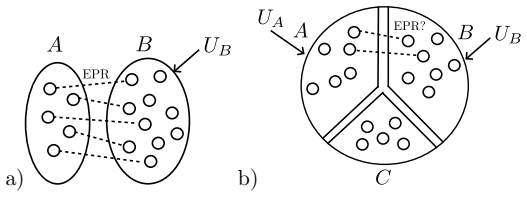
We show that no EPR-like bipartite entanglement can be distilled from a tripartite Haar random state |Ψ⟩_ABC by local unitaries or local operations when each subsystem A, B, or C has fewer than half of the total qubits. We derive an upper bound on the probability of sampling a state with EPR-like entanglement at a given EPR fidelity tolerance, showing a doubly-exponential suppression in the number of qubits. The proof relies on a simple volume argument supplemented by an ε-net argument and concentration of measure. Viewing |Ψ⟩_ABC as a bipartite quantum error-correcting code C→AB implies that neither output subsystem A nor B supports any non-trivial logical operator. We also establish that W
What carries the argument
The volume argument with ε-net and concentration of measure that bounds the set of states possessing high EPR fidelity.
If this is right
- Neither subsystem A nor B supports non-trivial logical operators when the state is viewed as a bipartite code C→AB.
- W-like or GHZ-like entanglement cannot be distilled by local operations.
- Tripartite Haar random states admit no nontrivial global symmetries.
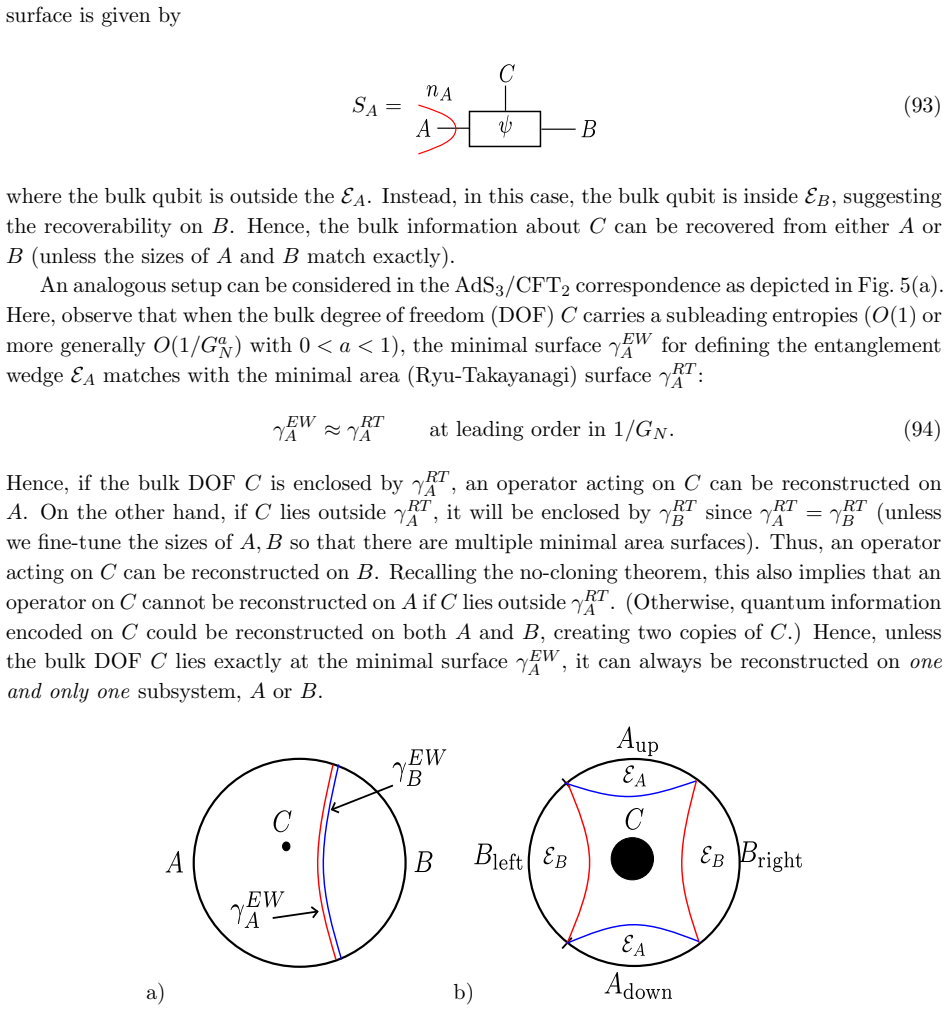
- In the AdS/CFT setting a connected entanglement wedge does not imply the existence of distillable bipartite entanglement.
Where Pith is reading between the lines
- The same suppression may extend to other multipartite-to-bipartite distillation tasks beyond EPR pairs.
- Small-system numerical checks could verify whether the doubly exponential bound already appears at modest qubit numbers.
- The result suggests that random entanglement resources for quantum networks will typically require multipartite decoding protocols rather than pairwise extraction.
Load-bearing premise
The volume argument supplemented by an ε-net argument and concentration of measure applies to bound the probability for states with high EPR fidelity when each subsystem has fewer than half the total qubits.
What would settle it
Numerical sampling of Haar-random tripartite states on 6-12 qubits with each subsystem smaller than half the total, followed by an exhaustive search over local unitaries to check whether the fraction of states yielding EPR fidelity above a fixed threshold exceeds the doubly exponential upper bound.
Figures


read the original abstract
We show that no EPR-like bipartite entanglement can be distilled from a tripartite Haar random state $|\Psi\rangle_{ABC}$ by local unitaries or local operations when each subsystem $A$, $B$, or $C$ has fewer than half of the total qubits. Specifically, we derive an upper bound on the probability of sampling a state with EPR-like entanglement at a given EPR fidelity tolerance, showing a doubly-exponential suppression in the number of qubits. Our proof relies on a simple volume argument supplemented by an $\epsilon$-net argument and concentration of measure. Viewing $|\Psi\rangle_{ABC}$ as a bipartite quantum error-correcting code $C\to AB$, this implies that neither output subsystem $A$ nor $B$ supports any non-trivial logical operator. We also establish general constraints on the structure of tripartite entanglement in Haar random states, showing that W- or GHZ-like entanglement cannot be distilled and that nontrivial global symmetries are absent. Finally, we discuss a physical interpretation in the AdS/CFT correspondence, indicating that a connected entanglement wedge does not necessarily imply bipartite entanglement, contrary to a previous belief.
Editorial analysis
A structured set of objections, weighed in public.
Referee Report
Summary. The paper claims that a Haar-random tripartite pure state |Ψ⟩_ABC admits no distillable EPR-like bipartite entanglement (at fixed fidelity) via local unitaries or LOCC whenever each subsystem dimension is strictly less than half the total number of qubits; the probability of sampling such a state is bounded above by a doubly-exponentially small quantity in the total qubit number. The argument proceeds by a volume estimate on the set of states that are close (after local unitaries) to an EPR ⊗ junk form, supplemented by an ε-net covering and concentration-of-measure tail bounds. Additional claims include the absence of distillable W- or GHZ-type tripartite entanglement, the lack of nontrivial global symmetries, and the consequence that the state viewed as a quantum error-correcting code from C to AB supports no nontrivial logical operators supported on A or on B. A brief discussion of implications for the AdS/CFT entanglement wedge is included.
Significance. If the central bound holds, the result supplies a clean, quantitative demonstration that typical tripartite entanglement is incompatible with bipartite distillability under the stated subsystem-size condition. The proof relies on standard, parameter-free tools (volume ratios, ε-nets, and Lévy concentration) that have been successfully applied to similar atypicality statements in quantum information; the doubly-exponential suppression is a strong, falsifiable prediction. The QEC reformulation and the holographic remark are natural corollaries that may stimulate further work on the structure of random states.
minor comments (2)
- The precise scaling (e.g., whether the bound holds for subsystem dimension ≤ 2^{n/2-1} or a slightly weaker threshold) should be stated explicitly in the first paragraph of the introduction and in the statement of the main theorem.
- Notation for the total Hilbert-space dimension (2^n) and the individual subsystem dimensions should be fixed once at the beginning rather than re-introduced in each section.
Simulated Author's Rebuttal
We thank the referee for their positive assessment and recommendation to accept the manuscript. Their summary correctly reflects the central claims regarding the absence of distillable bipartite EPR entanglement in typical tripartite Haar-random states under the stated dimension condition, along with the supporting volume and concentration arguments, the QEC implications, and the holographic remarks.
Circularity Check
No significant circularity
full rationale
The paper's central claim is established via a volume argument on the Haar measure, combined with an ε-net covering and standard concentration-of-measure bounds to show doubly-exponential suppression of states admitting local-unitary or LOCC distillation of an EPR pair when each subsystem is smaller than half the total dimension. These are external, parameter-free mathematical tools whose validity does not depend on any fitted quantities, self-definitions, or prior results by the same authors; the subsystem-size condition simply places the relevant submanifolds inside the regime where the bounds apply. No load-bearing step reduces by construction to the paper's own inputs or to a self-citation chain.
Axiom & Free-Parameter Ledger
axioms (2)
- domain assumption Haar measure on the unitary group for the tripartite Hilbert space
- standard math Concentration of measure phenomenon in high-dimensional spaces
Reference graph
Works this paper leans on
-
[1]
Srednicki, Chaos and Quantum Thermalization , Phys
M. Srednicki, Chaos and Quantum Thermalization , Phys. Rev. E 50 (1994)
work page 1994
-
[2]
P. Hayden and J. Preskill, Black holes as mirrors: Quantum information in random subsystems, JHEP 09 (2007) 120
work page 2007
-
[3]
M.L. Mehta, Random matrices, vol. 142, Elsevier (2004). 25
work page 2004
-
[4]
Page, Average entropy of a subsystem , Phys
D.N. Page, Average entropy of a subsystem , Phys. Rev. Lett. 71 (1993) 1291
work page 1993
-
[5]
P. Hosur, X.-L. Qi, D.A. Roberts and B. Yoshida, Chaos in quantum channels , JHEP 02 (2016) 004
work page 2016
- [6]
-
[7]
F. Pastawski, B. Yoshida, D. Harlow and J. Preskill, Holographic quantum error-correcting codes: Toy models for the bulk/boundary correspondence , JHEP 06 (2015) 149
work page 2015
- [8]
-
[9]
A. Ambainis and J. Emerson, Quantum t-designs: t-wise independence in the quantum world , in Twenty-Second Annual IEEE Conference on Computational Complexity (CCC’07) , p. 129, (2007)
work page 2007
-
[10]
Lubkin, Entropy of an n-system from its correlation with a k-reservoir , J
E. Lubkin, Entropy of an n-system from its correlation with a k-reservoir , J. Math. Phys. 19 (1978) 1028
work page 1978
-
[11]
S. Lloyd and H. Pagels, Complexity as thermodynamic depth , Ann. Phys. 188 (1988) 186
work page 1988
-
[12]
Efficient decoding for the Hayden-Preskill protocol
B. Yoshida and A. Kitaev, Efficient decoding for the Hayden-Preskill protocol , arXiv:1710.03363
work page internal anchor Pith review Pith/arXiv arXiv
- [13]
-
[14]
H. Shapourian, S. Liu, J. Kudler-Flam and A. Vishwanath, Entanglement Negativity Spectrum of Random Mixed States: A Diagrammatic Approach , PRX Quantum 2 (2021) 030347
work page 2021
-
[15]
B. Yoshida and I.L. Chuang, Framework for classifying logical operators in stabilizer codes , Phys. Rev. A 81 (2010) 052302
work page 2010
-
[16]
S. Nezami and M. Walter, Multipartite Entanglement in Stabilizer Tensor Networks , Phys. Rev. Lett. 125 (2020) 241602
work page 2020
-
[17]
G. Smith and D. Leung, Typical entanglement of stabilizer states , Physical Review A—Atomic, Molecular, and Optical Physics 74 (2006) 062314
work page 2006
-
[18]
M. Freedman and M. Headrick, Bit threads and holographic entanglement , Comm. Math. Phys. 352 (2017) 407
work page 2017
-
[19]
S.X. Cui, P. Hayden, T. He, M. Headrick, B. Stoica and M. Walter, Bit Threads and Holographic Monogamy, Comm. Math. Phys. 376 (2019) 609
work page 2019
- [20]
-
[21]
J. Harper and M. Headrick, Bit threads and holographic entanglement of purification , JHEP 08 (2019) 101
work page 2019
- [22]
-
[23]
C. Akers and P. Rath, Entanglement Wedge Cross Sections Require Tripartite Entanglement , JHEP 04 (2020) 208
work page 2020
- [24]
- [25]
- [26]
-
[27]
S. Bravyi and B. Terhal, A no-go theorem for a two-dimensional self-correcting quantum memory based on stabilizer codes , New J. Phys. 11 (2009) 043029
work page 2009
-
[28]
T. Mori and B. Yoshida, Does connected wedge imply distillable entanglement? , arXiv:2411.03426
-
[29]
C.H. Bennett, D.P. DiVincenzo, J.A. Smolin and W.K. Wootters, Mixed state entanglement and quantum error correction, Phys. Rev. A 54 (1996) 3824
work page 1996
-
[30]
I. Devetak and A. Winter, Distillation of secret key and entanglement from quantum states , Proceedings of the Royal Society A: Mathematical, Physical and engineering sciences 461 (2005) 207
work page 2005
-
[31]
P. Hayden, D.W. Leung and A. Winter, Aspects of generic entanglement , Comm. Math. Phys. 265 (2006) 95
work page 2006
- [32]
-
[33]
K. B¨ or¨ oczky and G. Wintsche,Covering the sphere by equal spherical balls , in Discrete and Computational Geometry: The Goodman-Pollack Festschrift , B. Aronov, S. Basu, J. Pach and M. Sharir, eds., (Berlin, Heidelberg), pp. 235–251, Springer Berlin Heidelberg (2003), DOI
work page 2003
-
[34]
O. Marchal and J. Arbel, On the sub-gaussianity of the beta and dirichlet distributions , Electronic Communications in Probability 22 (2017)
work page 2017
-
[35]
M.A. Nielsen and I.L. Chuang, Quantum computation and quantum information , Cambridge university press (2010)
work page 2010
-
[36]
Ledoux, The Concentration of Measure Phenomenon , no
M. Ledoux, The Concentration of Measure Phenomenon , no. 89 in Mathematical surveys and monographs, American Mathematical Society (2001). 27
work page 2001
- [37]
-
[38]
Metric Entropy of Homogeneous Spaces
S.J. Szarek, Metric entropy of homogeneous spaces , arXiv preprint math/9701213 (1997)
work page internal anchor Pith review Pith/arXiv arXiv 1997
-
[39]
Susskind, ER=EPR, GHZ, and the consistency of quantum measurements , Fortsch
L. Susskind, ER=EPR, GHZ, and the consistency of quantum measurements , Fortsch. Phys. 64 (2016) 72
work page 2016
-
[40]
X. Dong, X.-L. Qi and M. Walter, Holographic entanglement negativity and replica symmetry breaking, JHEP 06 (2021) 024
work page 2021
-
[41]
A. Almheiri, X. Dong and D. Harlow, Bulk Locality and Quantum Error Correction in AdS/CFT, JHEP 04 (2015) 163
work page 2015
-
[42]
H. Barnum and E. Knill, Reversing quantum dynamics with near-optimal quantum and classical fidelity, J. Math. Phys. 43 (2002) 2097
work page 2002
-
[43]
C. Akers and G. Penington, Leading order corrections to the quantum extremal surface prescription, JHEP 04 (2021) 062 [ 2008.03319]. 28
discussion (0)
Sign in with ORCID, Apple, or X to comment. Anyone can read and Pith papers without signing in.