REVIEW 6 major objections 6 minor 5 cited by
Model Tampering Attacks Enable More Rigorous Evaluations of LLM Capabilities
T0 review · 6 major / 6 minor · reviewed 2026-08-09 · deepseek-v4-flash
Pith's one-line read The paper argues that attacks modifying a model's weights or latent activations reveal worst-case LLM capabilities that prompt-only evaluations miss, and that these tampering attacks can predict and conservatively bound held-out…
desk verdict The fine-tuning-undoes-unlearning result is solid and important, but the predictive claim about held-out input-space attacks is weaker than the abstract implies and survives only on the conservative-bounding half. read the letter →
The pith
A machine-rendered reading of the paper's core claim, the machinery that carries it, and where it could break.
The reading
What carries the argument
The mechanism that carries the argument is the model tampering attack suite: embedding-space perturbations, latent-space perturbations, weights-and-activations pruning, benign fine-tuning, LoRA fine-tuning, and full-parameter fine-tuning, all rendered universal so they work for any prompt. Fine-tuning attacks take 1–16 gradient steps, sometimes with as few as 64 examples, and they act on the model's internals rather than searching the prompt space. The paper also uses weighted principal component analysis over attack-success vectors, weighted by unlearning score, to show that attacks share a low-dimensional robustness structure, and linear regression on attack subsets to show that tampering attacks add predictive signal for worst-case input-space failure.
What would settle it
Take the released 65 unlearned models and run a genuinely novel input-space attack, for example a multi-turn jailbreak in a low-resource language that was not part of the attack suite. If its success rate correlates near zero with the model tampering attacks and exceeds the best fine-tuning attack on most models, the predictive claim fails; separately, a utility-preserving unlearning method whose WMDP-Bio accuracy rises by less than 10 points after 16 gradient steps on 128 examples would refute the reversal claim.
Extended reading notes
Core claim
The paper's central claim is that model tampering attacks—modifications to latent activations or weights rather than to prompts—reveal worst-case LLM capabilities that input-space evaluations miss, and do so efficiently enough to serve as routine complements. Empirically, it reports that for 65 Llama-3-8B-Instruct derived models unlearned on WMDP-Bio, attack successes live in a low-dimensional subspace: three principal components explain 89% of the variance. It also reports that embedding, latent, pruning, and benign fine-tuning attack successes correlate with the success of held-out input-space attacks, while the stronger of LoRA and full fine-tuning attacks empirically exceeds the best input-space attack on 64 of 65 models. Finally, it reports that all utility-preserving unlearning methods can be attacked to recover more than 30 WMDP-Bio percentage points within 16 gradient steps and at most 128 examples, sometimes in a single step. The paper treats the held-out standard attacks as proxies for unforeseen input-space attacks, and notes weaker but still positive correlations with a proprietary, externally developed input-space attack.
Load-bearing premise
The paper's main claim depends on the assumption that the five held-out prompt attacks stand in for all future, unseen prompt attacks; if a genuinely new attack exploits a different mechanism, the observed correlations and conservative upper bounds may not hold.
Editorial extensions
If this is right
- Standard risk evaluations that only manipulate prompts should be supplemented with latent-space and weight-space attacks, because the paper shows input-only results understate worst-case capability.
- Fine-tuning attacks can serve as a conservative upper-bound proxy: the stronger of LoRA and full fine-tuning beat the best input-space attack on 64 of 65 unlearned models.
- Unlearning methods should be stress-tested against few-step fine-tuning before deployment, since all utility-preserving methods recovered more than 30 percentage points of WMDP-Bio performance within 16 gradient steps.
- Because three principal components explain most attack-success variance, a small diverse set of attacks can approximate full-suite robustness measurements.
- Refusal-tuned models show the same pattern: model tampering, especially fine-tuning and multi-turn attack algorithms, jailbroke all 9 safety-tuned models tested.
Reading between the lines
- Editorial inference: if the low-dimensional robustness subspace holds beyond the one model family tested, evaluators could select a small battery of tampering and input attacks spanning the principal components rather than enumerating attacks.
- Editorial inference: the weak cross-task correlations with the proprietary external evaluation suggest tampering attacks indicate vulnerability within a task distribution, not global capability deletion; safety cases should combine tampering probes with task-specific benchmarks.
- Editorial inference: because benign fine-tuning on ordinary text also resurfaces unlearned knowledge, the result implies that even non-adversarial downstream adaptation of open-weight models can restore supposedly removed capabilities, a deployment-relevant consequence beyond the paper's attack framing.
- Editorial inference: a testable extension is to check whether the same low-dimensional robustness pattern appears across model sizes and architectures; if it does, tampering attacks could become a cheap pre-deployment screening tool.
Editorial analysis
A structured set of objections, weighed in public.
Referee Report
Summary. The paper proposes adding model tampering attacks (perturbations to latent activations or model weights) to the standard input-space attack toolbox for LLM capability evaluation. It pits 8 unlearning methods and 9 refusal-finetuned Llama-3-8B-Instruct models against 5 input-space and 6 model tampering attacks, measuring WMDP-Bio accuracy recovery and StrongReject compliance rates. The main claims are: (1) attack robustness lies on a low-dimensional subspace; (2) model tampering attack success can empirically predict and conservatively bound the success of held-out input-space attacks; and (3) state-of-the-art unlearning can be undone within 16 fine-tuning steps. The paper releases 64 unlearned models and includes proprietary held-out attacks from the UK AI Security Institute and Haize Labs' Cascade as additional validation.
Significance. If the central claims hold, the paper makes a valuable methodological contribution: it provides the first systematic comparison of input-space and weight/latent-space capability elicitation, releases a reusable unlearning model suite, and offers practical efficiency evidence for model tampering attacks. The low-dimensional subspace finding and the masking of input-space bounds by fine-tuning attacks are relevant to safety evaluations of open-weight models. The paper is also commendable for explicitly acknowledging non-i.i.d. data, reporting a held-out proprietary attack evaluation, and releasing artifacts. However, the strongest contribution is the benchmark and the conservative-estimate observation; the predictive claim is currently weaker than the abstract states, for reasons detailed in the major comments.
major comments (6)
- [Appendix A.4, Table 4; §4.1.3] The Abstract and Figure 7 state that state-of-the-art unlearning can be reversed within 16 gradient steps using 128 or fewer examples, but the hyperparameter table in Appendix A.4 lists configurations with 400 examples and up to 50 gradient steps (Full-1: 400 examples, 25 steps; LoRA-1, LoRA-2, Benign-1: 400 examples, 50 steps). Either the "within 16 steps" claim applies only to a subset of rows in Table 4 and must be stated as such, or the efficiency figures in Table 3 are incomplete. This is load-bearing for contribution (3), so the manuscript should be corrected and the affected claims re-examined.
- [§4.1.3, Figure 5] The predictive claim that model tampering attacks "empirically predict" held-out input-space attacks is estimated on 65 non-independent points: eight evenly spaced checkpoints from each of eight unlearning runs of Llama-3-8B-Instruct plus one additional TAR model. Weighted Pearson correlations such as r=0.87 (pruning) and r=0.84 (benign fine-tuning) can be inflated by within-run trajectory correlations and by method-level differences, for example dysfluent GradDiff and TAR models failing all tasks. The footnote disclaiming formal p-values is appropriate, but the abstract and contribution 3 present the predictive relationship without this caveat. The paper should report analyses that hold out entire unlearning runs or method families, use one checkpoint per run, or bootstrap over independent runs, and show whether the correlations survive.
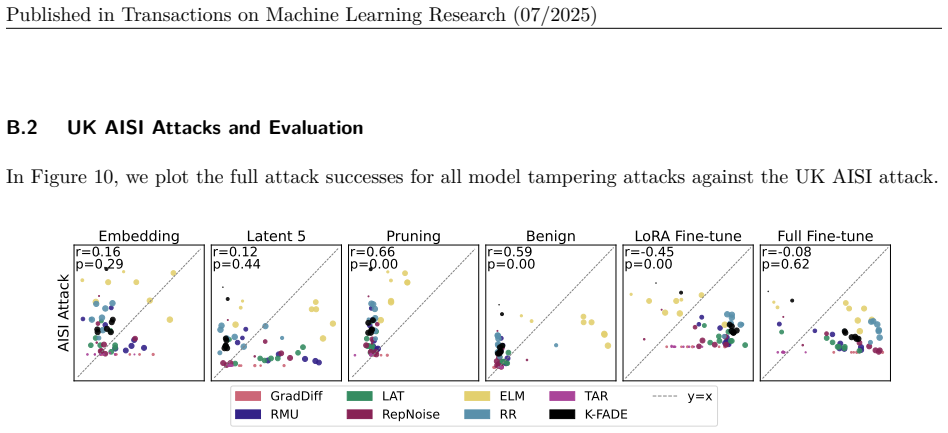
- [§4.1.3, Figures 6, 10, 12; §4.2, Figure 17] The held-out proprietary evaluations substantially weaken the predictive claim. For the UK AISI attack, only pruning (r=0.66) and benign fine-tuning (r=0.59) correlate with attack success, best fine-tuning correlates negatively (r=-0.16), and cross-task residual correlations are weak (Figure 12). In the jailbreaking replication with 9 models, no clear correlation appears (Figure 17, best fine-tune r=0.32, p=0.40). Since these are the closest available tests to "unforeseen" input-space attacks, the current evidence supports a narrower claim: certain tampering attacks are informative for some held-out attacks on the same task, not a general predictive relationship. The paper should temper the contribution or provide additional evidence for generalization to new models and new attacks.
- [Appendix A.4, "Excluded attacks"] The attack suite was selected after many-shot and translation attacks were found to be consistently unsuccessful and were excluded from the reported results. If these exclusions were made after inspecting outcomes, the reported correlations and the "64 of 65 models" conservative-estimate percentages in Figure 5 are conditional on a favorable selection and may overstate the relationship. Please report the full set of attempted attacks, state the selection rule, and show whether the main correlations and the 64/65 result are robust under alternative attack suites.
- [Equation (1), §4.1.2] The unlearning score in Eq. (1) uses hand-picked utility weights (1/4, 1/4, and 1/2 for MMLU, AGIEval, and MT-Bench), and the PCA in §4.1.2 weights rows by sqrt(S_unlearn). The low-dimensional subspace and the unlearning-score-weighted correlations both depend on this aggregation. A short ablation varying the utility weights, the PCA row-weighting exponent, or using unweighted rows would establish that the subspace and predictive results are not artifacts of the chosen aggregation.
- [§4.1.3, contribution 3] The phrase "conservative estimates" is used for fine-tuning attacks exceeding the best input-space attack on 64 of 65 models. Because fine-tuning modifies weights rather than inputs, this may simply reflect a strictly more powerful threat model rather than a bound on unknown input-space attacks. The Discussion's caveat about possible limitations in the mechanistic similarity of input-space and tampering attacks (Section 5) should be integrated into the formulation of the contribution, and the estimand (maximum over the five tested input-space attacks) should be defined explicitly.
minor comments (6)
- [§1, Contribution 4] The list of contributions states that 64 models are released, while Section 3 and the experiments use 65 models (8 checkpoints from 8 methods plus one TAR-v2 model); please make the count consistent.
- [Appendix A.4, Table 4] Please state in the Table 4 caption which rows correspond to the attacks summarized in Figure 7 so that the "16 steps, 128 examples" statement can be verified against the hyperparameters.
- [References] The K-FADE method is cited as "McKinney et al." without a year or venue in the bibliography; please add the full reference.
- [Figure 3] The caption of Figure 3(b) should clarify that the displayed values are eigenvalue-weighted principal component loadings rather than raw loadings, since the current label alone is ambiguous.
- [§4.1.3] The text moves from correlations to "conservative estimates" without explicitly defining the estimand; please define it as the maximum over the five tested input-space attacks and note that it is not a bound over all possible future attacks.
- [Figure 13] The full correlation matrix shows negative correlations for the adversarial fine-tuning attacks, which complicates the predictive story; a main-text sentence explaining this would help readers interpret the contrast with the positive correlations in Figure 5.
Circularity Check
No significant circularity: predictive and bounding claims rest on independent empirical comparisons; self-citations are methodological only.
full rationale
The paper's central claims are empirical and measured independently: attack successes are defined as increases in WMDP-Bio (or StrongReject) performance under each attack relative to an unperturbed baseline, and the 'prediction' claim is supported by correlations between independently measured tampering and input-space attack successes, plus cross-validated linear regressions that hold out entire unlearning families and, in the strongest version, hold out one input-space attack at a time. No parameter in those regressions is fitted to the quantity being predicted, and the held-out input-space attacks are not used to construct the tampering attacks. The 'conservative estimate' claim is a direct empirical comparison (best fine-tuning attack exceeds best input-space attack on 64/65 models), not an algebraic consequence of the definitions. The unlearning score in Eq. (1) is a hand-specified aggregation and is used only for checkpoint selection and as a PCA/correlation weight; it does not enter the definitions of attack success, so it cannot make the subspace or correlation results true by construction. Self-citations (e.g., Sheshadri et al. 2024, Lynch et al. 2024, McKinney et al.) supply methods and defenses, but none is invoked as an external theorem that forces the paper's conclusions; the paper explicitly treats its held-out input-space attacks as proxies for unforeseen attacks and reports that the UK AISI correlations are weaker and that jailbreak correlations are not clear with n=9. Those are validity and robustness limitations, not circularity. No quoted step reduces one equation to another by construction.
Assumptions & free parameters
free parameters (3)
- Unlearning score utility weights =
1/4 MMLU, 1/4 AGIEval, 1/2 MT-Bench
- PCA row weighting exponent =
sqrt(unlearning score)
- Pruning fraction =
15%
assumptions (5)
- domain assumption WMDP-Bio accuracy is a valid measure of dual-use biology knowledge, and StrongReject AutoGrader is a valid measure of harmful compliance.
- domain assumption Held-out input-space attacks (GCG, AutoPrompt, BEAST, PAIR, Human) are treated as proxies for unforeseen input-space attacks.
- domain assumption Llama-3-8B-Instruct is a representative model for generalizing the robustness findings.
- domain assumption Universal adversarial perturbations attribute attack success to capability elicitation rather than answer-forcing.
- domain assumption The 65 model checkpoints are treated as samples for computing Pearson correlations.
Cite this review
Pith. "Pith review of Model Tampering Attacks Enable More Rigorous Evaluations of LLM Capabilities." pith.science (2026). https://pith.science/paper/TFMY67TH
@misc{pith2026250205209,
  author       = {Pith},
  title        = {Pith review of: Model Tampering Attacks Enable More Rigorous Evaluations of LLM Capabilities},
  year         = {2026},
  howpublished = {\url{https://pith.science/paper/TFMY67TH}},
  note         = {Machine review of arXiv:2502.05209}
}
read the original abstract
Evaluations of large language model (LLM) risks and capabilities are increasingly being incorporated into AI risk management and governance frameworks. Currently, most risk evaluations are conducted by designing inputs that elicit harmful behaviors from the system. However, this approach suffers from two limitations. First, input-output evaluations cannot fully evaluate realistic risks from open-weight models. Second, the behaviors identified during any particular input-output evaluation can only lower-bound the model's worst-possible-case input-output behavior. As a complementary method for eliciting harmful behaviors, we propose evaluating LLMs with model tampering attacks which allow for modifications to latent activations or weights. We pit state-of-the-art techniques for removing harmful LLM capabilities against a suite of 5 input-space and 6 model tampering attacks. In addition to benchmarking these methods against each other, we show that (1) model resilience to capability elicitation attacks lies on a low-dimensional robustness subspace; (2) the success rate of model tampering attacks can empirically predict and offer conservative estimates for the success of held-out input-space attacks; and (3) state-of-the-art unlearning methods can easily be undone within 16 steps of fine-tuning. Together, these results highlight the difficulty of suppressing harmful LLM capabilities and show that model tampering attacks enable substantially more rigorous evaluations than input-space attacks alone.
Figures


Figures from the paper (16 more)




Forward citations
Cited by 5 Pith papers
-
Operationalising the Superficial Alignment Hypothesis via Task Complexity
A few kilobytes of program can adapt pre-trained LLMs to strong performance on math, translation, and instruction-following—evidence that task knowledge already lives in the model.
-
RippleBench: Capturing Ripple Effects Using Existing Knowledge Repositories
RippleBench automatically generates questions at increasing semantic distance from unlearned topics and shows all eight tested unlearning methods degrade accuracy that recovers only slowly with distance.
-
Video Deepfake Abuse: How Company Choices Predictably Shape Misuse Patterns
A few open-weight video models and distribution platforms dominate the creation and spread of NSFW AI video, making developer and platform choices the main intervention points for reducing non-consensual deepfake abuse.
-
Anchoring Refusal Direction: Mitigating Safety Risks in Tuning via Projection Constraint
ProCon anchors each sample's hidden-state projection onto the LLM's initial refusal direction during instruction fine-tuning, reducing refusal-direction drift and safety risks with limited task-performance loss.
-
Prompt Attacks Reveal Superficial Knowledge Removal in Unlearning Methods
Prepending a Hindi filler paragraph to WMDP-bio questions restores 57.3% accuracy in ELM-unlearned models, showing the unlearning is superficial output suppression rather than true knowledge removal.
Reference graph
Works this paper leans on
-
[1]
write newline
" write newline "" before.all 'output.state := FUNCTION n.dashify 't := "" t empty not t #1 #1 substring "-" = t #1 #2 substring "--" = not "--" * t #2 global.max substring 't := t #1 #1 substring "-" = "-" * t #2 global.max substring 't := while if t #1 #1 substring * t #2 global.max substring 't := if while FUNCTION format.date year duplicate empty "emp...
-
[2]
T., O'Brien, J., Soder, L., Bucknall, B., Bluemke, E., Schuett, J., Trager, R., Strahm, L., and Chowdhury, R
Anderljung, M., Smith, E. T., O'Brien, J., Soder, L., Bucknall, B., Bluemke, E., Schuett, J., Trager, R., Strahm, L., and Chowdhury, R. Towards publicly accountable frontier llms: Building an external scrutiny ecosystem under the aspire framework. 2023
2023
-
[3]
Jailbreaking leading safety-aligned llms with simple adaptive attacks
Andriushchenko, M., Croce, F., and Flammarion, N. Jailbreaking leading safety-aligned llms with simple adaptive attacks. arXiv preprint arXiv:2404.02151, 2024
arXiv 2024
-
[4]
Many-shot jailbreaking
Anil, C., Durmus, E., Sharma, M., Benton, J., Kundu, S., Batson, J., Rimsky, N., Tong, M., Mu, J., Ford, D., et al. Many-shot jailbreaking. Anthropic, April, 2024
2024
-
[5]
Unlearning in large language models via activation projections, 2025
Anonymous. Unlearning in large language models via activation projections, 2025
2025
-
[6]
Refusal in language models is mediated by a single direction
Arditi, A., Obeso, O., Syed, A., Paleka, D., Rimsky, N., Gurnee, W., and Nanda, N. Refusal in language models is mediated by a single direction. arXiv preprint arXiv:2406.11717, 2024
arXiv 2024
-
[7]
Mt-bench-101: A fine-grained benchmark for evaluating large language models in multi-turn dialogues
Bai, G., Liu, J., Bu, X., He, Y., Liu, J., Zhou, Z., Lin, Z., Su, W., Ge, T., Zheng, B., et al. Mt-bench-101: A fine-grained benchmark for evaluating large language models in multi-turn dialogues. arXiv preprint arXiv:2402.14762, 2024
arXiv 2024
-
[8]
Open problems in machine unlearning for ai safety
Barez, F., Fu, T., Prabhu, A., Casper, S., Sanyal, A., Bibi, A., O'Gara, A., Kirk, R., Bucknall, B., Fist, T., et al. Open problems in machine unlearning for ai safety. arXiv preprint arXiv:2501.04952, 2025
arXiv 2025
Show all 92 references
-
[9]
and Poria, S
Bhardwaj, R. and Poria, S. Language model unalignment: Parametric red-teaming to expose hidden harms and biases. arXiv preprint arXiv:2310.14303, 2023
2023 arXiv
-
[10]
Brazil. Bill No. 2338 of 2023: Regulating the Use of Artificial Intelligence, Including Algorithm Design and Technical Standards , 2023. URL https://digitalpolicyalert.org/event/11237-introduced-bill-no-2338-of-2023-regulating-the-use-of-artificial-intelligence-including-algor...
2023
-
[11]
AI and Data Act: Part of Bill C-27, Digital Charter Implementation Act, 2022 , 2022
Canada. AI and Data Act: Part of Bill C-27, Digital Charter Implementation Act, 2022 , 2022. URL https://www.parl.ca/DocumentViewer/en/44-1/bill/C-27/first-reading. Accessed: 2024-11-21
2022
-
[12]
A., Jagielski, M., Gao, I., Koh, P
Carlini, N., Nasr, M., Choquette-Choo, C. A., Jagielski, M., Gao, I., Koh, P. W. W., Ippolito, D., Tramer, F., and Schmidt, L. Are aligned neural networks adversarially aligned? Advances in Neural Information Processing Systems, 36, 2024
2024
-
[13]
Defending against unforeseen failure modes with latent adversarial training
Casper, S., Schulze, L., Patel, O., and Hadfield-Menell, D. Defending against unforeseen failure modes with latent adversarial training. arXiv preprint arXiv:2403.05030, 2024
2024 arXiv
-
[14]
J., and Wong, E
Chao, P., Robey, A., Dobriban, E., Hassani, H., Pappas, G. J., and Wong, E. Jailbreaking black box large language models in twenty queries, 2024. URL https://arxiv.org/abs/2310.08419
2024 arXiv
-
[15]
Interim Measures for the Management of Generative Artificial Intelligence Services , 2023
China. Interim Measures for the Management of Generative Artificial Intelligence Services , 2023. URL https://www.chinalawtranslate.com/en/generative-ai-interim/. Accessed: 2024-11-21
2023
-
[16]
G., Islam, M
Chowdhury, A. G., Islam, M. M., Kumar, V., Shezan, F. H., Jain, V., and Chadha, A. Breaking down the defenses: A comparative survey of attacks on large language models. arXiv preprint arXiv:2403.04786, 2024
2024
-
[17]
O., and Nilsson, F
Clausen, J., Hansson, S. O., and Nilsson, F. Generalizing the safety factor approach. Reliability Engineering & System Safety, 91 0 (8): 0 964--973, 2006
2006
-
[18]
and Roger, F
Deeb, A. and Roger, F. Do unlearning methods remove information from language model weights?, 2024. URL https://arxiv.org/abs/2410.08827
2024 arXiv
-
[19]
The llama 3 herd of models
Dubey, A., Jauhri, A., Pandey, A., Kadian, A., Al-Dahle, A., Letman, A., Mathur, A., Schelten, A., Yang, A., Fan, A., et al. The llama 3 herd of models. arXiv preprint arXiv:2407.21783, 2024
2024 arXiv
-
[20]
The eu artificial intelligence act
EU. The eu artificial intelligence act. https://artificialintelligenceact.eu/, 2023. Accessed: 2024-09-29
2023
-
[21]
Scaling laws for adversarial attacks on language model activations
Fort, S. Scaling laws for adversarial attacks on language model activations. arXiv preprint arXiv:2312.02780, 2023
2023 arXiv
-
[22]
Towards a science of ai evaluations
Gal, Y. Towards a science of ai evaluations. https://www.cs.ox.ac.uk/people/yarin.gal/website/blog_98A8.html, 2024. Accessed: 2025-01-26
2024
-
[23]
Erasing conceptual knowledge from language models
Gandikota, R., Feucht, S., Marks, S., and Bau, D. Erasing conceptual knowledge from language models. arXiv preprint arXiv:2410.02760, 2024
2024 arXiv
-
[24]
Stress-testing capability elicitation with password-locked models
Greenblatt, R., Roger, F., Krasheninnikov, D., and Krueger, D. Stress-testing capability elicitation with password-locked models. arXiv preprint arXiv:2405.19550, 2024
2024 arXiv
-
[25]
Cascade: Exploring hierarchical inference in language models, 2023
Haize Labs . Cascade: Exploring hierarchical inference in language models, 2023. URL https://blog.haizelabs.com/posts/cascade/. Accessed: 2025-01-22
2023
-
[26]
T., Haghtalab, N., and Steinhardt, J
Halawi, D., Wei, A., Wallace, E., Wang, T. T., Haghtalab, N., and Steinhardt, J. Covert malicious finetuning: Challenges in safeguarding llm adaptation. In Forty-first International Conference on Machine Learning
-
[27]
Measuring massive multitask language understanding
Hendrycks, D., Burns, C., Basart, S., Zou, A., Mazeika, M., Song, D., and Steinhardt, J. Measuring massive multitask language understanding. arXiv preprint arXiv:2009.03300, 2020
2009 arXiv
-
[28]
Hofst \"a tter, F., Teoh, J., van der Weij, T., and Ward, F. R. The elicitation game: Stress-testing capability elicitation techniques. In Workshop on Socially Responsible Language Modelling Research, 2024
2024
-
[29]
J., Shen, Y., Wallis, P., Allen-Zhu, Z., Li, Y., Wang, S., Wang, L., and Chen, W
Hu, E. J., Shen, Y., Wallis, P., Allen-Zhu, Z., Li, Y., Wang, S., Wang, L., and Chen, W. Lora: Low-rank adaptation of large language models. arXiv preprint arXiv:2106.09685, 2021
2021 arXiv
-
[30]
S., and Smith, V
Hu, S., Fu, Y., Wu, Z. S., and Smith, V. Jogging the memory of unlearned model through targeted relearning attack. arXiv preprint arXiv:2406.13356, 2024
2024 arXiv
-
[31]
F., and Liu, L
Huang, T., Hu, S., Ilhan, F., Tekin, S. F., and Liu, L. Harmful fine-tuning attacks and defenses for large language models: A survey. arXiv preprint arXiv:2409.18169, 2024
2024 arXiv
-
[32]
S., Dick, R
Jain, S., Kirk, R., Lubana, E. S., Dick, R. P., Tanaka, H., Grefenstette, E., Rockt \"a schel, T., and Krueger, D. S. Mechanistically analyzing the effects of fine-tuning on procedurally defined tasks. arXiv preprint arXiv:2311.12786, 2023
2023 arXiv
-
[33]
Language models resist alignment, 2024
Ji, J., Wang, K., Qiu, T., Chen, B., Zhou, J., Li, C., Lou, H., and Yang, Y. Language models resist alignment, 2024
2024
-
[34]
Jailbreakzoo: Survey, landscapes, and horizons in jailbreaking large language and vision-language models
Jin, H., Hu, L., Li, X., Zhang, P., Chen, C., Zhuang, J., and Wang, H. Jailbreakzoo: Survey, landscapes, and horizons in jailbreaking large language and vision-language models. arXiv preprint arXiv:2407.01599, 2024
2024
-
[35]
Act on the protection of personal information, 2025
Korea . Act on the protection of personal information, 2025. URL https://likms.assembly.go.kr/bill/billDetail.do?billId=PRC_R2V4H1W1T2K5M1O6E4Q9T0V7Q9S0U0
2025
-
[36]
T., Cheng, Y., Xu, K., Wang, J., Wang, H., and Li, W
Leong, C. T., Cheng, Y., Xu, K., Wang, J., Wang, H., and Li, W. No two devils alike: Unveiling distinct mechanisms of fine-tuning attacks. arXiv preprint arXiv:2405.16229, 2024
2024 arXiv
-
[37]
Lora fine-tuning efficiently undoes safety training in llama 2-chat 70b
Lermen, S., Rogers-Smith, C., and Ladish, J. Lora fine-tuning efficiently undoes safety training in llama 2-chat 70b. arXiv preprint arXiv:2310.20624, 2023
2023 arXiv
-
[38]
Llm defenses are not robust to multi-turn human jailbreaks yet
Li, N., Han, Z., Steneker, I., Primack, W., Goodside, R., Zhang, H., Wang, Z., Menghini, C., and Yue, S. Llm defenses are not robust to multi-turn human jailbreaks yet. arXiv preprint arXiv:2408.15221, 2024 a
2024 arXiv
-
[39]
D., Dombrowski, A.-K., Goel, S., Phan, L., et al
Li, N., Pan, A., Gopal, A., Yue, S., Berrios, D., Gatti, A., Li, J. D., Dombrowski, A.-K., Goel, S., Phan, L., et al. The wmdp benchmark: Measuring and reducing malicious use with unlearning. arXiv preprint arXiv:2403.03218, 2024 b
2024 arXiv
-
[40]
Against the achilles' heel: A survey on red teaming for generative models
Lin, L., Mu, H., Zhai, Z., Wang, M., Wang, Y., Wang, R., Gao, J., Zhang, Y., Che, W., Baldwin, T., et al. Against the achilles' heel: A survey on red teaming for generative models. arXiv preprint arXiv:2404.00629, 2024
2024 arXiv
-
[41]
Continual learning and private unlearning
Liu, B., Liu, Q., and Stone, P. Continual learning and private unlearning. In Conference on Lifelong Learning Agents, pp.\ 243--254. PMLR, 2022
2022
-
[42]
R., et al
Liu, S., Yao, Y., Jia, J., Casper, S., Baracaldo, N., Hase, P., Xu, X., Yao, Y., Li, H., Varshney, K. R., et al. Rethinking machine unlearning for large language models. arXiv preprint arXiv:2402.08787, 2024 a
2024 arXiv
-
[43]
Threats, attacks, and defenses in machine unlearning: A survey
Liu, Z., Ye, H., Chen, C., Zheng, Y., and Lam, K.-Y. Threats, attacks, and defenses in machine unlearning: A survey. arXiv preprint arXiv:2403.13682, 2024 b
2024 arXiv
-
[44]
B., and Barez, F
Lo, M., Cohen, S. B., and Barez, F. Large language models relearn removed concepts. arXiv preprint arXiv:2401.01814, 2024
2024 arXiv
-
[45]
and Rimsky, N
Lu, D. and Rimsky, N. Investigating bias representations in llama 2 chat via activation steering, 2024
2024
-
[46]
An adversarial perspective on machine unlearning for ai safety
ucki, J., Wei, B., Huang, Y., Henderson, P., Tram \`e r, F., and Rando, J. An adversarial perspective on machine unlearning for ai safety. arXiv preprint arXiv:2409.18025, 2024
2024 arXiv
-
[47]
Eight methods to evaluate robust unlearning in llms
Lynch, A., Guo, P., Ewart, A., Casper, S., and Hadfield-Menell, D. Eight methods to evaluate robust unlearning in llms. arXiv preprint arXiv:2402.16835, 2024
2024 arXiv
-
[48]
Pointer sentinel mixture models, 2016
Merity, S., Xiong, C., Bradbury, J., and Socher, R. Pointer sentinel mixture models, 2016
2016
-
[49]
Nevo, S., Lahav, D., Karpur, A., Bar-On, Y., and Bradley, H. A. Securing AI Model Weights: Preventing Theft and Misuse of Frontier Models. Number 1. Rand Corporation, 2024
2024
-
[50]
AI Risk Management Framework : AI RMF (1.0), January 2023
NIST. AI Risk Management Framework : AI RMF (1.0), January 2023. URL https://nvlpubs.nist.gov/nistpubs/ai/NIST.AI.100-1.pdf
2023
-
[51]
Openai system card: December 2024, 2024
OpenAI. Openai system card: December 2024, 2024. URL https://cdn.openai.com/o1-system-card-20241205.pdf. Accessed: 2024-12-07
2024
-
[52]
Can sensitive information be deleted from llms? objectives for defending against extraction attacks
Patil, V., Hase, P., and Bansal, M. Can sensitive information be deleted from llms? objectives for defending against extraction attacks. arXiv preprint arXiv:2309.17410, 2023
2023 arXiv
-
[53]
Peng, S., Chen, P.-Y., Hull, M., and Chau, D. H. Navigating the safety landscape: Measuring risks in finetuning large language models. arXiv preprint arXiv:2405.17374, 2024
2024 arXiv
-
[54]
Fine-tuning aligned language models compromises safety, even when users do not intend to! arXiv preprint arXiv:2310.03693, 2023
Qi, X., Zeng, Y., Xie, T., Chen, P.-Y., Jia, R., Mittal, P., and Henderson, P. Fine-tuning aligned language models compromises safety, even when users do not intend to! arXiv preprint arXiv:2310.03693, 2023
2023 arXiv
-
[55]
Safety alignment should be made more than just a few tokens deep, 2024 a
Qi, X., Panda, A., Lyu, K., Ma, X., Roy, S., Beirami, A., Mittal, P., and Henderson, P. Safety alignment should be made more than just a few tokens deep, 2024 a
2024
-
[56]
On evaluating the durability of safeguards for open-weight llms
Qi, X., Wei, B., Carlini, N., Huang, Y., Xie, T., He, L., Jagielski, M., Nasr, M., Mittal, P., and Henderson, P. On evaluating the durability of safeguards for open-weight llms. arXiv preprint arXiv:2412.07097, 2024 b
2024 arXiv
-
[57]
D., Xu, P., Honigsberg, C., and Ho, D
Raji, I. D., Xu, P., Honigsberg, C., and Ho, D. Outsider oversight: Designing a third party audit ecosystem for ai governance. In Proceedings of the 2022 AAAI/ACM Conference on AI, Ethics, and Society, pp.\ 557--571, 2022
2022
-
[58]
Open problems in technical ai governance
Reuel, A., Bucknall, B., Casper, S., Fist, T., Soder, L., Aarne, O., Hammond, L., Ibrahim, L., Chan, A., Wills, P., et al. Open problems in technical ai governance. arXiv preprint arXiv:2407.14981, 2024
2024 arXiv
-
[59]
Representation noising effectively prevents harmful fine-tuning on llms
Rosati, D., Wehner, J., Williams, K., Bartoszcze, ., Atanasov, D., Gonzales, R., Majumdar, S., Maple, C., Sajjad, H., and Rudzicz, F. Representation noising effectively prevents harmful fine-tuning on llms. arXiv preprint arXiv:2405.14577, 2024
2024 arXiv
-
[60]
S., Saha, S., Sriramanan, G., Kattakinda, P., Chegini, A., and Feizi, S
Sadasivan, V. S., Saha, S., Sriramanan, G., Kattakinda, P., Chegini, A., and Feizi, S. Fast adversarial attacks on language models in one gpu minute, 2024. URL https://arxiv.org/abs/2402.15570
2024 arXiv
-
[61]
Sankaranarayanan, S., Jain, A., Chellappa, R., and Lim, S. N. Regularizing deep networks using efficient layerwise adversarial training. In Proceedings of the AAAI Conference on Artificial Intelligence, volume 32, 2018
2018
-
[62]
Towards best practices in agi safety and governance: A survey of expert opinion
Schuett, J., Dreksler, N., Anderljung, M., McCaffary, D., Heim, L., Bluemke, E., and Garfinkel, B. Towards best practices in agi safety and governance: A survey of expert opinion. arXiv preprint arXiv:2305.07153, 2023
2023 arXiv
-
[63]
Adversarial attacks and defenses in large language models: Old and new threats
Schwinn, L., Dobre, D., Günnemann, S., and Gidel, G. Adversarial attacks and defenses in large language models: Old and new threats. 2023
2023
-
[64]
Soft prompt threats: Attacking safety alignment and unlearning in open-source llms through the embedding space
Schwinn, L., Dobre, D., Xhonneux, S., Gidel, G., and Gunnemann, S. Soft prompt threats: Attacking safety alignment and unlearning in open-source llms through the embedding space. arXiv preprint arXiv:2402.09063, 2024
2024 arXiv
-
[65]
Shayegani, E., Mamun, M. A. A., Fu, Y., Zaree, P., Dong, Y., and Abu-Ghazaleh, N. Survey of vulnerabilities in large language models revealed by adversarial attacks. arXiv preprint arXiv:2310.10844, 2023
2023 arXiv
-
[66]
C., Perez, E., Hadfield-Menell, D., et al
Sheshadri, A., Ewart, A., Guo, P., Lynch, A., Wu, C., Hebbar, V., Sleight, H., Stickland, A. C., Perez, E., Hadfield-Menell, D., et al. Latent adversarial training improves robustness to persistent harmful behaviors in llms. arXiv preprint arXiv:2407.15549, 2024
2024 arXiv
-
[67]
Model evaluation for extreme risks
Shevlane, T., Farquhar, S., Garfinkel, B., Phuong, M., Whittlestone, J., Leung, J., Kokotajlo, D., Marchal, N., Anderljung, M., Kolt, N., et al. Model evaluation for extreme risks. arXiv preprint arXiv:2305.15324, 2023
2023 arXiv
-
[68]
Shin, T., Razeghi, Y., au2, R. L. L. I., Wallace, E., and Singh, S. Autoprompt: Eliciting knowledge from language models with automatically generated prompts, 2020. URL https://arxiv.org/abs/2010.15980
2020 arXiv
-
[69]
Ununlearning: Unlearning is not sufficient for content regulation in advanced generative ai
Shumailov, I., Hayes, J., Triantafillou, E., Ortiz-Jimenez, G., Papernot, N., Jagielski, M., Yona, I., Howard, H., and Bagdasaryan, E. Ununlearning: Unlearning is not sufficient for content regulation in advanced generative ai. arXiv preprint arXiv:2407.00106, 2024
2024 arXiv
-
[70]
Singh, M., Sinha, A., Kumari, N., Machiraju, H., Krishnamurthy, B., and Balasubramanian, V. N. Harnessing the vulnerability of latent layers in adversarially trained models, 2019
2019
-
[71]
A strongreject for empty jailbreaks
Souly, A., Lu, Q., Bowen, D., Trinh, T., Hsieh, E., Pandey, S., Abbeel, P., Svegliato, J., Emmons, S., Watkins, O., et al. A strongreject for empty jailbreaks. arXiv preprint arXiv:2402.10260, 2024
2024 arXiv
-
[72]
Sun, M., Liu, Z., Bair, A., and Kolter, J. Z. A simple and effective pruning approach for large language models. arXiv preprint arXiv:2306.11695, 2023
2023 arXiv
-
[73]
Tamper-resistant safeguards for open-weight llms
Tamirisa, R., Bharathi, B., Phan, L., Zhou, A., Gatti, A., Suresh, T., Lin, M., Wang, J., Wang, R., Arel, R., et al. Tamper-resistant safeguards for open-weight llms. arXiv preprint arXiv:2408.00761, 2024
2024 arXiv
-
[74]
Llama 2: Open foundation and fine-tuned chat models
Touvron, H., Martin, L., Stone, K., Albert, P., Almahairi, A., Babaei, Y., Bashlykov, N., Batra, S., Bhargava, P., Bhosale, S., et al. Llama 2: Open foundation and fine-tuned chat models. arXiv preprint arXiv:2307.09288, 2023
2023 arXiv
-
[75]
A pro-innovation approach to AI regulation
UK DSIT . A pro-innovation approach to AI regulation. Technical report, August 2023. URL https://www.gov.uk/government/publications/ai-regulation-a-pro-innovation-approach/white-paper
2023
-
[76]
F., and Ward, F
van der Weij, T., Hofst \"a tter, F., Jaffe, O., Brown, S. F., and Ward, F. R. Ai sandbagging: Language models can strategically underperform on evaluations. arXiv preprint arXiv:2406.07358, 2024
2024 arXiv
-
[77]
and Shu, K
Wang, H. and Shu, K. Backdoor activation attack: Attack large language models using activation steering for safety-alignment. arXiv preprint arXiv:2311.09433, 2023
2023 arXiv
-
[78]
Efficient adversarial training in llms with continuous attacks
Xhonneux, S., Sordoni, A., G \"u nnemann, S., Gidel, G., and Schwinn, L. Efficient adversarial training in llms with continuous attacks. arXiv preprint arXiv:2405.15589, 2024
2024 arXiv
-
[79]
Y., Zhao, X., and Lin, D
Yang, X., Wang, X., Zhang, Q., Petzold, L., Wang, W. Y., Zhao, X., and Lin, D. Shadow alignment: The ease of subverting safely-aligned language models. arXiv preprint arXiv:2310.02949, 2023
2023 arXiv
-
[80]
On the vulnerability of safety alignment in open-access llms
Yi, J., Ye, R., Chen, Q., Zhu, B., Chen, S., Lian, D., Sun, G., Xie, X., and Wu, F. On the vulnerability of safety alignment in open-access llms. In Findings of the Association for Computational Linguistics ACL 2024, pp.\ 9236--9260, 2024 a
2024
-
[81]
Jailbreak attacks and defenses against large language models: A survey
Yi, S., Liu, Y., Sun, Z., Cong, T., He, X., Song, J., Xu, K., and Li, Q. Jailbreak attacks and defenses against large language models: A survey. arXiv preprint arXiv:2407.04295, 2024 b
2024 arXiv
-
[82]
Yong, Z.-X., Menghini, C., and Bach, S. H. Low-resource languages jailbreak gpt-4. arXiv preprint arXiv:2310.02446, 2023
2023 arXiv
-
[83]
Refuse whenever you feel unsafe: Improving safety in llms via decoupled refusal training
Yuan, Y., Jiao, W., Wang, W., Huang, J.-t., Xu, J., Liang, T., He, P., and Tu, Z. Refuse whenever you feel unsafe: Improving safety in llms via decoupled refusal training. arXiv preprint arXiv:2407.09121, 2024
2024 arXiv
-
[84]
N., Song, D., Li, B., and Jia, R
Zeng, Y., Sun, W., Huynh, T. N., Song, D., Li, B., and Jia, R. Beear: Embedding-based adversarial removal of safety backdoors in instruction-tuned language models. arXiv preprint arXiv:2406.17092, 2024
2024 arXiv
-
[85]
Removing rlhf protections in gpt-4 via fine-tuning
Zhan, Q., Fang, R., Bindu, R., Gupta, A., Hashimoto, T., and Kang, D. Removing rlhf protections in gpt-4 via fine-tuning. arXiv preprint arXiv:2311.05553, 2023
2023 arXiv
-
[86]
Adversarial machine learning in latent representations of neural networks
Zhang, M., Abdi, M., and Restuccia, F. Adversarial machine learning in latent representations of neural networks. arXiv preprint arXiv:2309.17401, 2023
2023
-
[88]
Catastrophic failure of llm unlearning via quantization, 2025
Zhang, Z., Wang, F., Li, X., Wu, Z., Tang, X., Liu, H., He, Q., Yin, W., and Wang, S. Catastrophic failure of llm unlearning via quantization, 2025. URL https://arxiv.org/abs/2410.16454
2025 arXiv
-
[89]
Zhao, S., Jia, M., Guo, Z., Gan, L., Xu, X., Wu, X., Fu, J., Feng, Y., Pan, F., and Tuan, L. A. A survey of backdoor attacks and defenses on large language models: Implications for security measures. arXiv preprint arXiv:2406.06852, 2024
2024 arXiv
-
[90]
Agieval: A human-centric benchmark for evaluating foundation models
Zhong, W., Cui, R., Guo, Y., Liang, Y., Lu, S., Wang, Y., Saied, A., Chen, W., and Duan, N. Agieval: A human-centric benchmark for evaluating foundation models. arXiv preprint arXiv:2304.06364, 2023
2023 arXiv
-
[91]
Representation engineering: A top-down approach to ai transparency
Zou, A., Phan, L., Chen, S., Campbell, J., Guo, P., Ren, R., Pan, A., Yin, X., Mazeika, M., Dombrowski, A.-K., et al. Representation engineering: A top-down approach to ai transparency. arXiv preprint arXiv:2310.01405, 2023 a
2023 arXiv
-
[92]
Z., and Fredrikson, M
Zou, A., Wang, Z., Carlini, N., Nasr, M., Kolter, J. Z., and Fredrikson, M. Universal and transferable adversarial attacks on aligned language models. arXiv preprint arXiv:2307.15043, 2023 b
2023 arXiv
-
[93]
Improving alignment and robustness with circuit breakers
Zou, A., Phan, L., Wang, J., Duenas, D., Lin, M., Andriushchenko, M., Wang, R., Kolter, Z., Fredrikson, M., and Hendrycks, D. Improving alignment and robustness with circuit breakers. arXiv preprint arXiv, 2406, 2024
2024
Reviewed August 9, 2026 · model on record in the stance chip above.
Discussion (0). Continue with ORCID to comment.