Construction and Decoding of Quantum Margulis Codes
Pith reviewed 2026-05-23 00:43 UTC · model grok-4.3
The pith
Quantum Margulis codes from classical Margulis constructions admit effective decoding by the standard min-sum algorithm with linear complexity under the code capacity model.
A machine-rendered reading of the paper's core claim, the machinery that carries it, and where it could break.
Core claim
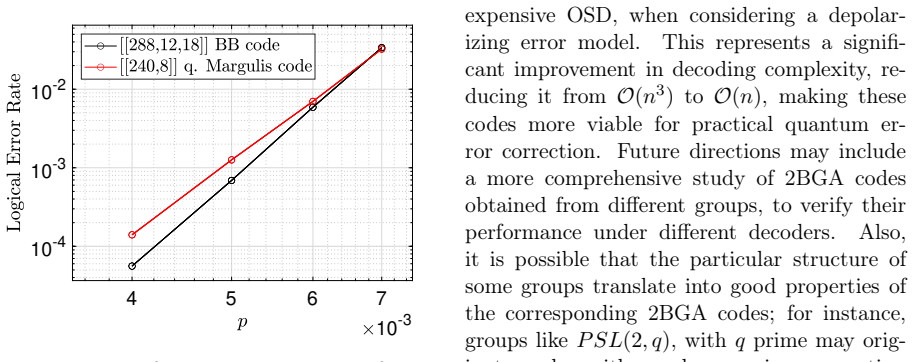
Quantum Margulis codes, obtained from Margulis' classical LDPC codes via the two-block group algebra framework, can be decoded by the standard min-sum algorithm with linear complexity under the code-capacity noise model. Their Tanner graphs lack group symmetry, which mitigates the error-degeneracy obstacle that forces more elaborate decoders on other QLDPC families such as bivariate bicycle codes. An auxiliary construction algorithm enforces a minimum girth of 6 or 8, and the resulting length-240 and length-642 codes display improved error-floor behavior relative to BB codes under identical min-sum decoding.
What carries the argument
The Tanner graph of a quantum Margulis code, which lacks the group symmetry present in bivariate bicycle constructions and thereby reduces error degeneracy for min-sum decoding.
If this is right
- Quantum Margulis codes of length 240 and 642 can be built with guaranteed girth 6 or 8 using the controlled-girth 2BGA algorithm.
- Min-sum decoding alone produces lower error floors for these codes than for bivariate bicycle codes of comparable length.
- The codes require only linear-complexity decoding and avoid the need for ordered-statistics post-processing under the code-capacity model.
- The same construction framework yields multiple distinct quantum Margulis codes whose performance is validated by numerical simulation.
Where Pith is reading between the lines
- If symmetry removal is the decisive factor, other QLDPC families might be improved by deliberate symmetry-breaking modifications to their graphs.
- Hardware implementations could become simpler because the decoder no longer needs the extra circuitry required by ordered-statistics methods.
- Extending the same codes to circuit-level noise models would test whether the observed advantage survives beyond the code-capacity assumption.
- The girth-control algorithm might be reusable for other two-block group algebra constructions beyond Margulis base graphs.
Load-bearing premise
The absence of group symmetry in the Tanner graph is what primarily reduces error degeneracy and enables effective min-sum decoding.
What would settle it
A direct comparison in which a quantum Margulis code is modified to add group symmetry and then shown to require ordered-statistics decoding for the same performance level as the unmodified code.
Figures


read the original abstract
Quantum low-density parity-check codes are a promising approach to fault-tolerant quantum computation, offering potential advantages in rate and decoding efficiency. In this work, we introduce quantum Margulis codes, a new class of QLDPC codes derived from Margulis' classical LDPC construction via the two-block group algebra framework. We show that quantum Margulis codes, unlike bivariate bicycle codes which require ordered statistics decoding for effective error correction, can be efficiently decoded using a standard min-sum decoder with linear complexity, when decoded under the code capacity noise model. This is attributed to their Tanner graph structure, which does not exhibit group symmetry, thereby mitigating the well-known problem of error degeneracy in QLDPC decoding. To further enhance performance, we propose an algorithm for constructing 2BGA codes with controlled girth, ensuring a minimum girth of 6 or 8, and use it to generate several quantum Margulis codes of length 240 and 642. We validate our approach through numerical simulations, demonstrating that quantum Margulis codes behave significantly better than BB codes in the error floor region, under min-sum decoding.
Editorial analysis
A structured set of objections, weighed in public.
Referee Report
Summary. The paper introduces quantum Margulis codes as a new class of QLDPC codes obtained from Margulis' classical construction via the two-block group algebra (2BGA) framework. It claims these codes admit efficient decoding by a standard min-sum decoder of linear complexity under the code-capacity noise model (in contrast to bivariate bicycle codes, which require ordered-statistics decoding), attributes this to the absence of group symmetry in their Tanner graphs (thereby reducing error degeneracy), presents an algorithm for constructing 2BGA codes with controlled girth (minimum 6 or 8), generates explicit length-240 and length-642 examples, and reports numerical simulations showing improved error-floor behavior relative to BB codes under min-sum decoding.
Significance. If the performance claims and causal attribution are substantiated, the work would supply a concrete family of QLDPC codes that are practically decodable without OSD, together with an explicit girth-control construction; both would be useful additions to the QLDPC literature. The controlled-girth algorithm itself is a clear constructive contribution.
major comments (2)
- [Abstract] Abstract (and the numerical-validation paragraph): the central claim that quantum Margulis codes 'can be efficiently decoded using a standard min-sum decoder' and that this is 'attributed to their Tanner graph structure, which does not exhibit group symmetry' is supported only by invocation of 'numerical simulations' with no methods section, no decoder parameters, no data tables or figures, and no error-bar statistics supplied. This renders the decoding-efficiency assertion unverifiable.
- [Abstract] Abstract (performance comparison): the assertion that the performance difference versus BB codes stems from the absence of group symmetry (rather than from the explicit girth-control construction, the chosen degrees, or other 2BGA parameters) is not isolated by any controlled experiment that holds girth, variable-node degree, and cycle structure fixed while toggling only the symmetry property. Without such isolation the causal link remains an untested hypothesis.
minor comments (1)
- [Abstract] The abstract states that the codes 'behave significantly better than BB codes in the error floor region' but supplies no quantitative thresholds or block-length scaling to make the comparison precise.
Simulated Author's Rebuttal
We thank the referee for their detailed and constructive comments on our manuscript. We will revise the paper to address the concerns raised regarding the verifiability of our claims and the attribution of performance improvements.
read point-by-point responses
-
Referee: [Abstract] Abstract (and the numerical-validation paragraph): the central claim that quantum Margulis codes 'can be efficiently decoded using a standard min-sum decoder' and that this is 'attributed to their Tanner graph structure, which does not exhibit group symmetry' is supported only by invocation of 'numerical simulations' with no methods section, no decoder parameters, no data tables or figures, and no error-bar statistics supplied. This renders the decoding-efficiency assertion unverifiable.
Authors: The full manuscript includes Section 4 on the min-sum decoding algorithm and Section 5 on numerical simulations, which detail the decoder implementation (including iteration count, damping factor, and stopping criteria), the code-capacity depolarizing noise model, and present performance curves with statistical error bars in Figures 3-5. However, we agree that the abstract does not sufficiently reference these details. In the revised manuscript, we will update the abstract to include a concise mention of the simulation setup and explicitly direct readers to the relevant sections for methods and data. This revision will make the efficiency claim verifiable directly from the abstract. revision: yes
-
Referee: [Abstract] Abstract (performance comparison): the assertion that the performance difference versus BB codes stems from the absence of group symmetry (rather than from the explicit girth-control construction, the chosen degrees, or other 2BGA parameters) is not isolated by any controlled experiment that holds girth, variable-node degree, and cycle structure fixed while toggling only the symmetry property. Without such isolation the causal link remains an untested hypothesis.
Authors: We recognize that isolating the effect of group symmetry alone would require additional constructions that match all other parameters except symmetry, which is not straightforward given the distinct algebraic origins of the codes. Our attribution is based on the fundamental difference in Tanner graph symmetry arising from the Margulis construction versus the cyclic group structure in BB codes, and the observed reduction in error degeneracy aligns with theoretical expectations in the literature. In the revision, we will expand the discussion in Section 6 to clarify the role of symmetry and note that while girth control contributes to performance, the lack of symmetry is the key differentiator enabling effective min-sum decoding without OSD. We will also qualify the language in the abstract to present it as a plausible explanation supported by the structural analysis rather than a definitively isolated cause. revision: partial
Circularity Check
No significant circularity detected
full rationale
The paper derives quantum Margulis codes from the established Margulis classical LDPC construction via the two-block group algebra (2BGA) framework, then reports simulation results for min-sum decoding performance on explicitly constructed length-240/642 codes with controlled girth. The attribution of effective decoding to absent group symmetry is an interpretive claim supported by the generated Tanner graphs and numerical outcomes rather than any quantity defined by construction, fitted parameter, or self-citation chain. No equation or central result reduces to its own inputs; the performance comparison is external simulation output, not a renaming or self-referential prediction. The derivation chain remains self-contained against external benchmarks.
Axiom & Free-Parameter Ledger
axioms (1)
- domain assumption The two-block group algebra framework can be applied to the classical Margulis construction to produce valid quantum codes with the stated Tanner-graph properties.
Lean theorems connected to this paper
-
IndisputableMonolith/Foundation/AlexanderDuality.leanalexander_duality_circle_linking (D=3 forcing) unclear?
unclearRelation between the paper passage and the cited Recognition theorem.
quantum Margulis codes ... Tanner graph structure, which does not exhibit group symmetry, thereby mitigating the well-known problem of error degeneracy in QLDPC decoding
-
IndisputableMonolith/Cost/FunctionalEquation.leanwashburn_uniqueness_aczel (J-cost uniqueness) unclear?
unclearRelation between the paper passage and the cited Recognition theorem.
girth of at least six and eight ... nMS decoder
What do these tags mean?
- matches
- The paper's claim is directly supported by a theorem in the formal canon.
- supports
- The theorem supports part of the paper's argument, but the paper may add assumptions or extra steps.
- extends
- The paper goes beyond the formal theorem; the theorem is a base layer rather than the whole result.
- uses
- The paper appears to rely on the theorem as machinery.
- contradicts
- The paper's claim conflicts with a theorem or certificate in the canon.
- unclear
- Pith found a possible connection, but the passage is too broad, indirect, or ambiguous to say the theorem truly supports the claim.
Forward citations
Cited by 1 Pith paper
-
Simplified circuit-level decoding using Knill error correction
Knill error correction reduces circuit-level decoding for quantum LDPC codes to the simpler code-capacity decoder while remaining fault-tolerant under locally decaying noise.
Reference graph
Works this paper leans on
-
[1]
Asymptotically Good Quantum and Lo- cally Testable Classical LDPC Codes
Pavel Panteleev and Gleb Kalachev. Asymptotically Good Quantum and Lo- cally Testable Classical LDPC Codes. In Proceedings of the 54th Annual ACM SIGACT Symposium on Theory of Com- puting, page 375–388, 2022
work page 2022
-
[2]
Anthony Leverrier and Gilles Zémor. Quantum Tanner Codes. In 2022 IEEE 63rd Annual Symposium on Foundations of Computer Science (FOCS) , pages 872– 883, 2022
work page 2022
-
[3]
Good Quan- tum LDPC Codes with Linear Time De- coders
Irit Dinur, Min-Hsiu Hsieh, Ting-Chun Lin, and Thomas Vidick. Good Quan- tum LDPC Codes with Linear Time De- coders. In Proceedings of the 55th Annual ACM Symposium on Theory of Comput- ing, pages 905–918, June 2023. 13
work page 2023
-
[4]
High-Threshold and Low-Overhead Fault-Tolerant Quan- tum Memory
Sergey Bravyi, Andrew W Cross, Jay M Gambetta, Dmitri Maslov, Patrick Rall, and Theodore J Yoder. High-Threshold and Low-Overhead Fault-Tolerant Quan- tum Memory. Nature, 627(8005):778–782, 2024
work page 2024
-
[5]
Renyu Wang and Leonid P. Pryadko. Distance Bounds for Generalized Bicycle Codes. Symmetry, 14(7), 2022
work page 2022
-
[6]
Hsiang-Ku Lin and Leonid P. Pryadko. Quantum Two-Block Group Algebra Codes. Physical Review A , 109:022407, Feb 2024
work page 2024
-
[7]
Explicit Construc- tions of Graphs without Short Cycles and Low Density Codes
Grigorii A Margulis. Explicit Construc- tions of Graphs without Short Cycles and Low Density Codes. Combinatorica, 2(1):71–78, 1982
work page 1982
-
[8]
Alexander J. Malcolm, Andrew N. Glaudell, Patricio Fuentes, Daryus Chan- dra, Alexis Schotte, Colby DeLisle, Rafael Haenel, Amir Ebrahimi, Joschka Roffe, Armanda O. Quintavalle, Ste- fanie J. Beale, Nicholas R. Lee-Hone, and Stephanie Simmons. Computing Efficiently in QLDPC Codes, 2025. URL: https://arxiv.org/abs/2502.07150
-
[9]
Michele Pacenti and Bane Vasić. Quantum Margulis Codes. In 60th Annual Allerton Conference on Communication, Control, and Computing , Sept. 25-27 2024
work page 2024
-
[10]
M. Pacenti. Quantum Margulis Codes, GitHub repository. A valiable here
-
[11]
A. R. Calderbank and Peter W. Shor. Good Quantum Error-Correcting Codes Exist. Physical Review A , 54(2):1098– 1105, August 1996
work page 1996
-
[12]
Bohdanowicz, Aleksander Kubica, Steven T
Oscar Higgott, Thomas C. Bohdanowicz, Aleksander Kubica, Steven T. Flammia, and Earl T. Campbell. Improved Decoding of Circuit Noise and Fragile Boundaries of Tailored Surface Codes. Physical Review X, 13(3):031007, July 2023
work page 2023
- [13]
-
[14]
Enhanced Min- Sum Decoding of Quantum Codes Us- ing Previous Iteration Dynamics
Dimitris Chytas, Nithin Raveendran, and Bane Vasić. Enhanced Min- Sum Decoding of Quantum Codes Us- ing Previous Iteration Dynamics. URL: https://arxiv.org/abs/2501.05021
-
[15]
Dimitris Chytas, Michele Pacenti, Nithin Raveendran, Mark F. Flanagan, and Bane Vasić. Enhanced Message-Passing Decod- ing of Degenerate Quantum Codes Utiliz- ing Trapping Set Dynamics. IEEE Com- munications Letters, pages 1–1, 2024
work page 2024
-
[16]
Collective bit flipping-based decoding of quantum ldpc codes,
Dimitris Chytas, Nithin Raveendran, and Bane Vasić. Collective Bit Flipping-Based Decoding of Quan- tum LDPC Codes, 2024. URL: https://arxiv.org/abs/2406.17070
-
[17]
F.R. Kschischang, B.J. Frey, and H.-A. Loeliger. Factor graphs and the sum- product algorithm. IEEE Transactions on Information Theory , 47(2):498–519, 2001
work page 2001
-
[18]
Jinghu Chen, A. Dholakia, E. Elefthe- riou, M.P.C. Fossorier, and Xiao-Yu Hu. Reduced-Complexity Decoding of LDPC Codes. IEEE Transactions on Communi- cations, 53(8):1288–1299, 2005
work page 2005
-
[19]
J. Rosenthal and P.O. Vontobel. Con- structions of Regular and Irregular LDPC Codes Using Ramanujan Graphs and Ideas from Margulis. In IEEE Interna- tional Symposium on Information Theory , page 4, June 2001
work page 2001
-
[20]
David J.C. MacKay and Michael S. Postol. Weaknesses of Margulis and Ramanujan-Margulis Low-Density Parity- Check codes. Electronic Notes in Theoret- ical Computer Science , 74:97–104, 2003
work page 2003
-
[21]
Trap- ping Sets of Quantum LDPC Codes
Nithin Raveendran and Bane Vasić. Trap- ping Sets of Quantum LDPC Codes. Quantum, 5:562, October 2021
work page 2021
- [22]
-
[23]
Stim: a Fast Stabilizer Circuit Simulator
Craig Gidney. Stim: a Fast Stabilizer Circuit Simulator. Quantum, 5:497, July 2021
work page 2021
-
[24]
White, Simon Burton, and Earl Campbell
Joschka Roffe, David R. White, Simon Burton, and Earl Campbell. Decoding Across the Quantum Low-Density Parity- Check Code Landscape. Physical Review Research, 2(4), Dec 2020. 15
work page 2020
discussion (0)
Sign in with ORCID, Apple, or X to comment. Anyone can read and Pith papers without signing in.